Monthly Archives: June 2015

Bank Stock Prices Fall When Interest Rates Rise: Lessons from Bank Of America 1974

by Donald Van Deventer

Summary

  • Wm. Mack Terry explained the basics of how rates impact bank stocks at Bank of America in 1974. Net income goes up, margins go up, and stock price goes down.
  • We value a bank by replication, assembling a series of Treasury securities with the same financial characteristics as a bank. All of Mr. Terry’s conclusions are correct.
  • A more technical analysis and references are provided. Correlations with 11 different Treasury yields are added in Appendix A. Finally, a worked example is given in Appendix B.
 

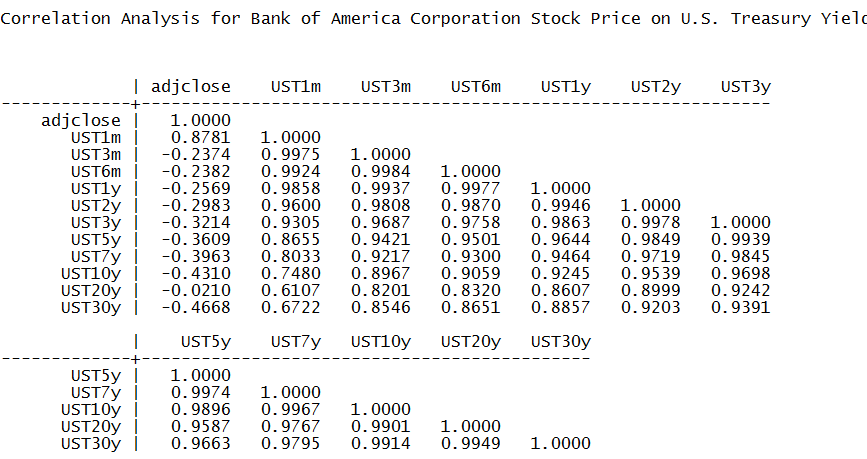
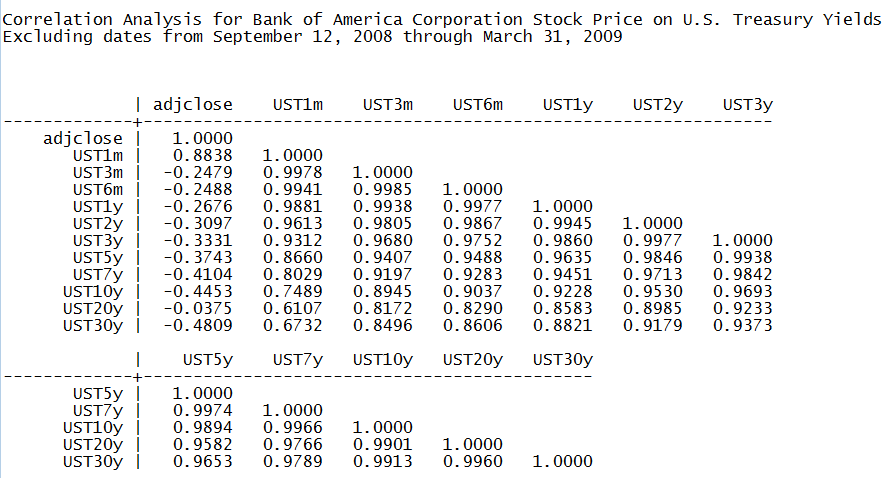
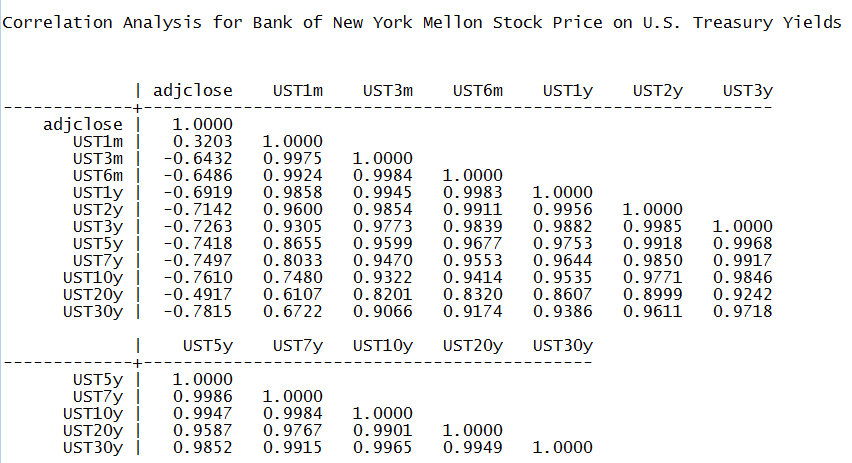
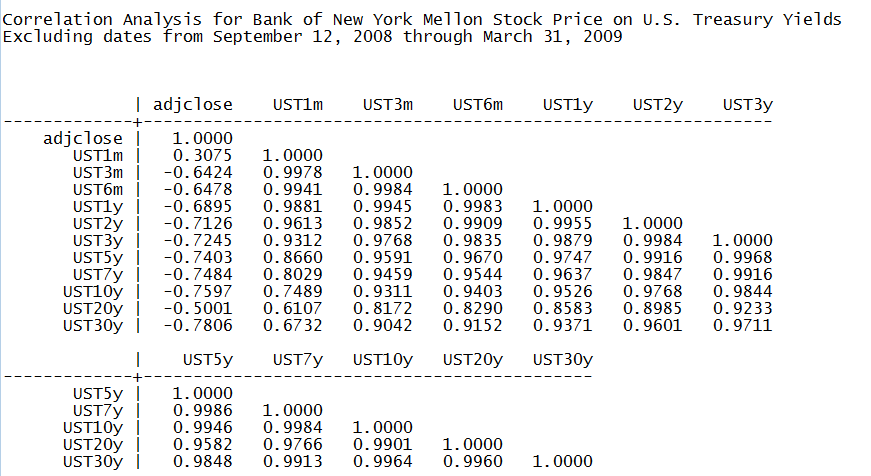
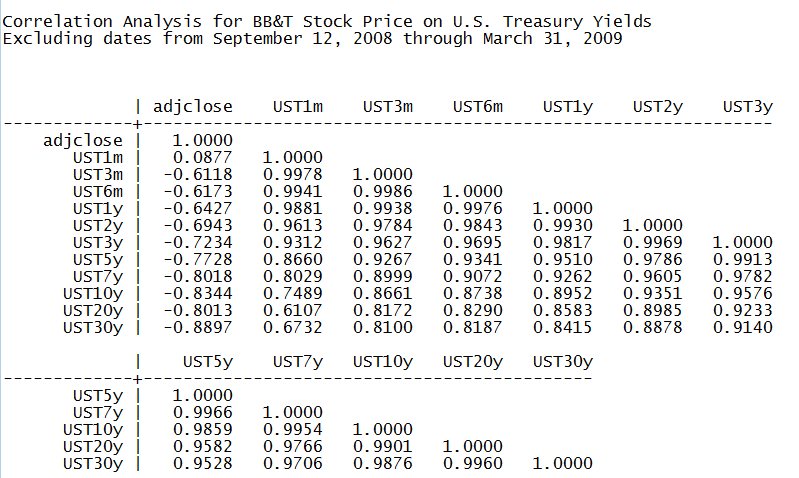
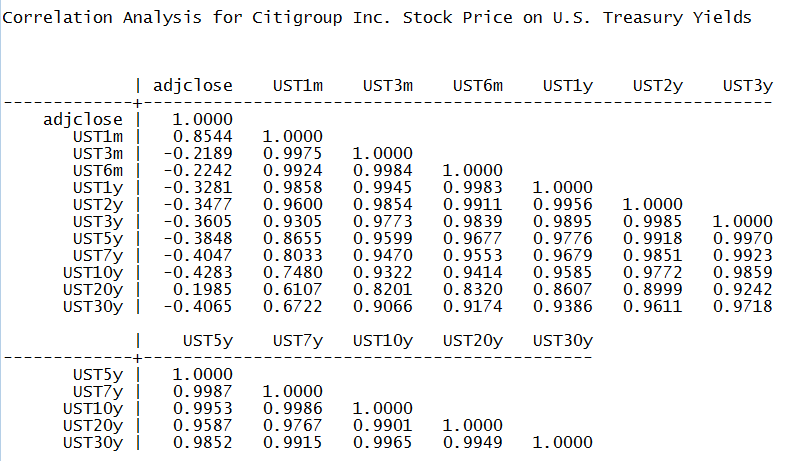
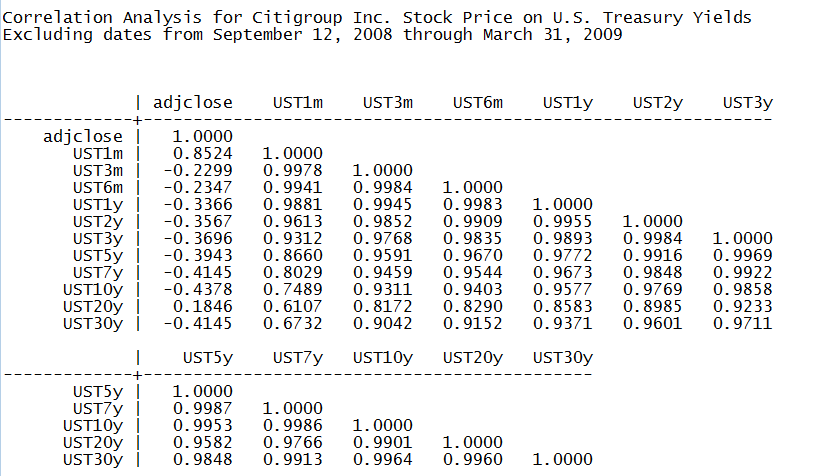
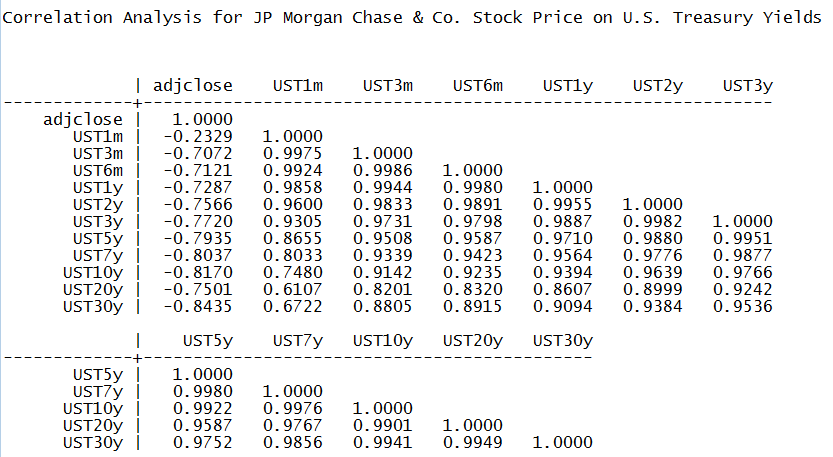
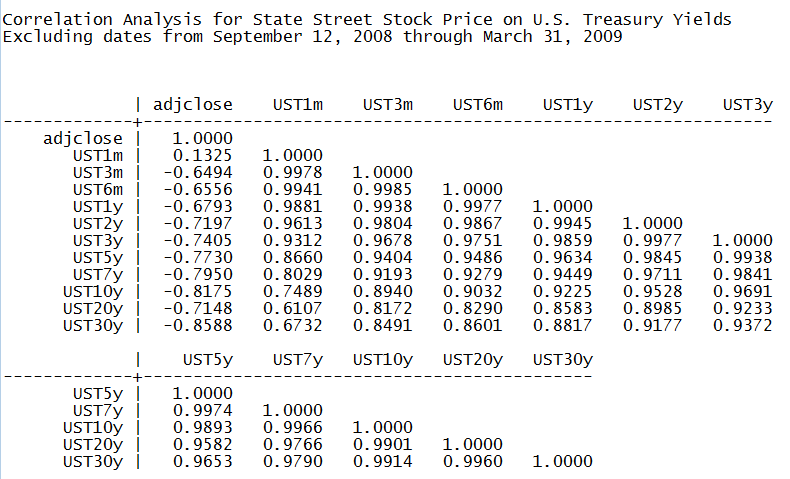
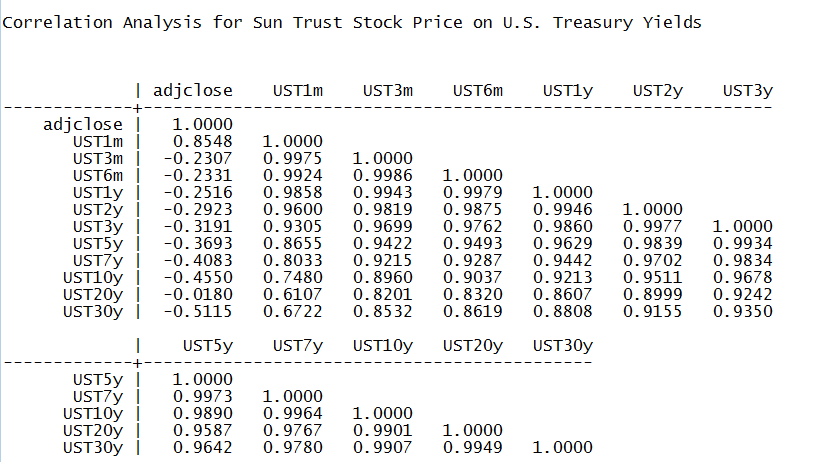
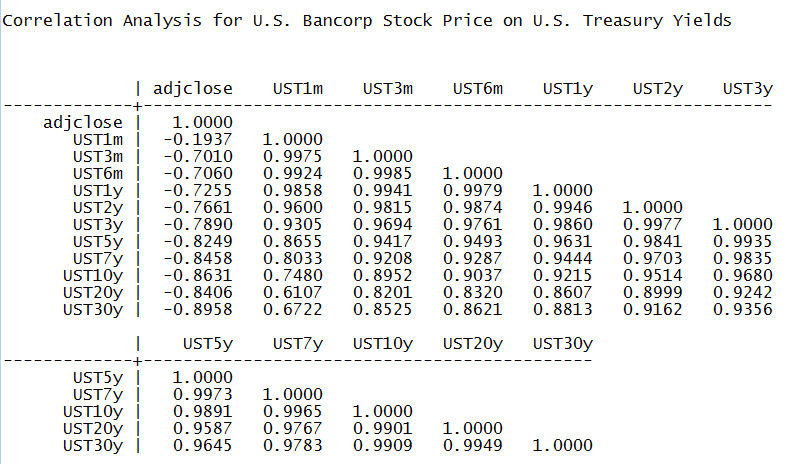
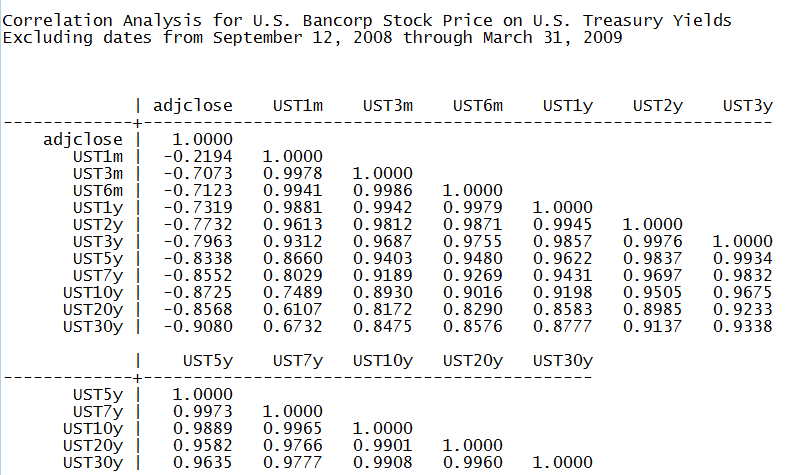
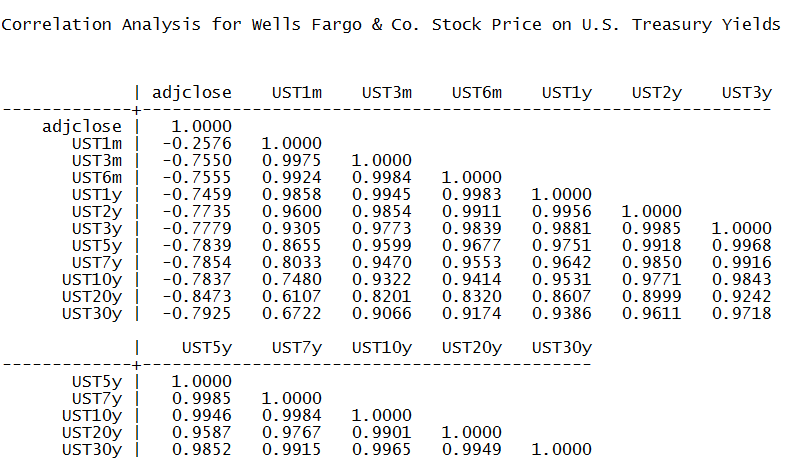
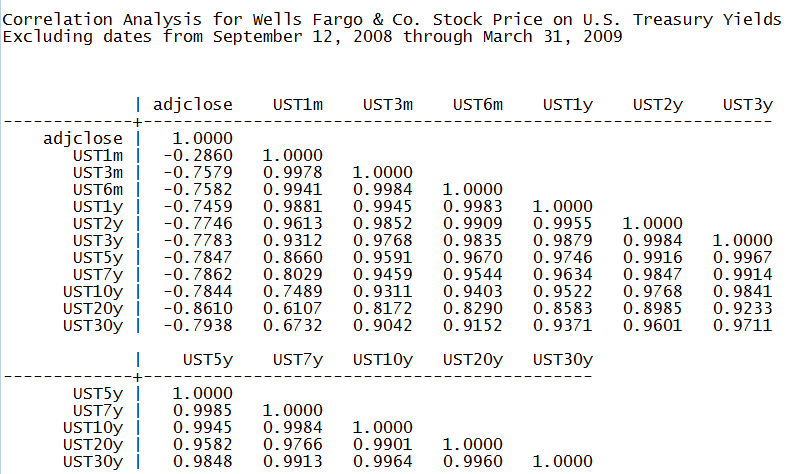
We want to thank our readers for the very strong response to our June 17, 2015, note “Bank Stock Prices and Higher Interest Rates: Lessons from History.” For those readers who asked “is the correlation between Treasury yields and bank stock prices negative at other maturities besides the 10 year maturity?” – we include Appendix A. Appendix A shows that for all nine bank holding companies studied, there is negative correlation between the bank’s stock price and Treasuries for all maturities but two. One exception is the 1-month Treasury bill yield, which is the shortest time series reported by the U.S. Department of the Treasury. The 1-month Treasury bill yield has only been reported since July 31, 2001. The correlation between the longer 3-month Treasury bill yield series and the stock prices of all nine bank holding companies is negative. The other series that occasionally has positive correlations is the 20 year U.S. Treasury yield, which is the second shortest yield series provided by the U.S. Department of the Treasury.

In this note, we use modern “no arbitrage” finance and a story from 1974 to explain why there is and there should be a negative correlation between bank stock prices and interest rates. We finish with recommendations for further reading for readers with a very strong math background.

Wm. Mack Terry and Lessons from the Bank of America, 1974

In the summer of 1974 I began the first of two internships with the Financial Analysis and Planning group at Bank of America (NYSE:BAC) in San Francisco. My boss was Wm. Mack Terry, an eccentric genius from MIT and one of the smartest people ever to work at the Bank of America. One day he came to me and made a prediction. This is roughly what he said:

“Interest rates are going to go up, and two things are going to happen. Our net income and our net interest margins are going to go up, and our senior management is going to claim credit for this. But they’ll be wrong when they do so. Our income will only go up because we don’t pay interest on our capital. Shareholders are smart and recognize this. When they discount our free cash flow at higher interest rates, even with the increase on capital, our stock price is going to go down.”

Put another way, higher rates never increase the value of investments of capital funds, and the hedged interest rate spread is a long term fixed rate security that drops in value when rates rise. That is unless the leading researchers are completely wrong in their finding that credit spreads narrow when rates rise.

Everything Mack predicted came true. The 1-year U.S. Treasury yield was in the 8 percent range in the summer of 1974. It ultimately peaked at 17.31% on September 3, 1981. The short run impact of the rate rise was positive at Bank of America, but the long run impact was devastating. By the mid-1980s, the bank was in such distress that my then employer First Interstate Bancorp launched a hostile tender to buy Bank of America.

Their biggest problem was an interest rate mismatch, funding 30 year fixed rate mortgages with newly deregulated consumer deposits when rates went up.

The point of the story is not the anecdote about Bank of America per se. Why was Mack’s prediction correct? We give the formal academic references below, but we can use modern “no arbitrage” financial logic to understand what happened. We model a bank that’s assumed to have no credit risk by replication, assembling the bank piece by piece from traded securities. This was the approach taken by Black and Scholes in their famous options model, and it’s a common one in modern “no arbitrage” finance. We take a more complex approach in the “Technical Notes” section. For now, let’s make these assumptions to get at the heart of the issue:

  1. We assume the bank has no assets that are at risk of default.
  2. All of its profits come from investing at rates higher than U.S. Treasuries and by taking money from depositors at rates lower than U.S. Treasury yields
  3. We assume that the bank borrows money in such a way that all assets financed with borrowed money have no interest rate risk: the credit spread is locked in. We assume the net interest margin is locked in at a constant dollar amount that works out to $3 per share per quarter.
  4. We assume this constant dollar amount lasts for 30 years.
  5. With the bank’s capital, we assume the bank either buys 3-month Treasury bills or 30-year fixed rate Treasury bonds. We analyze both cases.
  6. We assume taxes are zero and that 100% of the credit spread cash flow is paid out as dividends to keep things simple.
  7. We assume the earnings on capital are retained and grow like the proceeds of a money market fund.

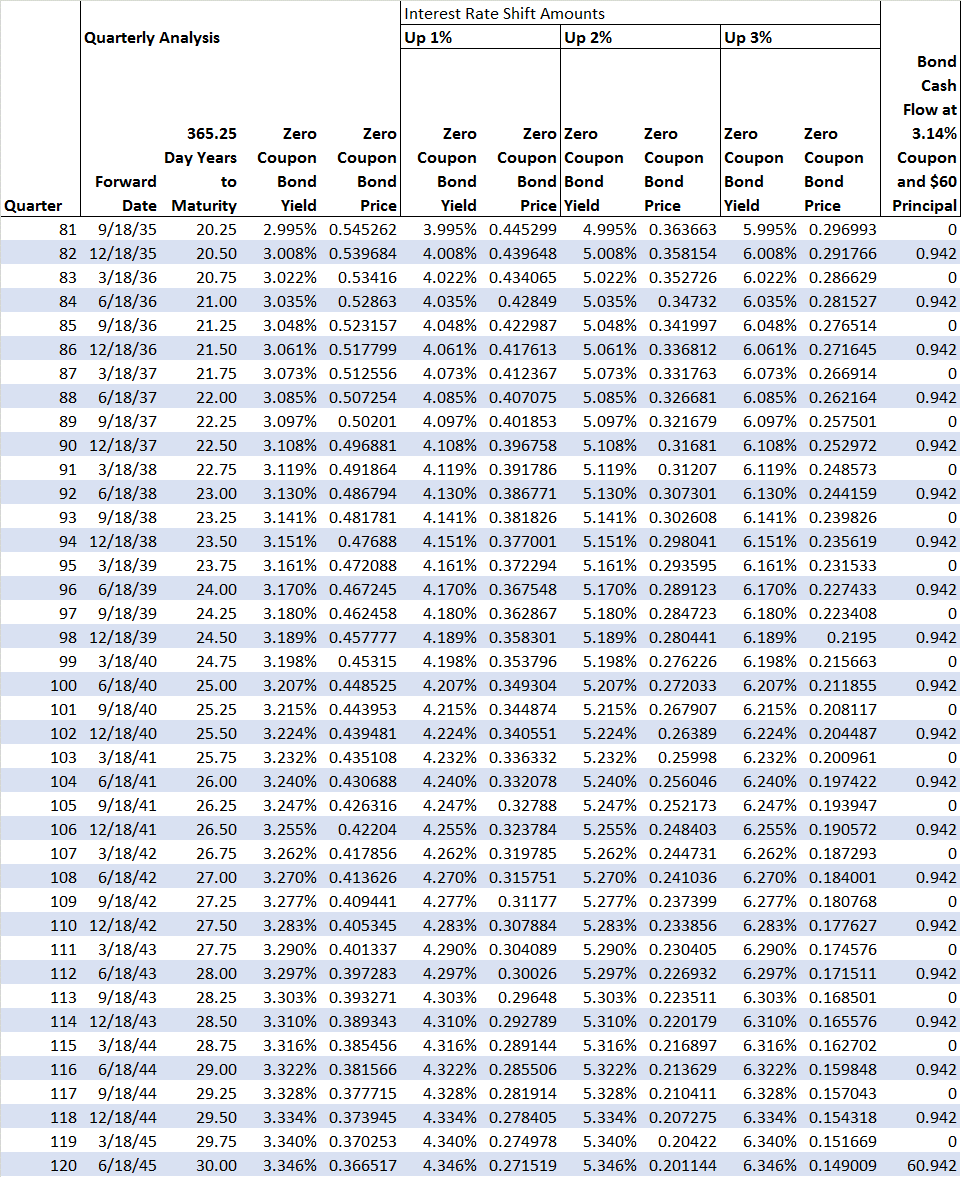
We use the U.S. Treasury curve of June 18 to analyze our simple bank. The present value of a dollar received in 3 months, 6 months, 9 months, etc. out to 30 years can be calculated using U.S. Treasury strips (zero coupon bonds) whose yields are shown here:

(click to enlarge)
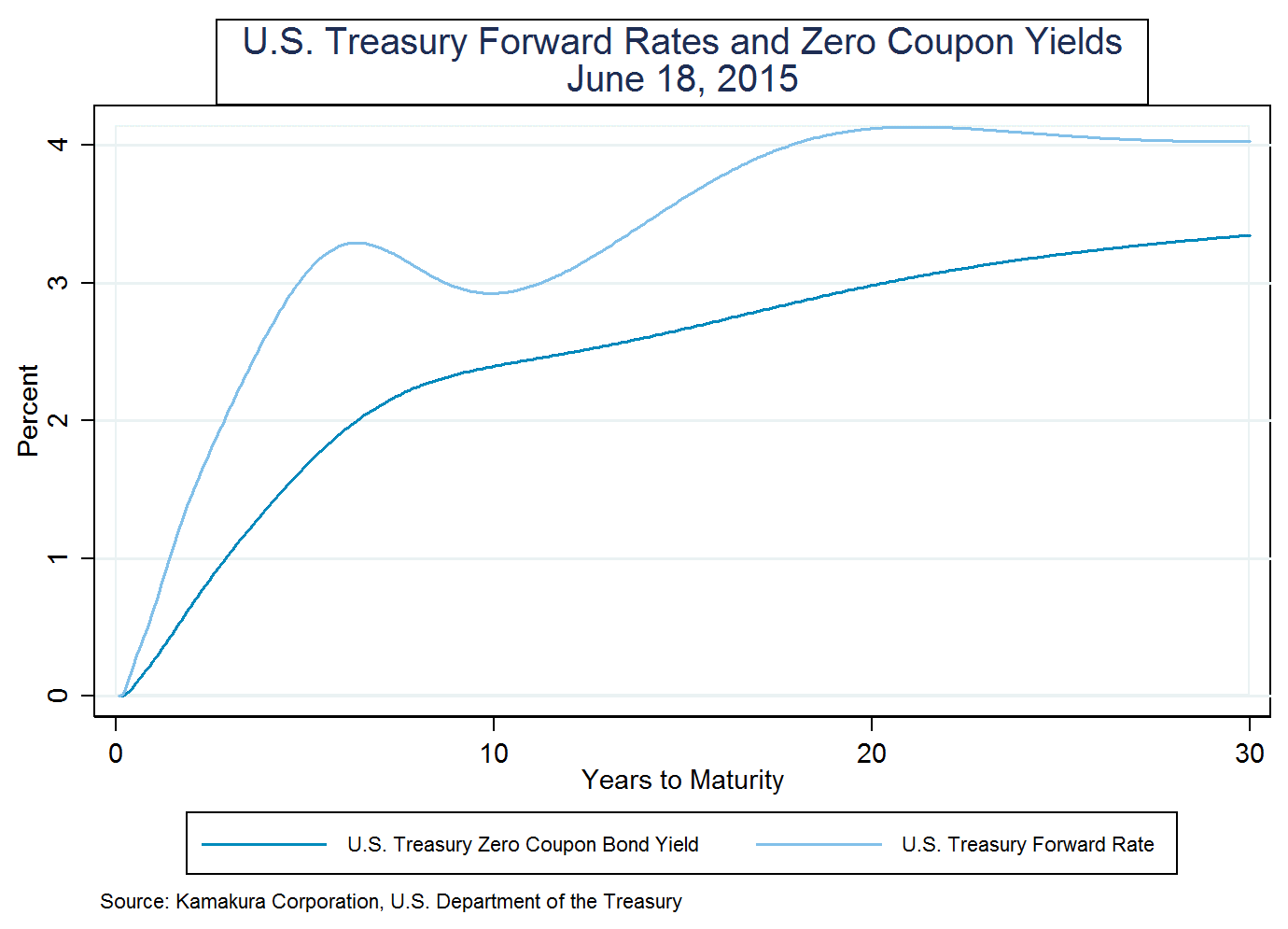
We write the present value of a dollar received at time tj as P(tj). The first quarter is when j is 1. The last quarter is when j is 120. The cash flow thrown off to shareholders from the hedged borrowing and lending is the sum of $3 per quarter times the correct discount factors out to 30 years.

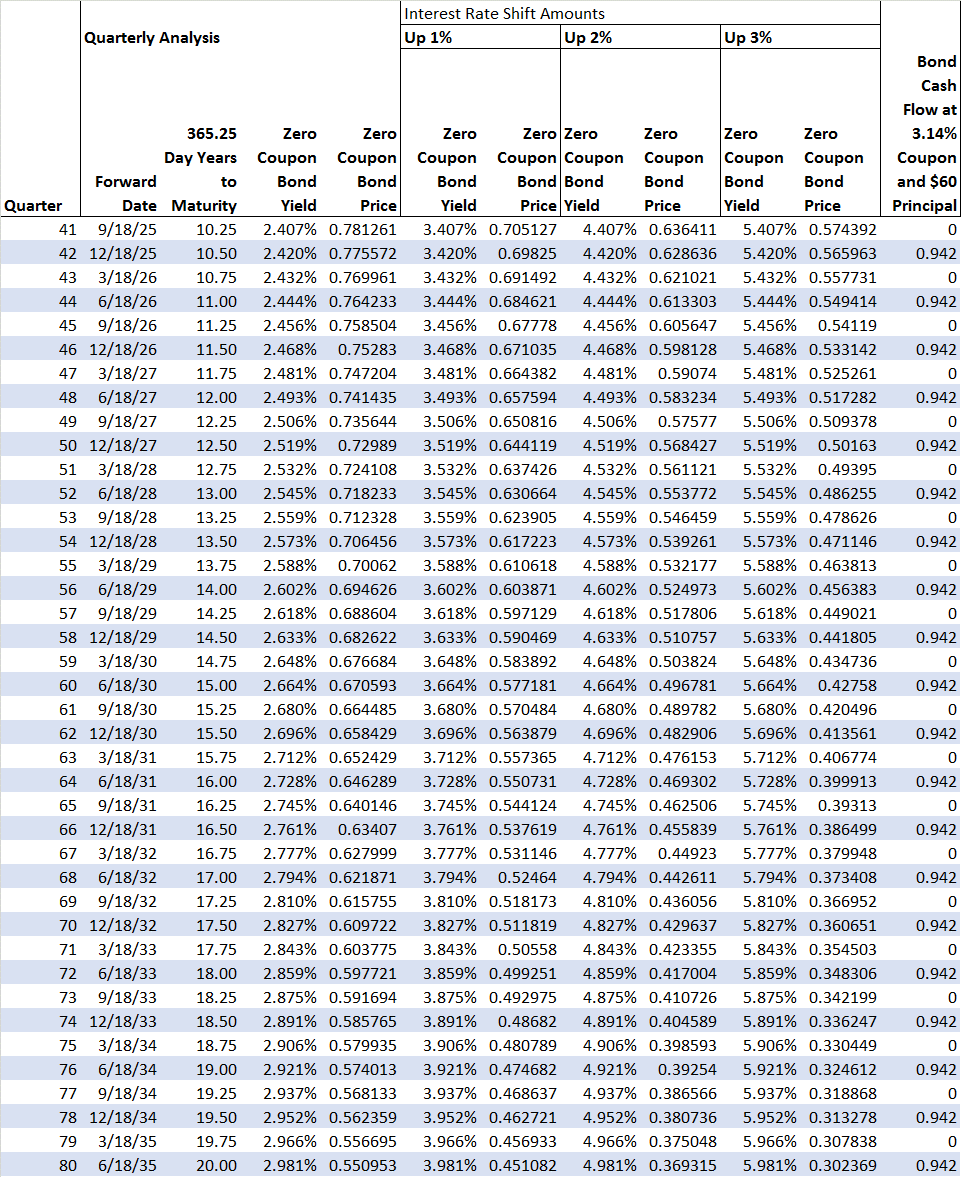
The sum of the discount factors is 81.02. When we say “the sum of the discount factors,” note that means that the entire 30 year Treasury yield curve is used in valuing the bank’s franchise, even if the bank makes that $3 per quarter rolling over short term assets and liabilities. When we multiply the sum of the discount factors by $3 per quarter, the value of the hedged lending business contributes $3 x 81.02 = $243.06 to the share price. This calculation is given in Appendix B.

How about the value of earnings on capital? And how much capital is there? The short answer is that it doesn’t matter – we’re just trying to illustrate valuation principals here. But let’s assume the $3 in quarterly “spread” income, $12 a year, is 1% of assets. That makes assets $1200 (per share). With 5% capital, we’ll use $60 as the bank’s capital. We analyze two investment strategies for capital: Strategy A is to invest in 3-month Treasury bills. They are yielding 0.01% on June 18. Strategy B is to invest in the current 30 year Treasury bond, yielding 3.14% on June 18. Let’s evaluate the stock price right now under both strategies. If rates don’t move, the current outlook is this if the bank invests its capital in Treasury bills using Strategy A:

Net income will be $12.006 per year. The value of capital at time zero is $60 because we’ve invested $60 in T-bills worth $60. The value of the hedged “spread lending” franchise, discounted over its 30-year life, is $243.060. That means the stock price must be the sum of these two pieces or there’s a chance for risk-less arbitrage. The stock price must be $303.060.

What happens to the stock price if, one second after we buy the stock, zero coupon bond yields across the full yield curve rise by 1%, 2%, or 3%? This is a mini-version of the Federal Reserve’s Comprehensive Capital Analysis and Review stress tests. The stock price changes like this:

Higher rates are “good for the bank” in the sense that net income will rise because earnings on the 3-month Treasury bills will be 1%, 2% or 3% higher. This is exactly what Mack Terry explained to me in 1974. This has no impact on stock price, however, because the investment in T-bills is like an investment in a money market fund. Since the discount factor rises when the income rises, the value is stable. So the value of the invested capital is steady at $60. See the “Technical Notes” references for background on this. What happens to the value of the spread lending franchise? It gets valued just like a constant payment mortgage that won’t default or prepay. The value drops from $243.06 to either $215.04, $191.55 or $171.72. The calculations also are given in Appendix B. The result is a stock price that’s lower in every scenario, dropping 9.25%, 17.00% or 23.54%.

But wait, one might ask. Won’t the amount of lending increase and credit spreads widen at higher rates? Before we answer that question, we can calculate our breakeven expansion requirements. For the value of the lending franchise to just remain stable, we need to restore the value from 215.04, 191.55 or 171.72 to 243.06. This requires that the cash flow expand by 243.06/215.04-1 in the “up 1%” scenario. That means our cash flow has to expand by 13.03% from $12 a year to $13.56 per year. For the up 2% and up 3% scenarios, the increases have to be by 26.89% or 41.54%.

Just from a common sense point of view, this expansion of lending volume seems highly unlikely at best. A horde of academic studies discussed in Chapter 17 of van Deventer, Imai and Mesler also have found that when rates rise, credit spreads shrink rather than expand. Selected references are given in the “Technical Notes.”

Is Strategy B a better alternative? Sadly, no, because the income on invested capital stays the same (3.14% times $60) and the present value of the 30-year bond investment falls. Here are the results:

Good News and Conclusions

There is some good news in this analysis. Given the assumptions we have made, this bank will never go bankrupt. Because the assets funded with borrowed money are perfectly hedged from a rate risk point of view, the bank is in the “safety zone” that Dr. Dennis Uyemura and I described in our 1992 introduction to interest rate management, Financial Risk Management in Banking. The other good news is that Mack Terry’s example shows that the entire spectrum of Treasury yields is used to value bank stocks because the cash flow stream from the banking franchise spans a 30-year time horizon.

This example shows that, under simple but relatively realistic assumptions, the value of a bank can be replicated as a portfolio of Treasury-related securities. This portfolio falls in value when rates rise. The negative correlation between Treasury yields that 30 years of history shows is not spurious correlation – it’s consistent with the fundamental economics of banking when interest rate risk is hedged.

Wm. Mack Terry knew this in 1974, and legions of interest rate risk managers of banks have replicated this simple example in their regular interest rate risk simulations that are required by bank regulators around the world. What surprises me is that people are surprised to learn that higher interest rates lower bank stock prices.


Technical Notes

When writing for a general audience, some readers become concerned that the author only knows the level of analysis reflected in that article. We want to correct that impression in this section. We start with some general observations and close with references for technically oriented readers:

  1. For more than 50 years, beginning with the capital asset pricing model of Sharp, Mossin and Lintner, securities returns have been analyzed on an excess return basis relative to the risk free rate as a function of one or more factors. It is well known that the capital asset pricing model itself is not a very accurate description of security returns as a function of the risk factors.
  2. Arbitrage pricing theory expanded explanatory power by adding factors. Merton’s inter-temporal capital asset pricing model (1974) added interest rates driven by one factor with constant volatility.
  3. Best practice in modeling traded asset returns is defined by Amin and Jarrow (1992), who build on the multi-factor Heath, Jarrow and Morton interest rate model which allows for time varying and rate varying interest rate volatility. Amin and Jarrow also allow for time varying volatility as a function of interest rate and other risk factors.
  4. This is the procedure my colleagues and I use to decompose security returns. An important part of that process is an analysis of credit risk, as explained by Campbell, Hilscher and Szilagyi (2008, 2011). Jarrow (2013) explains how credit risk is incorporated in the Amin and Jarrow framework. This is the procedure we would explain in a more technical forum, like our discussion with clients.
  5. Asset return analysis is built on the Heath Jarrow and Morton interest rate simulation. The most recent 100,000 scenario simulation for U.S. Treasury yields (“The 3 Month T-bill Yield: Average of 100,000 Scenarios Up to 3.23% in 2025“) was posted on Seeking Alpha on June 16, 2015.

References for random interest rate modeling are given here:

Heath, David, Robert A. Jarrow and Andrew Morton, “Bond Pricing and the Term Structure of Interest Rates: A Discrete Time Approach,” Journal of Financial and Quantitative Analysis, 1990, pp. 419-440.

Heath, David, Robert A. Jarrow and Andrew Morton, “Contingent Claims Valuation with a Random Evolution of Interest Rates,” The Review of Futures Markets, 9 (1), 1990, pp.54 -76.

Heath, David, Robert A. Jarrow and Andrew Morton,”Bond Pricing and the Term Structure of Interest Rates: A New Methodology for Contingent Claim Valuation,” Econometrica, 60(1), 1992, pp. 77-105.

Heath, David, Robert A. Jarrow and Andrew Morton, “Easier Done than Said”, RISK Magazine, October, 1992.

References for modeling traded securities (like bank stocks) in a random interest rate framework are given here:

Amin, Kaushik and Robert A. Jarrow, “Pricing American Options on Risky Assets in a Stochastic Interest Rate Economy,” Mathematical Finance, October 1992, pp. 217-237.

Jarrow, Robert A. “Amin and Jarrow with Defaults,” Kamakura Corporation and Cornell University Working Paper, March 18, 2013.

The impact of credit risk on securities returns is discussed in these papers:

Campbell, John Y., Jens Hilscher and Jan Szilagyi, “In Search of Distress Risk,” Journal of Finance, December 2008, pp. 2899-2939.

Campbell, John Y., Jens Hilscher and Jan Szilagyi, “Predicting Financial Distress and the Performance of Distressed Stocks,” Journal of Investment Management, 2011, pp. 1-21.

The behavior of credit spreads when interest rates vary is discussed in these papers:

Campbell, John Y. & Glen B. Taksler, “Equity Volatility and Corporate Bond Yields,” Journal of Finance, vol. 58(6), December 2003, pages 2321-2350.

Elton, Edwin J., Martin J. Gruber, Deepak Agrawal, and Christopher Mann, “Explaining the Rate Spread on Corporate Bonds,” Journal of Finance, February 2001, pp. 247-277.

The valuation of bank deposits is explained in these papers:

Jarrow, Robert, Tibor Janosi and Ferdinando Zullo. “An Empirical Analysis of the Jarrow-van Deventer Model for Valuing Non-Maturity Deposits,” The Journal of Derivatives, Fall 1999, pp. 8-31.

Jarrow, Robert and Donald R. van Deventer, “Power Swaps: Disease or Cure?” RISK magazine, February 1996.

Jarrow, Robert and Donald R. van Deventer, “The Arbitrage-Free Valuation and Hedging of Demand Deposits and Credit Card Loans,” Journal of Banking and Finance, March 1998, pp. 249-272.

The use of the balance of the money market fund for risk neutral valuation of fixed income securities and other risky assets is discussed in technical terms by Heath, Jarrow and Morton and in a less technical way:

Jarrow, Robert A. Modeling Fixed Income Securities and Interest Rate Options, second edition, Stanford Economics and Finance, Stanford, 2002.

Jarrow, Robert A. and Stuart Turnbull, Derivative Securities, second edition, South-Western College Publishing, 2000.

Appendix A: Expanded Correlations

The expanded correlations in this appendix use data from the U.S. Department of the Treasury as distributed by the Board of Governors of the Federal Reserve in its H15 statistical release.

It is important to note that the 1-month Treasury bill rate has only been reported since July 31, 2001, and that is the reason that the correlations between bank stock prices and that maturity are so different from all of the other maturities. The history of reported data series is taken from van Deventer, Imai and Mesler, Advanced Financial Risk Management, 2nd edition, 2013, chapter 3.

(click to enlarge)

Bank of America Corporation Correlations

(click to enlarge)
(click to enlarge)
Bank of New York Mellon Correlations

(click to enlarge)
(click to enlarge)
BB&T Correlations

(click to enlarge)

(click to enlarge)
Citigroup Inc. Correlations

(click to enlarge)
(click to enlarge)
JP Morgan Chase & Co. Correlations

(click to enlarge)
(click to enlarge)

State Street Correlations

(click to enlarge)

(click to enlarge)
Sun Trust Correlations

(click to enlarge)
(click to enlarge)

U.S. Bancorp Correlations

(click to enlarge)
(click to enlarge)
Wells Fargo & Company Correlations

(click to enlarge)
(click to enlarge)
Appendix B

Valuing the Banking Franchise: Worked Example

The background calculations for today’s analysis are given here. The extraction of zero coupon bond prices from the Treasury yield curve is discussed in van Deventer, Imai and Mesler (2013), chapters 5 and 17.

(click to enlarge)

(click to enlarge)
(click to enlarge)
RIAs Join Brokers In Promoting Securities-Backed Lending

These loans are growing quickly beyond wire houses, but some are concerned about the risks and conflicts of interest

http://www.investmentnews.com/storyimage/CI/20150611/FREE/150619979/AR/0/AR-150619979.jpg&imageversion=superwide&maxw=800&maxh=500&q=90&cci_ts=20150611145635

Traditionally a major focus at bank-owned brokerage firms, securities-backed loans — where a wealthy investor puts up their portfolio as collateral for a big-money purchase &mash; are increasingly being marketed through independent registered investment advisers.

In the past two years, use of the products has soared as custodians beef up their lending capabilities. Pershing Advisor Solutions, a subsidiary of The Bank of New York Mellon Corp., began offering the loans to RIAs last year and has already issued 254 of them worth $1 billion through more than 20% of its 570 RIA clients. Fidelity Investments, which serves about 3,000 RIAs, has seen balances for securities-backed loans increase 63% in its RIA segment over the past two years.

“Non purpose loans have gotten more attention over the last year-plus with the custodians,” said John Sullivan, a former lending specialist at Smith Barney who is now a relationship manager at Dynasty Financial Partners. “Every effort is being made by firms like Dynasty and the various custodians that are out there to be able to replicate or in some cases exceed the existing platform” at the wirehouses.

For years, the loans have been a popular product at the wirehouses, including Bank of America Merrill Lynch and Morgan Stanley Wealth Management. They are billed as a way for wealthy investors to make large purchases, such as a yacht or vacation home, without having to sell a portion of their portfolio or incur capital gains taxes in the short term. Bank of America Merrill Lynch had $11.7 billion in margin loans outstanding, according to its most recent SEC filings from March.

There is no upfront cost to set up a securities-based line of credit, and firms offer competitive rates, which are sometimes lower than a traditional bank loan and are particularly attractive now with low interest rates. The loans can be made in a relatively shorter period of time than traditional bank loans as well. They take as few as eight business days at Pershing.

But there are other reasons firms, including the wirehouses like securities-backed lending. The loans provide another income source from clients in fee-based accounts and can be more profitable for the firm than other investment products because they don’t have to share as much of the revenue with their advisers who sells the clients on the loan.

“Lending growth will enhance the stability of revenue and earnings for the firm as a whole and make our client relationships deeper and stickier,” Morgan Stanley & Co.‘s former chief financial officer, Ruth Porat, said in an earnings call in July.

RIAs specifically don’t receive any additional compensation from a bank or custodian for selling securities-backed loans, but there are other benefits. For example, the loans allow wealthy clients to make multimillion dollar purchases without cutting into the assets under management. Bob LaRue, a managing director at BNY Mellon, said new business from clients often results as well — and, of course, the dollars left in the portfolio have the potential for gains, which raise AUM.

Herein lies the rub, according to Tim Welsh, president and consultant of Nexus Strategy, a wealth management consulting firm. “They don’t sell, so the assets under management stay the same — so it inherently has a conflict of interest,” he said.

That can be a problem, Mr. Welsh said, particularly because client demand typically is highest for these kinds of loans at the wrong time.

“In every bull market I’ve seen, this is always a predictor of the top,” Mr. Welsh said. “When people start borrowing money against their assets, they’re really confident that they’re going up. And investors are always one step behind in terms of tops and bottoms.”

The risk is that if the value of a client’s portfolio drops, the firm can sell the securities or ask that the client put down more money to back that up. Using securities as collateral can be subject to greater volatility than other types, such as a home equity loan.

“When the markets rationalize, bills come due, and if you don’t have liquidity, all of a sudden you have to sell,” Mr. Welsh said. “It definitely raises the risk profile up immediately.”

Adviser Josh Brown of Ritholtz Wealth Management has dubbed the growth in these loans a “rich man’s subprime.”

“Once again, super-cheap financing based on an asset whose value can fluctuate wildly (a stock and bond portfolio, in this case) is being used for the purchase of assets that can be significantly less liquid, like real estate, fine art or business expansion,” Mr. Brown wrote in a story last year on the growth of the loans in the wirehouse space. “Don’t say I didn’t warn you.”

Regulators have taken notice as well. The Financial Industry Regulatory Authority Inc., which oversees broker-dealers, warned in January that it was looking into the marketing of securities-backed loans as part of this year’s regulatory agenda.

“Finra has observed that the number of firms offering [securities-backed loans] is increasing, and is concerned about how they are marketed,” the regulator said.

That said, Mr. Sullivan and others who defend securities-backed lending said it works well if that risk is taken into account.

“It’s really about staying invested for the long-term and meeting short-term cash flow needs with some borrowing that’s not going to exceed a certain percentage on the assets,” Mr. Sullivan said.

Mr. LaRue said advisers have to consider whether it makes sense to trade leverage for the tax benefits.

“The appropriateness of leverage depends on each individual client’s needs,” he said. “If you are borrowing [to avoid the capital gains] taxes and keep a favorable investment strategy in place, then perhaps leveraging those assets at a low interest rate makes sense.”

By Mason Braswell for Investment News

The Biggest Threat To Your Retirement Portfolio: Mild Dementia

Summary

  • Self-directed investors take appropriate steps to protect their assets should they become fully disabled, but ignore the threat posed by the changes characteristic of early dementia.
  • The many different causes of dementia have very different patterns of onset. Some are particularly dangerous to investors because sufferers don’t immediately lose their memories – just their judgment.
  • Because physicians are slow to pronounce people incapable of managing their affairs, a proactive strategy is needed to protect you from yourself should you lose judgment or emotional control.

by Psycho Analyst in Seeking Alpha:
The Biggest Threat To Your Retirement Portfolio: Mild Dementia

https://i0.wp.com/images.wisegeek.com/older-woman-with-head-on-shoulder-of-older-man.jpg

By the time they have reached retirement age, most investors who have significant assets have made wills, set up trusts, and acted responsibly to make sure that after their deaths their money goes where they want it to go. Most have also drawn up Powers of Attorney, which give someone they choose the ability to manage their affairs if they are incapacitated by illness or dementia and no longer able to manage them on their own. They also discuss with their spouse or heirs how they would suggest these beneficiaries invest their money once they have passed on.

Having done this, these retirees relax, convinced they have taken care of all the unpleasant situations we all prefer not to think about, and can safely go back to not thinking about them.

But this kind of planning does not take care of the biggest threat to the assets of these self-directed investors: the very poor decisions they are likely to make with their investments should they become one of the one in seven people who will begin to experience the earliest phases of dementia in their late sixties or subsequent decades.

Dementia Can Be Very Hard to Detect

Unless you have seen a loved one go through this process, you are probably unaware of how insidious it can be, and, most importantly for your assets, how long a person who is in these early phases of mental deterioration can keep their loved ones from realizing just how poorly they are functioning and continue to manage their money while making increasingly poor decisions as their brains erode.

The most typical pattern with many forms of dementia is that loved ones only realize there is a problem after the big checks have been written to scammers, the good investments sold at bad prices, or the abusive annuities and whole life policies purchased.

People are able to make these disastrous investing decisions in the earliest stages of dementia because their loved ones, who assume dementia announces itself with forgetfulness, don’t realize there are quite a few syndromes that develop into dementia whose first symptoms are not forgetfulness, but are instead loss of judgment, impulse control, and emotional balance.

Dementia Is Not One Condition But Many With Different Patterns of Onset

http://i2.wp.com/caregiverrelief.com/wp-content/uploads/2013/05/problem-solved.jpg?resize=300%2C336

That is because there are many different conditions that produce dementia which afflict the elderly. They include the classic form of Alzheimer’s, where the earliest symptoms are the loss of memory and verbal abilities. But the elderly also develop vascular dementia, where they experience a series of micro strokes that slowly diminish their faculties. And when this happens, the symptoms depend heavily on which parts of the brain are affected by the strokes.

Other conditions that cause differing forms of cognitive deterioration including Parkinson’s Disease, Lewy Body Dementia, and Frontotemporal Dementia. In some of these conditions, the emotions deteriorate before other cognitive abilities fade, leaving the person prone to excessive fear or rage. In others, risk-taking behavior accelerates. People with these conditions may lose their fear of strangers and their ability to discriminate between friends and exploiters, making them very easy to con.

Similar changes in mood, cognition, and behavior can also be caused by pharmaceutical drugs commonly prescribed to the elderly, sometimes in combinations that can be toxic to the elderly brain.

When memory loss is evident, relatives are quick to suspect dementia. If you get lost driving home, your loved ones likely to take a look at how you are managing your finances and if they see problems, intervene. People who have these forms of dementia are themselves more likely to be aware that something is wrong, early on, too, and ask for help.

If you are repeatedly forgetting how to find your investment accounts on your computer and forgetting which bank you put your money in, as terrible as your condition may be, it is less threatening to your portfolio than when you have other, more subtle forms of deterioration. Because when these more subtle forms occur, people are much less likely to be aware that they have become impaired, and are much more resistant to having others take over managing their affairs.

Loss of Impulse Control, Mood, and Judgment, Not Memory, Pose the Biggest Threats to Your Portfolio

In these more subtle forms of dementia, the first symptoms are not memory loss. Instead they involve loss of impulse control, emotional balance, or judgment. When dementia presents in this fashion, and you start exhibiting more signs of rage or anxiety than normal, your loved ones will tend to assume you are just getting crotchety, as is to be expected with the elderly.

But when that anxiety leads you to sell all your stocks one morning because you read a MarketWatch scare headline that terrified you, the damage to your retirement can be irreversible. Likewise, if the emotion that goes out of control as your frontal cortex deteriorates is greed, you may sell all your dividend stocks and put them into the tech IPOs or penny stock biotech, because some pumper posting online has told you it is a sure ten-bagger that will make you rich.

While doctors can usually pick up that a patient is suffering from classic Alzheimer’s with a few simple screening tests, they are slow to diagnose dementia in older people based only on more subtle changes in their mood, emotions, or even behavior.

Relatives may be helpless to call a doctor’s attention to these problems as HIPAA forbids doctors to even discuss a person’s health with a concerned relative or friend unless the patient has specifically authorized them to do so in writing.

Relatives may not even know there is a problem when the person with very early dementia is an experienced investor who manages their own portfolio. While they may notice there is a problem when grandpa, who never gambled, starts going to the casino every week, when grandpa starts gambling with naked options bought on margin, the only evidence is buried in his account statements, which are available online only to those who are able to log into grandpa’s account.

So this is why it is when people are in these very early phases of dementia that the worst kinds of financial elder abuse occur. This is when elderly retired professors likely wire all the money in their savings accounts to Nigeria. It is then that elderly widows fall in love with handsome young strangers they meet on cruise ships and turn their assets over to them to invest. There is an entire industry made up of boiler shop weasels who do nothing but telemarket the elderly all day hoping to find one in this state on whom they can unload penny stocks and sleazy annuities.

It Can Happen Here

Readers who are currently managing their assets very well will nod their heads, all the while thinking, “This can’t happen to me.” But the sad fact is that it can. Because the hallmark of this kind of dementia is that it can happen to anyone and when it does, it comes on so insidiously that, unlike classic Alzheimer’s, the person affected has no idea that it has affected them. NIH research has found that one in seven Americans over age 71 is affected by some form of dementia. Various studies suggest that the incidence rises with each subsequent decade of age.

If you are affected by the earliest stages of dementia, it will be very hard for you to realize anything is wrong, even if you have made plans about handing over control of your investments should you become impaired. You might start buying and selling more impulsively without noticing it. You may lose your ability to analyze stocks using the techniques that you used to build up your portfolio and rely increasingly on what TV pundits or writers on sites like this tell you are “can’t fail” opportunities. While markets are rising, the damage might be slight. But your ability to weather a bear market may decline, and worst case, you will end up like the many retirees who sold everything in 2008 and never reentered the market.

So, to protect your assets as you age from what you might do as you begin to lose your judgment or emotional control, you need to do more than choose someone to exercise your Power of Attorney, because that person can only step in when you have been declared incompetent.

What You Can Do Now To Keep Your Investments Safe Later

The first and most important thing is to make sure that your loved ones understand how dangerous the early, hard to detect changes caused by dementia can be. Make them aware that what may seem like small behavioral changes they see in you may be more significant than they appear and that the time to act is before you have made some unrecoverable error of judgment.

Make Your Doctor an Ally

https://i0.wp.com/blogforalzheimers.com/wp-content/uploads/2012/02/EarlyAlzheimersDiseaseDiagnosis.jpg

Sign the forms available at your physician’s office that give your loved ones the ability to talk to your doctors about your mental state, if they see behaviors that trouble them so that the doctor can help them determine if you may be posing a risk to yourself. If there is any doubt, get a referral to a gerontologist, a doctor who specializes in the treatment of the elderly.

Periodically ask your loved ones if they detect differences in your emotions, judgment, or behavior, which might mean that you are making questionable decisions. If they admit that they do, take immediate steps to bring in another individual to keep an eye on your investments.

Instruct your loved ones that if your emotional control goes and you get angry in inappropriate ways when told you are mismanaging your investments, they should contact your physician and begin the process of bringing in someone else to check that you are still capable of managing your assets.

To facilitate this process give your doctor now, while you are obviously mentally capable, a notarized statement describing the kinds of circumstances under which you would want the doctor to declare you incapable of managing your finances. Also give a copy of this statement to your POA.

Make it clear that significant signs of poor judgment or loss of emotional control, not just memory loss, should be grounds for such a declaration. Without such a declaration from your physician, your POA cannot take over the managing of your finances no matter how much you may need it. And without such a statement from you, doctors may err on the side of caution and declare you mentally capable as long as you know what day it is and can repeat a list of words a few minutes after hearing them.

Bring Your POA into Your Investment Process Now While You Are Functioning Well

Another important thing to do is to give the person you have appointed as your Power of Attorney the ability to see how you are investing, so they can intervene before you make severe mistakes. Give them the ability to access and review your investment records. If you are not comfortable having them access your accounts, at least ask them to review your transactions periodically to make sure that you aren’t departing from your usual investment style. Let this person periodically look over your bank and credit card statements, too, looking for unusual spending patterns.

If you aren’t comfortable giving them this access now, when you can explain the decisions you make and how you are using your money, you might consider finding another person to act as your POA. If you don’t trust them with your accounts now, when you are there to oversee things, how can you trust them to manage your money for you should you become incapacitated?

By working jointly with your POA now, you will get a much better idea of whether they are the right person to manage your affairs should the need arise. They, in turn, will get a much better understanding of why you are invested the way you are and how to manage your investments in harmony with the principles you embrace.

You should also discuss with your POA any major gifts you plan to make to charities. A lot of seemingly legitimate charities, including religious groups, hospitals, and universities, target well-off older people with high-pressure sales tactics, wining and dining them and offering to name things after them in return for large donations. To avoid being exploited by charities as you age, write out a list now of which institutions you plan to contribute to and in what amounts, and give this document to the person you have chosen as your POA so they can refer to it in the future and keep you from being swayed by marketers who appeal to your vanity as your emotions and judgment begin to weaken.

Another approach that may be helpful to some investors, rather than relying entirely on their appointed power of attorney, is to develop a “buddy system” with another retiree or two who invest using a style similar to their own. Keep each other up-to-date with portfolio changes, and ask that if your buddy observes behavior that sets off warning signals, they inform your family that it might be time to call for help.

Consider Paying a Professional

https://i0.wp.com/dementiaroadmap.info/walthamforest/wp-content/uploads/sites/17/homepage-walthamforest2-860x360.jpg

If the person you have appointed as your POA turns out not to be able to understand your current investments, this is a good sign that you are investing in a way that could be very perilous to your retirement savings should anything happen to you. Since you may live for a decade or more in a condition where your POA would have to manage your resources, and since managing them well means the difference between living in an upscale assisted living facility and a hellhole nursing home, it is essential that if your POA can’t understand and manage your current investment strategy on their own, you either find one who can, simplify your investments to where your current POA can manage them, or turn your assets over to a well-recommended professional fee-paid investment advisor.

If your POA is your spouse, you might want to reconsider this choice if they are near your age because the risk of developing subtle mental changes also applies to them. Some studies suggest that dementia is actually more prevalent among older women than it is in men, possibly because less healthy men are less prone to survive to older ages so older men who do survive are more healthy.

If you can’t find a relative who has the understanding, education and integrity needed to manage your investments, you may have to enlist the services of a carefully screened, fee-paid financial advisor. This will involve trade-offs, as advisors will invest their way, not yours. But even the worst advisor is more likely to preserve your wealth better than an ignorant relative or a spouse who is also becoming demented.

And if you need to find such an advisor, the time to do it is now, when your brain is working well. Intellectual incapacity can strike very suddenly, and you should not expect a POA who is overwhelmed with the responsibility of handling your affairs to be able to find someone capable of managing your affairs when they are in the middle of a crisis involving hospital visits or moving you to a rehabilitation facility or into assisted living.

When you interview advisors, ask probing questions to see how well they listen and how willing they are to invest your money the way you want it invested. Ask who takes over if they retire or leave. If you can’t find an advisor you trust, or balk at paying their hefty fees, an inexpensive, partially automated advisory service like the Vanguard Personal Advisor Service might be a safe choice. If Vanguard’s index funds are good enough for Warren Buffett to recommend to his own wife, they probably will work for you. The fee-paid Vanguard service supposedly will also optimize your investment allocation to take into account your tax situation.

If you don’t have family or don’t trust your family with your financial affairs, it is essential that you find someone now who can take on this role. Perhaps a trusted accountant or attorney would be the appropriate person to turn to. Yes, it will cost money, but not nearly as much as you can lose if you don’t take steps to protect yourself from what happens should you unknowingly experience the early stages of dementia.


Consumers Can’t Void Second Mortgage In Bankruptcy, SCOTUS Rules

By Ashlee Kieler

Consumers taking out a second mortgage will now have to consider the fact that if they encounter financial difficulties and file for bankruptcy, they won’t be able to strip off the additional loan obligation.

The Wall Street Journal reports that the Supreme Court ruled in favor of banks when it came to determining that struggling homeowners can’t get rid of a second mortgage using Chapter 7 bankruptcy protection, even if the home’s value is less than the amount owed on the first mortgage.

Monday’s unanimous ruling involved two cases in which Florida homeowners sought to cancel their second mortgages – issued by Bank of America – under the argument that when both primary and subsequent loans are underwater, the second is worthless.

The homeowners in the cases were previously allowed by lower courts to nullify the second mortgages. Back in 2013, those rulings were affirmed by the Atlanta-based 11th U.S. Circuit Court, the Associated Press reports.

However, Bank of America maintained that the rulings conflicted with Supreme Court precedent, arguing that even if the primary mortgage is underwater, it shouldn’t affect the lien securing the second loan.

According to the bank, there remains a possibility that the second loan would be repaid if the property’s value rose in the future.

https://i0.wp.com/i1.mirror.co.uk/incoming/article4797897.ece/alternates/s615/Zombie-businesses-and-interest-rates.jpgThe company also claimed that after the Circuit Court ruling, hundreds – if not thousands – of struggling homeowners had moved to nullify their second loans, the AP reports.

Justice Clarence Thomas said on Monday that the SCOTUS decision took into consideration the shifting nature of property, the WSJ reports.

“Sometimes a dollar’s difference will have a significant impact on bankruptcy proceedings,” he wrote in the decision.

Supreme Court: ‘Underwater’ Homeowners Can’t Void Second Mortgages in Bankruptcy [The Wall Street Journal]
Supreme Court says homeowners underwater on loans can’t void second mortgage in bankruptcy [The Associated Press]