Monthly Archives: February 2017

Foreign Governments Dump US Treasuries as Never Before, But Who the Heck is Buying Them?

It started with a whimper a couple of years ago and has turned into a roar: foreign governments are dumping US Treasuries. The signs are coming from all sides. The data from the US Treasury Department points at it. The People’s Bank of China points at it in its data releases on its foreign exchange reserves. Japan too has started selling Treasuries, as have other governments and central banks.

Some, like China and Saudi Arabia, are unloading their foreign exchange reserves to counteract capital flight, prop up their own currencies, or defend a currency peg.

Others might sell US Treasuries because QE is over and yields are rising as the Fed has embarked on ending its eight years of zero-interest-rate policy with what looks like years of wild flip-flopping, while some of the Fed heads are talking out loud about unwinding QE and shedding some of the Treasuries on its balance sheet.

Inflation has picked up too, and Treasury yields have begun to rise, and when yields rise, bond prices fall, and so unloading US Treasuries at what might be seen as the peak may just be an investment decision by some official institutions.

The chart below from Goldman Sachs, via Christine Hughes at Otterwood Capital, shows the net transactions of US Treasury bonds and notes in billions of dollars by foreign official institutions (central banks, government funds, and the like) on a 12-month moving average. Note how it started with a whimper, bounced back a little, before turning into wholesale dumping, hitting record after record (red marks added):

https://i0.wp.com/wolfstreet.com/wp-content/uploads/2017/02/US-Treasuries-net-foreign-transactions.png

The People’s Bank of China reported two days ago that foreign exchange reserves fell by another $12.3 billion in January, to $2.998 trillion, the seventh month in a row of declines, and the lowest in six years. They’re down 25%, or almost exactly $1 trillion, from their peak in June 2014 of nearly $4 trillion (via Trading Economics, red line added):

https://i0.wp.com/wolfstreet.com/wp-content/uploads/2017/02/China-Foreign-exchange-reserves-2017-01.png

China’s foreign exchange reserves are composed of assets that are denominated in different currencies, but China does not provide details. So of the $1 trillion in reserves that it shed since 2014, not all were denominated in dollars.

The US Treasury Department provides another partial view, based on data collected primarily from US-based custodians and broker-dealers that are holding these securities for China and other countries. But the US Treasury cannot determine which country owns the Treasuries held in custodial accounts overseas. Based on this limited data, China’s holdings of US Treasuries have plunged by $215.2 billion, or 17%, over the most recent 12 reporting months through November, to just above $1 trillion.

So who is buying all these Treasuries when the formerly largest buyers – the Fed, China, and Japan – have stepped away, and when in fact China, Japan, and other countries have become net sellers, and when the Fed is thinking out loud about shedding some of the Treasuries on its balance sheet, just as nearly $900 billion in net new supply (to fund the US government) flooded the market over the past 12 months?

Turns out, there are plenty of buyers among US investors who may be worried about what might happen to some of the other hyper-inflated asset classes.

And for long suffering NIRP refugees in Europe, there’s a special math behind buying Treasuries. They’re yielding substantially more than, for example, French government bonds, with the US Treasury 10-year yield at 2.4%, and the French 10-year yield at 1.0%, as the ECB under its QE program is currently the relentless bid, buying no matter what, especially if no one else wants this paper. So on the face of it, buying US Treasuries would be a no-brainer.

But the math got a lot more one-sided in recent days as French government bonds now face a new risk, even if faint, of being re-denominated from euros into new French francs, against the will of bondholders, an act of brazen default, and these francs would subsequently get watered down, as per the euro-exit election platform of Marine Le Pen. However distant that possibility, the mere prospect of it, or the prospect of what might happen in Italy, is sending plenty of investors to feed on the richer yields sprouting in less chaos, for the moment at least, across the Atlantic.

By Wolf Richter | Wolf Street

Mortgage Rates Will Rise When The Fed Backs Away From Buying Mortgage Bonds

The Federal Reserve’s oft-forgotten policy of buying mortgage-backed securities helped keep mortgage rates low over the last several years.

https://i0.wp.com/ochousingnews.com/wp-content/uploads/2015/03/Janet_Yellen_housing_bubble1.jpg

The monthly housing market reports I publish each month became bullish in late 2011 due to the relative undervaluation of properties at the time. I was still cautious due to weak demand, excessive shadow inventory, the uncertainty of the duration of the interest rate stimulus, and an overall skepticism of the lending cartel’s ability to manage their liquidations.

In 2012, the lending cartel managed to completely shut off the flow of foreclosures on the market, and with ever-declining interest rates, a small uptick in demand coupled with a dramatic reduction in supply caused the housing market to bottom.

Even with the bottom in the rear-view mirror, I remained skeptical of the so-called housing recovery because the market headwinds remained, and the low-interest rate stimulus could change at any moment. Without the stimulus, the housing market would again turn down.

It wasn’t until Ben Bernanke, chairman of the federal reserve, took out his housing bazooka and fired it in September 2012 that I became convinced the bottom was really in for housing. Back in September, Bernanke pledged to buy $40 billion in mortgage-backed securities each month for as long as it takes for housing to fully recover. With an unlimited pledge to provide stimulus, any concerns about a decline in prices was washed away.

In addtion to buying new securities, the federal reserve also embarked on a policy of reinvesting principal payments from agency debt and mortgage-backed securities back into mortgages — a policy they continue to this day.

https://i0.wp.com/ochousingnews.com/wp-content/uploads/2012/11/elephant_in_the_room.jpg

Everyone Is Suddenly Worried About This U.S. Mortgage-Bond Whale

by Liz McCormick and Matt Scully, February 5, 2017

Almost a decade after it all began, the Federal Reserve is finally talking about unwinding its grand experiment in monetary policy.

And when it happens, the knock-on effects in the bond market could pose a threat to the U.S. housing recovery.

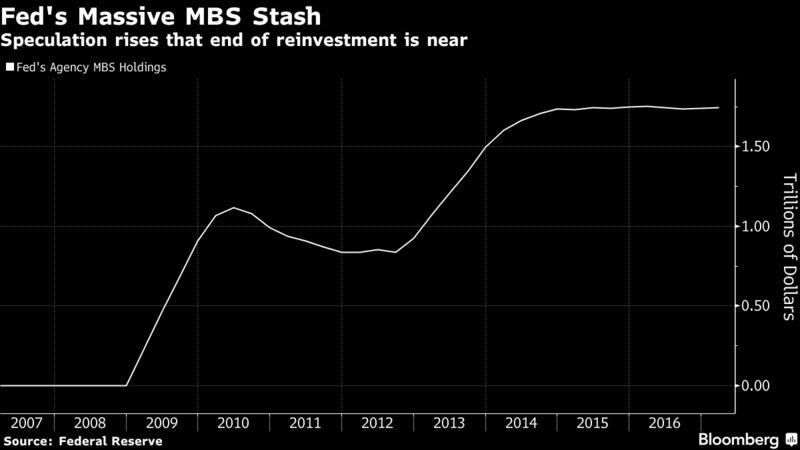
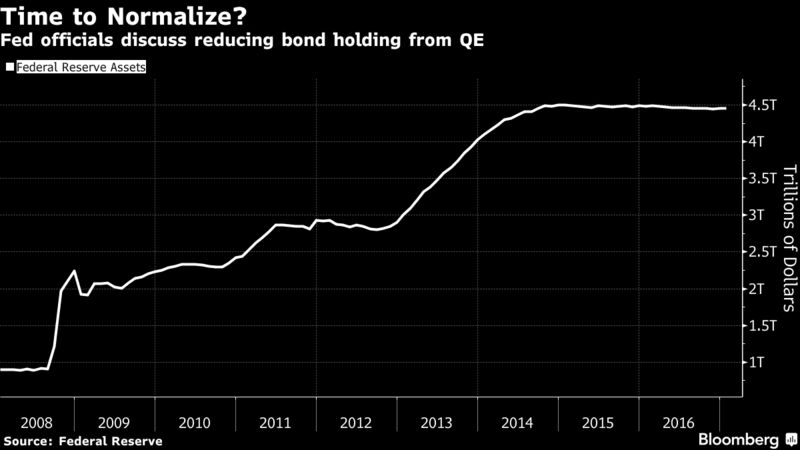
Just how big is hard to quantify. But over the past month, a number of Fed officials have openly discussed the need for the central bank to reduce its bond holdings, which it amassed as part of its unprecedented quantitative easing during and after the financial crisis. The talk has prompted some on Wall Street to suggest the Fed will start its drawdown as soon as this year, which has refocused attention on its $1.75 trillion stash of mortgage-backed securities.

While the Fed also owns Treasuries as part of its $4.45 trillion of assets, its MBS holdings have long been a contentious issue, with some lawmakers criticizing the investments as beyond what’s needed to achieve the central bank’s mandate. Yet because the Fed is now the biggest source of demand for U.S. government-backed mortgage debt and owns a third of the market, any move is likely to boost costs for home buyers. …

In the past year alone, the Fed bought $387 billion of mortgage bonds just to maintain its holdings. Getting out of the bond-buying business as the economy strengthens could help lift 30-year mortgage rates past 6 percent within three years, according to Moody’s Analytics Inc.

It’s difficult to imagine that losing a buyer of that magnitude wouldn’t cause prices to fall, thereby raising yields and mortgage interest rates.

https://i0.wp.com/ochousingnews.com/wp-content/uploads/2015/06/rising_interest_rates_housing.png

The surge in mortgage rates is already putting a dent in housing demand. Sales of previously owned homes declined more than forecast in December, …, according to data from the National Association of Realtors.

People are starting to ask the question, “Gee, did I miss my opportunity here to get a low-rate mortgage?”  …

While this may close the door on the opportunity to get a low rate, it opens the door on the opportunity to get a low price.

People can only afford what they can afford. If their payment stretches to finance huge sums like they do today, then prices get bid up to that equilibrium price level. If their payment finances a smaller sum, like they will if mortgage rates rise, then prices will need to “adjust” downward to this new equilibrium price level.

I wouldn’t count on a big drop. Prices are sticky on the way down, particularly without a flood of foreclosures to push them down. Today’s owners with low-rate mortgages won’t sell unless they really need to, and lenders would rather can-kick than cause another foreclosure crisis, so any downward movement would be slow.

As prices creep downward, rents and incomes will rise offsetting some of the pain, and those buyers that are active will substitute downward in quality to something they can afford. It’s a prescription for low sales volumes and unhappy buyers and sellers. The buyers pay too much, and the sellers get too little.

https://i0.wp.com/ochousingnews.com/wp-content/uploads/2016/03/fed_taper_stimulus.pngNevertheless, the consequences for the U.S. housing market can’t be ignored.

The “Fed has already hiked twice and the market is expecting” more, said Munish Gupta, a manager at Nara Capital, a new hedge fund being started by star mortgage trader Charles Smart. “Tapering is the next logical step.”

As the federal reserve tapers its purchases of mortgage bonds, it opens up this market to private investment. Perhaps money will flow out of 10-year treasuries into mortgage-backed securities for a little more yield. It’s also possible that Congress will reform mortgage finance and remove the government guarantee from these securities, making them less desirable.

It’s entirely possible that the yield on the 10-year treasury will drop this year. Higher short term rates and a strengthening economy means the US dollar should appreciate relative to other currencies, attracting foreign capital. Once converted to US dollars, that capital must find someplace to invest, and US Treasuries are the safest investment providing some yield. If a great deal of foreign capital enters the country and buys treasuries, yields will drop, and mortgage rates may drop with them. Rising mortgage rates are not a certainty.

For now, the federal reserve will keep buying mortgage-backed securities, but the messy taper is on the horizon. Apparently, when it comes to boosting housing, Yellen plans to stay the course.

Source: OC Housing News

For Those of You Waiting on Financial Collapse…

The economy will never collapse.

https://whiskeytangotexas.files.wordpress.com/2017/01/mj.gif

Ladies and gentlemen, I am a banker. That’s right, that evil, fat cat, wall street banker that became such a popular moniker during our last administration and I’m also a prepper. Rather than debate the topic of bugging in/out of an incredibly densely populated area which I contend with all the time, I wanted to write about a topic that I see a lot of op-eds about and that is the impending doom of economic collapse and it being the pretense for TEOTWAWKI.

As anyone who is skilled in their field of practice is, I have the ability (mostly because I’m intricately connected to it every day) to decipher the ongoing fear that we as a nation are teetering on the brink of economic collapse and that you must immediately liquidate all holdings and bank accounts and mattress those funds. I will try to impress upon you below how unlikely and improbable this really is.

As a student of Finance you’re taught words like inflation, bubbles and leverage. You pause and look at “The Market” throughout the day and wonder why Apple is up or why oil is down but you really don’t understand how tightly things are tied together and quite frankly how much reliance on everything a simple stock or sector has on everything else in the global economy. Now don’t get me wrong, any company can have a bad day, or week or year. I’s talked about all the time. But the system crashing down as a result of just the system and not some other calamity like plague or an EMP for that matter is just not going to happen.

Checks and Balances

For an economy like the U.S. to go belly up, that would essentially mean that every other country in the world just doesn’t care about receiving payments on their debt. When I spoke above about things being so tied together, did you know that practically every country in the world owns the United States? That’s right, the Chinese own the statue of liberty, the French own the grand canyon and our friends in the Congo own Mt Rushmore. It’s true, well maybe not exactly but that deficit everyone hears about is nothing more than conceptual money that we owe ourselves not to mention every other country out there. No one is coming to collect.

https://i1.wp.com/www.theprepperjournal.com/wp-content/uploads/2017/02/Stock-Market-Crash-2017.jpg?resize=768%2C374

Every once in a while, corrections are needed.

Do you think there’s a vault out there with trillions of dollars in it? I promise you there’s not. Corporations, foreign governments and independent debt owners care about one thing and one thing only, the interest payment. The interest on the debt they have in the investment they make. That monthly stipend of interest is what’s real and more importantly how people balance the check book. No one ever assumes they’ll get their money back, in fact if they did, we’d be in a far better position. All we’d have to do is print the money but guess what, it wouldn’t be worth very much if there was an excess of it would it? Nobody wants to be paid back these ridiculous sums of money for one simple reason, their value will go down. 1 trillion dollars in owed money is worth 100 times what 1 trillion dollars in cash is. Checks and Balances is just that, what makes the world go round is certainty that you can collect on your debt, not by collecting on what’s owed. The country’s of the world can’t function with trillions of dollars sitting in a vault, they’d essentially be broke.

Value is just perception

If you have a house, and you want to sell it, what’s it worth? Whatever you think your house is worth based on improvements you might have made or what your county is assessing a tax figure on and holding you accountable to pay is really not the answer. Your home and anything for that matter is worth what we call fair market value. Fair market value is the price that some else (the market) is willing to pay (fair value). I bring this up because such is the case with everything when it comes to what things are worth. Now a house is much different from an investment vehicle like a bond for example. You live in your house, it provides you safety, security, memories all of which are equitable things. You might even be willing to put a price tag on that in your mind. A bond or a stock or balance sheet doesn’t really stack up to that house of yours does it? Yet this is what the world economy is made up of, fictional pieces of perceived value. They don’t even print shares of stock or bond anymore so you couldn’t burn it to keep you warm at night. That’s not me being a cynic it’s just the truth. Everything we have with regard to wealth is just in the perception of faith and tied to nothing really tangible. Take a minute to think about that.

Every once in a while, corrections are needed

But banker you ask, what about the next recession, my portfolio might evaporate if it’s not allocated appropriately. Well folks, I’m here to tell you, you losing money is all part of the master plan. Making money is too however. There’s an old adage, maybe you’ve heard it. “Markets can digest good news and bad news but they hate uncertainty”. Isn’t that true of mostly everything come to think of it? Fact is our entire system was built on bull runs (times in which there’s a surge in value) and bear runs (times in which there’s a decline in value). If no one ever lost money the system wouldn’t work. Value wouldn’t change because risk would be taken out of the equation. Everyone would be richer but no one would be richer. What makes the world economy function is that there’s no guarantee that stipend I mentioned that all governments are tied to will be insured and reliable. This is where jockeying comes in and the gambling mentality takes over. Since the dawn of modern finance prospectors and prognosticators have set the benchmark to try to out-earn (even by just the tiniest of margins) their competitors. People wager on perceived value and that’s the x-factor (greed that is) that sets the bulls or bears running and ushers in peaks and valleys. Corrections are there by design and you’ll have to stomach it unless you plan to completely go off grid. That’s not really prepping though, that’s fully prepared. For the rest of us that aspire to “get there”, you have to be prepared to get bounced around with the financial tide.

Conclusion

OK oh ye faithful that have stuck around and for those of you that did, thank you, here’s the synopsis. Unless greed is wiped from the earth OR unless the debt holders want to stop making money, the system will not collapse. Even in the greatest of calamity’s like The Great Depression and or The Great Recession people made money. They just chose the right time to bet against common thought. Point is the system always recovers. We as preppers, for lack of a better way to say it are prepared. We’re prepared beyond what’s in our refrigerator or a minor terrorist crisis in our general vicinity or at least we’re trying to get there. Know this, peaks and valleys within our financial system will always continue but with 100% certainty, the system is rigged.

If things ever got bad enough for the U.S. to the point of bread lines and soup kitchens, we’d just print the money we needed as a government to make our debt payment. If another country couldn’t make their payment, we’d just chisel away at their principal and then auction it off again to the highest bidder for, that’s right you guessed it, another payment plan. Take solace in the fact that there are 100 others ways all of them far more likely to disrupt the balance and cause us to make tough decisions for our family’s. For the ones convinced that the economic system will fail them, you might be caught short-handed in your preps. Invest instead in gas masks or wind turbines or lamp oil, hey, you might just make someone rich.

Source: The Prepper Journal

The Mortgage-Bond Whale That Everyone Is Suddenly Worried About

https://martinhladyniuk.com/wp-content/uploads/2016/12/crystal_ball.jpeg

◆ Fed holds $1.75 Trillion of MBS from quantitative easing program

◆ Comments spur talk Fed may start draw down as soon as this year

Almost a decade after it all began, the Federal Reserve is finally talking about unwinding its grand experiment in monetary policy.

And when it happens, the knock-on effects in the bond market could pose a threat to the U.S. housing recovery.

Just how big is hard to quantify. But over the past month, a number of Fed officials have openly discussed the need for the central bank to reduce its bond holdings, which it amassed as part of its unprecedented quantitative easing during and after the financial crisis. The talk has prompted some on Wall Street to suggest the Fed will start its drawdown as soon as this year, which has refocused attention on its $1.75 trillion stash of mortgage-backed securities.

https://assets.bwbx.io/images/users/iqjWHBFdfxIU/iw9D0Hp.UlwQ/v2/800x-1.png

While the Fed also owns Treasuries as part of its $4.45 trillion of assets, its MBS holdings have long been a contentious issue, with some lawmakers criticizing the investments as beyond what’s needed to achieve the central bank’s mandate. Yet because the Fed is now the biggest source of demand for U.S. government-backed mortgage debt and owns a third of the market, any move is likely to boost costs for home buyers.

In the past year alone, the Fed bought $387 billion of mortgage bonds just to maintain its holdings. Getting out of the bond-buying business as the economy strengthens could help lift 30-year mortgage rates past 6 percent within three years, according to Moody’s Analytics Inc.

Unwinding QE “will be a massive and long-lasting hit” for the mortgage market, said Michael Cloherty, the head of U.S. interest-rate strategy at RBC Capital Markets. He expects the Fed to start paring its investments in the fourth quarter and ultimately dispose of all its MBS holdings.

Unprecedented Buying

Unlike Treasuries, the Fed rarely owned mortgage-backed securities before the financial crisis. Over the years, its purchases have been key in getting the housing market back on its feet. Along with near-zero interest rates, the demand from the Fed reduced the cost of mortgage debt relative to Treasuries and encouraged banks to extend more loans to consumers.

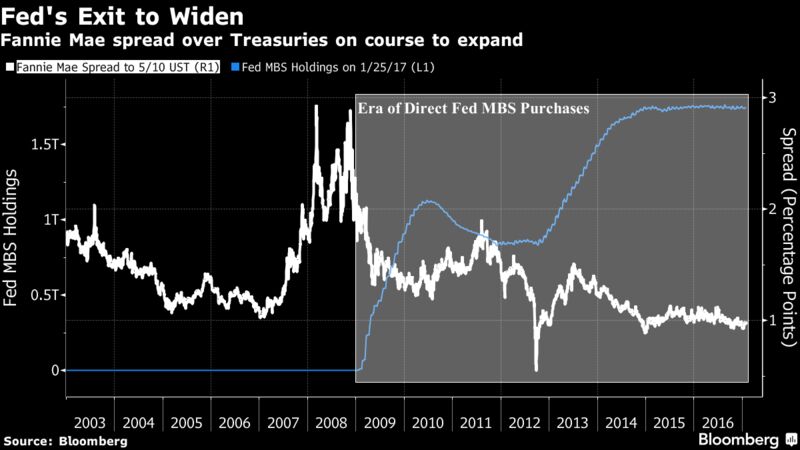
In a roughly two-year span that ended in 2014, the Fed increased its MBS holdings by about $1 trillion, which it has maintained by reinvesting its maturing debt. Since then, 30-year bonds composed of Fannie Mae-backed mortgages have only been about a percentage point higher than the average yield for five- and 10-year Treasuries, data compiled by Bloomberg show. That’s less than the spread during housing boom in 2005 and 2006.

https://assets.bwbx.io/images/users/iqjWHBFdfxIU/iI0W5wRpyb2Q/v2/800x-1.png

Talk of the Fed pulling back from the market has bond dealers anticipating that spreads will widen. Goldman Sachs Group Inc. sees the gap increasing 0.1 percentage point this year, while strategists from JPMorgan Chase & Co. say that once the Fed actually starts to slow its MBS reinvestments, the spread would widen at least 0.2 to 0.25 percentage points.

“The biggest buyer is leaving the market, so there will be less demand for MBS,” said Marty Young, fixed-income analyst at Goldman Sachs. The firm forecasts the central bank will start reducing its holdings in 2018. That’s in line with a majority of bond dealers in the New York Fed’s December survey.

The Fed, for its part, has said it will keep reinvesting until its tightening cycle is “well underway,” according to language that has appeared in every policy statement since December 2015. The range for its target rate currently stands at 0.5 percent to 0.75 percent.

Mortgage Rates

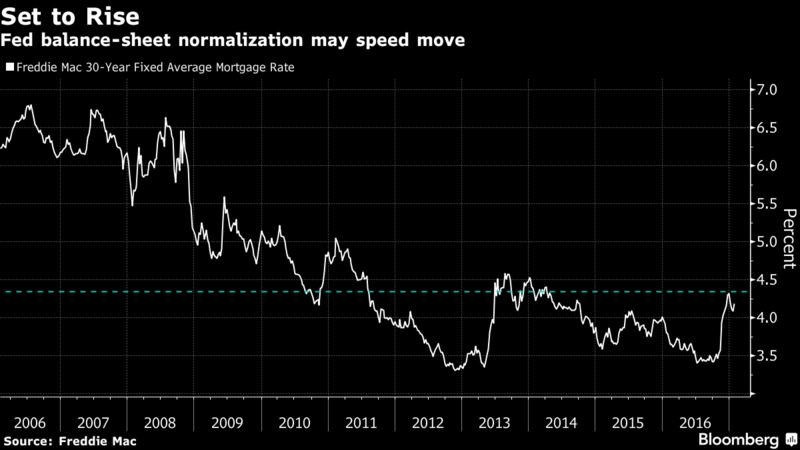
Mortgage rates have started to rise as the Fed moves to increase short-term borrowing costs. Rates for 30-year home loans surged to an almost three-year high of 4.32 percent in December. While rates have edged lower since, they’ve jumped more than three-quarters of a percentage point in just four months.

The surge in mortgage rates is already putting a dent in housing demand. Sales of previously owned homes declined more than forecast in December, even as full-year figures were the strongest in a decade, according to data from the National Association of Realtors.

https://assets.bwbx.io/images/users/iqjWHBFdfxIU/iVfEyIkMkcSI/v2/800x-1.png

People are starting to ask the question, “Gee, did I miss my opportunity here to get a low-rate mortgage?” said Tim Steffen, a financial planner at Robert W. Baird & Co. in Milwaukee. “I tell them that rates are still pretty low. But are rates going to go up? It certainly seems like they are.”

Part of it, of course, has to do with the Fed simply raising interest rates as inflation perks up. Officials have long wanted to get benchmark borrowing costs off rock-bottom levels (another legacy of crisis-era policies) and back to levels more consist with a healthy economy. This year, the Fed has penciled in three additional quarter-point rate increases.

The move to taper its investments has the potential to cause further tightening. Morgan Stanley estimates that a $325 billion reduction in the Fed’s MBS holdings from April 2018 through end of 2019 may have the same impact as nearly two additional rate increases.

Finding other sources of demand won’t be easy either. Because of the Fed’s outsize role in the MBS market since the crisis, the vast majority of transactions are done by just a handful of dealers. What’s more, it’s not clear whether investors like foreign central banks and commercial banks can absorb all the extra supply — at least without wider spreads.

On the plus side, getting MBS back into the hands of private investors could help make the market more robust by increasing trading. Average daily volume has plunged more than 40 percent since the crisis, Securities Industry and Financial Markets Association data show.

https://assets.bwbx.io/images/users/iqjWHBFdfxIU/i6uJwa0MlVJQ/v2/800x-1.png

“Ending reinvestment will mean there are more bonds for the private sector to buy,” said Daniel Hyman, the co-head of the agency-mortgage portfolio management team at Pacific Investment Management Co.

What’s more, it may give the central bank more flexibility to tighten policy, especially if President Donald Trump’s spending plans stir more economic growth and inflation. St. Louis Fed President James Bullard said last month that he’d prefer to use the central bank’s holdings to do some of the lifting, echoing remarks by his Boston colleague Eric Rosengren.

Nevertheless, the consequences for the U.S. housing market can’t be ignored.

The “Fed has already hiked twice and the market is expecting” more, said Munish Gupta, a manager at Nara Capital, a new hedge fund being started by star mortgage trader Charles Smart. “Tapering is the next logical step.”

by Liz McCormick and Matt Scully | Bloomberg