Monthly Archives: April 2019

How A Hijacked Listing For One Of Los Angeles’ Most Expensive Homes Led To A $60MM Lawsuit Against Zillow

() It’s hard to overstate the opulence showcased in developer Bruce Makowsky’s $150-million spec house, dubbed “Billionaire.” Perched above Bel Air, the four-story mansion offers a world of pure imagination within its walls.

A Bel-Air mansion built on speculation is at the center of a legal dispute after a Zillow listing for the $150-million home was hijacked by an unknown user. (Berlyn Photography)

Jockeying for attention across 38,000 square feet are 12 bedrooms, 21 bathrooms, three kitchens, 130 artworks, a 40-seat movie theater, a $30-million fleet of exotic cars, two wine cellars stocked with Champagne, a four-lane bowling alley and a candy room filled with towering cylinders of sweets.

Image is everything when seeking nine figures for a single estate. What, then, happens when that image is allegedly tainted? That’s what a lawsuit filed by the self-assured, suede-jacket-wearing Makowsky against real estate company Zillow aims to find out.

Earlier this year, Zillow falsely showed that the mega-mansion sold for tens of millions less than its asking price. Makowsky sued for $60 million in damages, citing permanent harm to the property’s perception.

On April 19, Zillow filed to dismiss the suit, chiefly citing a section of the Communications Decency Act that protects web operators from being responsible for information published by its users. The hearing is set for June 24.

The sham began in February, when an unknown user with a Chinese IP address and fake phone number side-stepped Zillow’s security measures and toyed with the sale prices displayed on the mansion’s listing.

Zillow displays pages for roughly 110 million homes in the U.S., and it allows owners to go in and change information about their home when necessary. Usually, that means noting a recent remodel or added square footage that may affect a home’s value, but the feature also opens the door for false information.

On Feb. 4, Zillow showed that Makowsky’s home — which is on the market for $150 million — sold for $110 million. It never did. Over the course of the next week, the real estate site falsely reported sale prices of $90.54 million and $94.3 million, as well as a phantom open house that never took place.

Soon after, Makowsky’s attorney Ronald Richards pointed out the falsities to Zillow’s legal team in an email. After some back and forth, included in the lawsuit, Kim Nielson, senior lead counsel for Zillow Group, responded with this:

“Any home on our website can be claimed by the homeowner. There are a series of questions that must be answered, but if someone attempts to claim it enough times, they will know the questions asked (and be able to figure out what information they need to verify their identity).”

She added that not all claims are manually reviewed, which allowed the user to manipulate the listing details without proving their identity.

Later that month, a limited liability company owned by Makowsky filed the lawsuit seeking $60 million in damages. It claims that Zillow “admittedly published false information” and destroyed the property’s perception as an elite listing worth more than $100 million.

Makowsky himself has axed the price twice since bringing the spec house to market for $250 million two years ago. He most recently trimmed the tag to $150 million in January, saying that he was just trying to be realistic.

Makowsky made his fortune selling handbags on QVC before shifting to high-end real estate about eight years ago as the head of BAM Luxury Development Group. (Cindy Ord / Getty Images)

Taking aim at Zillow’s security process, the lawsuit alleges that Zillow has no safeguards in place to stop trolls or criminals from claiming a property and posting false information.

A spokeswoman for Zillow declined to comment on the pending litigation but stressed that it goes to great lengths to display current and accurate data on its website, which is largely sourced from public records.

The complaint also stresses Zillow’s market power. The website leads the real estate industry with an estimated 36 million unique monthly visitors, and Makowsky said multiple colleagues called to congratulate him on a sale that never happened.

But of those millions of monthly visitors to Zillow, few are searching for homes priced in the nine figures other than for aspirational reasons. Fewer have the actual means to afford it.

Only a handful of local L.A. residents, and a small market outside of that, have the ability to buy homes listed for north of $100 million. As of 2017, there were 680 billionaires in the U.S, according to the research firm Wealth-X, and about 2,750 worldwide.

Jerry Jolton, an agent with Coldwell Banker Residential Brokerage, said three things need to come together to sell a home in the $100-million arena: luck, timing and the right client.

“We’re dealing with a very exclusive group of people who’ve attained such wealth,” he said.

Oftentimes, developers eye international wealth when floating a nine-digit listing. However, Jolton said foreign buyers account for only around 21% of L.A.-area homes sales over $20 million.

Beyond visitors to online listing services, Makowsky faces another challenge in his pursuit of a high-dollar deal: comparable sales in the tony Westside area.

Michael Sahakian, also with Coldwell Banker, sold the property that now holds Makowsky’s mansion back in the ’90s. While noting the estate’s opulence, he said its placement in East Gate Bel Air — one of the city’s most exclusive and pricey pockets — will make selling it a challenge.

Most homes there sell for around $2,000 to $3,000 per square foot. For context, Makowsky’s estate is on the market for $3,947 per square foot.

Still, because an acre of East Gate goes for around $20 million, it’s rare for a home larger than 30,000 square feet to go up for sale.

Makowsky, in his early 60s, made his fortune selling handbags on QVC before shifting to high-end real estate about eight years ago as the head of BAM Luxury Development Group.

His development brand is largely a reflection of his own extravagant interests and tastes; many of the lavish furnishings, finishes and other accouterments incorporated into his projects are sourced from his travels around the world. Custom furnishings produced by high-end brands such as Fendi, Bentley and Louis Vuitton often play an integral role in his homes.

Among his notable projects was a testosterone-infused showplace in Beverly Hills that featured a $200,000 sculpture of a giant blue hand grenade and a replica of James Dean’s motorcycle. Originally listed at $85 million, the 23,000-square-foot house sold in 2014 to Minecraft creator Markus Persson for $70 million.

Source:
If “Getting Ahead” Depends On Asset Bubbles, It’s Not “Getting Ahead,” It’s Gambling

“Given that the economy is now totally and completely dependent on inflating asset bubbles, it makes no sense to invest for the long-term” – Charles Hugh Smith

Beneath the endlessly hyped expansion in gross domestic product (GDP) of the past two decades, the economy has changed dramatically. The American Dream boils down to social and economic mobility, a.k.a. getting ahead through hard work, merit and wise investments in oneself and one’s family.

The opportunities for this mobility in the post World War 2 era broadened as civil rights and equal rights expanded. The 1970s saw a disruption of working-class mobility as high-paying factory jobs disappeared, leaving services jobs that paid less or required more training, i.e. a college degree.

The U.S. economy took off in the 1980s for a number of reasons, including computer technologies, federal stimulus (deficit spending) and financialization (a topic I’ve covered many times). With millions more college graduates entering the workforce and the Internet creating entire new industries, the opportunities to “get ahead” increased across the social and economic spectrum.

But something changed in the aftermath of the dot-com bubble bursting. The fruits of financialization–highly leveraged debt gambled for short-term gains in markets–were extended to everyone with a job (or a willingness to lie) via liar loans, no-document loans and subprime mortgages.

Just like bigshot financiers on Wall Street, J.Q. Citizen could leverage a couple thousand dollars in cash (or even better, borrow the closing costs via a 105% of value mortgage and put nothing down) and buy a McMansion worth $250,000 or even $500,000.

The only difference between bigshot financiers and J.Q. Citizen was the scale of the leverage and gamble: J.Q. Citizen could leverage a few grand into hundreds of thousands, while the financier could leverage a bit of collateral into mega-millions.

The goal wasn’t homeownership, the purported “official” goal of subprime mortgages: it was short-term speculative gains via “flipping” the house in a few months. Just like the bigshot financiers, the subprime mortgage market enabled marginal borrowers to take control of assets far in excess of their actual capital and sell them to a greater fool for a quick profit far in excess of their earnings.

Wall Street loved this distribution of financialization to the masses because Wall Street made a fortune packaging (securitizing) this toxic debt and selling it to unwary, credulous investors as “low risk” (heh) assets.

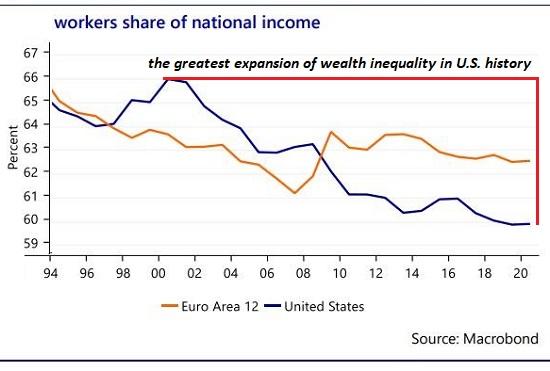
After the mortgage-securitization-fraud-housing bubble popped, a secular trend– wages for the bottom 95% of wage earners stagnating–accelerated. “Getting ahead” via earning a college diploma, working hard and counting on merit no longer worked; families with privileges and capital got wealthier, and everyone else found the purchasing power of their earnings declined even as stocks and housing soared.

https://www.zerohedge.com/s3/files/inline-images/worker-share2-19a_0.jpg?itok=lgCLfxx6

The only way to “get ahead” in a globalized, financialized economy is either 1) earn at least $200,000 a year from one’s labor or 2) gamble in the inflating bubbles of stocks and housing. In high-cost regions, even $200,000 isn’t enough to get ahead (i.e. buy a crumbling bungalow on a tiny lot for $800,000) if the wage-earner has student loans and/or children; the household needs two earners making top 5% salaries.

The more money the central banks throw at stock-housing asset bubbles, the higher they loft, a process that has pushed housing in high-cost regions out of reach of all those with average jobs and incomes. So much for “getting ahead.”

The economy has changed dramatically for the worse: getting a graduate degree no longer guarantees getting ahead (millions of other workers globally have the same credentials); working hard is equally iffy, and traditional investments in one’s family either no longer yields gains (higher education) or they are gambles in the guise of “investments” (housing).

Given that the economy is now totally and completely dependent on inflating asset bubbles, it makes no sense to invest for the long-term: a short-term gambling mentality is required to avoid getting destroyed when the bubble-du-jour pops.

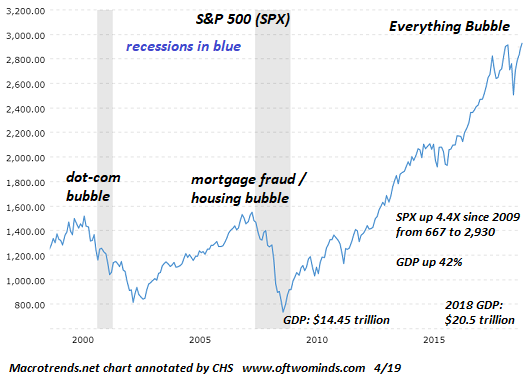
Everyone who believes bubbles never pop, they only expand forever and ever, has never looked at a chart of the S&P 500 (SPX), which illustrates that bubbles always pop, destroying the capital of all who neglected to sell at the top.

https://www.zerohedge.com/s3/files/inline-images/SPX-everything-bubble4-19.png?itok=ngOBz-7j

If “getting ahead” depends on playing asset bubbles, it’s not getting ahead, it’s gambling.

Source: by Charles Hugh Smith via OfTwoMinds blog,

New Home Sales Soar To 16-Month Highs As Price Plunges

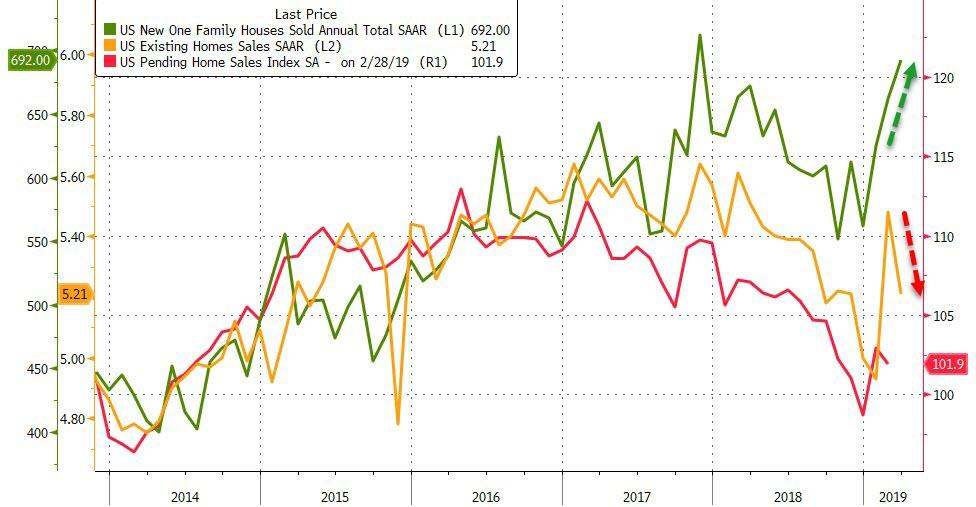
New home sales were expected to retrace some of February’s gains but in a reversal of yesterday’s dismal drop in existing home sales, new home sales in March soared 4.5% higher MoM (and February was revised stronger from +4.9% MoM to +5.9% MoM).

This is the 3rd straight month of rising new home sales.

https://www.zerohedge.com/s3/files/inline-images/bfmF21A.jpg?itok=f4HyxKtq

The 692k SAAR is the highest since Nov 2017 – near the post-crisis highs.

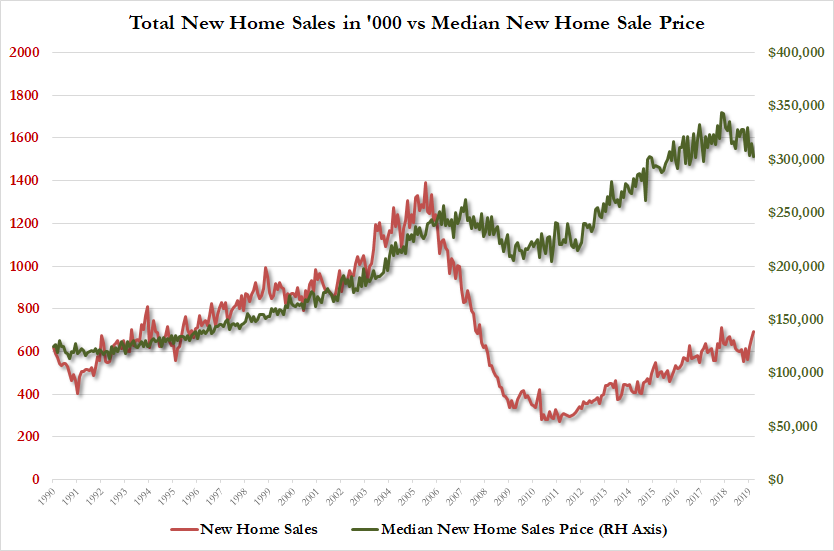
The reason – among others – is simple – median new home prices plunged to their lowest since Feb 2017 (a 9.7% from a year earlier to a two-year low of $302,700)….

https://www.zerohedge.com/s3/files/inline-images/2019-04-23.png?itok=Ouo7e1vD

A mixed picture across regions with Northeast March new home sales plunging to 28K, down 22.2% from February, but Midwest surged from 74K to 87K, up 17.6%.

The supply of homes at the current sales rate decreased to six months from 6.3 months in February. The number of new homes for sale in the period was little changed at 344,000.

New-home purchases account for about 10 percent of the market and are calculated when contracts are signed. They are considered a timelier barometer than purchases of previously-owned homes, which are calculated when contracts close.

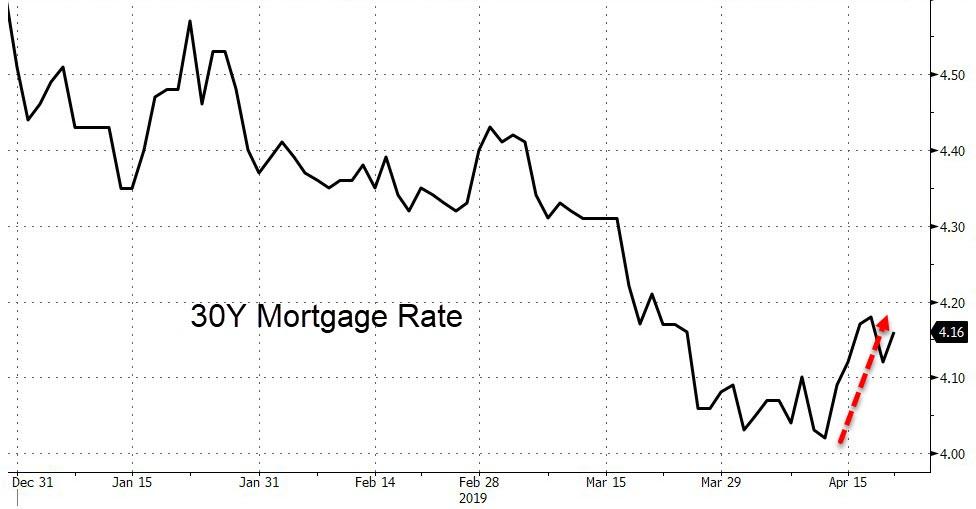
Let’s just hope the recent resurgence in mortgage rates doesn’t last…

https://www.zerohedge.com/s3/files/inline-images/bfmDB7B.jpg?itok=zHL-lBVs

Source: ZeroHedge

America’s Forced Financial Flight From Unaffordable And Dysfunctional Cities

The forced flight from unaffordable and dysfunctional urban regions is as yet a trickle, but watch what happens when a recession causes widespread layoffs in high-wage sectors.

https://www.zerohedge.com/sites/default/files/inline-images/exodus%20pic.jpg?itok=GDY4lm8A

(Charles Hugh Smith) For hundreds of years, rural poverty has driven people to urban areas: cities offer paying work and abundant opportunities to get ahead, and these financial incentives have transformed the human populace from largely rural to largely urban in the developed world.

Now a new set of financial pressures are forcing a migration of urban residents out of cities which are increasingly unaffordable and dysfunctional. As highly paid skilled workers and global capital have flooded into high-job-growth regions, living costs and the costs of doing business have skyrocketed: where not too long ago $1,000 a month would secure a modest one-bedroom apartment in major urban job centers, now it takes $2,000 or $3,000 a month to rent a modest flat.

Wages for the average worker have not doubled or tripled, and this asymmetry between soaring living costs and stagnant incomes is driving the exodus out of cities that are only affordable to the top 10% of wage earners, or those who bought a house decades ago and have locked in low property taxes.

Gordon Long and I discuss this forced migration in a new video program. It’s important to note that we’re not talking about economy-wide inflation or the general rise in the cost of living; we’re talking about the hyper-drive cost increases that characterize high-cost urban areas.

I’ve addressed economy-wide real-world inflation many times,for example:

The Burrito Index: Consumer Prices Have Soared 160% Since 2001 (August 1, 2016)

Burrito Index Update: Burrito Cost Triples, Official Inflation Up 43% from 2001 (May 31, 2018)

In high-cost urban regions, burritos aren’t $7.50; they’re $10 or $12. Parking tickets aren’t $15, they’re $60, and so on.

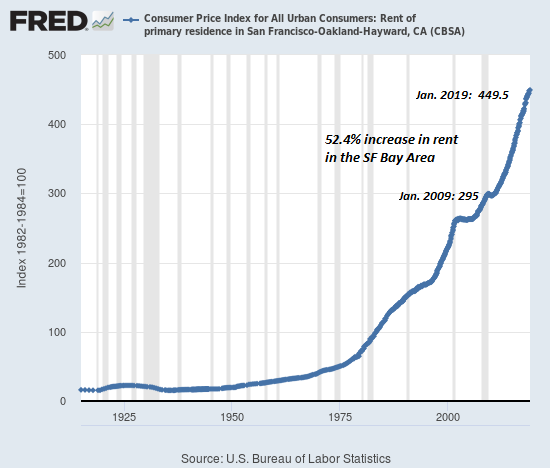
Consider this chart of rents in the San Francisco Bay Area: unless the household’s income has shot up in parallel with rents, this cost of living is simply unaffordable.

https://www.zerohedge.com/s3/files/inline-images/rent-SFbay2-19_0.png?itok=vCP2ue4x

Here are the dynamics driving this financially forced flight, which hits the young especially hard: who can afford to buy a house when cramped, decaying 100-year old bungalows are $900,000 and property taxes are $15,000 or more? Who can afford to have kids when childcare costs a small fortune?

The elderly retired who don’t own a house free and clear are also being priced out of these regions.

1. Household income is stagnating as real-world inflation erodes the purchasing power of income: rent, housing, childcare, healthcare, dining out are all rising far faster than “official” inflation of 2% annually.

2. Prices in high-cost urban zones are increasing faster than in less pricey regions. Areas with job growth are experiencing supply-demand imbalances in rent and housing. Only top earners can afford to buy a home.

3. Young households are burdened with student loan debt, making it financially difficult to buy a home in a pricey urban zone and start a family. The only way to afford a home and children is to move to a region with affordable housing and living costs.

4. Income in high-cost urban areas is more heavily skewed by “winner take most” dynamics of finance and technology; the Pareto Distribution of 20% earn 80% of the income is extended so the top 4% take 64% the income. Even above-average incomes are not enough to support a traditional middle-class lifestyle.

5. Local government services cost more in high-cost urban areas, and so cities and municipalities are relentlessly increasing taxes, fees and licensing, pressuring all but the top tier of households.

6. The sacrifices required to live in high-cost urban areas are no longer worth it: traffic congestion, long commutes, high-stress jobs, homelessness and decaying infrastructure are outweighing the benefits of hipster urbanism.

Although it’s verboten to mention this in the we’re so fabulous local media, many of these high-cost urban regions are hopelessly dysfunctional. Taxpayers have ponied up billions of dollars in new taxes, fees and bond measures, and yet none of the problems that make daily life miserable ever get better.

At some point, the urban hipsterism that seemed so cool and appealing becomes just another example of the Haves and Have-Nots: how many households can afford $200+ for a meal and drinks at the latest foodie-fusion bistro? What level of sainthood is required to tolerate the traffic or crowded public transport to get to the hipster paradise, including avoiding the bodies, needles and other detritus of the entrenched homeless on the sidewalks?

https://www.zerohedge.com/s3/files/inline-images/lifestyle_2.jpg?itok=2F-CmRxH

The forced flight from unaffordable and dysfunctional urban regions is as yet a trickle, but watch what happens when a recession causes widespread layoffs in high-wage sectors and suddenly the hipster bistro that was always jammed is empty, and then shuttered. To replaced the taxes lost to layoffs and closed businesses, the political class will have no choice but to launch a frenzy of higher taxes, fees and surcharges on those left behind.

Source: by Charles Hugh Smith | Of Two Minds

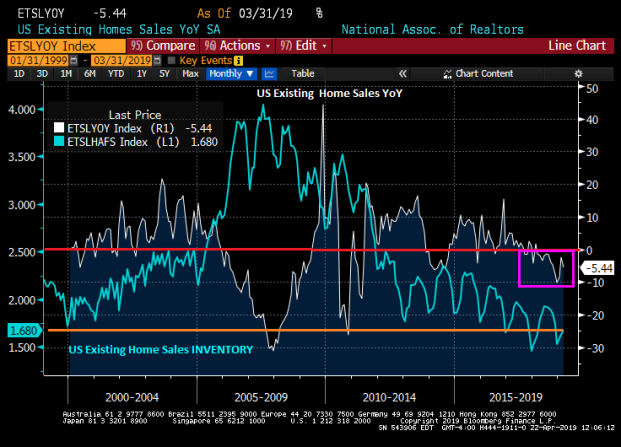
Existing Home Sales Fall 5.44% Year Over Year In March

Existing Housing Sales Inventory Lowest Since 1999

https://confoundedinterestnet.files.wordpress.com/2019/04/ehsyoyinv.png

At the same time, the INVENTORY of existing home sales rose in March, but still remains near its lowest level since 1999.

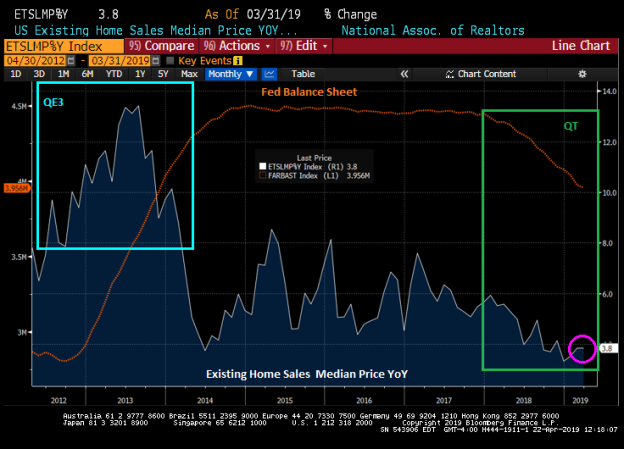
Existing home sales Median Price YoY has slowed to 3.8% with The Fed’s quantitative tightening (QT). As opposed to 13.4% YoY during The Fed’s QE3.

https://confoundedinterestnet.files.wordpress.com/2019/04/ehdmf.png

Time to bring out your Fed!

https://confoundedinterestnet.files.wordpress.com/2019/02/powellfrown.jpg

Source: Confounded Interest

Less Than 25% Of College Graduates Can Answer These 4 Simple Money Questions

Americans have become numb to financial intelligence. This is no more evident than a recent Sallie Mae survey, which indicated that college graduates can’t even answer simple questions about financial concepts, such as interest.

https://www.zerohedge.com/s3/files/inline-images/college-debt1.jpg?itok=LmThGrUi

The statistics are not looking good for the United States, a nation deeply indebted, addicted to consumerism, and woefully ignorant about it all.  Not long ago, SHTFPlanreported that a mere 1 in 10 Americans is actually capable of getting an A on a basic financial security test.

And even college graduates, who are likely tens of thousands (if not more) dollars in debt because of school, learned little to nothing about handling their personal finances. The big red flag comes from consumer banking firm Sallie Mae. The firm released its new “Majoring in Money” study which asked hundreds of current and recently graduated college students up to age 29 about basic financial concepts. The results are worrisome.

Sallie Mae asked these individuals four questions related to credit and interest, and fewer than one in four got all four of these correct.

1. Interest accumulation: 
Suppose you had $100 in a savings account and the interest rate was 2% per year. After 5 years, how much do you think you would have in the account if you left the money to grow?
a. More than $102
b. Exactly $102
c. Less than $102
d. Not sure

2. Effects of payment behavior on credit cost: 
Assuming the following individuals have the same credit card with the same interest rate and balance, which will pay the most in interest on their credit card purchases over time?
a. Joe, who makes the minimum payment on his credit card bill every month
b. Jane, who pays the balance on her credit card in full every month
c. Joyce, who sometimes pays the minimum, sometimes pays less than the minimum and missed one payment on her credit card bill
d. All of them will pay the same amount in interest over time
e. Not sure

3. Impact of repayment term on cost of credit: 
Imagine that there are two options when it comes to paying back a loan and both come with the same interest rate. Provided you have the needed funds, which option would you select to minimize your total costs over the life of the loan (i.e., all of your payments combined until the loan is completely paid off)?
a. Option 1 allows you to take 10 years to pay back the loan
b. Option 2 allows you to take 20 years to pay back the loan
c. Both options have the same out-of-pocket cost over the life of the loan
d. Not sure

4. Interest terminology: 
Which of the following best defines the term “interest capitalization”?
a. The type of interest charged on high-balance loans
b. The addition of unpaid interest to the principal balance of a loan
c. Interest that is charged when you postpone payments on your loan

The fact that we have an entire generation, largely college educated, who cannot answer these questions does not bode well for our future as a society.  Not knowing the answers to these could end up costing people a lot of money down the road. According to Market Watch, 83% of college grads carry a credit card as revealed by Sallie Mae, but only about six in 10 say they pay the balance(s) in full and on time each month. Coupled with the fact that nearly seven in 10 college students take out student loans, graduating with an average of nearly $30,000 in debt, the decline in financial intelligence is evident.

There are ways to learn the basics of personal finance. Dave Ramsey’s Total Money Makeover book was of the most help to many people, and Ramsey is perhaps the most well-known personal finance guru out there.  He takes a strick “no debt” approach that has worked not only for himself, buy countless others. He also offers an easy to follow guide which he’s dubbed “the baby steps” that will get people on the path to financial freedom.

Other resources are those such as Robert Kiyosaki’s Rich Dad, Poor Dad: What the Rich Teach Their Kids About Money That the Poor and Middle Class Do Not!

Both books are excellent resources that teach the very basics about money and personal finance that no one is learning about in their public school educations.

*  *  *

The answers are 1: A, 2: C, 3: A, and 4: B

Source: by Mac Salvo | ZeroHedge

Average US Credit Score Hits An All Time High

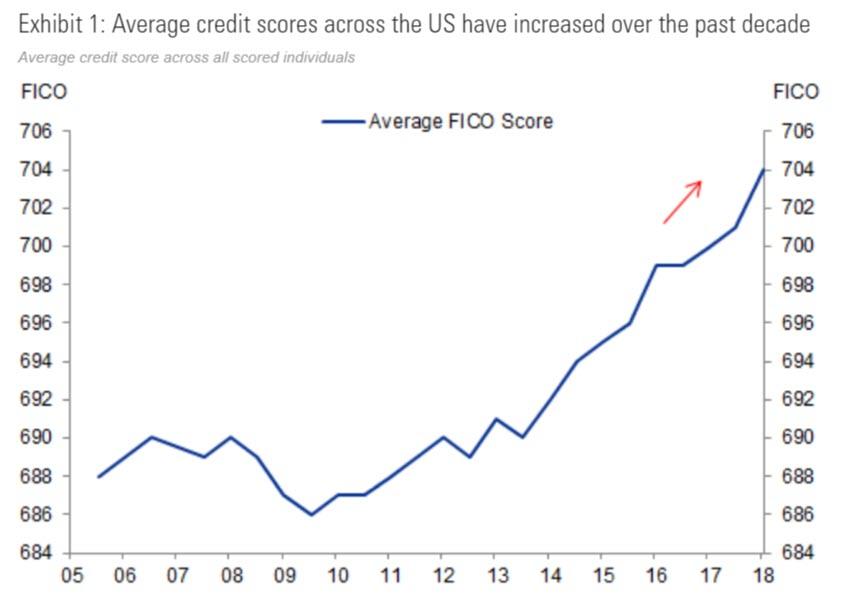
Something unexpected happened after the financial crisis: Americans have become far more responsible when it comes to their finances. At least that is the conclusion one would derive by looking at the average US credit score, which has increased by nearly 20 points, from 686 in 2009 to 704 in 2018.

https://www.zerohedge.com/s3/files/inline-images/Average%20FICO%20increase.jpg?itok=M6Ul8mAd

Additionally, according to Moody’s, there are around 15 million more consumers with credit scores above 740 today than there were in 2006, and about 15 million fewer consumers with scores below 660.

As we discussed recently, on the surface, this “disappearance” of subprime borrowers is good news. But is there more than meets the eye to the American consumer’s FICO score renaissance? And, separately, are FICO scores subject to “grade inflation“, as the Federal Reserve recently claimed?

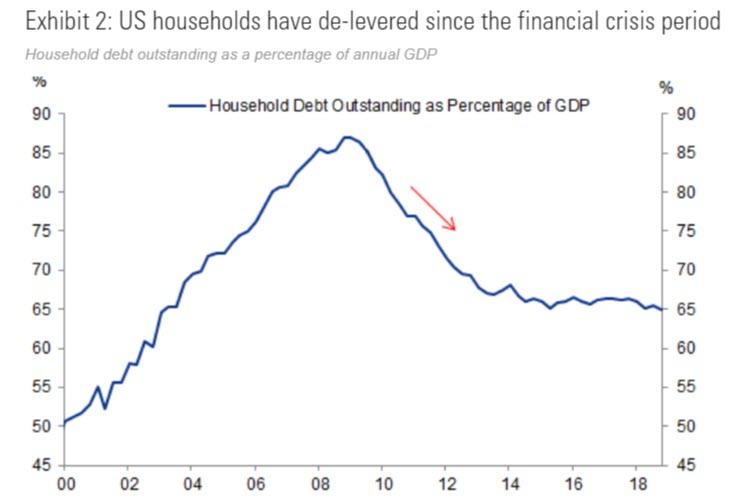
To answer these questions, Goldman recently conducted an analysis into the causes behind this welcome development in US credit scores. The bank founds that, as expected, some of this increase reflects legitimate improvements in the credit behavior of US consumers. For example, household debt has declined as a percentage of GDP:

https://www.zerohedge.com/s3/files/inline-images/household%20debt%20to%20GDP.jpg?itok=sjdJoasg

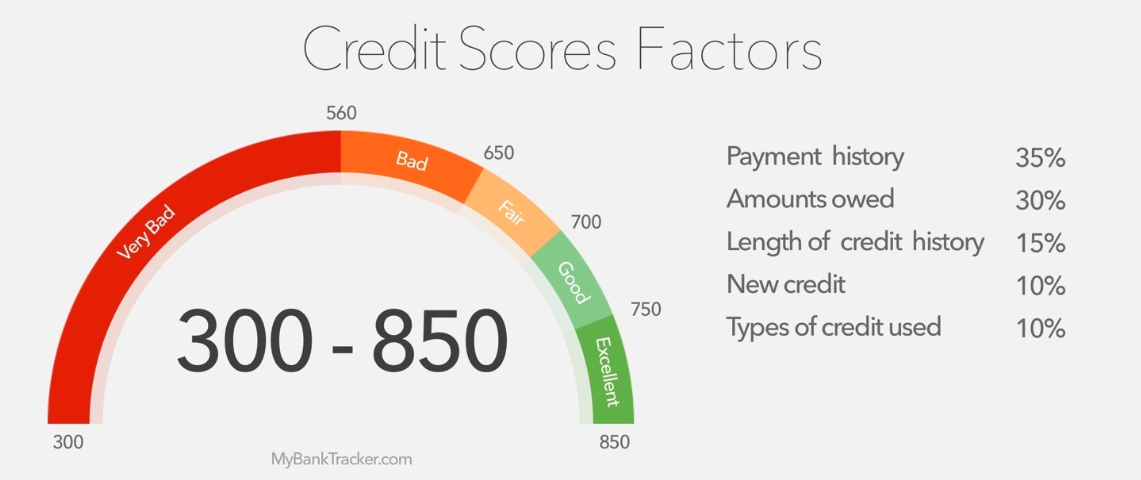
Since measures of indebtedness / over-extension represent roughly 30% of the FICO credit score calculation, this de-leveraging will, appropriately, lead to higher credit scores.

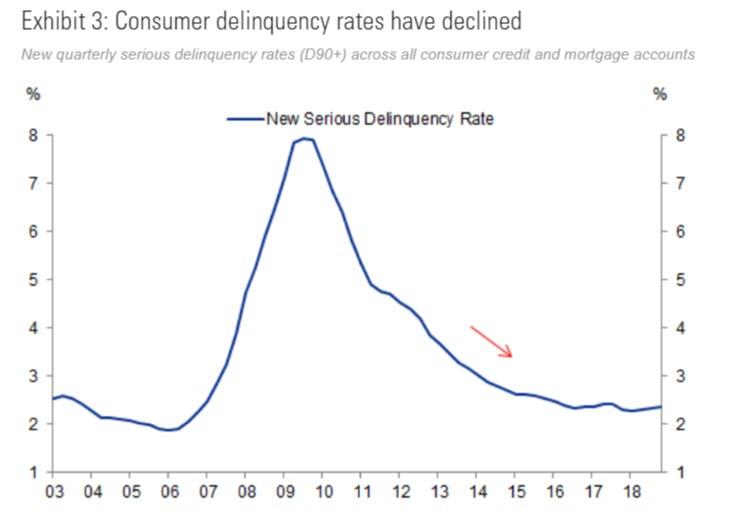
Some of the increase in average FICO scores is also a reflection of the relatively benign macro-economy to which consumers have been exposed in recent years, according to Goldman. Past payment history is the largest driver of most credit score formulas, and low current delinquency rates help drive credit scores higher even if these low rates of delinquency are partly explained by the strong economy.

https://www.zerohedge.com/s3/files/inline-images/consumer%20delinquency%20rates%20gs.jpg?itok=bxbOOTL0

With these two considerations in mind, Goldman cautions that in light of the strong economy and lack of a (recent) stressful economic scenario, with unemployment rates now below 4%, high credit scores for 2019 vintage borrowers might overstate credit quality.

Echoing this point, Cris deRitis, Moody’s deputy chief economist said that “borrowers with low credit scores in 2019 pose a much higher relative risk. Because loss rates today are low and competition for high-score borrowers is fierce, lenders may be tempted to lower their credit standards without appreciating that the 660 credit-score borrower today may be relatively worse than a 660-score borrower in 2009.”

“Borrowers’ scores may have migrated up, but inherently their individual risk, and their attitude towards credit and ability to pay their bills, has stayed the same. You might have thought 700 was a good score, but now it’s just average,” deRitis continued.

Indeed, despite the record high average FICO score, cracks are already starting to show on the surface: there has been a rising number of missed payments by borrowers with the highest risk, despite the past decade of “growth”. And now that the economy is starting to show weakness, these delinquencies could accelerate and lead to larger than expected losses.

Ethan Dornhelm, vice president of scores and predictive analytics at FICO doesn’t seem to notice score inflation and blames the issue on underwriters: “The relationship between FICO score and delinquency levels can and does shift over time. We recognize there’s a lot more context you can obtain beyond a consumer’s credit file. We do not think that score inflation is the issue, but the risk layering on underwriting factors outside of credit scores, such as DTI, loan terms, and even trends in macroeconomic cycles, for example.”

Marketplace and peer to peer lending has also been showing signs of stress. Missed payments and writedowns increased last year, according to NY data and analytic firm PeerIQ. “We don’t see the purported improvement in underwriting just yet,” PeerIQ wrote in a recent report.

And the pressure isn’t just showing up in auto loans and marketplace lending. Private label credit cards, those issued by stores, instead of big banks, saw the highest number of missed payments in seven years last year. “As an investor it’s incumbent on you to do that deep credit work, which means you have to know as much as possible about how things should pay off or default”, said Michelle Russell-Dowe, who invests in consumer asset-backed securities at Schroder Investment Management. “If you don’t think you’re being paid for the risk, you have no business investing in it.”

Of course, with FICO scores rising to new all time highs, it is only logical to expect that virtually no underwriter will actually bother to understand the underlying credit risk(s), which is also why consumers will likely be saddled with even more debt just as the broader economy is set to turn. The only question is whether such inflation FICO scores will be the catalyst behind the next debt-driven meltdown.

Source: ZeroHedge
HUD Planning Crackdown On Illegal Aliens Taking Advantage Of Public Housing

The Department of Housing and Urban Development (HUD) will be proposing a new rule that further prevents illegal immigrants from taking advantage of public housing assistance, The Daily Caller has learned.

https://i0.wp.com/www.gopusa.com/wp-content/uploads/2019/04/section_8.jpg

Section 214 of the Housing and Community Development Act prevents non-citizens from obtaining financial housing assistance. However, the presence of so-called “mixed families” has complicated the enforcement of the rule. Illegal immigrants have previously been able to skirt the restrictions by living with family members who are U.S. citizens and receive subsidized housing through HUD. (RELATED: Trump’s HUD Official Moves To The Projects In The Bronx)

HUD intends to roll out a proposal over the next few weeks that prohibits any illegal immigrant from residing in subsidized housing, even if they are not the direct recipient of the benefit. HUD currently estimates that tens of thousands of HUD-assisted households are headed by non-citizens.

Families who are caught gaming the system by allowing illegal immigrants to stay with them either have to comply with the new rule or they will be forced to move out of their residence.

Households will be screened through the Systematic Alien Verification for Entitlements, or “SAVE,” program.

An administration official told the Caller that this is a continuation of the president’s “America First” policies.

“This proposal gets to the whole point Cher was making in her tweet that the President retweeted. We’ve got our own people to house and we need to take care of our citizens,” the official said. “Because of past loopholes in HUD guidance, illegal aliens were able to live in free public housing desperately needed by so many of our own citizens. As illegal aliens attempt to swarm our borders, we’re sending the message that you can’t live off of American welfare on the taxpayers’ dime.”

According to HUD, there are currently millions of American citizens on the waitlist for government-assisted housing because the department does not have enough resources to provide every eligible family with financial assistance.

The president has repeatedly lamented the drain that illegal immigration has on resources for American families.

Source: by Amber Athey | The Daily Caller
***

HUD moves to cancel illegal aliens’ public housing access

https://martinhladyniuk.com/wp-content/uploads/2019/04/03c40-1402448651971.jpg


The Trump administration is proposing a new rule to try to block some 32,000 illegal immigrant-led families from claiming public housing assistance, saying it’s unfair to hundreds of thousands of Americans who are stuck on waiting lists.

College (As We Knew It) Is Broken In America

The system of higher education in the United States is being rebuilt from the foundation and we’ve only just started to see the impact of this dramatic transformation.

https://www.zerohedge.com/s3/files/inline-images/1_bLQ43HLQRp1r6KGs2G7PsA.jpeg?itok=8ZUw2Azc

  • The way students and parents pay for college is changing
  • The methods and the places students learn are changing (and have been for a while)
  • Our culture is changing to finally accept that “traditional” 4-year college isn’t the answer for everyone

(Alex Mitchell) But before we talk about all of the changes that are happening in higher education right now, let’s talk about why college is, to put it simply, broken in the United States.

College is Broken.

It’s impossible to miss the many ways college is broken today. And I’m not just talking about the high profile bribery scandal that broke several weeks ago.

https://www.zerohedge.com/s3/files/inline-images/0_I8t9FuX3aOfz0Xf4.jpg?itok=23sE11h7

While parents paying hundreds of thousands to millions of dollars to guarantee college admission through a “side door” is concerning, it pales in comparison to these other indicators of college broken-ness.

1. Student Loans Are Crippling Tens of Millions

https://www.zerohedge.com/s3/files/inline-images/1_XWCrOtVijQ8gqcEWKuWMBA.jpeg?itok=-WUgAjr1

44.2 Million Americans currently are carrying close to $1.5 Trillion in student loan debt (this is ~20% of the US adult population).

Even more astonishing, over 11% of these loans are delinquent (90+ days without payment or in default).

This delinquency rate is >5x the credit card delinquency rate!

Student loans have become such a burden that companies have been started to offer student loan repayment as a fringe benefit: Goodly.

Shout out to Goodly for helping the many already in debt, but we need to stop the problem at the source too!

Sources: Federal ReserveBloomberg

2. Tuition Increases Are Relentless

From 1988 to 2008, tuition increased on average by 3.5% per year. From 2008 to 2018, tuition continued to increase at a still-suffocating 3% per year.

In 1998, tuition at a private 4-year college was 77% of the average male income in the United States.

By 2016, this had increased to 116%.

On the public college side, the increase is even more dramatic. In 1998, the costs averaged 29% of the average male income in the United States,increasing to 52% in 2016.

Incomes simply have not kept pace with tuition increases.

Source: ProCon.org
3. Incentives Are Distorted Between Colleges and Students

Students continue to attend college and continue to take on these significant loans because they believe they are making a good investment. College graduates earn substantially more than High School graduates over the course of their career, right? Correct, but…

The fundamental problem is that if the college they attend turns out to be a bad investment, as a growing number of private 4-year colleges do, only the student pays this penalty (and they pay a BIG, often lifelong, one).

The college already got paid by either the government or the student loan company and there is simply no penalty for their lack of performance in student education and career placement (save for some very limited publicly funded university penalties).

There are also no meaningful incentives from the government to provide education in areas where jobs are in the highest demand.

The only true incentive these colleges have is one that is too distant for many: The ability to continue to recruit new students who will pay their ever-increasing tuition rates.

How College is Changing Right Now

Where And How You Learn

https://www.zerohedge.com/s3/files/inline-images/1_FnaWQrD-Ck6oo3kZDTDewA.png?itok=irWRrRA8

  • MOOCs: Massive Open Online Courses aren’t new, but the depth of courses they offer continues to increase dramatically. Between EdX, Coursera, Khan Academy, and Udacity you can learn almost anything from anywhere for free.
  • Code Schools (v2!): Code Schools have already gone through one wave of evolution with ineffective programs and schools failing, new models for sustainable funding and profitability emerging and consolidation accelerating.
  • Technical Trade Schools: Technical school used to mean learning a trade like Carpentry or studying as an Electrician’s apprentice. This concept has been reinvigorated with companies like NextGenT that offer many technical certificate programs in high demand fields like cybersecurity.

How You Pay

https://www.zerohedge.com/s3/files/inline-images/0_EY83JvQcUR1AlUoW.png?itok=xFR1KAN3

  • ISAs: Income Share Agreements. Instead of paying tuition up front, a student agrees to pay a percentage of their future income to the school or lender. There is usually an income “floor” that the student must be above in order for the income share to take effect after graduation. There is also usually a repayment “ceiling” (so the former student doesn’t end up paying an obscene amount if they get a high-salary position immediately out of school). Companies like Vemo Education have started to bring this payment model to significant numbers of both code schools and traditional 4-year colleges.
  • Get Paid to Learn: Several companies are taking the idea of the ISA a step further. In addition to paying nothing upfront, these companies are actually paying you a salary to learn. They are betting on high demand career fields like software development and data science and trying to make it as easy as possible for top candidates to join their schools. Several “get paid to learn” companies include Lambda SchoolModern Labor, and CareerKarma.

Cultural Changes and Pressures

https://www.zerohedge.com/s3/files/inline-images/1__PoBC5GGlnmj_-WPLl9bzA.jpeg?itok=dyAes7AM

  • Reducing the 4 Year College “Pressure”: It’s taken a long time, and particularly affluent parts of our country are still pretty resistant, but code schools and alternative higher education options have begun to gain acceptance as a better option for meaningful percentages of high school graduates.

Thank you for reading. If you’re enjoying this post so far, I think you would enjoy my new book, Disrupt Yourself. For a limited time, I’m offering a free pre-release chapter.

Claim yours now here: I want a free chapter of Disrupt Yourself!

Prediction: College in 10 Years…

  • Mid-tier private colleges cease to exist
  • Code schools will (continue to) consolidate dramatically
  • All colleges remaining offer ISAs and many offer “get paid to learn” options
  • Community College still exists as the low cost higher education option and may even grow in influence and size
  • A small set of top code schools achieve “Ivy League” status and diversify to offer robust curriculum for developers, data scientists, designers, product managers and more (essentially the tech company talent stack)
  • Student loan debt collapses in value as defaults skyrocket

Prediction: College in 20 Years…

  • Ivy League and top research universities are only “old guard” that remain
  • Community college is free everywhere in the USA as a guaranteed, robust, public secondary education (in many states this is the case already)
  • All colleges that remain offer both ISAs and “you get paid to learn” options
  • Code schools look like colleges and colleges look like code schools to the point where they are hard to differentiate

College is Changing and It’s a Good Thing

College is broken today.

But fortunately, many startups, companies, and public figures are starting to pay attention and build the next generation of higher education.

It’s going to be disruptive, it’s going to be scary (at times), but with the right minds focused on this huge problem, our country will build a secondary education system that has:

  • Free options that are robust (Community College)
  • Stronger alignment with high-demand careers
  • True incentive alignment between students and education providers
  • Little to no debt for students (!)

Source: ZeroHedge
***

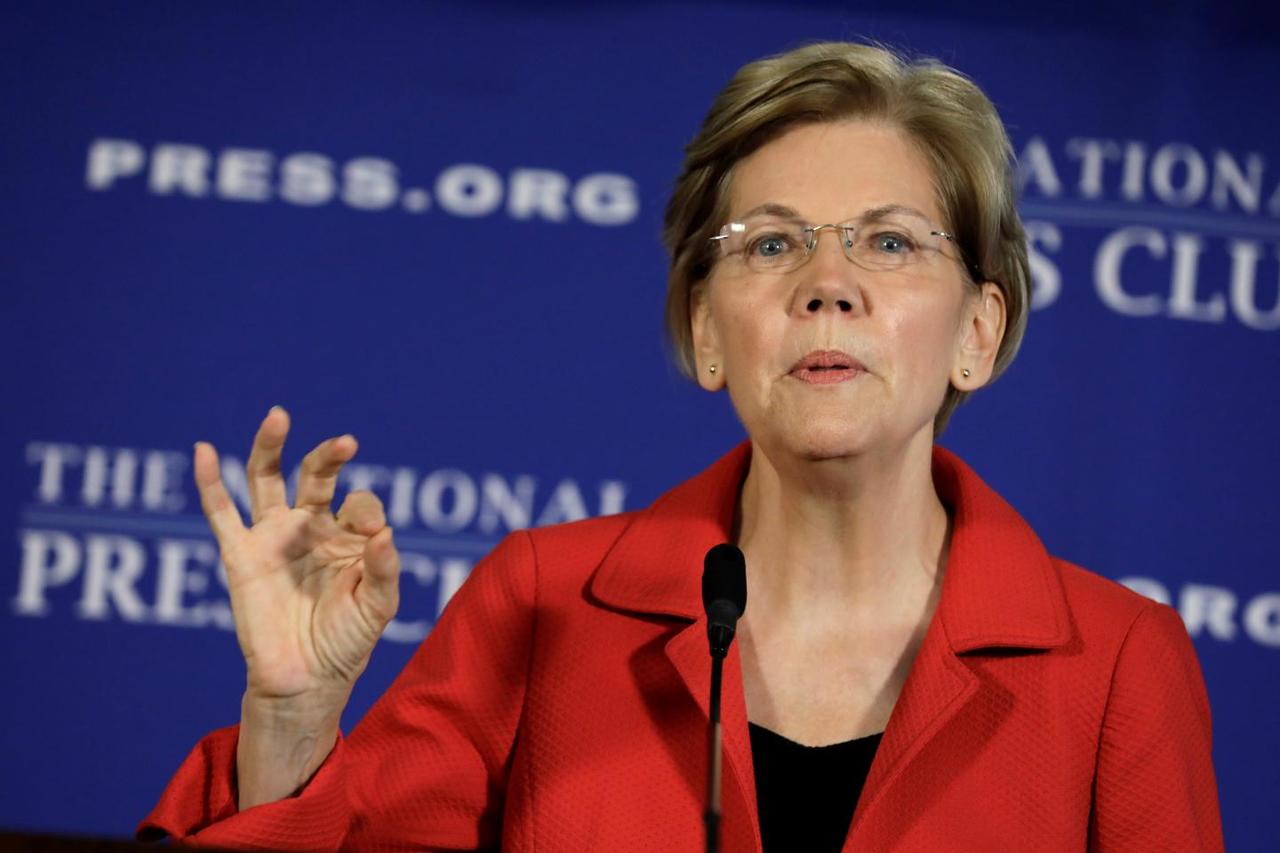
Warren Proposes $640 Billion Student Debt Forgiveness, Free College

https://www.zerohedge.com/s3/files/inline-images/warren%20ok.jpg?itok=1l-bbRLU


“It’s a problem for all of us”

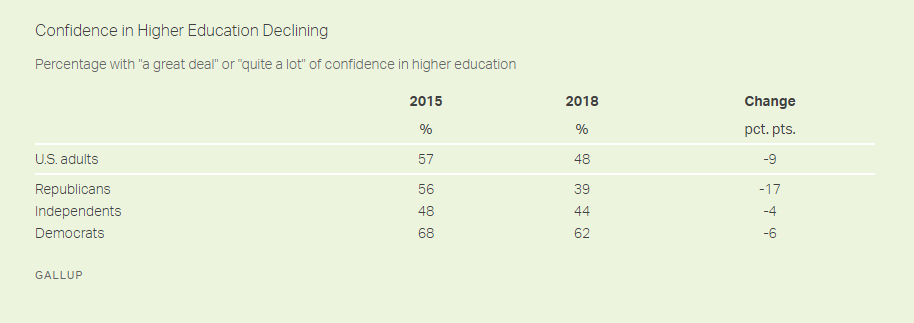
Confidence In Higher Education Plummets

Confidence in higher education in the United States has dropped significantly since 2015, according to polling company Gallup, which notes that it’s the worst-performing institution they measure

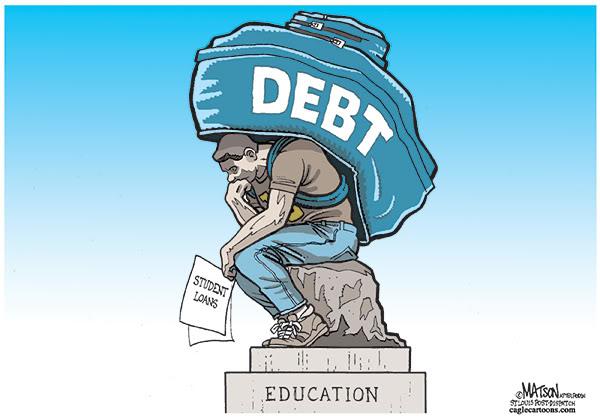
https://www.zerohedge.com/s3/files/inline-images/debt%20college.jpg?itok=TYG5HbL4

The crisis in confidence coincides with a similar decline in the public’s view that higher education is affordable and available to those who need it, according to the report – suggesting that affordability and access are linked to the faith people have in the institution of higher learning.

https://www.zerohedge.com/s3/files/inline-images/confidence_0.png?itok=yJOS-iL2

The waning confidence in higher education isn’t limited to the general public either; academics have begun to lose faith as well

Concerns about the future of higher education also exist within academia. College and university trustees and board members — many of whom are intimately familiar with higher ed’s services, operations and impact — remain concerned about the industry’s future, despite being more confident in their own institution’s future. The AGB 2018 Trustee Index, a recent study conducted by the Association of Governing Boards and Gallup, finds that three in four trustees (74%) are concerned or very concerned about the future of higher education in the U.S. Their concerns remain focused largely on one main challenge: affordability. –Gallup

What do college and university trustees point to as the top issues causing the drop in public confidence? Negative media reports about student debt (72%) and news reports on the cost of tuition (64%). To that end, more than half of trustees (58%) say their top concern about the future of higher education is the cost.

https://www.zerohedge.com/s3/files/inline-images/college%20students.jpg?itok=YQ4oIGXe

When it comes to affordability, the National Center for Education Statistics estimates that the total cost of tuition, fees and living expenses rose 28% between 2005/2006 – 2015/2016 in the United States after account for inflation, while enrollment across all higher education sectors dropped by 1.4% in 2018, which Gallup says is consistent with recent trends. 

Many colleges, universities and even states are attempting to address affordability concerns and related enrollment decreases by freezing or reducing tuition costs. For the seventh year in a row, Purdue University has frozen its tuition rates. Western Governors University has bucked the enrollment trend in higher education for a variety of reasons, including because of its commitment to keep costs contained. In the past five years, WGU has increased the cost of annual tuition by only $600, while total enrollment has more than doubled, to over 100,000 students. –Gallup

The solution? 

Restoring confidence in higher education – and boosting enrollment – can be accomplished by restoring affordability while improving the quality of higher education, according to the report. 

A 2015 Gallup report revealed a clear relationship between student debt levels and graduates’ perceptions that their degree was ‘worth it.’ Graduates drowning in student loan debt were obviously less likely to consider their education a worthwhile investment. 

However, and fortunately for higher education, a high-quality experience in school blunted the negative effect of student debt on graduates’ beliefs that their undergraduate experience was worthwhile, proving that the significant investment can be worth it for some grads. The AGB 2018 Trustee Index also shows that trustees have been asked to make changes to the academic programs offered at their institution to better respond to 21st-century needs. Half of trustees say senior administrators have asked them to increase or introduce STEM programs, and about one-third say they have been asked to increase or introduce applied or experiential learning programs. –Gallup

While the American public largely still believes that higher education is the way to achieve a better life through higher-paying jobs, institutions must figure out how to provide a quality education without saddling grads with debt that takes decades to pay off. 

Source: ZeroHedge

The Biggest Home Price Drops Are In These 10 Cities

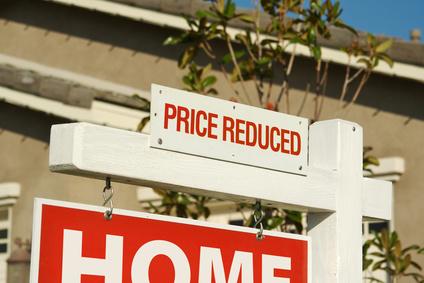
As the US housing market deteriorates, the shift to a buyer’s market accelerates, says Knock, a home trade-in online service. The 2Q19 National Knock Deals Report predicts that U.S. markets will have the highest percentage of homes that sell at discount versus the list price, in many years.

https://www.zerohedge.com/s3/files/inline-images/price%20cuts%20sign.jpg?itok=TsLLIrmQ

Knock projects that 75% of current listings will sell below their list price within the current quarter. While this is slightly lower than the 1Q19 forecast of 77%, it reflects a significant y/y increase (7% y/y) as the housing market starts to turn.

“The Q1 Forecast, which may have seemed to be a big jump over 2018, was actually much closer to the reality of home sales in Q1 2019 than home sales at the same time last year, or even at the end of 2018,” said Jamie Glenn, Co-Founder and COO at Knock. “It’s clear that we’re at an inflection point in the shift to more of a buyer’s market, and the Q2 Forecast provides insights into where and how buyers can capitalize on that.”

Six out of the ten cities on the list were located in Southern markets. Knock said the increase of Southern markets is a 40% increase over the last quarter.

Providence, RI; Cleveland, OH; New York, NY; and Chicago, IL were the other four markets that made the list.

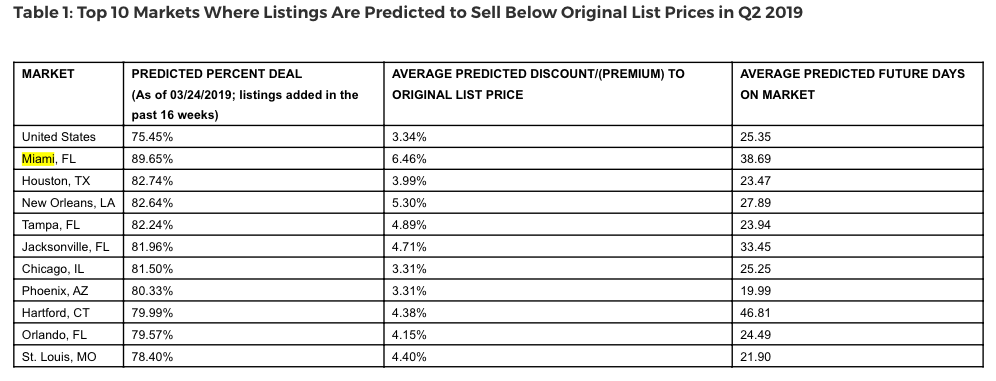
The report noted that the four markets in Florida ( Miami, Tampa, Jacksonville, and Orlando) were hit the hardest by price reductions.

In Miami, the report says about 88% of single-family home sales in 1Q19 sold below original list prices. Average days on the market of Miami homes sold in 1Q19 were 82, which plays a significant role in discounting.

https://www.zerohedge.com/s3/files/inline-images/home%20price%20cuts%202q.png?itok=S3qDz-xT

“This seems like an interesting telltale that the market is shifting in favor of buyers,” Knock Chief Executive Officer Sean Black told Bloomberg in a phone interview. “Florida is a popular secondary home destination so it tends to drop faster in a downward market because it’s losing buyers, both domestically and internationally. Everybody needs a primary home. Not everybody needs a second home.”

Back in September, we outlined that “existing home sales have peaked, reflecting declining affordability, greater price reductions, and deteriorating housing sentiment.”

https://www.zerohedge.com/s3/files/inline-images/Screen-Shot-2018-09-22-at-7.20.10-PM_1.png?itok=rTP3ODfl

Greater price reductions, more inventory, and more days on the market is a recipe for a significant downward impulse in home prices across the country.

So if you haven’t called your realtor – maybe now is the time before the market goes bust.

Source: ZeroHedge
Armed Realtors Face Off With Menacing Attacker (VIDEOS)

Two Ohio realtors with concealed carry permits came up against an armed man inside one of their empty properties who said he was going to attack them. The real estate agents, Kyle Morrical and his father Phil Morrical III, encountered Derek Miller inside a vacant house in Hamilton that had been reportedly broken into the day before.

“He told us he had a gun and a knife. He was either going to shoot us or stab us and he punched me in my face,” Kyle told Local 12.

That’s when Kyle pulled his gun and the father-and-son pair held the attacker down while a neighbor called the police. Miller was taken into custody and charged with assault, menacing and trespassing.

The Morrical’s, who showed off a collection of compact semi-autos by Glock, Ruger, and S&W to local media, said they go to the range at least once a month to practice.

“I hoped I would never have to use it because it’s one of those things that you hope you never have to use, but you have it just in case,” Kyle said.

According to the National Association of Realtors, their group’s 2018 safety report found that 43 percent of members choose to carry self-defense weapons. The group represents some 1.3 million members.

The National Rifle Association profiled a group of real estate agents in Ohio in 2015 who chose to get their concealed handgun license following the murder of two realtors on the job.

Source: by Chris Eger | Guns.com
Will “Inflated” FICO Scores Be The Catalyst For The Next Meltdown

Consumer credit scores have been artificially inflated during the past decade and are covering up a very real danger lurking behind hundreds of billions of dollars in debt. And when Goldman Sachs is the one ringing the alarm bell, you know the issue may actually be serious.

Joined by Moody’s Analytics and supported by “research” from the Federal Reserve, the steady rise of credit scores during our last decade of “economic expansion” has led to a dangerous concept called “grade inflation”, according to Bloomberg

Grade inflation is the idea that debtors are actually riskier than their scores indicate, due to metrics not accounting for the “robust” economy, which may negatively affect the perception of borrowers’ ability to pay back bills on time. This means that when a recession finally happens, there could be a larger than expected fallout for both lenders and investors. 

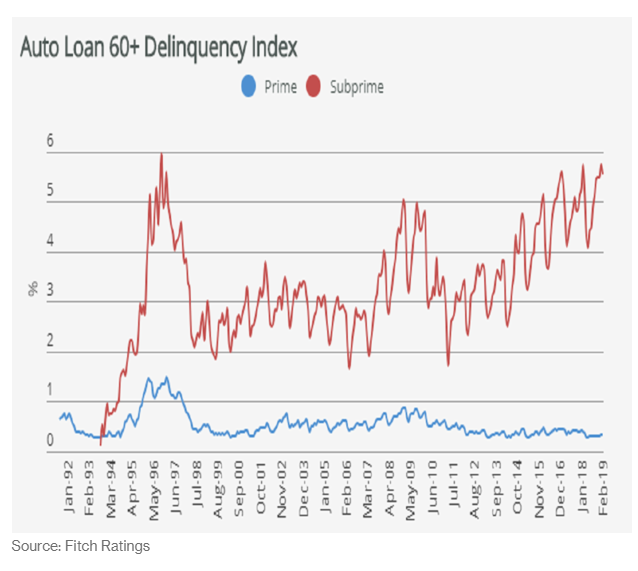
There are around 15 million more consumers with credit scores above 740 today than there were in 2006, and about 15 million fewer consumers with scores below 660, according to Moody’s.

On the surface, this disappearance of subprime borrowers is good news. But is there more than meets the eye to the American consumer’s FICO score renaissance?

Cris deRitis, deputy chief economist at Moody’s Analytics said: “Borrowers with low credit scores in 2019 pose a much higher relative risk. Because loss rates today are low and competition for high-score borrowers is fierce, lenders may be tempted to lower their credit standards without appreciating that the 660 credit-score borrower today may be relatively worse than a 660-score borrower in 2009.”

https://www.zerohedge.com/s3/files/inline-images/credito.png?itok=JNm0oVR2

The problem is most acute for smaller firms that tend to lend more to people with poor credit histories. Many of these firms rely on FICO scores and are unable to account for other metrics, like debt-to-income levels and macroeconomic data. Among the most exposed outstanding debts are car loans, consumer retail credit and personal loans that are doled out online. These types of debt total about $400 billion – and about $100 billion of that sum has been bundled into securities that have been sold to ravenous yield chasers “investors”. 

Meanwhile, cracks are already starting to show on the surface: there has been a rising number of missed payments by borrowers with the highest risk, despite the past decade of “growth”. And now that the economy is starting to show weakness, these delinquencies could accelerate and lead to larger than expected losses. 
Goldman Sachs analyst Marty Young said in an interview: “Every credit model that just relies on credit score now – and there’s a lot of them – is possibly understating the risk. There are a whole bunch of other variables, including the business cycle, that need to be taken into account.”

https://www.zerohedge.com/s3/files/inline-images/csf.png?itok=-GFXI6V6

FICO credit scores are used by more than 90% of U.S. lenders to determine whether a borrower is an acceptable risk. Most scores range from 300 to 850, with a higher score purporting to show that someone is more likely to pay back their debts. Some big banks and lenders have recognized the problem and have included other factors in their underwriting decisions. 

“Borrowers’ scores may have migrated up, but inherently their individual risk, and their attitude towards credit and ability to pay their bills, has stayed the same. You might have thought 700 was a good score, but now it’s just average,” deRitis continued.

Ethan Dornhelm, vice president of scores and predictive analytics at FICO magically doesn’t seem to notice score inflation and blames the issue on underwriters: “The relationship between FICO score and delinquency levels can and does shift over time. We recognize there’s a lot more context you can obtain beyond a consumer’s credit file. We do not think that score inflation is the issue, but the risk layering on underwriting factors outside of credit scores, such as DTI, loan terms, and even trends in macroeconomic cycles, for example.”

Goldman’s Young attributes the rise in missed auto loan payments to the change in scores. The Federal Reserve Bank of New York said the number of auto loans at least 90 days late topped 7 million at the end of last year.

https://www.zerohedge.com/s3/files/inline-images/DBC.png?itok=NjTepdPp

Michelle Russell-Dowe, who invests in consumer asset-backed securities at Schroder Investment Management, said: “Some deep-subprime auto lenders may be deeply reliant on credit scores, although there’s a pretty wide range within the auto industry of how lenders use scores and other metrics. For marketplace lending, regardless of the statistics you collect on borrowers, there is something adversely selective about somebody looking for loans online.”

Marketplace and peer to peer lending has also been showing signs of stress. Missed payments and writedowns increased last year, according to NY data and analytic firm PeerIQ. “We don’t see the purported improvement in underwriting just yet,” PeerIQ wrote in a recent report.

And the pressure isn’t just showing up in auto loans and marketplace lending. Private label credit cards, those issued by stores, instead of big banks, saw the highest number of missed payments in seven years last year.

“As an investor it’s incumbent on you to do that deep credit work, which means you have to know as much as possible about how things should pay off or default. If you don’t think you’re being paid for the risk, you have no business investing in it,” Russell-Dowe concluded, stating what should be – but isn’t – the obvious.

Source: ZeroHedge
Globalist Utopia: Negative Rates Are Coming, Whether You Like It Or Not
There is nothing that a human mind can’t conceive. It can shoot for the stars or dive in the ocean which twinkles in the shadows of stars and ascend back with sparkling mind bearing uncanny ambition, only to float contended.  

https://www.zerohedge.com/s3/files/inline-images/the-wizard-of-oz.jpg?itok=6D0neJ7E(by Ritesh Jain via WorldOutOfWhack.com)

Today, we live in fear of losing wealth, we worry what economic consequences would do to our cash, we look through a microscope and scrutinize every word, every policy, every regulation or find something to put above ‘every’ and list out the glaring negatives with a slight trace of approval. If only one could notice the lens of the microscope, would then one could tell reel and real apart.

Such is the case of negative interest rates. It is dealt differently by different flock of loaded individuals, generally in ways which would not only prevent losses but essentially gain cash. This flock stands on one side of the transaction contemplating means to win regardless of the loss that still deliberating other doomed flock endures. Well, this is how the world works. It is a Bernoulli trial. But there exists a splash of humble wit folks floating beneath the starry sky delighted by the victory of each one and beaten down none.

Theory? Without thinking too much, negative rates indicate that the economy is unable to generate sufficient income to service its debt. Almost always, all roads leads us back to debt sustainability levels. In order for an economic system to reduce debt, it requires growth or inflation or currency devaluation. For an economic system to exercise one of the two (growth not included), capital transfer is to be facilitated. This capital movement in negative rates environment is from the savers to the borrowers. Your invested value, the money you gave to borrowers would have a value lower than the face value. Barbaric! Savers should be the winners not the borrowers!

So each flock as per their liking would act in a way that makes them the gaining side. In real world scenario, one flock could be investors who when yields falls even deeper into negative territory scoop a profit through capital gain. Flock of foreign investors may try to earn through currency appreciation. Another flock would focus on real rates even though they are negative as that would preserve their capital under deflationary conditions when nominal yields would decrease their capital. Who would want that!

Investopedia gave an example, “In 2014, the European Central Bank (ECB) instituted a negative interest rate that only applied to bank deposits intended to prevent the Eurozone from falling into a deflationary spiral.”

Let’s recall a real practical example. The case of Switzerland.

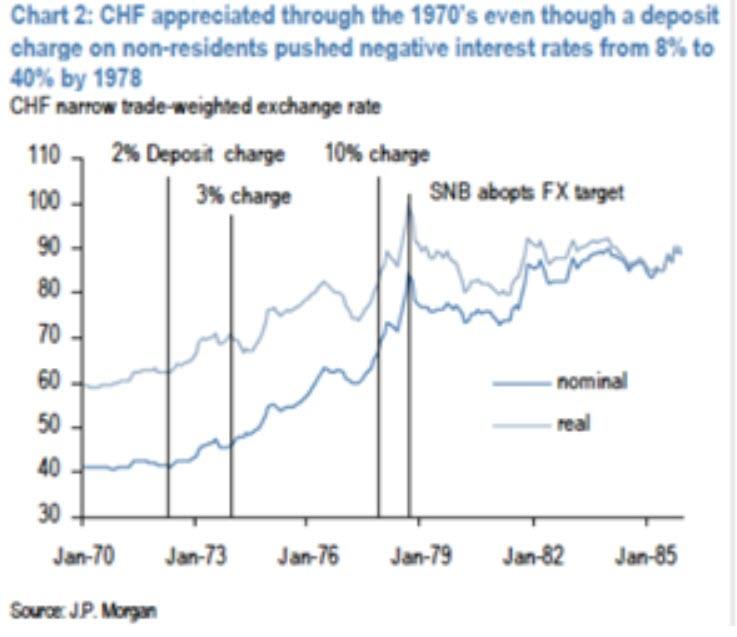
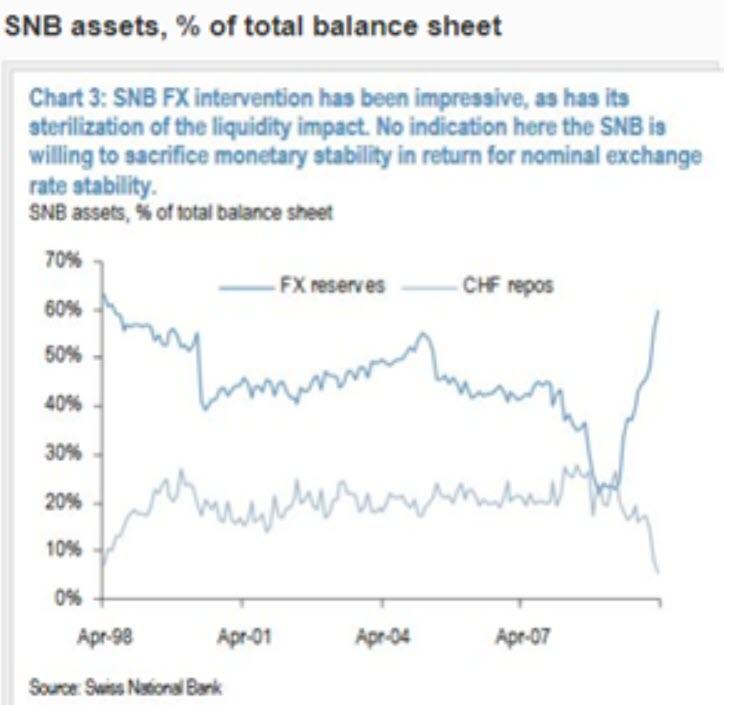
Paul Meggyesi of JP Morgan said, “The defacto negative interest rate regime lasted until October 1973. The negative interest rate was re-introduced in November 1973 at 3% per quarter and then increased to 10% per quarter in February 1978. All though this period capital inflows were being sustained by the global monetary turmoil/inflation that characterized the first years of floating exchange rates, not to mention the SNB’s singular focus on promoting monetary and price stability through money supply targeting. Ultimately the SNB abandoned these purely technical attempts to curb capital inflows and embraced a much more effective policy of currency debasement, namely it abandoned money supply targeting in favor of an explicit exchange rate target that required huge amounts of unsterilized intervention, money supply expansion and ultimately inflation. (Suffice to say this policy lasted only until 1982, when the Swiss realized that inflation was too high a price to pay for a weak currency).”

https://www.zerohedge.com/s3/files/inline-images/2019-04-06_8-34-46.jpg?itok=3SQ7hMZd

He continued “Negative interest rates will only deter capital inflows if they are sufficiently large to offset the capital gain an investor expects to earn through capital appreciation. CHF rose by 8% in nominal and real terms in 1972-1973. Appreciation in 1973 – 1978 was 62% in nominal and 29% in real terms.”

https://www.zerohedge.com/s3/files/inline-images/2019-04-06_8-35-22.jpg?itok=y2bASUGG

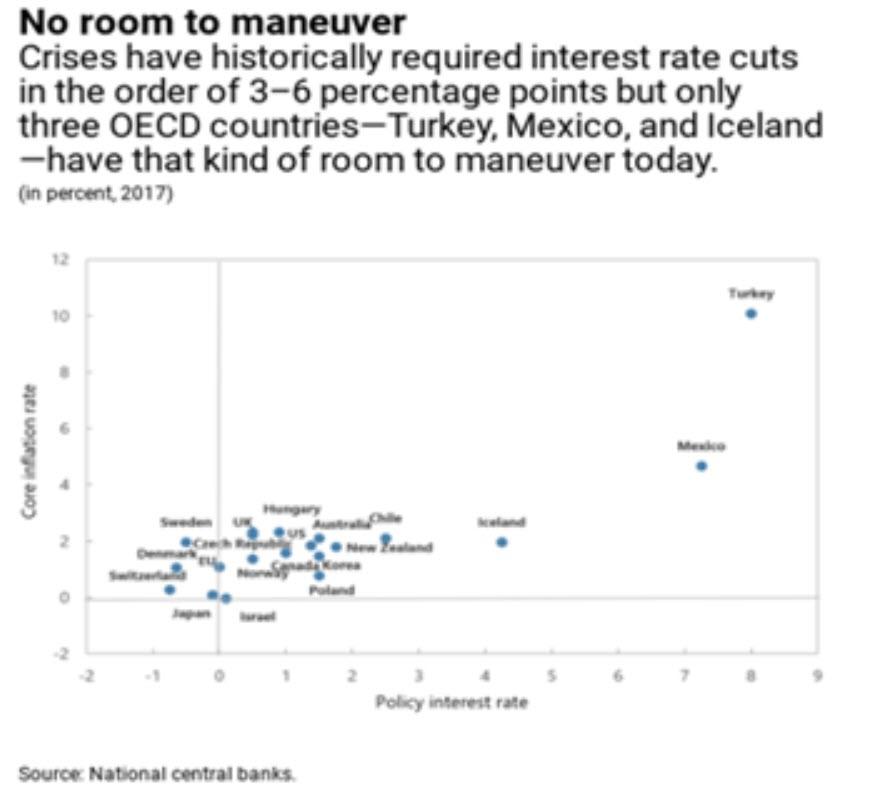
In fact, during global financial crisis many central banks reduced their policy interest rates to zero. A decade later, today, still many countries are recovering and have kept interest rates low. Severe recessions in the past have required 3 – 6 percent point cuts in interest rates to revive the economy. If any crisis were to happen today, only a few countries could respond to the monetary policy. For countries with already prevailing low or negative interest rates, this would be a catastrophe.

https://www.zerohedge.com/s3/files/inline-images/2019-04-06_8-36-01.jpg?itok=WTy8K9lG

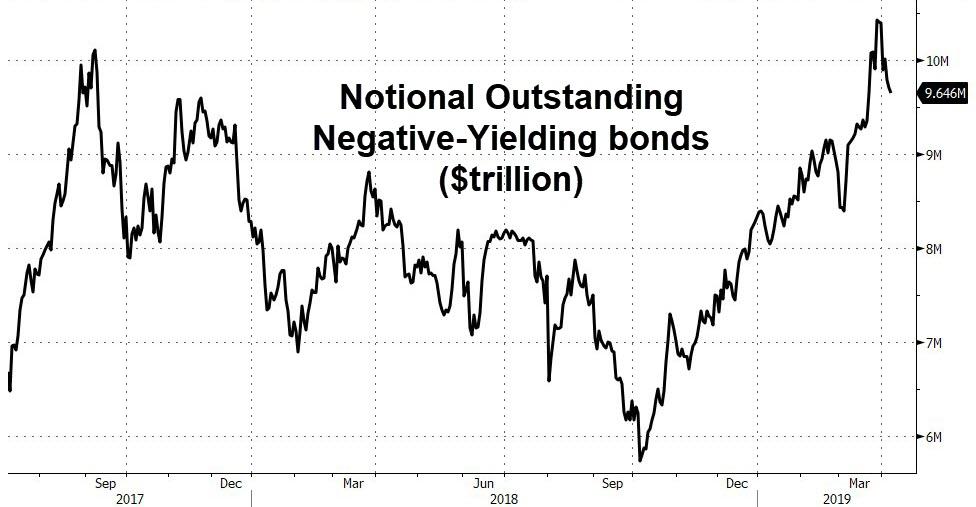
Today, around $10 trillion of bonds are trading at negative yields mainly in Europe and Japan as per Bloomberg.

https://www.zerohedge.com/s3/files/inline-images/bfmB6CE.jpg?itok=0Qt-XvS1

Poisons have antidotes, and sometimes one need to gulp down the poison to witness the mystique surrounding the life and glide with accidental possibilities, the possibilities which one wouldn’t seek if they remain wary of novel minted cure. 

Here enters a splash of humble wit folks! They want a win – win. So these folks came up with an idea, an idea with legal and operational complication but they have swamped themselves with research to find ways to not stumble in future and yes they do have a long way to go but we have a start. These folks are our very adored IMF Staff.!

They are exploring an option that would help central banks make ‘deeply negative interest rates’ feasible option.

Excerpt from their article ‘Cashing In: How to make Negative Interest Rates Work’:

“In a cashless world, there would be no lower bound on interest rates. A central bank could reduce the policy rate from, say, 2 percent to minus 4 percent to counter a severe recession. When cash is available, however, cutting rates significantly into negative territory becomes impossible.”

“…Cash has the same purchasing power as bank deposits, but at zero nominal interest. Moreover, it can be obtained in unlimited quantities in exchange for bank money. Therefore, instead of paying negative interest, one can simply hold cash at zero interest. Cash is a free option on zero interest, and acts as an interest rate floor.

Because of this floor, central banks have resorted to unconventional monetary policy measures. The euro area, Switzerland, Denmark, Sweden, and other economies have allowed interest rates to go slightly below zero, which has been possible because taking out cash in large quantities is inconvenient and costly (for example, storage and insurance fees). These policies have helped boost demand, but they cannot fully make up for lost policy space when interest rates are very low.”

https://www.zerohedge.com/s3/files/inline-images/2019-04-06_11-47-05.jpg?itok=33IB-Oyu

“… in a recent IMF staff study and previous research, we examine a proposal for central banks to make cash as costly as bank deposits with negative interest rates, thereby making deeply negative interest rates feasible while preserving the role of cash.

The proposal is for a central bank to divide the monetary base into two separate local currencies—cash and electronic money (e-money).

E-money would be issued only electronically and would pay the policy rate of interest, and cash would have an exchange rate—the conversion rate—against e-money. This conversion rate is key to the proposal. When setting a negative interest rate on e-money, the central bank would let the conversion rate of cash in terms of e-money depreciate at the same rate as the negative interest rate on e-money. The value of cash would thereby fall in terms of e-money.

To illustrate, suppose your bank announced a negative 3 percent interest rate on your bank deposit of 100 dollars today. Suppose also that the central bank announced that cash-dollars would now become a separate currency that would depreciate against e-dollars by 3 percent per year. The conversion rate of cash-dollars into e-dollars would hence change from 1 to 0.97 over the year. After a year, there would be 97 e-dollars left in your bank account. If you instead took out 100 cash-dollars today and kept it safe at home for a year, exchanging it into e-money after that year would also yield 97 e-dollars.

At the same time, shops would start advertising prices in e-money and cash separately, just as shops in some small open economies already advertise prices both in domestic and in bordering foreign currencies. Cash would thereby be losing value both in terms of goods and in terms of e-money, and there would be no benefit to holding cash relative to bank deposits. This dual local currency system would allow the central bank to implement as negative an interest rate as necessary for countering a recession, without triggering any large-scale substitutions into cash.”

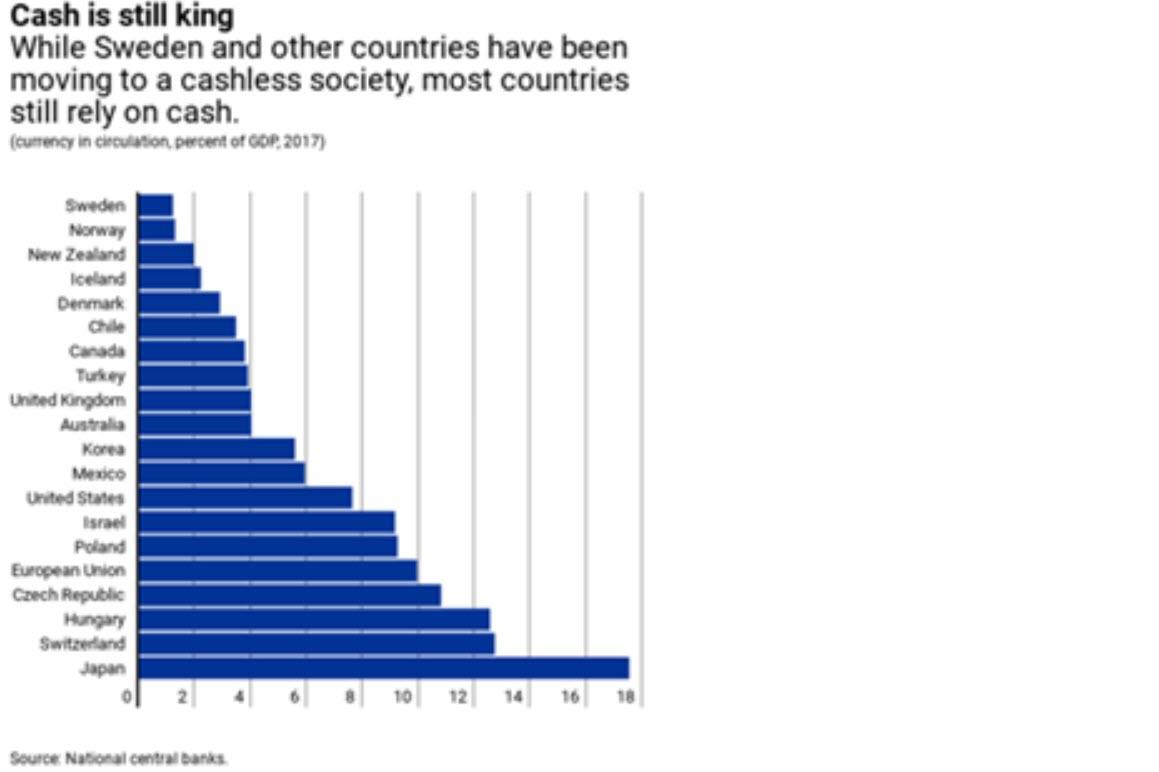
Negative rates are coming whether we like it or not. There is only so much growth we can get in steady state among rising debt levels. The only hurdle to implementing negative rates is currency in circulation and that’s why more and more countries are trying to outlaw cash. Interesting and profitable times ahead for those who understand the brave new world.

Source: ZeroHedge

Rollercoaster! Global Economic Growth (G10, US, Emerging) Sliding Down Together

The global economy is in a rollercoaster pattern.

And unfortunately the G10, US and Emerging nations are on the downward side.

https://confoundedinterestnet.files.wordpress.com/2019/04/rollercoaster.jpg

This might explain Larry Kudlow’s call for a 50 bps drop in the Fed Funds Target Rate. At least Trump’s nominee for The Fed’s Board of Governors was previously the President of the Kansas City Federal Reserve. And CEO of Godfathers Pizza! Conditional on the US Senate approving his appointment, “Welcome to the party, pal!”

Source: Confounded Interest

***

This week in politicks…


Global Trade Growth Slashed Again As Trade Tensions Persist

The World Trade Organization published a new report that shows world trade is projected to “face strong headwinds” into 2020.

https://www.zerohedge.com/s3/files/inline-images/2019-04-03_09-07-12.png?itok=6L_Pee-u

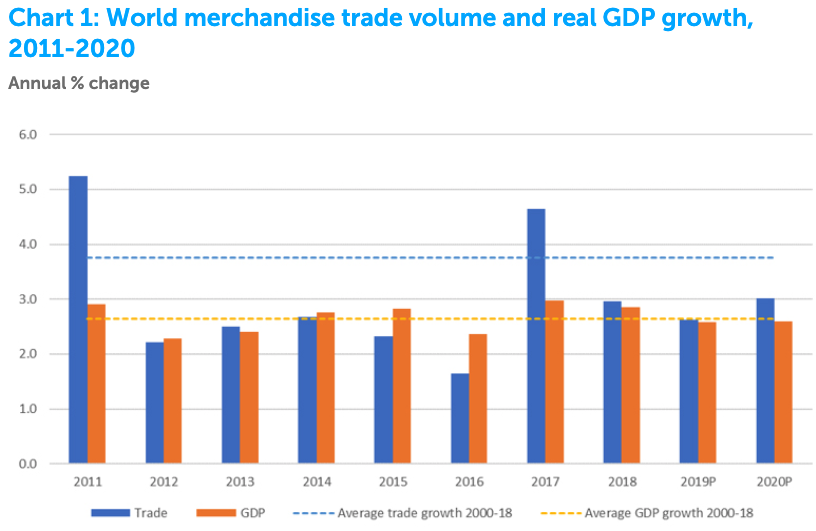
WTO economists expect merchandise trade volume growth to drop to 2.6% in 2019, down from 3% last year. The report said a rebound in global trade is possible if trade tensions dramatically ease.

https://www.zerohedge.com/s3/files/inline-images/chart%201%20world%20merchandise.png?itok=HNHmzWzR

The bearish forecast for 2019/2020 marks the second consecutive year that WTO economists revised their outlook and also follows similar warnings from the World Bank and the International Monetary Fund.

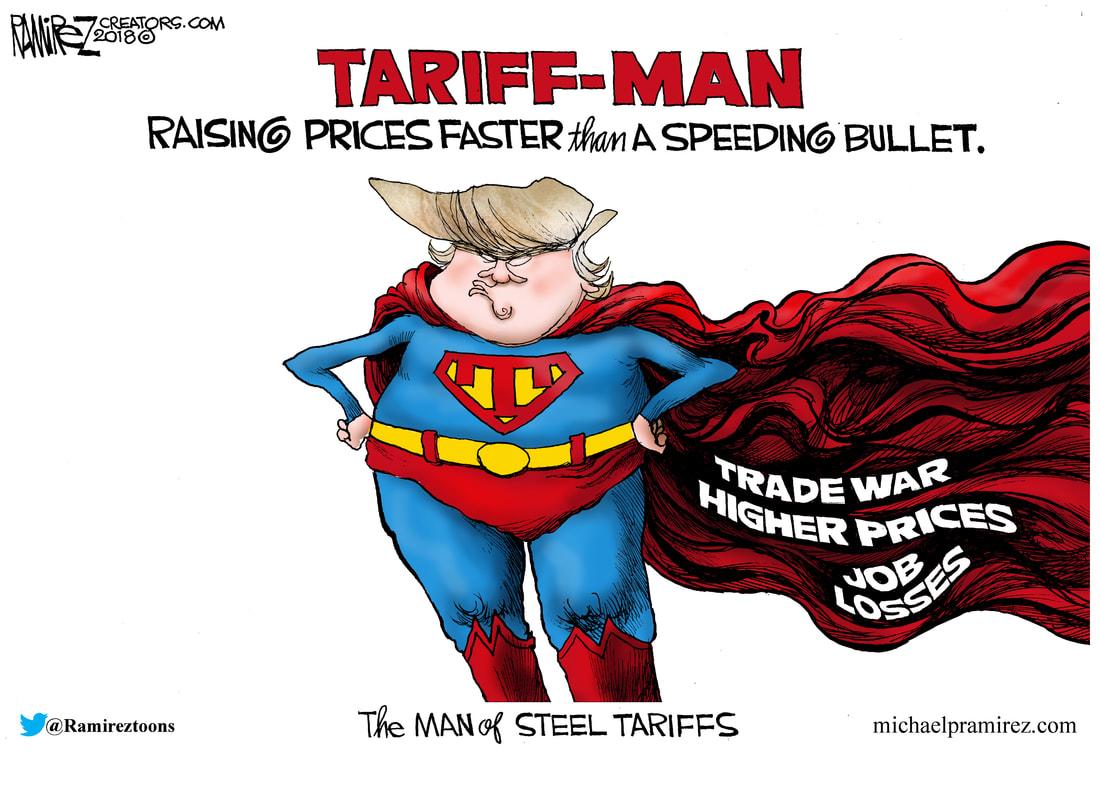
https://www.zerohedge.com/s3/files/inline-images/tariff%20man.jpg?itok=--3SBv2f

“It is increasingly urgent that we resolve tensions and focus on charting a positive path forward for global trade which responds to the real challenges in today’s economy – such as the technological revolution and the imperative of creating jobs and boosting development. WTO members are working to do this and are discussing ways to strengthen and safeguard the trading system. This is vital. If we forget the fundamental importance of the rules-based trading system we would risk weakening it, which would be a historic mistake with repercussions for jobs, growth and stability around the world,” Azevedo said.

The report said current forecasts reflect downgraded GDP projections for North America, Europe, and Asia —  mostly due to waning effects of fiscal stimulus by the Trump administration.

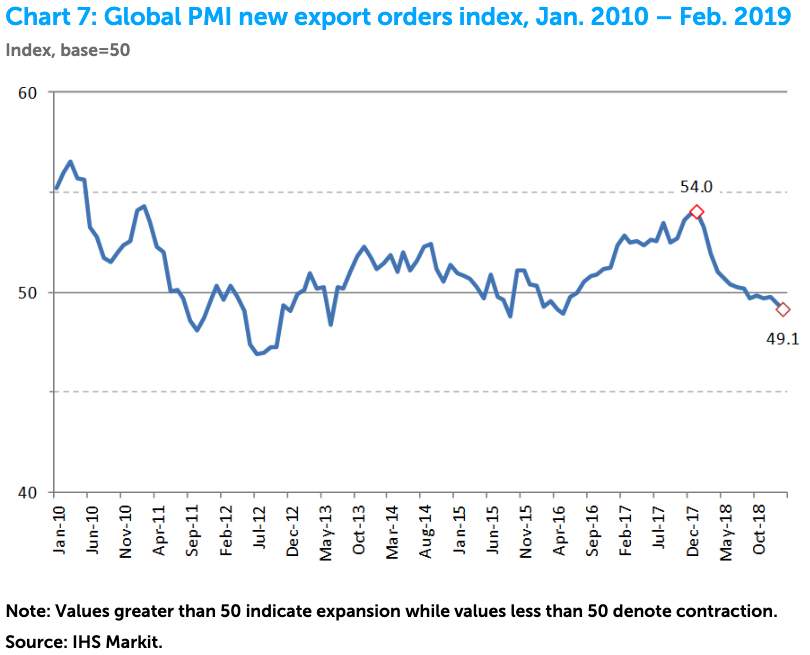
https://www.zerohedge.com/s3/files/inline-images/global%20pmi.png?itok=alOJjjO7

WTO economists noted a “phase-out” of monetary stimulus in Europe and a continuing economic transition of China’s economy from manufacturing to services.

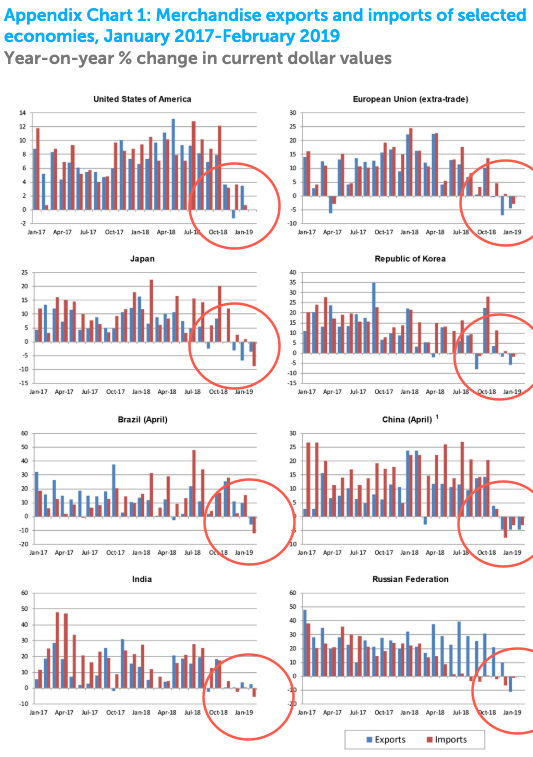
The reported noted that trade growth severely waned in 2H18 by several factors, including several rounds of tariffs and retaliatory tariffs affecting hundreds of goods, an already slowing Chinese economy, volatility in financial markets, and tighter monetary conditions by Central Banks.

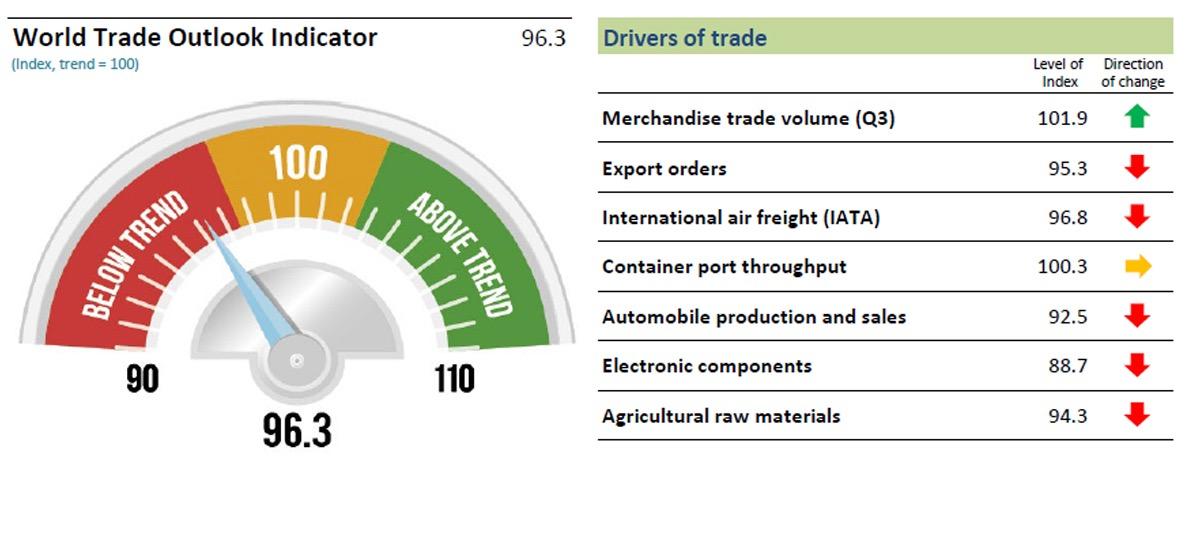
Forward-looking trade indicators turned negative in 1Q19, including WTO’s World Trade Outlook Indicator (WTOI). WTOI index dropped to 96.3, below its baseline value of 100, indicating that the global slowdown will persist for some time.

https://www.zerohedge.com/s3/files/inline-images/wtoi%20chart_0.jpg?itok=bDQVUR5b

The sustained loss of trade momentum highlights the urgency of the Trump administration to reduce trade tensions, which together with the rise of nationalism and financial volatility could deepen the synchronized global slowdown well into 2020.

Source: ZeroHedge

The Hidden Cost Of Losing Local Mom-And-Pop Businesses

What cannot be replaced by corporate chains is neighborhood character and variety.

https://www.zerohedge.com/s3/files/inline-images/2019-04-03_9-46-32.jpg?itok=arRLQ1oM

There is much more to this article than first meets the eye: In a Tokyo neighborhood’s last sushi restaurant, a sense of loss

“Eiraku is the last surviving sushi bar in this cluttered neighborhood of steep cobblestoned hills and cherry trees unseen on most tourist maps of Tokyo. Caught between the rarified world of $300 omakase dinners and the brutal efficiency of chain-restaurant fish, mom-and-pop shops like it are fast disappearing.

Chef Masatoshi Fukutsuna and his wife, Mitsue, smile without a word. In the 35 years since they opened up shop, the couple has seen many of their friends move away for a job or family, only to return decades later, often without the job or the family, their absence unspoken.

Absence is a part of life here on what remains of the Medaka shopping street, a road so narrow that cars have to drive up onto the sidewalk to let another vehicle pass.

Once the sky turns pink and the sun sets, the street descends into shadow, save for the faintest glow from halogen lamp posts.

It’s a neighborhood in twilight. More like it are scattered across this city, their corner cafes and stores far from the neon blare of the famous shopping districts. The number of independent, family-owned sushi bars in Tokyo has halved to 750 in the last decade, a trade association says, driven out of business by fast-food joints and a younger generation that doesn’t want to inherit them.

“People would rather pay 100 yen for a plate of sushi at a really cheap place or they’d shell out tens of thousands of yen to go to a famous sushi restaurant in Ginza that they heard about on television,” says the chef, absentmindedly changing the channel of the TV. “But places like ours, shops that are right in the middle, we just can’t seem to survive.”

In the U.S., and presumably elsewhere, there are other financial pressures on small businesses: the complexity of compliance with the ever-increasing thicket of regulations is constantly increasing, as are taxes and fees as local government seeks to extract more revenue from the small-business tax donkeys.

These increases in costs while revenues sag as customers seek cheaper chain meals or simply stop going out at all are a double-whammy.

But look at what’s lost in the demise of local small businesses:

— The loss of neighborhood character and variety, replaced by homogenized chains and lifeless shuttered storefronts.

— the loss of food that’s been prepared by hand with real ingredients.

— the loss of neighborhood cohesion and social circles; residents who were once recognized as individuals and who belonged to loose but important social circles are unknown in faceless chain outlets.

— the loss of local employment. Employees in chain outlets commute from distant places, and their hours and locations may change, making it impossible to know local residents.

— the loss of walkable, interesting neighborhoods. What’s there to explore or provide interest in a string of steel and glass chain outlets?

— the loss of local social gathering places. Once local neighborhood places are lost, people Belfast in a monotonous uniformity of menus and spaces.

What’s scarce and thus valuable are not fast-food outlets; what’s scarce and valuable are walkable, diverse neighborhoods of locally owned and operated stores and cafes which offer social refreshment and bonds as well as home-cooked meals.

Source: by Charles Hugh Smith | Of Two Minds

The Manhattan Housing Market Is On Its Worst Cold Streak In 30 Years

A confluence of factors ranging from stubborn sellers refusing to budge on their asks, the Trump tax plan’s SALT cap, and a glut of luxury apartments prompted sales of Manhattan real estate to drop again in the fourth quarter, according to reports published by a trio of residential brokers. By one broker’s count, Q1 marked the sixth straight quarterly drop in sales volume, the worst streak in at least 30 years.

Per the FT, sales tumbled by 11%, according to broker Stribling & Associates, by 5%, according to Corcoran, and by 2.7% for co-ops and condominium apartments, according to Douglas Elliman and real estate appraisal firm Miller Samuel.

https://www.zerohedge.com/s3/files/inline-images/Screen%20Shot%202019-04-03%20at%204.48.05%20PM.png?itok=PevIY0Zp

While the average sales price for new developments climbed a staggering 89.4% to $7.6 million, that figure was exaggerated by a single purchase: Ken Griffin’s purchase of a $240 million penthouse at 220 Central Park South, which, according to some, was the most expensive home ever sold in America. But depending on the report, the median sales price ranged from 2% lower to 3.2% higher. And although the entry level market in Manhattan – that is, apartments priced at $1 million and below – had held up for most of the past year, it has recently started to suffer.

“It’s like a layer cake,” Jonathan Miller, CEO of Miller Samuel, told CNBC. “When you have softening at the top, it starts to melt into the next layer and the next layer after that, because those buyers further down have to compete on price.”

According to one broker, sellers with unrealistic expectations are the biggest barrier to sales, because they’re refusing to adjust for the fact that listings have been piling up and sitting on the market for longer periods, giving buyers more room to negotiate, and more options. Inventory has climbed 9% over the past nine months, and there’s a glut in new developments that’s only going to get worse.

https://www.zerohedge.com/s3/files/inline-images/Screen%20Shot%202019-04-03%20at%204.47.37%20PM.png?itok=bxNvq8i5

And of course, New York City isn’t helping the market by passing an a one-time “mansion tax” on all apartments selling for $1 million or more – which is a large chunk of apartments sold in the borough. But it could have been worse: As one broker put it, the pied-e-terre tax that was briefly considered would have been a “market stopper.”

“The pied-à-terre tax would have been a market stopper, [the mansion tax] is a market dampener,” said Ms Liebman. “I don’t think New York City is acting very friendly right now to the wealthy buyers,” she said, adding that many are opting to buy in Florida and other states with lower taxes than New York.

But although higher taxes are expected to drive more would-be buyers toward rentals, the number of new leases in Manhattan was also down 3% in Q1. Meanwhile, leases climbed a staggering 38% year-over-year in Brooklyn.

As brokers in New York City and other high end markets like Greenwich, Conn. struggle with slowing sales, we imagine brokers in mid-tier markets are watching with a wary eye to see if the weakness spreads.

Source: ZeroHedge

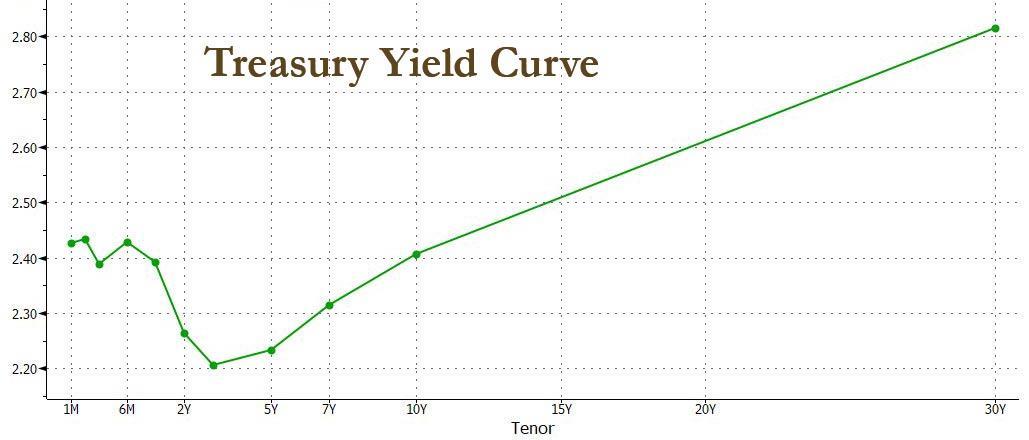
Hedge Fund CIO: “America’s Yield Curve Inversion Can Mean One Of Three Things”

Three Worlds

America’s yield curve inversion can mean one of three things,” said (Eric Peters, CIO of One River Asset Management). “We’re either living in a world of secular stagnation and investors worry that central banks no longer have sufficient policy tools to spur growth and inflation,” he continued. “Or the economy is simply sliding toward recession and the inversion will persist until the Fed panics and spurs a recovery,” he said. “Or we’re living in a world, where the market is moving in ways that defy historical norms because of global QE. And if that’s the case, the curve is sending a false signal.”

https://www.zerohedge.com/s3/files/inline-images/TSY%20yield%20curve%203.31.jpg?itok=B16pb_qT

“If we’re sliding toward recession, then it seems odd that credit markets are holding up so well,” continued the same CIO. “So keep an eye on those,” he said. “And if the curve is sending a false signal due to German and Japanese government bonds yielding less than zero out to 10yrs, then the recent Fed pivot and these low bond rates in America may very well spur a blow-off rally in stocks like in 1999.” A dovish Fed in 1998 (post-LTCM) and 1999 (pre-Y2K) provided the liquidity without which that parabolic rally could have never happened.

https://www.zerohedge.com/s3/files/inline-images/aligator%20jaws%20march%202019_1.jpg?itok=KGvQ1sIB

“But if investors believe America is succumbing to the secular stagnation that has gripped Japan and Europe, and if they’re growing scared that global central banks are no longer capable of rescuing markets, then we have a real problem,” said the CIO. “Because a recession is bad for markets, but not catastrophic provided that central banks can step in to spur recovery. But with global rates already so low, if investors lose faith in the ability of central banks to do what they have always done, then we’re vulnerable to a stock market crash.”

Sovereignty:

Turkish overnight interest rates squeezed to 300% on Monday. Then 600% on Tuesday. By Wednesday, they hit 1,200%. Downward pressure on the Turkish lira, and the government’s efforts to punish speculators fueled the historic rise. Erdogan allegedly wants to limit lira loses ahead of today’s elections. The pressures that drove the currency lower were mainly of Turkish origin. Of course, the Turks have every right to their own economic policies, but they must bear the consequences. That’s what comes with being a sovereign state.

The Greeks and Turks are neighbors. The Turks began negotiations to join the EU in 2005, with plans to adopt the Euro after their acceptance. Those negotiations stalled in 2016. As they look across the border at their Greek neighbors now, and see their interest rates stuck at -0.40%, are they envious? Perhaps. But having witnessed the 2011 Greek humiliation, would the Turks be willing to forfeit sovereignty for the Euro’s stability and stagnation? And how do the Greeks (and Italians) feel about having forfeited their sovereignty?

Anecdote:

“Only optimists start companies,” I answered. The Australian superannuation CEO had asked if I’m an optimist or pessimist. “I see the potential for technological advances to produce abundance in ways difficult to fathom. But I also see the chance of something profoundly dark,” I continued. He observed that people seemed consumed by the latter but spend so little time on the former. “That’s good. Humans are wonderful at solving problems of our own creation. The more we worry, the less goes wrong,” I said. So he asked what worries me most?

“Not the displacement of human labor by machines, we can solve the resulting social challenges. I worry that the only thing Americans seem to agree on now is that China is our adversary.” And pressing, he asked me to list the things I admire about China. “Okay. I admire China’s work ethic, drive, ambition, economic accomplishments. They’ve overtaken us in many advanced scientific fields. I admire that very much.” He smiled and asked me to carry on. “I’m grateful for their competition. It makes us better. And I admire that they’ve evolved communism to make it work while all others failed. The world is better with diversity of thought, philosophy – diversity increases resiliency, robustness. And democratic free-market capitalism will grow stronger with a formidable competitor.” He smiled.

“But China’s system values the collective over the individual. We value the opposite. And I’m concerned the two systems cannot peacefully coexist now that we’re the world’s two largest economies. I don’t want to live under their system, I don’t want their vision of the future for my children. They probably feel the same way. Both views are valid but incompatible, and increasingly in conflict,” I explained. He nodded and said, “I don’t want that for our children either.”

Source: ZeroHedge