Monthly Archives: April 2015

Is $50 “Hard Floor” Oil Price Already In?

Volte-Face Investments believes that it is …

https://martinhladyniuk.com/wp-content/uploads/2015/04/011bb-peak-oil-situation-31-jul-12.jpg

The Last Two Oil Crashes Show Peak Oil Is Real

Summary

  • Recent oil crashes show you the hard floor for gauging value oil company equities.
  • Properly understood, the crashes lend an insight into the concept of Peak Oil.
  • All oil equity investors should understand the overarching upward trend on display here.
 

Note: ALL prices used in this article are using current 2015 dollars, inflation adjusted using the
US BLS inflation calculator.

Generally, when I invest, I try to keep my thesis very simple. Find good companies, with good balance sheets and some kind of specific catalytic event on the horizon. But when one starts to concentrate their holdings in a sector, as I have recently in energy (see my recent articles on RMP Energy (OTCPK:OEXFF) and DeeThree Energy (OTCQX:DTHRF), you need to also get a good handle on the particular tail or headwinds that are affecting it. Sometimes a sector like oil (NYSEARCA:USO) can be subjected to such forces, like the recent oil price crash, where almost no company specific data mattered.

One of the biggest arguments, normally used by proponents of owning oil stocks as core holdings, in the energy sector is “Peak Oil.” For the unfamiliar, it is a theory forwarded first by M. King Hubbert in the 1950s regarding U.S. oil production. Essentially, the theory stated that the U.S. would reach a point where the oil reserves would become so depleted that it would be impossible to increase oil production further, or even maintain it at a given level, regardless of effort. This would inevitably lead to oil price rises of extreme magnitudes.

Since those early beginnings, the details have been argued over in an ever-evolving fashion. The argument has shifted with global events, technological developments, and grown to encompass nearly every basin in the world (even best-selling books have been written about peak oil like Twilight in the Desert: The Coming Saudi Oil Shock and the World Economy by Matt Simmons about a decade ago) consuming endless bytes of the Internet in every kind of investment forum and medium of exchange.

In general, I believe that the term “peak oil” is a highly flawed one. Some picture peak oil in a Mad Max fashion, with oil supplies running out like a science fiction disaster movie. Others simply dismiss peak oil as having failed to predict these so-called peaks repeatedly (the world is producing a record amount of oil right now, so all previous absolute “Peak Oil” calls below these amounts are obviously wrong). But what people should be stating when they use these terms is a Peak Oil Price.

Using my own thinking and phrasing, I believe civilization has probably passed $25 Peak Oil. This means that if you set the oil price to $25 a barrel, there is no method available to humanity to provide enough oil to meet demand over any period of time that’s really relevant. I also believe we are in the middle of proving that we have also passed $50 Peak Oil. My final conjecture here is that we will prove in the near-term future to have reached $75 Peak Oil. I don’t believe we are quite at $100 Peak Oil.

Notice that in my formulation the term Peak Oil is always stated as a peak price. Oil is not consumed in a vacuum. The price affects the demand the world has for the product and simultaneously changes the ability of all sorts of entities (businesses and governments) to retrieve deposits of it. This is what I hope to prove in this article.

So what data could I bring to this crowded table?

Well we have one thing we now have that previous entrants into the Peak Oil melee didn’t, which is the recent price crash in oil. Peak oil is often falsely portrayed as a failed idea since it hasn’t resulted in a super squeeze to ultra high prices. These spike prices are viewed as the really critical element by energy investors since they are trying to find the best case. After all, who doesn’t want to own an oil producer if they can identify a spot in which oil prices will rise to some enormous number.

But that is the wrong way to go about it for your oil investments over the long haul. Because what $50 Peak Oil really provides is a floor. In a world where we have passed $25 Peak Oil, it should be impossible, without exogenous events of enormous magnitude (world war, etc.), to press the price of the product below that price. If you could do so, you would immediately disprove the thesis. You would then know the floor provided by whichever peak oil price level you selected was wrong. The same idea seems to hold true for $50 Peak Oil now.

To prove this “floor” we need to choose times of extreme stress in the oil markets, and look at those oil prices and see what the bottoms were. For these examples, let’s select WTI oil, whose weekly average prices are reported all the way back to 1986 by the EIA.

Let’s take the three big crashes in the oil markets. I will use a full year’s average to try to smooth out the various difficulties presented by weather, seasonal effects, or various one-off events (outages, etc.). The first crash I will use as a benchmark is The 1986 Oil Crash. The 1986 breakdown was a supply crash, caused by supply swamping demand. How big a disaster was it for the oil industry?

In 1986, the Saudis opened the spigot and sparked a four-month, 67 percent plunge that left oil just above $10 a barrel. The U.S. industry collapsed, triggering almost a quarter-century of production declines, and the Saudis regained their leading role in the world’s oil market.

This was quite a crash obviously. Triggering a 25 year decline? Not going to find a lot worse than this. So in inflation adjusted dollars what was WTI oil at for the year of 1986? It sold for around $32 a barrel. Now let’s note that at this time WTI crude was actually at a higher price vs. Brent and other world prices. On a Brent basis, crude would have been just around $25 for the year. This will prove to be an important point in a short while.

The next crash we will use to benchmark was the 2008 Financial Crisis. On this website, I should hope that this world crisis will need no introduction and little explanation. This crash in oil prices (and just about every other thing priced by human beings) was a demand crash. The financial disintegration across the world led to massive drops in demand, as jobs were lost across the world by the millions. So with this demand crash what was the average price of WTI crude in the year 2009? It sold in that year for a little over $60.

The last crash I will add is the current drop, starting sometime around October by my reckoning. I would find it hard to imagine any reader of this article is unfamiliar with the current situation in North America or the world regarding oil, at least in a headline sense. This seems to be a supply crash again, where North American-led tight oil drillers have caused an increase in production that the world’s demand couldn’t handle at the $100 price level. Since then, prices have dropped down to a level that suppresses the production of oil and enhances demand.

In the first four months of 2015, the North American oil rig count has already dropped by more than 50% as compared to last year and the demand for oil has begun to increase according to EIA statistics. The current price of WTI oil has been just over $49 as an average for the year 2015. However, let us note that WTI oil now sells for a large discount to world prices, and during the previous two crashes, WTI sold for a premium.

Now we have three data points. Each one is a fairly long period of time, not just a single week. We know that the world in 1986 nearly ended for the oil industry, yet in current dollars, WTI oil was unable to trade for a year below $30 a barrel. Then we had in 2008 and 2009 an economic crisis which was widely described as being the most dire financial disaster since WWII. In 2009, WTI oil still ended up trading well over the 1986 low. In fact it was nearly double that price. This shows just how hard it can be using almost any technique to push oil prices below a true peak number.

Now we have another supply led crunch. One that is widely described as the worst oil crash since 1986, a nearly 30 year time gap. We are attacking the oil price from the supply side instead of 2008’s demand side. Yet thus far, in 2015, oil is still trading more than 50% higher than the 1986 year average, inflation adjusted. In fact, WTI, when adjusted for its current discount to world prices, is trading close to its 2009 average price. Again, nearly double the price of the 1986 crash.

What does this all mean for investing? It means to me that $25 Peak Oil is behind us. You couldn’t really hit and maintain that number in the 1986 crash when many more virgin conventional reservoirs of oil were available. Despite the last three oil crises, not one of them could get WTI oil to $25 and keep it there. Now, using much more expensive oil resources (shale fracing, deep water drilling, arctic development, etc.), it doesn’t seem like the last two disasters have been able to press WTI oil much below $50 for a material length of time. In this recent crash, the $50 floor was able to be reached only with several years of hyper-investment made possible by the twin forces of sustained high prices and access to ultra-cheap capital. Both of these forces are no longer present in the oil markets.

Therefore, I think using a $50 Peak Oil number is a very reasonable hard floor to use when stress testing your oil stocks. It means that when I am choosing a stock that produces oil, it can survive both from supply and the demand led crashes using the worst the world can throw at it.

Some will say this reasoning is simplistic. One could claim any number of variables in the future (technology, peace in the Middle East, etc.) could change all the points I am relying on here. But we have thrown everything at the oil complex between 2008 and now; both from the supply side and the demand sides; breakdowns of the whole world economy, wars, sanctions, natural disasters, hugely stupid governmental policies, OPEC’s seeming fade to irrelevance, biofuels, periods of ultra-high prices, technological progress, electric cars, etc. Yet, here we stand with these numbers staring us in the face.

In conclusion, I feel these price points prove the reality of $50 Peak Oil (WTI). If WTI oil averages more than $50 in 2015 (which I strongly feel the data shows will happen), then it will confirm my thesis that no matter what happens in the world, human beings cannot seem to produce the amount of oil they require for less than that number. Therefore, one will know what the hard floor for petroleum is provided by the hugely complex interplay of geology, politics, economics, and technology by simply measuring those effects on one easy-to-measure point of data, namely price. This version of peak oil also means I have a minimum to test my selections on. I can buy companies that can at least deal with that floor, then make large profits as the prices rise from that hard floor. All oil fields deplete, and for the past twenty years, the solution has universally been to add more expensive technological solutions, exploit smaller or more physically difficult deposits, or use more expensive alternatives. The oil market does not have the same options available to it like it did 1986. Large, cheap conventional oil deposits are no longer available in sufficient supply, which is likely what the oil price is telling us by having higher Peak Floors during crashes. Without the magic of sustained ultra high prices, the investment levels that made this run at the $50 Peak Oil level will not exist going into the future. This means that the Peak Oil floor price should be creeping higher as a sector tailwind, giving a patient and selective investor a tremendous advantage for themselves.

Read more: Volte-Face Investments: The Last Two Oil Crashes Show Peak Oil Is Real

US Oil Rig Count Decline Quickened This Week

Idle rigs in Helmerich & Payne International Drilling Co.'s yard in Ector County, Texas. North Dakota has also been hit hard, forcing gains in technology.

Source: Rigzone

The fall in U.S. rigs drilling for oil quickened a bit this week, data showed on Friday, suggesting a recent slowdown in the decline in drilling was temporary, after slumping oil prices caused energy companies to idle half the country’s rigs since October.

Drillers idled 31 oil rigs this week, leaving 703 rigs active, after taking 26 and 42 rigs out of service in the previous two weeks, oil services firm Baker Hughes Inc said in its closely watched report.

With the oil rig decline this week, the number of active rigs has fallen for a record 20 weeks in a row to the lowest since 2010, according to Baker Hughes data going back to 1987.
Since the number of oil rigs peaked at 1,609 in October, energy producers have responded quickly to the steep 60 percent drop in oil prices since last summer by cutting spending, eliminating jobs and idling rigs.

After its precipitous drop since October, the U.S. oil rig count is nearing a pivotal level that experts say could dent production, bolster prices and even coax oil companies back to the well pad in the coming months.

https://jafrianews.files.wordpress.com/2015/04/shia-houthi-threatens-to-attack-saudi-arabia-it-air-strikes-continue.jpg

Pioneer Natural Resources Co, a top oil producer in the Permian Basin of West Texas, said this week it will start adding rigs in June as long as market conditions are favorable. U.S. crude futures this week climbed to over $58 a barrel, the highest level this year, as a Saudi-led coalition continued bombings in Yemen.

That was up 38 percent from a six-year low near $42 set in mid March on oversupply concerns and lackluster demand, in part on expectations the lower rig count will start reducing U.S. oil output.

After rising mostly steadily since 2009, U.S. oil production has stalled near 9.4 million barrels a day since early March, the highest level since the early 1970s, according to government data.

The Permian Basin in West Texas and eastern New Mexico, the nation’s biggest and fastest-growing shale oil basin, lost the most oil rigs, down 13 to 242, the lowest on record, according to data going back to 2011.

Texas was the state with the biggest rig decline, down 19 to 392, the least since 2009.
In Canada, active oil rigs fell by four to 16, the lowest since 2009. U.S. natural gas rigs, meanwhile, climbed by eight to 225, the same as two weeks ago.

Bankruptcies Suddenly Soar Across Corporate America, Worst First Quarter Since 2009

by Wolf Street

“Come down to Houston,” William Snyder, leader of the Deloitte Corporate Restructuring Group, told Reuters. “You’ll see there is just a stream of consultants and bankruptcy attorneys running around this town.”

But it’s not just in Houston or in the oil patch. It’s in retail, healthcare, mining, finance…. Bankruptcies are suddenly booming, after years of drought.

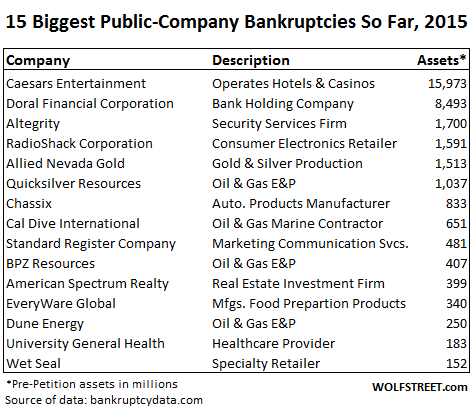
In the first quarter, 26 publicly traded corporations filed for bankruptcy, up from 11 at the same time last year, Reuters reported. Six of these companies listed assets of over $1 billion, the most since Financial-Crisis year 2009. In total, they listed $34 billion in assets, the second highest for a first quarter since before the financial crisis, behind only the record $102 billion in 2009.

The largest bankruptcy was the casino operating company of Caesars Entertainment that has been unprofitable for five years. It’s among the zombies of Corporate America, kept moving with new money from investors that had been driven to near insanity by the Fed’s six-plus years of interest rate repression.

Next in line were Doral Financial, security services outfit Altegrity, RadioShack, and Allied Nevada Gold. The first oil-and-gas company showed up in sixth place, Quicksilver Resources [Investors Crushed as US Natural Gas Drillers Blow Up].

Among the largest 15 sinners on the list, based on Bankruptcydata.com, are six oil-and-gas related companies. But mostly in the lower half. So far, larger energy companies are still hanging on by their teeth.

US-bankruptcies-Q1-2015This isn’t the list of a single troubled sector that ran out of luck. This isn’t a single issue, such as the oil-price collapse. This is the list of a broader phenomenon: too much debt across a struggling economy. And now the reckoning has started.

So maybe the first-quarter surge of bankruptcies was a statistical hiccup; and for the rest of the year, bankruptcies will once again become a rarity.

Wishful thinking? The list only contains publicly traded companies that have already filed. But the energy sector, for example, is full of companies that are owned by PE firms, such as money-losing natural gas driller Samson Resources. It warned in March that it might have to use bankruptcy to restructure its crushing debt.

Similar troubles are building up in other sectors with companies owned by PE firms. As a business model, PE firms strip equity out of the companies they buy, load them up with debt, and often pay special dividends out the back door to themselves. These companies are prime candidates for bankruptcy.

Restructuring specialists are licking their chops. Reality is setting in after years of drought when the Fed’s flood of money kept every company afloat no matter how badly it was leaking. These folks are paid to renegotiate debt covenants, obtain forbearance agreements from lenders, renegotiate loans, etc. At some point, they’ll try to “restructure” the debts.

“There is a ton of activity under the water,” explained Jon Garcia, founder of McKinsey Recovery & Transformation Services.

Just on Wednesday, gun maker Colt Defense, which is invoking a prepackaged Chapter 11 filing, proposed to exchange its $250 million of 8.75% unsecured notes due 2017 for new 10% junior-lien notes due in 2023, according to S&P Capital IQ/LCD. But at a pro rata of 35 cents on the dollar!

Equity holders are out of luck. The haircut would “address key issues relating to Colt’s viability as a going concern,” the filing said. It would allow the company “to attract new financing in the years to come.” Always fresh money!

Also on Wednesday, Walter Energy announced that it would skip the interest payment due on its first-lien notes. In early March, when news emerged that it had hired legal counsel to explore restructuring options, these first-lien notes plunged to 64.5 cents on the dollar and its shares became a penny stock.

None of them has shown up in bankruptcy statistics yet. They’re part of the “activity under water,” as Garcia put it.

But these Colt Defense and Walter Energy notes are part of the “distressed bonds” whose values have collapsed and whose yields have spiked in a sign that investors consider them likely to default. These distressed bonds, according to Bank of America Merrill Lynch index data, have more than doubled year over year to $121 billion.

The actual default rate, which lags behind the rise in distressed debt levels, is beginning to tick up. Yet it’s still relatively low thanks to the Fed’s ongoing easy-money policies where new money constantly comes forward to bail out old money.

But once push comes to shove, equity owners get wiped out. Creditors at the lower end of the hierarchy lose much or all of their capital. Senior creditors end up with much of the assets. And the company emerges with a much smaller debt burden.

It’s a cleansing process, and for many existing investors a total wipeout. But the Fed, in its infinite wisdom, wanted to create paper wealth and take credit for the subsequent “wealth effect.” Hence, with its policies, it has deactivated that process for years.

Instead, these companies were able to pile even more debt on their zombie balance sheets, and just kept going. It temporarily protected the illusory paper wealth of shareholders and creditors. It allowed PE firms to systematically strip cash out of their portfolio companies before the very eyes of their willing lenders. And it prevented, or rather delayed, essential creative destruction for years.

But now reality is re-inserting itself edgewise into the game. QE has ended in the US. Commodity prices have plunged. Consumers are strung out and have trouble splurging. China is slowing. Miracles aren’t happening. Lenders are getting a teeny-weeny bit antsy. And risk, which everyone thought the Fed had eradicated, is gradually rearing its ugly head again. We’re shocked and appalled.


Fed’s Dudley Warns about Wave of Municipal Bankruptcies

The Fed is doing workshops on municipal bankruptcies now.

It has been a persistent ugly list of municipal bankruptcies: Detroit, MI; Vallejo, San Bernardino, Stockton, and Mammoth Lakes, CA; Jefferson County, AL. Harrisburg, PA; Central Falls, RI; Boise County, ID.

There are many more aspirants for that list, including cities bigger than Detroit. Detroit was the test case for shedding debt. If bankruptcy worked in Detroit, it might work in Chicago. Illinois Gov. Bruce Rauner wants to make Chapter 9 bankruptcies legal for cities in his state, which is facing its own mega-problems.

“Bankruptcy law exists for a reason; it’s allowed in business so that businesses can get back on their feet and prosper again by restructuring their debts,” Rauner said. “It’s very important for governments to be able to do that, too.”

His plan for sparing Illinois that fate is to cut state assistance to municipalities, which doesn’t sit well with officials at these municipalities. Chicago Mayor Rahm Emanuel’s office countered that balancing the state budget on the backs of the local governments is itself a “bankrupt” idea.

Puerto Rico doesn’t even have access to a legal framework like bankruptcy to reduce its debts, but it won’t be able to service them. It owes $73 billion to bondholders, about $20,000 per-capita – more than any of the 50 states. If you own a muni bond fund, you’re probably a creditor. Bond-fund managers use its higher-yielding debt to goose their performance. But now some sort of default and debt relieve is in the works. The US Treasury Department is involved too.

“People before debt,” the people in Puerto Rico demand. It’s going to be expensive for bondholders.

That’s the ugly drumbeat in the background of New York Fed President William Dudley’s speech today at the New York Fed’s evocatively  named workshop, “Chapter 9 and Alternatives for Distressed Municipalities and States.”

So they’re doing workshops on municipal bankruptcies now….

“We at the New York Fed are committed to playing a role in ensuring the stability of this important sector,” he said, referring to the sordid finances of state and local governments. But he wasn’t talking about future bailouts by the Fed. He was issuing a warning to municipalities and their creditors about “the emerging fiscal stresses in the sector.”

It’s a big sector. State and local governments employ about 20 million people – “nearly one in seven American workers.” The sector accounts for about $2 trillion, or 11%, of US GDP. And its services like public safety, education, health, water, sewer, and transportation, are “absolutely fundamental to support private sector economic activity.”

The problem is how all this and other budget items have gotten funded. There are about $3.5 trillion in municipal bonds outstanding. So Dudley makes a crucial distinction:

When governments invest in long-lived capital goods like water and sewer systems, as well as roads and bridges, it makes sense to finance these assets with debt. Debt financing ensures that future residents, who benefit from the services these investments produce, are also required to help pay for them. This principle supports the efficient provision of these long-lived assets.

“Unfortunately,” he said, governments borrow to “cover operating deficits. This kind of debt has a very different character than debt issued to finance infrastructure.” It’s “equivalent to asking future taxpayers to help finance today’s public services.”

In theory, 49 states require a balanced budget every year, but it’s easy enough to “find ways to ‘get around’ balanced budget requirements” and cover operating expenses with borrowed money, he said, including the widespread practice of “pushing the cost of current employment services into the future” by underfunding pensions and retiree healthcare benefits for current public employees.

The total mountain of unfunded liabilities remains murky, but estimates for unfunded pension liabilities alone “range up to several trillion dollars.” With these unfunded liabilities, employees are the creditors. That would be on top of the $3.5 trillion in official debt, where bondholders are the creditors.

And eventually, high debt levels and the provision of services clash as in Detroit and Stockton, he said, and render public sector finances “unsustainable.”

But cutting services to the bone to be able to service the ballooning debt entails a problem: citizens can vote with their feet and move elsewhere, thus reducing the tax base and economic activity further. To forestall that, municipalities may alter their priorities and favor the provision of services over debt payments. “This may occur well before the point that debt service capacity appears to be fully exhausted,” he said.

In other words, the prioritization of cash flows to debt service may not be sustainable beyond a certain point. While these particular bankruptcy filings [by Detroit and Stockton] have captured a considerable amount of attention, and rightly so, they may foreshadow more widespread problems than what might be implied by current bond ratings.

That was easy to miss: foreshadow more widespread problems than what might be implied by current bond ratings. Dudley in essence said that current bond ratings – and therefore current bond prices and yields – don’t reflect the ugly reality of state and municipal financial conditions.

It was a warning for states and municipalities to get their financial house in order “before any problems grow to the point where bankruptcy becomes the only viable option.”

It was a warning for public employees and retirees – in their role as creditors – to not rely on promises made by their governments concerning pensions and retiree healthcare benefits.

And it was a warning for municipal bondholders that their portfolios were packed with risky, but low-yielding securities that might end up being renegotiated in bankruptcy court, along with claims by public employees and what’s left of their pension funds. And it was a blunt warning not to trust the ratings that our infamous ratings agencies stamp on these municipal bonds.

Some states are worse than others. Even with capital gains taxes from the booming stock market and startup scene raining down on my beloved and crazy state of California, it ranks as America’s 7th worst “Sinkhole State,” where taxpayers shoulder the largest burden of state debt.

Millions Facing Higher Flood Insurance Premiums

FILE - In this Oct. 30, 2012 file photo, a boat floats in the driveway of a Lindenhurst home on New York’s Long Island, in the flooding aftermath of Superstorm Sandy. Under new legislation that went into effect in April 2015, those living in high-risk flood regions, like some of the communities that experienced Sandy's wrath in 2012, are paying 18 percent increases in their federal flood insurance.

A $24 billion sea of red ink has millions of Americans in vulnerable flood zones, including homeowners still struggling to recover from Superstorm Sandy, facing steep increases in flood insurance premiums.

New legislation that went into effect this month — the second time in two years Congress has tweaked the troubled National Flood Insurance Program — allows rate increases of up to 18 percent.

“This appears to be death by a thousand cuts,'” said Scott Primiano, an Amityville, New York, insurance broker who has been holding seminars for clients to explain the new legislation. “The concept sounds good, but no one can say what the full risk is. … They are going to take it in bits and pieces every year and it keeps going until Congress determines we’ve had enough.”

Federal Emergency Management Agency spokesman Rafael Lemaitre said the flood insurance program has for decades been paying out more than it took in, with the United States as a whole totaling more than $260 billion in flood-related damages between 1980 and 2013. He said the new legislation is “intended to improve the long-term sustainability of the program while being sensitive to needs of policyholders.”

Lemaitre noted that a previous overhaul in 2012 had socked many policyholders with even higher rate hikes — as much as 25 percent annually.

In addition to rate increases capped at 18 percent annually for those with mortgages living in high-risk flood regions, the new legislation means all flood insurance customers nationwide will pay at least a $25 surcharge on their annual premiums. And homeowners with a “secondary residence,” such as vacation properties, will pay a $250 surcharge.

The law gives FEMA 18 months to complete a study on flood insurance affordability and up to 36 months to find a way to offer targeted assistance to policyholders who can’t afford high premiums. Congress also said FEMA should set a goal of limiting annual premiums to no more than $2,500 per year for $250,000 in coverage, but didn’t offer any suggestions on how to do that.

https://i0.wp.com/i.usatoday.net/news/graphics/2010/0820-flood-insurance/floodInsurance-map.jpg

“Most of the 30 million homeowners have no idea that their flood insurance is going to rise,” says George Kasimos of Toms River, New Jersey, who founded the grass-roots group Stop FEMA Now after learning of increases in flood insurance premiums. “The exorbitant rise in flood insurance increases is going to make the 2007 housing bubble look like a walk in the park.”

Tom Daniels, a 66-year-old retiree from Lindenhurst, New York, said his home had 3 1/2 feet of water after Sandy struck, and received $97,000 in insurance to pay for the damage. He said his flood insurance rates are up $600 a year, and now pays more than $2,800 annually.

“I had a feeling they were going to go up,” he said. “I think I’m one of the lucky ones because I only have to pay $50 a month more. I understand that and we’re grateful for what we’ve got.”

Susan Goldstone said she is still struggling to assist her parents in their attempts to get their Oceanside, New York, home repaired after Sandy flooded up to 8 feet of their house.

“We’re still paying for flood insurance, but we’re still not back in the house,” she said. “How do they expect people to stay in their home? It’s crazy high and then you have to deal with the taxes. When does it end? There must be some other alternative.”

Here’s What Could Point To More Upside For Oil

https://i0.wp.com/thumbnails.cnbc.com/VCPS/Y2015/M04D16/3000371772/5ED2-REQ-0416TradeNationOilBounce_mezz.jpgClick here to play video

Crude oil has already bounced back by 30 percent over the past month. But according to Richard Ross of Evercore ISI, currency market moves are predicting more upside for the battered commodity.

Over the past week, oil-exposed currencies such as the Canadian dollar, the Norwegian krone and the Australian dollar have surged in value against the U.S. dollar. And since these currencies tend to be correlated with crude, Ross extrapolates that oil has more upside.

Crude-exposed currencies “are really firming here, and they have been firming over the past month or so along with crude oil itself, and I think that holds bullish implications,” Ross said.

Looking at the Canadian currency in particular, Ross predicts that “the Canadian dollar continues to firm against the U.S. dollar, and this should be supportive of crude.”

Even the crumbling Russian ruble has had a great run over the past month, Ross points out.

“Earlier this year, the ruble was staring into the abyss,” he said in a Thursday “Trading Nation” segment. “Strength in the Russian ruble, once again, has a positive read-through for crude oil.”

However, not everyone buys the thesis.

Referring to the commodity currencies, Boris Schlossberg of BK Asset Management said that “they’re kind of reactive. It’s hard to make that case completely.”

In other words, crude is driving currencies like the Canadian dollar, and not the other way around.

Denver Tops New List of Hottest Housing Markets

https://richmerritt.files.wordpress.com/2012/03/la_skyline_mountains2.jpgby Phil Hall

The hottest single-family housing markets in the nation are located across the Southwest and the South, according to the latest data released by Auction.com.

Among the nation’s 49 largest markets, Denver topped the list when it came to a combination of strong housing demand and favorable affordability coupled with a vibrant economy and demographic conditions. According to Auction.com, Denver experiences a 9.2 percent year-over-year home price growth and a 4.6 percent year-over-year home sales growth.

But why Denver, of all places?

“I’m tempted to tell you it is a Rocky Mountain high,” said Rick Sharga, executive vice president at Auction.com. And while Sharga admitted that the legalization of recreational marijuana in Colorado has helped to boost Denver’s tourism and hospitality industries, the city is enjoying a sturdy economic growth in the professional services sector. “They have exceptional job growth, about three times the national average.”

Rounding out the top 10 for the strongest markets are San Antonio, Nashville, Fort Lauderdale, Dallas, Fort Worth, Seattle, San Francisco, Phoenix and Charlotte. Conspicuously absent from the upper level of strong markets were Northeastern cities—the highest ranked on the Auction.com list was Boston in 34th place.

“We are seeing sort of the opposite of what we’re seeing in the South or Southwest,” said Sharga about the Northeast’s economic health and housing environment. “The population growth is flat or negative and there is not a lot of the job growth that we see in other markets.”

As a national whole, Sharga stated that housing has seen and hopes to see better days. “We’re off to a worse than expected start,” he said of the 2015 housing picture. “I expect a fairly healthy spring, approaching five units in sales. But we should be in the area of six units in sales.”

Hobbiton is a Real Place in New Zealand

https://twistedsifter.files.wordpress.com/2015/03/hobbiton-movie-set-tour-new-zealand-13.jpgsource: Twisted Sifter

When Peter Jackson spotted the Alexander Farm during an aerial search of the North Island for the best possible locations to film The Lord of The Rings film trilogy, he immediately thought it was perfect for Hobbiton.

Site construction started in March 1999 and filming commenced in December that year, continuing for three months. The set was rebuilt in 2011 for the feature films “The Hobbit: An Unexpected Journey”, “The Hobbit: The Desolation of Smaug”, and “The Hobbit: There and Back Again”.

It is now a permanent attraction complete with hobbit holes, gardens, bridge, Mill and The Green Dragon Inn.

hobbiton movie set tour new zealand (7)

hobbiton movie set tour new zealand (3)

Matamata, home of the Hobbiton Movie Set, is a small agricultural town in the heart of the Waikato region, nestled at the base of the Kaimai ranges. It is about a 2 hour drive from Auckland and you can also find other nearby places and estimated travel times below:

From Hamilton: A 45-minute drive.
From Rotorua: A 45-minute drive.
From Taupo: One-and-a-half-hour drive.
From Tauranga: 45-minute drive.
From Waitomo: One-and-a-half-hour drive.

hobbiton movie set tour new zealand (10)

hobbiton movie set tour new zealand (11)

hobbiton movie set tour new zealand (12)

Thirty-seven hobbit holes were originally created with untreated timber, ply and polystyrene. After the 2011 rebuild, there are now 44 unique hobbit holes, the Green Dragon Pub, Mill, double arched bridge and the famous Party Tree.

hobbiton movie set tour new zealand (8)

hobbiton movie set tour new zealand (6)

The Alexanders moved to the 1250 acre (500 hectare) property, in 1978. Since then it has been farmed as a traditional New Zealand sheep and beef farm. It is still farmed the same today and is run by the brothers and their father.
 
The property runs approximately 13,000 sheep and 300 Angus beef cattle hence the major sources of income are mutton, wool and beef. The brothers shear all the sheep on the property themselves, approximately every eight months. [source]

hobbiton movie set tour new zealand (5)

hobbiton movie set tour new zealand (1)

hobbiton movie set tour new zealand (4)

hobbiton movie set tour new zealand (2)

hobbiton movie set tour new zealand (14)

How To Avoid Fake Vacation Rentals

The home-sharing economy is heating up. Inevitably, more and more of us have been getting fleeced on fake vacation rentals.

Vacation planning often begins with excitement, optimism and nowadays the Internet. The online search leads far into a world of glossy photos, descriptive blurbs and, of course, countless promises of customer satisfaction. Even if you’re not inclined to rent a stranger’s house, you may find that for the most popular destinations, traditional hotels are booked or inadequate. So renting a vacation home is a natural alternative. According to the Vacation Rental Managers Association, 24 percent of leisure travelers report having stayed in a vacation home, up from around 11 percent in 2008.

Before the Internet, the search for a private vacation rental was slow and impractical. It involved trading a lot of phone calls, mailing printed packages and coordinating to solve all kinds of problems. Hoteliers like Marriott, Hilton and Hyatt Hotels built empires based on the wealthy traveler’s desire for luxury and reticence to deal with this process.

Then along came online portals like VRBO, Airbnb and Craigslist. All of a sudden, we’re in the mood to share.

For the most part, the rise of all of this house sharing has been positive. Sophisticated channels like Airbnb and HomeAway try especially hard to protect renters by providing secure payment, user comments and star ratings. But even they are not immune from deceit.

Vacation rental scams come in many different forms. Some Web portals are run by technologists with no connection to the actual real estate. Through smart search engine optimization, these sites attract users, and then sell the lead to the true agent, who offsets the cost with higher rent.

Sure, it looks like the perfect spot for a vacation. But will it be there when you arrive?

The worst rip-offs seduce would-be vacationers with fabulous pictures of fictitious properties. Once the renter is hooked, the phony landlord collects an up-front “security deposit” and runs for the hills. Victims are left unaware they’ve been cheated until weeks later, when they show up at the address with their luggage in hand.

Other variations on the scam are only slightly less fraudulent. Some fakes use the bait-and-switch method by showing unavailable properties, only to divert the renter to another, less desirable spot. Other tricksters may double-book a property, then send whichever vacationer arrives last to a second-rate backup, along with sincere apologies.

You’re too sharp to be ensnared in any of these scams, right? Real estate is my business, so I used to believe the same thing. Then I tried renting a vacation home in Aspen, Colorado, for a summer holiday.

I found many remarkable online listings — only to discover after contacting their presumed representatives that the properties were always booked. After many failed tries and long phone calls I realized I was being conned. I stopped browsing and hired a high-quality local real estate broker to show me real listings.

My experience could have been worse — some friends from Germany were recently snared here in Miami. Fortunately, they insisted on withholding their security deposit from their seemingly delightful contact until after completing a property inspection. Still, she pressured these visitors to wire funds — right up to the time they were driving to the property after their long flight. Having stood their ground, they arrived at the home, which appeared exactly as it did online. Unfortunately, it was occupied by its unsuspecting owner — who had no intention to rent. Of course, my friends never again succeeded in connecting with their agent and had to scramble to locate a hotel room.

Why aren’t authorities cracking down? Perhaps because the dollar figures involved in each case simply aren’t enough to justify an intercontinental examination. The victims, by definition, don’t live anywhere near the jurisdiction of the reported crime. Most often, the crooks don’t either.

So how do you protect yourself? Here’s a list of 10 ways to combat this scam:

  1. Don’t be fooled by photography. In particular, be wary of the nicest-looking, most Photoshopped property photos. Ask the owner for additional photos — an honest lessor will always have them. Or ask your agent to use technology like FaceTime or Skype to show you the property live. At the very least, use Google GOOG -0.11% Earth and Google’s Street View feature to confirm that the property you’re renting actually exists at the address advertised. You can also use those Google tools to get an unvarnished look at the property’s exterior.
  2. Be careful of the cheapest properties. If prices seem too good to be true, they probably are. If you don’t have a feel for what a reasonable price is in an area, get one. Scammers often go after people who aren’t that savvy. And drive a hard bargain — not just to get a better deal, but also to detect odd behavior from the other party.
  3. Never pay with cash. The preferred methods of payment among criminals are cash and cash-transfer services like MoneyGram and Western Union WU 0%. Use a credit card instead — Visa, MasterCard and American Express will all allow you to recover money you lose to fraud. Reputable sites like Airbnb will hold your security funds in escrow. They play middleman, making sure you’ve put the funds in place before you get keys. (Some portals offer insurance against fraud — but it’s expensive and may not cover much; read the policy closely.)
  4. Use a trusted local agent. Yes, you should expect to pay them. But they can show you bona fide listings or go look at the properties that you’ve seen on the Internet for you. Be sure to check their license.
  5. Confirm legitimacy. For ownership and all documents, confirm that the owner’s name on the lease is the same as the one shown on public property appraiser records. Then have a lawyer review the lease, just like you would a full-year agreement.
  6. Read the comments. The feedback from previous renters that appears on sites like Airbnb and VRBO is invaluable. And in some cases, you’re even allowed to pose questions to other users.
  7. Trust your instincts. If you apply some skepticism to the process, you’re more likely to see red flags. You’re also more likely to catch suspicious behavior. My Germans looked back after their experience and realized their phony realty agent had exhibited all kinds of weird tics. They were so excited about their trip to Miami that they failed to pick up on them.
  8. Take your time. No need to rush. For long vacations, consider going ahead of time to check out the property, or not renting a house for the first week — stay at a hotel for a few nights. It will give you an opportunity to see the property you’re renting in person before turning over your security deposit.
  9. Be a regular. If you rent a home you like, stick with it. You’ll develop a relationship with the owner if you go back to the same place year in, year out — and avoid the risk of being scammed on a new property. If you’re traveling to a new place, try to find a friend who lives there and will give you honest feedback on potential rentals, good neighborhoods, etc.
  10. Beware group think. If you’re vacationing with a half-dozen other people, everybody tends to figure that somebody else is paying attention to the details and making sure the group isn’t getting ripped off. Then, when the amazing six-bedroom place you all rented together is nowhere to be found and your security deposit evaporates, everybody’s pointing fingers.

Demand for Housing Hits All-Time Low

by Colin Wilhelm

Consumer demand for housing has dropped to its lowest recorded level due to reduced confidence in financial security and income raises, a new survey from Fannie Mae says.

The government-sponsored enterprise’s March national housing survey found that 41% of Americans expect their financial situation to improve over the next year, and 22% said their income had increased substantially over the last year.

Most importantly, the percentage of respondents who said they planned to buy a home dropped five basis points to 60%, an all-time survey low.

“We’ve seen modest improvement in total compensation resulting from a strengthened labor market,” Fannie Mae chief economist Doug Duncan said in a release.

“However, income growth perceptions and personal financial expectations both eased off of recent highs, consistent with Friday’s weak jobs report. Simultaneously, the share of consumers expecting to buy on their next move has declined. Meanwhile, the wait for housing expansion continues.”

One Third Of U.S. Companies’ Q1 Job Cuts Due To Oil Prices

https://i0.wp.com/www.jobcutnews.com/wp-content/uploads/2011/10/pink-slips.jpgby Olivia Pulsinelli

Oil prices caused one-third of the job cuts that U.S.-based companies announced in the first quarter, according to a new report. March was the fourth month in a row to record a year-over-year increase in job cuts, Chicago-based outplacement consultancy Challenger, Gray & Christmas Inc. reports. And 47,610 of the 140,214 job cuts announced between January and March were directly attributed to falling oil prices. Not surprisingly, the energy sector accounted for 37,811 of the job cuts — up a staggering 3,900 percent from the same quarter a year earlier, when 940 energy jobs were cut. However, U.S. energy firms only announced 1,279 job cuts in March, down about 92 percent from the 16,339 announced in February and down nearly 94 percent from the 20,193 announced in January. The trend held true in Houston, where several energy employers announced job cuts in January and February, while fewer cuts were announced in March. Overall job-cut announcements are declining, as well. U.S. employers announced 36,594 job cuts in March, down 27.6 percent from the 50,579 announced in February and down 31 percent from the 53,041 announced in January. In December, 32,640 job cuts were announced. “Without these oil related cuts, we could have been looking one of lowest quarters for job-cutting since the mid-90s when three-month tallies totaled fewer than 100,000. However, the drop in the price of oil has taken a significant toll on oil field services, energy providers, pipelines, and related manufacturing this year,” John Challenger, CEO of Challenger, Gray & Christmas, said in a statement.

The U.S. Oil Boom Is Moving To A Level Not Seen In 45 Years

by Myra P. Saefong

Peak U.S. oil production is a ‘moving target’

SAN FRANCISCO (MarketWatch) — U.S. oil production is on track to reach an annual all-time high by September of this year, according to Rystad Energy. If production does indeed top out, then supply levels may soon hit a peak as well. That, in turn, could lead to shrinking supplies. The oil-and-gas consulting-services firm estimates an average 2015 output of 9.65 million barrels a day will be reached in five months — topping the previous peak annual reading of 9.64 million barrels a day in 1970. Coincidentally, the nation’s crude inventories stand at a record 471.4 million barrels, based on data from U.S. Energy Information Administration, also going back to the 1970s. The staggering pace of production from shale drilling and hydraulic fracturing have been blamed for the 46% drop in crude prices CLK5, -1.08% last year. But reaching so-called peak production may translate into a return to higher oil prices as supplies begin to thin.

Rystad Energy’s estimate includes crude oil and lease condensate (liquid hydrocarbons that enter the crude-oil stream after production), and assumes an average price of $55 for West Texas Intermediate crude oil. May WTI crude settled at $49.14 a barrel on Friday. The forecast peak production level in September is also dependent on horizontal oil rig counts for Bakken, Eagle Ford and Permian shale plays stabilizing at 400 rigs, notes Per Magnus Nysveen, senior partner and head of analysis at Rystad. Of course, in this case, hitting peak production isn’t assured. “Some will be debating whether the U.S. has reached its peak production for the current boom, without addressing the question of what level will U.S. production climb to in any future booms,” said Charles Perry, head of energy consultant Perry Management. “So one might also say U.S. peak production is a moving target.” James Williams, an energy economist at WTRG Economics, said that by his calculations, peak production may have already happened or may occur this month, since the market has seen a decline in North Dakota production, with Texas expected to follow.

Permian Basin Idles Five Rigs This Week

by Trevor Hawes

Drilling rig

The number of rigs exploring for oil and natural gas in the Permian Basin decreased five this week to 285, according to the weekly rotary rig count released Thursday by Houston-based oilfield services company Baker Hughes.

The North American rig count was released a day early this week because of the Good Friday holiday, according to the Baker Hughes website.

District 8 — which includes Midland and Ector counties — shed four rigs, bringing the total to 180. The district’s rig count is down 42.68 percent on the year. The Permian Basin is down 46.23 percent.

At this time last year, the Permian Basin had 524 rigs.

TEXAS

Texas’ count fell six this week, leaving 456 rigs statewide.

In other major Texas basins, there were 137 rigs in the Eagle Ford, unchanged; 29 in the Haynesville, down three; 23 in the Granite Wash, down one; and six in the Barnett, unchanged.

Texas had 877 rigs a year ago this week.

UNITED STATES

The number of rigs in the U.S. decreased 20 this week, bringing the nationwide total to 1,028.

There were 802 oil rigs, down 11; 222 natural gas rigs, down 11; and four rigs listed as miscellaneous, up two.

By trajectory, there were 136 vertical rigs, down eight; 799 horizontal rigs, down 13; and 93 directional rigs, up one. The last time the horizontal rig count fell below 800 was the week ending June 4, 2010, when Baker Hughes reported 798 rigs.

There were 993 rigs on land, down 17; four in inland waters, unchanged; and 31 offshore, down three. There were 29 rigs in the Gulf of Mexico, down four.

The U.S. had 1,818 rigs at this time last year.

TOP 5s

The top five states by rig count this week were Texas; Oklahoma with 129, down four; North Dakota with 90, down six; Louisiana with 67, down five; and New Mexico with 51, unchanged.

The top five rig counts by basin were the Permian; the Eagle Ford; the Williston with 91, down six; the Marcellus with 70, unchanged; and the Cana Woodford and Mississippian with 40 each. The Mississippian idled three rigs, while the Cana Woodford was unchanged. The Cana Woodford shale play is located in central Oklahoma.

CANADA AND NORTH AMERICA

The number of rigs operating in Canada fell 20 this week to 100. There were 20 oil rigs, up two; 80 natural gas rigs, down 22; and zero rigs listed as miscellaneous, unchanged.

The last time Canada’s rig count dipped below 100 was the week ending May 29, 2009, when 90 rigs were reported.

Canada had 235 rigs at this time last year.

The total number of rigs in the North America region fell 40 this week to 1,128. North America had 2,083 rigs a year ago this week.

The “Revolver Raid” Arrives: A Wave Of Shale Bankruptcies Has Just Been Unleashed

by Tyler Durden

Back in early 2007, just as the first cracks of the bursting housing and credit bubble were becoming visible, one of the primary harbingers of impending doom was banks slowly but surely yanking availability (aka “dry powder”) under secured revolving credit facilities to companies across America. This also was the first snowflake in what would ultimately become the lack of liquidity avalanche that swept away Lehman and AIG and unleashed the biggest bailout of capitalism in history. Back then, analysts had a pet name for banks calling CFOs and telling them “so sorry, but your secured credit availability has been cut by 50%, 75% or worse” – revolver raids.Well, the infamous revolver raids are back. And unlike 7 years ago when they initially focused on retail companies as a result of the collapse in consumption burdened by trillions in debt, it should come as no surprise this time the sector hit first and foremost is energy, whose “borrowing availability” just went poof as a result of the very much collapse in oil prices.
As Bloomberg reports, “lenders are preparing to cut the credit lines to a group of junk-rated shale oil companies by as much as 30 percent in the coming days, dealing another blow as they struggle with a slump in crude prices, according to people familiar with the matter.


Sabine Oil & Gas Corp. became one of the first companies to warn investors that it faces a cash shortage from a reduced credit line, saying Tuesday that it raises “substantial doubt” about the company’s ability to continue as a going concern.

It’s going to get worse: “About 10 firms are having trouble finding backup financing, said the people familiar with the matter, who asked not to be named because the information hasn’t been announced.”

Why now? Bloomberg explains that “April is a crucial month for the industry because it’s when lenders are due to recalculate the value of properties that energy companies staked as loan collateral. With those assets in decline along with oil prices, banks are preparing to cut the amount they’re willing to lend. And that will only squeeze companies’ ability to produce more oil.

Those loans are typically reset in April and October based on the average price of oil over the previous 12 months. That measure has dropped to about $80, down from $99 when credit lines were last reset.

That represents billions of dollars in reduced funding for dozens of companies that relied on debt to fund drilling operations in U.S. shale basins, according to data compiled by Bloomberg.

“If they can’t drill, they can’t make money,” said Kristen Campana, a New York-based partner in Bracewell & Giuliani LLP’s finance and financial restructuring groups. “It’s a downward spiral.”

As warned here months ago, now that shale companies having exhausted their ZIRP reserves which are largely unsecured funding, it means that once the secured capital crunch arrives – as it now has – it is truly game over, and it is just a matter of months if not weeks before the current stakeholders hand over the keys to the building, or oil well as the case may be, over to either the secured lenders or bondholders.

The good news is that unlike almost a decade ago, this time the news of impending corporate doom will come nearly in real time: “Publicly traded firms are required to disclose such news to investors within four business days, under U.S. Securities and Exchange Commission rules. Some of the companies facing liquidity shortfalls will also disclose that they have fully drawn down their revolving credit lines like Sabine, according to one of the people.”

Speaking of Sabine, its day of reckoning has arrived

Sabine, the Houston-based exploration and production company that merged with Forest Oil Corp. last year, told investors Tuesday that it’s at risk of defaulting on $2 billion of loans and other debt if its banks don’t grant a waiver.

Another company is Samson Resource, which said in a filing on Tuesday that it might have to file for a Chapter 11 bankruptcy protection if the company is unable to refinance its debt obligations. And unless oil soars in the coming days, it won’t. 


Its borrowing base may be reduced due to weak oil and gas prices, requiring the company to repay a portion of its credit line, according to a regulatory filing on Tuesday. That could “result in an event of default,” Tulsa, Oklahoma-based Samson said in the filing.

Indicatively, Samson Resources, which was acquired in a $7.2-billion deal in 2011 by a team of investors led by KKR & Co, had a total debt of $3.9 billion as of Dec. 31. It is unlikely that its sponsors will agree to throw in more good money after bad in hopes of delaying the inevitable.

The revolver raids explain the surge in equity and bond issuance seen in recent weeks:

Many producers have been raising money in recent weeks in anticipation of the credit squeeze, selling shares or raising longer-term debt in the form of junk bonds or loans.

Energy companies issued more than $11 billion in stock in the first quarter, more than 10 times the amount from the first three months of last year, Bloomberg data show. That’s the fastest pace in more than a decade.

Breitburn Energy Partners LP announced a $1 billion deal with EIG Global Energy Partners earlier this week to help repay borrowings on its credit line. EIG, an energy-focused private equity investor in Washington, agreed to buy $350 million of Breitburn’s convertible preferred equity and $650 million of notes, Breitburn said in a March 29 statement.

Unfortunately, absent an increase in the all important price of oil, at this point any incremental dollar thrown at US shale companies is a dollar that will never be repaid.

Finally, speaking of Samson, its imminent bankruptcy should not come as a surprise. Back in January we laid out the shale companies which will file for bankruptcy first. The recent KKR LBO was one of them.

Many more to come as the countdown to the day of reckoning for the US shale sector has just about run out.

Six Bullet Proof Ways To Get Listings Without Cold Calling

Does anyone actually like cold calling?  I’m definitely not a natural cold caller.  And I’m assuming there are a fair number of you out there who would rather generate listings through other methods.  So, I’m focusing on providing the best tactics for you get more listings, listing leads, and ultimately more money all without you having to do cold calling.

by Easy Agent Pro

1) Target Divorcees

targeting divorcee for real estate listings

This is a slightly taboo topic but presents a great opportunity for agents looking for listings.  Did you know that most judges mandate that couples sell their current property?  This is part of the reason for the huge number of divorcees that list their homes each year!

Over 31% of people going through a divorce will list their home within 6 months of filing for their divorce.  This gives you a huge opportunity!  Not only can you list their property, but you can garner two buyers from the transaction.

If 31% of people going through a divorce end up selling their home and there are 1.2 million divorces in the United States a year, that means over 300,000 people list their home within 6 months of filing.

That’s a lot of transactions in a very short period of time! And a list of VERY motivated sellers.

There is very little competition for being the divorce listings expert! You can easily setup Facebook ads like this that target these home sellers:

get home listings without cold calling

And then use landing pages to collect their contact information:

This method will make you the divorce listings expert in no time! You should even place a section on your website or blog about this topic to start collecting leads.

2) Inherited Homes

inherited homes for real estate listings

Did you know that over 1 million people inherit a home every year?  That’s an amazing opportunity for agents!

Think about it, would you want to move into a home that you recently inherited?  Probably not. It might not be in the right location. Maybe it needs too many repairs.  A huge majority of these new homeowners end up selling the property.

You need to target these people! And here’s how:

1) You’ll first want to find an online search for all the local cases in your county.  This is typically held on a “county clerk’s” website. And you are looking for cases in regards to “inheritance.” A simple Google search will do the trick:

get listings without cold calling

Then, you’ll have access to search public data and records.  You should be able to secure the name of the former property owner. At this point, you head over to YellowPages and click “Search People.”  Enter the person’s name into the form:

get listings

You should be able to find the address of the property that was recently inherited.  Now, simply prospect away!

Another tactic for attracting sellers of inherited properties is through Real Estate Farming.  You can learn how to farm in real estate with SEO here.

3) Send Letters To FSBO

get real estate listings fsbo

Do you mail FSBO’s?  I’m sure a lot of you answered yes to that question.  But how many of you have a pre-thought out series of mailers that you send once every 4-7 days?  The percentage of realtors that follow up with their mailer is very small.  In fact, over 65% of sales people never follow up with a marketing idea.

That’s bad.  It takes between 5 and 12 points of contact for someone to be interested in doing business with you.  You have to nurture these people along and get them warm to the idea of doing business with you.  One way of doing this is sending FSBO’s a series of mailers.  How many pain points does the typical prospecting session for FSBO’s contain? It’s usually 3-7 different pain points!  You can think of 5 different things you’d like to explain to a FSBO, write them out in letter format, and then mail them to the home owner.

The marketing costs for this are incredibly low!  Maybe 5 stamps, a Real Estate Logo, and some paper?  The thing with FSBO’s is that they’ve probably been burned by a realtor before.  So, you’re instantly standing out from the crowd by being the most persistent person out there.

I can’t stress enough the value of following up with your marketing actions.  This is the key to experiencing great success in real estate.

4) Vacant Homes

vacant homes for real estate listings

The US Census Bureau shows that there were 104 million vacant homes at the end of the 1st quarter in 2014.  By the end of the second quarter, there were only 93.2 million vacant homes.  By the end of the third quarter, 96.1 vacant homes. And by the end of the fourth quarter, 94.5 vacant homes.

That’s a lot of transactions taking place!

If I were a realtor, I’d hire an admin or local college student to help prospect vacant homes.  You can pay them hourly or work out a commission based arrangement for finding properties.  This way, you save your time while still being the first realtor to find the vacant properties!  Once you find them, it’s just a matter of time before the previous homeowner wants to sell.

You can use your local county clerk’s website to prospect for homes that might be vacant.

5) Look Into Property Taxes

property taxes for real estate listings

Speaking of the county clerk’s website again, you can research homes that are behind in paying their property taxes while you are there!  These houses give you an enormous opportunity! Did you know that over 23% of homes that are sold in any given year have some type of back tax to pay?

The fact that this many sellers are behind on property taxes is a critical determining factor in finding motivated sellers!  You can prospect for these buyers in several ways.

1) Launch a niche SEO Campaign for keywords related to property taxes and selling your home.  Look at this:

low seo competition

2) Start advertising online: Google Adwords and Facebook ads are very expensive if you target: Dallas Homes For Sale.  But if you’re targeting “Sell A Home Quickly In Dallas Due To Taxes” there is a lot less competition!

3) Mail Individuals You Find On The Clerk’s Website: You can create a series of mailers you send to people who are behind on their taxes!

6) Partner With Small Local Banks Or Small Builders

get real estate listings

Finally, you aren’t in this battle alone!  Small local banks, builders, mortgage providers, plumbers, electricians, marriage counselors, dentists, etc., etc., etc. are all looking for business just like you.  They are entrepreneurs looking to grow their businesses.  And most of them probably wouldn’t mind a realtor giving them referrals.  Why not start with the YellowPages and find a business in each major category to be your recommended provider?

Now, this won’t help you if you just spend 1 hour once talking with that person.  Be sure to put them into your CRM, and follow up with them every month.  Maybe even get coffee with them once a month.  Figure out concrete ways for the two of you to work together! Incorporate this spirit of working together into your entire real estate brand and real estate slogans.