Monthly Archives: June 2017

Bob Rodriguez: “We Are Witnessing The Development Of A Perfect Storm”

Bob Rodriguez: “We Are Witnessing The Development Of A Perfect Storm”

Robert L. Rodriguez was the former portfolio manager of the small/mid-cap absolute-value strategy (including FPA Capital Fund, Inc.) and the absolute-fixed-income strategy (including FPA New Income, Inc.) and a former managing partner at FPA, a Los Angeles-based asset manager. He retired at the end of 2016, following more than 33 years of service.

He won many awards during his tenure. He was the only fund manager in the United States to win the Morningstar Manager of the Year award for both an equity and a fixed income fund and is tied with one other portfolio manager as having won the most awards. In 1994 Bob won for both FPA Capital and FPA New Income, and in 2001 and 2008 for FPA New Income.

The opinions expressed reflect Mr. Rodriguez’ personal views only and not those of FPA.

 I spoke with Bob on June 22.

In a recent quarterly market commentary Jeremy Grantham posited that reversion to the mean may not be working as it has in the past. What are your thoughts on mean reversion?

There will be a reversion to the mean. We are in a very difficult and challenging time for active managers, and in particular, value style managers. Many of these managers are fighting for their economic lives.

Given that I am no longer involved professionally in managing money, I believe the standards in the industry are being compromised; monetary policy has so totally distorted the capital markets. You are now into the eighth year of a period that is unprecedented in the likes of human history.

The closest policy period to what we have now would have been between 1942 and 1951, when the Fed and Treasury had an accord to keep interest rates low. Interest rates were artificially held lower to help finance the World War II effort. With the renewal of inflation after the war, a policy war developed between the Treasury and the Fed on the continuation of a low interest rate policy. The Treasury-Fed of 1951 brought this period to a close. But that is the only time we’ve had a period of nine years of manipulated, price-controlled interest rates.

This was a historical policy I discussed with my colleagues upon my return from sabbatical in 2011: what could unfold were controlled, manipulated and distorted pricing that could disrupt the normal functioning of the capital markets. The historical cycles that Jeremy would be referring to that entailed a reversion to the mean could be distorted, for a period of time, by this type of monetary policy action.

But I do not believe the economic laws of gravity have been permanently changed.

At a Grant’s Conference last year Steven Bregman asserted that indexation in general and ETFs in particular were factors in the under-performance of active managers and are potentially a bubble. Are you familiar with his work and what are your thoughts on ETFs? What is driving the flow of mutual fund assets to passive strategies and what can or should fund companies do in the face of this trend?

I go back to a speech I gave in 2009, Reflections and Outrage, and buried within that speech is a section that said that if active managers did not get their act together then the likelihood would be that passive strategies would continue to take market share. When you have a market that is distorted by zero interest rate policy, David Tepper said it very well many years ago, “Well, you’ve got to ride it.”

It’s a rocket ship that’s going up. If you are fully invested in the right areas, you have a shot at out-performing. However, if you are an active manager who has a valuation discipline, given the valuation excesses in the capital markets now and that have been developing for the past several years, then an elevated level of liquidity would be held, if you were allowed to do so. As such, you will likely underperform the market.

Active managers have not demonstrated a value-add to an appreciable extent over the last 20 years. When I look back at what happened prior to 2000, if an active growth stock manager could not see the most extraordinary distortion and elevated, speculative market in history, when will they? In the lead up to the 2007-2009 financial crisis, many value-style managers did not cover themselves in glory either. If you looked at what their major stock ownership concentrations were, they were very much in large banks and various types of financial institutions that were going to get crushed in the credit downturn. If they couldn’t acknowledge or identify the greatest credit excess in history, when will they?

I’m picking on both growth- and value-style managers for missing two of the great bubbles in history. This miss led to capital destruction. Now we have a clueless Fed, in my opinion, that has never known what a bubble is beforehand. It is accentuating one that has been developing as a result of its policy insanity of QE. Markets are going straight up predicated on it.

The public looks at these outcomes and says, “Why should I pay higher fees to managers who can’t outperform or can’t even identify a major speculative blow off. I might as well be fully invested. I might as well be in an ETF or index fund.”

Thus, since 2007, indexing or passive activities have risen from approximately 7% to 9% of total managed assets to almost 40%. As you shift assets from active managers to passive managers, they buy an index. The index is capital weighed, which means more and more money is going into fewer and fewer stocks.

We’ve seen this act before. If you didn’t own the nifty 50 stocks in the early 1970s, you underperformed and, thus, money continued to go into them. If you were a growth stock manager in 1998-1999 and you were not buying “net” stocks, you underperformed and were fired. More and more money went into fewer and fewer stocks. Today you have a similar case with the FANG stocks. More and more money is being deployed into a narrower and narrower area. In each case, this trend did not ended well.

When the markets finally do break, as they always have historically, ETFs and index funds will be destabilizing influences, because fear will enter the marketplace. A higher percentage of assets will be in indexed funds and ETFs. Investors will hit the “sell” button. All you have to ask is two words, “To whom?” To whom do I sell? Index funds and ETFs don’t carry any cash reserves. The active managers have been diminished in size, and most of them aren’t carrying high levels of liquidity for fear of business risk.

We are witnessing the development of a “perfect storm.”

The Wall Street Journal has reported that central banks from Switzerland to South Africa are investing their reserves in equities. How should investors respond to the participation in the price discovery system by players that can print money and may not be performance-driven?

The last thing I ever wanted to do as a professional was allocate capital to areas that government was buying. With governmental-driven decisions there are virtually no penalties for bad decision making. Look at the rank stupidity of Dodd-Frank, or Paulson, Bernanke, and Greenspan. They were clueless before each of the last crises. They helped drive a system off the tracks. What penalty have they paid? None! They get to keep their pensions.

But when you have central banks deploying capital and their cost of money is zero, they destroy the capital-asset pricing mechanism; they destroy comparability; the distortions continue.

As a dedicated contrarian, the last place I want to invest money is where governments are deploying the capital because they are so totally distorting the market.

How did the discipline of value investing as you practiced it at FPA, change over the course of your career, particularly since the financial crisis?

It’s an interesting question and I’ve asked myself that many times.

The markets moved more slowly prior to this century – the ebbs and flows, the decision-making and the conveyance of information. With the advance of electronics and the internet, the speed of dissemination of news accelerated. I don’t believe that judgments have improved; just the speed has accelerated and the time frames of patience have shortened.

I bet my entire business in the spring of 1998 when for the prior 11 or 12 years I ran my mutual fund, the FPA Capital Fund, on fumes, with 1% to 2% cash and sometimes even less than 1%. Had you held liquidity, with short-term bond yields in the high-single to double-digits, you would have underperformed the stock market by anywhere from 900 to 1,100 basis points. By 1998 the consultant’s mantra was to be “fully invested.”

I went out in the spring of 1998 arguing that the equity market was becoming excessively priced, and it continued to do so. I sought permission to move my liquidity limits from 7% to 10% which were the typical maximums, to upward of 30%. I had to fight every client on that. By the spring of 2000, without losing any money and avoiding the carnage, I took a little bit over a 50% reduction in my assets under management. I got fired. In 2007-2009, I did far more preparation and communication prior to that crisis and entered it with 45% cash.

In the first phase of a debacle like what went on in the financial crisis, it doesn’t matter whether you are a virgin or are the opposite. When they raid the entertainment house and you happen to be a person walking by, just out of the church right next door, you get caught with all of the people there.

In the aftermath the police discover, “Oh, you shouldn’t be here.” Well, it’s the same way in a crash; virtually everything gets hit. Then in the second and third stages, the real values start to unfold and you get a greater differentiation. That is what happened with my fund between 2007 and 2009 and subsequently.

A cash level of 45% was a real tough strategy for clients to handle. I had one client say, “Please stay fully invested for my account and just do your thing with the others.” I said, “No, the price you ask me to pay is too high. By being fully invested managing your money, I will contaminate my thinking, which will negatively affect my other clients. I’m sorry, that’s a price too high to pay.” I said, “Where do you want me to return the money?” He said, “Let me think about it.” The next day his response was, “Okay, you’ve got flexibility.” But I still took over a 50% hit in redemptions during that crisis.

Looking back at these two prior major cycles, it is far more difficult for a value manager to hold liquidity today in light of the policies that are being deployed. These are the worst fiscal and monetary policies in human history.

If I were still professionally managing money, despite my background of pain-and-suffering from being redeemed, my liquidity allocation would be north of 60% today.

So-called “smart-beta” products have become very popular, particularly those that incorporate a quantitatively-driven value strategy based on the Fama-French factor models. For investors that want a value-oriented portfolio, what concerns should they have with these strategies?

I have never seen a quantitative strategy succeed longer term. They are predicated on models. The models are predicated on history. When history changes, they have to develop a new factor model.

We witnessed this in the last cycle. There was an article in the WSJ quoting a quant manager who said on a Wednesday, we had experienced a 1-in-10,000 year event. On Thursday, we had a 1-in-10,000 year event. On Friday we had a 1-in-10,000 year event. A former colleague wrote an email that weekend that said, “I have a quick question to ask. On Monday, are we safe for the next 30,000 years?”

All of these strategies are meant to enhance or give an essence of how you are going to try and minimize risk and enhance return. When you are in an environment where the lead entity, the Federal Reserve, has its foot on the scale and is distorting the information coming out of the capital markets, where interest rates can go to zero, what is the proper hurdle rate for budgetary or capital allocation decisions? These actions distort the price comparison or discovery process in the capital asset-pricing model. This is highly disturbing.

By the way, I wrote a piece in 2008 before the Fed even knew they were going to balloon their balance sheet. It said they would have to increase the balance sheet by at least a trillion to a trillion and a half. They hadn’t got to that realization yet.

After 45 years of watching the Fed, the only Fed chairman that was worth spit was Paul Volcker. The last great central banker that we had in the last 110 years other than Volcker was J.P. Morgan. The difference is, when Morgan tried to contain the 1907 crisis, he wasn’t using zeros and ones of imaginary computer money; he was using his own capital. As long as you have anointed centralized bureaucratic decision makers like the Federal Reserve, that in many ways is similar to the concentrated decision making structure of the former Soviet Union, decisions will be late and generally wrong. The Fed is a large organization and like all large organizations, there are internal pressures where they try to come to a consensus, and so they do.

This is not how you make your greatest decisions.

If there is one piece of investment advice you would offer to a young professional embarking on a career now, what would that be?

I will give the same advice that I got when I was a very young professional back in 1973. I was two years into the field and a gentleman spoke before my investment class. After everybody had walked out, I walked up to Mr. Munger and I asked him, “Sir, if I could only do one thing that would make myself a better investment professional, what would you recommend?” He responded, “Read history, read history, read history.” I have done that over the years. Had you read about the banking crisis of 1907 and what preceded it in the 1890s, you would have recognized it in a form in 2007.

If there is one piece of management advice that you could offer to that same person, what would that the?

You must have two things – discipline and integrity. Compromise either and you will fail.

That’s true in all walks of life.

Yes, but it’s very easy to use the justification that this time is different.

The world has changed. I gave a speech in 2001 to some pension advisors. I said, “Look at you people out there.” I hadn’t shown them my chart yet but I said, “Look at what we have just gone through. We had the greatest, the highest level of computerization in the history of man, the most timely acquisition to information, the highest percentage of advanced degreed professionals and college graduates in the field, and we got an outcome no different than 1974, 1929, 1907. There is something more here going on.”

Then I held up two hand-written stick figures – I was not a good artist. They were cows and they were talking to one another. One cow said to the other, “Glad we’re not part of the herd.” The other cow said, “Yea.” The next exhibit was an aerial shot. It showed the two cows are in a ravine, so they can only see themselves. But all around them is the herd. I looked out and said, “People, whether you realize it or not, you are part of the herd. All you have to understand is one word, now let’s say it all together. Moo.” What a way to influence friends and make new clients.

How are you investing your personal assets?

I am at my lowest exposure to equities since 1971. They represent less than a fraction of one percent. Liquidity is north of 65%, all in Treasury-type securities, nothing beyond a three-year term. I do not trust what is going on fiscally or monetarily, and I’ll circle back on this in a moment. The balance is in rare fully paid-for physical assets.

Circling back, after I stepped down from daily money management at the end of 2009, I took a sabbatical. One of my goals was to meet a gentleman by the name of David Walker, the former comptroller general of the U.S. He wrote a book called Comeback America that I read in January of 2010. I sent my review to Dave. Two days later Dave called me and said, “My name is Dave Walker. Is this Bob Rodriguez? If so, I want to thank you for your review.” That’s how we came to know one another. I’d used his work for over 10 years. For the next three and a half years I was a sponsor of his program, Comeback America. He closed it down in 2013, a complete unmitigated failure.

Think about the budgetary battles of 2011; the only thing that was cut was defense. Two thirds of the expenditure cuts that were going to get controlled under the system would not occur until after 2016. Funny how that works. In the presidential debates, only one candidate used a word that I think has now left the English language, “sequester.” That was Bush and it was to eliminate sequestration to raise defense spending.

The 2016 election was one of the most important elections in the last 80 years. Back in 2009 I said if we do not get our economic house in order sometime between 2014 and 2018, we could see a crisis of equal or greater magnitude than the 2007-2009 crisis. I also argued that we would have a substandard recovery that would be no better than 2% real GDP growth for as far as the eye can see. Productivity and capital spending would be substandard. All of those have played out.

Here we are in 2017. I have seen absolutely nothing that would give me any degree of confidence that Washington will get its act together. We are into a period of expanding deficits. We are hitting a time where the entitlements are worsening in terms of their funding status. We are in a decade that is unprecedented from anything that we’ve seen before with monetary policy and fiscal policy.

Why on Earth should I allocate capital into a system where the scales are completely manipulated, price discovery is distorted, and the Fed doesn’t have a clue what’s going on? They’ve missed every economic forecast for the last nine years straight. Why would anybody pay any attention to what those people are doing?

I have confidence in one thing. The Fed will blow it.

My thoughts are very much analogous to those of Lacy Hunt. Where Lacy and I part company is what happens after the deformation hits. He would argue that we will be in a dis- or deflationary period for an extended period of time; therefore, you should own 30- and 20-year Treasury bonds.

I’m not so sure about that scenario. It occurred in Japan because it has a very cohesive society. That is not the case in the United States or in Europe. Our patience will be far shorter. At some point, in no more than one to two years, the Fed would likely panic and panic big time, and we will see QE on steroids. We will see monetary inflation. Lacy and I have a similar view. But the really big question is what the outcomes will be on the other side of this mess. Both of us could be very right, or very wrong, or partially in between.

I am managing my estate in a hedged fashion because what we are going through is without any precedent in human history. How can anybody have confidence that their particular view is the right view?
Source: ZeroHedge

Is Bitcoin A Bubble Set To Burst?

The bitcoin price is up roughly 10X over the past two years, so it is understandable why some people believe it is overvalued. If you do a Google search on “Bitcoin Bubble,” you will find nearly 700,000 results. People love to proclaim that bitcoin is a bubble, especially those that missed the inflation of said bubble.

But are they correct? Is it too late to get on board the bitcoin rocket?

Only time will tell, but I suspect that the price of bitcoin will climb many multiples higher before reaching a top. We have yet to see a mania phase and in fact, less than 5% of the investing public owns any bitcoin. The vast majority still have no idea what blockchain technology is or how to acquire bitcoin.

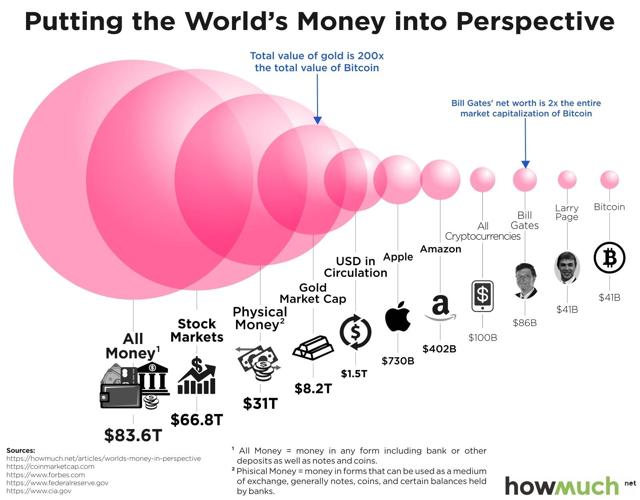
The market cap of bitcoin, now that the price has risen to $2,700, is around $45 billion. A decade ago, the term billion meant something. You didn’t really hear much talk of trillions. But thanks to our central planners and their lackeys in government, trillions are now the new billions. At any rate, let’s take a look at bitcoin’s valuation versus other markets in order to put things into perspective:

https://static.seekingalpha.com/uploads/2017/6/27/saupload_bitcoin-all-money-perspective_thumb1.jpg

Despite the rapid rise in the bitcoin price, it is still worth no more than the wealth of Google (NASDAQ:GOOG) co-founder Larry Page alone. Bill Gates could buy all of the bitcoin in existence, twice over. The total value of all bitcoin is just 1/10th of Amazon’s (NASDAQ:AMZN) market cap or 1/17th of Apple’s (NASDAQ:AAPL) market cap.

While the price of a Bitcoin surpasses that of an ounce of gold for the first time earlier this year, the total value of gold is still 200 times the value of bitcoin. Even if we take into account the value of all cryptocurrencies at around $100 billion, Apple is still worth 4 times this number and the gold market is valued at more than 80 times all cryptocurrencies combined!


The total market value of publicly traded shares at stock exchanges around the world is $66.8 trillion. This is nearly 1,500 times the valuation of bitcoin or 670 times the valuation of all cryptocurrencies combined.

When we move into central bank funny money, the total amount of money in the world is $84 trillion, or roughly 800 times the value of all cryptocurrencies in existence. In physical coins and notes, the total global money supply is $31 trillion or 310 times the value of all cryptocurrencies.

So, while the meteoric rise of bitcoin has led to a significant market valuation, it is still small relative to other markets or even relative to the wealth of a single software entrepreneur. What happens when even a small percentage of the $67 trillion invested in stocks or $83.6 trillion in central bank money begins to move into bitcoin and other cryptocurrencies?

This possibility is not nearly as far-fetched as it may seem on the surface. People are losing trust in government/central bank money and other traditional measures of wealth. As this trend accelerates, I believe an increasing amount of money will flow into bitcoin and other cryptocurrencies, pushing their valuations many times higher than today.

Is bitcoin overvalued? Are the cryptocurrency markets in a bubble about to burst?

Nope, not by a long shot. At the very least, I believe these markets need to reach parity with the gold market, which implies an increase in the valuation of cryptocurrencies of at least 80 times the current valuation. That would turn an investment of just $12,500 into $1 million!

So even if you’ve missed the incredible bull market in cryptocurrencies thus far, I believe there is still plenty of upside ahead. While I continue to hold bitcoin and Ethereum has core positions, I am especially bullish on a number of altcoins that I think will outperform bitcoin by a wide margin over the next 12-24 months.

By Jason Hamlin | Seeking Alpha

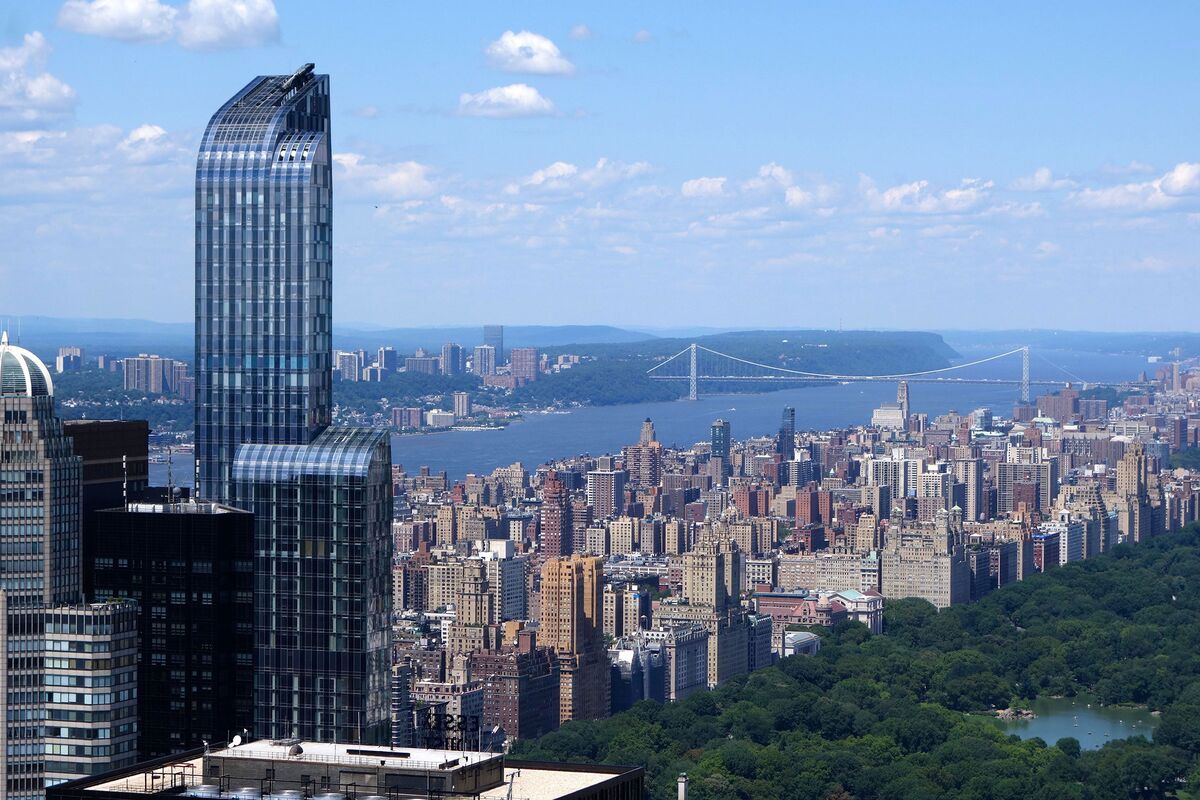
Another Huge Foreclose Hits NYC Billionaire Row

https://assets.bwbx.io/images/users/iqjWHBFdfxIU/iPFENNj86ytU/v3/1200x-1.jpg

Meet The Money-Laundering, Nigerian Oil Magnate Behind New York’s $50MM Condo Foreclosure

Yet another luxury condo at Manhattan’s One57 tower, a member of “Billionaire’s Row,” a group of high-end towers clustered along the southern edge of Central Park, had gone into foreclosure – the second in the span of a month.  The 6,240-square-foot, full-floor penthouse in question, One57’s Apartment 79, sold for $50.9 million in December 2014, making it the eighth-priciest in the building and likely the largest residential foreclosure in Manhattan’s history.

According to Bloomberg, the owner of the apartment attempted to conceal his/her identity by using a shell company (you know how those kooky billionaires can be) but was able to obtain an ‘unusually large’ mortgage with an even more unusual term: one-year.

In September 2015, the company took out a $35.3 million mortgage from lender Banque Havilland SA, based in Luxembourg. The full payment of the loan was due one year later, according to court documents filed in connection with the foreclosure.

The borrower failed to repay, and now Banque Havilland is forcing a sale to recoup the funds, plus interest.

Of course, it was only a matter of time until the mystery man behind Manhattan’s most recent luxury real estate epic fail was exposed.  As such, meet Nigerian oil magnate, Kola Aluko.

https://i0.wp.com/www.zerohedge.com/sites/default/files/images/user230519/imageroot/2017/06/24/2017.06.24%20-%20Kola%202_0.JPG

As it turns out, the world renowned, Nigerian-born, billionaire playboy is about $25,000 behind on his property taxes.  But, that is probably the least of his worries as the New York Post points out that he currently wanted by authorities in both Nigeria and Europe for defrauding the Nigerian government out of oil sale profits.

But Aluko has bigger problem, it seems. The 47-year-old tycoon is under investigation in Nigeria and in Europe for alleged money-laundering crimes.

A Nigerian court, according to various reports, tried to freeze Aluko’s assets, including his One57 unit, as part of the alleged scheme to defraud the government of oil sale profits.

Meanwhile, it seems that the only reason Aluko isn’t already in prison is because the Nigerian courts can’t seem to find him to serve papers.  Apparently he’s been hiding out on this 213-foot, $100 million yacht, the Galactica Star, for over a year.

https://i0.wp.com/www.zerohedge.com/sites/default/files/images/user230519/imageroot/2017/06/24/2017.06.24%20-%20Kola%20Boat%201_0.JPG

Over the past year, the boat has been spotted making port calls in Cancun, Mexico and Turkey.

https://i0.wp.com/www.zerohedge.com/sites/default/files/images/user230519/imageroot/2017/06/24/2017.06.24%20-%20Kola%20Boat%202.JPG

Of course, if you’re going to be an international playboy then you need to have rich and famous friends and, as it turns out, rappers Jay-Z and P. Diddy seemed to have fulfilled that role for Aluko.  Back in 2012 the rap duo apparently hosted Aluko’s birthday party in Beverly Hills.  Then, just a few years later in 2015, Jay-Z and wife Beyonce rented Aluko’s mega-yacht for the bargain basement price of just $900,000 per week to sail around the Mediterranean.

https://i0.wp.com/www.zerohedge.com/sites/default/files/images/user230519/imageroot/2017/06/24/2017.06.24%20-%20JayZ_0.JPG

Well, presumably it was fun while it lasted.

Source: ZeroHedge


What Amazon Did To Malls, It Will Now Do To Grocery Stores

Amazon bought Whole Foods today. Widespread carnage in the grocery stock prices followed. Jim Cramer called it a major deflationary disruption saying stores cannot compete.

https://mishgea.files.wordpress.com/2017/06/amazon-whole-1.png

“If I was the Federal Reserve, I would have a meeting on this. Inflation is going to go down…. You have to rethink food … Costco knows how to compete. It will be in there tooth and nail with toilet paper and paper towels. … But Kroger, a crisis in Cincinnati, crisis.”

“Major Disruption of Society”

https://mishgea.files.wordpress.com/2017/06/whole-food-markets.png

SupplyChain247 reports Amazon’s Move to Purchase Whole Foods Is ‘Disruption of Society’

TheStreet’s Action Alerts PLUS Portfolio Manager Jim Cramer said Amazon’s move to acquire Whole Foods is a disruption of society, “this is what I regard to be a move by Amazon to destroy the margins and own the business of food and groceries in this country,” Cramer said.

With Amazon putting down $13.7 billion to buy Whole Foods, Bezos is sending a powerful message to his retail rivals;

  • Food suppliers will now be dealing with an even larger grocery store, meaning potentially pressured profit margins for organic players such as Hain Celestial.
  • Amazon officially shows intent to enter bricks-and-mortar retail in a larger way than just bookstores. Combine that with its unmatched digital presence, Walmart, Target and others have been put on notice.
  • Grocer stores like Kroger will now be in an even bigger price war.
  • Amazon Prime integrated into Whole Foods could hurt Costco over time. Many Costco members are also Prime members.

“What Amazon did to the mall, it will now do to grocery stores,” said Cramer.

Here is a Tweet to think about:

https://s15-us2.ixquick.com/cgi-bin/serveimage?url=http%3A%2F%2Fww2.hdnux.com%2Fphotos%2F61%2F76%2F72%2F13102721%2F3%2F1024x1024.jpg&sp=b76e76c7757b7554682dd83e6c322f6e

By Mike “Mish” Shedlock


Central Banks Are Driving Many To Cryptocurrencies

Two years ago, Bitcoin was considered a fringe technology for libertarians and computer geeks. Now, Bitcoin and other cryptocurrencies, such as Ethereum, are gaining mainstream adoption. However, mainstream adoption has been propelled by financial speculation instead of by demand for a privately minted and deflationary medium of exchange. After the Fed’s rate hike this week, Bitcoin and alternative cryptocurrencies, such as Ethereum and Dash dropped in value instantly. Bitcoin, for example, dropped by approximately 16% in value while other coins dropped by approximately 25%. However, Bitcoin’s price recovered to the previous high within 18 hours.

https://i0.wp.com/www.zerohedge.com/sites/default/files/images/user3303/imageroot/2017/06/14/20170617_btcx1.jpg

Contrary to popular belief that Bitcoin is deflationary, the currency currently has an annual inflation rate of approximately 4%. The reason that Bitcoin allows investors to hedge the expansionary monetary policies adhered to by central banks is because the demand for Bitcoin is growing at a pace that is higher than the increase in the supply of Bitcoin. As explained in a Mises Daily article written by Frank Shostak in 2002, the term inflation was originally used to describe an increase in the money supply. Today, the term inflation refers to a general increase in prices.

If the original definition is applied, then Bitcoin is an inflationary currency. However, as I discussed in the 2017 edition of In Gold We Trust, the supply of newly minted Bitcoin follows a predictable inflation rate that diminishes over time. Satoshi modeled the flow of new Bitcoin as a Poisson process, which will result in a discernible inflation rate compared to the stock of existing Bitcoin by 2020. Every four years, the amount of Bitcoin minted annually is halved. The last programmed “halving” occurred in June of 2016. Therefore, the next halving will occur in 2020. The inverse of the inflation rate, the StFR, also indicates the decreasing flow of newly minted coins into the Bitcoin economy. The stock to flow ratio (StFR) of Bitcoin is currently 25 years; however, the StFR ratio will increase to approximately 56 years. This means that the StFR of Bitcoin should surpass gold’s during the next five years. Prior to January 3, 2009, no Bitcoin existed. Therefore, Bitcoin’s StFR was effectively zero. However, the rapid reduction in the amount of Bitcoin mining over time results in an increasing StFR over time. By 2024, only 3.125 Bitcoin will be mined every ten minutes resulting in a StFR of approximately 119 years.

If the new meaning of inflation is applied, then Bitcoin is deflationary because the purchasing power of each unit increases overtime.

When I began investing in Bitcoin in 2014, a Model S Tesla worth $70,000 cost 230 Bitcoin. Today, a Model S Tesla worth $70,000 costs 28 Bitcoin. On June 11 of this year, the price of Bitcoin reached a new all-time high above $3,000 after trading at approximately $2,300 two weeks ago. Furthermore, Bitcoin’s market capitalization of $40 billion is expected to rise further as the uncertainty surrounding this technology decreases. Bitcoin’s price data only covers the past six years, which means there is basically no data available for statistical analysis.

Risk Assessments

The Ellsberg paradox shows that people prefer outcomes with known probability distributions compared to outcomes where the probabilities are unknown. The estimation error associated with forecasts of Bitcoin’s risks and returns may be negatively biasing the price downward. As time passes, people will become more “experienced” with Bitcoin, which may reduce uncertainty and the subsequent discount it wields on the price of Bitcoin.

An economic downturn occurs approximately once every ten years in the US, and it has been a decade since the 2007/2008 financial meltdown. If the economy cannot handle the increase in rates, and the Fed is forced to reverse their decision, the price of Bitcoin and other cryptocurrencies are likely to respond positively. Although the cryptocurrency market took a steep plunge after Janet Yellen’s second rate hike of 2017, prices fully recovered within a day. The quick rebound underscores the lack of assets that allow investors to accumulate wealth safely. Negative interest rates in Europe and fiat demonetization in developing countries are still driving demand for Bitcoin and alternative cryptocurrencies. Although Bitcoin was initially ridiculed as money for computer nerds and a conduit for illegal activity, investors are beginning to see the potential for this technology to be an integral part of wealth management from the perspective of portfolio diversification.

Demelza Hays via The Mises Institute | Clipped From ZeroHedge

NAR Cites “Housing Emergency” as Starts Unexpectedly Dive 5.5 Percent: NAR “Befuddled”

https://s14-eu5.ixquick.com/cgi-bin/serveimage?url=http%3A%2F%2Fblog.newinhomes.com%2Fwp-content%2Fuploads%2F2017%2F05%2Fconstruction-6-642x336.jpg&sp=e923574909156e73634c83abbc3a079a

The second-quarter economic report misery continues in a major way today with housing starts and permits unexpectedly falling.

The Econoday consensus was was for starts to rise 4.35%. Instead, starts fell 5.5%. Adding insult to injury, April was revised lower by 1.37 percentage points making the consensus estimate off by an amazing 11.22 percentage points.

The bad economic news keeps building, this time in the housing sector. Housing starts fell an unexpected 5.5 percent in May to a far lower-than-expected annualized rate of 1.092 million with permits likewise very weak, down 4.9 percent to a 1.168 million rate.

All components show declines with single-family starts down 3.9 percent to a 794,000 rate and permits down 1.9 percent to 779,000. Multi-family starts fell 9.7 percent to 298,000 with permits down 10.4 percent to 389,000. Total completions did rise 5.6 percent to a 1.164 million rate, which adds supply to a thin market, but homes under construction slipped 0.7 percent to 1.067 million.

Adding to the bad news are downward revisions to starts including April which is now at 1.156 vs an initial 1.172 million. Looking at the quarter-to-quarter comparison, starts have averaged 1.124 million so far in the second quarter, down a very sizable 9.2 percent from 1.238 million in the second quarter. Permits, at an average of 1.198 million, are down 4.9 percent.

Residential investment looks to be yet another negative for second-quarter GDP.

Housing Emergency?

Mortgage News Dailly has some amusing comments by Lawrence Yun, the National Association of Realtors chief economist, in its report Drop in Housing Starts Could Intensify Inventory Issues.

The negative report prompted the following statement from the National Association of Realtor’s Chief Economist Lawrence Yun. “Housing shortages look to intensify and may well turn into a housing emergency if the discrepancy between housing demand and housing supply widens further. The falling housing starts and housing permits in May are befuddling given the lack of homes for sale and the quick pace of selling a newly-constructed homes. Meanwhile, job creations of a consistent 2 million a year will push up housing demand further. One thing that moving up is the housing costs for consumers: higher home prices and higher rents.”

NAR “Befuddled”

Yun is befuddled. That’s hardly surprising given that it does not take much to befuddle economists.

Let me clear up the confusion:

  • People cannot afford homes so they are not buying them.
  • Builders will not purposely build homes to sell at a loss.
  • The alleged demand for new homes is imaginary.

Such analysis is beyond the scope of most economists, so I am happy to help out.

By Mike “Mish” Shedlock

I was wrong about Ethereum

https://martinhladyniuk.com/wp-content/uploads/2017/06/8e8ec-1pefoggpju2yc3xlxyvnlnq.png

I was wrong about Ethereum because it’s such a good store of value…

no wait, let me try again.

I was wrong about Ethereum because it’s such a decentra…

nope.

I was wrong about Ethereum because everyone is using it as a supercomputer…

No.

I do admit I didn’t see this Ethereum bubble coming, but then again I wrongly assumed that no startup would need or even dare to ask $50 million in funding and I also wrongly assumed that people would use common sense and that leading developers would speak out against this sort of practice. Quite the opposite it seems.

Ethereum’s sole use case at the moment is ICOs and token creation.

https://martinhladyniuk.com/wp-content/uploads/2017/06/20d2d-1ta-18j7fq5drlgmvkastrg.gif

What’s driving the Ethereum price?

Greed.

Greed from speculators, investors and developers.

https://martinhladyniuk.com/wp-content/uploads/2017/06/dd025-16j36g9dnmdn5zwhcygwmvq.gif

Can you blame them? 

Speculators and investors: No.

Developers: Absolutely.

So let’s think for a minute and think what determines the price? Supply + demand. Pretty straightforward.

Supply: the tokens that are available on the market, right? But with every ICO there are more tokens that are being “locked up”. Obviously the projects will liquidate some, to get fiat to pay for development of their project, but they also see the rising price of Ethereum. So at that point greed takes over and they think, totally understandable, “We should probably just cash out what we really need and keep the rest in ETH, that’s only going up anyway it seems.”
And obviously there are new coins being mined, but if you look at the amount of ETH these ICOs raise, at this point, it’s just a drop in a bucket.

Demand: You have the normal investors (who are already very late to the game at this point… as usual), but the buy pressure that these ICOs are creating is crazy and scary. Take TenX for example, it’s an upcoming ICO at the end of the month. The cap is 200,000 ETH (at current ETH price of $370) that’s $74,000,000 for a startup. Here’s the best part: it’s only 51% of the tokens. Effectively giving it an instant $150 million valuation (if it sells out, which it probably will).
Another example is Bancor, a friend of mine runs a trading group, he collected 1,100+ BTC to put into Bancor. This needs to be converted into ETH before the sale starts. These are decent size players, but not even the big whales who participate in these ICOs.

https://martinhladyniuk.com/wp-content/uploads/2017/06/d249a-1aycmygxz5x0g7grgqo-o0g.jpeg

What will the price do next?

It can go quite a bit higher, there are so many coins being taken off the market by these ICOs, that it can still continue for a while and everyone is seeing this and thinking: “Why aren’t I doing an ICO”. There are lots more coming.

At one point it will crash, hard. What the trigger will be? Bug(s) in smart contracts, major hack, big ICO startup that fails/fucks up, network split, even something as silly as not having a decent ICO for a couple of weeks which creates sell pressure from miners and ICO projects can cause a big crash. It’s not a question of “if”, it’s a question of “when”. That being said: Markets can remain irrational for quite a long time.

Usually when a bubble like this pops we could easily see 70–80% loss of value (for reference: Bitcoin went from $1,200 to $170 after 2013–2014 bubble). This is however quite the unusual situation and I’m not sure to what kind of bubble I can really compare it.

I’m sure most of you have seen “Wolf of Wall Street”. Just re-watch this clip and see if you find any similarities with the current situation. (bonus clip)

What I really find interesting is what the ICO startups will do, Bitcoin had hodlers and investors mainly, individuals who most of the time had a fulltime job and didn’t need to sell. With Ethereum there is this huge amount being held by companies who need to pay bills. Will they panic dump to secure a “healthy” amount of fiat funding, will they try to hold through a bear cycle?

Taking Responsibility:

Everyone loves making money, you can’t blame traders or investors from taking advantage of this hype. That would be silly. People will buy literally anything if they can make a quick buck out of it.

The responsibility here is with the developers, Consensys and the Ethereum Foundation but they don’t take responsibility since they’re getting more money. This will end with the regulators stepping in.

The reason why I say that it’s with developers, Consensys and the Ethereum Foundation is simple:

  • The developers of a project assign these crazy token sale caps, more money than any startup would ever need.
  • The Ethereum foundation members+ core developers use their own celeb status to actively promote these projects as advisors, for which they’re compensated well, luring in people who have no clue what they’re buying.
  • Consensys promotes all of this since it’s the marketing branch of Ethereum. The more fools that buy in, the better.

Let me illustrate this with an example. Have you heard of primalbase? It’s an ICO with a token for shared work spaces. Why would a shared work space need its own token? It doesn’t, it really really really doesn’t. Let’s take a look at the advisors:

https://martinhladyniuk.com/wp-content/uploads/2017/06/6a588-1hyey0dln9laomkewvtzm0w.png

First thing that an advisor should’ve said in this case was: “Don’t do it, it’s stupid, it makes no sense.” But well there we have Mr Ethereum himself.

We all know that Vitalik has a cult-like following with the Ethereum investors so it will be very easy for primal base to launch their ICO and use Vitalik’s face and name to get itself funded.

This is just one example, if you go through all of these ICOs you find a lot of familiar names and faces. Nothing wrong with being an advisor, but when you’re just sending people to the slaughterhouse…

The sad part is that a lot of people will lose a lot of money on this, some of them obviously more than they can afford to lose, that’s how it always goes. The regulators will step in after this bubble pops and what scares me is the fact that it will damage all of crypto, including Bitcoin, not just Ethereum and its ICO’s.

https://martinhladyniuk.com/wp-content/uploads/2017/06/99108-1fjx5ibm_funxytvx8im-va.jpeg

But you’re just an Ethereum hater

I’ve heard all the accusations:

  • I hate Ethereum because I’m a Bitcoin Maximalist. I’m not, I like other projects too, like Siacoin for example.
  • I hate Ethereum because I missed out. I did miss out on the crowdsale, but I traded plenty of Ethereum and it’s ICOs and made some nice profit.
  • I hate Ethereum because I don’t understand it. Really? Do you? The only smart contracts running on it are ICO token sales. Or contracts to buy ICO tokens the second they become available.
  • I hate Ethereum because I’m jealous of Vitalik. No, it’s impressive what he did at his young age. At the same time I think he’s largely responsible for this bubble and he has made a lot of mistakes. We all make mistakes, but bailing out your friends from the DAO while other hacks and losses aren’t compensated or fixed just shows total lack of integrity. Or it’s everything or it’s nothing. And when it comes to immutability in crypto, it should be nothing.

For the people that are scared that Ethereum will replace Bitcoin

Ethereum is not a store of value. It isn’t capped. Yes, I know they’re planning to switch to PoS (which it already kind of is). Do you think they managed to create the first software implementation ever without any bugs? Doing such a major change on a (currently) $30 billion market is completely irresponsible, borderline insanity. Even if we assume that there are no bugs, what about the miners? The miners who bought their equipment to mine Ethereum, the miners that supported the network for years. “But they knew we were switching to PoS.” Of course they knew, and do you think they’ll just give up on such a profitable coin? Some might switch immediately to Zcash and Ethereum Classic but there will be another fork and we’ll have ETHPoS and ETHPoW, with of course all the Ethereum tokens being on both chains. Even Ethereum developers think that his is a very likely scenario.

Ethereum’s fees are lower. They are, sometimes, by a bit. If you’re trying to send something when no token sale is active obviously, else you have people spending $100’s to get in on the token sale and clog up the network. Also doesn’t apply when you send something from exchanges since for example with Poloniex it’s about $1.9 vs $0.28 for Bitcoin. Oh and another exception is when you actually use it for smart contracts, which require more gas to process than a normal transactions from account A to account B. You know.. the actual reason why Ethereum was created.

Ethereum is not decentralized. Bitcoin isn’t as decentralized as it should be, we all know that, but compared to most other coins, Bitcoin is very decentralized. Vitalik has called himself a benevolent dictator in the past. He is the single point of failure in this project and if he gets compromised in any way that’s the end. There is no way of knowing if this happens and since people blindly follow everything he says, he has the power to do anything. Satoshi was smart enough to remove himself from the Bitcoin project.

Ethereum is not immutable. Don’t have to spend much time on this: see DAO and split that lead to Ethereum and Ethereum Classic.

Ethereum has the Enterprise Ethereum Alliance. But but but.. all those big banks use Ethereum. No, they don’t. They use “an” Ethereum, which is a (private) fork of Ethereum. By that definition 99% of all altcoins are using Bitcoin. Still a separate chain. The fact that we’re talking about a private blockchain here actually makes altcoins more like Bitcoin than “an Ethereum” that EEA uses like Ethereum. You can compare it to 2013–2014 when some companies started to get interested in blockchain vs Bitcoin, only difference here is that for Ethereum it’s part of their marketing campaign to lure in potential investors.

If you think I’m just full of crap, which is fair, I am just some random popular guy on Twitter who has been around from before Ethereum. Have a look at what Vlad has to say about the current state of Ethereum here and here. Vlad Zamfir is probably the smartest guy on the Ethereum team, and I say this while I don’t agree with him on many of his opinions, I do respect him.

Conclusion:

If you’re an actual developer, be realistic and honest with your investors. Do you really ever need more than $5 mill? Finish a MVP first and then do a tokensale, if you really really need to do an ICO. Plenty of rich crypto investors and traders now that would love to be part of your project and who would be happy to just invest for equity. Yes, it will probably be less than what you can get in an ICO, but at least you didn’t sell out and it shows you actually really care about your product/service/…

If you’re a trader or investor, be realistic about the bubble. I know you hear this a 100 times when you’re trading but: don’t invest what you can’t afford to lose. 
I have some Ethereum, not as a long term investment, but because the price is going up and I need it to invest in tokens which I can quickly flip as soon as they come on the market. That’s just the type of market we’re in. Everyone is making a lot of money, awesome right? What could potentially go wrong.

https://martinhladyniuk.com/wp-content/uploads/2017/06/c07e5-1bvz_kr86wkgx_jobtahdew.gif

By Whale Panda | Medium

Cryptocurrencies Will Make The Next Crisis Worse … For Banksters

(The International Reporter, Editor’s Note): Let me remind Bundesbank and all the other banks, that after the 2008 crisis and the ‘too big to fail”criminality that since then has stolen tax payers money globally, that nobody is interested in the banking industry anymore. Along with their compounding interest rates they are seen as liars, cheats, thieves and outright criminals cashing in on the misfortune of others. Digital currencies are far safer…so far… and are the only outlet since these same criminals have been rigging the precious metals prices, currencies exchange rates and the markets in general to their own benefit and to the detriment of everyone else.

* * *

(ZeroHedge) When global financial markets crash, it won’t be just “Trump’s fault” (and perhaps the quants and HFTs who switch from BTFD to STFR ) to keep the heat away from the Fed and central banks for blowing the biggest asset bubble in history: according to the head of the German central bank, Jens Weidmann, another “pre-crash” culprit emerged after he warned that digital currencies such as bitcoin would worsen the next financial crisis.

As the FT reports, speaking in Frankfurt on Wednesday the Bundesbank’s president acknowledged the creation of an official digital currency by a central bank would assure the public that their money was safe. However, he warned that this could come at the expense of private banks’ ability to survive bank runs and financial panics.

As Citigroup’s Hans Lorenzen showed yesterday, as a result of the global liquidity glut, which has pushed conventional assets to all time highs, a tangent has been a scramble for “alternatives” and resulted in the creation and dramatic rise of countless digital currencies such as Bitcoin and Ethereum. Citi effectively blamed the central banks for the cryptocoin phenomenon.

https://i0.wp.com/www.zerohedge.com/sites/default/files/images/user5/imageroot/2017/06/04/citi%20lor%205_0.jpg

Weidmann had a different take, and instead he focused on the consequences of this shift towards digitalisation which the Bundesbank president predicted, would be the main challenge faced by central banks. In an ironic twist, in order to challenge the “unofficial” digital currencies that have propagated in recent years, central banks have also been called on to create distinct official digital currencies, and allow citizens to bypass private sector lenders. As Weidmann explained, this will only make the next crisis worse:

Allowing the public to hold claims on the central bank might make their liquid assets safer, because a central bank cannot become insolvent. This is an feature which will become relevant especially in times of crisis when there will be a strong incentive for money holders to switch bank deposits into the official digital currency simply at the push of a button. But what might be a boon for savers in search of safety might be a bane for banks, as this makes a bank run potentially even easier.

Essentially, Weidmann warned that digital currencies – whose flow can not be blocked by conventional means – make an instant bank run far more likely, and in creating the conditions for a run on bank deposits lenders would be short of liquidity and struggle to make loans.

“My personal take on this is that central banks should strive to make existing payment systems more efficient and still faster than they already are – instant payment is the buzzword here,” the Bundesbank president said. “I am pretty confident that this will reduce most citizens’ interest in digital currencies.”

Which, considering the all time highs in both Bitcoin and Ethereum, would suggest that citizens faith and confidence in the existing “payment systems”, and thus central banks, are at all time lows.

* * *

The Next Financial Crisis Has Already Arrived In Europe, And People Are Starting To Freak Out


China Says “Don’t Panic” As Yield Curve Inversion Deepens Amid Liquidity Collapse

The curious case of the inverted yield curve in China’s $1.7 trillion bond market is worsening as WSJ notes that an odd combination of seasonally tight funding conditions and economic pessimism pushed long-dated yields well below returns on one-year bonds, the shortest-dated government debt.

10-Year China bond yields fell to 3.55% overnight as the 1-Year yield rose to 3.61% – the most inverted in history, more so than in June 2013, when an unprecedented cash crunch jolted Chinese markets and nearly brought the nation’s financial system to its knees.

https://i0.wp.com/www.zerohedge.com/sites/default/files/images/user3303/imageroot/2017/06/11/20170613_china2_0.jpgThis inversion is being exacerbated by seasonally tight funding conditions.

June is traditionally a tight time for banks because of regulatory checks, and, as Bloomberg reports, this year, lenders are grappling with an official campaign to reduce the level of borrowing as well.

Wholesale funding costs climbed to the most expensive in history, and the 30-day Shanghai Interbank Offered Rate has jumped 51 basis points this month to the highest level in more than two years.

https://i0.wp.com/www.zerohedge.com/sites/default/files/images/user3303/imageroot/2017/06/11/20170613_china1_0.jpg

And this demand for liquidity comes as Chinese banks’ excess reserve ratio, a gauge of liquidity in the financial system, fell to 1.65 percent at the end of March, according to data from the China Banking Regulatory Commission. The index measures the money that lenders park at the PBOC above and beyond the mandatory reserve requirement, usually to draw risk-free interest.

“Major banks don’t have much extra funds, as is shown by the excess reserve data,”
analysts at China Minsheng Banking Corp.’s research institute wrote in a June 5 note. Lenders have become increasingly reliant on wholesale funding and central bank loans this year, they said.

https://i0.wp.com/www.zerohedge.com/sites/default/files/images/user3303/imageroot/2017/06/11/20170613_china3_0.jpg

As The Wall Street Journal reports, an inverted yield curve defies common understanding that bonds requiring a longer commitment should compensate investors with a higher return. It usually reflects investor pessimism about a country’s long-term growth and inflation prospects.

“But the curve inversion we are seeing right now is one with Chinese characteristics and it’s different from the previous one in the U.S.,” said Deng Haiqing, chief economist at JZ Securities.

The current anomaly in the Chinese bond market is partly the result of mild inflation and expectations of a slowing economy, Mr. Deng said. “At the same time, short-term interest rates will likely stay elevated because the authorities will keep borrowing costs high so as to facilitate the deleveraging campaign,” he said.

Notably, it appears officials are concerned at the potential for fallout from this crisis situation.

In an article published Saturday, the central bank’s flagship newspaper, Financial News, said that the severe credit crunch four years ago won’t repeat itself this month because the central bank will keep liquidity conditions “not too loose but also not too tight.”


Chinese financial markets tend to be particularly jittery come June due to a seasonal surge of cash demand
arising from corporate-tax payments and banks’ need to meet regulatory requirements on capital.

On Sunday, the official Xinhua News Agency ran a similar commentary that sought to stabilize markets expectations. “Don’t panic,” it urged investors.

Sounds like exactly the time to ‘panic’ if your money is in this.

Source: ZeroHedge

You Can Now Buy Weed-Infused Wine In CA

https://i0.wp.com/www.trueactivist.com/wp-content/uploads/2017/06/Cannabis-Wine-1-1024x512.jpg

(True Activist) As consumers become more educated on the benefits of marijuana — both recreational and medicinal, it continues to be decriminalized at an increasing pace. So far, 29 states (and DC) in the United States have legalized cannabis for medicinal use and eight for recreational. With the freedom to cultivate the herb and utilize it in numerous ways, entrepreneurs have started experimenting with cannabis and infusing it into a variety of edibles — such as baked goods, candies, soda and now… wine.

That’s right, cannabis-infused wine (otherwise known as Canna Vine) is finally available for sale in California. According to the Los Angeles Times, the beverage is made from organically grown marijuana and bio-dynamically farmed grapes. Because the product is low in THC — the primary psychoactive compound found within cannabis — it delivers a mellow “body high” without large effects.

The innovative wine was developed by cancer survivor Lisa Molyneux, who owns the dispensary Greenway in Santa Cruz, and Louisa Sawyer Lindquist, who owns Verdad Wines in Santa Maria. Molyneux, particularly, was inspired to invent the wine to aid fellow cancer survivors.


There’s a reason Canna Vine costs anywhere from $120 to $400 for half a bottle. The process to make the product begins with one pound of marijuana. After the weed is wrapped in cheese cloth, it is added to a barrel of wine where it sits for approximately one year to ferment and repose.

Though the concept of cannabis-infused wine is nothing new (in ancient China, it was prescribed for pain relief), the fact that it can be legally procured in the modern age is.

https://i0.wp.com/www.trueactivist.com/wp-content/uploads/2017/06/Cannabis-Wine-3-1024x683.jpg

The founders of Canna Vine are presently experimenting with the green wine (literally) to find the best balance of Sativa and Indica. Their ultimate aim is to sell a wine that creates “uplifting and relaxing sensations.”

Said Molyneux,

“What’s nice about it is how subtle it is. There’s a little flush after the first sip, but then the effect is really cheery, and at the end of the night you sleep really well. It really is the best of both worlds; you get delicious wines with medicinal benefits.”

Melissa Etheridge, — a prominent advocate of Canna Vine — credits the beverage with helping her through chemotherapy. She said,

“When I was in my deepest, darkest, last throes of chemo,” says Etheridge, “I couldn’t smoke or use a vaporizer — and I was never really an edibles eater; I didn’t want to be ‘out of it.’”

“It lands in a really beautiful place,” she added.

What’s the catch?

First of all, the infused wine is only legal to purchase in California. Second, one needs a medical marijuana license to purchase the product.

California is presently the only place one can procure alcohol infused with weed. Even states like Washington, Oregon, and Colorado don’t allow the combination to be produced or sold.

Presently, both Molyneux and Lindquist seek to refine the wine to position themselves in the market of high-quality cannabis-infused products. Said Lindquist,

“Cannabis wine has been so effective as a stress reliever, as a mood elevator, and as a medicineI have no idea what the market will be like for it, but whatever I make I want to be safe, made from pure ingredients and, hopefully, delicious.”

Source: New World Order Report

Whistleblower: “All misery on earth is a business model”

Dutch banking whistle blower Ronald Bernard is back and this time he’s exposing the entire international banking  syndicate which controls not only the global monetary system, but the entire planet itself and all of its resources. The Bank For International Settlements sits atop the pyramid of power, followed by the IMF and World Bank. The power and directives flow downward through the big international banks, the multinational corporations, and finally to the governments. As Bernard explains, “All misery on earth is a business model.”


SGT Interview Summary Begins at 1:52

Full Interview: Part 1

Full Interview: Part 2

The Math Of Bitcoin And Why It’s Not Yet In A Bubble [video]

I have read many articles lately claiming that Bitcoin is in a bubble.  Some proclaim it similar to the famous Great Tulip bubble of 1637… but that comparison is only for those who do not understand the significance of what is happening currently with blockchain technology.  If you are new to Bitcoin and blockchain technology, I would suggest that it’s highly important for you to take the time to research the basics of how it works and why it’s different – simply Google “how does Bitcoin work.”

The main argument of those who proclaim it to be in a bubble is that the people buying it at these prices are not buying it for its original purpose – which they believe to be enabling transactions.  Yes, it is being used for transactions, much more than 100,000 businesses now take Bitcoin for transactions.  But instead naysayers believe that others are buying it as an “investment” and thus will surely be burned.

For me, and I believe most who understand what is happening, we are not buying it for either of those reasons.  We own it because we see it acting as a “store of value,” where nothing else priced in dollars is.  With interest rates artificially low (manipulated by central banks), a normal person cannot earn even near the pace of actual inflation with any type of traditional savings account.  Bonds are artificially in a bubble, stocks are artificially in a bubble, real estate is in yet another bubble, everywhere one who understands bubble dynamics looks they see a bubble (but not Bitcoin, people are trading in their worth less and less dollars for them).  The bubble is the dollar – the world’s “reserve” and “petro” dollar is being drowned by central banks all over the globe, not just our own “FED.”

And thus there is no store of value to be found.  This is a terribly ugly situation for people who believe in hard work and saving to get ahead; to someday retire comfortably.  Retirees on fixed incomes simply cannot, and will not be able to keep up as the impossible math of dollar debt continues on its vertical ascent.

We would love to love gold and silver, but those too, are manipulated by central banks who own the majority of it.  They manipulate and derivative the markets to artificially keep devaluation of the dollar hidden.

Control of the dollar is centralized with the banks, that’s why we refer to them as “central” banks.  All the power and control resides with them; as private individuals were wrongly, and illegally, given the power to “coin” money with the Federal Reserve Act of 1913.

What makes Bitcoin a better store of value?

1.  It is decentralized.  This is huge!  It means that it is not under the control of central banks, and thus cannot be manipulated directly by them.  This is THE MOST IMPORTANT aspect, it is a game changer as it changes the WHO is behind it – something that gold and silver do not do because central banks have printed “money” to buy the majority of it.

Caution – Central banks may be able to indirectly manipulate blockchain currencies in the future if they create ETFs and other derivatives based upon them.  This, however, will not change the underlying store of value, and when it happens I would encourage you not to own the derivative, but to instead buy Bitcoin directly, again because it’s not in control of the central banks, is decentralized versus their centralized everything which makes them vulnerable.  Yes – Central Banks can print dollars and use them to buy Bitcoin, but that will only drive the price up and cause others to enter as well.  In the end they cannot manipulate what they don’t control.

Even if central banks were to “ban” exchanges in one country, all one will have to do is join an exchange overseas.  This has the central banks trumped, it cannot be stopped.

To better understand the power of decentralization, please take the time to watch the video at the end of this post, or (click on this link).

2.  Unlike tulips, dollars, or even precious metals, Bitcoin is strictly limited in its supply.  This is where the math comes in.  Bitcoin was founded in 2008 and there will ultimately be only 21 million Bitcoin ever mined.  Today we are approaching the 80% mark, the remaining 20% will take years to mine, and the “mining” gets more difficult and slow as we go.

This is a hard feature built into the coding.  It’s what makes Bitcoin a store of value – the more money that comes in, the more each Bitcoin is worth.  As I type, that is $2,774.00 per Bitcoin according to Coinbase where you can go to open an account, much like a brokerage account (there are currently 7.3 million Coinbase users).  Of course you can buy Bitcoin in any increment, you don’t have to buy them in whole units.

People all over the world can buy, own, and transact in Bitcoin.  There are now 7.3 billion people on the planet, so if all 21 million Bitcoin were distributed evenly to every person on the planet, each person would have only .0028767 of one bitcoin!

Another way of stating that math is that only 1 person out of every 347.6 people can possibly ever own a whole Bitcoin.

Today the market cap of Bitcoin is $45.17 Billion.  The more money that comes in, the higher the market cap, the higher the price of Bitcoin.

Many analysts start to compare Bitcoin’s market cap with that of large companies like Apple, whose current market cap is 18 times that of Bitcoin’s at $810 Billion.

But here’s the deal.  Bitcoin is not a company, it is a form of money.  Unlike dollars, there will not be an endless supply.  In fact, if you took the entire M2 money supply of the United States, currently $13.5 trillion, and put it all into Bitcoin instead, then each Bitcoin would be worth $642,857.  But Bitcoin is not just traded in dollars – it’s traded in every currency in the world.  And right now global M2 money supply is calculated as roughly $72 trillion, or $3.4 million per Bitcoin.

It’s true that other blockchain currencies are springing up like daisies, or tulips.  But their market caps combined are just now rivaling that of Bitcoin’s.  So, yes, they will be “diluting” bitcoin’s math.  Not all crypto currencies have hard limits to their supply, and that will mean that they will always be worth less.  Right now Ethereum is in second place with a market cap of about $24 billion compared to Bitcoin’s $45 billion.  Litecoin is another cryptocurrency designed to be “silver” compared to Bitcoin’s “gold.”  There will only be 84 million Litecoins ever mined, exactly 4 times the amount of Bitcoins.  However, Litecoins are currently trading for roughly 1/100th the price of Bitcoin, I would expect the math to eventually catch up as more people become aware of Litecoin’s also limited supply.

3.  Bitcoin is a better store of value because it is secure.  Decentralization and encryption make it secure.  It can be stored in electronic cyber “vaults” where you keep a hard copy of the encryption cypher.  This means that your exchange can be hacked, your computer hacked, but your bitcoin don’t actually reside in either!  They reside on someone else’s computer somewhere – and only you have the code to get to it.  Thus they cannot be confiscated by a government, a banker, or a hacker.

I liken this to the pursuit of freedom versus the pursuit of security.  When you pursue freedom, you get security at very little cost.  That’s what decentralization does.  Bitcoin is the pursuit of freedom – whereas centralized systems, such as central banking, or even socialism, are the pursuit of security and the abandonment of freedom.

Pursue freedom!

4.  Bitcoin transactions are stored on a public ledger, all confirmed transactions are included in the blockchain.  Again, decentralized bookkeeping is less vulnerable and more secure than centralized legers.  This is where Ethereum, another blockchain currency, shines.  Ethereum is built upon an encrypted ledger and can be used for many purposes, not just as a currency.

One use is that these encrypted ledgers will enable safe and secure online voting one day soon.

Someday Bitcoin will, in fact, be in a bubble.  But that day is not now, not even close.  The great thing about all cryptocurrencies is that they can and do exist alongside of whatever “money” we use for our transactions.  They also exist alongside of gold/silver, and may in fact be drawing money that otherwise would be seeking a store of value there.

So I say, let competition reign!  I will use dollars for transactions because I have to (for now), but I will use cryptocurrencies, gold, and silver to park my dollars so that the central banks cannot destroy their value.  And that in a nutshell is why Bitcoin is NOT in a bubble, and won’t be for quite some time.

That said, do expect many sharp pullbacks along the way.  Remember that NOTHING moves in a straight line, EVERYTHING moves in waves.  You need to pullback to fuel the next push higher – this is true with all waves.   The chart shape is definitely showing parabolic growth, but I expect that when looked at across many more years this will simply be a part of building a base.

https://i0.wp.com/www.zerohedge.com/sites/default/files/images/user3303/imageroot/2017/06/07/20170609_btc_0.jpg

So how will we know that a true bubble has formed?  For me I know that cryptocurrencies are the future and that they will trade alongside sovereign currencies and will eventually replace them.  I will NOT own any cryptocurrency created or “managed” by a bank.  Until the market cap of Bitcoin rivals that of the United States, I will not be convinced that growth has stalled.  There are, of course, other signs we can look for.

As a review, here are HYMAN MINSKY’S SEVEN BUBBLE STAGES:

The late Hyman Minsky, Ph.D., was a famous economist who taught for Washington University’s Economics department for more than 25 years prior to his death in 1996. He studied recurring instability of markets and developed the idea that there are seven stages in any economic bubble:

Stage One – Disturbance:

Every financial bubble begins with a disturbance. It could be the invention of a new technology, such as the Internet (Bitcoin). It may be a shift in laws or economic policy. The creation of ERISA or unexpected reductions of interest rates are examples. No matter what the cause, the outlook changes for one sector of the economy.

Stage Two – Expansion/Prices Start to Increase:

Following the disturbance, prices in that sector start to rise. Initially, the increase is barely noticed. Usually, these higher prices reflect some underlying improvement in fundamentals. As the price increases gain momentum, more people start to notice.

*I THINK THIS IS WHERE BITCOIN IS NOW

Stage Three – Euphoria/Easy Credit:

Increasing prices do not, by themselves, create a bubble. Every financial bubble needs fuel; cheap and easy credit is, in most cases, that fuel (central banks creating it still like mad). Without it, there can’t be speculation. Without it, the consequences of the disturbance die down and the sector returns to a normal state within the bounds of “historical” ratios or measurements. When a bubble starts, that sector is inundated by outsiders; people who normally would not be there (not yet with Bitcoin). Without cheap and easy credit, the outsiders can’t participate.

The rise in cheap and easy credit is often associated with financial innovation. Many times, a new way of financing is developed that does not reflect the risk involved. In 1929, stock prices were propelled into the stratosphere with the ability to trade via a margin account. Housing prices today skyrocketed as interest-only, variable rate, and reverse amortization mortgages emerged as a viable means for financing overpriced real estate purchases. The latest financing strategy is 40, or even 50 year mortgages.

Stage Four – Over-trading/Prices Reach a Peak:

As the effects of cheap and easy credit digs deeper, the market begins to accelerate. Overtrading lifts up volumes and spot shortages emerge. Prices start to zoom, and easy profits are made. This brings in more outsiders, and prices run out of control. This is the point that amateurs, the foolish, the greedy, and the desperate enter the market. Just as a fire is fed by more fuel, a financial bubble needs cheap and easy credit and more outsiders.

(I believe stage 4 is still in the distant future for Bitcoin)

Stage Five – Market Reversal/Insider Profit Taking:

Some wise voices will stand up and say that the bubble can no longer continue. They argue that long run fundamentals, the ratios and measurements, defy sound economic practices. In the bubble, these arguments disappear within one over-riding fact – the price is still rising. The voices of the wise are ignored by the greedy who justify the now insane prices with the euphoric claim that the world has fundamentally changed and this new world means higher prices. Then along comes the cruelest lie of them all, “There will most likely be a ‘soft’ landing!”

This stage can be cruel, as the very people who shouldn’t be buying are. They are the ones who will be hurt the most. The true professionals have found their ‘greater fool’ and are well on their way to the next ‘hot’ sector.  Those who did not enter the market are caught in a dilemma. They know that they have missed the beginning of the bubble. They are bombarded daily with stories of easy riches and friends who are amassing great wealth. The strong will not enter at stage five and reconcile themselves to the missed opportunity. The ‘fool’ may even realize that prices can’t keep rising forever… however, they just can’t act on their knowledge. Everything appears safe as long as they quit at least one day before the bubble bursts. The weak provide the final fuel for the fire and eventually get burned late in stage six or seven.

Stage Six – Financial Crisis/Panic:

A bubble requires many people who believe in a bright future, and so long as the euphoria continues, the bubble is sustained. Just as the euphoria takes hold of the outsiders, the insiders remember what’s real. They lose their faith and begin to sneak out the exit. They understand their segment, and they recognize that it has all gone too far. The savvy are long gone, while those who understand the possible outcome begin to slowly cash out. Typically, the insiders try to sneak away unnoticed, and sometimes they get away without notice. Whether the outsiders see the insiders leave or not, insider profit taking signals the beginning of the end.

(This is where I believe Stocks, Bonds, Real Estate, Auto prices, Student loans, etc. are today; although it is wise to remember that the best performing markets in terms of percentage rise are the ones where hyperinflation is occurring – Zimbabwe, Nigeria, and today Venezuela.  An interesting thought is that we may see cryptocurrencies appear to be inflating while real assets move to another round of deflation – dollars seek safety/store of value)

Stage seven – Revulsion/Lender of Last Resort:

Sometimes, panic of the insiders infects the outsiders. Other times, it is the end of cheap and easy credit or some unanticipated piece of news. But whatever it is, euphoria is replaced with revulsion. The building is on fire and everyone starts to run for the door. Outsiders start to sell, but there are no buyers. Panic sets in, prices start to tumble downwards, credit dries up, and losses start to accumulate.

(When this happens to stocks, I expect Bitcoin and other cryptos to benefit).

By Nathan Martin | Economic Edge Blog

Tech-Wreck Continues – FANG Stocks Tumble Below Friday Flash-Crash Lows

It’s not over…

Felix Zulauf (via Barron’s round table)

Do you have any specific investment picks for the second half?

I don’t. Investors should tighten risk-management strategies to their portfolios. I expect the FANG stocks and the Nasdaq to have a big selloff. They could easily fall 30% or 40%. But I don’t want to end my Roundtable career on a bearish note. [Zulauf announced at the January Roundtable that he is “retiring” from the panel after this year.]

Once the bear market is over and the recession or economic crisis passes, stocks will go up again.

FANG Stocks just took out Friday’s flash-crash lows…

https://i0.wp.com/www.zerohedge.com/sites/default/files/images/user3303/imageroot/2017/06/11/20170612_fang4_0.jpg

Source: ZeroHedge

FANGs Flash Crashed – Worst Day Since Election

FANG Stocks: Coined by CNBC business pundit Jim Cramer, the term refers to four publicly-traded tech giants Facebook Inc. (FB), Amazon.com Inc. (AMZN), Netflix Inc. (NFLX), and Google (GOOGL), which is now Alphabet Inc. All four of the companies are online or tech-centric, command massive market shares in their respective industries and are valued and traded at very high prices.

The sudden rotation out of growth/momentum stocks, highlighted earlier, sure escalated quickly…

… With growth getting dumped…

https://i0.wp.com/www.zerohedge.com/sites/default/files/images/user3303/imageroot/2017/06/07/20170609_EOD4.jpg

… and AMZN flash-crashing:
https://i0.wp.com/www.zerohedge.com/sites/default/files/images/user3303/imageroot/2017/06/07/20170609_AMZN.jpg
Some zoomed in context:
https://i0.wp.com/www.zerohedge.com/sites/default/files/images/user3303/imageroot/2017/06/07/20170609_AMZN1.jpg
Even AAPL got hammered:
https://i0.wp.com/www.zerohedge.com/sites/default/files/images/user3303/imageroot/2017/06/07/20170609_AMZN2.jpg
In fact, all the FANG stocks were in trouble, on their biggest down day since the election:
https://i0.wp.com/www.zerohedge.com/sites/default/files/images/user3303/imageroot/2017/06/07/20170609_EOD3.jpg

Mall Tenants Are Seeking Shorter Leases

https://s14-eu5.ixquick.com/cgi-bin/serveimage?url=https%3A%2F%2Fwww.planetizen.com%2Ffiles%2Fimages%2Fshopping%2520mall.jpg&sp=0b43f95e3a26db3199afcda811c0c4f5

As if things weren’t bad enough for America’s mall owners, what with the having to filling their retail space with high schools, grocers and churches, it seems that retailers have grown so uncertain about the future of these 1980s relics that they’re only willing to sign 1-2 year leases these days.

As Bloomberg points out this morning, leases renewals used to be 5-10 years in length but are increasingly only being signed with 1-2 year terms.  Meanwhile, thousands of stores are closing each year and it’s only expected to get worse over time.

After more than a dozen bankruptcies this year contributed to thousands of store closures, visibility for the industry is so poor that retailers are pushing for lease renewals as short as a year or two — down from five to 10 years.

“You’re certainly seeing the renewals geared toward the shorter term, rather than the five-year renewal,” said Andrew Graiser, head of A&G Realty Partners. Retailers are now struggling to figure out how many stores they actually need, he added, and landlords are looking at them “with a much closer eye than they did before.”

Somewhere between 9,000 and 10,000 stores will close in the U.S. this year, said Garrick Brown, vice president of Americas retail research for commercial broker Cushman & Wakefield — more than twice as many as the 4,000 last year. He sees this figure rising to about 13,000 next year.

“Everyone’s trying to figure out where the bottom of the market’s going to be,” Brown said. He estimates it could occur in 2018 or early 2019.

https://i0.wp.com/www.zerohedge.com/sites/default/files/images/user230519/imageroot/2017/06/09/2017.06.09%20-%20Malls_0.JPG

Not surprisingly, retailers are finding it difficult to sign long-term leases in an environment where 26% of malls around the country are expected to close their doors over the next five years.

Further complicating the lease-length dilemma is the question of which shopping centers will still be around in a decade. Cushman & Wakefield’s Brown sees about 300 of 1,150 U.S. malls shutting down in the next five years.

Perry Mandarino, senior managing director and head of corporate finance at B. Riley & Co., predicts that retail bankruptcies and restructurings will further accelerate in 2018. Some of this will be the result of a long-overdue shakeout of the surfeit of U.S. store space, but the downturn is also compounded by shifts to online shopping and consumers spending on experiences rather than physical stuff, he said.

Meanwhile, landlords are trying to fight back, though it’s a fairly difficult task both arms tied behind their backs.

Landlords “have their backs against the wall, so they’ve been fighting back, hard,” he said. “What you have is a game of chicken up to the end.”

“With all this excess inventory, landlords are trying to do whatever they can to keep malls occupied,” Agran said. “The more empty spaces, the more difficult it is to attract new tenants.”

Frankly, it’s shocking that Abercrombie wouldn’t jump at the opportunity to scoop up some prime square footage in this mall…it already has the Chili’s awning and everything.

https://i0.wp.com/www.zerohedge.com/sites/default/files/images/user230519/imageroot/2017/06/09/Mall_0.JPG

Source: ZeroHedge

“Nothing Else Matters”: Central Banks Have Bought A Record $1.5 Trillion Of Risk Assets YTD In 2017

One month ago, when observing the record low vol coupled with record high stock prices, we reported a stunning statistic: central banks have bought $1 trillion of financial assets just in the first four months of 2017, which amounts to $3.6 trillion annualized, “the largest CB buying on record” according to Bank of America. Today BofA’s Michael Hartnett provides an update on this number: he writes that central bank balance sheets have now grown to a record $15.1 trillion, up from $14.6 trillion in late April, and says that “central banks have bought a record $1.5 trillion in assets YTD.”

https://i0.wp.com/www.zerohedge.com/sites/default/files/images/user5/imageroot/2017/06/04/CBs%201.5tn_0.jpg

The latest data means that contrary to previous calculations, central banks are now injecting a record $300 billion in liquidity per month, above the $200 billion which Deutsche Bank recently warned is a “red-line” indicator for risk assets.

This, as we said last month, is why “nothing else matters” in a market addicted to what is now record central bank generosity.

What is ironic is that this unprecedented central bank buying spree comes as a time when the global economy is supposedly in a “coordinated recovery” and when the Fed, and more recently, the ECB and BOJ have been warning about tighter monetary conditions, raising rates and tapering QE.

To this, Hartnett responds that “Fed hikes next week & “rhetorical tightening” by ECB & BoJ beginning, but we fear too late to prevent Icarus” by which he means that no matter what central banks do, a final blow-off top in the stock market is imminent.

He is probably correct, especially when looking at the “big 5” tech stocks, whose performance has an uncanny correlation with the size of the consolidated central bank balance sheet.

https://i0.wp.com/www.zerohedge.com/sites/default/files/images/user5/imageroot/2017/06/04/Central%20banks%20vs%20tech%20stocks_0.jpg

Source, ZeroHedge


Will Millennials Ever Become A Generation Of Homeowners?

BofA Has A Troubling Answer

America’s biggest as of 2016 generation, the Millennials, has a heavy burden on its collective 150 million shoulders: its task is to not only step in as a buyer of stocks once the baby boomers begin selling in bulk, but to also provide the much needed support pillar for the recovery of the US housing market. In fact, there have been countless “bullish” housing market theories built upon the premise that sooner or later tens of millions of young American adults will emerge from their parents’ basements, start a household, and buy a house.

So far that theory has not been validated. One simple reason is that Millennials simply can’t afford to buy a house. As we reported last week, a study from Apartment List showed that nearly 70% of young American adults, those aged 18 to 34 years old, said they have saved less than $1,000 for a down payment. This is similar to what a recent GoBanking Survey found last year, according to which 72% of “young millennials”- those between 18 and 24 years old – had $1,000 in their savings accounts and 31% have $0; a sliver (8%) have over $10,000 saved. Of the “older millennials”, those between 25 and 34, 67% had less than $1,000 in their savings accounts, 33% have nothing at all, and 15% had over $10,000.

So does that mean that Millennials can simply be written off as a potential generation of homeowners, and if so, what are the implications for the broader housing market?

That’s the question BofA economist Michelle Meyer asked on Friday, although she phrased it in the proper context: “Is it [still] cool to buy a home.

To our surprise, Meyer found that while the home ownership rate among young adults has plunged to a record low, helping to explain the slow recovery in single family home building, and confirming empirical observations that Millennials have largely been a ‘renter’ generation, by Bank of America’s calculations, the Millennial generation can afford to buy a home – at least in terms of making the monthly payments. While we – and many others would dispute that – BofA does make some other interesting observations, namely that lifestyle changes, including delayed marriage and child rearing, have led to fewer homeowners and a tendency to live close to city centers. Well, if it’s not money it’s clearly something else. Let’s dig in.

First, here is BofA on a rather trivial, if critical topic: “the importance of the youth”

In order to understand the future of the housing stock, it helps to get a grasp on the growth in population, which is a function of immigration and the rate of births/deaths. The Census Bureau is projecting population growth of 0.8% annually over the next decade and 0.7%, on average, through 2036, showing continued slowing from the 0.9% average last decade. Perhaps even more important, however, is the age composition, with a particular focus on young adults who are the drivers of household formation. There are currently 75 million individuals considered to be Millennials, making up the largest generation. The average age is 27.5, implying that there is a large cohort of young adults coming to age (Chart 1). In theory, this should underpin growth in home ownership. But, it is complicated – we have to understand the ability of Millennials to afford housing and the desire to become homeowners vs. renters.

https://i0.wp.com/www.zerohedge.com/sites/default/files/images/user5/imageroot/2017/06/04/bofa%20Mil%201_0.jpg

Can they afford to buy?

The first question to ask is whether the younger generation can afford to buy a home. We turn to the National Association of Realtors (NAR) affordability index which is a ratio between median family income and the qualifying income for a mortgage as a function of median existing single-family home prices and mortgage rates. According to this measure, homeownership is still very affordable relative to history. What about for young adults? Following the NAR’s methodology, we compute an affordability measure for the 25-34 year old age cohort using median household income data from the Census Bureau. Our computed index only goes to 2015 given data limitations, but we extrapolate forward (Chart 2). We find that housing is still affordable for young adults, although not to the extent it is for the overall population. The gap in affordability between the overall population and young adults has widened over the years. That said, the affordability index for young adults is still above the historical average for the aggregate, implying that housing is generally affordable.

So what seems to be the problem? One obstacle is being able to make the downpayment. The NAR measure assumes a 20% down payment, which is a high hurdle for young adults– remember that the bulk of the current 25-34 year old cohort started their careers during the financial crisis and early stages of the recovery, when the economy and labor market were fragile. Plugging in a lower down payment of 10% and the situation looks worse due to increased principal and interest payments. With a 10% downpayment, the index would be at 125.2 in 2015, which is 11% lower than the standard 25-34 year old index and 25% lower than the broad NAR index.

Another challenge is the ability to take on a mortgage loan given high student debt. According to the NY Fed’s credit panel, total outstanding student debt has reached $1.3 trillion, a substantial increase from the $260bn level in 2004. According to the NAR’s Generational Report, nearly 50% of homebuyers under the age of 36 noted that student debt delayed their home purchase, making it harder to afford the downpayment. And, of course, there is the challenge from tighter credit standards which has made it more difficult to achieve homeownership.

But do they want to buy?

Addressing whether Millennials can afford to buy is only one part of the story. We need to understand if they actually want to buy. The homeownership rate has tumbled at a faster rate for 25-34 year olds than for other generations which we do not think can be explained by affordability metrics (Chart 3). We think it also owes to lifestyle changes. Maybe there is something to the stories about Millennials preferring to spend money on avocado toast instead of their home?

https://i0.wp.com/www.zerohedge.com/sites/default/files/images/user5/imageroot/2017/06/04/bofa%20Mil%202.jpg

The shopping cart of young adults

Using data from the Consumer Expenditure Survey, we can look at the evolution of the consumer basket over time for those aged 24-35 (Table 1). Relative to the peak of the housing bubble in 2004, there has been a decline in the share of dollars spent on owned shelter and an increase in spending on renting. It also seems that this age group is spending more on healthcare and household operations, which include services paid to keep their household running efficiently (think cleaning). This has come at the expense of spending on apparel, transportation and groceries. The young adult in 2004 has a difference shopping cart than one today.

The single life

The change in spending patterns could reflect the fact that young adults are not only less likely to be homeowners, but they are less likely to be married or even live independently. Instead, this age group is living with parents or other relatives more than in the past (Chart 4). This adjustment in living arrangements has been ongoing for years but the Great Recession seemed to have speed up the trend. Today only 55% of those aged 25-34 live with a spouse/partner compared to over 80% in 1967. Life events such as getting married or having children are typical triggers to buying a home. The longer this age group lives with parents or independently, the more home ownership will be delayed.

https://i0.wp.com/www.zerohedge.com/sites/default/files/images/user5/imageroot/2017/06/04/bofa%20mil%203.jpg

City slickers

We have also seen a shift toward urban centers and away from rural areas over the years. This goes hand-in-hand with a decline in home ownership for young adults. Interestingly the share of young adults living in the suburbs has been fairly steady at around 41% (Chart 5). Moreover, it appears that there is a flocking toward the major cities, specifically in the city centers which are close to transit, workplaces and restaurants. City centers typically have more rental properties than the suburbs. But we also see greater home sales close to city centers than in the past. According to BuildZoom, new home sales within 5 miles of the centers of the 10 most densely cities have exceeded 2000 levels but if you go another 10 miles out, sales are about 50% below 2000 levels.

There are both cyclical and secular forces behind the drop in the home ownership rate for young adults. While young adults can generally afford housing, there are other constraints including the ability to make a large enough down payment and tighter credit standards. Lifestyle changes are partly to blame.

BofA’ troubling conclusion: “These dynamics won’t change in the medium-term which should translate to a lower equilibrium pace for single family housing starts.”

Source: ZeroHedge


Japanese And South Koreans Fueling Bitcoin’s Meteoric Rise

Bitcoin’s 150% surge since the beginning of the year has caught the attention of “Mrs. Watanabe,” the metaphorical Japanese housewife investor, and a legion of South Korean retirees who’re hoping to escape rock-bottom interest rates by investing in cryptocurrencies, according to Reuters.  

Retail investors in Asia, many of whom are already regular investors in stock and futures markets, are turning to bitcoin in droves. Trading volume on Asia-based exchanges exploded following a Japanese law that officially designated bitcoin as legal currency. And now that the largest Chinese exchanges have reinstated customer withdrawals, the bitcoin market in China will likely stabilize, and the price will likely rise as a result.

Bitcoin was recently trading in South Korea at a $400 premium to its value on US-based exchanges, in part due to tough money-laundering rules that make it difficult to move bitcoin in and out of those markets, Reuters reports.

One of the retail traders interviewed by Reuters said she started with bitcoin because she’s worried she won’t be able to rely on her pension.


After I first heard about the bitcoin scheme, I was so excited I couldn’t sleep. It’s like buying a dream,” said Mutsuko Higo, a 55-year-old Japanese social insurance and labor consultant who bought around 200,000 yen ($1800) worth of bitcoin in March to supplement her retirement savings.”

Everyone says we can’t rely on Japanese pensions anymore,” she said. “This worries me, so I started bitcoins.”

Another trader noted that most South Korean buyers see bitcoin as an investment; few plan to use it for payments purposes.

https://s16-us2.ixquick.com/cgi-bin/serveimage?url=http%3A%2F%2Fstatic1.businessinsider.com%2Fimage%2F54db4b97eab8ea4223fac3ee-1200-750%2Fscreenshot%25202015-02-11%252007.31.04.png&sp=b365104fa280190cd5e8d82898fc8074

The risks for these traders are high, Reuters says, alluding to the collapse of Mt. Gox, which led to hundreds of millions of dollars in losses for its customers.

The digital currency is largely unregulated in Asia. In Hong Kong, exchanges operate with a money-changer’s license, while in South Korea they are regulated like online shopping malls, Reuters says.

There’s also a burgeoning cottage industry of seminars, social media and blogs all designed to promote bitcoin or bitcoin-like schemes. The cryptocurrency world is rife with scams, and pyramid schemes are becoming increasingly common.

Police in South Korea last month uncovered a $55 million cryptocurrency pyramid scheme that sucked in thousands of homemakers, workers and self-employed businessmen seduced by slick marketing and promises of wealth, Reuters reported.

Seminars in Tokyo, Seoul and Hong Kong promote schemes that require investors to pay an upfront membership fee of as much as $9,000, according to Reuters. Investors in these scams are encouraged to promote the cryptocurrency and bring in new members in return for some bitcoins and other benefits.

One Tokyo scheme offered members-only shopping websites that accept bitcoin, 24-hour car assistance and computer problems, and bitcoin-based gifts when a member gets married, has a baby – or even dies, according to marketing materials seen by Reuters.

Leonhard Weese, president of the Bitcoin Association of Hong Kong and a bitcoin investor, warned amateur investors against speculating in the digital currency.

“Trading carries huge risk: there is no investor protection and plenty of market manipulation and insider trading. Some of the exchanges cannot be trusted in my opinion.”

Regulators in China have already cracked down on money laundering at local exchanges. South Korea’s Financial Services Commission has set up a task force to explore regulating cryptocurrencies, but it has not set a timeline for publishing its conclusions, Reuters reported.

And Japan’s Financial Services Agency (FSA) supervises bitcoin exchanges, but not traders or investors.

“The government is not guaranteeing the value of cryptocurrencies. We are asking for bitcoin exchanges to fully explain the risk of sharp price moves,” an FSA official told Reuters.

Bitcoin was trading $2,529 on Coinbase Sunday, while it traded at $2,593 on Bitflyer, one of the largest Japanese exchanges.

One Japanese finance blogger said his most popular article has been an explanation of bitcoin. Readership of the article doubled last month when bitcoin was on its record run.

Rachel Poole, a Hong Kong-based kindergarten teacher, said she read about bitcoin in the press, and bought five bitcoins in March for around HK$40,000 ($5,100) after studying blogs on the topic. She kept four as an investment and has made HK$12,000 tax-free trading the fifth after classes.

“I wish I’d done it earlier,” she said.


Clif High – Crypto Currencies Break Loose, then Gold & Silver (video)


Where does Internet data mining expert Clif High see Bitcoin going in the hyperinflation we are heading into? Clif High says, “I’ve got what you call a strike point, a numeric value our data sets are aiming at that shows Bitcoin should be about $13,800 sometime in early February of 2018. That will basically be a fivefold increase at what we are at now. . . . I always thought cryptos would have to break out first in order to upset . . . the structure of the central banks so silver and gold could break loose. I suspect silver will break loose. The rocket shot on that will be staggering, but bear in mind I am the Internet’s worst silver forecaster. I have had silver at $600 per ounce in our data since 2003. If that occurs, look at how shocking and rapid that rise is going to be.”

High goes on to say, “Gold and silver are the most undervalued assets on the planet.” . . . And he predicts “by early February, gold will be at $4,800 per ounce and silver will be around $600 per ounce.”

High also says, “The Fed can’t kill crypto currencies . . . The elites are fearful because they can’t control crypto currencies, and they can’t suppress them. There will be no more source of free printed money for bribing people. . . . When the dollar dies, the corruption and crime will be revealed.”

Join Greg Hunter as he goes One-on-One with Internet data mining expert Clif High of HalfPastHuman.com.

Source: ZeroHedge

Projecting the Price of Bitcoin

The wild card in cryptocurrencies is the role of Big Institutional Money.

Charles Huge Smith has taken the liberty of preparing a projection of bitcoin’s price action going forward:
https://i0.wp.com/www.oftwominds.com/photos2017/BTC-projected.png
You see the primary dynamic is continued skepticism from the mainstream, which owns essentially no cryptocurrency and conventionally views bitcoin and its peers as fads, scams and bubbles that will soon pop as price crashes back to near-zero.

Skepticism is always a wise default position to start one’s inquiry, but if no knowledge is being acquired, skepticism quickly morphs into stubborn ignorance.

Bitcoin et al. are not the equivalent of Beanie Babies. Cryptocurrencies have utility value. They facilitate international payments for goods and services.

The primary cryptocurrencies are not a scam. Advertising a flawless Beanie Baby and shipping a defective Beanie Baby is a scam. Advertising a mortgage-backed security as low-risk and delivering a guaranteed-to-default stew of toxic mortgages is a scam.

The primary cryptocurrencies (bitcoin, Ethereum and Dash) have transparent rules for emitting currency. The core characteristic of a scam is the asymmetry between what the seller knows (the product is garbage) and what the buyer knows (garsh, this mortgage-backed security is low-risk–look at the rating).

Both buyers and sellers of primary cryptocurrencies are in a WYSIWYG market: what you see is what you get. While a Beanie Baby scam might use cryptocurrencies as a means of exchange, this doesn’t make primary cryptocurrencies a scam, any more than using dollars to transact a scam makes the dollar itself a scam.

Bubbles occur when everyone and their sister is trading/buying into a “hot” market. Bubbles pop when the pool of greater fools willing and able to pay nose-bleed valuations runs dry. In other words, when everyone with the desire and means to buy in and has already bought in, there’s nobody left to buy in at a higher price (except for central banks, of course).

At that point, normal selling quickly pushes prices off the cliff as there is no longer a bid from buyers, only frantic sellers trying to cash in their winnings at the gambling hall.

While a few of my global correspondents own/use the primary cryptocurrencies, and a few speculate in the pool of hundreds of lesser cryptocurrencies, I know of only one friend/ relative /colleague / neighbor who owns cryptocurrency.

When only one of your circle of acquaintances, colleagues, friends, neighbors and extended family own an asset, there is no way that asset can be in a bubble, as the pool of potential buyers is thousands of times larger than the pool of present owners.

I discussed The Network Effect last year: The Network Effect, Jobs and Entrepreneurial Vitality (April 7, 2016):

The Network Effect is expressed mathematically in Metcalfe’s Law: the value of a communications network is proportional to the square of the number of connected devices/users of the system.

https://i0.wp.com/www.oftwominds.com/photos2016/network-effect1a.jpg

The Network Effect cannot be fully captured by Metcalfe’s Law, as the value of the network rises with the number of users in communication with others and with the synergies created by networks of users within the larger network, for example, ecosystems of suppliers and customers.

In other words, the Network Effect is not simply the value created by connected users; more importantly, it is the value created by the information and knowledge shared by users in sub-networks and in the entire network.

This is The Smith Corollary to Metcalfe’s Law: the value of the network is created not just by the number of connected devices/users but by the value of the information and knowledge shared by users in sub-networks and in the entire network.

In the context of the primary cryptocurrencies, the network effect (and The Smith Corollary to Metcalfe’s Law) is one core driver of valuation: the more individuals and organizations that start using cryptocurrencies, the higher the utility value and financial value of those networks (cryptocurrencies).

In other words, cryptocurrencies are not just stores of value and means of exchange–they are networks.

The true potential value of cryptocurrencies will not become visible until the global economy experiences a catastrophic collapse of debt and/or a major fiat currency. These events are already baked into the future, in my view; nothing can possibly alter the eventual collapse of the current debt/credit bubble and the fiat currencies that are being issued to inflate those bubbles.

The skeptics will continue declaring bitcoin a bubble that’s bound to pop at $3,000, $5,000, $10,000 and beyond. When the skeptics fall silent, the potential for a bubble will be in place.

When all the former skeptics start buying in at any price, just to preserve what’s left of their fast-melting purchasing power in other currencies, then we might see the beginning stages of a real bubble.

The wild card in cryptocurrencies is the role of Big Institutional Money. When hedge funds, insurance companies, corporations, investment banks, sovereign wealth funds etc. start adding bitcoin et al. as core institutional holdings, the price may well surprise all but the most giddy prognosticators.

The Network Effect can become geometric/exponential very quickly. It’s something to ponder while researching the subject with a healthy skepticism.

By Charles Huge Smith | Of Two Minds