Monthly Archives: August 2015

Margin Calls Mount On Loans Against Stock Portfolios Used To Buy Homes, Boats, “Pretty Much Everything”

Boat house good for family vacations: Ultimate Spider-Man, Crui Ships, Yachts Design, Swim Pools, Palms Trees, Tropical Islands, Ocean View, Heavens, Super Yachts

Take the Ultimate Vacation on Tropical Island Paradise Super yacht

In a securities-based loan, the customer pledges all or part of a portfolio of stocks, bonds, mutual funds and/or other securities as collateral. But unlike traditional margin loans, in which the client uses the credit to buy more securities, the borrowing is for other purchases such as real estate, a boat or education.

The result was “dangerously high margin balances,” said Jeff Sica, president at Morristown, N.J.-based Circle Squared Alternative Investments, which oversees $1.5 billion of mostly alternative investments. He said the products became “the vehicle of choice for investors looking to get cash for anything.” Mr. Sica and others say the products were aggressively marketed to investors by banks and brokerages.

From the Wall Street Journal article: Margin Calls Bite Investors, Banks

Today’s article from the Wall Street Journal on investors taking out large loans backed by portfolios of stocks and bonds is one of the most concerning and troubling finance/economics related articles I have read all year.

Many of you will already be aware of this practice, but many of you will not. In a nutshell, brokers are permitting investors to take out loans of as much as 40% of the value from a portfolio of equities, and up to a terrifying 80% from a bond portfolio. The interest rates are often minuscule, as low as 2%, and since many of these clients are wealthy, the loans are often used to purchase boats and real estate.

lakehouse!: Lake Houses, Dreams Home, Dreams Houses, Lakes Houses, Boats Houses, Boathouse, Garage, Vacations Houses, Dreamhous

At the height of last cycle’s credit insanity, we saw average Americans take out large home loans in order to do renovations, take vacations, etc. While we know how that turned out, there was at least some sense to it. These people obviously didn’t want liquidate their primary residence in order to do these things they couldn’t actually afford, so they borrowed against it.

In the case of these financial assets loans, the investors could easily liquidate parts of their portfolio in order to buy their boats or houses. This is what a normal, functioning sane financial system would look like. Rather, these clients are so starry eyed with financial markets, they can’t bring themselves to sell a single bond or share in order to purchase a luxury item, or second home. Of course, Wall Street is encouraging this behavior, since they can then earn the same amount of fees managing financial assets, while at the same time earning money from the loan taken out against them.

I don’t even want to contemplate the deflationary impact that this practice will have once the cycle turns in earnest. Devastating momentum liquidation is the only thing that comes to mind.

So when you hear about margin loans against stocks, it’s not just to buy more stocks. It’s also to buy “pretty much everything…”

From the Wall Street Journal:

Loans backed by investment portfolios have become a booming business for Wall Street brokerages. Now the bill is coming due—for both the banks and their clients.

Among the largest firms, Morgan Stanley had $25.3 billion in securities-based loans outstanding as of June 30, up 37% from a year earlier. Bank of America, which owns brokerage firm Merrill Lynch, had $38.6 billion in such loans outstanding as of the end of June, up 14.2% from the same period last year. And Wells Fargo & Co. said last month that its wealth unit saw average loans, including these loans and traditional margin loans, jump 16% to $59.3 billion from last year.

In a securities-based loan, the customer pledges all or part of a portfolio of stocks, bonds, mutual funds and/or other securities as collateral. But unlike traditional margin loans, in which the client uses the credit to buy more securities, the borrowing is for other purchases such as real estate, a boat or education.

Securities-based loans surged in the years after the financial crisis as banks retreated from home-equity and other consumer loans. Amid a years long bull market for stocks, the loans offered something for everyone in the equation: Clients kept their portfolios intact, financial advisers continued getting fees based on those assets and banks collected interest revenue from the loans.

This is the reason Wall Street loves these things. You earn on both sides, while making the financial system much more vulnerable. Ring a bell?

The result was “dangerously high margin balances,” said Jeff Sica, president at Morristown, N.J.-based Circle Squared Alternative Investments, which oversees $1.5 billion of mostly alternative investments. He said the products became “the vehicle of choice for investors looking to get cash for anything.” Mr. Sica and others say the products were aggressively marketed to investors by banks and brokerages.

Even before Wednesday’s rally, some banks said they were seeing few margin calls because most portfolios haven’t fallen below key thresholds in relation to loan values.

“When the markets decline, margin calls will rise,” said Shannon Stemm, an analyst at Edward Jones, adding that it is “difficult to quantify” at what point widespread margin calls would occur.

Bank of America’s clients through Merrill Lynch and U.S. Trust are experiencing margin calls, but the numbers vary day to day, according to spokesman for the bank. He added the bank allows Merrill Lynch and U.S. Trust clients to pledge investments in lieu of down payments for mortgages.

Clients may be able to borrow only 40% or less of the value of concentrated stock positions or as much as 80% of a bond portfolio. Interest rates for these loans are relatively low—from about 2% annually on large loans secured by multi million-dollar accounts to around 5% on loans less than $100,000.

80% against a bond portfolio. Yes you read that right. Think about how crazy this is with China now selling treasuries, and U.S. government bonds likely near the end of an almost four decades bull market.  
 

About 18 months ago, he took out a $93,000 loan through Neuberger Berman, collateralized by about $260,000 worth of stocks and bonds, and used the proceeds to buy his share in a three-unit investment property in the Bushwick section of Brooklyn, N.Y. He says that his portfolio, up about 3% since he took out the loan, would need to fall 25% before he would worry about a margin call.

Regulators earlier this year had stepped up their scrutiny of these loans due to their growing popularity at brokerages. The Financial Industry Regulatory Authority put securities-based loans on its so-called watch list for 2015 to get clarity on how securities-based loans are marketed and the risk the loans may pose to clients.

“We’re paying careful attention to this area,” said Susan Axelrod,head of regulatory affairs for Finra.

Beach Vacations

I think the window for “paying close attention” closed several years ago.

All I have to say about this is, good lord.

by Mike Kreiger

America’s Home Buyers Being Targeted as Washington’s ‘Pay-For’ Piggy Bank

Would-be home buyers recently averted a major price hike by the narrowest of margins. No, this potential hike had little to do with the wholesale cost of building materials, the cost of borrowing capital, a scarcity of inventory, or the transaction costs of builders, Realtors or lenders. Rather, the latest proposed tax on new homeowners was designed to cover the cost of maintaining our nation’s bridges and roads.

Wait a second — what, if anything, does highway spending have to do with the cost of a residential mortgage? If you guessed “absolutely nothing at all” you’d be correct. Unless, of course, you happen to be a member of the 114th Congress. In that case, America’s newest class of would-be homeowners represents something similar to years past when homeowners were taxed to cover things like the payroll tax reduction extension.

In the Washington of today — similar to past occasions, the American homeowner is all-too-often referred to as a “pay for.”

In this case, various members of Congress sought an offset for a proposed $47 billion federal highway spending bill.

As crazy as it sounds, the latest unsuccessful home ownership “pay-for” proposal isn’t the first time such a plan has been considered. In fact, if you bought a home after December 2011 with a mortgage purchased by Fannie Mae and Freddie Mac, you’re already paying for much more than the cost of a place to live.

The Temporary Payroll Tax Cut Continuation Act of 2011 — H.R. 3765 of the 112th Congress charged new homeowners an additional 10 basis points in guarantee fee costs over the life of a 30-year mortgage. The proceeds were intended to help cover an increase in a two-month extension of the payroll tax credit and also unemployment compensation payments to long-term unemployed workers for roughly two months, from mid-December 2011 until February 29, 2012.

The law states that loan guarantee fees at Fannie and Freddie will rise “by not less than an average increase of 10 basis points for each origination year or book year above the average fees imposed in 2011 for such guarantees.” This means that an estimated $36 billion in additional fees collected over 10 years will be used to offset $33 billion in up-front costs tallied by a mere eight weeks of payroll tax deductions and unemployment insurance.

Kap / Spain, Cagle Cartoons

Of course none of this has anything to do with the financial health of Fannie Mae and Freddie Mac or the creditworthiness of the individual borrower, but it directly impacts the cost of a new home purchase or refinance. It happened because there’s value in home ownership — value that some congressional leaders think can be taxed for almost anything.

The recent flurry of loan guarantee fee increases at Fannie Mae and Freddie Mac (three times in just over four years) has nothing to do with the risk expected within the overall portfolios of loan business purchased by either of the two mortgage guarantor giants Fannie Mae or Freddie Mac during this time frame. The overall creditworthiness of loan portfolios purchased by both Fannie Mae and Freddie Mac has risen significantly over the last six years. In fact, both GSEs carry loan portfolios with aggregate average FICO scores well in excess of the average American. Yet, loan guarantee fees at Fannie Mae and Freddie Mac have skyrocketed by more than 160 percent over the exact same time period.

One reason for the recent rise in “g-fee” expenses has to do with congressional spending packages brokered by both parties for all sorts of concerns. Add to this equation the simple fact that the GSEs themselves are essentially a government-controlled duopoly, and one can understand exactly how the last six years of guarantee fee hikes came to pass.

Fannie Mae and Freddie Mac both currently operate under federal conservatorship administered by the Federal Housing Finance Agency (FHFA). Now in its 84th consecutive month, this “temporary” conservatorship has continued for almost seven years with no proposed plan for a future model. Freddie Mac declared over $8 billion in profits in 2014 alone. Fannie Mae recently declared profits of $4.6 billion in the brief April-through-June time period of 2Q 2015 by itself. Meanwhile, home buyers, cities, communities and the lenders and real estate agents that support the home ownership market have continued to struggle to recover from the housing financial crisis.

Keep in mind, the true cost of capital for Fannie Mae and Freddie Mac alike, is essentially zero — they are “conservatees” of the federal government. The notion of passing the cost of capital to the consumer, much like a private sector bank would, simply does not apply in the same sense.

The damage that a deliberate yet unwarranted campaign of GSE guarantee fee has done to American home ownership is clear. With wrongheaded policies such as these, it is easy to understand how the U.S. home ownership rate has dropped to the lowest level in almost 50 years.

It bears mentioning that not everyone on Capitol Hill is interested in using your nest egg as their fiscal piggy bank. Various members of Congress from both political parties have stood in unison to say “enough.” Republican Senator Bob Corker of Tennessee recently joined Democratic Senator Mark Warner of Virginia in authoring an open letter to Senate Majority Leader Mitch McConnell (R) and Senate Minority Leader Harry Reid (D) in opposition to the “homes for highways” pay-for gambit.

“Each time guarantee fees are extended, increased or diverted for unrelated spending, homeowners are charged more for their mortgages and taxpayers are exposed to additional risk,” said Senators Corker and Warner. Exactly.

It took a (rare) bipartisan effort led by Senators Corker and Warner to publicly shame Congress into upholding the same measure prohibiting such g-fee “pay-for” deals that they themselves passed only months ago.

It has happened before, and it will undoubtedly happen again. It’s just too easy, and it makes almost everyone happy. Everyone except the unsuspecting homeowner, that is. Various constituent groups get whatever spending item they’re after today, fiscal watchdogs get the satisfaction of knowing that at least someone, somewhere, is on the hook to pay the added cost. The problem is, if you’re in the market to buy a home in the foreseeable future or planning to refinance your existing home loan, that “someone” will most likely be you.

Prospective new homeowners have all sorts of pressing concerns to consider. Strapping the cost of a federal highway spending bill onto their backs by way of artificially inflated loan guarantee fees paid over the life of a 30-year mortgage shouldn’t be one of them.

Read more by Garrick T. Davis in The Huffington Post

Nine Elms: sky pool to be suspended 10-storeys high between two apartment blocks

https://d3llm9uqwxjhoi.cloudfront.net/sites/default/files/430-sky-pool-2_0.jpg
Described as a “world first”, a 90ft-long “sky pool” that floats in the air is the latest show stopper at Nine Elms, the capital’s new riverside district beside Battersea Power Station

A spectacular  glass-encased outdoor swimming pool, suspended 10 storeys up and providing a “bridge” between two apartment blocks with communal rooftop sun terraces, is the latest architectural show stopper at Nine Elms, the riverside district wrapping around Battersea Power Station.

The pool at Embassy Gardens, a 2,000-home complex being built alongside the new American Embassy, is described as a “world first”.

Entirely transparent, it measures 90 feet long by 19 feet wide and is nearly 10 feet deep, with a water depth of about four feet. It is the inspiration of Sean Mulryan, chairman and founder of developer Ballymore. Next month, the group will unveil Legacy Buildings, the second phase of the scheme.

 
https://d3llm9uqwxjhoi.cloudfront.net/sites/default/files/430-sky-pool_0.jpg
 

Using eight-inch-thick glass, the  so-called “sky pool” appears to float in the air and resembles a giant aquarium.

It will be for the private use of residents, who will be able to swim from one building to the next and enjoy a dramatic vista of the Palace of Westminster and the London Eye. The linked sky deck at the top of the two buildings will have a summer bar and sun loungers, a spa and orangery.

read more in homes & property luxury

Pension Funds Sue Big Banks over Manipulation of $12.7 Trillion Treasuries Market

At least two government pension funds have sued major banks, accusing them of manipulating the $12.7 trillion market for U.S. Treasury bonds to drive up profits, thereby costing the funds—and taxpayers—millions of dollars.

As with another case earlier this year, in which major banks were found to have manipulated the London Inter bank Offered Rate (LIBOR), traders are accused of using electronic chat rooms and instant messaging to drive up the price that secondary customers pay for Treasury bonds, then conspiring to drop the price banks pay the government for the bonds, increasing the spread, or profit, for the banks. This also ends up costing taxpayers more to borrow money.

In the latest complaint, the Oklahoma Firefighters Pension and Retirement System is suing Barclays Capital, Deutsche Bank, Goldman Sachs, HSBC Securities, Merrill Lynch, Morgan Stanley, Citigroup and others, according to Courthouse News Service. Last month State-Boston Retirement System (SBRS) filed a similar complaint against 22 banks, many of which are the same defendants in the Oklahoma suit.

“Defendants are expected to be ‘good citizens of the Treasury market’ and compete against each other in the U.S. Treasury Securities markets; however, instead of competing, they have been working together to conclusively manipulate the prices of U.S. Treasury Securities at auction and in the when-issued market, which in turn influences pricing in the secondary market for such securities as well as in markets for U.S. Treasury-Based Instruments,” the Oklahoma complaint states.

The State-Boston suit, which named Bank of America Corp’s Merrill Lynch unit, Citigroup, Credit Suisse Group, Deutsche Bank, Goldman Sachs, HSBC, JPMorgan Chase, UBS and 14 other defendants, makes similar charges.

SBRS uncovered the scheme when it hired economists to analyze Treasury securities price behavior, which pointed to market manipulation by the banks.

“The scheme harmed private investors who paid too much for Treasuries, and it harmed municipalities and corporations because the rates they paid on their own debt were also inflated by the manipulation,” Michael Stocker, a partner at Labaton Sucharow, which represents State-Boston, said in an interview with Reuters. “Even a small manipulation in Treasury rates can result in enormous consequences.”

Both the suits are seeking treble unnamed damages from the financial institutions involved. The LIBOR action earlier this year involved a settlement of $5.5 billion.

The U.S. Justice Department has reportedly launched its own investigation into the alleged Treasury market conspiracy.

by Steve Straehley in allgov.com

To Learn More:

Banks Rigged Treasury Bonds, Class Claims (by Lorraine Baily, Courthouse News Service)

State-Boston Retirement System, on behalf of itself and v. Bank of Nova Scotia (Courthouse News Service)

Lawsuit Accuses 22 Banks of Manipulating U.S. Treasury Auctions (by Jonathan Stempel, Reuters)

Four Banks Guilty of Currency Manipulation but, as Usual, No One’s Going to Jail (by Steve Straehley and Noel Brinkerhoff, AllGov)

7 Million People Haven’t Made A Single StudentLoan.gov Payment In At Least A Year


Perhaps it’s all the talk about across-the-board debt forgiveness or maybe the total amount of outstanding student debt has simply grown so large ($1.3 trillion) that even those with no conception of how much money that actually is realize that it’s simply never going to paid back so there’s no point worrying about, but whatever the case, the general level of concern regarding America’s student debt bubble doesn’t seem to be at all commensurate with the size of the problem. 

And it’s not just the sheer size of the debt pile that’s worrisome. There’s also the knock-on effects, such as delayed household formation and the attendant downward pressure on the home ownership rate, and of course hyperinflation in the rental market. 

Of course one reason no one is panicking – yet – is that the severity of the problem is masked by artificially suppressed delinquency rates. As we’ve documented in excruciating detail, if one excludes loans in deferment and forbearance from the numerator in the delinquency calculation, but includes those loans in the denominator then the delinquency rate will be deceptively low. In any event, as WSJ reports, even if one looks at something very simple like, say, the number of borrowers who haven’t made a payment in a year, the picture is not pretty and it’s getting worse all the time. Here’s more:

Nearly seven million Americans have gone at least a year without making a payment on their federal student loans, a staggering level of default that highlights how student debt continues to burden households despite an improving labor market.

As of July, 6.9 million Americans with student loans hadn’t sent a payment to the government in at least 360 days, quarterly data from the Education Department showed this week. That was up 6%, or 400,000 borrowers, from a year earlier.

The figures translate into about 17% of all borrowers with federal loans being severely delinquent—and that share would be even higher if borrowers currently in school were excluded. Additionally, millions of other borrowers who haven’t hit the 360-day threshold that the government defines as a default are months behind on their payments.

Each new crop of students is experiencing the same problems” with repaying, said Mark Kantrowitz, a higher-education expert and publisher of the information website Edvisors.com. “The entire situation isn’t getting better.”

The development carries big implications for borrowers, taxpayers and the economy. Economists have warned of student-debt defaults damaging borrowers’ credit standing, which would hurt their ability to borrow for things like cars and homes. That in turn would hamper the economy, which relies heavily on consumer purchases for economic activity. Delinquencies also drain government revenues, which are used to make future loans.

So what’s the solution you ask? According to the government, the answer is the income based repayment plans. Here’s The Journal again:

 Education Secretary Arne Duncan said declines [in some categories of delinquencies] resulted from rising participation in income-based repayment plans, which lower borrowers’ monthly bills by tying payments to their incomes. Enrollment in the plans surged 56% over the past year among direct-loan borrowers.

The administration has urgently promoted the plans, mainly through emails to borrowers, over the past two years in an effort to stem defaults. The plans set payments as 10% or 15% of their discretionary income, defined as adjusted gross income minus 150% the federal poverty level.

The plans carry risks, though, for both borrowers and the government. Many borrowers’ payments aren’t enough to cover the interest on their debt, allowing their balances to grow and threatening to trap them under debt for years.

At the same time, the government could be left forgiving huge amounts of debt if borrowers stay in the plans. The government forgives balances after 10, 20 or 25 years of on-time payments, depending on the plan.


But aside from the fact that these plans will cost taxpayers an estimated $39 billion over the next decade – and that’s just counting those expected to enroll in plans going forward and ignoring the $200 billion or so in loans already enrolled in an IBR plan – the most absurd thing about Duncan’s claim is that, as we’ve shown, IBR programs don’t drive down delinquency rates, they just change the meaning of the term “payment”:

See how that works? If you can’t afford to pay, just tell the Department of Education and they’ll enroll you in an IBR plan where your “payments” can be $0 and you won’t be counted as delinquent.

So we suppose we should retract the statement we made above. You are correct Mr. Duncan, these plans are actually very effective at bringing down delinquencies and the method is remarkably straightforward: the government just stopped counting delinquent borrowers as delinquent.

Source: Zero Hedge

Scared Foreign “Smart Money” Sees US Housing as Safe Haven, Pours into Trophy Cities, Drives up Prices

https://i0.wp.com/www.toptennewhomes.com/blog/wp-content/uploads/2012/05/Chinese-Buys-US-Homes.jpgWealthy, very nervous foreigners yanking their money out of their countries while they still can and pouring it into US residential real estate, paying cash, and driving up home prices – that’s the meme. But it’s more than a meme as political and economic risks in key countries surge.

And home prices are being driven up. The median price of all types of homes in July, as the National Association of Realtors (NAR) sees it, jumped 5.6% from a year ago to $234,000, now 1.7% above the totally crazy June 2006 peak of the prior bubble that blew up in such splendid manner. But you can’t even buy a toolshed for that in trophy cities like San Francisco, where the median house price has reached $1.3 million.

And the role of foreign buyers?

[N]ever have so many Chinese quietly moved so much money out of the country at such a fast pace. Nowhere is that Sino capital flight more prevalent than into the US residential real estate market, where billions are rapidly pouring into the American Dream. From New York to Los Angeles, China’s nouveau riche are going on a housing shopping spree.

So begins RealtyTrac’s current Housing News Report.

“For economic and political reasons, Chinese investors want to protect their wealth by diversifying their assets by buying US real estate,” William Yu, an economist at UCLA Anderson Forecast, told RealtyTrac. “The best place for China’s smart money to invest is the United States.”

In the 12-month period ending March 2015, buyers from China have for the first time ever surpassed Canadians as the top foreign buyers, plowing $28.6 billion into US homes, at an average price of $831,800, according to the NAR. In dollar terms, Chinese buyers accounted for 27.5% of the $104 billion that foreign buyers spent on US homes. It spawned a whole industry of specialized Chinese-American brokers.

Political and economic instability in China along with the anti-corruption drive have been growing concerns for wealthy Chinese, Yu said. “China’s real estate market has peaked already. Their housing bubble has popped.”

So they’re hedging their bets to protect their wealth. And more than their wealth….

“China’s economic elites have one foot out the door, and they are ready to flee en masse if the system really begins to crumble,” explained David Shambaugh Professor at George Washington University in Washington, D.C.

China has capital controls in place to prevent this sort of thing for the average guy. But Yu said there are ways for well-connected Chinese to transfer money to the US, particularly those with business relationships in Hong Kong or Taiwan.

But in the overall and immense US housing market, foreign buying isn’t exactly huge. According to NAR, foreign buyers acquired 209,000 homes over the 12-month period, or 4% of existing home sales. But foreign buyers go for the expensive stuff, and in dollar terms, their purchases amounted to 8% of existing home sales.

In most states, offshore money accounts for only 3% or less of total homes sales. But in four states it’s significant: Florida (21%), California (16%), Texas (8%), and Arizona (5%). And in some trophy cities in these states, the percentages are huge.

“On the residential side, Chinese buyers are looking for very specific things,” Alan Lu, owner of ALTC Realty in Alhambra, California, told RealtyTrac. “They are looking for grand houses with large footprints. And they want lots of upgrades. It’s a must. They also like new homes.”

Among California cities that are hot with Chinese investors: Alhambra, Arcadia, Irvine, Monterey Park, San Francisco, San Marino, and in recent years Orange County, “a once heavily white middle-class suburb that is now 40% Asian and becoming increasingly expensive,” according to RealtyTrac:

Buyers from China, including investors from Hong Kong and Taiwan, are driving up prices and fueling new construction in Southern California areas such as Arcadia, a city of 57,000 people with top-notch schools, a large Chinese immigrant community, and a constellation of Chinese businesses.

For example, at a new Irvine, California development Stonegate, where homes are priced at over $1 million, upwards of 80% of the buyers in the new Arcadia development are overseas Chinese, according to Bloomberg….

Similar dynamics are playing out in New York.

“In Manhattan, we estimate that 15% of all transactions are to foreign buyers,” Jonathan Miller, president of New York real estate appraisal firm Miller Samuel Inc., told RealtyTrac. “Luxury real estate is the new global currency,” he said. “Foreigners are putting their cash into a hard asset.” And they see US real estate as “global safe haven.”

And then there’s Florida, where offshore money accounts for 25% of all real estate sales, twice as high as in California, according to a join report by the Florida Realtors and NAR. In 2014, foreigners gobbled up 26,500 properties for $8 billion. Based on data by the Miami Downtown Development Authority, offshore money powered 90% of residential real estate sales in downtown Miami.

In other places it isn’t quite that high….

“About 70% of our buyers are foreign, but recently there’s definitely been a slowdown in the international buyer market,” explained Lisa Miller, owner of Keller Williams Elite Realty in Aventura, Florida. “We still have a large amount of Latin American buyers, but the Russian buyers have dropped off,” she said, pointing at the fiasco in the Ukraine, the plunging ruble, and the sanctions on Russia.

But there’s a little problem:

http://imagesus.homeaway.com/mda01/b831e93e-3e1d-450b-8c4d-89820688907a.1.10

“We have an enormous amount of condo inventory in South Florida,” Miller said. “We have 357 condo towers either going up or planned in South Florida. We have a ton of condo inventory.”

Brazilians are among the top buyers in South Florida’s luxury condo market. “Brazilians like the water,” explained Giovanni Freitas, a broker associate with The Keyes Company in Miami. “They love to shop. They want high-end properties. They also buy the most expensive properties. And they love brand-name products.”

Capital flight accounts for 80% of his Brazilian business, he said; Brazilians are fretting over the economy at home and the left-leaning policies of President Dilma Rousseff. Miami Beach is a magnet for them. For instance, according to NBC, they own nearly half of the condos at the W South Beach.

Other nationalities, including Canadian snowbirds, play a role as well. Even the Japanese. They’re increasingly worried about their government’s dedication to resolving its insurmountable debt problem by crushing the yen. Miyuki Fujiwara, an agent with the Keyes Company in Miami, told RealtyTrac: “Many of my Japanese customers buy two or three condo units at a time.”

by Wolf Street

Why Insider Trading Should Be Legal

wall streetTIVOLI, New York — It’s hot here in the Hudson River Valley.

People are taking it easy, sitting on benches in the shade. We had to put in a window air conditioner to take some of the heat out. Still, we sweat … and we wait for the cool of the evening.

The markets are lackluster, too. A little up, a little down. Languid. Summertime slow.

Counterfeit information

We have been focusing on technology — sometimes directly, often obliquely.

It is the subject of our next monthly issue of The Bill Bonner Letter, requiring us to do some homework with the help of our resident tech expert, Jeff Brown.

But today, let’s look at how the stock market reacts to new technology.

Investors are supposed to look ahead. They are expected to dole out the future earnings of technology stocks and figure out their present value.

Not that they know immediately and to the penny what Twitter or Tesla should be worth, but markets are always discovering prices, based on public information flowing to investors.

The problem is the feds have distorted, twisted, and outright counterfeited this information. They falsified it for the benefit of the people it’s supposed to be protecting us against: the insiders.

The entire edifice of federal regulation and policing is a scam — at least when it comes to the stock market.

First the feds claimed to be creating a “level playing field” by prohibiting “insider trading.”

If you had privileged information — say, as the accountant for a Fortune 500 company, or the lawyer for an upcoming merger — you were supposed to play dead.

“Front-running” — buying or selling in advance of the public release of information — is against the law. And in 1934, Congress set up a special bureaucracy, the Securities Exchange Commission — to enforce it.

Tilting the playing field

But the SEC never leveled the playing field. Instead, it tilted it even more in the insiders’ favor.

Those who knew something were not supposed to take advantage of it, so this information became even more valuable.

That is why so many investors turned to “private equity.” Insiders at private companies — held close to the vest by the investment firms that owned them — could trade on all the inside information they wanted.

The law prohibits insiders from manipulating a publicly traded stock for their benefit.

But there’s an odd exemption for the people who control a public company. General Motors announces a share buyback plan, for example. It will spend $5 billion to buy back its shares in the open market and then cancel them. This raises the earnings per share of the outstanding shares, making them more valuable as a result.

Why would an automaker — recently back from the dead, thanks to a handout from the feds — take its precious capital and give it to management (in the form of more valuable stock options) and shareholders (in the form of higher stock prices)?

There you have your answer: GE execs and their insider shareholders (mostly hedge funds) joined forces to manipulate the stock upward and give themselves a big payday.

Reports the Harvard Business Review:

quote

‘A little coup de whiskey’

Here at the Diary, we disagree …

The feds should not ban share buybacks. Instead, insider trading should be legal for everyone.

And the feds shouldn’t bail out the insiders, either. The government bailed out GM to the tune of $50 billion in return for a 61% equity stake in the company.

gm general motors

But at the end of 2013, Washington was able to sell off the last of its GM shares … for “just” an $11 billion loss.

How?

The Fed fiddled with stock market prices … by pushing down the so-called “risk-free” rate on bonds. A lower rate means less opportunity cost for stock market investors.

Just look at the valuations of today’s tech companies. They’re over the top, much like they were at the peak of the dot-com bubble in 2000. They are driven to extraordinary levels not by a prudent calculation of anticipated earnings but by the Fed’s EZ money regime.

This conclusion, by the way, was buttressed by our look at the automakers of 100 years ago.

Now, there was a game-changing industry!

It was so promising and so crowded with new entrants that you could barely walk down Shelby Street in Detroit without getting run over by an automobile you’d never heard of.

Most of those companies went broke within a few years. A few, however, prospered.

GM’s share price barely budged between 1915 and 1925 — when the company was one of the greatest success stories of the greatest new tech industry the world had ever seen.

But then, in 1927, the influential New York Fed President Benjamin Strong gave the market “a little coup de whiskey.”

The Fed not only bought $445 million of government bonds, resulting in the biggest increase in bank reserves the US had ever seen, but it also cut its key lending rate from 4% to 3.5%.

After that, it was off to the races! GM shares rose 2,200%.

In other words, the prices of “tech” stocks were manipulated then, as now, by the feds.

Cheap credit — not an honest calculation of anticipated earnings — is what sent GM soaring in the late 1920s.

And it is why our billion-dollar tech babies are flying so high today.

New Cars Could Limit Mortgage Options

Could that shiny new car you just financed with a big dealer loan or lease put a damper on your ability to refinance your mortgage or move to a different house? Could your growing debt — for autos, student loans and credit cards — make it tougher to come up with all the monthly payments you owe? Absolutely.

And some mortgage and credit analysts are beginning to cast a wary eye on the prodigious amounts of debt American homeowners are piling up. New research from Black Knight Financial Services, an analytics and technology company focused on the mortgage industry, reveals that homeowners’ non-mortgage debt has hit its highest level in 10 years.

New debt taken on to finance autos accounted for 81 percent of the increase — a direct consequence of booming car sales and attractive loan deals. The average transaction price of a new car or pickup truck in April was $33,560, according to Kelley Blue Book researchers.

Student-loan debt is also contributing to strains on owners’ budgets. Balances are up more than 55 percent since 2006.Credit-card debt is another factor, but it has not mushroomed like auto and student loans have. Nonetheless, homeowners carrying balances on their cards owe an average $8,684, according to Black Knight data.The jump in non-mortgage debt is especially noteworthy among owners with Federal Housing Administration and Veterans Affairs home loans. These borrowers — who typically have lower credit scores and make minimal down payments (as little as 3.5 percent for FHA, zero for VA) — now carry non-mortgage debt loads that average $29,415. By contrast, borrowers using conventional Fannie Mae and Freddie Mac financing have significantly lower debt loads — an average $22,414 — but typically have much higher credit scores and have made larger down payments.

Is there reason for concern? Bruce McClary, vice president at the National Foundation for Credit Counseling, thinks there could be if the pattern continues.

Some people have lost sight of the ground rules for responsible credit and are “pushing the boundaries,” he said.

Auto costs — monthly loan payments plus fuel and maintenance — shouldn’t exceed

15 to 20 percent of household income, he said. Yet some people who already have debt-strained budgets are buying new cars with easy-to-obtain dealer financing that knocks them well beyond prudent guidelines.

According to a recent study by credit bureau Equifax, total outstanding balances for auto loans and leases surged by

10.5 percent during the past 12 months. Of all auto loans originated through April, 23.5 percent were made to consumers with subprime credit scores.

Ben Graboske, senior vice president for data and analytics at Black Knight Financial Services, cautions that although rising debt loads might look ominous, there is no evidence that more borrowers are missing mortgage payments or heading for default. Thanks to rising home-equity holdings and improvements in employment, 30-day delinquencies on mortgages are just 2.3 percent, he said, the same level as they were in 2005, before the housing crisis. Even FHA delinquencies are relatively low at 4.53 percent.

But Graboske agrees that other consequences of high debt totals could limit homeowners’ financial options: They “are going to have less wiggle room” in refinancing their current mortgages or obtaining a new mortgage to buy another house.

Why?

Because debt-to-income ratios are a crucial part of mortgage underwriting and are stricter and less flexible than they were a decade ago. The more auto, student-loan and credit-card debt you have along with other recurring expenses such as alimony and child support, the tougher it will be to refinance or get a new home loan.

If your total monthly debt for mortgage and other obligations exceeds 45 percent of your monthly income, lenders who sell their mortgages to giant investors Fannie Mae and Freddie Mac could reject your application for a refinancing or new mortgage, absent strong compensating factors such as exceptional credit scores and substantial cash or investments in reserve. FHA is more flexible but generally doesn’t want to see debt levels above 50 percent.

Bottom line: Before signing up for a hefty loan on a new car, take a hard, sober look at the effect it will have on your debt-to-income ratio. When it comes to what Graboske calls your mortgage wiggle room, less debt, not more, might be the way to go.

Read more in The Columbus Dispatch where author Kenneth R. Harney covers housing issues on Capitol Hill for the Washington Post Writers Group. kenharney@earthlink.net

House Prices In ‘Gayborhoods’ Have Soared 20% In Three Years

Commercial Street in Provincetown on Cape Cod.

Gay Americans can take pride in these house prices.

Over the last three years, home prices in neighborhoods popular with cohabiting, married or partnered gay men have grown by an average of 23%, according to research by the real-estate website Trulia. Similarly, prices have risen in neighborhoods that are popular with cohabiting, married or partnered gay women — by an average of 18%. “In honor of Gay Pride this year [the last weekend in June in many U.S. cities], we wanted to revisit these neighborhoods and find out what’s changed,” says Trulia housing economist Ralph McLaughlin.

Among the areas characterized as male “gayborhoods,” prices rocketed 65% to $260 per square foot in the 92262 ZIP Code of Palm Springs, Calif., between 2012 and 2015 and rose 47% to $768 in the 94131 ZIP Code, which comprises the Noe Valley, Glen Park and Diamond Heights neighborhoods of San Francisco. One theory: “If you are not raising children, you have two male incomes and have more money to devote to improve their home environment,” says Gary Gates, a demographer and research director of the Williams Institute for Sexual Orientation Law and Public Policy at the University of California.

Among neighborhoods popular with lesbians, prices rose 64% to $389 per square foot in the Redwood Heights/Skyline area of Oakland, Calif.

Many of these neighborhoods are in metro areas that have also experienced sharp price gains. But housing in almost all of the so-called gayborhoods was more expensive than in nearby sections, Trulia found. Homes in the Castro neighborhood of San Francisco cost $948 per square foot, which is 34% more expensive than the San Francisco metro area as a whole, while West Hollywood, Calif., and Provincetown, Mass., are 123% and 119% more expensive, respectively. Guerneville, Calif., was the only area less expensive than its wider metro-area comparable, but only by 2%.

Where gay men’s neighborhoods are getting more expensive
ZIP Code and city Median price per sq. foot, June 2012 Median price per sq. foot, June 2015 % change in price per sq. foot, June 2012–June 2015
92262: Palm Springs, Calif. $158 $260 65%
94131: Noe Valley/Glen Park/Diamond Heights, San Francisco $522 $768 47%
92264: Palm Springs, Calif. $174 $240 38%
48069: Pleasant Ridge, suburban Detroit $137 $188 37%
94114: Castro, San Francisco $699 $948 36%
90069: West Hollywood, Los Angeles $611 $802 31%
75219: Oak Lawn, Dallas $185 $225 22%
33305: Wilton Manors, Fort Lauderdale, Fla. $249 $292 17%
19971: Rehoboth Beach, Del. $193 $203 5%
02657: Provincetown, Cape Cod, Mass. $604 $616 2%
Average for all gay men’s neighborhoods $188 $238 23%
Note: Only ZIP Codes with at least 1,000 persons are included in the analysis. Average growth rate is weighted by number of gay households, so the listed percentage increase is different than the simple percentage change between average price per foot in 2012 and 2015. Data in this report are different from our report in June 2012 because of new MSA definitions and observed time period of listings (month vs. previous year in the June 2012 report)

Using the 2010 Census, McLaughlin calculated the share of households with same-sex couples in every ZIP Code. Focusing on the top 10 among these ZIP Codes, he then calculated the median price per foot of homes for sale in each ZIP Code on Trulia as of June 1, 2015, and compared it with June 1, 2012. He excluded neighborhoods with populations of less than 1,000. Gayborhoods are defined in the census as those with the highest proportion of same-sex cohabiting couples. (The census doesn’t measure sexual orientation.)

Why the discrepancy in price growth between the two? “The top gay-men neighborhoods are places where prices were already high relative to their metros and were not hit as hard during the housing crash as other less expensive neighborhoods,” McLaughlin says. Gay female couples are more than twice as likely to have children as are gay male couples, he adds, “so it could be that gay women seek up-and-coming neighborhoods with good schools to raise their children.”

Many of the neighborhoods on the list of gayborhoods are also places where people are less likely to have children, Gates says. “This survey is picking up neighborhoods where proportionally, fewer households have children in them,” Gates says. “This survey could be picking up a very practical economic reality.” Wellfleet and Provincetown, both on Cape Cod in Massachusetts; Rehoboth Beach, Del.; and Palm Springs are also popular among retirement communities, he says. “The Castro in San Francisco, while popular with both gay men and lesbians, is not high for child-friendly amenities for families,” he says.

Where gay women’s neighborhoods are getting more expensive
ZIP Code and city Median price per sq. foot, June 2012 Median price per sq. foot, June 2015 % change in price per sq. foot, June 2012–June 2015
94619: Redwood Heights/Skyline, Oakland, Calif. $237 $389 64%
30002: Avondale Estates, suburban Atlanta $114 $173 52%
02130: Jamaica Plain, Boston $303 $414 37%
94114: Castro, San Francisco $699 $948 36%
95446: Guerneville, north of San Francisco $270 $335 24%
01060: Northampton, Mass. $197 $216 10%
19971: Rehoboth Beach, Del. $193 $203 5%
01062: Northampton, Mass. $190 $196 3%
02657: Provincetown, Cape Cod, Mass. $604 $616 2%
02667: Wellfleet, Cape Cod, Mass. $326 $323 -1%
Average for all gay women’s neighborhoods $133 $157 18%
Note: Only ZIP Codes with at least 1,000 persons are included in the analysis. Average growth rate is weighted by number of gay households, so the listed percentage increase is different than the simple percentage change between average price per foot in 2012 and 2015. Data in this report are different from our report in June 2012 because of new MSA definitions and observed time period of listings (month vs. previous year in the June 2012 report)

There are other possible limitations to house-price rises within a gayborhood. A neighborhood may need to be “socially liberal” for an increase in same-sex households to increase house prices, a 2011 study by researchers at Konkuk University in Seoul and Tulane University in New Orleans found. They looked at Columbus, Ohio, and, adjusting for factors such as housing, crime and school quality, analyzed house prices with how residents voted in a 2004 ballot initiative on the Defense of Marriage Act. They found a “positive and significant” impact on prices, but only in more liberal locales.

Diversity is good for the economic development of cities and housing prices, according to Richard Florida, an urban theorist and author of “The Rise of the Creative Class: And How It’s Transforming Work, Leisure, Community, and Everyday Life,” a book that was republished last year a decade after it was first released.

Florida found that high-tech hot spots followed the locational patterns of gay people. Other measures he created, such as the Bohemian Index, which measured the prevalence of artists, writers and performers, had similar results. “Artistic and gay populations,” he wrote, “cluster in communities that value open-mindedness and self-expression.”

By Quentin Fottrell. Read more in Market Watch

Welcome To The Revenue Recession


The “Revenue Recession” is alive and well, at least when it comes to the 30 companies of the Dow Jones Industrial Average. 

Every month we look at what brokerage analysts have in their financial models in terms of expected sales growth for the Dow constituents.  This year hasn’t been pretty, with Q1 down an average of 0.8% from last year and Q2 to be down 3.5% (WMT and HD still need to report to finish out the quarter).  The hits keep coming in Q3, down an expected 4.0% (1.4% less energy) and Q4 down 1.8% (flat less energy). 

The good news is that if markets discount 2 quarters ahead, we should be through the rough patch because Q1 2015 analyst numbers call for 1.9% sales growth, with or without the energy names of the Dow. The bad news is that analysts tend to be too optimistic: back in Q3 last year they thought Q2 2015 would be +2%, and that didn’t work out too well. 

Overall, the lack of revenue growth combined with full equity valuations (unless you think +17x is cheap) is all you need to know about the current market churn. And why it will likely continue.

The most successful guy I’ve ever worked for – and he has the billions to prove it – had the simplest mantra: “Don’t make things harder than they have to be”.  In the spirit of that sentiment, consider a simple question: which Dow stocks have done the best and worst this year, and why?  Here’s the answer:

The three best performing names are UnitedHealth (+19.3%), Visa (+18.2%) and Disney (14.2%).

The worst three names are Dupont (-28.3%), Chevron (-23.5%) and Wal-Mart (-16.0%).

Now, consider the old market aphorism that “Markets discount two quarters ahead” (remember, we’re keeping this simple).   What are analysts expecting for revenue growth in Q3 and Q4 that might have encouraged investors to reprice these stocks higher in the first 7 months of the year?


For the three best performing stocks, analysts expect second half revenues to climb an average of 14.1% versus last year. 

And for the worst three?  How about -22.1%. Don’t make things harder than they have to be.

That, in a nutshell, is why we look at the expected revenue growth for the 30 companies of the Dow every month.  Even though earnings and interest rates ultimately drive asset prices, revenues are the headwaters of the cash flow stream.  They also have the benefit of being easier for an analyst to quality control than earnings.  Not easy, mind you – just easier.  Units, price and mix are the only three drivers of revenues you have to worry about.  When those increase profitably the rest of the income statement – including the bottom line – tends to take care of itself.  

By both performance and revenue growth measures, 2015 has been tough on the Dow. It is the only one of the three major U.S. “Indexes” to be down on the year, with a 2.3% decline versus  +1.2% for the S&P 500 and +6.3% for the NASDAQ.  Ten names out of the 30 are lower by 10% or more, or a full 33%.  By comparison, we count 107 stocks in the S&P 500 that are lower by 10% or greater, or only 21% of that index.  

Looking at the average revenue growth for the Dow names tells a large part of the story, for the last time the Average enjoyed positive top line momentum was Q3 2014 and the next time brokerage analysts expect actual growth isn’t until Q1 2016. The two largest problems are well understood: declining oil and other commodity prices along with an increase in the value of the dollar. For a brief period there was some hope that declining energy company revenues would migrate to other companies’ top lines as consumers spent their energy savings elsewhere.  That, of course, didn’t quite work out.  

Still, we are at the crosswords of what could be a turn back to positive growth in 2016. Here’s how Street analysts currently expect that to play out:

At the moment, Wall Street analysts that cover the companies of the Dow expect Q3 2015 to be the trough quarter for revenue growth for the year.  On average, they expect the typical Dow name to print a 4.0% decline in revenues versus last year.  Exclude financials, and the comp gets a little worse: 4.4%.  Take out the 2 energy names, and the expected comp is still negative to the tune of 1.5%.

Things get a little better in Q4, presumably because we start to anniversary the declines in oil prices as well as the strength of the dollar.  These both began to kick in during Q4 2014, and as the old Wall Street adage goes “Don’t sweat a bad quarter – it just makes next year’s comp that much easier”.  That’s why analysts are looking for an average of -1.8% revenue comps for Q4, and essentially flat (-0.01%) when you take out the Dow’s energy names.

Go all the way out to Q1 2016, and analysts expect revenue growth to finally turn positive: 1.9% versus Q1 2015, whether you’re talking about the whole Average or excluding the energy names Better still, analysts are showing expected revenue growth for all of 2016 at 4.1%.  OK, that’s probably overly optimistic unless the dollar weakens next year.  But after 2015, even 1-3% growth would be welcome.

We’re still keeping it simple, so let’s wrap up.  What ails the Dow names also hamstrings the U.S. equity market as whole.  We need better revenue growth than the negative comps we’ve talked about here or the flattish top line progressions of the S&P 500 to get stocks moving again. The third quarter seems unlikely to provide much relief.  On a more optimistic note, our chances improve in Q4 and even more so in Q1 2016. Until we see the U.S. economy accelerate and/or the dollar weaken and/or oil prices stabilize, the chance that investors will pay even higher multiples for stagnant earnings appears remote.  That’s a recipe for more volatility – potentially a lot more.

Via Zero Hedge … Via ConvergEx’s Nick Colas

GUNDLACH: If oil goes to $40 a barrel something is ‘very, very wrong with the world’

Jeffrey Gundlach

Jeff Gundlach – bond trader

West Texas Intermediate crude oil is at a 6-year low of $43 a barrel. 

And back in December 2014, “Bond King” Jeff Gundlach had a serious warning for the world if oil prices got to $40 a barrel.

“I hope it does not go to $40,” Gundlach said in a presentation, “because then something is very, very wrong with the world, not just the economy. The geopolitical consequences could be — to put it bluntly — terrifying.”

Writing in The Telegraph last week, Ambrose Evans-Pritchard noted that with Brent crude oil prices — the international benchmark — below $50 a barrel, only Norway’s government is bringing in enough revenue to balance their budget this year. 

And so in addition to the potential global instability created by low oil prices, Gundlach added that, “If oil falls to around $40 a barrel then I think the yield on ten year Treasury note is going to 1%.” The 10-year note, for its part, closed near 2.14% on Tuesday. 

On December 9, 2014, WTI was trading near $65 a barrel and Gundlach said oil looked like it was going lower, quipping that oil would find a bottom when it starts going up. 

WTI eventually bottomed at $43 in mid-March and spend most all of the spring and early summer trading near $60. 

On Tuesday, WTI hit a fresh 6-year low, plunging more than 4% and trading below $43 a barrel. 

WTI

In the last month, crude and the entire commodity complex have rolled over again as the market battles oversupply and a Chinese economy that is slowing.

And all this as the Federal Reserve makes noise about raising interest rates, having some in the market asking if these external factors — what the Fed would call “exogenous” factors — will stop the Fed from changing its interest rate policy for the first time in over almost 7 years. 

In an afternoon email, Russ Certo, a rate strategist at Brean Capital, highlighted Gundlach’s comments and said that the linkages between the run-up, and now collapse, in commodity prices since the financial crisis have made, quite simply, for an extremely complex market environment right now. 

“There is a global de-leveraging occurring in front of our eyes,” Certo wrote. “And, I suppose, the smart folks will determine the exact causes and translate what that means for FUTURE investment thesis. Today it may not matter other than accurately anticipating a myriad of global price movements in relation to each other.”

CRB commodity price index

Why U.S. Oil Production Remains High While Prices Tank – Bakken Update

Summary

  • US production remains high due to high-grading, well design, cost efficiencies, and lower oil service contracts.
  • High-grading from marginal to core areas can increase per well production from 200% to 500% depending on area, which means one core well can equate to several marginal producers.
  • Shorter stages, increased proppant and frac fluids increase production and flatten the depletion curve.
  • EOG’s work in Antelope field provides a framework for other operators to increase production while completing fewer wells.
  • Few operators are currently developing Mega-fracs, this provides significant upside to US shale production as others start producing more resource per foot.
by Michael Filloon, Split Rock Private Trading and Wealth Management

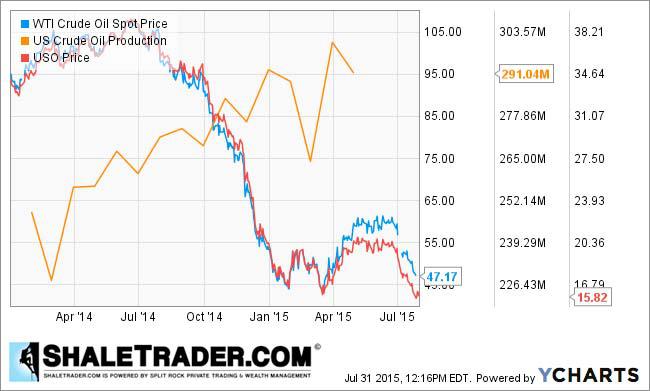
US Oil production remains at volumes seen when WTI was at $100/bbl. Many analysts believed operators couldn’t survive, but $60/bbl may be good enough for operators to drill economic wells. Oil prices have decreased significantly, and the US Oil ETF (NYSEARCA:USO) with it. Many were wrong about US production, and the belief $60/bbl oil would decrease US production. Although completions have been deferred, high-grading and mega-fracs have made up for fewer producing wells. When calculating US production going forward, it is important to account for the number of new completions. If more wells are completed, the higher the influx of production should be. We are finding the quality of geology and well design have a greater effect on total production than originally thought.

(click to enlarge)

(Source: Shaletrader.com)

There are several factors influencing US production. Operators have moved existing rigs to core areas. This decreases its ability getting acreage held by production. In the Bakken, rigs have moved near the Nesson Anticline.

In the Eagle Ford, Karnes seems to be the area of interest. Midland County in the Permian has also been attractive. Operators have decided to complete wells with better geology. When an operator completes wells in core acreage versus marginal leasehold, we see increased production per location. This is just part of the reason US production remains high.

The average investor does not understand the significance. Most think wells have like production, but areas are much different. When oil was at a $100/bbl, it allowed operators to get acreage held by production, although payback times were not as good. Marginal acreage was more attractive, even at lower IRRs. Operators have a significant investment in acreage, and do not want to lose it. Because of this, many would operate in the red expecting future rewards. Just because E&Ps lose money, does not mean the business isn’t economic. It is the way business is done in the short term as oil is an income stream. Wells produce for 35 to 40 years, and once well costs are paid back there are steady revenues. Changes in oil prices have changed this, as now operators will have to focus on better acreage.

Re-fracs are starting to influence production. Although most operators have not begun programs, interest is high. Re-fracs may not be a game changer, but could be an excellent way to increase production at a lower cost. This is not as significant with well designs of today, but older designs left a significant amount of resource. More importantly, when operators began, it was drilling the best acreage. Archaic well designs could leave some stages completely untouched. Current seismic can now identify this, and provide for a better re-frac. We expect to see some very good results in 2016. In conjunction with high-grading, well design continues to be the main reason production has maintained. Changes to well design have been significant, and the resulting production increases much better than anticipated.

No operator is better than EOG Resources (NYSE:EOG) at well design. From the Bakken, to the Eagle Ford and Permian it continues to outperform the competition.

The following map courtesy of ShaleMapsPro.com does a good job of illustrating EOG’s exposure in the Eagle Ford.

EagleFord.SeekingAlpha

(Source: Shalemapspro.com)

EOG’s focusing of frac jobs closer to the well bore has provided for much better source rock stimulation (fraccing). Since more fractures are created, there is a greater void in the shale. This means more producing rock has contact with the well. EOG continues to push more sand and fluids in the attempt to recover more resource per foot. To evaluate production, it must be broken into days over 6 to 12 months. To evaluate well design, locations must be close to one another and by the same operator. This consistency allows us to see advantages to well design changes. Lastly, we compare marginal acreage it is no longer working to the high-grading program. This is how operators are spending less and producing more.

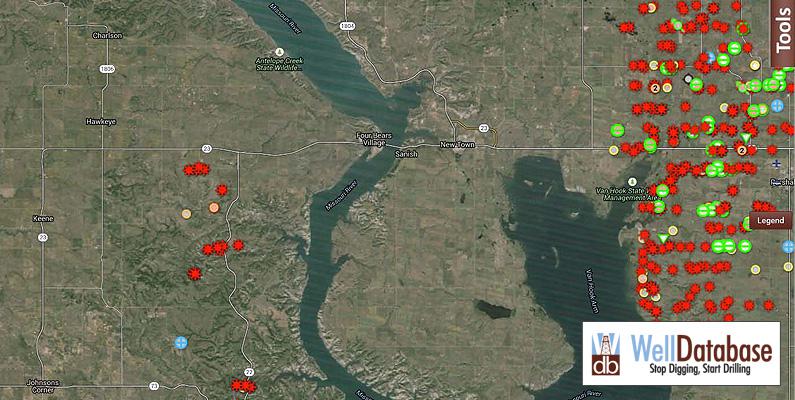
EOG is working in the Antelope field of northeast McKenzie County. This is Bakken core acreage and considered excellent in both the middle Bakken and upper Three Forks.

(click to enlarge)
(Source: Welldatabase.com)

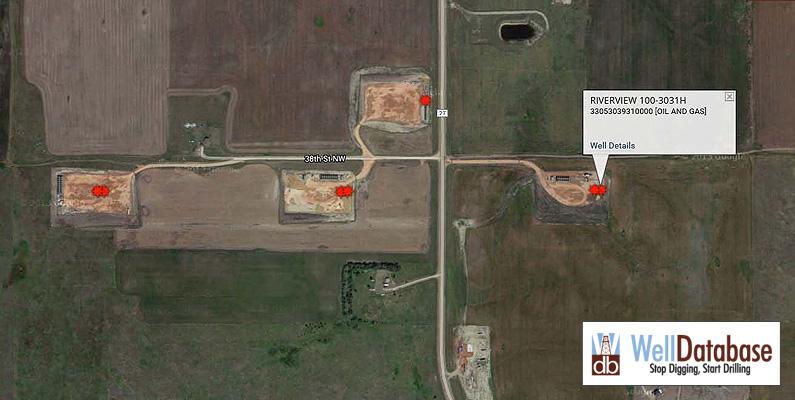
The center of the above map is the location of both its Riverview and Hawkeye wells. These six wells are located in two adjacent sections. The pad is just west of New Town in North Dakota. Riverview 100-3031H was completed in 6/12. It is an upper Three Forks well. 39 stages were used on an approximate 9000 foot lateral. 5.7 million pounds of sand were used with 85000 barrels of fluids.

(click to enlarge)
(Source: Welldatabase.com)

Date Oil (BBL) Gas ((NYSEMKT:MCF)) BOE
6/1/2012 4,384.00 3,972.00 3972
7/1/2012 27,133.00 15,337.00 15337
8/1/2012 24,465.00 17,223.00 17223
9/1/2012 21,457.00 9,190.00 9190
10/1/2012 18,040.00 12,601.00 12601
11/1/2012 19,924.00 13,366.00 13366
12/1/2012 28,134.00 22,259.00 22259
1/1/2013 15,382.00 12,661.00 12661
2/1/2013 3,429.00 2,451.00 2451
3/1/2013 15,242.00 22,774.00 22774
4/1/2013 15,761.00 8,479.00 8479
5/1/2013 13,786.00 18,372.00 18372
6/1/2013 14,485.00 18,555.00 18555
7/1/2013 15,668.00 27,250.00 27250
8/1/2013 12,084.00 23,876.00 23876
9/1/2013 13,841.00 46,815.00 46815
10/1/2013 11,388.00 45,800.00 45800
11/1/2013 2,711.00 10,533.00 10533
12/1/2013 0 0 0
1/1/2014 5,953.00 35 35
2/1/2014 11,368.00 20,851.00 20851
3/1/2014 8,784.00 11,179.00 11179
4/1/2014 5,607.00 8,479.00 8479
5/1/2014 4,727.00 5,663.00 5663
6/1/2014 8,359.00 12,726.00 12726
7/1/2014 8,799.00 22,957.00 22957
8/1/2014 7,958.00 31,621.00 31621
9/1/2014 7,218.00 44,318.00 44318
10/1/2014 3,778.00 14,058.00 14058
11/1/2014 3,701.00 9,951.00 9951
12/1/2014 6,612.00 18,435.00 18435
1/1/2015 6,181.00 24,142.00 24142
2/1/2015 3,517.00 10,722.00 10722
3/1/2015 5,218.00 24,175.00 24175
4/1/2015 4,275.00 24,233.00 24233

(Source: Welldatabase.com)

Riverview 100-3031H was a progressive well design for 2012. It produced well. To date it has produced 379 thousand bbls of crude and 615 thousand Mcf of natural gas. This equates to $24 million in revenues. Over the first 360 days (using the true number of production days) it produced 240,036 bbls of crude. The month of December 2013, this well was shut in for the completion of an adjacent well. There was a return to production but no significant jump in production from pressure generated by the new locations. This well declined 42% over 12 months. This is much lower than estimates shown through other well models. The next year we see a 35% decline. 10 months later we see an additional decline of approximately 55%. The decline curve of a well is very specific to geology and well design. Keep in mind averages are just that, and do not provide specific data. These averages should not be used to evaluation acreage and operator as there are wide average swings. Also, averages are generally over a long time frame. Production in the Bakken began in 2004 (first horizontal well completed). Wells in 2004 produce nothing like wells today. Updated averages based on year (IP 360) are more useful. Riverview 100-3031H was part of a two well pad. A middle Bakken well was also completed.

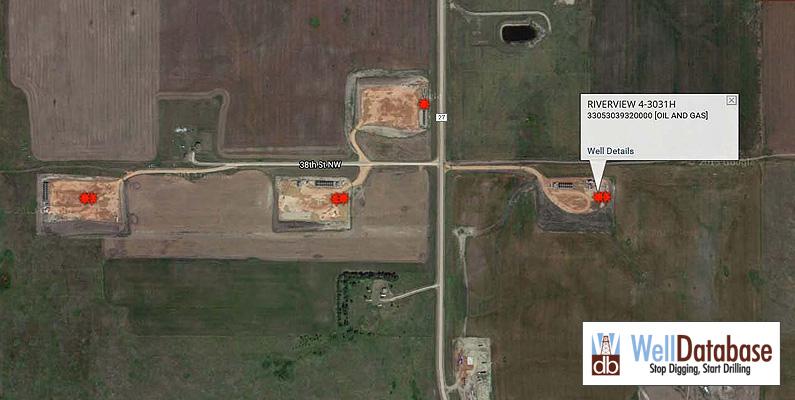
Riverview 4-3031H began producing a month after Riverview 100-3031H. It was a 38 stage 9000 foot lateral. 4.3 million lbs of sand were used and 69000 bbls of fluids.

(click to enlarge)
(Source: Welldatabase.com)

The Riverview and Hawkeye wells analyzed in this article were drilled in a southern fashion.

Date Oil Gas BOE
7/1/2012 20,529.00 12,537.00 12537
8/1/2012 16,553.00 16,903.00 16903
9/1/2012 17,096.00 10,148.00 10148
10/1/2012 23,197.00 17,914.00 17914
11/1/2012 20,122.00 14,402.00 14402
12/1/2012 27,340.00 33,217.00 33217
1/1/2013 16,044.00 24,394.00 24394
2/1/2013 4,267.00 4,946.00 4946
3/1/2013 27,516.00 26,219.00 26219
4/1/2013 20,792.00 7,940.00 7940
5/1/2013 17,516.00 35,948.00 35948
6/1/2013 15,457.00 50,500.00 50500
7/1/2013 13,480.00 50,807.00 50807
8/1/2013 11,254.00 42,300.00 42300
9/1/2013 9,319.00 40,341.00 40341
10/1/2013 8,559.00 33,116.00 33116
11/1/2013 2,190.00 40 40
12/1/2013 0 0 0
1/1/2014 1,124.00 11 11
2/1/2014 5,271.00 81 81
3/1/2014 8,931.00 9,827.00 9827
4/1/2014 5,469.00 7,940.00 7940
5/1/2014 4,807.00 5,748.00 5748
6/1/2014 8,522.00 13,819.00 13819
7/1/2014 7,982.00 17,983.00 17983
8/1/2014 7,169.00 26,755.00 26755
9/1/2014 5,750.00 22,586.00 22586
10/1/2014 1,349.00 3,194.00 3194
11/1/2014 6,495.00 15,947.00 15947
12/1/2014 6,442.00 18,806.00 18806
1/1/2015 5,840.00 22,126.00 22126
2/1/2015 4,171.00 18,682.00 18682
3/1/2015 4,221.00 18,539.00 18539
4/1/2015 3,878.00 19,725.00 19725

(Source: Welldatabase.com)

Riverview 4-3031H has produced 361 thousand bbls of crude and 657 thousand Mcf of natural gas. It under produced Riverview 100-3031H, but this is consistent with well design. 360 day production totaled 237,735 bbls of oil. We do not know if the Three Forks is a better pay zone than the middle Bakken as the well design was not consistent. Most operators have reported better results from the middle Bakken. The Three Forks well used one more stage (less feet per stage should mean better fracturing). It also used significantly more sand and fluids. Either way both wells were good results. Riverview 4-3031H only declined approximately 36% in a comparison of the first month to month 12. This was 7% better than 100-3031H. It declined another 41% in year two on a month to month comparison. This was 6% greater. 56% was seen when compared to adjusted production for 5/15. The Three Forks well declines slower in later production than 4-3031H. This may be due to well design. The well with more stages, proppant and fluids continues to out produce the Bakken well. It is possible the source rock is better. There are many other variables to look at, but this data provides why EOG continues to push ahead with more complex locations.

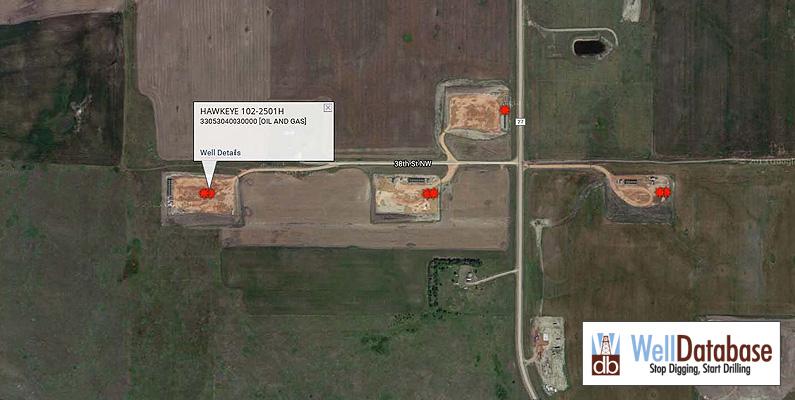
In September of 2012, EOG drilled its next well in this area. Hawkeye 100-2501H is a 13700 foot lateral targeting the upper Three Forks. It is a 47 stage frac. 14 million pounds of sand were used with 158000 bbls of fluids.

(click to enlarge)
(Source: Welldatabase.com)

Of the three pads, this well is located in the center. It was an interesting design, given the length of the lateral.

Date Oil Gas BOE
9/1/2012 21,959.00 444 444
10/1/2012 54,927.00 155 155
11/1/2012 47,557.00 57,300.00 57300
12/1/2012 55,367.00 92,144.00 92144
1/1/2013 33,396.00 55,877.00 55877
2/1/2013 22,100.00 32,810.00 32810
3/1/2013 36,631.00 57,544.00 57544
4/1/2013 29,075.00 32,696.00 32696
5/1/2013 22,210.00 33,351.00 33351
6/1/2013 17,544.00 25,794.00 25794
7/1/2013 15,872.00 23,600.00 23600
8/1/2013 19,647.00 28,746.00 28746
9/1/2013 15,486.00 22,352.00 22352
10/1/2013 21,325.00 31,678.00 31678
11/1/2013 6,418.00 9,214.00 9214
12/1/2013 0 0 0
1/1/2014 0 0 0
2/1/2014 0 0 0
3/1/2014 29,699.00 23,822.00 23822
4/1/2014 39,782.00 32,696.00 32696
5/1/2014 35,267.00 61,543.00 61543
6/1/2014 27,554.00 49,551.00 49551
7/1/2014 7,229.00 12,565.00 12565
8/1/2014 31,155.00 98,086.00 98086
9/1/2014 12,617.00 32,742.00 32742
10/1/2014 2 4 4
11/1/2014 7,769.00 15,996.00 15996
12/1/2014 15,487.00 49,147.00 49147
1/1/2015 4,427.00 9,918.00 9918
2/1/2015 9,344.00 20,654.00 20654
3/1/2015 8,459.00 25,171.00 25171
4/1/2015 7,235.00 24,752.00 24752

(Source: Welldatabase.com)

Hawkeye 100-2501H had some excellent early production numbers. From that perspective, it is one of the best wells to date in the Bakken. It has already produced 655,000 bbls of crude and 960,000 Mcf of natural gas. It has revenues in excess of $42 million to date. This includes roughly four non-producing or unproductive months. Crude production over the first 360 days was 389,835 bbls. Over the first 12 months, this well produced crude revenues in excess of $23 million. Decline rates were higher, as the first full month of production declined 65% over the first year. This isn’t important as early production rates were some of the highest seen in North Dakota. It is important to note, decline rates are emphasized but higher pressured wells may deplete faster depending on choke and how quickly production is propelled up and out of the wellbore. Any well that produces very well initially will have higher decline rates, but this does not lessen the value of the well. This specific well is depleting faster, but no one is complaining about payback times well under a year. Decline rates decrease significantly in year two at 11%. This well saw a marked increase in production when adjacent wells were turned to sales. The additional pressure associated with well communication increased production from 20,000 bbls/month to 35,000 bbls/month on average. This occurred over a 6 month period.

(click to enlarge)
(Source: Welldatabase.com)

Hawkeye 102-2501H was the fourth completion. This 14,000 foot 62 stage lateral targeted the upper Three Forks. It used 14.5 million pounds of sand and 164,000 bbls of fluids.

Date Oil Gas BOE
1/1/2013 18,486.00 41 41
2/1/2013 27,120.00 8,705.00 8705
3/1/2013 39,702.00 15,748.00 15748
4/1/2013 17,714.00 30,501.00 30501
5/1/2013 41,368.00 57,489.00 57489
6/1/2013 26,602.00 34,399.00 34399
7/1/2013 0 0 0
8/1/2013 133 0 0
9/1/2013 0 0 0
10/1/2013 0 0 0
11/1/2013 0 0 0
12/1/2013 0 0 0
1/1/2014 5,163.00 6,403.00 6403
2/1/2014 41,917.00 74,353.00 74353
3/1/2014 36,439.00 18,111.00 18111
4/1/2014 19,477.00 30,501.00 30501
5/1/2014 26,388.00 43,071.00 43071
6/1/2014 27,480.00 49,456.00 49456
7/1/2014 14,529.00 33,072.00 33072
8/1/2014 24,542.00 62,753.00 62753
9/1/2014 17,613.00 53,460.00 53460
10/1/2014 17,451.00 66,544.00 66544
11/1/2014 9,634.00 33,366.00 33366
12/1/2014 16,338.00 76,547.00 76547
1/1/2015 11,450.00 65,277.00 65277
2/1/2015 8,971.00 50,919.00 50919
3/1/2015 3,177.00 14,820.00 14820
4/1/2015 6,495.00 13,616.00 13616

(Source: Welldatabase.com)

It has produced 458,000 bbls of crude and 839,000 Mcf to date. This equates to roughly $30 million over well life. 360 day production was 394,673 bbls of crude. Production was interesting as initial production was outstanding. The big production numbers were hindered as many of the early months had missed production days. We don’t know if there were production problems, but do know the well was shut when adjacent wells were turned to sales. Production was over 1000 bbls/d over the first six months. It was shut in for another six months. After this production jumped, but this is misleading. Given the fewer days of production per month, there wasn’t much of an increase when the new wells were turned to sales. The decline over the first year on a monthly basis is 20%. The second year is much greater at 80%. We have seen recent production decrease significantly, and is something to watch. Lower decline rates initially are more important. This is because production rates are higher. It equates to greater total production.

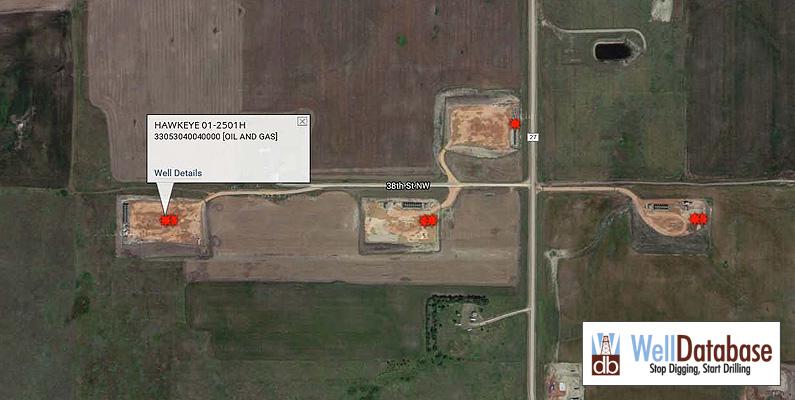
Hawkeye 01-2501H was completed in January of 2013.

(click to enlarge)
(Source: Welldatabase.com)

It is a 64 stage, 15000 foot lateral targeting the middle Bakken. This well used 172,000 bbls of fluids and 15 million pounds of sand.

Date Oil Gas BOE
1/1/2013 18,792.00 43 43
2/1/2013 30,211.00 13,879.00 13879
3/1/2013 42,037.00 17,648.00 17648
4/1/2013 17,433.00 36,881.00 36881
5/1/2013 38,754.00 63,501.00 63501
6/1/2013 28,602.00 48,817.00 48817
7/1/2013 0 0 0
8/1/2013 134 1 1
9/1/2013 0 0 0
10/1/2013 0 0 0
11/1/2013 0 0 0
12/1/2013 0 0 0
1/1/2014 6,311.00 7,186.00 7186
2/1/2014 43,713.00 74,099.00 74099
3/1/2014 39,156.00 18,492.00 18492
4/1/2014 23,408.00 36,881.00 36881
5/1/2014 21,681.00 33,498.00 33498
6/1/2014 28,502.00 51,543.00 51543
7/1/2014 18,795.00 45,017.00 45017
8/1/2014 25,512.00 58,837.00 58837
9/1/2014 20,522.00 60,662.00 60662
10/1/2014 19,137.00 68,576.00 68576
11/1/2014 12,093.00 37,043.00 37043
12/1/2014 16,587.00 45,980.00 45980
1/1/2015 14,246.00 62,819.00 62819
2/1/2015 9,220.00 35,931.00 35931
3/1/2015 3,617.00 6,634.00 6634
4/1/2015 13,702.00 42,551.00 42551

(Source: Welldatabase.com)

It has produced 492,170 bbls of crude and 866,520 Mcf of natural gas. 360 day production was 412,072 bbls of oil.

(click to enlarge)
(Source: Welldatabase.com)

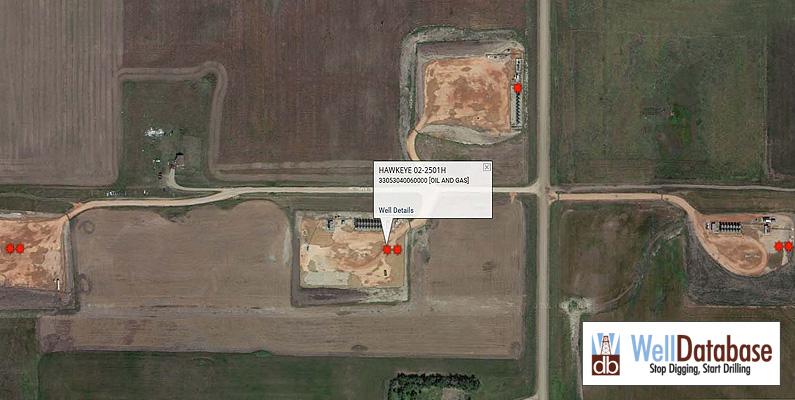
This is an excellent well, but the location of focus is Hawkeye 02-2501H. It was completed last in this group. This well provides the link between changes in well design to production improvements.

Date Oil Gas BOE
12/1/2013 3,022.00 6,533.00 6533
1/1/2014 37,385.00 75,940.00 75940
2/1/2014 30,066.00 58,949.00 58949
3/1/2014 22,876.00 50,690.00 50690
4/1/2014 26,703.00 43,926.00 43926
5/1/2014 31,987.00 55,124.00 55124
6/1/2014 27,777.00 47,166.00 47166
7/1/2014 31,500.00 50,279.00 50279
8/1/2014 51,709.00 99,583.00 99583
9/1/2014 43,292.00 98,069.00 98069
10/1/2014 40,143.00 98,927.00 98927
11/1/2014 24,064.00 50,495.00 50495
12/1/2014 31,488.00 99,684.00 99684
1/1/2015 27,087.00 94,621.00 94621
2/1/2015 22,207.00 94,490.00 94490
3/1/2015 22,590.00 125,634.00 125634
4/1/2015 17,707.00 94,910.00 94910

(Source: Welldatabase.com)

The production numbers are significant. In less than a year and a half, it has produced 490,000 bbls of crude and 1.25 Bcf of natural gas. Revenues to date are $33.2 million. Its 360 day crude production was 427,663 bbls. The production is impressive but the decline curve is more important. This Hawkeye well has a steady production rate with only a slight decline. This is where the analysts may be getting it wrong, as decline curves change significantly by area and well design. What EOG has done is not only increased production significantly, but also flattened the curve. Initial production is interesting as we don’t see peak production until nine months. This means our best month is August of 2014, and not the first full month. When we analyze the production after one full year of production, there is no drop off.

This 12800 foot 69 stage lateral is a very good middle Bakken design. EOG decided to pull back some of the lateral length. There are several possible reasons for this. We think it is possible EOG has discovered it was having difficulty in getting proppant to the toe of the well. But this is why operators test the length. More importantly, the increase in stages in conjunction with a shorter lateral provides for shorter stages. This means the operator will probably do a better job of stimulating the source rock. This well also used massive volumes of fluids and sand. 460,000 bbls of fluids were used with over 27 million lbs of proppant. I don’t normally break down the types of sand, as it can be trivial to some but in this case I have as the design seems somewhat unique. This well used approximately 16 million lbs of 100 mesh sand, 7 million lbs of 30/70 and 4 million 40/70. The large volumes of mesh sand are interesting. It would seem EOG is trying to push the finest sand deep into the fractures to maintain deeper shale production.

Well Date Lateral Ft. Stages Proppant Lbs. Fluids Bbls. 12 mo. Oil Production Bbls. Production/Ft.
Riverview 100-3031H 6/12 9,000 39 5.7M 85,000 240,036 26.67
Riverview 4-3031H 7/12 9,000 38 4.3M 69,000 237,735 26.42
Hawkeye 100-2501H 9/12 13,700 47 14M 158,000 389,835 28.46
Hawkeye 102-2501H 1/13 14,000 62 14.5M 164,000 394,673 28.19
Hawkeye 01-2501H 1/13 15,000 64 15M 172,000 412,072 27.47
Hawkeye 02-2501H 12/13 12,800 69 27M 460,000 427,663 33.41

I completed the above table for several reasons. The first was to show well design’s effect on one year total production. We used 360 days as a base. We didn’t use 12 months as that will skew data, as some wells don’t produce every day of every month. Wells are shut in for service or more importantly when new production from adjacent locations are turned to sales. So these are a specific number of days and not estimates. We also broke down production per foot of lateral. This may be more important than any other factor. Production per well is important, but lateral length is a key as it shows how well the source rock was stimulated. In reality, production per foot matters more at longer lateral lengths. Many operators don’t like to do laterals longer than 10,000 feet, as production per foot decreases sharply. When looking at well production data, it is obvious that production per foot suffers as the toe of the lateral gets farther from the vertical.

There are several other ETFs that focus on U.S. and world crude prices:

  • iPath S&P Crude Oil Total Return Index ETN (NYSEARCA:OIL)
  • ProShares Ultra Bloomberg Crude Oil ETF (NYSEARCA:UCO)
  • VelocityShares 3x Long Crude Oil ETN (NYSEARCA:UWTI)
  • ProShares Ultrashort Bloomberg Crude Oil ETF (NYSEARCA:SCO)
  • U.S. Brent Oil ETF (NYSEARCA:BNO)
  • PowerShares DB Oil ETF (NYSEARCA:DBO)
  • VelocityShares 3x Inverse Crude Oil ETN (NYSEARCA:DWTI)
  • PowerShares DB Crude Oil Double Short ETN (NYSEARCA:DTO)
  • U.S. 12 Month Oil ETF (NYSEARCA:USL)
  • U.S. Short Oil ETF (NYSEARCA:DNO)
  • PowerShares DB Crude Oil Long ETN (NYSEARCA:OLO)
  • PowerShares DB Crude Oil Short ETN (NYSEARCA:SZO)
  • iPath Pure Beta Crude Oil ETN (NYSEARCA:OLEM)

All six wells had fantastic results. The first two Riverview wells are still considered sand heavy fracs and produced almost a quarter of a million barrels of oil. This does not include natural gas in the estimates, but EURs for these wells are approximately 1200 MBo. We don’t put much emphasis on EURs other than an indicator of how good production is in comparison. Since locations will produce from 35 to 40 years, we are more inclined to emphasize one year production. Although the Hawkeye wells drilled on 9/12 and 1/13 didn’t show a large uptick in production per foot, it is still quite impressive considering the lateral length. Overall production uplift was exceptional, and these wells produce decent payback times at current oil price realizations.

There is no doubt this area has superior geology. It is definitely a core area, but may not be as good as Parshall field. Because of this, we know other areas would not produce as well, but still it provides a decent comparison for the upside to well design. Geology is still key and this is probably why EOG recently drilled a 15 well pad in the same general area. These wells are still in confidential status, so we do not know the outcome. Given the results in this area, these wells could be very interesting. The most important reason to focus on these Mega-Fracs is repeatability. If EOG can do this, so can other operators. Our expectations are many operators will be able to complete wells this good within the next 12 to 24 months. If this occurs we could see production maintained at much lower prices and fewer completions.

Gov Jumbo vs. Private Jumbo Loans Today

Government-backed jumbo loans can be cheaper and easier to get than jumbos that exceed the $625,500 federal limit

https://i0.wp.com/si.wsj.net/public/resources/images/BN-JS449_JCONFO_M_20150805104039.jpgSave Money With Smaller Jumbos by Anya Martin in The Wall Street Journal

Home buyers trying to purchase a pricey property will probably need a jumbo loan—a mortgage that exceeds government limits. But there are different types of jumbos, and some are a little easier and cheaper to get than others.

But first, a handy breakdown for those befuddled by the confounding terminology of the mortgage business:

Conforming mortgages are capped at $417,000 and backed by government agencies, such as Fannie Mae, Freddie Mac, the Federal Housing Administration (FHA) and the Veterans Administration (VA).

Conforming jumbo mortgages exceed $417,000 and can go up to $625,500—the exact limit depends on housing costs in your area. The loans are sometimes called “super conforming loans” or “agency jumbos” because they’re still guaranteed by government agencies.

Jumbo mortgages exceed government limits and, thus, are typically held by the lender as part of its portfolio or bundled and sold to investors as mortgage-backed securities.

Borrowers typically pay lower interest rates on conforming loans than on non-conforming jumbo mortgages. (Rates and qualification requirements vary by lender.)

Escalating home-sales prices are pushing more buyers into both conforming and non-conforming jumbos, says Tim Owens, who heads Bank of America’s retail sales group.

Jumbo mortgage volume totaled about $93 billion in the second quarter of 2015, up 33% over the first quarter, according to Inside Mortgage Finance, an industry publication.

The volume of government-backed conforming jumbos also saw brisk growth, increasing 32% between the first and second quarters to $34.2 billion—more than double since a year ago, Inside Mortgage Finance data show.

“The agency jumbo market is firing on all cylinders—purchase, refinance and every loan program,” says Guy Cecala, publisher of Inside Mortgage Finance. The biggest jump was in FHA jumbo mortgages, with volume up 136% between the first and second quarters, he adds.

The spike in FHA mortgages, in particular, comes after the agency on Jan. 26 reduced its required mortgage insurance premiums, Mr. Cecala says. Premiums dropped from 1.35% to 0.85% of the balance on fixed-rate FHA loans with terms above 15 years.

More lenient credit requirements spur borrowers to prefer agency jumbo mortgages over non-conforming loans, says Mathew Carson, a broker with San Francisco-based First Capital Group. He is working with a professional couple borrowing $511,000 for a home in Petaluma, Calif., where the government’s loan limit is $520,950. The couple, both first-time home buyers, could opt for a conforming or a non-conforming jumbo loan but chose a conforming jumbo backed by the FHA. Why? The FHA mortgage required a 3.5% down payment, whereas lenders for a non-conforming loan could require the standard 20% down payment.

Fannie Mae and Freddie Mac also reduced their minimum down payments to 3.5% of the loan amount in December.

Another benefit to conforming loans is lower credit-score requirements, with minimums in the 600s for Fannie Mae and Freddie Mac mortgages and in the 500s for FHA loans, says Tom Wind, executive vice president of home lending at Jacksonville, Fla.-based EverBank. Most lenders prefer to see 700 and above for their privately held jumbos, he adds.

An increase in the volume of VA mortgages is most likely due to more awareness of the benefit among active military and veterans, says Tony Dias, Honolulu branch manager of Veterans United, which specializes in VA loans. In Hawaii alone, Veterans United’s loan volume for 2015 is projected to reach $320 million, he adds.

Here are a few more considerations when choosing between a conforming and a non-agency jumbo mortgage:

• Mortgage insurance. Fannie Mae and Freddie Mac mortgages with less than a 20% down payment require mortgage insurance, but borrowers can drop the insurance once their loan-to-value (LTV) ratio dips below 80%, meaning the loan amount can’t exceed 80% of the value of the home. FHA borrowers must pay the insurance for the duration of the loan, adding to the lifetime cost of the loan, unless they refinance.

• Bonus for veterans. VA jumbos require no mortgage insurance and no down payment unless the amount borrowed exceeds the area’s conforming-loan limit. Even then, the 25% down payment only applies to the amount above the loan limit, so, for example, a borrower would only have to put down $25,000 on an $821,000 loan in Honolulu where the limit is $721,050, Mr. Dias says.

• Additional lender restrictions. Fannie Mae mortgages can have a debt-to-income ratio (DTI) as high as 50%, meaning the borrower’s monthly expenses can be as high as 50% of her gross monthly income. Most lenders typically stick to 43% DTI (prescribed by federal rules for privately held qualified mortgages) for their conforming jumbos as well, Mr. Carson says.

A Luxury Tear Down In LA’s Bird Streets

http://www.trbimg.com/img-55bc0e76/turbine/la-fi-0802-tear-downs-03-jpg-20150731/900/900x506

A luxury tear-down in the Bird Streets. 9212 Nightingale Drive, priced at $13.8 million, the 5,000-square-foot house on more than half an acre is being marketed as the site for a 12,000-square-foot home that developers hope would garner as much as $70 million.

By Neal J. Leitereg in The Los Angeles Times

The actual house didn’t factor much into the equation when Dr. Dre parted with his Hollywood Hills West home in January for $32 million.

The contemporary-style residence behind gates on Oriole Way was not purchased for its 9,696 square feet of space, but rather for its land value and potential to build an astonishing $100-million-plus estate on what has been called the best view lot in Los Angeles.

Such is life in the so-called Bird Streets, an enclave that has long been popular among celebrity and mogul types, where a developers flush with cash look to double down on a surging luxury market.

At 9212 Nightingale Drive, a home taken down to the studs and built new last year is now being shopped as a tear-down, according to listing agent Benjamin Bacal of Rodeo Realty Beverly Hills. That’s how popular and sought-after the area has become.

Priced at $13.8 million, the 5,000-square-foot house on more than half an acre is being marketed as the site for a 12,000-square-foot home that developers hope would garner as much as $70 million.

If that sounds like a pie-in-the-sky figure, Bacal points to two other homes on the same street where $70 million seems to be the magic number.

Three doors down, Global Radio founder and president Ashley Tabor has invested more than $30 million into a two-house compound he bought from Megan Ellison, the film producer and daughter of billionaire Larry Ellison, in 2013 for $26.25 million.

In similar fashion, billionaire Ted Waitt, who co-founded Gateway Inc., has put about $30 million toward his home on Nightingale. Also purchased from Ellison in 2013, the corner-lot property cost $20.5 million.

Each could end up worth $70 million, as long as the tear-down market stays red hot.