Monthly Archives: February 2015

Chicago PMI Crashes to 5 1/2 Year Low: Production, New Orders, Backlogs Suffer Double Digit Declines

by Mike “Mish” Shedlock

Fourth quarter GDP was revised lower today to 2.2 percent from 2.6 percent previously estimated.

Looking ahead, I think we are going to see some shocking downward estimates in the months to come. Meanwhile, a shocking PMI report came out today.

Chicago PMI Crashes to 5 1/2 Year Low

ISM Chicago reports Chicago Business Barometer At 5½-Year Low

The Chicago Business Barometer plunged 13.6 points to 45.8 in February, the lowest level since July 2009 and the first time in contraction since April 2013. The sharp fall in business activity in February came as Production, New Orders, Order Backlogs and Employment all suffered double digit losses, leaving them below the 50 level which separates contraction from expansion.

New Orders suffered the largest monthly decline on record, leaving them at the lowest since June 2009. Lower order intake and output levels led to a double digit decline in Employment which last month increased markedly to a 14-month high.

Disinflationary pressures were still in evidence in February, although the slight bounce back in energy costs pushed Prices Paid to the highest since December – although still below the breakeven 50 level. Some purchasers cited weakness in some metals prices including copper and brass, but others said suppliers were slow to pass along lower prices to customers.

Commenting on the Chicago Report, Philip Uglow, Chief Economist of MNI Indicators said, “It’s difficult to reconcile the very sharp drop in the Barometer with the recent firm tone of the survey. There’s some evidence to point to special factors such as the port strike and the weather, although we’ll need to see the March data to get a better picture of underlying growth.“

Blame it on the Ports

Everyone was quick to blame this on the ports and bad weather.

But the LA port issue has been festering for months. Weren’t economists aware of the ports? Of bad weather?

The reason I ask is the Bloomberg Consensus Estimate was 58.7. The range was 55.5 to 59.6. Who predicted 59.6?

Housing Crash In China Steeper Than In Pre-Lehman America

China has long frustrated the hard-landing watchers – or any-landing watchers, for that matter – who’ve diligently put two and two together and rationally expected to be right. They see the supply glut in housing, after years of malinvestment. They see that unoccupied homes are considered a highly leveraged investment that speculators own like others own stocks, whose prices soar forever, as if by state mandate, but that regular people can’t afford to live in.

Hard-landing watchers know this can’t go on forever. Given that housing adds 15% to China’s GDP, when this housing bubble pops, the hard-landing watchers will finally be right.

Home-price inflation in China peaked 13 months ago. Since then, it has been a tough slog.

Earlier this month, the housing news from China’s National Bureau of Statistics gave observers the willies once again. New home prices in January had dropped in 69 of 70 cities by an average of 5.1% from prior year, the largest drop in the new data series going back to 2011, and beating the prior record, December’s year-over-year decline of 4.3%. It was the fifth month in a row of annual home price declines, and the ninth month in a row of monthly declines, the longest series on record.

Even in prime cities like Beijing and Shanghai, home prices dropped at an accelerating rate from December, 3.2% and 4.2% respectively.

For second-hand residential buildings, house prices fell in 67 of 70 cities over the past 12 months, topped by Mudanjiang, where they plunged nearly 14%.

True to form, the stimulus machinery has been cranked up, with the People’s Bank of China cutting reserve requirements for major banks in January, after cutting its interest rate in November. A sign that it thinks the situation is getting urgent.

So how bad is this housing bust – if this is what it turns out to be – compared to the housing bust in the US that was one of the triggers in the Global Financial Crisis?

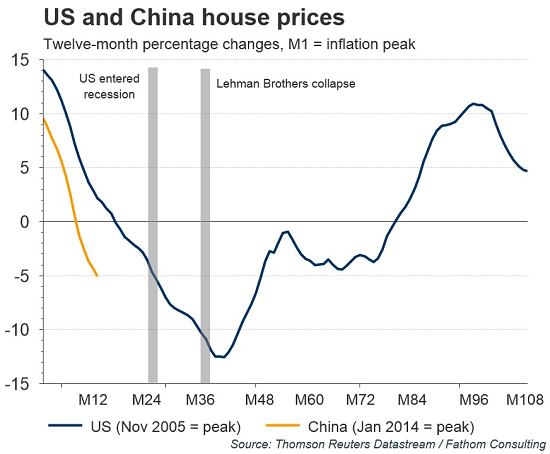
Thomson Reuters overlaid the home price changes of the US housing bust with those of the Chinese housing bust, and found this:

The US entered recession around two years after house price inflation had peaked. After nine months of recession, Lehman Brothers collapsed. As our chart illustrates, house price inflation in China has slowed from its peak in January 2014 at least as rapidly as it did in the US.

Note the crashing orange line on the left: year-over-year home-price changes in China, out-crashing (declining at a steeper rate than) the home-price changes in the US at the time….

US-China-housing-crash

The hard-landing watchers are now wondering whether the Chinese stimulus machinery can actually accomplish anything at all, given that a tsunami of global stimulus – from negative interest rates to big bouts of QE – is already sloshing through the globalized system. And look what it is accomplishing: Stocks and bonds are soaring, commodities – a demand gauge – are crashing, and real economies are languishing.

Besides, they argue, propping up the value of unoccupied and often unfinished investment properties that most Chinese can’t even afford to live in might look good on paper, but it won’t solve the problem. And building even more of these units props up GDP nicely in the short term, and therefore it’s still being done on a massive scale, but it just makes the supply glut worse.

Sooner or later, the hard-landing watchers expect to be right. They know how to add two and two together. And they’re already smelling the sweet scent of being right this time, which, alas, they have smelled many times before.

But it does make you wonder what the China housing crash might trigger when it blooms into full maturity, considering the US housing crash helped trigger of the Global Financial Crisis. It might be a hard landing for more than just China. And ironically, it might occur during, despite, or because of the greatest stimulus wave the world has ever seen.

Stocks, of course, have been oblivious to all this and have been on a tear, not only in China, but just about everywhere except Greece. But what happens to highly valued stock markets when they collide with a recession? They crash.


What to Expect When This Stock Market Meets a Recession

Last week I had a fascinating conversation with Neile Wolfe, of Wells Fargo Advisors, LLC., about high equity valuations and what happens when they collide with a recession.

Here is my monthly update that shows the average of the four valuation indicators: Robert Shiller’s cyclically adjusted price-to-earnings ratio (CAPE), Ed Easterling’s Crestmont P/E, James Tobin’s Q Ratio, and my own monthly regression analysis of the S&P 500:

Click to View

Based on the underlying data in the chart above, Neile made some cogent observations about the historical relationships between equity valuations, recessions and market prices:

  • High valuations lead to large stock market declines during recessions.
  • During secular bull markets, modest overvaluation does not produce large stock market declines.
  • During secular bear markets, modest overvaluation still produces large stock market declines.

Here is a table that highlights some of the key points. The rows are sorted by the valuation column.

Beginning with the market peak before the epic Crash of 1929, there have been fourteen recessions as defined by the National Bureau of Economic Research (NBER). The table above l ists the recessions, the recession lengths, the valuation (as documented in the chart illustration above), the peak-to-trough changes in market price and GDP. The market price is based on the S&P Composite, an academic splicing of the S&P 500, which dates from 1957 and the S&P 90 for the earlier years (more on that splice here).

I’ve included a row for our current valuation, through the end of January, to assist us in making an assessment of potential risk of a near-term recession. The valuation that preceded the Tech Bubble tops the list and was associated with a 49.1% decline in the S&P 500. The largest decline, of course, was associated with the 43-month recession that began in 1929.

Note: Our current market valuation puts us between the two.

Here’s an interesting calculation not included in the table: Of the nine market declines associated with recessions that started with valuations above the mean, the average decline was -42.8%. Of the four declines that began with valuations below the mean, the average was -19.9% (and that doesn’t factor in the 1945 outlier recession associated with a market gain).

What are the Implications of Overvaluation for Portfolio Management?

Neile and I discussed his thoughts on the data in this table with respect to portfolio management. I came away with some key implications:

  • The S&P 500 is likely to decline severely during the next recession, and future index returns over the next 7 to 10 years are likely to be low.
  • Given this scenario, over the next 7 to 10 years a buy and hold strategy may not meet the return assumptions that many investors have for their portfolio.
  • Asset allocation in general and tactical asset allocation specifically are going to be THE important determinant of portfolio return during this time frame. Just buying and holding the S&P 500 is likely be disappointing.
  • Some market commentators argue that high long-term valuations (e.g., Shiller’s CAPE) no longer matter because accounting standards have changed and the stock market is still going up. However, the impact of elevated valuations — when it really matters — is expressed when the business cycle peaks and the next recession rolls around. Elevated valuations do not take a toll on portfolios so long as the economy is in expansion.

How Long Can Periods of Overvaluations Last?

Equity markets can stay at lofty valuation levels for a very long time. Consider the chart posted above. There are 1369 months in the series with only 58 months of valuations more than two Standard Deviations (STD) above the mean. They are:

  • September 1929 (i.e., only one month above 2 STDs prior to the Crash of 1929)
  • Fifty-one months during the Tech bubble (that’s over FOUR YEARS)
  • Six of the last seven months have been above 2 STDs

Stay tuned.

Affordable Housing Plan Slaps Fee on California Property Owners

https://texaslynn.files.wordpress.com/2010/11/california-flag-peoples-republic.jpg

by Phil Hall

The speaker of California’s State Assembly is seeking to raise new funds for affordable housing development by adding a new $75 fee to the costs of recording real estate documents.

Toni Atkins, a San Diego Democrat, stated that the new fee would be a permanent addition to the state’s line-up of fees and taxes and would apply to all real estate documents except those related to home sales. Atkins conspicuously avoided citing the $75 figure in a press statement issued by her office, only briefly identifying it as a “small fee” while insisting that she had broad support for the plan.

“The permanent funding source, which earned overwhelming support from California’s business community, will generate hundreds of millions annually for affordable housing and leverage billions of dollars more in federal, local, and bank investment,” Atkins said. “This plan will reap benefits for education, healthcare and public safety as well. The outcomes sought in other sectors improve when housing instability is addressed.”

Atkins added that her plan should add between $300 million to $720 million a year for the state’s affordable housing endeavors. But Atkins isn’t completely focused on collecting revenue: She is simultaneously proposing that developers offering low-income housing should receive $370 million in tax credits, up from the current level of $70 million.

This is the third time that a $75 real estate transaction fee has been proposed in the state legislature. Earlier efforts were put forward in 2012 and 2013, but failed to gained traction. Previously, opponents to the proposal argued that transactions involving multiple documents would be burdened with excess costs because the fee applies on a per-document basis and not a per-transaction basis.

One of the main opponents of Atkins’ proposal, Jon Coupal, president of the Howard Jarvis Taxpayers Association, told the San Francisco Chronicle that the speaker was playing word games by insisting this was merely a fee and that she was penalizing property owners to finance a problem that they did not create.

“It’s clearly a tax, not a fee,” said Coupal. “There is not a nexus between the fee payer and the public need being addressed. It’s not like charging a polluter a fee for the pollution they caused. It’s a revenue that is totally divorced from the so-called need for affordable housing.”

Gundlach: If The Fed Raises Rates By Mid-Year “The Sinister Side Of Low Oil may Raise Its Head

jeffrey gundlach

Photo by Reuters | Eduardo Munoz.  Article by by Robert Huebscher in Advisor Perspective

The Fed should reject its inclination to raise rates, according to Jeffrey Gundlach. It’s rare that he agrees with Larry Summers, but in this case the two believe that the fundamentals in the U.S. economy do not justify higher interest rates.

Gundlach, the founder and chief investment officer of Los Angeles-based Doubleline Capital, spoke to investors in a conference call on February 17. The call was focused on the release of the new DoubleLine Long Duration Fund, but Gundlach also discussed a number of developments in the economy and the bond market.

Signals of an impending rate increase have come from comments by Fed governors that the word “patient” should be dropped from the Fed meeting notes, according to Gundlach. That word has taken on special significance, he explained, since Janet Yellen attached a two-month time horizon to it.

“If they drop that word,” Gundlach said, “it would be a strong signal that rates would rise in the following two months.”

The Fed seems “philosophically” inclined to raise rates, Gundlach said, even though the fundamentals do not justify such a move. Strong disinflationary pressure coming from the collapse in oil prices should caution the Fed against raising rates, he said.

Gundlach was asked about comments by Gary Shilling that oil prices might go as low at $10/barrel. “We better all hope we don’t get $10,” he said, “because something very deflationary would be happening in this world.” If that is the case, Gundlach said investors should flock to long-term Treasury bonds.

“I’d like to think that the world is not in that kind of deflationary precipice,” he said.

Oil will break below its previous $44 low, Gundlach said. But he did not put a price target on oil.

Gundlach warned that by mid-year, if the Fed does raise rates, “the sinister side of low oil may raise its head.” At that time, lack of hiring or layoffs in the fracking industry could cripple the economy, according to Gundlach.

In the short term, Gundlach said that the recent rise in interest rates is a signal that the “huge deflationary scare” –which was partly because of Greece – has dissipated. Investors should monitor Spanish and Italian yields, he said. If they remain low, it is a signal that Greece is not leaving the Eurozone or that, if it does, “it is not a big deal.”

http://www.advisorperspectives.com/newsletters15/Gundlach_to_the_Fed.php

The War On Success Of Small Business In America

Source: Zero Hedge

This is the war on success that our government is waging. They are almost trying to make the economy worse by putting companies out of business. To Quote Jim Clifton of Gallup:

Our leadership keeps thinking that the answer to economic growth and ultimately job creation is more innovation, and we continue to invest billions in it. But an innovation is worthless until an entrepreneur creates a business model for it and turns that innovative idea in something customers will buy. Because we have misdiagnosed the cause and effect of economic growth, we have misdiagnosed the cause and effect of job creation.

For the first time in 35 years, American business deaths now outnumber business births.

Let’s get one thing clear: This economy is never truly coming back unless we reverse the birth and death trends of American businesses. It is catastrophic to be dead wrong on the biggest issue of the last 50 years — the issue of where jobs come from…when small and medium-sized businesses are dying faster than they’re being born, so is free enterprise.

And when free enterprise dies, America dies with it.

Mike Maloney explains…

Courts Confirm Fannie and Freddie Are Sovereign Credits: Report

by Jacob Passy

Recent court decisions against Fannie Mae and Freddie Mac shareholders have put to rest the notion that the two mortgage giants exist as anything but instrumentalities of the U.S. government, according to a report released Thursday by Kroll Bond Rating Agency.

Private equity investor groups recently have raised lawsuits against the Federal Housing Finance Agency, in an effort to regain control of the two entities. The failure of these legal actions points to the de facto nature of the two entities as sovereign credits, given their complete backing by the U.S. government.

The KBRA report also suggests that Fannie Mae and Freddie Mac have morphed into insurance agents rather than insurance companies, since they cannot produce the capital to bear the risk of their guarantees that the FHFA prices to begin with.

Still, the two bodies’ investors take issue with the 3rd Preferred Stock Purchase Agreement that directs all of Fannie Mae and Freddie Mac’s profits to the government, the KBRA report said.

But these investors’ suits have been unsuccessful because, in judges’ eyes, the legislation passed by Congress that saved Fannie Mae and Freddie Mac from the brink gives the U.S. Treasury and FHFA the right to manage the two companies as they see fit. But KBRA finds instead that “the 3rd PSPA simply compensates the Treasury for the capital injection made in 2008 and, more important, the open-ended support of the U.S. taxpayer.”

The report goes on to argue that these investors misinterpret the support the U.S. government lent to the two mortgage entities. Prior to the capital injection, Fannie Mae and Freddie Mac had negative net worth, meaning that Treasury’s aid only brought them to zero.

But, as the report reads, all of the profits the two make now represent therefore the return on the government’s investment, so to recapitalize Fannie Mae and Freddie Mac would essentially involve taxpayer money, which the report found “galling.”

“They are not talking about injecting any of their own cash into the companies,” KBRA writes. “If you accept the idea that the taxpayers are due a return on both the implicit and explicit capital advanced to keep the mortgage market operating, there are no earnings to be retained in the GSEs.”

The report did contend that while this may not spell out good news for the two mortgage agencies’ equity investors, it should end some of the uncertainty bond investors have faced by confirming their standing in the eyes of government.


Fannie Mae Ended 2014 on a Sour Note

by Phil Hall

Fannie Mae hit more than a few financial potholes during 2014, closing the year with significantly lower net income and comprehensive income and a stated concern that things may not get better during 2015.

The government-sponsored enterprise reported annual net income of $14.2 billion and annual comprehensive income of $14.7 billion in 2014, far below 2013’s levels of $84 billion in net income and $84.8 billion in comprehensive income.

The fourth quarter of 2014 was especially acute: Fannie Mae’s net income of $1.3 billion and comprehensive income of $1.3 billion for this period, a steep drop from the net income of $3.9 billion and comprehensive income of $4.0 billion for the third quarter. Fourth quarter net revenues were $5.5 billion, down from $6 billion for the third quarter, while fee and other income was $323 million for the fourth quarter, compared with $826 million for the third quarter. Net fair value losses were $2.5 billion in the fourth quarter, up substantially from $207 million in the third quarter.

Fannie Mae explained that its fourth quarter results were “driven by net interest income, partially offset by fair value losses on risk management derivatives due to declines in longer-term interest rates in the quarter.” Nonetheless, Fannie Mae reported a positive net worth of $3.7 billion as of Dec. 31, 2014, which resulted in a dividend obligation to the U.S. Department of the Treasury of $1.9 billion that will be paid next month.

In announcing its 2014 results, Fannie Mae offered a blunt prediction that this year will see continued disappointments.

“[Fannie Mae] expects its earnings in future years will be substantially lower than its earnings for 2014, due primarily to the company’s expectation of substantially lower income from resolution agreements, continued declines in net interest income from its retained mortgage portfolio assets, and lower credit related income,” said Fannie Mae in a press statement. “In addition, certain factors, such as changes in interest rates or home prices, could result in significant volatility in the company’s financial results from quarter to quarter or year to year. Fannie Mae’s future financial results also will be affected by a number of other factors, including: the company’s guaranty fee rates; the volume of single-family mortgage originations in the future; the size, composition, and quality of its retained mortgage portfolio and guaranty book of business; and economic and housing market conditions.”


 Default Risk Index For Agency Purchase Loans Hits Series High

by Brian Honea

Agency Loan Mortgage Default Risk

The default risk for mortgage loan originations rose in January, marking the fifth straight month-over-month increase, according to the composite National Mortgage Risk Index (NMRI) released by AEI’s International Center on Housing Risk.

In January, the NMRI for Agency purchase loans increased to a series high of 11.94 percent. That number represented an increase of 0.4 percentage points from the October through December average and a jump of 0.8 percentage points from January 2014.

“With the NMRI once again hitting a series high, the risks posed by the government’s 85 percent share of the home purchase market continue to rise,” said Stephen Oliner, co-director of AEI’s International Center on Housing Risk.

Default risk indices for Fannie Mae, FHA, and VA loans hit series highs within the composite, according to AEI. The firm attributes to the consistent monthly increases in risk indices to a substantial shift in market share from large banks to non-bank accounts, since the default risk tends to be greater on loans originated by non-bank lenders.

AEI’s study for January revealed that the volume of high debt-to-income (DTI) loans has not been reduced by the QM regulation. About 24 percent of loans over the past three months had a total DTI above 43 percent, compared to 22 percent for the same period a year earlier. The study also found that Fannie Mae and Freddie Mac were compensating to a limited extent for the riskiness of their high DTI loans.

Further, the NMRI for FHA loans in January experienced a year-over-year increase of 1.5 percentage points up to 24.41 percent – meaning that nearly one quarter of all recently guaranteed home purchase loans backed by FHA would be projected to default if they were to experience an economic shock similar to 2007-08. AEI estimates that if FHA were to adopt VA’s risk management practices, the composite index would fall to about 9 percent.

“Policy makers need to be mindful of the upward risk trends that are occurring with respect to both first-time and repeat buyers,” said Edward Pinto, co-director of AEI’s International Center on Housing Risk. “Recent policy moves by the FHA and FHFA will likely exacerbate this trend.”

AEI said the cause of the softness in mortgage lending is not tight lending standards, but rather reduced affordability, loan put back risk, and slow income growth among households.

More than 180,o00 home purchase loans were evaluated for the January results, bringing the total number of loans rated in the NMRI since December 2012 to nearly 5.5 million, according to AEI.

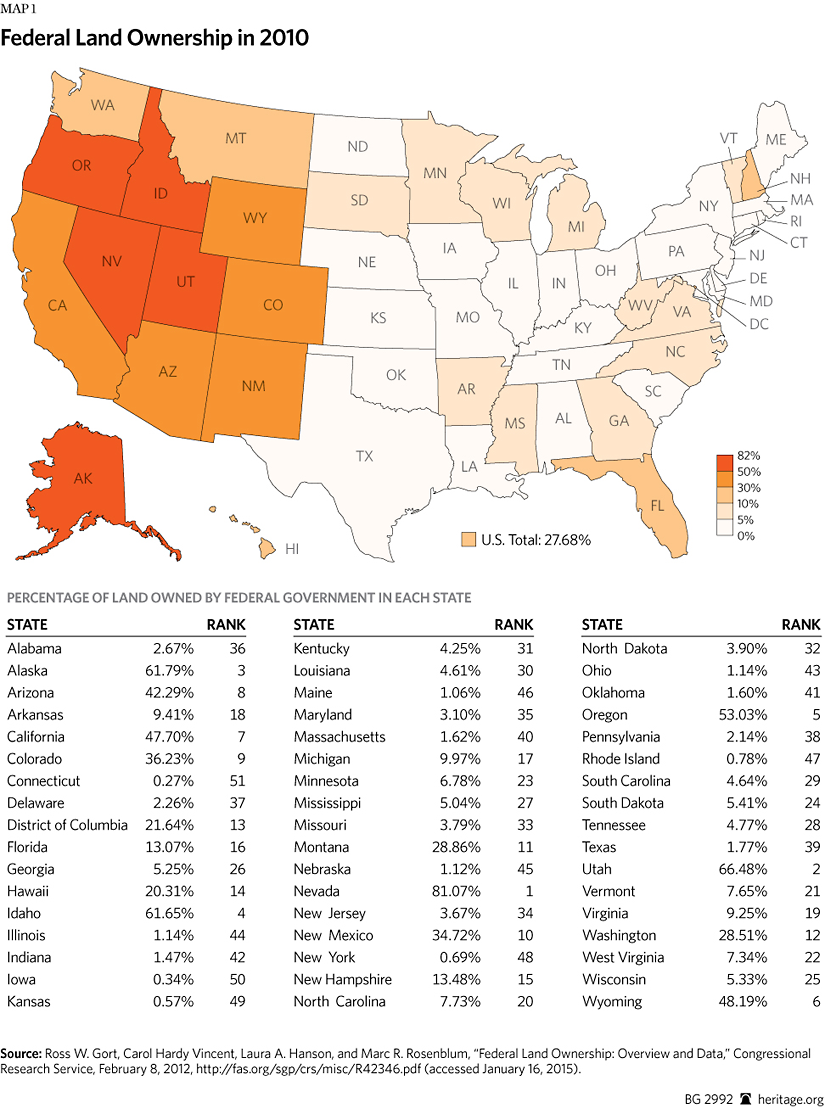
Study: Government’s Control of Land Is Hurting Oil Production, Job Growth

by Ben Smith

Current government regulations imposed by the Bureau of Land Management are harming energy production and holding back the U.S. economy, a new study reveals.

“While federally owned lands are also full of energy potential, a bureaucratic regulatory regime has mismanaged land use for decades,” write The Heritage Foundation’s Katie Tubb and Nicolas Loris.

The report focuses on the Federal Lands Freedom Act, introduced by Rep. Diane Black, R-Tenn., and Sen. James Inhofe, R-Okla. It is designed to empower states to regain control of their lands from the federal government in order to pursue their own energy goals. That is a challenge in an oil-rich state like Colorado.

“We need to streamline the process as there are very real consequences to poor [or nonexistent] management,” Tubb, a Heritage research associate, told The Daily Signal.

“Empowering the states is the best solution. The people who benefit have a say and can share in the benefits. If there are consequences, they can address them locally with state and local governments that are much more responsive to elections and budgets than the federal government.”

Emphasizing the need to streamline the process, Tubb pointed to the findings in the new report.

“The Bureau of Land Management estimates that it took an average of 227 days simply to complete a drill application,” Tubb said.

That’s more than the average of 154 days in 2005 and more than seven times the state average of 30 days, according to the report.

The report blames this increase in the application process on the drop in drilling on federal lands.

“Since 2009,” Tubb and Loris write, “oil production on federal lands has fallen by nine percent, even as production on state and private lands has increased by 61 percent over the same period.”

Despite almost “43 percent of crude oil coming from federal lands,” government-owned lands have seen a 13-point drop in oil production, from 36 percent to 23 percent.

The report also examines the recent oil-related job boom.

“Job creation in the oil and gas industry bucked the slow economic recovery and grew by 40 percent from 2007 to 2012, in comparison to one percent in the private sector over the same period,” according to the report.

That boom has had a big impact on jobs.

Map: John Fleming

“Energy-abundant states like Colorado and Alaska would stand to benefit tremendously. We’ve seen oil and natural gas production increase substantially in Colorado over the past eight years, bringing jobs and economic activity to the state,” said Loris, an economist who is Heritage’s Herbert and Joyce Morgan fellow.

Tubb cautioned that any change will happen slowly. “The federal government likely will not release the land that easily.”

Loris agreed, noting the long-running debate about the Arctic National Wildlife Refuge.

“It was no surprise that the Alaskan delegation was up in arms when the administration proposed to permanently put ANWR off limits to energy exploration,” Loris told The Daily Signal. “Many in the Alaskan delegation and Alaskan natives, including village of Kaktovik—the only town in the coastal plain of ANWR, support energy development.”

“We are putting power to the people,” Tubb concluded.

A Raw Deal for Real-Estate Agents

Real estate can be risky for agents themselves. Fickle buyers, unforeseen structural issues, setbacks in financing can all scuttle a deal.

THE COMMITMENT-PHOBE Known for repeatedly pulling out of the purchase right before the contract is signed. Illustration: Laszlito Kovacs

By Nancy Keates | Wall Street Journal, Feb. 19, 2015

She saw a ghost. That was the excuse, anyway, for one buyer’s decision to back out at the last minute from closing on a $1.4 million house in San Francisco, losing a roughly $21,000 deposit in the process.

Her real-estate agent, Amanda Jones of Sotheby’s International Realty, estimates she spent about 250 hours over six months showing the prospective buyer about 130 houses in the Bay Area. In the end, she believes the woman just changed her mind. “It was horrible,” the agent says.

Few professions demand as much upfront time and legwork with the risk of zero return on the effort as real-estate sales. Fickle buyers, unforeseen structural issues, setbacks in financing can all scuttle a sale. Now, there’s another common deal breaker: an overheated housing market in which frenzied bidding wars lead to rash decisions—followed by buyers’ remorse.

“It’s such a fast-paced market right now. Buyers are expected to make offers after seeing a place once at a packed house, so they don’t have time to think things through,” says Kaitlin Adams, an agent with New York-based Compass.

THE NERVOUS NELLIE Spends countless hours to find the perfect home, but backs out at the last minute, saying it just doesn’t ‘feel right.

Nationally, median home prices in 2014 rose to their highest level since 2007, while housing inventory continued to drop—falling 0.5% lower than a year ago, according to the National Association of Realtors. The percentage of buyers backing out of contracts has gone up by about 8%—to 19.1% in the third quarter of 2014 from 17.76% in the third quarter of 2012, according to Evercore ISI, an investment-banking advisory firm.

The war stories come mostly at the high end in select markets, where affluent buyers are less affected by the prospect of losing thousands in earnest money or down payments. Cormac O’Herlihy of Sotheby’s International Realty in Los Angeles recently had buyers he calls “nervous nellies” back out on a $6 million house. “They enjoy an overabundance of financial ability,” Mr. O’Herlihy says.

Julie Zelman, a New York-based agent with Engel & Völkers, spent the past year searching for an apartment for a recently divorced client in his 40s who said he wanted to move from Manhattan’s Upper East Side to a building downtown—preferably one populated by celebrities. Twice the client was about to close when he changed his mind: The first time was at a building called Soho Mews—he’d read it was the home of an Oscar-nominated actress and a Grammy-winning musician. The man offered $2.8 million for a two-bedroom unit but then backed out. Another time, he walked away after offering $3.1 million on a two-bedroom unit in 1 Morton Square, where a popular TV actress once lived.

“He was wasting everyone’s time. It was humiliating for me,” says Ms. Zelman, who thinks the client wasn’t mentally ready for such a big change. The client ended up renting an apartment on the Upper East Side.

THE FAULT FINDER Cites microscopic flaws to quash the deal—and get the earnest money back.

When buyers change their minds before signing a contract, they don’t lose any money. Nataly Rothschild, a New York-based broker, says she thought she had finally closed a deal after a couple’s yearlong house hunt. Because there were five other offers pending, her clients offered $200,000 over the almost $2 million asking price on the three-bedroom, three-bathroom listed for $1.8 million on Manhattan’s Upper East Side. Then Ms. Rothschild, an agent at Engel & Völkers, got a call from the couple’s attorney saying the buyer, who was nine months pregnant, had broken down in tears, saying she just couldn’t sign because it didn’t feel right. “I felt miserable for her,” says Ms. Rothschild. “But we were all shocked.”

Buyers who change their minds after signing a contract typically lose their earnest money, a deposit that shows the offer was made in good faith. That money is often held by the title company or in an escrow account and later applied to down payment and closing costs. If the deal falls through, whoever holds the deposit determines who gets the earnest money. In standard contracts, the earnest money goes to the seller. If, however, a contingency spelled out in the contract emerges—the buyer’s financing falls through, for example—the buyer usually gets the earnest money back.

Vivian Ducat, an agent with Halstead Property in New York, had a client lose $55,000 in earnest money after a change of heart on a $550,000 co-op. The woman, who was living in California, had wanted to buy a place in New York because one of her children was living there. At the last minute she balked, emailing that she “couldn’t handle the New York lifestyle.” She’d signed the contract and even filled out all the paperwork for the co-op board.

THE OVER BIDDER. Gets caught up in the frenzy of the bidding war, then realizes he didn’t mean to spend so much.

In rare instances, buyers can get their earnest money back through arbitration if they can prove a valid cause. Ms. Adams, the Compass agent, represented the sellers of a one-bedroom apartment in Brooklyn Heights that was listed for just under $600,000. When a bidding war with five offers ensued, the unit went for $70,000 above asking price to a couple from the West Coast who wanted to use it as a part-time residence. After the contract was signed, the building’s co-op board enacted a new rule that owners had to live in the building full time. As a result, the West Coast couple got their earnest money back, and the unit sold to another buyer at about $80,000 above the asking price.

Even if the real reason is simply buyer’s remorse, real-estate agents say buyers can get back earnest money as long as they can find some valid-sounding reason for dissatisfaction. Ms. Jones in San Francisco had clients withdraw an offer on a $1.1 million house. They’d been looking for two years and when the house came up the wife was traveling abroad; the husband said he was sure she would love it. Turns out the wife didn’t like it at all. The couple used the excuse of a leak found in the inspection process and got their $33,000 deposit back.

And about that ghost. A buyer who put down $43,000 in earnest money pulled out after a neighbor told them the previous owner had died in the home, among other things. The matter went into arbitration, and the potential buyer got the entire deposit back.

Ever since then, Ms. Jones says she has sellers disclose in their contracts the possibility that there might be a ghost. “You have to prepare for anything,” she says.

How The Baltic Dry Index Predicted 3 Market Crashes: Will It Do It Again?

Summary

  • The BDI as a precursor to three different stock market corrections.
  • Is it really causation or is it correlation?
  • A look at the current level of the index as it hits new lows.
 by Jonathan Fishman

The Baltic Dry Index, usually referred to as the BDI, is making historical lows in recent weeks, almost every week.

The index is a composition of four sub-indexes that follow shipping freight rates. Each of the four sub-indexes follows a different ship size category and the BDI mixes them all together to get a sense of global shipping freight rates.

The index follows dry bulk shipping rates, which represent the trade of various raw materials: iron, cement, copper, etc.

The main argument for looking at the Baltic Dry Index as an economic indicator is that end demand for those raw materials is tightly tied to economic activity. If demand for those raw materials is weak, one of the first places that will be evident is in shipping prices.

The supply of ships is not very flexible, so changes to the index are more likely to be caused by changes in demand.

Let’s first look at the three cases where the Baltic Dry Index predicted a stock market crash, as well as a recession.

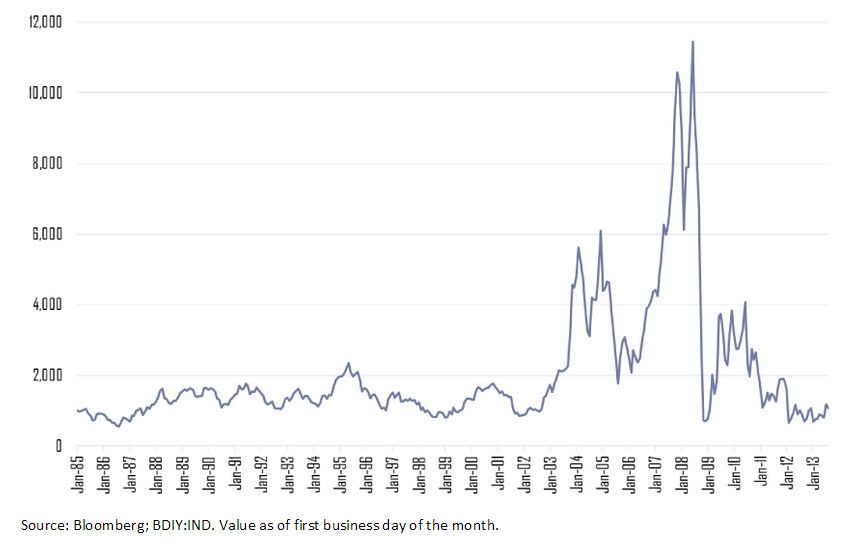
1986 – The Baltic Dry Index Hits Its first All-time Low.

In late 1986, the newly formed BDI (which replaced an older index) hit its first all-time low.

Other than predicting the late 80s-early 90s recession itself, the index was a precursor to the 1987 stock market crash.

(click to enlarge)

1999 – The Baltic Dry Index Takes a Dive

In 1999, the BDI hit a 12-year low. After a short recovery, it almost hit that low point again two years later. The index was predicting the recession of the early 2000s and the dot-com market crash.

(click to enlarge)

2008 – The Sharpest Decline in The History of the BDI

In 2008, the BDI almost hit its all-time low from 1986 in a free fall from around 11,000 points to around 780.

(click to enlarge)

You already know what happened next. The 2008 stock market crash and a long recession that many parts of the global economy is still trying to get out of.

Is It Real Causation?

One of the pitfalls that affects many investors is to confuse correlation and causation. Just because two metrics seem to behave in a certain relationship, doesn’t tell us if A caused B or vice versa.

When trying to navigate your portfolio ahead, correctly making the distinction between causation and correlation is crucial.

Without doing so, you can find yourself selling when there is no reason to, or buying when you should be selling.

So let’s think critically about the BDI.

Is it the BDI itself that predicts stock market crashes? Is it a magical omen of things to come?

My view is that no. The BDI is not sufficient to determine if a stock market crash is coming or not. That said, the index does tells us many important things about the global economy.

Each and every time the BDI hit its lows, it predicted a real-world recession. That is no surprise as the index follows a fundamental precursor, which is shipping rates. It’s very intuitive; as manufacturers see demand for end products start to slow down, they start to wind-down production and inventory, which immediately affects their orders for raw materials.

Manufacturers are the ultimate indicator to follow, because they are the ones that see end demand most closely and have the best sense of where it’s going.

But does an economic slowdown necessarily bring about a full-blown market crash?

Only if the stock market valuation is not reflecting that coming economic downturn. When these two conditions align, chances are a sharp market correction is around the corner.

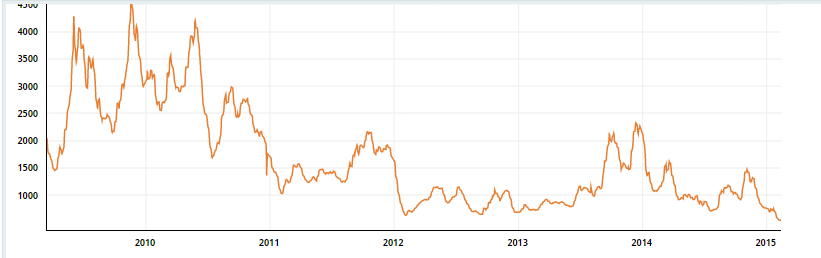
2010-2015 – The BDI Hits All-time Low, Again

In recent weeks, the BDI has hit an all-time low that is even lower than the 1986 low point. That comes after a few years of depressed prices.

(click to enlarge)

Source: Bloomberg

What does that tell us?

  1. The global economy, excluding the U.S., is still struggling. Numerous signs for that are the strengthening dollar, the crisis in Russia and Eastern Europe, a slowdown in China, and new uncertainties concerning Greece.
  2. The U.S. is almost the sole bright spot in the landscape of the global economy, although it’s starting to be affected by the global turmoil. A strong dollar hits exporters and lower oil prices hit the American oil industry hard.

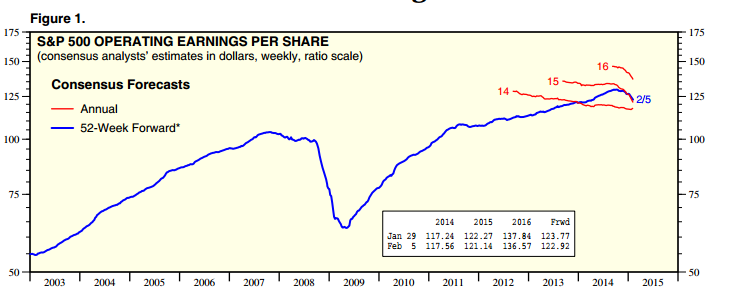
Looking at stock prices, we are at the peak of a 6-year long bull market, although earnings seem to be at all-time highs as well.

(click to enlarge)

Source: Yardeni

What the BDI might tell us is that the disconnect between the global economy’s struggle and great American business performance across the board might be coming to an end.

More than that, China could be a significant reason for why the index has taken such a dive, as serious slowdowns on the real-estate market in China and tremendous real estate inventory accumulation are disrupting the imports of steel, cement and other raw materials.

Conclusion

The BDI tells us that a global economic slowdown is well underway. The source of that downturn seems to be outside of the U.S., and is more concentrated in China and the E.U.

The performance of the U.S. economy can’t be disconnected from the global economy for too long.

The BDI is a precursor for recessions, not stock market crashes. It’s not a sufficient condition to base a decision upon, but it’s one you can’t afford to ignore.

Going forward, this is a time to make sure you know the companies you invest in inside and out, and make sure end demand for their products is bound for continued growth and success despite overall headwinds.

HSBC Bank: Secret Origins To Laundering The World’s Drug Money

https://i0.wp.com/i1.tribune.com.pk/wp-content/uploads/2010/12/dollar-640x480.jpg
by GreatGameIndia

#SwissLeaks what the media has termed it is a trove of secret documents from HSBC’s Swiss private banking arm that reveals names of account holders and their balances for the year 2006-07. They come from over 200 countries, the total balance over $100 billion. But nowhere has the HSBC Swiss list touched off a more raging political debate than in India.

That’s why to obtain and investigate the Indian names, The Indian Express partnered in a three-month-long global project with the Washington-based International Consortium of Investigative Journalists (ICIJ) and the Paris-based Le Monde newspaper. The investigation revealed 1,195 Indian HSBC clients, roughly double the 628 names that French authorities gave to the Government in 2011. The new revelation— published as part of a global agreement — is expected to significantly widen the scale and scope of the ongoing probe by the Special Investigation Team (SIT) appointed by the Supreme Court.

For years, when banks have been caught laundering drug money, they have claimed that they did not know, that they were but victims of sneaky drug dealers and a few corrupt employees. Nothing could be further from the truth. The truth is that a considerable portion of the global banking system is explicitly dedicated to handling the enormous volume of cash produced daily by dope traffickers.

Contrary to popular opinion, it is not “demand” from the world’s population which creates the mind destroying drug trade. Rather, it is the world financial oligarchy, looking for massive profits and the destruction of the minds of the population it is determined to dominate, which organized the drug trade. The case of HSBC underscores that point. Serving as the central bank of this global apparatus, is HSBC.

East India Company Origins

The opium trade began in the early 1700s as an official monopoly of the British East India Company, which conquered India, and ran it on behalf of the British Crown and the financiers operating through the City of London. Indian-grown opium became a key component in the trade for tea and silk in China.  The East India Company had a thriving business selling British textiles and other manufactured products in India, and selling Chinese silk and tea in Britain. But the Company ran into problems with the opium end of the trade. The influx of opium caused major problems for China, and led the Emperor to issue an edict in 1729 prohibiting opium consumption. Then, in 1757, the Emperor restricted all foreigners and foreign vessels to a trading area in the port city of Canton. A stronger edict in 1799 prohibited the importation and use of opium under penalty of death.

None of this stopped the British from continuing to flood China with opium, creating millions of addicts, but it did cause the East India Company to protect its tea and silk trade by shifting its Chinese opium operations to nominally independent drug runners who bought opium legally from the East India Company in Calcutta, and smuggled it into China. The most prominent of these drug-running firms was Jardine Matheson & Co. It was founded in 1832 by two Scotsmen, William Jardine and James Matheson.  Jardine had been a ship’s surgeon with the East India Company, while Matheson was the son of a Scottish baronet. The firm today is controlled by the Keswick family. In 1839, the Chinese Emperor launched an anti-opium offensive, which included the confiscation of all opium stocks in the hands of Chinese and foreign merchants. The merchants put up a fight, but were ultimately forced to concede, turning in their opium stocks after being indemnified against losses by British officials.

In response, however, the British launched a propaganda campaign against China, accusing it of violating Britain’s right to “free trade.” Britain sent its fleet to China, to force the Chinese to capitulate to the opium trade. The action, known as the First Opium War, resulted in the Treaty of Nanking in 1842, under which China not only capitulated to the opium trade, but also agreed to pay reparations to the opium runners and gave the British control of the island of Hong Kong. However, the treaty did not specifically legalize opium, so the British launched a second Opium War, which resulted in the 1856 Treaty of Tientsin, which legitimized the opium trade and opened China up to foreigners even more.

As the opium and other trade with China expanded, Britain’s new territory of Hong Kong became a major imperial commercial center. The opium dealers gathered together to form a bank, the Hongkong and Shanghai Bank, as the financial flagship of the British opium trade. Over time, the bank—now known as HSBC—would extend its reach into the drug fields of the Middle East and Ibero-America, as befitting its role as the financial kingpin of Dope, Inc.

https://www.princeton.edu/~ina/images/data/drugs/trafficking.jpg

Role of Secret Societies

In 1783 Lord Shelbourne launched the Chinese opium trade with Scottish merchants from the East India Company and members of the House of Windsor-allied Knights of St. John Jerusalem.

Shelbourne’s chief propagandist was Adam Smith who worked for East India Company, which emerged from the slave-trading Levant Company and later became known as Chatham House, home to the powerful Royal Institute for International Affairs (RIIA). In 1776 the high seas pirate Adam Smith wrote Wealth of Nations, which became the bible of international capitalism.

In the Far East the British organized the Chinese Triad Society, also known as the Society of Heaven and Earth, to smuggle their opium.  Beginning in 1788 the Freemason Grand Lodge of England established lodges in China, one of which was the Triad Society.  Another was known as the Order of the Swastika.

In 1839 William Jardine- a Canton-based opium trafficker- steered Britain into the first Opium War after Chinese officials confiscated his stash. The second Opium War lasted from 1858-1860.  Lord Palmerston commanded both expeditions for the Brits.  He was also the High Priest of Scottish Rite Freemasonry in the British Empire.

Throughout the 19th century the British families of Matheson, Keswick, Swire, Dent, Inchcape, Baring and Rothschild controlled the Chinese heroin traffic.  The Inchcape’s and Baring’s Peninsular & Orient Steam Navigation Company (PONC) transported the dope around the world.

To the US West Coast, the families brought Chinese coolies to build JP Morgan’s railroads, slave laborers who were kidnapped (shanghaied) by the Triads.  The Triads came along too, setting up opium dens in San Francisco and Vancouver and using a network of Chinatowns as a channel for heroin.  This network exists today.  To the US East Coast the families brought African slaves and cotton.  These same families built plantations and became kings of southern cotton on the backs of shanghaied Africans.

The American families Perkins, Astor and Forbes made millions off the opium trade.  The Perkins’ founded Bank of Boston, which is today known as Credit Suisse First Boston.  The Perkins and Morgan families endowed Harvard University.  William Hathaway Forbes was a director at Hong Kong Shanghai Bank shortly after it was founded in 1866.  John Murray Forbes was the US agent for the Barings banking family, which financed most of the early drug trade.  The Forbes family heirs later launched Forbes magazine. Steve Forbes ran for President in 1996.  John Jacob Astor invested his opium proceeds in Manhattan real estate and worked for British intelligence.  The Astor family home in London sits opposite Chatham House.

These families launched the Hong Kong Shanghai Bank Corporation (HSBC) after the second Opium War as a repository for their opium proceeds.  HSBC, a subsidiary of the London-based HSBC Holdings, today prints 75% of Hong Kong’s currency, while the British Cecil Rhodes-founded Standard Chartered Bank prints the rest.  HSBC’s Hong Kong headquarters sits next to a massive Masonic Temple.

Freemasonry is a highly secretive society, making it an ideal vehicle for global drugs and arms trafficking.  According to 33rd Degree Mason Manly Hall, “Freemasonry is a fraternity within a fraternity – an outer organization concealing an inner brotherhood of the elect…the one visible and the other invisible.  The visible society is a splendid camaraderie of ‘free and accepted’ men enjoined to devote themselves to ethical, educational, fraternal, patriotic and humanitarian concerns.  The invisible society is a secret and most august fraternity whose members are dedicated to the service of an arcanum arcandrum (sacred secret).”

Wealth derived from selling this Chinese opium during British colonial rule, helped build many landmarks on India’s west coast. The Mahim Causeway, The Sir JJ School of Art, David Sassoon Library and Flora Fountain, landmarks in modern Mumbai, were built by prominent Parsi and Jewish traders from profits made by a flourishing opium and later cotton trade with China.

Prominent families from Mumbai’s past, names that adorn today’s famous institutions such as the Wadia’s, Tata’s, Jejeebhoy’s, Readymoney’s, Cama’s and Sassoon’s sold opium to China through the British. By the end of the nineteenth century, when the opium trade went bust, cotton from India’s western state of Gujarat, which had already developed strong trade links with Canton profited. The Paris’s ploughed profits from the trade with the Chinese back into India, setting up several schools, hospitals and banks. Historical records prove that some of India’s prominent Parsi traders at the time, were founders of the Hong Kong and Shanghai Banking Corporation (HSBC) founded in 1865. For a detailed report read Rothschild colonization of India.

It is this deadly opium empire that Gandhiji was very much conscious about and spoke out against for which he was jailed in 1921 by India’s British rulers for “undermining the revenue”. Having seen generations of Chinese youths rendered docile and passive Gandhijis was concerned over opium and its deadly effects on India which is clear from his letters. These opium production activities ran until 1924 in India and were stopped with the heroic efforts of Mahatma Gandhi who first agitated to remove opium production from India and destruction of China using Indian soil. Finally the British transferred the entire production to Afghanistan in 1924 handing the production to southern Afghani tribals which after 90 years became the golden crescent of opium production. Though the production is in the hands of Afghan tribals the distribution finance market control is still exercised by the same old British business houses or their proxies.

Afghan Opium for Bankers and Terrorists

There is a general impression that Afghanistan has always been the center of opium production. In fact, it has not. Prior to the Soviet invasion in 1979, opium production in Afghanistan was less than 1,000 tons; that grew to 8,200 tons (based on conservative UN Office on Drugs and Crime/UNODC figures) in 2008. Throughout this period, Afghanistan was in a state of war. Following the Soviet invasion, the anti-Soviet powers, particularly, the US, UK, and Saudi Arabia, began generating larger amounts of drug money to finance much of the war to defeat the Soviets. Since 1989, after the Soviet withdrawal, there has been an all-out civil war in Afghanistan, as the US-UK-Saudi-created mujahideen dipped further into the opium/heroin money.

What was happening in Afghanistan during this period that caused opium production to soar to those levels? History shows that the US invasion in 2001 came close to wiping out the Taliban forces; the Afghan people, at least at that point in time, because of the Pakistani-Saudi links to the Taliban and the oppressive nature of the Wahhabi-indoctrinated regime, supported the invading American and NATO forces. That began to change in 2005.

The year 2005 is important in this context, since one of the most damning parts of the US Senate report details HSBC’s relationship with the Saudi-based Al Rajhi Bank, a member of Osama bin Laden’s “Golden Chain” of important al-Qaeda financiers. The HSBC-Al Rajhi relationship has spanned decades; perhaps that is why, even when HSBC’s own internal compliance offices asked that it be terminated in 2005, and even when the US government discovered hard evidence of Al Rajhi’s relationship with terrorism, HSBC continued to do business with the bank until 2010.

In fact, the report said, Al Rajhi’s links to terrorism were confirmed in 2002, when US agents searched the offices of a Saudi non-profit US-designated terrorist organization, Benevolence International Foundation. In that raid, agents uncovered a CD-ROM listing the names of financiers in bin Laden’s Golden Chain. One of those names was Sulaiman bin Abdul Aziz Al Rajhi, a founder of Al Rajhi bank.

Recently an operation by German Customs official revealed that the British Queen financed Osama Bin Laden. German officials in an operation raided two containers passing through Hamburg Port and seized 14,000 documents establishing that Osama bin Laden was funded by UK Queen’s bank Coutts, which is part of the Royal Bank of Scotland.

HSBC & 26/11 Mumbai Attacks

Why did HSBC not terminate its links with the Al Rajhi in 2005? The answer lies in what was then put in place in Afghanistan to generate large amounts of cash. When it comes to opium/ heroin and offshore banks, Britain rules supreme. In 2005, poppy fields in southern Afghanistan began to bloom, and it became evident to the bankers and the geo-politicians of Britain and the US that cash to support the financial centers and the terrorists could be made right there.

It was announced on Jan. 27, 2006 in the British Parliament that a NATO International Security Assistance Force (ISAF) would be replacing the US troops in Helmand province as part of Operation Herrick. The British 16 Air Assault Brigade would make up the core of the force. British bases were then located in the districts of Sangin, Lashkar Gah, and Gereshk.

As of Summer 2006, Helmand was one of the provinces involved in Operation Mountain Thrust, a combined NATO/Afghan mission targeted at Taliban fighters in the south of the country. In July 2006, the offensive essentially stalled in Helmand, as NATO (primarily British) and Afghan troops were forced to take increasingly defensive positions under heavy insurgent pressure. In response, British troop levels in the province were increased, and new encampments were established in Sangin and Gereshk. In Autumn 2006, some 8,000 British troops began to reach “cessation of hostilities” agreements with local Taliban forces around the district centers where they had been stationed earlier in the Summer, and it is then that drug-money laundering began in earnest.

This drug money, at least a good part of it, is generated in this area with the help of Dawood Ibrahim, who also played a role in helping the Mumbai attackers by giving them the use of his existing network in Mumbai. At the time, Ibrahim worked on behalf of the British, and ran his operation through the British-controlled emirate of Dubai. Drugs came into Dubai through Dawood’s “mules,” protected by the Pakistani ISI and British MI6; the dope was shipped in containers which carried equipment sent there for “repair” from Kandahar and elsewhere in southern Afghanistan. British troops controlled Helmand province, where 53% of Afghanistan’s gargantuan 8,200 tons of opium was produced in 2007.

The drugs were converted, and still are today, to cash in Dubai, where Dawood maintains a palatial mansion, similar to the one he maintains in Karachi. Dubai is a tax-free island-city, and a major offshore banking center. The most common reason for opening an offshore bank account is the flexibility that comes with it.

With the development of the Dubai International Financial Centre (DIFC), which is the latest free-trade zone to be set up there, flexible and unrestricted offshore banking has become big business. Many of the world’s largest banks already have significant presence in Dubai – big names such as Abbey National Offshore, HSBC Offshore, ABN Amro, ANZ Grindlays, Banque Paribas, Banque de Caire, Barclays, Dresdner, and Merrill Lynch, all have offices in the Emirate already.

In addition to Dubai, most of the offshore banks are located in former British colonies, and all of them are involved in money laundering. In other words, the legitimization of cash generated from drug sales and other smuggled illegitimate goods into the “respectable banks” is the modus operandi of these offshore banks. The drugs that Dawood’s mules carry are providing a necessary service for the global financial system, as well as for the terrorists who are killing innocents all over the world.

In December of 2007, this Britain-run drug-money-laundering and terrorist-networking operation was about to be exposed when Afghan President Hamid Karzai learned that two British MI6 agents were working under the cover of the United Nations and the European Union behind his back, to finance and negotiate with the Taliban. He expelled them from Afghanistan. One of them, a Briton, Michael Semple, was the acting head of the EU mission in Afghanistan and is widely known as a close confidant of Britain’s Ambassador, Sir Sherard Cowper-Coles. Semple now masquerades as an academic analyst of Afghanistan, and was associated with the Harvard Kennedy School’s Carr Center. The second man, an Irishman, Mervin Patterson, was the third-ranking UN official in Afghanistan at the time that he was summarily expelled.

These MI6 agents were entrusted by London with the task of using Britain’s 7,700 troops in the opium-infested, Pushtun-dominated, southern province of Helmand to train 2,000 Afghan militants, ostensibly to “infiltrate” the enemy and “seek intelligence” about the lethal arms of the real Taliban. Karzai rightly saw it as Britain’s efforts to develop a lethal group within Afghanistan, a new crop of terrorists.

The drug money thus generated to fund the financial centers and terrorists through HSBC was also responsible for ongoing terrorist attacks that have destabilized most of South Asia. The most important of these was the massive attack on Mumbai.

The mode used to launder such drug money is through diamonds. A 2003 Report assessed various alternative financing mechanisms that could be used to facilitate money laundering and or terrorist financing. Trading in commodities, remittance systems, and currency were assessed on each of their abilities to earn, be moved, and store value. Diamonds were the only alternative financial device that fit into all of these assessment criteria.

Diamonds can be vulnerable for misuse for money laundering and terrorist financing purposes because they can transfer value and ownership quickly, often, with a minimal audit trail. They provide flexibility and an easy transportation of value.

Top diamond traders of the country, several of whom are now settled abroad, figure on what the media calls as the #SwissList, with mostly Mumbai addresses given. Many persons on the list are Gujarati diamond merchants with offices all over world having roots in Palanpur.

However their involvement in not just limited to money laundering. Almost 6 months before 26/11 2008 Mumbai Attacks the Financial Intelligence Unit of India (FIU-IND) (the central national agency responsible for receiving, processing, analyzing and disseminating information relating to suspect financial transactions) was already tracking the diamond industry for suspicious activities by terrorists.

“A year ago, some people from Mumbai began purchasing diamonds worth crores of rupees. When the industry tried to trace the traders, they turned out to be non-existent,” said Vanani.

The FIU traced all foreign transactions of Surat’s diamond industry, especially those emanating from Belgium. It found that a great deal of money was being invested by terrorist groups.

However in May 2014 eight of these Belgium based diamond dealers were given a clean chit by the Income Tax department in the black money case. The I-T department said a probe was initiated against the eight individuals, but there was no proof of tax evasion by them. Why is the Government reluctant in disclosing Black Money related data; be it NDA and even UPA before it ? For a detailed report on the issue read 26/11 – The Black Money Trail.

From the Far East to the Middle East to Ibero-America to India, everywhere the drug trade is flourishing, you will find HSBC. It may not handle the dope, but it does handle the money, making sure that the “citizens above suspicion” who run the empire get their cut of the proceeds.  Now HSBC has been caught red-handed laundering money in the U.S., India, China, Argentina almost everywhere the sun shined through the colonies. This is a bank which has abused us, assaulted our people, and violated the law with abandon. Isn’t it time we set an example and revoke its charter to do business here in India ?


HSBC Whistle Blower Spills Lynch Evidence To Senate

by Jerome Corsi | WMDcapitol


NEW YORK – The Senate Judiciary Committee on Wednesday conducted a two-hour session with HSBC whistle blower John Cruz in its investigation of attorney general nominee Loretta Lynch’s role in the Obama administration’s decision not to prosecute the banking giant for laundering funds for Mexican drug cartels and Middle Eastern terrorists, WND sources have confirmed.

WND was first to report in a series of articles beginning in 2012 charges by Cruz, a former HSBC vice president and relationship manager, based on his more than 1,000 pages of evidence and secret audio recordings.

The staff of the Senate Judiciary Committee focused Wednesday on Cruz’s allegations, first reported by WND Feb. 6, that Lynch, acting then in her capacity as the U.S. attorney for the Eastern District of New York, engaged in a Department of Justice cover-up. Obama’s attorney general nominee allowed HSBC to enter into a “deferred prosecution” settlement in which the bank agreed to pay a $1.9 billion fine and admit “willful criminal conduct” in exchange for dropping criminal investigations and prosecutions of HSBC directors or employees.

On Feb. 12, the Senate Judiciary Committee announced Chairman Sen. Chuck Grassley, R-Iowa, had decided to postpone the Senate vote on Lynch’s confirmation until the last week of February, when Congress returns from the Presidents Day recess. The decision is widely attributed to allowing Vitter and the Senate Judiciary Committee staff time to pursue the allegations concerning Lynch’s role in the HSBC scandal.

Read the explosive backstory inside the HSBC scandal – how WND first exposed the massive money-laundering scheme, the fallout from the eye-popping discovery and the role Loretta Lynch played in “Launder-gate.”

Cruz called the $1.9 billion HSBC fine “a joke,” explaining to WND that HSBC bank auditors had told him in 2009 that senior managers and compliance officers in New York were fully aware the London-headquartered bank was engaged in a criminal scheme to launder money internationally for Mexican drug cartels and Middle Eastern terrorists.

“The auditors warned me investigating the money laundering could cost me my job,” Cruz said. “The auditors told me in 2009 that nobody in the bank was going to go to jail and that HSBC had already put aside $2 billion in reserves to pay the fine they somehow had reason to suspect back then that the Department of Justice would demand to settle the case.”

Cruz argued that a $1.9 billion fine of an international bank the size of Hong Kong Shanghai Bank, the official name of HSBC, amounted to no more than “a few days operating profit.” He described it as “a cost of doing business” once HSBC had decided to launder money for international criminals.

Senate investigators to hear HSBC recordings

Confidential sources in Washington confirmed to WND that Jason Foster, the chief investigative counsel at the Senate Judiciary Committee, was directing the investigation into Cruz’s allegations against Lynch.

Cruz’s charges and documentation were brought to Sen. David Vitter, R-La., a member of the Senate Judiciary Committee, before the senator announced Feb. 11 that he was opening his own investigation of Lynch.

Like the reporting you see here? Sign up for free news alerts from WND.com, America’s independent news network.

Foster is considered on Capitol Hill to be one of the Senate’s best, most experienced investigators. A graduate of Georgetown University Law Center, he had more than 15 years experience directing fact-finding inquiries for the Senate Committee on Finance, Senate Homeland Security Committee and the House Committee on Government Reform, before becoming chief investigative counsel for the Senate Judiciary Committee in January 2011.

The Senate Judiciary Committee’s staff questioning of Cruz and his attorney focused on approximately 1,000 pages of HSBC customer account records that Cruz turned over to WND early in 2012. The records were pulled from the HSBC computer system before he was fired by HSBC senior management who didn’t want to investigate his claim to have discovered illegal money-laundering activity at the bank.

As WND reported in a series of articles beginning Feb. 1, 2012, Cruz was able to document a complex criminal scheme that involved wiring billions of dollars of money for Mexican drug cartels and Middle Eastern terrorists thorough thousands of bogus accounts created through identity theft. The scheme used the names and Social Security numbers of hundreds of unsuspecting current and former customers. It allegedly had the active participation of regional bank managers, branch managers and employees, as well as bank compliance officials at hundreds of HSBC locations throughout the nation. The money ultimately was wired by the bank to undisclosed bank accounts internationally.

Foster, on behalf of the Senate Judiciary Committee, has requested that Cruz to submit some 70 hours of conversations Cruz secretly recorded of bank management and compliance officers in New York. He also recorded his conversations with law-enforcement authorities, including the Suffolk County District Attorney’s office, the Department of Homeland Security and the IRS.

Cruz played for WND an audio recording he made of a phone call he placed to Jeremy Scileppi, the bureau chief at the office of the Suffolk County district attorney June 25, 2012. Scileppi told Cruz Suffolk County did not want to duplicate other investigations of HSBC money-laundering allegations.

Scileppi explained the Suffolk district attorney had turned over Cruz’s documentation to HSBC security personnel, “so the bank could conduct their own internal investigation,” as well as to the Brooklyn district attorney’s office and to the FBI, a division of the Department of Justice, as is the U.S. attorney’s office for the Eastern District of New York.

“We generally back off the investigation if the FBI or another federal agency is involved,” Scileppi explained. The way it works is that we don’t want two different agencies to chase the same squirrel up the same tree from two different sides, because, then, nobody gets the squirrel. The FBI told us to back off because they were working the HSBC money-laundering investigation.”

Cruz: ‘DHS stonewalled’

One day after WND’s first article on the HSBC money-laundering scandal was published in February 2012, WND received an email from Sgt. Frank J. DiGregorio, a DHS employee in New York.

“I have read your article in WND pertaining to the allegations by John Cruz against HSBC Bank. As a supervisor for Homeland Securities Investigators, I would very much like the opportunity to meet with Mr. Cruz and speak with him,” DiGregario said.

On Feb. 7, 2012, WND attended a meeting with DiGregorio and Graham R. Klein, special agent for the Department of Homeland Security, in an office building on Manhattan’s lower east side that bore no DHS designation, with Cruz attending by telephone.

With Cruz’s approval, WND handed over to DHS all the written documentation and audio recordings Cruz had provided, offering with Cruz’s permission to assist in the investigation in any way possible.

In a meeting lasting over an hour that Cruz audio-recorded without WND’s knowledge, DiGregorio and Klein promised to investigate the evidence and allegations Cruz had presented.

“This is an ongoing investigation,” DiGregorio told WND at the conclusion of the meeting. “Cruz made very serious allegations, and it takes time for us to do our work. But we have not forgotten about Cruz, and we will get back to him just as soon as we can.”

DiGregorio explained that as a detective sergeant in the office of the Queens County district attorney, he is currently assigned to Homeland Security Investigations, where he supervises Special Agent Klein.

Subsequent to the meeting, Cruz told WND he was shocked DHS claimed it was their first contact with him.

“Back in 2010, my attorney turned over information regarding HSBC to DiGregorio,” Cruz said, as reported by WND in an article published May 13, 2012. “Then, on Feb 7, 2012, Homeland Security said my attorneys never spoke to them, that they didn’t know who I am.”

Cruz was shocked.

“DiGregorio called me; he was belittling me,” Cruz recounted. “DiGregorio said I was a disgruntled employee, that I was just here for the money. They said, ‘Why did it take you two years to come forward?’”

IRS continues to stonewall Cruz

WND reported May 13, 2012, Cruz explained he had also presented his allegations and evidence to Internal Revenue Service Special Agent David Wagner and Supervisory Special Agent Kevin B. Sophia. Both were of the U.S. Department of Treasury, IRS, Criminal Investigation Division.

“I met with them in Denver, Colorado, on April 12, 2012, at the IRS office,” Cruz said. “I gave them a computer disc with all the HSBC documents on it. Agent Sophia asked, ‘What would make us believe HSBC employees would acknowledge illegal activity?’ I told them I recorded everything.”

Cruz also handed over to the IRS two discs with approximately 19 to 20 hours he had recorded of his discussions with HSBC employees concerning his allegations.

Cruz told WND the IRS agents were overwhelmed with the volume and detail of the information he handed over.

“The IRS agents said, ‘This is mind-boggling,’” Cruz recounted. “They told me that if the information on the computer disk and in the audio files was as I represented, the IRS agents were talking about arresting HSBC bank employees.”

Cruz noted the IRS was stunned at the dollar magnitude of the suspicious bank transactions he had documented, noting that billions of dollars in tax revenue was being lost, with bank employees transferring money into and out of bogus accounts set up for illegal gain.

The IRS explained to Cruz that the individuals whose identities may have been stolen to set up the apparently fraudulent accounts would also have to be investigated, to see if they were part of the suspicious activity or merely victims.

Either way, the Social Security numbers associated with the suspicious HSBC accounts turned out to be authentic numbers identified in many cases with present or former customers of the bank. And the billions of dollars traveling through the accounts had never been reported for income tax purposes.

“The IRS denied my request to be a whistle blower in the HSBC case,” Cruz told WND. “The IRS said the information I provided did not result in the collection of any fines, so I was not owed any fee by the federal government.”

Cruz: ‘I no longer trust DHS or the IRS’

As WND also reported May 13, 2012, Cruz handed over to WND audio recordings he made of his meetings with DHS and IRS officials – recordings he made without disclosing to the DHS and IRS.

Cruz explained that he no longer trusts even federal law enforcement to do their job investigating and prosecuting HSBC employees who may be involved in illegal bank transactions, as he alleges.

“It’s a circle,” Cruz explained. “I turn over the information to law enforcement, and law enforcement turns around and gives the information right back to the bank for the bank to conduct their own internal investigation.”

Cruz says he was fired by HSBC for bringing forth his charges.

“This is how the bank and employees in the bank make money,” he argued, explaining why he was fired instead of being given awards for meritorious service disclosing the suspicious activities. “It’s a lot easier to make money off fraudulent transactions than it is to make money off legal transactions.”

He indicated he was not concerned HSBC and/or its employees might sue him for libel or defamation.

“Sue me,” he said defiantly, “sue me all you want. Then bring out the proof. I will ask for every document. I will ask for a lot of documents. I will show that I am right, and I will give every tape recording to the public on air, so they can listen to these individuals talking.”

Cruz explained he taped the conversations with federal law enforcement authorities “to cover myself.”

“You never know what’s going to happen,” he explained. “Somebody could say, ‘Oh, you’re involved.’ I need to explain that I’m not involved, but that I reported it. Then, if they deny I reported it, I have the tapes to prove I reported it.”

Cruz affirmed to WND he was accusing by name federal officials in DHS and IRS, as well as officials in the district attorneys offices in Suffolk County and Queens County, New York, of not taking steps to stop immediately what he alleges is money laundering billions of dollars in the United States around the world.

He noted his contact with the IRS was relatively recent, and he has reason to believe the IRS has opened an investigation.

IRS agents Wagner and Sophia did not return WND calls for comment.

HSBC ‘a criminal organization’

Cruz began working at HSBC Jan. 14, 2008, as a commercial bank accounts relationship manager and was terminated for “poor job performance” on Feb. 17, 2010, after he refused to stop investigating the HSBC criminal money-laundering scheme from within the bank.

In his position as a vice president and a senior account relationship manager, Cruz worked in the HSBC southern New York region, a which accounts for approximately 50 percent of HSBC’s North American revenue. He was assigned to work with several branch managers to identify accounts to which HSBC might introduce additional banking services.

Cruz told WND he recorded hundreds of hours of meetings he conducted with HSBC management and bank security personnel in which he charged that various bank managers were engaging in criminal acts.

“I have hours of hours of recordings, ranging from bank tellers, to business representatives, to branch managers, to executives,” he said. “The whole system is designed to be a culture of fraud to make it look like it’s a legal system. But it’s not.”

Cruz explained that after many repeated efforts, he gave up on the idea that HSBC senior management or bank security would pursue his allegations to investigate and stop the wrongdoing.

“My conclusion was that HSBC wasn’t going to do anything about this account, because HSBC management from the branch level, to senior bank security, to executive senior management was involved in the illegal activity I found,” he said.

After repeated attempts to bring the information to the attention of law enforcement officers, Cruz hit a brick wall until WND examined his documentation and determined his shocking allegations were sufficiently substantiated.

“HSBC is a criminal organization,” he stressed. “It is a culture of crime.”

In 2011, Cruz published a book about his experience with HSBC, titled “World Banking World Fraud: Using Your Identity.”

We Live In An Era Of Dangerous Imbalances

by Tyler Durden

The intervention by the world’s central banks has resulted in today’s bizarro financial markets, where “bad news is good” because it may lead to more (sorry, moar) thin-air stimulus to goose asset prices even higher.

The result is a world addicted to debt and the phony stimulus now essential to sustaining it. In the process, a tremendous wealth gap has been created, one still expanding at an exponential rate.

History is very clear what happens with dangerous imbalances like this. They correct painfully. Through class warfare. Through currency crises. Through wealth destruction.

Is that really the path we want? Because we’re for sure headed for it.

Increasing Rent Costs Present a Challenge to Aspiring Homeowners

https://i0.wp.com/dsnews.com/wp-content/uploads/sites/25/2013/12/rising-arrows-two.jpgby Tory Barringer

Fast-rising rents have made it difficult for many Americans to save up a down payment for a home purchase—and experts say that problem is unlikely to go away any time soon.

Late last year, real estate firm Zillow reported that renters living in the United States paid a cumulative $441 billion in rents throughout 2014, a nearly 5 percent annual increase spurred by rising numbers of renters and climbing prices. Last month, the company said that its own Rent Index increased 3.3 percent year-over-year, accelerating from 2013 even as home price growth slows down.

Results from a more recent survey conducted by Zillow and Pulsenomics suggest that rent prices will continue to be a problem for the aspiring homeowner for years to come.

Out of more than 100 real estate experts surveyed, 51 percent said they expect rental affordability won’t improve for at least another two years, Zillow reported Friday. Another 33 percent were a little more optimistic, calling for a deceleration in rental price increases sometime in the next one to two years.

Only five percent said they expect affordability conditions to improve for renters within the next year.

Despite the challenge that rising rents presents to home ownership throughout the country, more than half—52 percent of respondents—said the market should be allowed to correct the problem on its own, without government intervention.

“Solving the rental affordability crisis in this country will require a lot of innovative thinking and hard work, and that has to start at the local level, not the federal level,” said Zillow’s chief economist, Stan Humphries. “Housing markets in general and rental dynamics in particular are uniquely local and demand local, market-driven policies. Uncle Sam can certainly do a lot, but I worry we’ve become too accustomed to automatically seeking federal assistance for housing issues big and small, instead of trusting markets to correct themselves and without waiting to see the impact of decisions made at a broader local level.”
On the topic of government involvement in housing matters: The survey also asked respondents about last month’s reduction in annual mortgage insurance premiums for loans backed by the Federal Housing Administration (FHA). The Obama administration has projected that the cuts will help as many as 250,000 new homeowners make their first purchase.

The panelists were lukewarm on the change: While two-thirds of those with an opinion said they think the changes could be “somewhat effective in making homeownership more accessible and affordable,” just less than half said the new initiatives are unwise and potentially risky to taxpayers.
Finally, the survey polled panelists on their predictions for U.S. home values this year. As a whole, the group predicted values will rise 4.4 percent in 2015 to a median value of $187,040, with projections ranging from a low of 3.1 percent to a high of 5.5 percent.

“During the past year, expectations for annual home value appreciation over the long run have remained flat, despite lower mortgage rates,” said Terry Loebs, founder of Pulsenomics. “Regarding the near-term outlook, there is a clear consensus among the experts that the positive momentum in U.S. home prices will continue to slow this year.”

On average, panelists said they expect median home values will pass their precession peak ($196,400) by May 2017.

OPEC Can’t Kill American Shale

https://i0.wp.com/static3.businessinsider.com/image/542c5b786da8118e288b4570/morgan-stanley-here-are-the-16-best-stocks-for-playing-the-american-shale-boom.jpgby Shareholdersunite

Summary

  • OPEC is supposedly out to beat, or at least curtail the growth of American shale oil production.
  • For a host of reasons, especially the much shorter capex cycle for shale, they will not succeed unless they are willing to accept permanent low oil prices.
  • But, permanent low oil prices will do too much damage to OPEC economies for this to be a credible threat.

We’re sure by now you are familiar with the main narrative behind the oil price crash. First, while oil production outside of North America is basically stagnant since 2005.

The shale revolution has dramatically increased supply in America.

(click to enlarge)

The resulting oversupply has threatened OPEC and the de-facto leader Saudi Arabia has chosen a confrontational strategy not to make way for the new kid on the block, but instead trying to crush, or at least contain it. Can they achieve this aim, provided it indeed is their aim?

Breakeven price
At first, one is inclined to say yes, for the simple reason that Saudi (and most OPEC) oil is significantly cheaper to get out of the ground.

(click to enlarge)

This suggests that all OPEC has to do is to keep output high and sooner or later the oversupply will work itself off the market, and expensive oil is more likely to see cutbacks than cheaper oil, although this critically depends on incentives facing individual producers.

Capex decline
It is therefore no wonder that we’ve seen significant declines in rig counts and numerous companies have announced considerable capex declines. While this needs time to work out into supply cutbacks, these will eventually come.

For instance BP (NYSE:BP) cutting capex from $22.9B in 2014 to $20B in 2015, or Conoco (NYSE:COP) reducing expenditures by more than 30% to $11.5B this year on drilling projects from Colorado to Indonesia. There are even companies, like SandRidge (NYSE:SD), that are shutting 75% of their rigs.

Leverage
It is often argued that the significant leverage of many American shale companies could accelerate the decline, although it doesn’t necessarily have to be like that.

While many leveraged companies will make sharp cutbacks in spending, which has a relatively rapid effect on production (see below), others have strong incentives to generate as much income as possible, so they might keep producing.

Even the companies that go belly up under a weight of leverage will be forced to relinquish their licenses or sell them off at pennies to the dollar, significantly lowering the fixed cost for new producers to take their place.

Hedging
Many shale companies have actually hedged much of their production, so they are shielded from much of the downside (at a cost) at least for some time. And they keep doing this:

Rather than wait for their price insurance to run out, many companies are racing to revamp their policies, cashing in well-placed hedges to increase the number of future barrels hedged, according to industry consultants, bankers and analysts familiar with the deals. [Reuters]

Economics
Being expensive is not necessarily a sufficient reason for being first in line for production cuts. For instance, we know that oil from the Canadian tar sands is at the high end of cost, but simple economics can explain why production cuts are unlikely for quite some time to come.

The tar sands involve a much higher fraction as fixed cost:

Oil-sands projects are multibillion-dollar investments made upfront to allow many years of output, unlike competing U.S. shale wells that require constant injections of capital. It’s future expansion that’s at risk. “Once you start a project it’s like a freight train: you can’t stop it,” said Laura Lau, a Toronto-based portfolio manager at Brompton Funds. Current oil prices will have producers considering “whether they want to sanction a new one.” [Worldoil]

So, once these up-front costs are made, these are basically sunk, and production will only decline if price falls below marginal cost. As long as the oil price stays above that, companies can still recoup part of their fixed (sunk) cost and they have no incentive to cut back production.

But, of course, you have tar sand companies that have not yet invested all required up-front capital and new capex expenditures will be discouraged with low oil prices. So, there is still the usual economic upward sloping supply curve operative here.

Swing producer
The funny thing is American shale oil is at the opposite end of this fixed (and sunk) cost universe, apart from acquiring the licenses. As wells have steep decline curves, production needs constant injection of capital for developing new wells.

Production can therefore be wound down pretty quickly should the economics require, and it can also be wound back up relatively quickly, which we think is enough reason why American shale is becoming the new (passive) swing producer. This has very important implications:

  • The relevant oil price to look at isn’t necessarily the spot price, but the 12-24 months future price, the time frame between capex and production.
  • OPEC will not only need to produce a low oil price today, that price needs to be low for a prolonged period of time in order to see cutbacks in production of American shale oil. Basically, OPEC needs the present oil price to continue indefinitely, as soon as it allows the price to rise again, shale oil capex will rebound and production will increase fairly soon afterwards.

So basically, shale is the proverbial toy duck which OPEC needs to submerge in the bathtub, but as soon as it releases the pressure, the duck will emerge again.

Declining cost curves
The shale revolution caught many by surprise, especially the speed of the increase in production. While technology and learning curves are still improving, witness how production cost curves have been pushed out in the last years:

There is little reason this advancement will come to a sudden halt, even if capex is winding down. In fact, some observers are arguing that producers shift production from marginal fields to fields with better production economics, and the relatively steep production decline curves allow them to make this shift pretty rapidly.

Others point out that even the rapid decline in rig count will not have an immediate impact on production, as the proportion of horizontal wells and platforms where multiple wells are drilled from the same location are increasing, all of which is increasing output per rig.

Another shift that is going on is to re-frack existing wells, instead of new wells. The first is significantly cheaper:

Beset by falling prices, the oil industry is looking at about 50,000 existing wells in the U.S. that may be candidates for a second wave of fracking, using techniques that didn’t exist when they were first drilled. New wells can cost as much as $8 million, while re-fracking costs about $2 million, significant savings when the price of crude is hovering close to $50 a barrel, according to Halliburton Co., the world’s biggest provider of hydraulic fracturing services. [Bloomberg]

Production cuts will take time
The hedging and shift to fields with better economics is only a few of the reasons why so far there has been little in the way of actual production cuts in American shale production, the overall oil market still remains close to record oversupply. The International Energy Agency (IEA) argues:

It is not unusual in a market correction for such a gap to emerge between market expectations and current trends. Such is the cyclical nature of the oil market that the full physical impact of demand and supply responses can take months, if not years, to be felt [CNBC].

In fact, the IEA also has explicit expectations for American shale oil itself:

The United States will remain the world’s top source of oil supply growth up to 2020, even after the recent collapse in prices, the International Energy Agency said, defying expectations of a more dramatic slowdown in shale growth [Yahoo].

OPEC vulnerable itself
Basically, the picture we’re painting above is that American shale will be remarkably resilient. Yes, individual companies will struggle, sharp cutbacks in capex are already underway, and some companies will go under, but the basic fact is that as quick as capex and production can fall, they can rise as quickly again when the oil price recovers.

How much of OPEC can the storm of the oil price crash, very much remains to be seen. There is pain all around, which isn’t surprising as one considers that most OPEC countries have budgeted for much higher oil prices for their public finances.

(click to enlarge)
You’ll notice that these prices are all significantly, sometimes dramatically, higher than what’s needed to balance their budgets. Now, many of these countries also have very generous energy subsidies on domestic oil use, supposedly to share the benefits of their resource wealth (and/or provide industry with a cost advantage).

So, there is a buffer as these subsidies can be wound down relatively painless. Some of these countries also have other buffers, like sovereign wealth funds or foreign currency reserves. And there is often no immediate reason for public budgets to be balanced.

But to suggest, as this article is doing, that OPEC is winning the war is short-sighted.

Conclusion
While doing damage to individual American shale oil producers and limiting its expansion, the simple reality is that for a host of reasons discussed above, OPEC can’t beat American shale oil production unless it is willing to accept $40 oil indefinitely. While some OPEC countries might still produce profitably at these levels, the damage to all OPEC economies will be immense, so, we can’t really see this as a realistic scenario in any way.

Global Capital Will Continue to Flow into Real Estate in 2015

Global Capital to Continue to Flow into Real Estate in 2015
By Michael Gerrity
According to LaSalle Investment Management’s new 2015 Investment Strategy Annual (ISA) report, money will continue to flow into real estate from across the capital markets worldwide, but investors should be increasingly concerned about getting caught late in the cycle and should anticipate  the next cyclical downturn in a few years.
 
ISA report states that different regions of the world will be growing at different speeds in 2015, investors need to prepare their portfolios for world where interest rates begin to rise more quickly in some parts than others.
 
Jacques Gordon, LaSalle’s Global Head of Research and Strategy said, “Where we are in the real estate cycle is one of the most commonly asked questions of real estate investment managers and with good reason. Investors are concerned about what might happen if capital markets turn away from property.  Timing strategies are difficult to apply to a relatively illiquid asset class like real estate. Nevertheless, adjusting portfolios as assets and markets move through their respective cycles can improve performance by enhancing returns and reducing risk.”ISA Investor Advice Includes:

  • Diversify their holdings across a number of countries that are in different stages of the capital market cycle.
  • Anticipate different interest rate environments by allocating to real estate assets with income streams that keep pace with rising inflation or debt costs in growing economies like the U.K or the U.S. Also, focus on high quality properties and locations in markets where growth/interest rates will stay “lower for longer”, such as Japan or Western Europe.
  • Invest in secular trends, rather than cyclical ones, that will be less exposed to a downturn. The ISA found that investments linked to Demographics, Technology and Urbanization (DTU) – first identified last year – are likely to be key in helping investors to identify such trends.
  • Continue to place a high emphasis on sustainability factors, like energy efficiency and recycling, when buying, improving and operating buildings. Tenants and the capital markets will be paying much more attention to environmental standards in the years ahead.

Gordon also noted that markets around the world are at very different stages in terms of market fundamentals and capital markets, and hence future performance. Thus, it makes sense to have an investment program that takes advantage of real estate cycles. Examples of cycle-sensitive strategies include: Harvesting gains and selling properties in frothy capital markets, taking advantage of higher levels of leasing/rental growth in growth markets, and focusing on locations/sectors that are positioned to qualify as mainstream “core” assets in a few years.
 
Other themes for 2015 identified by the ISA include:

  • Money is likely to continue to flow into real estate as long as the yields on property continue to offer a premium to investment-grade bonds.
  • The debt markets are also embracing real estate, although lending is not yet as aggressive as it was during the peak of the credit bubble.
  • Taken together, this is likely to keep pushing prices up, while continuing to lower the expected future returns on real estate.
  • It could also lead to an escalation in new development. After many years of low levels of new construction in nearly all G-20 countries, most major markets can easily absorb moderate additions to inventory without creating an oversupply problem.


Key Trends in The United States

 
Overall, North America is in a good position for 2015 with healthy real estate markets and economic growth. Despite global headwinds, the U.S. economy and real estate markets will improve at a faster pace over the next three years, a welcome trend after five years of below average recovery. Capital flows to real estate will remain very strong next year, with overall real estate transaction levels close to or surpassing the pre-recession peak. Both equity and debt will be plentiful, and lenders will become increasingly aggressive in deploying capital.
 
In addition, occupancy rates will continue to improve for industrial, retail and most notably office in 2015. However, occupancy rates will be stable in the apartment sector as new supply matches demand, while rental rates in select markets such as San Francisco, New York City and Portland will outpace the national average.
 
The Investment Strategy Annual also predicts that many firms will be willing to pay higher rents in 2015 for properties located in Central Business Districts, because these locations greatly improve the ability to recruit talented Millennials. Moreover, E-commerce will continue to take market share in the retail sector, although new fashion trends, convenience, services, and out-of-home dining will keep the best shopping centers full and able to raise rents. Urban retail will continue to outperform due to strong tenant demand and little new supply.
 
Key Trends in Canada
 
The Investment Strategy Annual predicts that Canada’s near-term economic growth in 2015 will trail the United States, yet remain ahead of most other G7 countries. While slower global growth could impact demand in Canada’s resources sector, improvement in the U.S. economy will benefit Canada in the form of stronger export volumes in 2015 and beyond. Private consumption is forecast to grow more slowly in 2015 given elevated housing prices and high household debt levels. Stronger business investment and government expenditures should partially offset this.
 
Growth in the Alberta oil sands will slow in 2015 as oil prices face downward pressure and U.S. production escalates. However, traditional oil and gas drilling is re-emerging as fracking technology improves and pipeline expansion delays have been alleviated by significant growth in rail transport. Consequently, economic growth and real estate demand in cities in Western Canada will continue to outpace the nation.
 
In addition, e-commerce adoption will continue to grow as a share of overall retail trade and drive further changes among retailers and distribution chains in Canada. Retailers with a proven, established e-commerce platform will grow at the expense of those with less efficient or no models.
 
Key Trends in Mexico
 
Given its close links to the U.S., Mexico’s economy should outperform many other emerging markets in 2015 and beyond. Economic growth should accelerate in 2015, led by export-oriented manufacturing. In addition, the negative effects of the 2014 tax reforms will fade out and the government will implement a more expansive fiscal policy for large infrastructure projects.

Falling Oil Prices Threaten Houston Building Boom

One-Sixth of U.S. Office Space Under Construction Is Here, but Need Is Waning

Construction giant Skanska AB is developing two office buildings in Houston’s “Energy Corridor.” The one that is nearly complete is mostly leased; the other building doesn’t yet have any tenants. Photo: Michael Stravato for Wall Street Journal. Article by Eliot Brown

HOUSTON—The jagged skyline of this oil-rich city is poised to be the latest victim of falling crude prices.

As the energy sector boomed in recent years, developers flocked to Houston, so much so that one-sixth of all the office space under construction in the entire U.S. is in the metropolitan area of the Texas city.

But now, the need for more offices is drying up, thanks to a drop in oil prices that has spun energy companies from an outlook of optimism and growth to anxiety and cutbacks. Oil prices have fallen by more than 50% since June.

Demand for office space is “going to basically stop,” said Walter Page, director of office research at property data firm CoStar Group Inc. “It hurts a lot more when you have a lot of construction.”

By the end of 2014, construction had started on about 80 buildings with about 18 million square feet of office space in the greater Houston area, according to CoStar. Many of the buildings were planned or started when oil was above $100 a barrel. On Tuesday, oil futures traded around $50. The amount under construction is equal to Kansas City, Mo.’s entire downtown office market and is 16% of all U.S. office development under way.

The rush of building has created thousands of jobs—not only at building sites, but also at window manufacturers, concrete companies and restaurants that feed the workers.

But just as the wave of office-space supply approaches, energy companies, including Halliburton Co. , Baker Hughes Inc., Weatherford International and BP PLC, have collectively announced that more than 23,000 jobs would be cut, with many of them expected to be in Houston.

Fewer workers, of course, means less need for office space. Employers have rushed to sublease space in recent months, with 5.2 million square feet of space on the market as of last month, up about 1 million square feet from mid-2014, according to brokerage firm Savills Studley. BP, for example, is trying to sublet 240,000 square feet of space at its campus in the Westlake neighborhood, which represents about 11% of BP’s space at the campus, according to CoStar. A BP spokesman said the company is “consolidating” its footprint.

Conditions could improve if oil prices rise. The International Energy Agency on Tuesday said oil companies’ recent cutbacks in production will likely slow the growth of U.S. oil output, which in turn would lead to a rebound in prices.

But the current building boom is Houston’s biggest since the 1980s, when an oil bust, coupled with a rash of empty skyscrapers, made Houston a national symbol of overbuilding. Then, armed with debt from a banking sector eager to lend, developers brought a tidal wave of building to Houston, in some years increasing the office stock by well over 10%. Vacancy rates shot up past 30% from single digits, property values plummeted and landlords defaulted on mortgages.

That contributed to a wave of failures for banks stuffed with commercial-property loans. More than 425 Texas institutions between 1980 and 1989 failed, including nine of the state’s 10 largest banks.

Few are predicting a shock near that scale this time. Even if oil prices stay low, the local economy is more diversified than in the 1980s with sectors such as health care and higher education comprising a larger share of the workforce. In addition, new construction represents about 6.3% all the area’s total office stock, and there is far less speculative construction done before a tenant is signed up.

“Everybody here in Houston is waiting to exhale,” said Michael Scheurich, chief executive of general contractor Arch-Con Corp., which currently is building two midsize office projects in the area. Mr. Scheurich said his company has grown to about 80 employees from fewer than 25 in 2011 amid the construction boom. Now he is hoping the local economy will have “a soft landing.”

Still, cranes abound throughout Houston, thanks to publicly traded real-estate companies, pension funds and other interests like Swedish construction giant Skanska AB, which are funding construction without as much reliance on debt as in the 1980s.

Everybody here in Houston is waiting to exhale.

—Michael Scheurich, chief executive at Arch-Con Corp.


Running west from the downtown along Interstate 10, numerous midsize construction projects aimed at the “upstream” companies focused on energy extraction are being built in the so-called Energy Corridor.

Analysts say this shows how the sector is highly susceptible to booms and busts because of the long lag time between when buildings are started and when they are delivered, compounded by the tendency of developers and financiers to start projects en masse, late in cycles.

Developers are often victims of “herding and group think,” said Rachel Weber, an urban planning professor at the University of Illinois at Chicago who is writing a book about office over development in Chicago. “There is a sense that if everybody is moving in the same direction and acting the same way, that you do better to mimic that kind of behavior.”

Many of those building are bracing for a sting in the short-term. It could be even more painful if oil prices stay low.

It “is going to be a soft year—it’s hard not to see that,” said Mike Mair, an executive vice president in charge of Houston-area development for Skanska. The company is putting the finishing touches on a new 12-story tower in the Energy Corridor that is 62% leased. Construction is under way on a nearly identical building next door for which it doesn’t have any tenants.

Still, Mr. Mair said he believes in the city’s economic strength in the mid- and long-term, giving him confidence to finish work on the second tower. “I’m not afraid of ’16 and ’17,” he said.

It “is going to be a soft year—it’s hard not to see that,” said Mike Mair, an executive vice president in charge of Houston-area development for Skanska. The company is putting the finishing touches on a new 12-story tower in the Energy Corridor that is 62% leased. Construction is under way on a nearly identical building next door for which it doesn’t have any tenants.

Still, Mr. Mair said he believes in the city’s economic strength in the mid- and long-term, giving him confidence to finish work on the second tower. “I’m not afraid of ’16 and ’17,” he said.

Of course, higher vacancy rates would mean lower rents, which is good for anyone signing a lease. Rents at top-quality buildings averaged $34.51 a square foot at the end of 2014, up about 15% from early 2012, according to CoStar. But brokers say landlord incentives have grown, and rents typically follow the direction of oil prices, with a lag of one or two quarters. Still, the rents are a bargain compared with other major cities such as New York, where top-quality offices rent for an average $59 a square foot.

The city of Houston, for one, could be a beneficiary of lower rents. The government had been planning to build a new police department headquarters at an estimated cost of between $750 million and $1 billion.

Late last month, the mayor’s office said it was examining the possibility of leasing the building that Exxon Mobil is leaving, which would cost far less than the city’s original plan.

Inaccurate Zillow ‘Zestimates’ A Source Of Conflict Over Home Prices

https://i0.wp.com/ei.marketwatch.com/Multimedia/2013/05/14/Photos/ME/MW-BC704_zillow_20130514170200_ME.jpg

By Kenneth R. Harney

When “CBS This Morning” co-host Norah O’Donnell asked the chief executive of Zillow recently about the accuracy of the website’s automated property value estimates — known as Zestimates — she touched on one of the most sensitive perception gaps in American real estate.

Zillow is the most popular online real estate information site, with 73 million unique visitors in December. Along with active listings of properties for sale, it also provides information on houses that are not on the market. You can enter the address or general location in a database of millions of homes and probably pull up key information — square footage, lot size, number of bedrooms and baths, photos, taxes — plus a Zestimate.

Shoppers, sellers and buyers routinely quote Zestimates to realty agents — and to one another — as gauges of market value. If a house for sale has a Zestimate of $350,000, a buyer might challenge the sellers’ list price of $425,000. Or a seller might demand to know from potential listing brokers why they say a property should sell for just $595,000 when Zillow has it at $685,000.

Disparities like these are daily occurrences and, in the words of one realty agent who posted on the industry blog ActiveRain, they are “the bane of my existence.” Consumers often take Zestimates “as gospel,” said Tim Freund, an agent with Dilbeck Real Estate in Westlake Village. If either the buyer or the seller won’t budge off Zillow’s estimated value, he told me, “that will kill a deal.”

Back to the question posed by O’Donnell: Are Zestimates accurate? And if they’re off the mark, how far off? Zillow CEO Spencer Rascoff answered that they’re “a good starting point” but that nationwide Zestimates have a “median error rate” of about 8%.

Whoa. That sounds high. On a $500,000 house, that would be a $40,000 disparity — a lot of money on the table — and could create problems. But here’s something Rascoff was not asked about: Localized median error rates on Zestimates sometimes far exceed the national median, which raises the odds that sellers and buyers will have conflicts over pricing. Though it’s not prominently featured on the website, at the bottom of Zillow’s home page in small type is the word “Zestimates.” This section provides helpful background information along with valuation error rates by state and county — some of which are stunners.

For example, in New York County — Manhattan — the median valuation error rate is 19.9%. In Brooklyn, it’s 12.9%. In Somerset County, Md., the rate is an astounding 42%. In some rural counties in California, error rates range as high as 26%. In San Francisco it’s 11.6%. With a median home value of $1,000,800 in San Francisco, according to Zillow estimates as of December, a median error rate at this level translates into a price disparity of $116,093.

Some real estate agents have done their own studies of accuracy levels of Zillow in their local markets.

Last July, Robert Earl, an agent with Choice Homes Team in the Charlottesville, Va., area, examined selling prices and Zestimates of all 21 homes sold that month in the nearby community of Lake Monticello. On 17 sales Zillow overestimated values, including two houses that sold for 61% below the Zestimate.

In Carlsbad, Calif., Jeff Dowler, an agent with Solutions Real Estate, did a similar analysis on sales in two ZIP Codes. He found that Zestimates came in below the selling price 70% of the time, with disparities ranging as high as $70,000. In 25% of the sales, Zestimates were higher than the contract price. In 95% of the cases, he said, “Zestimates were wrong. That does not inspire a lot of confidence, at least not for me.” In a second ZIP Code, Dowler found that 100% of Zestimates were inaccurate and that disparities were as large as $190,000.

So what do you do now that you’ve got the scoop on Zestimate accuracy? Most important, take Rascoff’s advice: Look at them as no more than starting points in pricing discussions with the real authorities on local real estate values — experienced agents and appraisers. Zestimates are hardly gospel — often far from it.

kenharney@earthlink.net Distributed by Washington Post Writers Group.

Oil Glut Gets Worse – Production, Inventories Soar to Record

https://i0.wp.com/bloximages.newyork1.vip.townnews.com/oaoa.com/content/tncms/assets/v3/editorial/9/14/914424e8-aaf0-11e4-ac1c-b74346c3e35b/54cf9855658eb.image.jpgby Wolf Richter

February 4th, 2015: Crude oil had rallied 20% in three days, with West Texas Intermediate jumping $9 a barrel since Friday morning, from $44.51 a barrel to $53.56 at its peak on Tuesday. “Bull market” was what we read Tuesday night. The trigger had been the Baker Hughes report of active rigs drilling for oil in the US, which had plummeted by the most ever during the latest week. It caused a bout of short covering that accelerated the gains. It was a truly phenomenal rally!

But the weekly rig count hasn’t dropped nearly enough to make a dent into production. It’s down 24% from its peak in October. During the last oil bust, it had dropped 60%. It’s way too soon to tell what impact it will have because for now, production of oil is still rising.

And that phenomenal three-day 20% rally imploded today when it came in contact with another reality: rising production, slack demand, and soaring crude oil inventories in the US.

The Energy Information Administration reported that these inventories (excluding the Strategic Petroleum Reserve) rose by another 6.3 million barrels last week to 413.1 million barrels – the highest level in the weekly data going back to 1982. Note the increasingly scary upward trajectory that is making a mockery of the 5-year range and seasonal fluctuations:

US-crude-oil-stocks-2015-02-04
And there is still no respite in sight.

Oil production in the US is still increasing and now runs at a multi-decade high of 9.2 million barrels a day. But demand for petroleum products, such as gasoline, dropped last week, according to the EIA, and so gasoline inventories jumped by 2.3 million barrels. Disappointed analysts, who’d hoped for a drop of 300,000 barrels, blamed the winter weather in the East that had kept people from driving (though in California, the weather has been gorgeous). And inventories of distillate, such as heating oil and diesel, rose by 1.8 million barrels. Analysts had hoped for a drop of 2.2 million barrels.

In response to this ugly data, WTI plunged $4.50 per barrel, or 8.5%, to $48.54 as I’m writing this. It gave up half of the phenomenal three-day rally in a single day.

Macquarie Research explained it this way:

In our experience, oil markets rarely exhibit V-shaped recoveries and we would be surprised if an oversupply situation as severe as the current one was resolved this soon. In fact, our balances indicate the absolute oversupply is set to become more severe heading into 2Q15.

Those hoping for a quick end to the oil glut in the US, and elsewhere in the world, may be disappointed because there is another principle at work – and that principle has already kicked in.

As the price has crashed, oil companies aren’t going to just exit the industry. Producing oil is what they do, and they’re not going to switch to selling diapers online. They’re going to continue to produce oil, and in order to survive in this brutal pricing environment, they have to adjust in a myriad ways.

“Efficiency and innovation, when price falls, it accelerates, because necessity is the mother of invention,” Michael Masters, CEO of Masters Capital Management, explained to FT Alphaville on Monday, in the middle of the three-day rally. “Even if the investment only spits out quarters, or even nickels, you don’t turn it off.”

Crude has been overvalued for over five years, he said. “Whenever the return on capital is in the high double digits, that’s not sustainable in nature.” And the industry has gotten fat during those years.

Now, the fat is getting trimmed off. To survive, companies are cutting operating costs and capital expenditures, and they’re shifting the remaining funds to the most productive plays, and they’re pushing 20% or even 30% price concessions on their suppliers, and the damage spreads in all directions, but they’ll keep producing oil, maybe more of it than before, but more efficiently.

This is where American firms excel: using ingenuity to survive. The exploration and production sector has been through this before. And those whose debts overwhelm them – and there will be a slew of them – will default and restructure, wiping out stockholders and perhaps junior debt holders, and those who hold the senior debt will own the company, minus much of the debt. The groundwork is already being done, as private equity firms and hedge funds offer credit to teetering oil companies at exorbitant rates, with an eye on the assets in case of default.

And these restructured companies will continue to produce oil, even if the price drops further.

So Masters said that, “in our view, production will not decrease but increase,” and that increased production “will be around a lot longer than people are forecasting right now.”

After the industry goes through its adjustment process, focused on running highly efficient operations, it can still scrape by with oil at $45 a barrel, he estimated, which would keep production flowing and the glut intact. And the market has to appreciate that possibility.


Rigs Down By 21% Since Start Of 2015
Permian Basin loses 37 rigs first week in February

by Trevor Hawes

The number of rigs exploring for oil and natural gas in the Permian Basin fell 37 this week to 417, according to the weekly rotary rig count released Friday by Houston-based oilfield service company Baker Hughes.

This week’s count marked the ninth-consecutive decrease for the Permian Basin. The last time Baker Hughes reported a positive rig-count change was Dec. 5, when 568 rigs were reported. Since then, the Permian Basin has shed 151 rigs, a decrease of 26.58 percent.

For the year, the Permian Basin has shed 113 rigs, or 21.32 percent.

In District 8, which includes Midland and Ector counties, the rig count fell 19 this week to 256. District 8 has shed 58 rigs, 18.47 percent, this year.

Texas lost 41 rigs this week for a statewide total of 654. The Lone Star State has 186 fewer rigs since the beginning of the year, a decrease of 22.14 percent.

In other major Texas basins, there were 168 rigs in the Eagle Ford, down 10; 43 in the Haynesville, unchanged; 39 in the Granite Wash, down one; and 19 in the Barnett, unchanged.

The Haynesville shale is the only major play in Texas to have added rigs this year. The East Texas play started 2015 with 40 rigs.

At this time last year, there were 483 rigs in the Permian Basin and 845 in Texas.

In the U.S., there were 1,456 rigs this week, a decrease of 87. There were 1,140 oil rigs, down 83; 314 natural gas rigs, down five; and two rigs listed as miscellaneous, up one.

By trajectory, there were 233 vertical drilling rigs, down two; 1,088 horizontal drilling rigs, down 80; and 135 directional drilling rigs, down five.

The top five states by rig count this week were Texas; Oklahoma with 176, down seven; North Dakota with 132, down 11; Louisiana with 107, down one; and New Mexico with 78, down nine.

The top five basins were the Permian; the Eagle Ford; the Williston with 137, down 11; the Marcellus with 71, down four; and the Mississippian with 53, down one.

In the U.S., there were 1,397 rigs on land, down 85; nine in inland waters, down three; and 50 offshore, up one. There were 48 rigs in the Gulf of Mexico, up one.

Canada’s rig count fell 13 this week to 381. There were 184 oil rigs, down 16; 197 natural gas rigs, up three; and zero rigs listed as miscellaneous, unchanged. Canada had 621 rigs a year ago this week, a difference of 240 rigs compared to this week’s count.

The number of rigs exploring for oil and natural gas in the North America region, which includes the U.S. and Canada, fell 100 this week to 1,837. There were 2,392 rigs in North America last year.

Rigs worldwide

On Friday, Baker Hughes released its monthly international rig count for January. The worldwide total was 3,309 rigs. The U.S. ended January with 1,683 rigs, just more than half of all rigs worldwide.

The following are January’s rig counts by region, with the top three nations in each region in parentheses:

Africa: 132 (Algeria: 97; Nigeria: 19; Angola: 14)

Asia-Pacific: 232 (India: 108; Indonesia: 36; China offshore: 33)

Europe: 128 (Turkey: 37; United Kingdom offshore: 15; Norway: 13)

Latin America: 351 (Argentina: 106; Mexico: 69; Venezuela: 64)

Middle East: 415 (Saudi Arabia: 119; Oman: 61; Iraq: 60)

Odessa migrant worker 1937

Migrant oil worker and wife near Odessa, Texas 1937

Photographer: Dorothea Lange Created: May 1937 Location: OdessaTexas

Call Number: LC-USF34-016932 Source: MRT.com

Farmer Mac: Super Profitable But Cheap Due To GSE Aversion

Source: Seeking Alpha About: Federal Agricultural Mortgage Corporation (AGM), Includes: FNMA

Summary

  • Farmer Mac, the Fannie Mae of agriculture, trades at 1 times book and 7 times earnings despite delivering sustainable 15-20% ROEs.
  • Organizational improvements are finally enabling Farmer Mac to rapidly gain share; penetration remains low, so the growth runway is long.
  • Investors drew the wrong lesson from Fannie Mae’s failure. GSE privileges enable super profits from mundane activities. Fannie failed because it strayed from its core business.

Farmer Mac’s Birth

During the late 1980s, plunging agricultural prices threatened the solvency of the Farm Credit System (FCS), a problem congress tried to address in the usual manner. They bailed it out. Non-FCS banks weren’t happy about that since they thought the FCS’ (“unfair”) advantages were the primary cause of the boom-bust cycle that required the bailout in the first place. So congress chartered Farmer Mac (NYSE:AGM) to help level the playing field for banks by providing a secondary market for their loans.

The FCS is old and big; it was chartered by the Feds in 1916 and it supplies ~40% of US farm credit. (All you really need to know about the FCS is that its institutions have lower long-term funding costs than deposit fueled banks; and they’re supposed to restrict their lending to agricultural and certain rural development situations.) It’s hierarchically structured and cooperatively owned. Agricultural operators borrow from and own stock in its retail lenders (Farm Credit Associations, FCAs, of which there are presently ~80); FCAs borrow from and own stock in wholesale lenders (Farm Credit Banks, FCBs, 4); who borrow from and own stock in the FCS Funding Corp. which taps capital markets; these proceeds then flow down through wholesalers to retailers to farmers. The FCS Insurance Corp. which has a $10b line of credit with Treasury guarantees FCS bond issuances. The system can borrow longer and cheaper than any purely private sector entities of lesser quality than, say, ExxonMobil, which enables the usual GSE competitive edge (like Fannie Mae, (OTCQB:FNMA) at funding long-term fixed rate assets. The system is exempt from taxes on certain types of lending. For these privileges the FCS is constrained to lend to underserved rural America, which it likes to define as widely as possible (a wholesaler recently lent to Verizon Wireless!). Though wholesale FCS institutions are in some ways similar to AGM they’re not allowed the leverage necessary to be an effective maker of secondary markets; and they can’t deal with non-FCS lenders (commercial banks). (See Bert Ely’s articles on the FCS for an insightful banker side point of view.) Anyway, back to the chronology.

Ag Banks, by which I mean non-FCS commercial banks with agriculturally concentrated portfolios, always hated the FCS for their privileges. So you can imagine their displeasure with the 1987 FCS bailout.

Farmer Mac was the bone congress threw to banks to apologize for the bailout of their rival. If a bank couldn’t offer a borrower as low a long-term fixed rate as a “predatory” FCS lender, they could still originate the loan and keep the customer by selling it to AGM. The rate ought to be FCS competitive since AGM, with their $1.5b emergency Treasury line of credit, can borrow cheap and long like the other GSEs. And banks could still make maybe 0.7% risk-free for servicing the sold loan. That was the idea at least, but it’s taken some time for things to work that way.

1996 Reform Launches Farmer Mac..Sort of

AGM, which was chartered in 1987 and operationalized in 1989, had nothing to do with the ag recovery that was gaining steam in 1995. They’d executed less than $1b in securitizations (transactions where purchased loans are pooled, made into a bond, guaranteed by AGM and sold) to that point, a trivial fraction of their potential addressable market. When AGM’s charter was initially being considered experts had expected $2-3b in securitizations per year.

In 1995 having never turned a profit and with just 43%, or $12m, of their original capital remaining, AGM appealed to congress to liberalize their straitjacket of a charter. They got what they asked for in the form of the 1996 Ag Reform Act.

The first key change was the elimination of the skin in the game rule that required originators to hold loan residuals, the first 10% loss position on loans sold. That provision in practice meant sellers retained all the credit risk. So selling banks had been getting neither relief of credit risk nor required capital.

Secondly, the Act let AGM bypass loan poolers (insurers and big banks) to buy loans directly from originators. It’s unclear to me why direct purchase was ever forbidden since an extra pooling intermediary adds cost and complexity, and makes both AGM and ag banks dependent on the efforts and interests of third parties. But anyway, the 1996 Act transformed AGM. The removal of these two key restrictions let them generate the business volume necessary to immediately turn and remain profitable. Business volume and profits grew rapidly from 1996 through 2003. Though the majority of the growth, especially between 2000 and 2003, was generated by transactions between FCS lenders and Farmer Mac!

(click to enlarge)

Internal Problems Limit Farmer Mac’s Growth With non-FCS Lenders

Much of their growth in this era was produced by a product called long-term standby purchase commitments (LTSPCs) which are sold primarily to FCS associations (they generate the Guarantee fee income you see above). These “credit enhancements,” or default insurance, are promises to buy defaulted loans from a predefined eligible pool in exchange for a guarantee fee of 20-50 bps assessed based on the size and quality of the pool. They reduce a lender’s required capital and credit concentrations, but leave it with the interest rate risk. The FCS prefers them to outright loan sales because they’re simple and cheap and because the FCS is less worried about rate risk than banks are. FCS lenders like LTSPCs; banks like outright loan sales. (AGM’s LTSPCs are held off-balance sheet, but they are required to allocate capital to them.)

By 2003 the popularity of LTSPCs meant that the FCS was doing three times more business with AGM than banks; an irony and an outrage for AGM’s initial supporters!

In 2003 the Independent Community Bankers Association (ICBA) told congress that AGM wasn’t doing a good job for its constituents. You see, there are 1,500 ag banks in the US and yet in any given year between the late 1990s and 2010 only 40-80 of them transacted with AGM. Of those, the top 10 would often comprise 90% of their volume. So most years AGM truly mattered to less than 1% of US ag banks! In contrast, ~30 of the 80 FCS associations bought LTSPCs each year. This is not how Farmer Mac was supposed to operate.

The asymmetry between FCS and bank participation was caused by two things. First, ag banks tend to be smaller than FCS lenders, and AGM’s programs were too clunky and time consuming for small lenders to participate in. Second, AGM was less rigid in the loan structures they were willing to guarantee with LTSPCs than the ones they’d purchase.

All Systems Go

Flash forward. After a decade of little quantifiable progress in expanding breadth, the number of banks who sold loans to AGM in 2013 nearly tripled to 220 from 80 in 2010; eligible and approved sellers tripled too, to more than 600. Here is the path of the dollar volume of loan purchases between 2008 and 2013: $196m, $195, $382, $495, $570, $825. Most tellingly, the top ten 2013 loan sellers comprised just 53% of AGM’s record $825m in 2013 volume. Breadth of participation is exploding. Right now.

What changed?

First, whereas the ICBA said underwriting took weeks or months back in 2003, AGM now targets two days. The 2005 launch of their web-based underwriting system (AgPower LOS), and its subsequent iterative improvement, deserves much of the credit.

Second, AGM was a young company back in 2003; officially 14 years old, but really just seven. It didn’t help that the data required to model prepayment speeds and credit losses was tough to come by. The result was rigid underwriting. For example, in 2003 the vast majority of their fixed rate portfolio loans carried prepayment protection, which borrowers hate; now it’s just 2%. (AGM never cared about prepayment protection in their LTSPC book because the lender kept the loans and interest rate risk on their own book.)

Third, was their outreach. AGM formed alliances with the American Banking Association (ABA) in 2005, and ICBA in 2009 featuring, among other things, pricing discounts for members and a commitment to get in the field to educate and learn from ag banks. This doesn’t sound important, but I gather that sleepy $25m rural banks aren’t the most proactive institutions, which in some ways is a good thing when I think about Countrywide and Indymac. Anyway.

In 2010, a ripe AGM collided with an amenable macro environment, with borrowers scrambling to refinance into long-term fixed rate loans, and their volume exploded. Today 75% of new loan and LTSPC transaction volume comes from non-FCS bank lenders, which is the way it always should have and would have been if AGM’s organization weren’t so immature until recently.

The fraction of US ag banks working with AGM has tripled from 5% to 15% since 2010; and AGM’s share of existing farm debt is still well under 5%. Low and rapidly growing penetration is the sort of thing you want to get exposure to. CEO Tim Buzby told the ABA in 2013, “…if you had told me five years ago that we were going to purchase $1 billion in loans [including $400m USDA guaranteed loans] in 2012, I would have said, ‘You need to explain to me how we’re going to do that.’ Now, if you told me that we’re not going to do $2 billion annually five years from now, I’d ask you to explain to me why not.'”

(click to enlarge)

[The source for the graphics and tables are AGM’s most recent investor presentation.]

Let me summarize before I move on. AGM’s charter restricted their growth before 1996; its liberalization enabled rapid (but narrowly fueled) growth and increasing profitability through 2003. With their addressable FCS market addressed, growth then stalled due to organizational problems that hindered their ability to serve non-FCS banks, which is ironic because it’s these entities who their funding capabilities complement best. More efficient underwriting, smarter and more flexible pricing, and successful outreach programs prepared the ground that spurred re-ignition of gradual growth in 2008-2010 and explosive growth post-2010 when the macro environment turned favorable. AGM has been posting 15-20% ROEs since 2010 and looks poised to do similarly in the future, as they continue to penetrate a huge non-FCS addressable market.

GSE Business Model Fundamentals

An institution’s structure determines what it ought to do. Farmer Mac can borrow cheap and long; and it’s allowed ~3 times the leverage of an ordinary bank. Therefore they are uniquely capable of transforming low credit risk, low fixed rate assets into substantial ROEs. And since it’s easy to underwrite prime assets originated by third parties they can run the business with 1/10th the overhead of an ordinary bank, amplifying their competitiveness in their niches.

Basic ag loans and LTSPCs, the stuff I’ve talked about so far, are actually the riskiest and most profitable bucket of assets AGM is exposed to. The other half of their program volume (assets + off-balance sheet guarantees) contains virtually no credit risk. For example, 13% of assets are USDA guaranteed rural loans backed by the full faith and credit of the US government. Another 32% are general obligation bonds issued by high quality credits like Metlife, all of which are 100-111% collateralized by eligible ag loans. Last, 17% of volume is a combination of direct and AgVantage (collateralized bond) exposure to Rural Utilities loans, which are highly regulated entities that enjoy the safety of cost-plus pricing. Their charter was expanded to include this business in 2008.

Spreads are low in these other business lines, but a 0.6% match-funded spread (locked-in by matched duration debt issuance) with no credit risk, requiring little labor to underwrite, levered 25-30 times (including preferred equity; 40 times on common equity), is a highly profitable risk adjusted deal. GSE charter privileges let you earn big profits in mundane ways.

Getting back to the “Farm & Ranch Segment,” which is how AGM collectively refers to their portfolioed ag loans and off-balance sheet guarantees: I’d mentioned that these are their riskiest assets. How risky?

(click to enlarge)

Not very. Cumulative losses are 1 bp per year; that is $1 on each $10,000 of loans. Total historical losses of $31m equate to about $2.00 per share fully-taxed. AGM’s actual book value is ~$30; it’d be $32 if they’d never lost a penny since 1989. Excluding a 2006 foray into ethanol facilities, which has been aborted, historical losses are half as large, 1/2 bp per year.

Credit losses are historically immaterial. And by every metric credit is more pristine than ever. The weighted average loan-to-value ratio is presently 44% based on originally appraised real estate values; factoring in land price appreciation, the market LTV is surely below 40%. That sort of collateral with sub 0.5% delinquency rates means minimal credit risk.

The Bull Thesis

Fannie Mae beat the market by a factor of 7.5 between 1984 and 1999. Digest that.

GSE privileges are valuable if you don’t venture from the core business model, which is pretty simple: don’t take substantial credit risk. Ever. Fannie imploded because, in an effort to gain back lost market share and to prove their social worth, they ventured into subprime and alt-a exposures between 2004-2006. Their prime book of business did just fine during this period.

AGM is priced at 1 times their ~$30 book value; and ~7 times their ~$4-4.40 EPS run-rate. With the organization and processes (finally) in place to play an ever increasing role in non-FCS agricultural/rural lending, I think they can grow program volume and earnings by 10-15% per year; and that they can maintain ROE in a 13-20% range indefinitely, at manageable risk. Obviously the market disagrees. What is AGM worth? Play around with how book value grows over long horizons at a 15%+ ROE; and with expansion in P/Book from a starting value of 1.0 to an ending value of 2.0, or 3.0. A 15% ROE for five years and an ending P/Book of 2.0 gives us a target of $120, 300% upside.

The Bear Thesis

Its corporate governance is awkward to say the least. Us “C” class shareholders can’t vote. The A and B shares are respectively restricted to non-FCS financial institutions, and FCS ones, who each elect 5 board reps. The remaining 5 reps of the 15 member board are presidential appointees who, I’d assume, are there to make sure everyone plays nice. As AGM’s role in banking grows at the expense of the FCS board, which seems to be functioning fine presently, may become more interesting. Further, AGM and the FCS share a common regulator, the Farm Credit Agency (FCA). If you ask bankers they’ll tell you the FCA is captured by the FCS. That’s not clear to me but do your own diligence.

Secondly, though AGM’s assets appear superbly safe, their leverage means the error margin is small. For example, AGM may not have survived 2008 if not for a capital injection from a group of concerned counterparties. The problems stemmed not at all from the core business; their liquidity portfolio contained Fannie and Lehman preferred stock! They’ve since tightened their investment standards considerably, but the Fannie/Lehman writedowns were life threatening only because AGM is so levered. Relatedly, though AGM’s interest rate risk management has dealt well with the stress of the last 7 years, and their duration gap never is more than a few months, it’s hard to tell what would happen if rates spiked 3-5% quickly.

Lastly, with the sector so healthy and liquid, there’s the risk that AGM won’t be needed. Back in 2003-2004, AGM blamed its shrinking program volume on just that. But in retrospect, I think we see that the problems were internal, not macroeconomic, because today, in a similarly healthy environment, we see their program volume and breadth marking new records quarterly.

Wrapping It Up

Michael Burry allocates his attention to investments that inspire in investors a reaction of superficial disgust; “ick!”. AGM does that. People see AGM and think Fannie, Leverage, whoa what happened in 2008 and what heck is an LTSPC? (Like this Seeking Alpha contributor does here.) Sure, they’ve been delivering ~18% ROEs in recent years, but that probably just reflects the blow-up risk they’re taking.

All these impressions are wrong in a nuanced way. AGM’s leverage has proven appropriate, maybe even inadequate, relative to the volatility of their core assets. Fannie was one of the best performing stocks on earth for 15 years; and their implosion was the product of stupidly straying into credit markets they never belonged in during the biggest housing bubble ever. And AGM’s problems in 2008 reflected specific, fixable mistakes in their liquidity portfolio, not a fundamental problem with the core business.

With a broader view we see a company that is constantly, concretely, and quantifiably improving its ability to translate its unique privileges into an abnormally high and steady return on equity. And those of us prone to long term, optimistic thinking can’t help but analogize to Fannie’s millionaire making run between 1984 and 1999.

I could be wrong. But I don’t think many folks have put the time in to find out.

5 Real Estate Trusts To Outperform In 2015

by Morgan Myro

Summary

  • Economic conditions are ripe for real estate trusts with short-term leases to improve, while longer lease duration REIT types will advance at a reduced rate.
  • A presentation that suggests storage REITs are expensive and as such, other short-term lease property sectors are more desirable.
  • A review of 5 U.S. REITs set to outperform, specifically in the apartment and hotel spaces.

“Strength does not come from winning. Your struggles develop your strengths. When you go through hardships and decide not to surrender, that is strength.” – Arnold Schwarzenegger

One of the most popular long-term holdings for income investors involves the real estate market. While single-property investments carry returns through a landlord-type management system, whether personally attained or through a management company, REITs (real estate investment trusts) offer professionally managed real estate portfolios that operate property, manage an ideal portfolio and use leverage to grow.

An investor with an after-debt market value of $1 MM in a personal real estate book could offer between one and several properties depending on market value, as well as income which investors call the “nut.” While is well known, these mom-and-pop type investors could fare much better in terms of growth and reduced risk to trade their entire real estate portfolio (save their own home) for a slice of several multi-million and billion-dollar, professionally managed REITs that pay dividends.

With the U.S. economy expanding and rates set to rise, major implications signal that the environment exists now to favor REITs with short-term leases, especially in terms of single-family and longer-term lease holdings in the real estate market.

The U.S. REIT Market Sub-Sectors

The REIT market is heavily divided into several sub-sectors, such as hotels, apartments and healthcare. While there are non-traditional categories as well, such as resource, mortgage (mREITs) and structural REITs (such as cell phone towers, golf courses, etc…), this article focuses on what is known as traditional, equity REITs (eREITs).

The following map is a guide to discovering the wonderful world of REITs.

REIT Categories Set To Outperform Today

When it comes to REIT diversification, most investors classify their REIT portfolio in a traditional sense and avoid the non-traditional areas such as resource and mREITs. Income investors who do use mREITs to boost portfolio yield would be smart to categorize them as dividend stocks, as they do not generally own real estate.

Today the U.S. economy is fascinating investors as it continues to grow in the face of global turbulence, albeit at a slower post-recessionary recovery rate than normal. While this fact has caused concern, the economic trade-off is potentially very lucrative: slower long-term growth versus higher short-term growth followed by a recession.

In times of recession, short-term leases are not generally favorable as there is a general decline in demand for real estate. Those with long-term leases in stable sectors would be preferred, as companies such as Wal-Mart Stores, Inc. (NYSE:WMT) and other stable, long-term leaseholders would continue to operate.

In times of economic improvement, short-term leases are favored as there is a general uptick in demand for real estate. More people are working in upturns, which increases the supply of those looking to spend on all sorts of goods and services, of which real estate benefits.

Where Is The U.S. Economy Headed?

In looking at the U.S. unemployment rate, the clear trend is that more workers are entering the workforce (source: BLS) and that this trend will continue into 2015 with an estimated year-end unemployment rate of 5.2-5.3% (source: FOMC).

In addition to a trend of higher U.S. employment, U.S. GDP growth is also expected to continue to trend higher in 2015. The real GDP growth of 2.4% in 2014 is expected to increase to a range of 2.6% to 3.0% according to the Fed (central tendency), while Goldman Sachs (NYSE:GS) anticipates 3.1% growth on the heels of world GDP growth of 3.4%.

(click to enlarge)

In addition to favorable U.S. macroeconomic conditions, the U.S. dollar has trended higher in terms of both the U.S. dollar index versus leading currencies as well as in terms of emerging market and commodity nation currencies.

Termed currency risk, the flight to U.S. dollars increases the value of U.S. assets in terms of other global currencies while promoting the U.S. in terms of lowered-borrowing costs and an increase in investment demand.

All of these circumstances favor the U.S. real estate market and as such, the conditions for short-term lease operators in diversified publicly traded REITs are favorable for success.

5 Short-Term Lease REITs Set To Outperform

There are a few short-term lease operator types that may do well, which includes the residential, storage and hotel categories of the traditional REIT class.

While the self-storage outlook remains bright as this property sector has a short duration and a lower economic sensitivity to the business cycle, the aggregate sector valuation is high and the accompanying yields are relatively low with modest growth prospects.

In addition to the high valuations and low yields, the top U.S. storage REITs have increased on average 26% in the past six months. The following charts include Public Storage (NYSE:PSA), Extra Space Storage Inc. (NYSE:EXR), Cube Smart (NYSE:CUBE), and Sovran Self Storage Inc. (NYSE:SSS).

These companies are all large players in the self-storage segment of the traditional, equity REIT class.

(click to enlarge)

There has been a huge run-up in the self-storage REITs over the past six months, with annualized returns of 52.89% on an equal-weighted average. When compared to the U.S. traditional equity REIT market as represented by the Vanguard REIT ETF (NYSEARCA:VNQ), self-storage has significantly outperformed.

(click to enlarge)

In looking at the average yield in the self-storage property sector versus the VNQ, self-storage is more expensive.

(click to enlarge)

With the apartment and hotel sectors, there are companies that offer above-average yields while taking advantage of the short lease-durations that should outperform in conjunction with U.S. economic growth.

(click to enlarge)

To refocus on the lease durations, hotels are able to raise prices very quickly, while apartment landlords may increase rents after a year. Also, to note, the barriers to entry are constrained in a construction/approval cycle of two years for hotels and 1 to 1.5 years for the hotel and apartment landlords, respectively. Finally, the economic sensitivity is highest here, which equates to a faster uptick in demand during economic booms.

Hotel & Apartment Landlords To Outperform

The larger REITs in any property sector are generally more expensive versus smaller peers, which equates to a lower dividend and much larger acquisitions or developments needed (relative to smaller peers) to move the growth needle.

As seen by the average annualized six-month return of the five hotel and apartment REITs selected for this portfolio versus the VNQ, there hasn’t been such a dramatic over-performance versus the traditional equity REIT index.

In terms of yield, the group here easily outperforms the VNQ as well, with an average yield of 4.89%, versus 3.35% for VNQ. This represents 46% more income for investors of this select REIT portfolio versus the VNQ.

1. Camden Property Trust (NYSE:CPT)

Camden is the top under $10 billion apartment community landlord that focuses on high-growth markets in the sun-belt states.

Camden’s Diversified Portfolio As Of 11/5/14

The company recently announced a raise to their quarterly dividend by 6.1% and as such, their 5-year CAGR (compound annual growth rate) of their dividend is an impressive 9.24%.

The company also has $1 billion in development projects that are currently in construction and has $684 million in the pipeline for future development. Using the midpoint of 2015 FFO guidance of $4.46 per share and a share price of $76.99, the company has a FWD P/FFO ratio of 17.26, or a FWD FFO yield of 5.8%.

2. Mid-America Apartment Communities (NYSE:MAA)

Mid-America Apartment Communities is slightly smaller than CPT with a market capitalization of $5.92 billion versus CPT’s $6.83 billion. MAA is also a takeover candidate, as the company is valued at much less than CPT (16.1x 2014 FFO versus CPT 18.3x 2014 FFO) but has a very similar and overlapping portfolio.

MAA raised their dividend 5.5% this year and over the past five years, the company has a dividend CAGR of 4.6%.

3. Preferred Apartment Communities (NYSEMKT:APTS)

APTS is a new player to the U.S. REIT market; however, it is only valued at 9.69x 2014 FFO and is run by John Williams, the founder of Post Properties Inc. (NYSE:PPS), a $3.3 billion apartment landlord and developer.

APTS Property Map

The company recently traded at $10.05 per share, just above the 2011 IPO price of $10. Regarding the dividend, the quarterly payout was raised 9.4% in December 2014.

From their first December payout of $0.125 in 2011 to the recent December 2014 payout of $0.175 (due to short operating history), the company has a three-year dividend CAGR of 11.87%, which is higher than both CPT and MAA’s 5-year CAGR.

4. Chatham Lodging Trust (NYSE:CLDT)

Chatham is a small-cap hotel operator that has shown significant growth over the past year. They have converted the dividend to monthly distributions, which is sure to appease income investors. Since going public in 2010, the dividend has increased by an average of 11.38% per year.

Chatham is an owner of the business/family segment of the hotel properties. Name brands include Residence at Marriott, Courtyard by Marriott, Homewood Suites by Hilton, Hyatt Place and Hampton Inn. While diversified, the company has a major interest in Silicon Valley, CA, home of several major U.S. technology companies.

The company just financed a secondary offering that raised ~$120 million in gross proceeds, which surely will help fuel future growth in same-store sales as well as property acquisitions.

5. Hospitality Properties Trust (NYSE:HPT)

Hospitality Properties Trust is the owner of hotels as well as travel centers throughout the U.S. They own mid-tier hotels in a similar fashion to Chatham, including similarly branded properties such as Courtyard by Marriott and Residence Inn by Marriott.

HPT Property Map

With gas prices down and the economy up, both car travel and commercial trucking should have strong demand this year. As such, the travel center aspect of the business should do well.

The company offers a high-yield of ~6% currently, however the five-year dividend CAGR is less impressive at 1.72%. Investors should look at this company to operate in more of a bond-like fashion, with limited dividend increases and a slow increase in the value of the stock.

Conclusion

While many investors have suffered losses from the energy sector as well as many foreign holdings over the past year, one can only look forward to succeed. With the economic conditions ripe for short lease-duration U.S. REITs to advance, the potential return within this area of investment is too alluring to ignore.

When considering hotels, apartments and storage, storage looks expensive with a huge recent run-up while hotels and apartments look appealing. Rather than surrender to index investing, smart investors may choose to strengthen their portfolio with hotel and apartment REITs that are positioned today for continued growth and above-average dividend distributions.

To learn more about CPT, MAA and APTS, please read “Currency Risk: The New Normal,” published February 3, 2015.

To learn more about CLDT and HPT, please read Chatham Lodging Trust: Still An Attractive Yield PlayandHospitality Properties Trust: High-Yield Play Continues To Deliver,” both published by Bret Jensen on December 11, 2014 and August 12, 2014, respectively.

To learn more about property sector lease durations and characteristics of these sectors, please read Cohen & Steers July 2014 Viewpoint report, “What History Tells Us About REITs And Rising Rates.”

Millennials Are Finally Entering The Home Buying Market

First-time buyers Kellen and Ben Goldsmith are shown in their new town home, which they purchased for $620,000 in Seattle’s Eastlake neighborhood. (Ken Lambert / Tribune News Service.  Authored by Kenneth R. Harney

Call them the prodigal millennials: Statistical measures and anecdotal reports suggest that young couples and singles in their late 20s and early 30s have begun making a belated entry into the home-buying market, pushed by mortgage rates in the mid-3% range, government efforts to ease credit requirements and deep frustrations at having to pay rising rents without creating equity.

Listen to Kathleen Hart, who just bought a condo unit with her husband, Devin Wall, that looks out on the Columbia River in Wenatchee, Wash.: “We were just tired of renting, tired of sharing with roommates and not having a place of our own. Finally the numbers added up.”

Erin Beasley and her fiance closed on a condo in the Capitol Hill area of Washington, D.C., in January. “With the way rents kept on going,” she said, “we realized it was time” after five years as tenants. “With renting, at some point you get really tired of it — you want to own, be able to make changes” that suit you, not some landlord.

Hart and Beasley are part of the leading edge of the massive millennial demographic bulge that has been missing in action on home buying since the end of the Great Recession. Instead of representing the 38% to 40% of purchases that real estate industry economists say would have been expected for first-timers, they’ve lagged behind in market share, sometimes by as much as 10 percentage points. But new signs are emerging that hint that maybe the conditions finally are right for them to shop and buy:

• Redfin, a national real estate brokerage, said that first-time buyers accounted for 57% of home tours conducted by its agents mid-month — the highest rate in recent years. Home-purchase education class requests, typically dominated by first-timers, jumped 27% in January over a year earlier. “I think it is significant,” Redfin chief economist Nela Richardson said. “They are sticking a toe in the water.”

• The Campbell/Inside Mortgage Finance HousingPulse Tracking Survey, which monthly polls 2,000 realty agents nationwide, reported that first-time buyer activity has started to increase much earlier than is typical seasonally. First-timers accounted for 36.3% of home purchases in December, according to the survey.

• Anecdotal reports from realty brokers around the country also point to exceptional activity in the last few weeks. Gary Kassan, an agent with Pinnacle Estate Properties in the Los Angeles area, says nearly half of his current clients are first-time buyers. Martha Floyd, an agent with McEnearney Associates Inc. Realtors in McLean, Va., said she is working with “an unusually high” number of young, first-time buyers. “I think there are green shoots here,” she said, especially in contrast with a year ago.

Assuming these early impressions could point to a trend, what’s driving the action? The decline in interest rates, high rents and sheer pent-up demand play major roles.

But there are other factors that could be at work. In the last few weeks, key sources of financing for entry-level buyers — the Federal Housing Administration and giant investors Fannie Mae and Freddie Mac — have announced consumer-friendly improvements to their rules. The FHA cut its punitively high upfront mortgage insurance premiums and Fannie and Freddie reduced minimum down payments to 3% from 5%.

Price increases on homes also have moderated in many areas, improving affordability. Plus many younger buyers have discovered the wide spectrum of special financing assistance programs open to them through state and local housing agencies.

Hart and her husband made use of one of the Washington State Housing Finance Commission’s buyer assistance programs, which provides second-mortgage loans with zero interest rates to help with down payments and closing costs. Dozens of state agencies across the country offer help for first-timers, often with generous qualifying income limits.

Bottom line: Nobody knows yet whether or how long the uptick in first-time buyer activity will last, but there’s no question that market conditions are encouraging. It just might be the right time.

kenharney@earthlink.net Distributed by Washington Post Writers Group. Copyright © 2015, LA Times

http://youtu.be/cR7ApVgOz8s