Category Archives: Bonds

ACKMAN: The US government is perpetrating ‘the most illegal act of scale’ with Fannie and Freddie

Bill Ackman

Bill Ackman, the founder of Pershing Square Capital

by Julia La Roche.

Hedge fund titan Bill Ackman, the founder of $19 billion Pershing Square Capital Management, slammed the US government on Tuesday night for keeping all of the profits from mortgage guarantors Fannie Mae and Freddie Mac.

Ackman called it “the most illegal act of scale” he has ever seen the US government do.

Ackman spoke on Tuesday evening during a panel at Columbia University for the launch of Bethany McLean’s new book “Shaky Ground.” McLean and former Fannie Mae CEO Frank Raines were also panelists. Ackman, however, did most of the talking.

During the financial crisis, Fannie and Freddie needed massive bailouts and were taken over by the government. It’s been seven years since the financial crisis and the companies are still in a state of conservatorship. Today, the government-sponsored enterprises (GSEs) make billions in profits, all of which goes directly to the Treasury.

Ackman, the largest shareholder of Fannie and Freddie, and other investors are suing the US government for taking property for public use without just compensation.

“And there is no way they will not be allowed to stand, from a legal point of view. And the reason for that is if the US government can step in and take 100% of profits of a corporation forever, then we are in a Stalinist state and no private property is safe — and take your money out of every financial institution, put it into gold or bitcoin and just get the hell out because we’re done, maybe the clothes on your back, but other than that nothing is safe,” he said.

A stands outside Fannie Mae headquarters in Washington February 21, 2014. REUTERS/Kevin Lamarque

            A man stands outside Fannie Mae in Washington

In Ackman’s view, Fannie and Freddie are vital to the US economy. Right now, he said, the biggest threat to the US middle class is rising rental rates.

“If you don’t own a home, and you’re a member of the middle class, you have a problem,” he said. “This is the biggest threat to the middle class livelihood is that your cost of living, the roof over your head is not fixed, it’s floating.”

Ackman said that Fannie and Freddie were set up to make middle class housing more accessible. Together, they have enabled widespread availability and affordability with the 30-year, fixed-rate, pre-payable mortgage—a system that’s been in place for 45 years.

Ackman said he’s optimistic about the future of Fannie and Freddie. He has said before that with the right reforms they could be worth a lot more. He has given the GSEs a price target ranging between $23 and $47, which is well above the current $2 range.

Watch the full panel below:

Read more in Business Insider

Department Of Justice Admits: We got it wrong

Summary:

  • The Bush and Obama administrations have not convicted a single senior bank officer for leading the fraud epidemics that triggered the crisis.
  • The banksters have learned to optimize “accounting control fraud” schemes and learned that they can grow immensely wealthy by leading those fraud epidemics with complete impunity.
  • We have known for decades that repealing the rule of law for elite white-collar criminals and relying on corporate fines always produces abject failure and massive corporate fraud.

by Barry Ritholtz in The Big Picture

By issuing its new memorandum the Justice Department is tacitly admitting that its experiment in refusing to prosecute the senior bankers that led the fraud epidemics that caused our economic crisis failed. The result was the death of accountability, of justice, and of deterrence. The result was a wave of recidivism in which elite bankers continued to defraud the public after promising to cease their crimes. The new Justice Department policy, correctly, restores the Department’s publicly stated policy in Spring 2009. Attorney General Holder and then U.S. Attorney Loretta Lynch ignored that policy emphasizing the need to prosecute elite white-collar criminals and refused to prosecute the senior bankers who led the fraud epidemics.

It is now seven years after Lehman’s senior officers’ frauds destroyed it and triggered the financial crisis. The Bush and Obama administrations have not convicted a single senior bank officer for leading the fraud epidemics that triggered the crisis. The Department’s announced restoration of the rule of law for elite white-collar criminals, even if it becomes real, will come too late to prosecute the senior bankers for leading the fraud epidemics. The Justice Department has, effectively, let the statute of limitations run and allowed the most destructive white-collar criminal bankers in history to become wealthy through fraud with absolute impunity. This will go down as the Justice Department’s greatest strategic failure against elite white-collar crime.

The Obama administration and the Department have failed to take the most basic steps essential to prosecute elite bankers. They have not restored the “criminal referral coordinators” at the banking regulatory agencies and they have virtually ignored the whistle blowers who gave them cases against the top bankers on a platinum platter. The Department has not even trained its attorneys and the FBI to understand, detect, investigate, and prosecute the “accounting control frauds” that caused the financial crisis. The restoration of the rule of law that the new policy promises will not happen in more than a token number of cases against senior bankers until these basic steps are taken.

The Justice Department, through Chris Swecker, the FBI official in charge of the response to mortgage fraud, issued two public warnings in September 2004 — eleven years ago. First, there was an “epidemic” of mortgage fraud. Second it would cause a financial “crisis” if it were not stopped. The Department’s public position, for decades, was that the only way to stop serious white-collar crime was by prosecuting the elite officials who led those crimes. For eleven years, however, the Department failed to prosecute the senior bankers who led the fraud epidemic. The Department’s stated “new” position is its historic position that it has refused to implement. Words are cheap. The Department is 4,000 days late and $24.3 trillion short. Economists’ best estimate is that the financial crisis will cause that massive a loss in U.S. GDP — plus roughly 15 million jobs lost or not created.

Americans need to come together to demand that the Department act, not just talk, to restore the rule of law and prosecute the bankers that led the fraud epidemics that drove the financial crisis. There is very little time left to prosecute, so the effort must be vigorous and urgent and a top priority.

Here is an example, in the cartel context, of the Department’s long-standing position that deterrence of elite white-collar crimes requires the prosecution and incarceration of the businessmen that lead the crimes. It contains the classic quotation that the Department has long used to explain its position. Note that the public statement of this position was early in the Obama administration (April 3, 2009), but plainly was already long-standing. The Department’s official made these passages her first two paragraphs in order to emphasize the points – and the fact that deterrence through the criminal prosecution of elite white-collar criminals works.

“It is well known that the Antitrust Division has long ranked anti-cartel enforcement as its top priority. It is also well known that the Division has long advocated that the most effective deterrent for hard core cartel activity, such as price fixing, bid rigging, and allocation agreements, is stiff prison sentences. It is obvious why prison sentences are important in anti-cartel enforcement. Companies only commit cartel offenses through individual employees, and prison is a penalty that cannot be reimbursed by the corporate employer. As a corporate executive once told a former Assistant Attorney General of ours: “[A]s long as you are only talking about money, the company can at the end of the day take care of me . . . but once you begin talking about taking away my liberty, there is nothing that the company can do for me.”(1) Executives often offer to pay higher fines to get a break on their jail time, but they never offer to spend more time in prison in order to get a discount on their fine.

We know that prison sentences are a deterrent to executives who would otherwise extend their cartel activity to the United States. In many cases, the Division has discovered cartelists who were colluding on products sold in other parts of the world and who sold product in the United States, but who did not extend their cartel activity to U.S. sales. In some of these cases, although the U.S. market was the cartelists’ largest market and potentially the most profitable, the collusion stopped at the border because of the risk of going to prison in the United States.”

As prosecutors, (real) financial regulators, and criminologists, we have known for decades that the only effective means to deter elite white-collar crimes is to imprison the elite officers that grew wealthy by leading those crimes (which include the largest “hard core cartels” in history – by three orders of magnitude). In the words of a Deutsche Bank senior officer, the bank’s participation in the Libor cartel produced a “mountain of money” for the bank (and the officers). Holder’s bank fines were useless – and the Department’s real prosecutors told him why they were useless from the beginning. No one, of course, thinks Holder went rogue in refusing to prosecute fraudulent bank officers. President Obama would have requested his resignation six years ago if he were upset at Holder’s grant of de facto immunity to our most destructive elite white-collar criminals.

Our saying during the savings and loan debacle was that in our response we must not be the ones “chasing mice while lions roam the campsite.” Holder, and his predecessors under President Bush, chased mice – and fed them to the lions. They overwhelmingly prosecuted working class homeowners who had supposedly deceived the most fraudulent bankers in world history – acting like a collection agency for the worst bank frauds.

As a U.S. attorney, Loretta. Lynch failed to prosecute any of the officers of HSBC that laundered a billion dollars for Mexico’s Sinaloa drug cartel and violated international and U.S. anti-terrorism sanctions. The HSBC officers committed tens of thousands of felonies and were caught red-handed, but now Attorney General Lynch refused to prosecute any of them – even the low-level fraud “mice.” Dishonest corporate leaders are delighted to trade off larger fines – which are paid for by the shareholders – to prevent the prosecution of even low-level officers who might “flip” and blow the whistle on the senior banksters that led the fraud schemes. To its shame, the Department’s senior leadership, including Holder and Lynch, have pretended for at least 11 years that the useless bank fines were a brilliant success. Those bank fines are paid by the shareholders. The Department’s cynical sweetheart deals with the elite criminals allowed them to keep their jobs and massive bonuses that they received because of the frauds they led. The Department compounded its shame by bragging that it was working with Obama’s (non) regulators to create guilty plea “lite” in which banks that admitted they committed tens of thousands of felonies involving hundreds of trillions of dollars of fraud were relieved of the normal restrictions that a fraud “mouse” is invariably subjected to for committing a single act of fraud involving $100.

The Department’s top criminal prosecutor, Lanny Breuer, publicly stated his paramount concern about the fraud epidemics that devastated our nation – he was “losing sleep at night over worrying about what a lawsuit might result in at a large financial institution.” That’s right – he was petrified of even bringing a civil “lawsuit” – much less a criminal prosecution – against “too big to prosecute” banks and banksters. I lose sleep over what fraud epidemics the banksters will lead against our Nation. The banksters have learned to optimize “accounting control fraud” schemes and learned that they can grow immensely wealthy by leading those fraud epidemics with complete impunity. None of them has a criminal record and even those that lost their jobs are overwhelmingly back in financial leadership positions. In the aftermath of the savings and loan debacle, because of the prosecutions and criminal records of the elites that led those frauds, no senior S&L fraudster who was prosecuted was able to become a leader of the fraud epidemics that caused our most recent financial crisis.

We have known for decades that repealing the rule of law for elite white-collar criminals and relying on corporate fines always produces abject failure and massive corporate fraud. We have known for millennia that allowing elites to commit crimes with impunity leads to endemic fraud and corruption. If the Department wants to restore the rule of law I am happy to help it do so. We have known for over 30 years the steps we need to take to succeed against elite white-collar criminals through vigorous regulators and prosecutors. We must not simply prosecute the current banksters, but also prevent and limit future fraud epidemics through regulatory and supervisory changes. I renew my long-standing offers to the administration to, pro bono, (1) provide the anti-fraud training and regulatory policies, (2) help restore the agency criminal referral process, and (3) embrace the whistle blowers and the scores of superb criminal cases against elite bankers that they have handed the Department on a platinum platter. We can make the “new” Justice Department policy a reality within months if that is truly Obama and Lynch’s goal.

Pension Funds Sue Big Banks over Manipulation of $12.7 Trillion Treasuries Market

At least two government pension funds have sued major banks, accusing them of manipulating the $12.7 trillion market for U.S. Treasury bonds to drive up profits, thereby costing the funds—and taxpayers—millions of dollars.

As with another case earlier this year, in which major banks were found to have manipulated the London Inter bank Offered Rate (LIBOR), traders are accused of using electronic chat rooms and instant messaging to drive up the price that secondary customers pay for Treasury bonds, then conspiring to drop the price banks pay the government for the bonds, increasing the spread, or profit, for the banks. This also ends up costing taxpayers more to borrow money.

In the latest complaint, the Oklahoma Firefighters Pension and Retirement System is suing Barclays Capital, Deutsche Bank, Goldman Sachs, HSBC Securities, Merrill Lynch, Morgan Stanley, Citigroup and others, according to Courthouse News Service. Last month State-Boston Retirement System (SBRS) filed a similar complaint against 22 banks, many of which are the same defendants in the Oklahoma suit.

“Defendants are expected to be ‘good citizens of the Treasury market’ and compete against each other in the U.S. Treasury Securities markets; however, instead of competing, they have been working together to conclusively manipulate the prices of U.S. Treasury Securities at auction and in the when-issued market, which in turn influences pricing in the secondary market for such securities as well as in markets for U.S. Treasury-Based Instruments,” the Oklahoma complaint states.

The State-Boston suit, which named Bank of America Corp’s Merrill Lynch unit, Citigroup, Credit Suisse Group, Deutsche Bank, Goldman Sachs, HSBC, JPMorgan Chase, UBS and 14 other defendants, makes similar charges.

SBRS uncovered the scheme when it hired economists to analyze Treasury securities price behavior, which pointed to market manipulation by the banks.

“The scheme harmed private investors who paid too much for Treasuries, and it harmed municipalities and corporations because the rates they paid on their own debt were also inflated by the manipulation,” Michael Stocker, a partner at Labaton Sucharow, which represents State-Boston, said in an interview with Reuters. “Even a small manipulation in Treasury rates can result in enormous consequences.”

Both the suits are seeking treble unnamed damages from the financial institutions involved. The LIBOR action earlier this year involved a settlement of $5.5 billion.

The U.S. Justice Department has reportedly launched its own investigation into the alleged Treasury market conspiracy.

by Steve Straehley in allgov.com

To Learn More:

Banks Rigged Treasury Bonds, Class Claims (by Lorraine Baily, Courthouse News Service)

State-Boston Retirement System, on behalf of itself and v. Bank of Nova Scotia (Courthouse News Service)

Lawsuit Accuses 22 Banks of Manipulating U.S. Treasury Auctions (by Jonathan Stempel, Reuters)

Four Banks Guilty of Currency Manipulation but, as Usual, No One’s Going to Jail (by Steve Straehley and Noel Brinkerhoff, AllGov)

Why Insider Trading Should Be Legal

wall streetTIVOLI, New York — It’s hot here in the Hudson River Valley.

People are taking it easy, sitting on benches in the shade. We had to put in a window air conditioner to take some of the heat out. Still, we sweat … and we wait for the cool of the evening.

The markets are lackluster, too. A little up, a little down. Languid. Summertime slow.

Counterfeit information

We have been focusing on technology — sometimes directly, often obliquely.

It is the subject of our next monthly issue of The Bill Bonner Letter, requiring us to do some homework with the help of our resident tech expert, Jeff Brown.

But today, let’s look at how the stock market reacts to new technology.

Investors are supposed to look ahead. They are expected to dole out the future earnings of technology stocks and figure out their present value.

Not that they know immediately and to the penny what Twitter or Tesla should be worth, but markets are always discovering prices, based on public information flowing to investors.

The problem is the feds have distorted, twisted, and outright counterfeited this information. They falsified it for the benefit of the people it’s supposed to be protecting us against: the insiders.

The entire edifice of federal regulation and policing is a scam — at least when it comes to the stock market.

First the feds claimed to be creating a “level playing field” by prohibiting “insider trading.”

If you had privileged information — say, as the accountant for a Fortune 500 company, or the lawyer for an upcoming merger — you were supposed to play dead.

“Front-running” — buying or selling in advance of the public release of information — is against the law. And in 1934, Congress set up a special bureaucracy, the Securities Exchange Commission — to enforce it.

Tilting the playing field

But the SEC never leveled the playing field. Instead, it tilted it even more in the insiders’ favor.

Those who knew something were not supposed to take advantage of it, so this information became even more valuable.

That is why so many investors turned to “private equity.” Insiders at private companies — held close to the vest by the investment firms that owned them — could trade on all the inside information they wanted.

The law prohibits insiders from manipulating a publicly traded stock for their benefit.

But there’s an odd exemption for the people who control a public company. General Motors announces a share buyback plan, for example. It will spend $5 billion to buy back its shares in the open market and then cancel them. This raises the earnings per share of the outstanding shares, making them more valuable as a result.

Why would an automaker — recently back from the dead, thanks to a handout from the feds — take its precious capital and give it to management (in the form of more valuable stock options) and shareholders (in the form of higher stock prices)?

There you have your answer: GE execs and their insider shareholders (mostly hedge funds) joined forces to manipulate the stock upward and give themselves a big payday.

Reports the Harvard Business Review:

quote

‘A little coup de whiskey’

Here at the Diary, we disagree …

The feds should not ban share buybacks. Instead, insider trading should be legal for everyone.

And the feds shouldn’t bail out the insiders, either. The government bailed out GM to the tune of $50 billion in return for a 61% equity stake in the company.

gm general motors

But at the end of 2013, Washington was able to sell off the last of its GM shares … for “just” an $11 billion loss.

How?

The Fed fiddled with stock market prices … by pushing down the so-called “risk-free” rate on bonds. A lower rate means less opportunity cost for stock market investors.

Just look at the valuations of today’s tech companies. They’re over the top, much like they were at the peak of the dot-com bubble in 2000. They are driven to extraordinary levels not by a prudent calculation of anticipated earnings but by the Fed’s EZ money regime.

This conclusion, by the way, was buttressed by our look at the automakers of 100 years ago.

Now, there was a game-changing industry!

It was so promising and so crowded with new entrants that you could barely walk down Shelby Street in Detroit without getting run over by an automobile you’d never heard of.

Most of those companies went broke within a few years. A few, however, prospered.

GM’s share price barely budged between 1915 and 1925 — when the company was one of the greatest success stories of the greatest new tech industry the world had ever seen.

But then, in 1927, the influential New York Fed President Benjamin Strong gave the market “a little coup de whiskey.”

The Fed not only bought $445 million of government bonds, resulting in the biggest increase in bank reserves the US had ever seen, but it also cut its key lending rate from 4% to 3.5%.

After that, it was off to the races! GM shares rose 2,200%.

In other words, the prices of “tech” stocks were manipulated then, as now, by the feds.

Cheap credit — not an honest calculation of anticipated earnings — is what sent GM soaring in the late 1920s.

And it is why our billion-dollar tech babies are flying so high today.

Welcome To The Revenue Recession


The “Revenue Recession” is alive and well, at least when it comes to the 30 companies of the Dow Jones Industrial Average. 

Every month we look at what brokerage analysts have in their financial models in terms of expected sales growth for the Dow constituents.  This year hasn’t been pretty, with Q1 down an average of 0.8% from last year and Q2 to be down 3.5% (WMT and HD still need to report to finish out the quarter).  The hits keep coming in Q3, down an expected 4.0% (1.4% less energy) and Q4 down 1.8% (flat less energy). 

The good news is that if markets discount 2 quarters ahead, we should be through the rough patch because Q1 2015 analyst numbers call for 1.9% sales growth, with or without the energy names of the Dow. The bad news is that analysts tend to be too optimistic: back in Q3 last year they thought Q2 2015 would be +2%, and that didn’t work out too well. 

Overall, the lack of revenue growth combined with full equity valuations (unless you think +17x is cheap) is all you need to know about the current market churn. And why it will likely continue.

The most successful guy I’ve ever worked for – and he has the billions to prove it – had the simplest mantra: “Don’t make things harder than they have to be”.  In the spirit of that sentiment, consider a simple question: which Dow stocks have done the best and worst this year, and why?  Here’s the answer:

The three best performing names are UnitedHealth (+19.3%), Visa (+18.2%) and Disney (14.2%).

The worst three names are Dupont (-28.3%), Chevron (-23.5%) and Wal-Mart (-16.0%).

Now, consider the old market aphorism that “Markets discount two quarters ahead” (remember, we’re keeping this simple).   What are analysts expecting for revenue growth in Q3 and Q4 that might have encouraged investors to reprice these stocks higher in the first 7 months of the year?


For the three best performing stocks, analysts expect second half revenues to climb an average of 14.1% versus last year. 

And for the worst three?  How about -22.1%. Don’t make things harder than they have to be.

That, in a nutshell, is why we look at the expected revenue growth for the 30 companies of the Dow every month.  Even though earnings and interest rates ultimately drive asset prices, revenues are the headwaters of the cash flow stream.  They also have the benefit of being easier for an analyst to quality control than earnings.  Not easy, mind you – just easier.  Units, price and mix are the only three drivers of revenues you have to worry about.  When those increase profitably the rest of the income statement – including the bottom line – tends to take care of itself.  

By both performance and revenue growth measures, 2015 has been tough on the Dow. It is the only one of the three major U.S. “Indexes” to be down on the year, with a 2.3% decline versus  +1.2% for the S&P 500 and +6.3% for the NASDAQ.  Ten names out of the 30 are lower by 10% or more, or a full 33%.  By comparison, we count 107 stocks in the S&P 500 that are lower by 10% or greater, or only 21% of that index.  

Looking at the average revenue growth for the Dow names tells a large part of the story, for the last time the Average enjoyed positive top line momentum was Q3 2014 and the next time brokerage analysts expect actual growth isn’t until Q1 2016. The two largest problems are well understood: declining oil and other commodity prices along with an increase in the value of the dollar. For a brief period there was some hope that declining energy company revenues would migrate to other companies’ top lines as consumers spent their energy savings elsewhere.  That, of course, didn’t quite work out.  

Still, we are at the crosswords of what could be a turn back to positive growth in 2016. Here’s how Street analysts currently expect that to play out:

At the moment, Wall Street analysts that cover the companies of the Dow expect Q3 2015 to be the trough quarter for revenue growth for the year.  On average, they expect the typical Dow name to print a 4.0% decline in revenues versus last year.  Exclude financials, and the comp gets a little worse: 4.4%.  Take out the 2 energy names, and the expected comp is still negative to the tune of 1.5%.

Things get a little better in Q4, presumably because we start to anniversary the declines in oil prices as well as the strength of the dollar.  These both began to kick in during Q4 2014, and as the old Wall Street adage goes “Don’t sweat a bad quarter – it just makes next year’s comp that much easier”.  That’s why analysts are looking for an average of -1.8% revenue comps for Q4, and essentially flat (-0.01%) when you take out the Dow’s energy names.

Go all the way out to Q1 2016, and analysts expect revenue growth to finally turn positive: 1.9% versus Q1 2015, whether you’re talking about the whole Average or excluding the energy names Better still, analysts are showing expected revenue growth for all of 2016 at 4.1%.  OK, that’s probably overly optimistic unless the dollar weakens next year.  But after 2015, even 1-3% growth would be welcome.

We’re still keeping it simple, so let’s wrap up.  What ails the Dow names also hamstrings the U.S. equity market as whole.  We need better revenue growth than the negative comps we’ve talked about here or the flattish top line progressions of the S&P 500 to get stocks moving again. The third quarter seems unlikely to provide much relief.  On a more optimistic note, our chances improve in Q4 and even more so in Q1 2016. Until we see the U.S. economy accelerate and/or the dollar weaken and/or oil prices stabilize, the chance that investors will pay even higher multiples for stagnant earnings appears remote.  That’s a recipe for more volatility – potentially a lot more.

Via Zero Hedge … Via ConvergEx’s Nick Colas

GUNDLACH: If oil goes to $40 a barrel something is ‘very, very wrong with the world’

Jeffrey Gundlach

Jeff Gundlach – bond trader

West Texas Intermediate crude oil is at a 6-year low of $43 a barrel. 

And back in December 2014, “Bond King” Jeff Gundlach had a serious warning for the world if oil prices got to $40 a barrel.

“I hope it does not go to $40,” Gundlach said in a presentation, “because then something is very, very wrong with the world, not just the economy. The geopolitical consequences could be — to put it bluntly — terrifying.”

Writing in The Telegraph last week, Ambrose Evans-Pritchard noted that with Brent crude oil prices — the international benchmark — below $50 a barrel, only Norway’s government is bringing in enough revenue to balance their budget this year. 

And so in addition to the potential global instability created by low oil prices, Gundlach added that, “If oil falls to around $40 a barrel then I think the yield on ten year Treasury note is going to 1%.” The 10-year note, for its part, closed near 2.14% on Tuesday. 

On December 9, 2014, WTI was trading near $65 a barrel and Gundlach said oil looked like it was going lower, quipping that oil would find a bottom when it starts going up. 

WTI eventually bottomed at $43 in mid-March and spend most all of the spring and early summer trading near $60. 

On Tuesday, WTI hit a fresh 6-year low, plunging more than 4% and trading below $43 a barrel. 

WTI

In the last month, crude and the entire commodity complex have rolled over again as the market battles oversupply and a Chinese economy that is slowing.

And all this as the Federal Reserve makes noise about raising interest rates, having some in the market asking if these external factors — what the Fed would call “exogenous” factors — will stop the Fed from changing its interest rate policy for the first time in over almost 7 years. 

In an afternoon email, Russ Certo, a rate strategist at Brean Capital, highlighted Gundlach’s comments and said that the linkages between the run-up, and now collapse, in commodity prices since the financial crisis have made, quite simply, for an extremely complex market environment right now. 

“There is a global de-leveraging occurring in front of our eyes,” Certo wrote. “And, I suppose, the smart folks will determine the exact causes and translate what that means for FUTURE investment thesis. Today it may not matter other than accurately anticipating a myriad of global price movements in relation to each other.”

CRB commodity price index

Energy Companies Face “Come-To-Jesus” Point As Bankruptcies Loom

Last week, amid a renewed bout of crude carnage, Morgan Stanley made a rather disconcerting call on oil. 

“On current trajectory, this downturn could become worse than 1986: An additional +1.5 mb/d [of OPEC supply] is roughly one year of oil demand growth. If sustained, this could delay the rebalancing of oil markets by a year as well. The forward curve has started to price this in: as the chart shows, the forward curve currently points towards a recovery in prices that is far worse than in 1986. This means the industrial downturn could also be worse. In that case, there would be little in analysable history that could be a guide to this cycle,” the bank wrote, presaging even tougher times ahead for the O&G space.

If Morgan Stanley is correct, we’re likely to see tremendous pressure on the sector’s highly indebted names, many of whom have been kept afloat thus far by easy access to capital markets courtesy of ZIRP.

With a rate hike cycle on the horizon, with hedges set to roll off, and with investors less willing to throw good money after bad on secondaries and new HY issuance, banks are likely to rein in credit lines in October when the next assessment is due. At that point, it will be game over in the absence of a sharp recovery in crude prices. 

https://s15-us2.ixquick.com/cgi-bin/serveimage?url=http%3A%2F%2Fts1.mm.bing.net%2Fth%3Fid%3DJN.ZLR3KYf8IWnQf4RM8n3EFg%26pid%3D15.1%26f%3D1&sp=357f055eb112ef212bb5189aeccf6ad8

Against this challenging backdrop, we bring you the following commentary from Emanuel Grillo, partner at Baker Botts’s bankruptcy and restructuring practice who spoke to Bloomberg Brief last week.  

*  *  *

Via Bloomberg Brief

How does the second half of this year look when it comes to energy bankruptcies?

A: People are coming to realize that the market is not likely to improve. At the end of September, companies will know about their bank loan redeterminations and you’ll see a bunch of restructurings. And, as the last of the hedges start to burn off and you can’t buy them for $80 a barrel any longer, then you’re in a tough place.

The bottom line is that if oil prices don’t increase, it could very well be that the next six months to nine months will be worse than the last six months. Some had an ability to borrow, and you saw other people go out and restructure. But the options are going to become fewer and smaller the longer you wait.

Are there good deals on the horizon for distressed investors?

A: The markets are awash in capital, but you still have a disconnect between buyers and sellers. Sellers, the guys who operate these companies, are hoping they can hang on. Buyers want to pay bargain-basement prices. There’s not enough pressure on the sellers yet. But I think that’s coming. 

https://s16-us2.ixquick.com/cgi-bin/serveimage?url=http%3A%2F%2Fts4.mm.bing.net%2Fth%3Fid%3DJN.WRi8a7AqdL7XZWEYpZehUA%26pid%3D15.1%26f%3D1&sp=65edb29198ceb6054d44a4f53685920c

Banks will be redetermining their borrowing bases again in October. Will they be as lenient this time around as they were in April?

A: I don’t know if you’ll get the same slack in October as in April, absent a turnaround in the market price for oil. It’s going to be that ‘come-to-Jesus’ point in time where it’s about how much longer can they let it play. If the banks get too aggressive, they’re going to hurt the value for themselves and their ability to exit. So they’re playing a balancing act.

They know what pressure they’re facing from a regulatory perspective. At the same time, if they push too far in that direction, toward complying with the regulatory side and getting out, then they’re going to hurt themselves in terms of what their own recovery is going to be. All of the banks have these loans under very close scrutiny right now. They’d all get out tomorrow if they could. That’s the sense they’re giving off to the marketplace, because the numbers are just not supporting what they need to have from a regulatory perspective.

Source: Zero Hedge

The “Revolver Raid” Arrives: A Wave Of Shale Bankruptcies Has Just Been Unleashed

by Tyler Durden

Back in early 2007, just as the first cracks of the bursting housing and credit bubble were becoming visible, one of the primary harbingers of impending doom was banks slowly but surely yanking availability (aka “dry powder”) under secured revolving credit facilities to companies across America. This also was the first snowflake in what would ultimately become the lack of liquidity avalanche that swept away Lehman and AIG and unleashed the biggest bailout of capitalism in history. Back then, analysts had a pet name for banks calling CFOs and telling them “so sorry, but your secured credit availability has been cut by 50%, 75% or worse” – revolver raids.Well, the infamous revolver raids are back. And unlike 7 years ago when they initially focused on retail companies as a result of the collapse in consumption burdened by trillions in debt, it should come as no surprise this time the sector hit first and foremost is energy, whose “borrowing availability” just went poof as a result of the very much collapse in oil prices.
As Bloomberg reports, “lenders are preparing to cut the credit lines to a group of junk-rated shale oil companies by as much as 30 percent in the coming days, dealing another blow as they struggle with a slump in crude prices, according to people familiar with the matter.


Sabine Oil & Gas Corp. became one of the first companies to warn investors that it faces a cash shortage from a reduced credit line, saying Tuesday that it raises “substantial doubt” about the company’s ability to continue as a going concern.

It’s going to get worse: “About 10 firms are having trouble finding backup financing, said the people familiar with the matter, who asked not to be named because the information hasn’t been announced.”

Why now? Bloomberg explains that “April is a crucial month for the industry because it’s when lenders are due to recalculate the value of properties that energy companies staked as loan collateral. With those assets in decline along with oil prices, banks are preparing to cut the amount they’re willing to lend. And that will only squeeze companies’ ability to produce more oil.

Those loans are typically reset in April and October based on the average price of oil over the previous 12 months. That measure has dropped to about $80, down from $99 when credit lines were last reset.

That represents billions of dollars in reduced funding for dozens of companies that relied on debt to fund drilling operations in U.S. shale basins, according to data compiled by Bloomberg.

“If they can’t drill, they can’t make money,” said Kristen Campana, a New York-based partner in Bracewell & Giuliani LLP’s finance and financial restructuring groups. “It’s a downward spiral.”

As warned here months ago, now that shale companies having exhausted their ZIRP reserves which are largely unsecured funding, it means that once the secured capital crunch arrives – as it now has – it is truly game over, and it is just a matter of months if not weeks before the current stakeholders hand over the keys to the building, or oil well as the case may be, over to either the secured lenders or bondholders.

The good news is that unlike almost a decade ago, this time the news of impending corporate doom will come nearly in real time: “Publicly traded firms are required to disclose such news to investors within four business days, under U.S. Securities and Exchange Commission rules. Some of the companies facing liquidity shortfalls will also disclose that they have fully drawn down their revolving credit lines like Sabine, according to one of the people.”

Speaking of Sabine, its day of reckoning has arrived

Sabine, the Houston-based exploration and production company that merged with Forest Oil Corp. last year, told investors Tuesday that it’s at risk of defaulting on $2 billion of loans and other debt if its banks don’t grant a waiver.

Another company is Samson Resource, which said in a filing on Tuesday that it might have to file for a Chapter 11 bankruptcy protection if the company is unable to refinance its debt obligations. And unless oil soars in the coming days, it won’t. 


Its borrowing base may be reduced due to weak oil and gas prices, requiring the company to repay a portion of its credit line, according to a regulatory filing on Tuesday. That could “result in an event of default,” Tulsa, Oklahoma-based Samson said in the filing.

Indicatively, Samson Resources, which was acquired in a $7.2-billion deal in 2011 by a team of investors led by KKR & Co, had a total debt of $3.9 billion as of Dec. 31. It is unlikely that its sponsors will agree to throw in more good money after bad in hopes of delaying the inevitable.

The revolver raids explain the surge in equity and bond issuance seen in recent weeks:

Many producers have been raising money in recent weeks in anticipation of the credit squeeze, selling shares or raising longer-term debt in the form of junk bonds or loans.

Energy companies issued more than $11 billion in stock in the first quarter, more than 10 times the amount from the first three months of last year, Bloomberg data show. That’s the fastest pace in more than a decade.

Breitburn Energy Partners LP announced a $1 billion deal with EIG Global Energy Partners earlier this week to help repay borrowings on its credit line. EIG, an energy-focused private equity investor in Washington, agreed to buy $350 million of Breitburn’s convertible preferred equity and $650 million of notes, Breitburn said in a March 29 statement.

Unfortunately, absent an increase in the all important price of oil, at this point any incremental dollar thrown at US shale companies is a dollar that will never be repaid.

Finally, speaking of Samson, its imminent bankruptcy should not come as a surprise. Back in January we laid out the shale companies which will file for bankruptcy first. The recent KKR LBO was one of them.

Many more to come as the countdown to the day of reckoning for the US shale sector has just about run out.

Why US Stock And Bond Markets Are High

We’ve been saying for quite some time now that the US equity market’s seemingly inexorable (until this week) tendency to rise to new highs in the absence of the Fed’s guiding hand is almost certainly in large part attributable to the fact that in a world where you are literally guaranteed to lose money if you invest in safe haven assets such as negative-yielding German bunds, corporations can and will take advantage of the situation by issuing debt and using the proceeds to buy back stock, thus underwriting the rally in US equities. Here’s what we said after stocks turned in their best month in three years in February:

It also explains why, in the absence of the Fed, stocks continue to rise as if QE was still taking place: simply said, bondholders – starved for any yield in an increasingly NIRP world – have taken the place of the Federal Reserve, and are willing to throw any money at companies who promise even the tiniest of returns over Treasuries, oblivious if all the proceeds will be used immediately to buyback stock, thus pushing equity prices even higher, but benefiting not only shareholders but management teams who equity-linked compensation has likewise never been higher.

If you need further proof that this is precisely what is going on in US markets, consider the following from Citi: 

Companies are rapidly re-leveraging…

…and the proceeds sure aren’t being invested in future productivity, but rather in buy backs and dividends…
https://i0.wp.com/www.zerohedge.com/sites/default/files/images/user92183/imageroot/2015/03/Leverage2.jpg
…and Citi says all that debt issued by struggling oil producers may prove dangerous given that “default risk in the energy space has jumped [and considering] the energy sector now accounts for 18% of the market”…
…and ratings agencies are behind the curve…
https://i0.wp.com/www.zerohedge.com/sites/default/files/images/user92183/imageroot/2015/03/Leverage4.jpg
We’ll leave you with the following:

To be sure, this theater of financial engineering – because stocks are not going up on any resemblance of fundamental reasons but simply due to expanding balance sheet leverage – will continue only until it can no longer continue.

Read more at Zero Hedge

Junk-Rated Oil & Gas Companies in a “Liquidity Death Spiral”

by Wolf Richter

https://ashwinikumar007.files.wordpress.com/2011/06/blackmoney.jpg

On the face of it, the oil price appears to be stabilizing. What a precarious balance it is, however.

Behind the facade of stability, the re-balancing triggered by the price collapse has yet to run its course, and it might be overly optimistic to expect it to proceed smoothly. Steep drops in the US rig count have been a key driver of the price rebound. Yet US supply so far shows precious little sign of slowing down. Quite to the contrary, it continues to defy expectations.

So said the International Energy Agency in its Oil Market Report on Friday. West Texas Intermediate plunged over 4% to $45 a barrel.

The boom in US oil production will continue “to defy expectations” and wreak havoc on the price of oil until the power behind the boom dries up: money borrowed from yield-chasing investors driven to near insanity by the Fed’s interest rate repression. But that money isn’t drying up yet – except at the margins.

Companies have raked in 14% more money from high-grade bond sales so far this year than over the same period in 2014, according to LCD. And in 2014 at this time, they were 27% ahead of the same period in 2013. You get the idea.

Even energy companies got to top off their money reservoirs. Among high-grade issuers over just the last few days were BP Capital, Valero Energy, Sempra Energy, Noble, and Helmerich & Payne. They’re all furiously bringing in liquidity before it gets more expensive.

In the junk-bond market, bond-fund managers are chasing yield with gusto. Last week alone, pro-forma junk bond issuance “ballooned to $16.48 billion, the largest weekly tally in two years,” the LCD HY Weekly reported. Year-to-date, $79.2 billion in junk bonds have been sold, 36% more than in the same period last year.

But despite this drunken investor enthusiasm, the bottom of the energy sector – junk-rated smaller companies – is falling out.

Standard & Poor’s rates 170 bond issuers that are engaged in oil and gas exploration & production, oil field services, and contract drilling. Of them, 81% are junk rated – many of them deep junk. The oil bust is now picking off the smaller junk-rated companies, one after the other, three of them so far in March.

On March 3, offshore oil-and-gas contractor CalDive that in 2013 still had 1,550 employees filed for bankruptcy. It’s focused on maintaining offshore production platforms. But some projects were suspended last year, and lenders shut off the spigot.

On March 8, Dune Energy filed for bankruptcy in Austin, TX, after its merger with Eos Petro collapsed. It listed $144 million in debt. Dune said that it received $10 million Debtor in Possession financing, on the condition that the company puts itself up for auction.

On March 9, BPZ Resources traipsed to the courthouse in Houston to file for bankruptcy, four days after I’d written about its travails; it had skipped a $60 million payment to its bondholders [read… “Default Monday”: Oil & Gas Companies Face Their Creditors].

And more companies are “in the pipeline to be restructured,” LCD reported. They all face the same issues: low oil and gas prices, newly skittish bond investors, and banks that have their eyes riveted on the revolving lines of credit with which these companies fund their capital expenditures. Being forever cash-flow negative, these companies periodically issue bonds and use the proceeds to pay down their revolver when it approaches the limit. In many cases, the bank uses the value of the company’s oil and gas reserves to determine that limit.

If the prices of oil and gas are high, those reserves have a high value. It those prices plunge, the borrowing base for their revolving lines of credit plunges. S&P Capital IQ explained it this way in its report, “Waiting for the Spring… Will it Recoil”:

Typically, banks do their credit facility redeterminations in April and November with one random redetermination if needed. With oil prices plummeting, we expect banks to lower their price decks, which will then lead to lower reserves and thus, reduced borrowing-base availability.

April is coming up soon. These companies would then have to issue bonds to pay down their credit lines. But with bond fund managers losing their appetite for junk-rated oil & gas bonds, and with shares nearly worthless, these companies are blocked from the capital markets and can neither pay back the banks nor fund their cash-flow negative operations. For many companies, according to S&P Capital IQ, these redeterminations of their credit facilities could lead to a “liquidity death spiral.”

Alan Holtz, Managing Director in AlixPartners’ Turnaround and Restructuring group told LCD in an interview:

We are already starting to see companies that on the one hand are trying to work out their operational problems and are looking for financing or a way out through the capital markets, while on the other hand are preparing for the events of contingency planning or bankruptcy.

Look at BPZ Resources. It wasn’t able to raise more money and ended up filing for bankruptcy. “I think that is going to be a pattern for many other companies out there as well,” Holtz said.

When it trickled out on Tuesday that Hercules Offshore, which I last wrote about on March 3, had retained Lazard to explore options for its capital structure, its bonds plunged as low as 28 cents on the dollar. By Friday, its stock closed at $0.41 a share.

When Midstates Petroleum announced that it had hired an interim CEO and put a restructuring specialist on its board of directors, its bonds got knocked down, and its shares plummeted 33% during the week, closing at $0.77 a share on Friday.

When news emerged that Walter Energy hired legal counsel Paul Weiss to explore restructuring options, its first-lien notes – whose investors thought they’d see a reasonable recovery in case of bankruptcy – dropped to 64.5 cents on the dollar by Thursday. Its stock plunged 63% during the week to close at $0.33 a share on Friday.

Numerous other oil and gas companies are heading down that path as the oil bust is working its way from smaller more vulnerable companies to larger ones. In the process, stockholders get wiped out. Bondholders get to fight with other creditors over the scraps. But restructuring firms are licking their chops, after a Fed-induced dry spell that had lasted for years.

Investors Crushed as US Natural Gas Drillers Blow Up

by Wolf Richter

The Fed speaks, the dollar crashes. The dollar was ripe. The entire world had been bullish on it. Down nearly 3% against the euro, before recovering some. The biggest drop since March 2009. Everything else jumped. Stocks, Treasuries, gold, even oil.

West Texas Intermediate had been experiencing its biggest weekly plunge since January, trading at just above $42 a barrel, a new low in the current oil bust. When the Fed released its magic words, WTI soared to $45.34 a barrel before re-sagging some. Even natural gas rose 1.8%. Energy related bonds had been drowning in red ink; they too rose when oil roared higher. It was one heck of a party.

But it was too late for some players mired in the oil and gas bust where the series of Chapter 11 bankruptcy filings continues. Next in line was Quicksilver Resources.

It had focused on producing natural gas. Natural gas was where the fracking boom got started. Fracking has a special characteristic. After a well is fracked, it produces a terrific surge of hydrocarbons during first few months, and particularly on the first day. Many drillers used the first-day production numbers, which some of them enhanced in various ways, in their investor materials. Investors drooled and threw more money at these companies that then drilled this money into the ground.

But the impressive initial production soon declines sharply. Two years later, only a fraction is coming out of the ground. So these companies had to drill more just to cover up the decline rates, and in order to drill more, they needed to borrow more money, and it triggered a junk-rated energy boom on Wall Street.

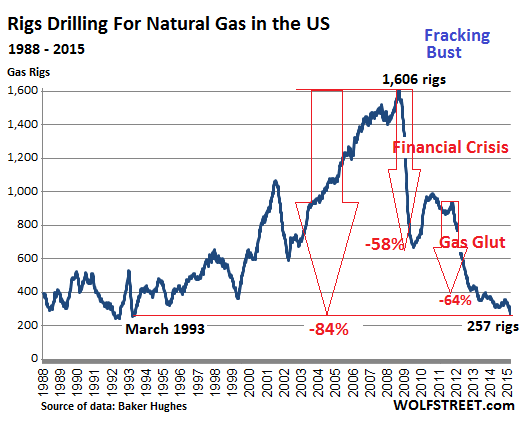
At the time, the price of natural gas was soaring. It hit $13 per million Btu at the Henry Hub in June 2008. About 1,600 rigs were drilling for gas. It was the game in town. And Wall Street firms were greasing it with other people’s money. Production soared. And the US became the largest gas producer in the world.

https://martinhladyniuk.com/wp-content/uploads/2015/03/be197-deathspiral2.jpg

But then the price began to plunge. It recovered a little after the Financial Crisis but re-plunged during the gas “glut.” By April 2012, natural gas had crashed 85% from June 2008, to $1.92/mmBtu. With the exception of a few short periods, it has remained below $4/mmBtu – trading at $2.91/mmBtu today.

Throughout, gas drillers had to go back to Wall Street to borrow more money to feed the fracking orgy. They were cash-flow negative. They lost money on wells that produced mostly dry gas. Yet they kept up the charade. They aced investor presentations with fancy charts. They raved about new technologies that were performing miracles and bringing down costs. The theme was that they would make their investors rich at these gas prices.

The saving grace was that oil and natural-gas liquids, which were selling for much higher prices, also occur in many shale plays along with dry gas. So drillers began to emphasize that they were drilling for liquids, not dry gas, and they tried to switch production to liquids-rich plays. In that vein, Quicksilver ventured into the oil-rich Permian Basin in Texas. But it was too little, too late for the amount of borrowed money it had already burned through over the years by fracking for gas below cost.

During the terrible years of 2011 and 2012, drillers began reclassifying gas rigs as rigs drilling for oil. It was a judgement call, since most wells produce both. The gas rig count plummeted further, and the oil rig count skyrocketed by about the same amount. But gas production has continued to rise since, even as the gas rig count has continued to drop. On Friday, the rig count was down to 257 gas rigs, the lowest since March 1993, down 84% from its peak in 2008.

US-rig-count_1988_2015-03-13=gas

Quicksilver’s bankruptcy is a consequence of this fracking environment. It listed $2.35 billion in debts. That’s what is left from its borrowing binge that covered its negative cash flows. It listed only $1.21 billion in assets. The rest has gone up in smoke.

Its shares are worthless. Stockholders got wiped out. Creditors get to fight over the scraps.

Its leveraged loan was holding up better: the $625 million covenant-lite second-lien term loan traded at 56 cents on the dollar this morning, according to S&P Capital IQ LCD. But its junk bonds have gotten eviscerated over time. Its 9.125% senior notes due 2019 traded at 17.6 cents on the dollar; its 7.125% subordinated notes due 2016 traded at around 2 cents on the dollar.

Among its creditors, according to the Star Telegram: the Wilmington Trust National Association ($361.6 million), Delaware Trust Co. ($332.6 million), US Bank National Association ($312.7 million), and several pipeline companies, including Oasis Pipeline and Energy Transfer Fuel.

Last year, it hired restructuring advisers. On February 17, it announced that it would not make a $13.6 million interest payment on its senior notes and invoked the possibility of filing for Chapter 11. It said it would use its 30-day grace period to haggle with its creditors over the “company’s options.”

Now, those 30 days are up. But there were no other “viable options,” the company said in the statement. Its Canadian subsidiary was not included in the bankruptcy filing; it reached a forbearance agreement with its first lien secured lenders and has some breathing room until June 16.

Quicksilver isn’t alone in its travails. Samson Resources and other natural gas drillers are stuck neck-deep in the same frack mud.

A group of private equity firms, led by KKR, had acquired Samson in 2011 for $7.2 billion. Since then, Samson has lost $3 billion. It too hired restructuring advisers to deal with its $3.75 billion in debt. On March 2, Moody’s downgraded Samson to Caa3, pointing at “chronically low natural gas prices,” “suddenly weaker crude oil prices,” the “stressed liquidity position,” and delays in asset sales. It invoked the possibility of “a debt restructuring” and “a high risk of default.”

But maybe not just yet. The New York Post reported today that, according to sources, a JPMorgan-led group, which holds a $1 billion revolving line of credit, is granting Samson a waiver for an expected covenant breach. This would avert default for the moment. Under the deal, the group will reduce the size of the revolver. Last year, the same JPMorgan-led group already reduced the credit line from $1.8 billion to $1 billion and waived a covenant breach.

By curtailing access to funding, they’re driving Samson deeper into what S&P Capital IQ called the “liquidity death spiral.” According to the New York Post’s sources, in August the company has to make an interest payment to its more junior creditors, “and may run out of money later this year.”

Industry soothsayers claimed vociferously over the years that natural gas drillers can make money at these prices due to new technologies and efficiencies. They said this to attract more money. But Quicksilver along with Samson Resources and others are proof that these drillers had been drilling below the cost of production for years. And they’d been bleeding every step along the way. A business model that lasts only as long as new investors are willing to bail out old investors.

But it was the crash in the price of “liquids” that made investors finally squeamish, and they began to look beyond the hype. In doing so, they’re triggering the very bloodletting amongst each other that ever more new money had delayed for years. Only now, it’s a lot more expensive for them than it would have been three years ago. While the companies will get through it in restructured form, investors get crushed.


This Chart Shows the True Collapse of Fracking in the US

by Wolf Richter
https://feww.files.wordpress.com/2009/08/rex-wtillerson-exxon.jpg

Rex Tillerson, Exxon Mobile CEO

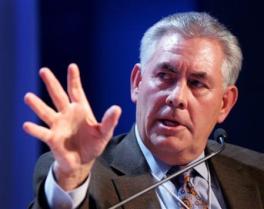
“People need to kinda settle in for a while.” That’s what Exxon Mobil CEO Rex Tillerson said about the low price of oil at the company’s investor conference. “I see a lot of supply out there.”

So Exxon is going to do its darnedest to add to this supply: 16 new production projects will start pumping oil and gas through 2017. Production will rise from 4 million barrels per day to 4.3 million. But it will spend less money to get there, largely because suppliers have had to cut their prices.

That’s the global oil story. In the US, a similar scenario is playing out. Drillers are laying some people off, not massive numbers yet. Like Exxon, they’re shoving big price cuts down the throats of their suppliers. They’re cutting back on drilling by idling the least efficient rigs in the least productive plays – and they’re not kidding about that.

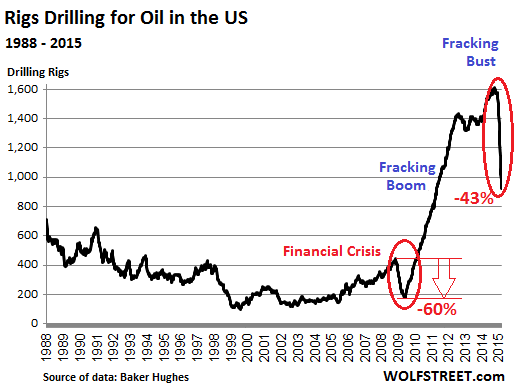
In the latest week, they idled a 64 rigs drilling for oil, according to Baker Hughes, which publishes the data every Friday. Only 922 rigs were still active, down 42.7% from October, when they’d peaked. Within 21 weeks, they’ve taken out 687 rigs, the most terrific, vertigo-inducing oil-rig nose dive in the data series, and possibly in history:

US-rig-count_1988_2015-03-06=oilAs Exxon and other drillers are overeager to explain: just because we’re cutting capex, and just because the rig count plunges, doesn’t mean our production is going down. And it may not for a long time. Drillers, loaded up with debt, must have the cash flow from production to survive.

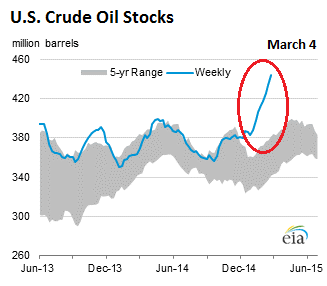
But with demand languishing, US crude oil inventories are building up further. Excluding the Strategic Petroleum Reserve, crude oil stocks rose by another 10.3 million barrels to 444.4 million barrels as of March 4, the highest level in the data series going back to 1982, according to the Energy Information Administration. Crude oil stocks were 22% (80.6 million barrels) higher than at the same time last year.

“When you have that much storage out there, it takes a long time to work that off,” said BP CEO Bob Dudley, possibly with one eye on this chart:

US-crude-oil-stocks-2015-03-04So now there is a lot of discussion when exactly storage facilities will be full, or nearly full, or full in some regions. In theory, once overproduction hits used-up storage capacity, the price of oil will plummet to whatever level short sellers envision in their wildest dreams. Because: what are you going to do with all this oil coming out of the ground with no place to go?

A couple of days ago, the EIA estimated that crude oil stock levels nationwide on February 20 (when they were a lot lower than today) used up 60% of the “working storage capacity,” up from 48% last year at that time. It varied by region:

Capacity is about 67% full in Cushing, Oklahoma (the delivery point for West Texas Intermediate futures contracts), compared with 50% at this point last year. Working capacity in Cushing alone is about 71 million barrels, or … about 14% of the national total.

As of September 2014, storage capacity in the US was 521 million barrels. So if weekly increases amount to an average of 6 million barrels, it would take about 13 weeks to fill the 77 million barrels of remaining capacity. Then all kinds of operational issues would arise. Along with a dizzying plunge in price.

In early 2012, when natural gas hit a decade low of $1.92 per million Btu, they predicted the same: storage would be full, and excess production would have to be flared, that is burned, because there would be no takers, and what else are you going to do with it? So its price would drop to zero.

They actually proffered that, and the media picked it up, and regular folks began shorting natural gas like crazy and got burned themselves, because it didn’t take long for the price to jump 50% and then 100%.

Oil is a different animal. The driving season will start soon. American SUVs and pickups are designed to burn fuel in prodigious quantities. People will be eager to drive them a little more, now that gas is cheaper, and they’ll get busy shortly and fix that inventory problem, at least for this year. But if production continues to rise at this rate, all bets are off for next year.

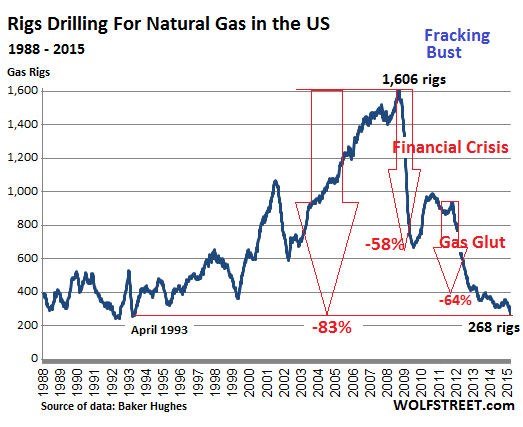
Natural gas, though it refused to go to zero, nevertheless got re-crushed, and the price remains below the cost of production at most wells. Drilling activity has dwindled. Drillers idled 12 gas rigs in the latest week. Now only 268 rigs are drilling for gas, the lowest since April 1993, and down 83.4% from its peak in 2008! This is what the natural gas fracking boom-and-bust cycle looks like:

US-rig-count_1988_2015-03-06=gasYet production has continued to rise. Over the last 12 months, it soared about 9%, which is why the price got re-crushed.

Producing gas at a loss year after year has consequences. For the longest time, drillers were able to paper over their losses on natural gas wells with a variety of means and go back to the big trough and feed on more money that investors were throwing at them, because money is what fracking drills into the ground.

But that trough is no longer being refilled for some companies. And they’re running out. “Restructuring” and “bankruptcy” are suddenly the operative terms.


“Default Monday”: Oil & Gas Face Their Creditors

by Wolf Richter

https://i0.wp.com/www.macleans.ca/wp-content/uploads/2013/02/MAC04_OILSANDS01-wide.jpg

Debt funded the fracking boom. Now oil and gas prices have collapsed, and so has the ability to service that debt. The oil bust of the 1980s took down 700 banks, including 9 of the 10 largest in Texas. But this time, it’s different. This time, bondholders are on the hook.

And these bonds – they’re called “junk bonds” for a reason – are already cracking. Busts start with small companies and proceed to larger ones. “Bankruptcy” and “restructuring” are the terms that wipe out stockholders and leave bondholders and other creditors to tussle over the scraps.

https://martinhladyniuk.com/wp-content/uploads/2015/03/27560-bankruptcy.jpg

Early January, WBH Energy, a fracking outfit in Texas, kicked off the series by filing for bankruptcy protection. It listed assets and liabilities of $10 million to $50 million. Small fry.

A week later, GASFRAC filed for bankruptcy in Alberta, where it’s based, and in Texas – under Chapter 15 for cross-border bankruptcies. Not long ago, it was a highly touted IPO, whose “waterless fracking” technology would change a parched world. Instead of water, the system pumps liquid propane gel (similar to Napalm) into the ground; much of it can be recaptured, in theory.

Ironically, it went bankrupt for other reasons: operating losses, “reduced industry activity,” the inability to find a buyer that would have paid enough to bail out its creditors, and “limited access to capital markets.” The endless source of money without which fracking doesn’t work had dried up.

https://i0.wp.com/fm.cnbc.com/applications/cnbc.com/resources/img/editorial/2013/09/03/101003666-89cb3e34560372ba5382f629569eaecb4db09256.530x298.jpg

On February 17, Quicksilver Resources announced that it would not make a $13.6 million interest payment on its senior notes due in 2019. It invoked the possibility of filing for Chapter 11 bankruptcy to “restructure its capital structure.” Stockholders don’t have much to lose; the stock is already worthless. The question is what the creditors will get.

It has hired Houlihan Lokey Capital, Deloitte Transactions and Business Analytics, “and other advisors.” During its 30-day grace period before this turns into an outright default, it will haggle with its creditors over the “company’s options.”

On February 27, Hercules Offshore had its share-price target slashed to zero, from $4 a share, at Deutsche Bank, which finally downgraded the stock to “sell.” If you wait till Deutsche Bank tells you to sell, you’re ruined!

When I wrote about Hercules on October 15, HERO was trading at $1.47 a share, down 81% since July. Those who followed the hype to “buy the most hated stocks” that day lost another 44% by the time I wrote about it on January 16, when HERO was at $0.82 a share. Wednesday, shares closed at $0.60.

Deutsche Bank was right, if late. HERO is headed for zero (what a trip to have a stock symbol that rhymes with zero). It’s going to restructure its junk debt. Stockholders will end up holding the bag.

https://i0.wp.com/bloximages.newyork1.vip.townnews.com/tulsaworld.com/content/tncms/assets/v3/editorial/f/d8/fd890ea6-d8e7-59fc-b849-cf74b6c4a4cd/527b48bba3b05.preview-300.jpg

On Monday, due to “chronically low natural gas prices exacerbated by suddenly weaker crude oil prices,” Moody’s downgraded gas-driller Samson Resources, to Caa3, invoking “a high risk of default.”

It was the second time in three months that Moody’s downgraded the company. The tempo is picking up. Moody’s:

The company’s stressed liquidity position, delays in reaching agreements on potential asset sales and its retention of restructuring advisors increases the possibility that the company may pursue a debt restructuring that Moody’s would view as a default.

Moody’s was late to the party. On February 26, it was leaked that Samson had hired restructuring advisers Kirkland & Ellis and Blackstone’s restructuring group to figure out how to deal with its $3.75 billion in debt. A group of private equity firms, led by KKR, had acquired Samson in 2011 for $7.2 billion. Since then, Samson has lost $3 billion. KKR has written down its equity investment to 5 cents on the dollar.

This is no longer small fry.

https://i0.wp.com/www.yourindustrynews.com/upload_images/BPZ_Energy.jpg

Also on Monday, oil-and-gas exploration and production company BPZ Resources announced that it would not pay $62 million in principal and interest on convertible notes that were due on March 1. It will use its grace period of 10 days on the principal and of 30 days on the interest to figure out how to approach the rest of its existence. It invoked Chapter 11 bankruptcy as one of the options.

If it fails to make the payments within the grace period, it would also automatically be in default of its 2017 convertible bonds, which would push the default to $229 million.

BPZ tried to refinance the 2015 convertible notes in October and get some extra cash. Fracking devours prodigious amounts of cash. But there’d been no takers for the $150 million offering. Even bond fund managers, driven to sheer madness by the Fed’s policies, had lost their appetite. And its stock is worthless.

https://i0.wp.com/b.vimeocdn.com/ts/433/407/433407397_640.jpg

Also on Monday – it was “default Monday” or something – American Eagle Energy announced that it would not make a $9.8 million interest payment on $175 million in bonds due that day. It will use its 30-day grace period to hash out its future with its creditors. And it hired two additional advisory firms.

One thing we know already: after years in the desert, restructuring advisers are licking their chops.

The company has $13.6 million in negative working capital, only $25.9 million in cash, and its $60 million revolving credit line has been maxed out.

But here is the thing: the company sold these bonds last August! And this was supposed to be its first interest payment.

That’s what a real credit bubble looks like. In the Fed’s environment of near-zero yield on reasonable investments, bond fund managers are roving the land chasing whatever yield they can discern. And they’re holding their nose while they pick up this stuff to jam it into bond funds that other folks have in their retirement portfolio.

Not even a single interest payment!

Borrowed money fueled the fracking boom. The old money has been drilled into the ground. The new money is starting to dry up. Fracked wells, due to their horrendous decline rates, produce most of their oil and gas over the first two years. And if prices are low during that time, producers will never recuperate their investment in those wells, even if prices shoot up afterwards. And they’ll never be able to pay off the debt from the cash flow of those wells. A chilling scenario that creditors were blind to before, but are now increasingly forced to contemplate.

Chart Of The Day: Recession Dead Ahead?

By Tyler Durden

The chart below showing the annual increase, or rather, decrease in US factory orders which have now declined for 6 months in a row (so no one can’t blame either the west coast port strike or the weather) pretty much speaks for itself, and also which way the US “recovery” (whose GDP is about to crash to the 1.2% where the Atlanta Fed is modeling it, or even lower is headed.

https://i0.wp.com/www.zerohedge.com/sites/default/files/images/user5/imageroot/2015/03/Factory%20Orders%20YY.jpg

As the St Louis Fed so kindly reminds us, the two previous times US manufacturing orders declined at this rate on an unadjusted (or adjusted) basis, the US economy was already in a recession.

https://i0.wp.com/www.zerohedge.com/sites/default/files/images/user5/imageroot/2015/03/fed%20recession%20NSA.jpg

And now, time for consensus to be shocked once again when the Fed yanks the rug from under the feet of the rite-hike-istas.

Gundlach: If The Fed Raises Rates By Mid-Year “The Sinister Side Of Low Oil may Raise Its Head

jeffrey gundlach

Photo by Reuters | Eduardo Munoz.  Article by by Robert Huebscher in Advisor Perspective

The Fed should reject its inclination to raise rates, according to Jeffrey Gundlach. It’s rare that he agrees with Larry Summers, but in this case the two believe that the fundamentals in the U.S. economy do not justify higher interest rates.

Gundlach, the founder and chief investment officer of Los Angeles-based Doubleline Capital, spoke to investors in a conference call on February 17. The call was focused on the release of the new DoubleLine Long Duration Fund, but Gundlach also discussed a number of developments in the economy and the bond market.

Signals of an impending rate increase have come from comments by Fed governors that the word “patient” should be dropped from the Fed meeting notes, according to Gundlach. That word has taken on special significance, he explained, since Janet Yellen attached a two-month time horizon to it.

“If they drop that word,” Gundlach said, “it would be a strong signal that rates would rise in the following two months.”

The Fed seems “philosophically” inclined to raise rates, Gundlach said, even though the fundamentals do not justify such a move. Strong disinflationary pressure coming from the collapse in oil prices should caution the Fed against raising rates, he said.

Gundlach was asked about comments by Gary Shilling that oil prices might go as low at $10/barrel. “We better all hope we don’t get $10,” he said, “because something very deflationary would be happening in this world.” If that is the case, Gundlach said investors should flock to long-term Treasury bonds.

“I’d like to think that the world is not in that kind of deflationary precipice,” he said.

Oil will break below its previous $44 low, Gundlach said. But he did not put a price target on oil.

Gundlach warned that by mid-year, if the Fed does raise rates, “the sinister side of low oil may raise its head.” At that time, lack of hiring or layoffs in the fracking industry could cripple the economy, according to Gundlach.

In the short term, Gundlach said that the recent rise in interest rates is a signal that the “huge deflationary scare” –which was partly because of Greece – has dissipated. Investors should monitor Spanish and Italian yields, he said. If they remain low, it is a signal that Greece is not leaving the Eurozone or that, if it does, “it is not a big deal.”

http://www.advisorperspectives.com/newsletters15/Gundlach_to_the_Fed.php

Courts Confirm Fannie and Freddie Are Sovereign Credits: Report

by Jacob Passy

Recent court decisions against Fannie Mae and Freddie Mac shareholders have put to rest the notion that the two mortgage giants exist as anything but instrumentalities of the U.S. government, according to a report released Thursday by Kroll Bond Rating Agency.

Private equity investor groups recently have raised lawsuits against the Federal Housing Finance Agency, in an effort to regain control of the two entities. The failure of these legal actions points to the de facto nature of the two entities as sovereign credits, given their complete backing by the U.S. government.

The KBRA report also suggests that Fannie Mae and Freddie Mac have morphed into insurance agents rather than insurance companies, since they cannot produce the capital to bear the risk of their guarantees that the FHFA prices to begin with.

Still, the two bodies’ investors take issue with the 3rd Preferred Stock Purchase Agreement that directs all of Fannie Mae and Freddie Mac’s profits to the government, the KBRA report said.

But these investors’ suits have been unsuccessful because, in judges’ eyes, the legislation passed by Congress that saved Fannie Mae and Freddie Mac from the brink gives the U.S. Treasury and FHFA the right to manage the two companies as they see fit. But KBRA finds instead that “the 3rd PSPA simply compensates the Treasury for the capital injection made in 2008 and, more important, the open-ended support of the U.S. taxpayer.”

The report goes on to argue that these investors misinterpret the support the U.S. government lent to the two mortgage entities. Prior to the capital injection, Fannie Mae and Freddie Mac had negative net worth, meaning that Treasury’s aid only brought them to zero.

But, as the report reads, all of the profits the two make now represent therefore the return on the government’s investment, so to recapitalize Fannie Mae and Freddie Mac would essentially involve taxpayer money, which the report found “galling.”

“They are not talking about injecting any of their own cash into the companies,” KBRA writes. “If you accept the idea that the taxpayers are due a return on both the implicit and explicit capital advanced to keep the mortgage market operating, there are no earnings to be retained in the GSEs.”

The report did contend that while this may not spell out good news for the two mortgage agencies’ equity investors, it should end some of the uncertainty bond investors have faced by confirming their standing in the eyes of government.


Fannie Mae Ended 2014 on a Sour Note

by Phil Hall

Fannie Mae hit more than a few financial potholes during 2014, closing the year with significantly lower net income and comprehensive income and a stated concern that things may not get better during 2015.

The government-sponsored enterprise reported annual net income of $14.2 billion and annual comprehensive income of $14.7 billion in 2014, far below 2013’s levels of $84 billion in net income and $84.8 billion in comprehensive income.

The fourth quarter of 2014 was especially acute: Fannie Mae’s net income of $1.3 billion and comprehensive income of $1.3 billion for this period, a steep drop from the net income of $3.9 billion and comprehensive income of $4.0 billion for the third quarter. Fourth quarter net revenues were $5.5 billion, down from $6 billion for the third quarter, while fee and other income was $323 million for the fourth quarter, compared with $826 million for the third quarter. Net fair value losses were $2.5 billion in the fourth quarter, up substantially from $207 million in the third quarter.

Fannie Mae explained that its fourth quarter results were “driven by net interest income, partially offset by fair value losses on risk management derivatives due to declines in longer-term interest rates in the quarter.” Nonetheless, Fannie Mae reported a positive net worth of $3.7 billion as of Dec. 31, 2014, which resulted in a dividend obligation to the U.S. Department of the Treasury of $1.9 billion that will be paid next month.

In announcing its 2014 results, Fannie Mae offered a blunt prediction that this year will see continued disappointments.

“[Fannie Mae] expects its earnings in future years will be substantially lower than its earnings for 2014, due primarily to the company’s expectation of substantially lower income from resolution agreements, continued declines in net interest income from its retained mortgage portfolio assets, and lower credit related income,” said Fannie Mae in a press statement. “In addition, certain factors, such as changes in interest rates or home prices, could result in significant volatility in the company’s financial results from quarter to quarter or year to year. Fannie Mae’s future financial results also will be affected by a number of other factors, including: the company’s guaranty fee rates; the volume of single-family mortgage originations in the future; the size, composition, and quality of its retained mortgage portfolio and guaranty book of business; and economic and housing market conditions.”


 Default Risk Index For Agency Purchase Loans Hits Series High

by Brian Honea

Agency Loan Mortgage Default Risk

The default risk for mortgage loan originations rose in January, marking the fifth straight month-over-month increase, according to the composite National Mortgage Risk Index (NMRI) released by AEI’s International Center on Housing Risk.

In January, the NMRI for Agency purchase loans increased to a series high of 11.94 percent. That number represented an increase of 0.4 percentage points from the October through December average and a jump of 0.8 percentage points from January 2014.

“With the NMRI once again hitting a series high, the risks posed by the government’s 85 percent share of the home purchase market continue to rise,” said Stephen Oliner, co-director of AEI’s International Center on Housing Risk.

Default risk indices for Fannie Mae, FHA, and VA loans hit series highs within the composite, according to AEI. The firm attributes to the consistent monthly increases in risk indices to a substantial shift in market share from large banks to non-bank accounts, since the default risk tends to be greater on loans originated by non-bank lenders.

AEI’s study for January revealed that the volume of high debt-to-income (DTI) loans has not been reduced by the QM regulation. About 24 percent of loans over the past three months had a total DTI above 43 percent, compared to 22 percent for the same period a year earlier. The study also found that Fannie Mae and Freddie Mac were compensating to a limited extent for the riskiness of their high DTI loans.

Further, the NMRI for FHA loans in January experienced a year-over-year increase of 1.5 percentage points up to 24.41 percent – meaning that nearly one quarter of all recently guaranteed home purchase loans backed by FHA would be projected to default if they were to experience an economic shock similar to 2007-08. AEI estimates that if FHA were to adopt VA’s risk management practices, the composite index would fall to about 9 percent.

“Policy makers need to be mindful of the upward risk trends that are occurring with respect to both first-time and repeat buyers,” said Edward Pinto, co-director of AEI’s International Center on Housing Risk. “Recent policy moves by the FHA and FHFA will likely exacerbate this trend.”

AEI said the cause of the softness in mortgage lending is not tight lending standards, but rather reduced affordability, loan put back risk, and slow income growth among households.

More than 180,o00 home purchase loans were evaluated for the January results, bringing the total number of loans rated in the NMRI since December 2012 to nearly 5.5 million, according to AEI.

What Does The Bank Of Canada Know That We Don’t?

“Unprecedented deflation are pushing rates down. However, investors are holding 1/3 outstanding shares of ETF | TLT short: Betting that rates will go up.”

Article and video commentary by Christine Hughes

In a totally unexpected move, the Bank of Canada cut the overnight interest rate by 25 basis points on Wednesday. This of course should make you wonder what the Bank of Canada knows that the rest of us don’t! I mean usually the Bank indicates a bias towards cutting interest rates, but this was just out of the blue. It signals that the oil shock on the economy is going to be a lot more significant than anyone expected.

The Canadian dollar dropped vs. the US dollar thanks to the surprise move. Gold and silver prices climbed on safe-haven demand. Canadian bond yields plunged. As per Bloomberg: “’It’s a big shock,’ David Doyle, a strategist at Macquarie Capital Markets, said by phone from Toronto. “They’re going to try to provide the necessary medicine here for the soft landing from slowing debt growth, from slowing investment in the oil sands, and I think they thought it needed some stimulus here.”

No one probably stands to hurt more from plunging oil prices than Alberta.

Energy companies have started cutting capital expenditure, and this means job losses, which means a slowing housing market. In fact, plunging oil prices have seen home sales in Calgary tumble 37% in the first half of January, compared to a year earlier. Prices dropped 1.5%. And active listings soared by nearly 65%.

As you can see in the chart below, while you may have thought Toronto was a hot housing market these past several years, you’d be wrong. It was Calgary.
jan21
What’s the most worrisome about this is that everyone thinks Canada’s mortgages are different than what caused the US housing market to blow up. Well, not exactly. See, mortgage standards vary by province, and things in Alberta don’t look good.

There are two types of mortgages Alberta can issue: recourse and non-recourse. In a recourse mortgage, the bank can cease your house, sell it, and you will still owe the remaining balance of your mortgage. In a non-recourse mortgage, the bank can seize your house, and you the borrower can walk away. If the asset doesn’t sell for at least what you owe, then the bank has to absorb the loss.

Below is a chart, courtesy of RBC Capital Markets, which outlines that 35% of all Alberta mortgages (by the big 6 banks) are non-recourse. They can walk away!  Pay attention to Royal Bank especially:
jan21
There’s definitely a reason why the Bank of Canada is very concerned! By Christine Hughes

  • If things are getting better, why do global rates keep falling?
  • To much debt is causing deflation.
  • US has the highest relative rates, hence where everybody wants to invest.

http://youtu.be/dJh1OFrIobo

GUNDLACH: Don’t Be Bottom-Fishing In Oil Stocks And Bonds

ducks bottom feedingSource: Business Insider

NEW YORK (Reuters) – DoubleLine Capital’s Jeffrey Gundlach said on Tuesday there is a possibility of a “true collapse” in U.S. capital expenditures and hiring if the price of oil stays at its current level.

Gundlach, who correctly predicted government bond yields would plunge in 2014, said on his annual outlook webcast that 35 percent of Standard & Poor’s capital expenditures comes from the energy sector and if oil remains around the $45-plus level or drops further, growth in capital expenditures could likely “fall to zero.”

Gundlach, the co-founder of Los Angeles-based DoubleLine, which oversees $64 billion in assets, noted that “all of the job growth in the (economic) recovery can be attributed to the shale renaissance.” He added that if low oil prices remain, the U.S. could see a wave of bankruptcies from some leveraged energy companies.

Brent crude approached a near six-year low on Tuesday as the United Arab Emirates defended OPEC’s decision not to cut output and traders wondered when a six-month price rout might end.

Brent has fallen as low as just above $45 a barrel, near a six-year low, having averaged $110 between 2011 and 2013.

Gundlach said oil prices have to stop going down so “don’t be bottom-fishing in oil” stocks and bonds. “There is no hurry here.”

Energy bonds, for example, have been beaten up and appear attractive on a risk-reward basis, but investors need to hedge them by purchasing “a lot, lot of long-term Treasuries. I’m in no hurry to do it.”

High-yield junk bonds have also been under severe selling pressure. Gundlach said his firm bought some junk in November but warned that investors need to “go slow” and pointed out “we are still underweight.”

Gundlach said U.S. stocks could outperform other countries’ equities as the economic recovery looks stronger than its counterparts, though double-digit gains cannot be repeated.

He also reiterated that it’s possible yields on the benchmark 10-year Treasury note could drop to 1 percent in 2015. The 10-year yield traded around 1.91 percent on Tuesday, little changed from late on Monday after hitting 20-month low of 1.8640 percent.

“The 10-year Treasury could join the Europeans and go to 1 percent. Why not?” Gundlach told Reuters last month. “If oil goes to $40, then the 10-year could be going to 1 percent.”

The yield on 10-year German Bunds stood at 0.47 percent on Tuesday.


Meanwhile…

Jeff Gundlach Unveils His Outlook For 2015

Screen Shot 2015 01 13 at 4.13.56 PM

by: Myles Unland

“V”

This is the title of the latest webcast from DoubleLine Capital’s Jeffrey Gundlach, who just wrapped up a webcast giving his outlook for 2015.

We last heard from Gundlach in December when he held a presentation called “This Time It’s Different,” in which he talked about the oil markets, the dollar, and how the 10-year Treasury bond could get to 1%.

Among the things Gundlach believes 2015 has in store for the market is more volatility, lower Treasury yields, and a Federal Reserve rate hike, “just to see if they can do it.”

Gundlach spent a good chunk of his open talking about the effects that the decline in oil will have on jobs growth and capital investment in the US, noting that 35% of capital investment from the S&P 500 is related to the energy sector.

The bull case for the US in 2015, Gundlach said, is predicated primarily on the strength of the US labor market. Meanwhile the chart of the year so far is the US 10-year yield against other major economies, with the US clearly having space to converge towards the super-low yields seen on 10-year bonds in Japan, Germany, and Switzerland.

We’ve broken out a number of Gundlach’s slides below and added commentary taken as he spoke live on Tuesday.

  • 4:22 PM

  • Gundlach’s leading slide.

Screen Shot 2015 01 13 at 4.21.40 PM

  • 4:22 PM

  • Gundlach says of the title that it stands for the fifth year that he’s being these webcasts, but also has a market theme. “Most risk markets have gone into a V since about June.”

Says that the “touchdown” part of the drop in oil is that consumers get more money in their pocket. “I think that’s one of the reasons, rightly, that people view the oil decline as somewhat positive.”

Gundlach says that there is a sinister side to the oil decline, which is potential impacts on employment in the US, particularly in the energy space.

Gundlach says “all of the job growth” from the recession until today can be attributed to the shale oil boom.

  • 4:25 PM

  • Gundlach says that if oil stays anywhere near where it is today, we’re going to see leveraged energy companies go bankrupt.

“And maybe some other things related to that.”

  • 4:27 PM

  • Gundlach said that in 2014 he thought bonds would return 6%. The Barclays Aggregate Bond Index returned 6%.

Screen Shot 2015 01 13 at 4.26.43 PM

  • 4:28 PM

  • Gundlach says, as he did in December, “TIPS are for losers, that’s for sure.”

  • 4:30 PM

  • Every yield curve flattened in 2014.

Screen Shot 2015 01 13 at 4.29.59 PM

  • 4:31 PM

  • “It wasn’t the US of A in 2014, but the US of Only.”

US stocks were the only really strong equity markets among major developed economies. Chinese and Indian stocks were big winners among emerging markets.

Screen Shot 2015 01 13 at 4.30.40 PM

  • 4:34 PM

  • Gundlach says he’s been positive on the US dollar since 2011. This was a huge consensus trade in 2014, and Gundlach says sometimes the consensus is right.

“It looks to me like the dollar is headed higher.”

Gundlach says he knows long dollar is a crowded trade, but the fundamentals bolstering a strong dollar remain in tact.

Additionally, Gundlach thinks the Fed will raise rates with a few more months of strong payrolls gains, which will only make the dollar stronger.
Screen Shot 2015 01 13 at 4.32.01 PM

  • 4:35 PM

  • Gundlach says his investments are still dollar-denominated.

  • 4:36 PM

  • What a year for the ruble.

Screen Shot 2015 01 13 at 4.35.43 PM

  • 4:37 PM

  • Mutual fund flows in 2014 looked a lot like 2007.

Screen Shot 2015 01 13 at 4.37.07 PM

  • 4:38 PM

  • The Long Bond had one of the best years ever in 2014.

Screen Shot 2015 01 13 at 4.38.03 PM

  • 4:39 PM

  • Gundlach said that in 2012, when bonds hit their low he had a 90% conviction that that would THE low for bonds. His conviction is less than that now.

  • 4:40 PM

  • 2014 was a disaster for commodities.

The best commodity in 2014 was gold.

Screen Shot 2015 01 13 at 4.39.46 PM

  • 4:42 PM

  • The white line is the commodity index, the yellow line is the commodity index you can actually invest in.

Investable commodities have been losers for years.

Gundlach says you lost 800 basis points per annum over the last 10 years investing in commodities.

Screen Shot 2015 01 13 at 4.40.56 PM

  • 4:42 PM

  • Gold gained ground in basically every currency except the US dollar in 2014.

Screen Shot 2015 01 13 at 4.42.11 PM

  • 4:43 PM

  • “Gold is on a stealthy rally and I suspect gold is going to be headed higher not lower.”

  • 4:43 PM

  • Gold gained 89% in ruble terms last year.

Screen Shot 2015 01 13 at 4.43.19 PM

  • 4:45 PM

  • “Bitcoin is on its way to being relegated to the ash heap of digital currencies.”

  • 4:47 PM

  • “One of the great vintages of Chateau Mouton.”

Screen Shot 2015 01 13 at 4.46.31 PM

  • 4:49 PM

  • Gundlach says the labor market is the backbone of the US bull case in 2015.

The number of companies worrying about poor sales is dropping, while there is a modest increase concerns about the quality of labor.

Gundlach says he is “from Missouri” on this one. He will wait to see wage growth show up before making the case for a lift off in wages.

  • 4:50 PM

  • The job scenario is stronger as fewer people apply for disability.

Screen Shot 2015 01 13 at 4.49.14 PM

  • 4:50 PM

  • Food stamp usage has been flat over the last few years.

Screen Shot 2015 01 13 at 4.50.01 PM

  • 4:52 PM

  • This is the most bullish chart of 2015.

Oil prices have been correlated with GDP growth 18 months forward.

And so this chart implies 3+% global growth going forward.

“On balance this should be viewed as an encouraging indicator.”

Gundlach doesn’t think, however that global growth is going to be upgraded in 2015, and like the last several years will be downgraded as the year goes along.

Screen Shot 2015 01 13 at 4.51.07 PM

  • 4:53 PM

  • The S&P 500 has been strong against the rest of the world since 2010, but this trend really accelerated in June of 2015.

Screen Shot 2015 01 13 at 4.52.34 PM

  • 4:54 PM

  • Gundlach says US outperformance “isn’t really a great sign.” But says US is probably the preferred place to invest against the rest of the world, however.

“It’s almost impossible for the gains from June 2014 to now to be repeated this year.”

  • 4:55 PM

  • Bear case is three big slides, Gundlach says.

  • 4:55 PM

  • The stock market has never been up seven years in a row.

Screen Shot 2015 01 13 at 4.55.26 PM

  • 4:56 PM

  • Gundlach adds that its rare for the bond market to go up three years in a row, and that happened in 2010, 2011, and 2012.

“Lo and behold, they didn’t go up in 2013.”

  • 4:57 PM

  • Margin debt has peaked, and with Fed raising rates, Gundlach says it seems likely that margin debt would likely shrink.

Screen Shot 2015 01 13 at 4.56.47 PM

“Let’s just say the S&P 500 has not gone up.”

“This seems to have been a predictable headwind, and it’s staring at us again.”

Screen Shot 2015 01 13 at 4.57.27 PM

  • 4:59 PM

  • Gunlach says stocks diverging from junk bonds is the most worrying signal coming out of markets right now.

  • 5:02 PM

  • Gundlach thinks we could go into an “overshoot” of low yields with yields rising in the second part of this year.

The path of least resistance to Gundlach seems to be for lower bond yields.

  • 5:04 PM

  • “I’ll bet you dollars to donuts the red line goes down.”

Gundlach says that oil just can’t stop going down. Last year, Treasury yields couldn’t stop going down, and this year oil can’t seem to stop going down.

Adds that contrarianism is dagnerous in commodities and stocks, says that contrarian investing is tempting, but oil is just a dangerous trade right now.

Screen Shot 2015 01 13 at 5.03.19 PM

  • 5:06 PM

  • Gundlach says that once oil broke $70, it would create acceptance that oil isn’t going back to $95, causing producers to increase production because they need the revenue, not cut production to boost prices.

And so here we are.

  • 5:08 PM

  • “When one sector gets weak, don’t make the rookie mistake of thinking that everything around it is fine.”

“It’s too early to be going all-in on the concept that we’re at the bottom of the oil or junk bond cycle.”

“Go slow.”

Gundlach says DoubleLine is still underweight junk bonds.

Gundlach says CPI is down over the last six months, and it is going to be negative.

Screen Shot 2015 01 13 at 5.08.32 PM

  • 5:10 PM

  • “So the Fed is kind of in a dilemma.”

The employment situation looks like it might be time to raise rates, but the inflation data is saying the opposite.

  • 5:10 PM

  • Non-government inflation data is also cratering.

Screen Shot 2015 01 13 at 5.10.03 PM

  • 5:11 PM

  • “The bloodless verdict of the bond market says that inflation will be negative for two years.”

Screen Shot 2015 01 13 at 5.10.39 PM

  • 5:14 PM

  • The chart of the year for bonds so far.

Screen Shot 2015 01 13 at 5.14.14 PM

  • 5:15 PM

  • Gundlach says the bond chart of the year is part of the argument about why oil at $40, weighing on inflation, could bring the 10-year below its 2012 lows.

  • 5:16 PM

  • “Watch this closely.”

Gundlach says something happened when investors got scared of Spanish and Italian bonds.

Screen Shot 2015 01 13 at 5.15.43 PM

  • 5:17 PM

  • “A harbinger of doom for the eurozone.”

Screen Shot 2015 01 13 at 5.16.17 PM

  • 5:19 PM

  • “This is what I think is going to happen in the US.”

Since the financial crisis, every interest rate hike has been accompanied by a reversal, and Gundlach thinks this will happen again.

Gundlach says, as he did in December, that he thinks the Fed is going to raise rates “just to do it.”

Screen Shot 2015 01 13 at 5.18.12 PM

  • 5:19 PM

  • Gundlach says that not a single OPEC member can balance their budget at current oil prices.

  • 5:20 PM

  • “I am quite sure that one of the things ‘V’ can represent in 2015 is volatility.”

“I expect this year to have substantially higher volatility than past years.”

Screen Shot 2015 01 13 at 5.19.54 PM

  • 5:21 PM

  • This chart corroborates the idea that maybe $50 is normal and that $100 oil was the outlier.

Screen Shot 2015 01 13 at 5.20.57 PM

  • 5:22 PM

  • 35% of CapEx in the S&P 500 is in the energy space, Gundlach says.

“That could cause some trouble.”

  • 5:24 PM

  • There are essentially no cities in China with rising home prices.

Screen Shot 2015 01 13 at 5.24.10 PM

  • 5:25 PM

  • “No wonder China is talking about a $10 trillion stimulus program.”

  • 5:25 PM

  • “You wonder how many lives this cat can have.”

Gundlach on the real estate market in China.

  • 5:26 PM

  • The good news? We won’t see high-yield debt defaults for a few years because everyone has refinanced their debt.

“There are lots of reasons to think rates should rise in five years, but not much in five days or five months.”
Screen Shot 2015 01 13 at 5.25.39 PM

  • 5:28 PM

  • Let’s talk about something you should not own …

Mall REITS.

Gundlach says that with online sales at 9% of retail sales coming online, it seems low. But consider that you can’t buy gasoline online, you don’t really buy groceries online.

“People don’t want the median banana.”

  • 5:29 PM

  • The Mall REIT index is up 35% or so in the last 12 months.

This seems like a horrible idea, Gundlach says.

“If you hate corporate bonds yielding 3%, if you hate mortgages yielding 3%, then how could you want to own a Mall REIT yielding 3%?”

Screen Shot 2015 01 13 at 5.28.43 PM

  • 5:31 PM

  • Gundlach says Russia doesn’t become a good speculative bet until oil stops dropping.

“You’ve got to see oil put in a low, a consolidation. Until then, Russia is dagnerous.”

  • 5:33 PM

  • Thoughts on Tesla, given oil …

“I think of all the car companies, Tesla is less of a car company than any other.”

“I’m surprised that anyone would change their car buying habits based on the six-month price of oil. Tesla isn’t so much a play on cars being sold, but on batteries being transformative in many phases of life.”

Gundlach again talking about potential for Tesla’s batteries to get homes entirely off the grid.

“Tesla has as good a chance as anybody to develop a battery that can change the world.”

Says that the stock is hugely overvalued if you just look at the auto sales.

Bill Gross Sees No Rate Increase Until Late 2015 ‘If at All’

Bill Gross

for Bloomberg News

Bill Gross, the former manager of the world’s largest bond fund, said the Federal Reserve won’t raise interest rates until late this year “if at all” as falling oil prices and a stronger U.S. dollar limit the central bank’s room to increase borrowing costs.

While the Fed has concluded its three rounds of asset purchases, known as quantitative easing, interest rates in almost all developed economies will remain near zero as central banks in Europe and Japan embark on similar projects, Gross said today in an outlook published on the website of Janus Capital Group Inc. (JNS:US), where he runs the $1.2 billion Janus Global Unconstrained Bond Fund.

“With the U.S. dollar strengthening and oil prices declining, it is hard to see even the Fed raising short rates until late in 2015, if at all,” he said. “With much of the benefit from loose monetary policies already priced into the markets, a more conservative investment approach may be warranted by maintaining some cash balances. Be prepared for low returns in almost all asset categories.”

Benchmark U.S. oil prices fell below $50 a barrel for the first time in more than five years today, as surging supply signaled that the global glut that drove crude into a bear market will persist. Gross, the former chief investment officer of Pacific Investment Management Co. who left that firm in September to join Janus, said in a Dec. 12 Bloomberg Surveillance interview with Tom Keene that the Fed has to take lower oil prices “into consideration” and take more of a “dovish” stance.

Yields on the 10-year U.S. Treasury note fell to 2.05 percent today, the lowest level since May 2013. Economists predict the U.S. 10-year yield will rise to 3.06 percent by end of 2015, according to a Bloomberg News survey with the most recent forecasts given the heaviest weightings.

Gundlach, new “King Of Bonds” sees 10Y Treasury testing 1.38% in 2015

Having totally and utterly failed in 2014, the consensus for 2015 is once again higher rates (well they can’t go any lower right?) with year-end 2015 expectations of 3.006% currently (having already plunged from over 3.65% in July). However, at the other end of the spectrum, DoubleLine’s Jeff Gundlach told Barron’s this weekend, the 10-yr Treasury yield may test the 2012 low of 1.38% as the Fed’s short-term rate increase is poised to trigger “surprising flattening” of the yield curve.     Source: Zero Hedge

Gundlach’s forecast is ‘very’ anti-consensus…

as the curve has already flattened dramatically…

Following the 2002-06 path almost unbelievably perfectly…

Gundlach adds,

U.S. GDP growth for ’15, ’16 may not achieve 3%+ target as dollar strength hurts exporters, oil price drops cause deflationary pressure, job and spending cuts for energy industries, Gundlach said

USD appreciation will continue as growth stumbles in other parts of the world, making U.S. bonds “all the more attractive” for foreign buyers, Gundlach said

“Trouble lies ahead” for the euro zone; people in Europe “are obviously losing confidence and scared” as German yield turns negative, Gundlach told Barron’s

And here is Jeff Gundlach’s latest chartapalooza presentation…
12-9-14 This Time – JEG Webcast Slides – FINAL for Distribution

—————————————————————–

Glory To The New Bond King

This story by Matt Schfrin appears in the November 24, 2014 issue of Forbes.

The master of his domain: DoubleLine founder Jeffrey Gundlach relaxes among his Warhols in Los Angeles (photo: Ethan Pines

Bill Gross’ spectacular fall from the top of the bond market has put tens of billions in play at a time when minuscule yields demand a fixed-income superstar. A brilliant, battle-scarred billionaire, Jeffrey Gundlach, stands ready to be coronated.

Bond manager Jeffrey Gundlach is wearing a white T-shirt, faded blue jeans and worn leather boat shoes as he traipses about the blooming morning glories in his perfectly landscaped backyard, perched high above a canyon overlooking the deep blue Pacific Ocean. It’s the middle of the afternoon on a work Monday in October; European bank stocks are tumbling; oil prices are down 25% since June; and against the backdrop of an anemic economy and 2.25% ten-year Treasury, the Federal Open Market Committee is about to make an important announcement. These are unsettling times in the financial markets, but for Gundlach it’s a picture-perfect autumn day in southern California, and he is living in paradise.

What’s next for the Fed? Gundlach would much rather discuss the iconic framed “Lemon Marilyn,” by Andy Warhol, above his mantel or how his “Progressions,” by minimalist Donald Judd, in the hallway is influenced by the Fibonacci sequence. “It is negative and positive space governed by a rule that happens to describe the shape of the solar system, which is exactly the opposite of what was popular in the ’50s, all this emotional stuff,” he says, pointing to his de Kooning. A few moments later he is explaining to a visitor that the geometry of the lot on which his new 13,000-square-foot, $16 million Tuscan mansion sits was designed to be in perfect harmony with the canyon cliff side it mirrors.

It is a paradise, but importantly Gundlach is finally feeling at ease because his new sanctuary is well fortified. Anyone wanting to get close to him or his prize paintings must breach the 8-foot wall surrounding his suburban residence or face the scrutiny of an armed naval vet at his front gate who asks visitors for a picture ID. Gundlach makes a point to show off one of the 50 concrete foundation caissons supporting his property. Each measures 3 feet in diameter and extends down as much as 75 feet through the porous desert soil into California bedrock.

After 30 years of staring into the black-and-green abyss of a Bloomberg terminal managing bond portfolios, Gundlach is making a statement with his magnificent new residence, one that underscores his ascendance in the business. Casa Gundlach is unlikely to succumb to the sudden mudslides known to take down other California palaces in places like Mill Valley or Malibu. And with a stellar performance record, $60 billion in assets under management and a killer contemporary art collection accumulated over the last decade, Jeffrey Gundlach has finally joined the billionaires club. More importantly, Los Angeles-based DoubleLine Capital, the house that Gundlach built in under five years, couldn’t be on better footing.

Just about a month earlier Bill Gross of Pacific Investment Management Co., the reigning master of the bond universe for two decades, requested an audience with Gundlach. In a scene that can only be described as Shakespearean, the incumbent bond king drove an hour up the 405 Freeway in the middle of the afternoon to Gundlach’s new castle to more or less grovel at his feet. Gross was certain PIMCO’s German owners were about to fire him, and he was asking his nemesis for a job–a portfolio manager position at DoubleLine. Gross said he wanted to run an “unconstrained” bond fund a small fraction of the size of the $200 billion-plus Total Return Fund he was famous for building. With the sun falling over the Pacific and shimmering on the surface of Gundlach’s infinity pool, Gross was deep in suck-up mode.

“He said to me, ‘I’m Kobe Bryant, you’re LeBron James. I’ve got five rings, you’ve got two, but you are maybe on your way to five and you’ve got time,’ ” says Gundlach, 55. (Gross, 70, refuses to comment on the meeting.) “ Bill was in his own world,” says a house-proud Gundlach, with a tone of disdain. “He doesn’t say anything [about my place]. Nothing. Doesn’t eat anything or even take a sip of water in three hours.”

Gross left the meeting with no deal in hand and ultimately jumped to Denver-based stock manager Janus Capital. From his office in Orange County’s Newport Beach, Gross now manages a $79 million mutual fund for Janus, roughly 0.03% the amount of assets he used to control.

Though a Gundlach-Gross alliance would have surely quickened the asset flight to DoubleLine from PIMCO–which has reported redemptions of $48 billion since Gross was forced to resign on Sept. 26–Gundlach claims to be relieved. “Our clients would have asked, ‘What is this? How is this going to work?’ I hear he is a difficult guy.”

Jeffrey Gundlach: A big thinker whose ambitions go beyond bonds (photo credit: Ethan Pines)

With Gross’ banishment the battle was over, but the spoils of the greatest market share shakeup in the history of the $45 trillion bond business is just getting under way. There may be as much as $100 billion in PIMCO assets in play, and DoubleLine is vying for them against larger rivals BlackRock, Dodge & Cox, Loomis Sayles and even index fund giant Vanguard. All are strong competitors, but none has lead managers like Gundlach, who combine bold market predictions with impressive long-term performance.

Gundlach’s superstar status can be viewed as both a blessing and a curse for DoubleLine. Like Gross–who has helped transform stodgy bond investing from a financial backwater to a lucrative playground for young M.B.A.s and Ph.D.s–Gundlach is well known for his arrogance, eccentricities and volatility. Institutional investors loathe the type of drama that unfolded at PIMCO–also, unfortunately, the hallmark of Gundlach’s style.

“You can’t please everybody, and I’m not gonna try,” insists Gundlach, as Pandora’s Sinatra Radio streams over his home’s sound system. “They point to our key man risk, and we say, ‘Everyone knows that it is key man reward.’ ” The lesson of Bill Gross is: Don’t put your money with a star manager who is owned by a parent company that controls him.”

The importance of being in control is something that Gundlach learned the hard way. For most of his 24-year tenure at Los Angeles’ Trust Company of the West (TCW), leading up to 2009, Gundlach was pegged as a star, a brash and brilliant money manager with a knack for calling markets. His specialty is mortgage-backed securities. The mutual fund he managed through 2009 beat 98% of all mutual funds in its category for a decade. Even more impressive was that he correctly foresaw the coming collapse of the housing market in 2007 and managed to hold on to more of his pre-crisis gains than any of his peers. In 2005, at age 46, he was made chief investment officer of mighty TCW, and by 2009 he was overseeing some $70 billion of its $110 billion in assets under management. In 2009 alone Gundlach’s annual compensation totaled no less than $40 million.

But despite his immense contribution to TCW’s success, at the end of the day Gundlach was still just a hired hand with no equity or control of his own destiny. He wanted more. He wanted to be named chief executive of TCW, but perhaps because of his abrasive style, the firm’s French owners, Société Générale and its billionaire founder, Robert Day, didn’t think he was fit for the job.

DoubleLine’s global developed credit chief Bonnie Baha and Luz Padilla (seated), who heads the firm’s emerging markets team (photo credit: Ethan Pines for Forbes)

“Look, it is clear that Jeffrey doesn’t suffer fools gladly, and he doesn’t tolerate people not thinking before opening their mouths,” says Bonnie Baha, a 19-year TCW veteran who has witnessed Gundlach’s biting tongue but is currently DoubleLine’s global developed credit chief.

Gundlach’s unhappiness prompted him to consider alternatives. He was courted by competitors, including Western Asset Management and PIMCO, which according to court documents considered him a potential successor to Gross. Then on Friday, Dec. 4, 2009, just after the market closed in New York, TCW fired Gundlach preemptively and had its outside counsel chase him out of its downtown L.A. office tower. In an effort to prevent institutional investors from taking their money and leaving with him, TCW simultaneously acquired cross-town bond manager Metropolitan West. In what former TCW employees describe as a surreal scene, Gundlach team members showed up the following Monday morning to find Met West traders sitting at their desks.

Despite promises of huge pay raises by TCW, 40 Gundlach loyalists defected, and within a month Gundlach had formed DoubleLine Capital. He found backers in Howard Marks and Bruce Karsh of Oaktree Capital Management, who had a similar acrimonious divorce from TCW 14 years earlier. (Distressed bond specialist Oaktree shares an office tower with DoubleLine and still owns 20% of the firm.) TCW had been gutted of its best fixed-income talent, and some $30 billion in assets eventually fled the firm.

But the drama was only beginning. Ugly lawsuits and counter lawsuits were filed. Gundlach was sued for more than $300 million and accused of everything from stealing hard drives to maintaining stashes of porno and pot. Distraught, Gundlach called a meeting of the 45 TCW coworkers he had lured away with a handshake promise of equity. His new firm had no assets and faced an immense potential liability, but he pledged that if the firm was forced out of business, he would find them all jobs. Gundlach counter sued for more than $500 million in fees he said he was owed.

The whole ordeal lasted two years, including a six-week jury trial in Los Angeles County Superior Court. All the while Gundlach and his bond traders persevered. The group continued to outperform, and DoubleLine assets swelled. By late 2010, barely a year after the firm opened its doors, assets reached $7 billion, hitting break-even, according to Gundlach.

Ultimately in late 2011 the jury found that Gundlach & Co. stole TCW’s trade secrets, but no damages were awarded. Instead, the jury awarded Gundlach $67 million for compensation he was owed. Before the appeals could be filed, TCW and Gundlach settled.

By then DoubleLine funds were already a screaming success and fast on the way to $50 billion in assets. Meanwhile, Morningstar’s “fund manager of the decade,” Bill Gross, was suffering from subpar returns in his mighty PIMCO Total Return fund. In 2011 he bet wrong on rates, missing the rally in Treasury bonds. That left PIMCO’s Total Return fund 87th among its competitors, returning just 4.2% to investors, compared with 9.5% for Gundlach’s flagship Total Return fund.

On Dec. 4, 2012, exactly three years from the day he had been fired from TCW, Gundlach rented a restaurant in the lobby of TCW’s headquarters to throw a lavish party. Cristal champagne was flowing, and his now wealthy employees and partners were treated to filet mignon and tuna tartare. A banner that read “DoubleLine $50 billion” was hung over the bar for all of TCW’s remaining salary men to see as they filed out of the building.

A brilliant analytical thinker who is both meticulous with his facts and mercenary in making rational decisions, Gundlach cares deeply for the loyalists who followed him to DoubleLine but rarely shows any emotion. He almost never socializes with his 125 co-workers.

A native of suburban Buffalo, N.Y., Gundlach’s DNA practically preordained him for entrepreneurial success. His paternal grandfather, Emanuel, was the son of a German minister and became a stockbroker during the roaring 1920s. Gundlach claims his grandfather foresaw the 1929 crash and banked the sizable sum of $30,000 ($400,000 in today’s dollars) ahead of the Great Depression. He then became a bathtub chemist, concocting hair tonic from the roots of witch hazel shrub. His product, Wildroot Hair Cream, became a national brand by the 1950s.

“He would give us bottles when I was a kid,” says Gundlach. “It was called greasy kid’s stuff. You know, like the Fonz.”

Gundlach’s uncle Robert was a physicist and renowned inventor, coming up with a process that allowed Rochester, N.Y.’s Haloid Photographic Co. (later known as Xerox) to make the copy machine commercially viable.

Gundlach’s father was a chemist for coatings maker Pierce & Stevens, and his mother a teacher and homemaker from a working-class family. Though the extended Gundlach clan spent summers at his grandfather’s rural upstate New York retreat, Starlit, his branch of the family never enjoyed the affluence of his famous uncle Robert, who had dozens of Xerox patents. “My uncle was very parsimonious–never wanted to spend a dime,” laments Gundlach.

Thus Gundlach was raised squarely in the middle class and to this day is uncomfortable hobnobbing with moneyed society members. Gundlach recalls that his maternal grandparents had such a distrust for the upper crust that they lobbied for his older brother Brad to go to the University of Buffalo over Princeton. (He eventually chose Tiger orange and black.) To this day Gundlach continues to brag about his “hammer swinging” eldest brother, Drew, who never went to college and remodels houses in upstate New York. Gundlach spends his Fourth of July and Thanksgiving holidays at Drew’s home.

Gundlach was a top student in high school with a near perfect score on the math SAT. Financial aid allowed him to attend Dartmouth, where he graduated summa cum laude in 1981 with a degree in math and philosophy. He considered becoming a philosophy professor, but then after studying the works of Austrian-British philosopher Ludwig Wittgenstein, he gave up. “I stopped caring about philosophy,” he says, explaining, “Wittgenstein was a mathematical philosopher, and his whole thing is that philosophy is just words that don’t mean anything. It’s like a fly that goes into a fly bottle and can’t find its way out. What is the meaning of life? It sounds like a , but it doesn’t mean anything.”

So Gundlach dived deeper into mathematics and was accepted in the doctoral program at Yale.

“My thesis was the probabilistic implications of the nonexistence of infinity,” explains Gundlach. “There is no infinity. It’s an illusion; there is absolutely nothing empirical that suggests infinity exists and nothing that operates under the assumption of infinity that has any practical implications.”

Apparently Gundlach’s thesis not only didn’t please his Yale advisor but was diametrically opposed to the work of one of the most influential mathematicians since Aristotle, Austrian logician Kurt Gödel and his Incompleteness Theorem.

So in 1985 Gundlach, who had been playing drums in bands while at Dartmouth and Yale, donned a spiky bleached-blond haircut and moved to Los Angeles to become an alternative rock star. A series of bands he played in, including one called Radical Flat, had limited success, and Gundlach was forced to hold down a day job in the actuarial department of Transamerica. He decided to apply for a job in the investment business after he watched a Lifestyles of the Rich and Famous episode lauding the profession as the highest paying.

A blind solicitation letter ultimately landed Gundlach in the fixed-income
department of the Trust Company of the West. He devoured the math-heavy bond market primer Inside the Yield Book the week before starting, learned trading on the job and eventually came to be the most powerful mortgage-backed securities money manager in the company.

It’s late October, and Gundlach is delivering the keynote speech at ETF.com’s Inside Fixed Income conference in Newport Beach, Calif. before an audience of 175 investment professionals and advisors. It’s about a month after the Bill Gross resignation bombshell shook the bond market, so attendance is higher than expected and the audience hangs on his every word.

“People like my macro stuff,” he muses. “There is very little patience for long wonky bond presentations, but people are interested in different ways of interpreting the forces behind macroeconomic events and geopolitics.”

His 56-slide PowerPoint presentation is entitled This Time It’s Different–directly thumbing his nose at legendary investor Sir John Templeton’s famous warning that those are the four most dangerous words in investing.

But Gundlach means it. His first slide is a quote from Greek philosopher Heraclitus: “No man ever steps in the same river twice, for it’s not the same river, and he’s not the same man.”

Gundlach is referring to the bizarre current market environment and insists that analysts studying the economic and monetary policy axioms of the past are making a serious mistake.

“In the past the feds would raise rates to be preemptive against inflation. There is no inflation today, and you see finance ministers saying that one of the dark clouds hanging over the global economy is that inflation is not accelerating,” he says. “So raising interest rates against that mentality is very different, and taking an average of the past rate-raising cycles is not going to give you a good road map as to where things go this time around.”

Here is the new bond king’s view of the world today:

The Fed may raise the federal funds rate for the wrong reasons.

“They don’t really need the rates to be higher, but they seem to want to reload the gun so they aren’t stuck at zero without any tools.”

Deflationary forces will accelerate if the Fed raises rates.

“With a tightening, the dollar is going to not just be strong, but it will run up like a scalded dog. If that happens, then commodity prices are going down, we will import deflation and you will see an episode of deflationary scare.”

The long end of the Treasury curve will stay put and possibly go down further.

“There’s a 30% chance that importing deflation creates a panic into Treasurys creating a ‘melt-up,’ moving rates to German Bund levels today of around 1%.

It’s not okay to own risk assets when the Fed starts hiking rates.

“What is fascinating is, if you sell junk bonds and buy Treasurys, the minute the Fed hikes the first time, going back to 1980, in every case you did well.”

Don’t be surprised to see the yield curve flatten and possibly invert.

“Long rates have done nothing but fall. That tells me the market is saying to the Fed, ‘Go ahead, make my day.’ The curve is going to invert when and if fed funds hit 2.5 to 3%.”

Be long the dollar, especially in emerging market bonds.

“We have been all dollar [denominated in our foreign bond holdings] since 2011. For a while it didn’t really matter, but now it matters a lot. If you are nondollar you are really in trouble.”

Stay away from home builders, TIPs and mortgage REITs, and oil will fall further.

“I am convinced the Saudis want the price of a barrel of oil to go to $70. They don’t care if they run a short-term deficit if it slows down U.S. fracking and turns the screws on countries in their region that mean them harm.”

As we get closer to 2020 interest rates and inflation (and taxes) could really start rising.

“We are in the calm right now before the hurricane. I’m talking about the aging of the great powers, which is undeniable and can’t be quickly reversed. The retiree-to-worker ratios, the size of labor forces globally. China will have no one in the labor force. Italy’s losing 39% of labor force in the next generation and a half. Japan has an implosion of working population and no immigration. Russia is facing one of the greatest demographic crisis in the history of the world, absent famine, war and disease. It’s pretty bad. Italy has no hope,” says Gundlach matter-of-factly.

“The Federal Reserve bought the bonds from the deficits of 2011, 2012 and 2013, and those will roll off increasingly over time. Come 2020 you are not just financing massive entitlements like Social Security and Medicare but also old debt. No one talks about that. It’s a big deal. China doesn’t have the demographics to buy that debt. Who’s going to buy it?”

The coming debt storm–which Gundlach says is too early to worry about tactically–will hit financial markets just as DoubleLine approaches its tenth anniversary in business.

Giant pension funds and endowments are typically plodding in the redeployment of assets because it often requires coordinating board meetings, soliciting bids from new firms, listening to presentations and gathering votes. But with tens of billions likely to shift out of PIMCO over the next few months, DoubleLine is buzzing with activity. The task at hand is proving to existing clients and to new ones that the drama days are over and DoubleLine is all grown up.

“I don’t think the controversies surrounding his TCW days are really relevant anymore in the analysis of DoubleLine,” says Michael Rosen, the chief investment officer at Angeles Investment Advisors, whose firm advises on $47 billion in pension and endowment money and who had resisted recommending DoubleLine to clients in the past. “That is ancient history at this point.”

Perhaps because of Gundlach and DoubleLine’s toxic inception the majority of its $60 billion in assets is held by individuals in the firm’s mutual funds, predominantly his mortgage-heavy DoubleLine Total Return Bond Fund, which has $38 billion under management and is up 8.93% annually since inception in 2010, and DoubleLine Core Fixed Income Fund, which is up 7.19% annually since inception. DoubleLine also has $4.5 billion in its Opportunistic Income, a hedge fund strategy, which uses leverage and deploys an amalgam of its manager’s best ideas.

So far Gundlach reports that it has gulped down $4 billion in new assets since Gross’ departure. However, competitors like BlackRock, Loomis Sayles and Vanguard are also seeing big inflows.

Somewhat unique to DoubleLine among big competitors is that it has no interest in the low-fee bond index fund money that BlackRock and Vanguard specialize in. He also insists he will close his funds to new investors before they get too large. “Our so-called flagship strategy Total Return will never go to $100 billion unless the bond market grows ten times in size,” he says. “We are not ambulance chasers.” Still Gundlach is clearly drooling at the prospect of feasting on PIMCO’s remains, because he doesn’t hesitate to gun at his competition.

What does he say about the reorganization of Bill Gross’ famous Total Return Fund? “Who’s managing it?” says Gundlach. “I don’t buy for a second that they will all work together and with no conflict. ”

Of PIMCO’s newly named Chief Investment Officer Daniel Ivascyn: “
He is their hottest performer in recent times. I hear he is reasonably good at explaining things, the fact that he read from a teleprompter and couldn’t answer any of the real questions notwithstanding. I’m sure he’s articulate.”

Gundlach even feels the need to neutralize two seemingly nonexistent threats, Bill Gross and Mohamed El-Erian, the former PIMCO co-chief investment officer executive, who remains on the payroll of PIMCO parent Allianz.

“People are too harsh on Gross’ performance. It’s not bad, it’s just average,” he says. “This past year it’s been bad, but for 5 years it’s been average.”

As for El-Erian, “Mohamed’s track record is hard to find, and when you find it, it’s bad.”

Gundlach protege, Jeffrey Sherman: Gumdlach says he is the rare quant manager with the “special sauce.” (photo credit: Ethan Pines for Forbes)

Meanwhile DoubleLine is bending over backward to show off the breadth and depth of its bench as Gundlach’s top portfolio managers make the rounds with salesmen. Key in this pursuit are veteran emerging markets manager Luz Padilla, global developed credit manager Bonnie Baha, mortgage-backed manager Vitaliy Liberman and a young portfolio manager named Jeffrey Sherman.

Sherman, 37, rides shotgun to Gundlach at DoubleLine’s monthly fixed-income asset allocation meeting, attended by all key portfolio managers. Gundlach sits at the head of the table, but Sherman organizes large parts of the 70-plus slides Gundlach presents at these important meetings covering macro themes and sector allocations for the firm’s multi-asset strategies. Sherman is emerging as the front-runner to eventually succeed Gundlach.

With his shoulder-length brown hair parted in the middle and his hipster beard, Sherman gives off a laid-back California surfer vibe, yet he impresses visitors with his ability to demystify complicated economic concepts as well as articulate big-picture strategies.

“What we are trying to do in these asset allocation programs is look at the entire portfolio. We are not allocating to each sector and asking each manager to outperform each month, we are thinking about how the whole portfolio works,” says Sherman, mentioning that government bond chief Gregory Whiteley, for example, is currently being asked to underweight his sector and hold long-duration bonds. “We are paid not on assets that each one of us is managing but on the collective success of the firm. That is very deeply entrenched in our process and very different from other firms.”

Like Gundlach, Sherman has humble roots. Neither of his parents attended college: His father worked in the oilfields of Bakersfield, Calif., and his mother is a bookkeeper. Also like Gundlach, a scholarship helped pay for his applied mathematics degree at University of the Pacific, where he also taught statistics. Upon graduating in 1999, Sherman saw the wave of quants heading to Wall Street and wound up pursuing an M.S. in financial engineering from Claremont Graduate University. A summer internship led him to the risk analytics department of TCW, and ultimately he defected to DoubleLine.

“Sherman is extremely analytic, which I am always attracted to,” says Gundlach. “But he also understands psychology. There are a lot of people who are quants, and they think you can explain the world with an econometric model. You just get the coefficients right and you can explain everything about the future. Sherman understands all of the coefficients and can derive all the equations just like I used to do, but he understands that it won’t predict where the market is going to be in a month. He is also good at explaining, which, of course, is the secret sauce of this business.”

In addition to Sherman’s key role in DoubleLine’s multi-asset strategies, Gundlach has put him in charge of new product development. This is critical to long-term growth because DoubleLine is still largely perceived as a mortgage bond specialist.

Besides two new NYSE-listed closed-end funds, DoubleLine has developed a commodities strategy, gathered $164 million in an enhanced S&P 500 stock index fund created in partnership with Nobel laureate Robert Shiller and started a small-cap stock fund. It’s also developing an infrastructure loan fund and a commercial-mortgage-backed-securities fund.

“I am really interested in doing distressed funds when the credit cycle turns, but you have to wait,” says Gundlach in anticipation of the debt woes on the horizon. “That’s one reason why we have been expanding our capabilities in bank loans, high yield, emerging markets debt and CMBS.”

Original backer Oaktree Capital, which has never wavered in its Gundlach bet, has already taken out more than $90 million in distributions on its original $20 million investment ( Oaktree also invested $20 million in DoubleLine’s hedge fund) through September 2014, and its 20% stake is estimated to be worth close to $400 million. Says Howard Marks, Oaktree chairman: “Jeffrey thinks beyond being a bond manager, and I don’t know if you noticed, he is a pretty confident guy.”

Gundlach is so self-assured that he has even taken to painting in the style of the masters in his art collection. Piet Mondrian–the inspiration for DoubleLine’s red, blue and black logo–is his favorite. Says Gundlach, “I knocked [Mondrian] off. Very hard to do. Surprisingly hard. Hard to make the lines crisp. Mine are more crisp than his, but that’s because I used tape.” Gundlach pauses, reflecting on his work. “It’s an interesting thing: There is this moment when you are not sure if you are done or not.”

Oil Bust Contagion Hits Wall Street, Banks Sit on Losses

https://i0.wp.com/www.bloomberg.com/image/iptmX9f9f1vc.jpgby Wolf Richter

Oil swooned again on Wednesday, with the benchmark West Texas Intermediate closing at $60.94. And on Thursday, WTI dropped below $60, currently trading at $59.18. It’s down 43% since June.

Yesterday, OPEC forecast that demand for its oil would further decline to 28.9 million barrels a day next year, after having decided over Thanksgiving to stick to its 30 million barrel a day production ceiling, rather than cutting it. It thus forecast that there would be on OPEC’s side alone 1.1 million barrels a day in excess supply.

Hours later, the US Energy Information Administration reported that oil inventories in the US had risen by 1.5 million barrels in the latest week, while analysts had expected a decline of about 3 million barrels.

So the bloodletting continues: the Energy Select Sector ETF (XLE) is down 26% since June; S&P International Energy Sector ETF (IPW) is down 34% since July; and the Oil & Gas Equipment & Services ETF (XES) is down 46% since July.

Goodrich Petroleum, in its desperation, announced it is exploring strategic options for its Eagle Ford Shale assets in the first half next year. It would also slash capital expenditures to less than $200 million for 2015, from $375 million for 2014. Liquidity for Goodrich is drying up. Its stock is down 88% since June.

They all got hit. And in the junk-bond market, investors are grappling with the real meaning of “junk.”

Sabine Oil & Gas’ $350 million in junk bonds still traded above par in September before going into an epic collapse starting on November 25 that culminated on Wednesday, when they lost nearly a third of their remaining value to land at 49 cents on the dollar.

In early May, when the price of oil could still only rise, Sabine agreed to acquire troubled Forest Oil Corporation, now a penny stock. The deal is expected to close in December. But just before Thanksgiving, when no one in the US was supposed to pay attention, Sabine’s bonds began to collapse as it seeped out that Wells Fargo and Barclays could lose a big chunk of money on a $850-million “bridge loan” they’d issued to Sabine to help fund the merger.

A bridge loan to nowhere: investors interested in buying it have evaporated. The banks are either stuck with this thing, or they’ll have to take a huge loss selling it. Bankers have told the Financial Times that the loan might sell for 60 cents on the dollar. But that was back in November before the bottom fell out entirely.

As so many times in these deals, there is a private equity angle to the story: PE firm First Reserve owns nearly all of Sabine and leveraged it up to the hilt.

The same week, a $220-million bridge loan, put together by UBS and Goldman Sachs for PE firm Apollo Group’s acquisition of oilfield-services provider Express Energy, was supposed to be sold. But investors balked. As of December 2, the loan was still being marketed, “according to two people with knowledge of the deal,” Bloomberg reported. If it can be sold at all, it appears UBS and Goldman will end up with a loss.

And so energy-related leveraged loans are tanking. These ugly sisters of junk bonds are issued by junk-rated corporations, and they have everyone worried [Treasury Warns Congress (and Investors): This Financial Creature Could Sink the System]. Their yields have shot up from 5.1% in August to 7.4% in the latest week, and to nearly 8% for those of offshore drillers [“Yes, it Was a Brutal Week for the Oil & Gas Loan Sector”].

Six years of the Fed’s easy money policies purposefully forced even conservative investors to either lose money to inflation or venture way out on the risk curve. So they ventured out, many of them without knowing it because it happened out of view inside their bond funds. And they funded the fracking boom and the offshore drilling boom, and the entire oil revolution in America, no questions asked.

Energy junk bonds now account for a phenomenal 15.7% of the $1.3 trillion junk-bond market. Alas, last week, JPMorgan warned that up to 40% of them could default over the next few years if oil stays below $65 a barrel. Bond expert Marty Fridson, CIO at LLF Advisors, figured that of the 180 “distressed” bonds in the BofA Merrill Lynch high-yield index, 52 were issued by energy companies. And Bloomberg reported that the yield spread between energy junk bonds and Treasuries has more than doubled since September to 942 basis points (9.42 percentage points).

The toxicity of energy junk bonds is spreading to the broader junk-bond market. The iShares iBoxx High Yield Corporate Bond ETF fell 1.2% to $88.43 on Thursday, the lowest since June 2012. And at the riskiest end of the junk-bond market, it’s getting ugly: the effective yield index for bonds rated CCC or lower jumped from 7.9% in late June to 11.4% on Wednesday.

After not finding any visible yield in the classic spots, thanks to the Fed’s policies, institutional investors – the folks that run your mutual fund or pension fund – took big risks just to get a tiny bit of extra yield. And to grab a yield of 5% in June, they bought energy junk debt so risky that it now has lost a painfully large part of its value, and some of it might default.

Oil and gas are inseparable from Wall Street. Over the years, as companies took advantage of the Fed’s policies and issued this enormous amount of risky debt at a super-low cost, and as they raised money by spinning off subsidiaries into over-priced IPOs that flew off the shelf in one of the most inflated markets in history, and as they spun off other assets into white-hot MLPs, and as banks put now iffy bridge loans together, and as mergers and acquisitions were funded, at each step along the way, Wall Street extracted its fees.

Now the boom is turning into a bust, and the contagion is spreading from the oil patch to Wall Street. Energy companies are cutting back. BP, Chevron, Goodrich…. They’re not cutting back production by turning a valve. They’ll keep the oil and gas flowing to generate cash to stay alive, and it will contribute to the glut.

Instead, they’re cutting back on exploration and drilling projects. It will hit local economies in the oil patch and ripple beyond them. As energy companies slash their capex and their stock buybacks, they’ll borrow less, those that can still borrow at all, and there won’t be many energy IPOs, and there may not be a lot of spinoffs into MLPs or any of the other financial maneuvers that Wall Street got so fat on during the fracking and offshore drilling boom. The fees will dry up. And some of the losses will come home to roost on bank balance sheets.

The contagion is already visible on Wall Street. Susquehanna Financial Group downgraded Goldman Sachs to neutral on Wednesday, citing the mayhem in the oil markets and the impact it has on junk bonds and leveraged loans and the other financial mechanism by which Goldman’s investment and lending divisions sucked fees out of the oil patch and its investors. And this is just the beginning.