Category Archives: Economy

Which American College Degrees Get The Highest Salaries?

If you’re a college graduate, you likely went to school to pursue an important passion of yours.

But as we all know, what we major in has consequences that extend far beyond the foundation of knowledge we build in our early years. As Visual Capitalist’s Jeff Desjardins notes, any program we choose to enroll in also sets up a track to meet future friends, career opportunities, and connections.

Even further, the college degree you choose will partially dictate your future earning potential – especially in the first decade after school. If jobs in your field are in high demand, it can even set you up for long-term financial success, enabling you to pay off costly student loans and build up savings potential.

DATA BACKGROUNDER

Today’s chart comes to us from Reddit user /r/SportsAnalyticsGuy, and it’s based on PayScale’s year-long survey of 1.2 million users that graduated only with a bachelor degree in the United States. You can access the full set of data here.

https://www.zerohedge.com/sites/default/files/inline-images/college-degrees-salary.png?itok=2q8VxePx(larger image)

The data covers two different salary categories:

Starting median salary: The median of what people were earning after they graduated with their degree.

Mid-career Percentiles: Salary data from 10 years after graduation, sorted by percentile (10th, 25th, Median, 75th, and 90th)

In other words, the starting median salary represents what people started making after they graduated, and the rest of the chart depicts the range that people were making 10 years after they got their degree. Lower earners (10th percentile) are the lower bound, and higher earners (90th) are the upper bound.

COLLEGE DEGREES, BY SALARY

What college majors win out?

Here’s the top 20 majors from the data set, sorted by mid-career median salary (10 years in):

https://www.zerohedge.com/sites/default/files/inline-images/2018-07-27_11-41-41.jpg?itok=kKEoZ3C1

Based on this data, there are a few interesting things to point out.

The top earning specialization out of college is for Physician Assistants, with a median starting salary of $74,300. The downside of this degree is that earning potential levels out quickly, only showing a 23.4% increase in earning power 10 years in.

In contrast, the biggest increases in earning power go to Math, Philosophy, Economics, Marketing, Physics, Political Science, and International Relations majors. All these degrees see a 90% or higher increase from median starting salary to median mid-career salary.

In absolute terms, the majors that saw the highest median mid-career salaries were all along the engineering spectrum: chemical engineering, computer engineering, electrical engineering, and aerospace engineering all came in above $100,000. They also generally had very high starting salaries.

As a final note, it’s important to recognize that this data does not necessarily correlate to today’s degrees or job market. The data set is based on people that graduated at least a decade ago – and therefore, it does not necessarily represent what grads may experience as they are starting their careers today.

Source: ZeroHedge


Millennials: We Have No Savings, But Want To Retire At 61

Failing to save for retirement tends to be the biggest financial regret among Americans but millennials still want it all, they want it quickly, and without much sacrifice, data from a recent Bankrate.com study suggests.

Perhaps unsurprising given the older generation’s general stereotyping of millennials as having less ambition and work ethic combined with an immediate gratification self-pitying me-first perspective on life, the survey finds that Americans ranging in age between 18 to 37 say that while they don’t have much savings, they still want to retire early. Well perhaps there’s ambition of a sorts, but ambition without the work and preparation. 

https://www.zerohedge.com/sites/default/files/inline-images/Millennial%20retire.jpg?itok=lM1Xdu4V

Of those millennials already saving, the median retirement account balance is about $19,100. But overall, roughly two-thirds of millennials have nothing saved so far — concludes a National Institute on Retirement Security report (NIRS).

The data shows that “younger Americans are hoping to retire in their early 60s, according to Bankrate’s survey. For millennials, 61 is the ideal retirement age.”

This is especially surprising given that as we’ve discussed time and time again, America’s millennial generation is burdened by debt, effectively precluded from home ownership and increasingly disgruntled and pessimistic about their future prospects for wealth and happiness. But perhaps they are also a bit delusional or at least less than realistic at times, especially on the topic of personal finances and the future.  

Add to this that it’s no secret that people are living longer and many are staying in the workforce long past the traditional retirement age of 65, but it appears there’s a vast disconnect between millennials’ goals and their preparations to reach those goals.

https://www.zerohedge.com/sites/default/files/inline-images/millennial%20retirement%20savings%20chart_0.jpg?itok=oErOUJBY

Though stating that obviously “early retirement is something that seems very appealing,” the Bankrate study analysts conclude:

If only wishing made it so. Of those millennials already saving, the median retirement account balance is about $19,100. But overall, roughly two-thirds of millennials have nothing saved so far, according to a February report by the National Institute on Retirement Security.

And a bit more modest, the study further finds “half of baby boomers think it’s best to retire at age 65 or older. Nearly 1 in 5 (17 percent) Americans ages 73 and older say you should wait until you’re at least 70 to retire.”

https://www.zerohedge.com/sites/default/files/inline-images/savings%20by%20generation%20chart.png?itok=gY3gWmVt

Among the data used by Bankrate is from the National Institute on Retirement Security (NIRS), which recently found that about 66 percent of people between the ages of 21 and 32 have yet to save a single dollar toward their retirement fund, based analyzing Census data collected in 2014.

Researchers for NIRS cite the “harsh economic landscape” millennials encountered when they first entered the workforce, especially the years between 2008 and 2012.

“Reality begins to set in as you advance toward retirement age,” observes Bankrate’s chief financial analyst, Greg McBride, who concludes, “I think that’s why you see those in the Silent Generation having the highest age estimate and the boomers being the next highest. A lot of those Gen Xers and millennials that say 60 or 61 today, they may put a different number on that and in another 20 years.”

Source: ZeroHedge

Oh Look! More Cow Manure (2Q-GDP Report)

This morning the GDP for 2Q was released and it “showed” that the economy has reached a $20 trillion annual run-rate in the United States.

Tout TV was up saying this was (of course) a first (actually it wasn’t; last quarter we had breached it too) and a large increase over the last 10 years.

Well, of course it was a large increase.

There’s only one problem: Exactly zero of it was actual economic expansion.

Yes, I said zero.  In fact the economy has contracted over the last 10 years.

What, you say?  That’s impossible — look at the numbers!

I did look at the numbers and you did not.

Remember that GDP is C + G + I + (net) Ex

In other words, Consumption + Government Spend + Investment + net Exports (Exports – Imports) = GDP.  That’s first-semester economics.

All unbacked borrowing by government is, of course, part of “G”, and once that’s in the economy it never leaves — unless of course government debt goes down (which it hasn’t even during Clinton’s alleged “surplus”, because that “surplus” never actually existed.)

It therefore circulates forevermore in every future quarter, but by emitting that debt you devalue all existing dollars!  This means that mathematically GDP “in dollars” will mathematically increase by exactly that amount but that says nothing about whether the actual quantity of goods and services increased.

If you have a certain amount of goods and services produced and double the amount of circulating “moneyness” in the economy then the price level on average doubles, since by definition all goods and services consumed were purchased with something — and that something in the US is denominated in dollars.  In other words you will report that “GDP” has “doubled” even though the amount of goods and services produced has not expanded at all.

So here’s the ugly — Here is US Government debt, to the penny, as of 7/25/2008:

07/25/2008 9,540,689,536,562.79

That is, $9.541 trillion dollars.

Here it is on 7/25/2018:

07/25/2018 21,265,465,085,278.12

$21.265 trillion dollars, or $11.72 trillion more.

The current annual run-rate of the economy is $20.402 trillion.  In 2008, Quarter 2, it was $14.805 trillion, or an actual increase of $5.60 trillion per year from then to today — in nominal, that is, “dollar-denominated” terms.

Federal government debt added alone was more than double the net increase in nominal GDP over that same period.

In other words the facts are that the economy has actually contracted, not expanded.  That’s why the common American is finding food more expensive, fuel more expensive, health care and housing more expensive, cars are more expensive etc etc etc when one looks at the number of hours of effort required to pay for each of such things, that is, in an actual “SI” (or invariant) unit.

The so-called “expansion” since the crash has all been sleight-of-hand — and continues to this day.  Nor is this new; it was in fact going on for a good long time (decades) prior to 2008 as well.

Goebbels had nothing on our so-called “modern media”, say much less our current President and the only reason they get away with this crap is that you can’t make change for a $20 without using a computer.

***

Don’t believe the hype.

Work on building skills and learning how to produce food.

It’s all a big con.

Source: by Karl Denninger | Market Ticker

***

Was Q2 GDP Really All That Extraordinary?

https://www.zerohedge.com/sites/default/files/styles/teaser_desktop_2x/public/2018-08/Q2-GDP-Extraordinary.png?itok=JxvuZPiC


Still think everything is “hunky dory?”

‘Ghosting’ On The Rise As Workers Blow Off Interviews

In a clear but perhaps unwelcome, for companies, sign that the US job market is at its hottest in decades, applicants are increasingly “ghosting” interviews, resulting in employers getting more creative in their hiring and retention efforts after frustration in attracting ideal candidates is on the rise, according to a new report.

“Ghosting” is a term coined by millennials denoting cutting off all communication with friends or a date, with zero warning or notice before hand, including blocking social media communications and avoiding them in public. Job candidates and employees are now “ghosting” their jobs by way of ditching scheduled job interviews, or even not showing up on the first day of work, or disappearing from existing positions without notice or reason.  

https://www.zerohedge.com/sites/default/files/inline-images/Ghosting%20Office%20Space.jpg?itok=sER9fvup“Office Space” (1999) via Hollywood Reporter

That this is taking place at the same time as the quits rate hit an all time high, is probably not a surprise: we detailed the so-called “take this job and shove it” indicator from the latest JOLTS report earlier this month – it shows worker confidence that they can leave their current job and find a better paying job elsewhere. Well, according to the BLS, as of May, this number hit an all time high, rising from 3.349MM in April to 3.561MM in May, an increase of 212K in the month, the biggest monthly increase since December 2015.

https://www.zerohedge.com/sites/default/files/inline-images/quits%20jun%202018_0_0.jpg?itok=XeUZPZBt

Meanwhile, unemployment has reached an 18-year low of nearly 3.8%, with more job openings than unemployed people in May of this year — only the second month in the past two decades this has happened.

https://www.zerohedge.com/sites/default/files/inline-images/openings%20vs%20unemployed.jpg

As a result, employees increasingly find themselves holding all the cards as 2.4% of all those employed quitting their jobs, usually to take another preferred position, the largest share in 17 years.

https://www.zerohedge.com/sites/default/files/inline-images/Ghosting%20chart%201.png?itok=PH2QuxqH

One president of a major staffing firm in the New York City area, Dawn Fay, told USA Today that “up to 20 percent of white-collar workers” are no-shows at scheduled interviews as they find themselves with more options, and explained further:

To some extent, employees are giving employers a taste of their own medicine. During and after the Great Recession of 2007 to 2009, when unemployment reached 10 percent, many firms ignored job applicants and never followed up after interviews. “Candidates were very frustrated because they felt employers were ghosting on them,” Fay says.

Now it’s payback time as other staffing agencies recently profiled report that they see upwards of 60% of candidates with multiple offers in a market that’s now pit companies in a cut-throat race to attract talent. Some companies report experimenting with group interviews of 20 or 30 applicants or more, with the expectation that up to half may never show up. 

USA Today notes that “While no one formally tracks such antics, many businesses report that 20 to 50 percent of job applicants and workers are pulling no-shows in some form, forcing many firms to modify their hiring practices.”

https://www.zerohedge.com/sites/default/files/inline-images/unemployment%20NPR.png?itok=M1YmoktP

In one prominent online journal geared towards HR professionals and employers, company owners and headhunters rant over recent hiring frustrations

“Downright rude and unprofessional,” says Carl Schussler, managing principal of Mitigate Partners. “What happened to handwritten thank you notes and treating people with respect?”

Kathleen Downs, senior vice president with staffing and recruiting company Robert Half Finance & Accounting agrees with Bieler that candidates’ having multiple choices in today’s job market feeds into this new trend of professional ghosting. She explains that during the Great Recession, companies would receive 100 applications and choose to interview 15 of them. “Now they receive five or six resumes, and if they are fortunate enough to interview all, each of them would have had three or four previous interviews,” she says.

Leylek agrees. “We are now working with a candidate-driven market,” he says. “Candidates are in a position where they hold all the cards.”

For businesses all of this of course spells lost money, time, and wasted expenses as difficult to fill and skill set specific jobs stay vacant event longer. 

Some staffing firms speculate in recent reports that it could simply be a decline in manners among a younger generation more at home in a social media world of impersonal relations and the ease of “blocking” contact.

Employee Benefit News cites the reasons behind “ghosting” in the work world as that while “social media made reaching out to people easier, it also made it easier for candidates to just not reply back,” and that “the uncomfortable situation of delivering the rejection personally that plays into this.”

But more obviously, it’s not social media induced shyness that’s the culprit, but a natural confidence that comes with a robust and growing job market so perhaps ghosting is but the latest positive phenomenon in a resurgent economy. 

Source: ZeroHedge

Public Sector Pensions: The Parasite Devours Its Host

The Wall Street Journal recently highlighted a better method of analysing the impact of public sector pensions on state and local budgets.

https://www.zerohedge.com/sites/default/files/inline-images/5b4f11d9dda4c8a4428b45d4.jpg?itok=Y9ox0EwA

The results are ominous for government finances, the bond markets, and pretty much everything else:

Why Your Pension Is Doomed

A new study shows that benefits are rising faster than GDP in most states.

Pension costs are soaring across the country, and government unions blame politicians for “under-funding” benefits. Lo, if only taxes were higher, state budgets would be peachy. The real problem, as a new study shows, is that politicians have promised over-generous benefits.

In anovel analysis,the Illinois-based policy outfit Wirepoints compared the growth of state pension liabilities relative to state GDP and fund assets. Most studies have examined “unfunded” pension liabilities, which is the difference between current assets and the present value of owed benefits. But this obfuscates the excessive pension promises that politicians have made.

https://www.zerohedge.com/sites/default/files/inline-images/Top6states.png?itok=ii6N4fxL

According to the study, accrued liabilities—how much states are on the hook for—between 2003 and 2016 grew more than 50% faster than the economies in 28 states and more than twice as fast as GDP in 12 states. Leading the list are the usual suspects of New Jersey (4.3 times faster than GDP), Illinois (3.23) and Connecticut (3.18), as well as New Hampshire (3.46) and Kentucky (3.08).

Between 2003 and 2016, New Jersey’s pension liability ballooned 176%. Unions blame lawmakers for not socking away more money years ago, though lower pension payments helped them bargain for higher pay. The reality is that New Jersey’s pension funds would be broke even had politicians squirrelled away billions more.

Ditto for Illinois, where the pension liability has grown by 8.8% annually over the last 30 years. Yet when the Illinois Supreme Court in 2015 blocked state pension reforms, the judges rebuked politicians for inadequately funding pensions. The solution, according to unions, is always to raise taxes. But no tax hike is ever enough because benefits keep growing faster than revenues.

New Jersey recently raised corporate and income taxes on high earners, but the state would need to spend billions more on pensions each year to adequately finance promised benefits. Illinois’s Democratic Legislature last year overrode GOP Gov. Bruce Rauner’s veto of a corporate and income tax hike. Yet the Democratic candidate for Governor, J.B. Pritzker, and unions are now campaigning to kill the state’s flat tax rate and raise taxes again.

Stanford University lecturer David Crane has calculated that every additional penny that California schools have received from the state’s 2012 “millionaire’s tax,” which raised the top individual rate to 13.3% from 10.3%, has gone toward retirement benefits. The only salve to state pension woes, as the Wirepoints study notes, is to rein in current worker benefits.

A case can be made – and was made a long time ago by F.D.R among many others – that the whole idea of public sector unions is misguided. As F.D.R said, “It is impossible to bargain collectively with the government,” because when government unions strike they strike against taxpayers, which he considered “unthinkable and intolerable.”

We’re seeing the truth of this now, as public sector unions use their growing clout to convince politicians to write checks that taxpayers can’t cover.

The inevitable result of a parasite that grows faster than its host is the death of the host. In this case that means municipal bankruptcies on a vast scale in the next recession, default on hundreds of billions of municipal bonds necessitating a government bailout – culminating in a system-wide crisis that pops the Everything Bubble here and around the world.

Unless something else blows up first. These days it’s not if, but when and in what order the world’s unsustainable imbalances tip over.

Source: ZeroHedge

California Gained Just 800 Jobs In June; Unemployment Remains At Record Low

http://www.latimes.com/resizer/Memjc0TDX_C-yMi6lC4IgOzjYlk=/1400x0/www.trbimg.com/img-5b520f9e/turbine/la-1532104602-2rb2nwgmwy-snap-image

Employers in California’s trade, transportation and utilities sector cut jobs in June. Above, the Port of Long Beach.

California’s economic engine paused in June, as employers added a meager 800 new jobs. The unemployment rate held steady at a record low of 4.2%, according to data released Friday by the state’s Employment Development Department.

The June numbers represent a pullback from May, when the Golden State added 7,200 jobs. And the gains in May were much smaller than April, when employers boosted payrolls by nearly 26,000.

The slowdown could signal that California is simply reaching full employment. Employers are struggling to find workers. Or it could be a sign of sagging confidence among executives. A growing trade war with China, for example, has unnerved companies in California’s logistics industry and beyond.

Economists, however, cautioned against reading too much into one or two months of data.

Lynn Reaser, chief economist of the Fermanian Business and Economic Institute at Point Loma Nazarene University, said June’s disappointing figures “warrant attention” and could be a sign of uncertainty around trade. But they are not cause for “undue alarm at this point.”

“June’s weak performance could be temporary,” she said in an email.

Others said it was too early to see effects from the tariffs the Trump administration has placed on Chinese goods. An initial levy on $34 billion of Chinese goods, along with countermeasures by China, took effect in July following months of tariff threats and saber-rattling between the world’s two largest economies. More tariffs have been threatened.

Michael Bernick, an attorney with Duane Morris and a former director of the Employment Development Department, said the slowdown was expected after a sustained stretch of job growth, noting that the current economic expansion is now the second longest in the post-World War II period.

“California has a broad and diverse economy, and we’re now in our 99th month of employment expansion,” he said in an email.

Last month, employers in four of California’s 11 industry sectors added jobs.

The education and health services sector gained the most, growing by 8,000 jobs. The information sector, which includes tech companies and Hollywood studios, grew by 4,600 jobs.

http://www.latimes.com/resizer/EljcnTk6n2YBPJ9M-ux3pw3OZJ0=/1400x0/www.trbimg.com/img-5b5217e4/turbine/la-1532106721-1amvs38pm0-snap-image

Employers in the government sector and the professional and business services sector also added jobs.

The other seven sectors saw job losses. Leisure and hospitality cut 4,000 jobs. The construction sector shrank by 2,900. Trade, transportation and utilities lost 2,600 jobs. Employers in manufacturing, finance, mining and logging and “other services” also trimmed payrolls.

Wages, meanwhile, rose 2.6% in California from the previous year, to $30.42 an hour, according to the federal Bureau of Labor Statistics, barely keeping up with the national increase in consumer prices. (The agency does not publish consumer inflation data for individual states.)

The number of jobs in Los Angeles County rose by 8,800. Employers in San Bernardino and Riverside counties added 3,400 jobs, while San Diego County employers cut 5,400. The number of jobs in Ventura County fell by 300. Orange County lost 100 jobs.

Across Los Angeles and Orange counties, wages rose 4.8%, to $29.39 an hour, though inflation took out a chunk of those gains.

So-called core inflation — consumer prices minus volatile food and energy costs — rose 3.5% in Los Angeles and Orange counties.

Sung Won Sohn, chief economist with Los Angeles consulting firm SS Economics, blamed June’s poor jobs figures partly on sky-high housing costs that make it difficult for employers to recruit and retain workers.

He noted that the number of people in the labor force — either those employed or looking for work — has been falling in recent months.

Dave Smith, an economist at the Pepperdine University Graziadio Business School, said that absent an increase in immigration, “we are just not at a capacity to add a lot more jobs.”

Bernick and others said that the economy appears mostly healthy despite the poor June numbers. But Bernick said federal trade policy could hamper further job growth.

“A widening trade war is the main threat to California’s continued employment expansion,” he said.

Source: by Andrew Khouri | Los Angeles Times

Fed Finds Wealth Advantage For College Grads Is Vanishing

Four years ago, in one of its taxpayer subsidized research papers, the San Fran Fed asked “is it still worth going to college“, looking at the trade off between the “investment” of tens of thousands of dollars in student loans relative to the pick up in earnings potential over one’s lifetime. It found that the answer is “yes” because “the value of a college degree remains high, and the average college graduate can recover the costs of attending in less than 20 years.” In other words by the time one is 42, one’s student loans will be paid off, assuming of course that one can still find a job. And, staying in this idealized world, the difference between earnings continues to grow “such that the average college graduate earns over $800,000 more than the average high school graduate by retirement age.”

Four years later, the New York decided to rerun the same analysis, which it described in a recent blog post “The College Boost: Is the Return on a Degree Fading?”, and came to a starkly bleaker conclusion. 

As DataTrek’s Nick Colas summarizes the Fed’s study, the net income and net worth benefits of a college or grad school degree are rapidly diminishing. Specifically, the NY Fed economists looked at two broad demographic cohorts (whites and African Americans), segmenting changes in expected income between those people born each decade between the 1930s and the 1980s. Their findings:

  • White workers with a 4-year degree born from the 1930s to the 1970s saw a +57–72% pickup in income over their non-college educated counterparts. Those born in the 1980s only saw a +43% improvement, however.
  • African American college grads born in the 1980s are, however, still seeing income differentials in line with older cohorts (+71% versus +66 – 76% for those born in the 1940s to 1970s).

https://www.zerohedge.com/sites/default/files/inline-images/BlogImage_4YrChangeExpInc_071018.png?itok=jxfejgwX

The data looks similar for those workers with a graduate degree. For white workers born in the 1980s, the differential to their peers without an advanced degree is +54%, lower than the +80–108% of older cohorts. For African Americans, the benefits of a graduate education remain consistently high (+73–125% more than those without a grad school degree) across all age groups.

https://www.zerohedge.com/sites/default/files/inline-images/BlogImage_GradChangeExpInc_071018_0.png?itok=mZuiRRTD

Where things look really bad is when you look at total wealth differentials between the age groups. These include both financial assets and non-financial, such as home ownership.

  • On that count, white families with a college educated household member who was born in the 1980s is +42% better off for their sheepskin, versus +134–247% for those born in the 1930s to the 1980s. Moreover, the older the graduate, the better the differential.
  • The news is even worse for African American households, where those born in the 1980s are only +6% better off than their non-college educated peers. Those differences were +126% to +253% for those born in the 1940s to the 1970s.

https://www.zerohedge.com/sites/default/files/inline-images/BlogImage_4YrChangeExpWealth_071218.png?itok=hkt_Ri06

Exactly the same thing holds true when applied to graduate degrees: earlier born households accumulate much more wealth than later ones when compared to those who did not earn such a degree.

https://www.zerohedge.com/sites/default/files/inline-images/BlogImage_GradChangeExpWealth_071218.png?itok=e8Aft6kM

Key takeaway: to us, this looks like a solid data-driven indictment of the rising cost of US education, with its concurrent increase in student debt (and one that is vastly different from the far rosier take by the San Fran Fed in 2014). A college and/or graduate degree does mean higher wages. But it also means more educational debt, which delays both savings and home ownership.

The notion that younger demographic college graduate cohorts will deliver out sized economic growth, as their parents did when they were younger, seems suspect at best.

Source: ZeroHedge

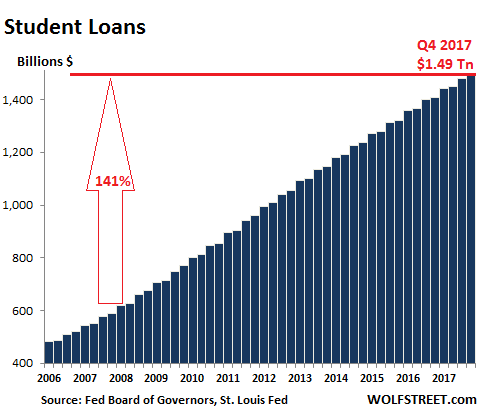
Student Debt Bubble Expands As Parents Do More Of The Borrowing

Not so long ago, student debt was mostly the responsibility of students. That is, you paid for college with loans and then paid off those loans with the proceeds of the good job you got with an advanced education.

These days it’s a little different. The cost of higher education is soaring, the jobs available to college grads don’t pay as much, relatively speaking, as they used to, and the size of loans available to students – though huge – don’t cover the full cost of many degrees.

One might expect these changes to lead more students to work for a few years and save up, or choose a cheaper degree, or eschew college altogether (as a lot of successful people now recommend) and substitute work experience for a diploma.

Some of that is happening but apparently the biggest change is that parents have stepped in to cover the difference between what their kids can borrow and the cost of a degree. As the chart below illustrates, until just a few years ago, the average debt of students exceeded that of students’ parents. But post-Great Recession, parents have given up trying to moderate the cost of their kids’ education and started doing the borrowing themselves. They’re now taking on the majority of new debts, and the gap is widening dramatically.

https://www.zerohedge.com/sites/default/files/inline-images/Student-loans-July-18.jpg?itok=KUg1xS-4

Retirement Crisis?

So we can add student loans to the list of instances where people who once tried to control their borrowing have stopped trying and are now just going with the flow. Which means several things.

First, kids who if left to themselves and the market would probably opt for one of the aforementioned cheaper alternatives are still in high-cost, frequently low-reward degree programs, and are being sheltered from the consequences by well-meaning parents.

Second, the retirement crisis that everyone is talking about – in which people who have never saved a penny are approaching retirement age and looking at 30 years of abject poverty – is being made that much worse by parents taking on new debts at a time of life when they should be aggressively trending towards debt-free/cash-rich.

Third and most important for people who aren’t participating in this game of financial musical chairs, the eventual implosion of the student loan market – i.e., the point at which loan defaults become intolerable – will lead to a government bailout, making student loans everyone else’s problem.

But of course the government won’t raise taxes or otherwise inflict immediate consequences on the electorate. It will borrow the money and create enough new currency to cover the first few years’ interest, leaving the longer-term consequences for later years and other people.

As with all the other mini-bubbles out there, if student loans were an isolated problem in a sea of rock-solid financial behavior they’d be easily managed. But they’re just one of many time bombs set to explode shortly.

https://www.zerohedge.com/sites/default/files/inline-images/Auto-loans-July-18.jpg?itok=6BbOoMkr

Auto loans, credit cards, underfunded pensions and increasingly mortgages and home equity lines are all heading the same way domestically, while emerging market dollar debt (which dwarfs the US mini-bubbles) is just as precarious internationally.

https://www.zerohedge.com/sites/default/files/inline-images/Emerging-market-debt-April-18.jpg?itok=bsE1w3xB

The question then becomes, how many of these bursting bubbles can the US paper over before the currency markets figure out that each will be followed by another, for as far as the eye can see?

Source: ZeroHedge

Trump Says No Economic Brexit Means No U.S. Trade Deal

https://theconservativetreehouse.files.wordpress.com/2018/07/sun-cover-1.jpg

President Trump gave Rupert Murdoch (British U.K. Sun) an interview prior to leaving Washington DC for Brussels and the NATO summit.   Mr. Multinational Murdoch is severely against President Trump’s trade positions and wants to retain control over the global trade structure.   Murdoch personally has billions of dollars dependent on retaining the current globalist multinational trade scheme.

That’s the backdrop to understand the timing and presentation of the interview content.

As to the substance of the interview, President Trump is 100% accurate.  If the U.K. keeps the pre-existing trade pact with the EU, and essentially stays economically attached to the EU through acquiescence to the EU trade bloc, then any bilateral trade deal between the U.S. and the U.K. is essentially impossible.   Duh.

The EU doesn’t allow member nations to conduct their own trade negotiations.  So, any agreement that keeps the U.K attached to the EU economically means any trade deal with the U.K. would be a trade deal with the EU; and the EU trade positions are adverse to the ongoing economic interests of the United States.

This factual reality is the basis for President Trump telling The Sun any trade deal with the U.K. will be impossible under the current ‘Brexit’ terms that Prime Minister Theresa May has consigned herself to accept.   According to the interview President Trump warned Prime Minister May of this likelihood. Mrs. May then screwed herself and her nation’s economic interests by following the path of appeasement with the European Union.  It is not Trump’s fault for calling out the reality of the British economic position.

If President Trump speaking honestly about the economic consequence from PM May’s decision causes consternation, well, so be it.  When the Brits get done gnashing their teeth, the math remains unchanged.  Attach yourself to the EU and no bilateral trade deal with the United States is possible.  No amount of foot-stomping is going to change that.

The Brits can kick out Theresa May and do what they should have done two years ago; withdrawn from the European Union – a ‘hard Brexit’.  Or, if they like the way things are going…. just keep on keeping on.  It’s their decision.

https://theconservativetreehouse.files.wordpress.com/2018/07/trump-uk-10.jpg

May looks as if she knows she is screwed;
Mr. May looks like he knows his wife is screwed and he hates everything;
The President looks like Thor;
and Melania looks like a misplaced Goddess, above the fray.
Just a Great photo!

https://s33.postimg.cc/nd18nyzsf/trump-farage.jpg

Source: by Sundance | The Conservative Tree House

June Jobs Report: 213,000 Jobs Added, Economy Expanding, Blue Collar Gains Most Substantive…

https://twitter.com/WiredSources/status/1015223147623321601?ref_src=twsrc%5Etfw%7Ctwcamp%5Etweetembed%7Ctwterm%5E1015223147623321601&ref_url=https%3A%2F%2Ftheconservativetreehouse.com%2F2018%2F07%2F06%2Fjune-jobs-report-213000-jobs-added-economy-expanding-blue-collar-gains-most-substantive%2Fcomment-page-1%2F%23comments

The Bureau of Labor Statistics presents the latest snapshot of jobs and employment.  According to the BLS data, behind the 213,000 jobs added, the most significant gains all center around growth in durable goods, manufacturing, transportation/distribution and the ancillary business services directly connected to the blue collar sector.

In addition, April was revised up from +159,000 to +175,000, and the change for May was revised up from +223,000 to +244,000. With these revisions, employment gains in April and May combined were 37,000 more than previously reported.

https://theconservativetreehouse.files.wordpress.com/2017/12/trump-hat-business-workers.jpg

In the macro-review things are looking great; however, when you go into the micro-review you discover things are even better, they are MAGAnificent.

To understand what is happening we must all remember the Trump MAGAnomic policies are geared toward enhancing the creation of “goods”; the production of physical “stuff”; the manufacturing and durable good sector; or put another way: Main Street/Blue Collar work.   MAGAnomic policy is geared toward expanding the production base of the U.S. economy.  Therefore all majority benefit will be necessarily attached to those workers and industries that are part of the expanding production base.

https://theconservativetreehouse.files.wordpress.com/2017/12/trump-hard-hat-3.jpg

Blue-collar trade jobs are exploding bigly; and with that MAGA development the work hours and earnings of those who participate within the trade-production processes are showing significant gains.  Work hours continue expanding and the wage rates within the MAGA-trades are also showing the most substantive gains. (Table B-2, and Table B-3)

However, with 30 years of economic policy which diminished the blue-collar-trade value, the largest portion of the U.S. workforce shifted away from trades, and/or the production of durable goods.  As a consequence the non-trade driven (investment economy or service economy) is full of workers educated in pre-elizabethan poetry, arts and useless humanities (See Table B-1 and compare year-to-year).   The non-trade-skilled-workers are plentiful as bank tellers, retail workers, data entry, etc. and their abundance is keeping the macro-view of wage growth artificially skewed.

Wages, hours worked and benefits for those participating in the production economy (the minority number; ie blue collar) are gaining at a much higher rate than wages and hours worked by employees outside of the production economy (the majority number). In the aggregate this gives the artificial view that wages and hours worked are not expanding at the same rate as the overall economy.  This is a mistaken perspective confounding the majority of the economic punditry.   Remember, we are in the space between two economic engines: A Wall Street engine, and A Main Street engine.

The economic fuel, the MAGA policy feeding the expanding economy, is being poured into the Main Street engine; the production economy.  The majority benefit from the Trump policy shift is being felt by anyone and everyone attached to the production economy.

Those workers who are attached to the Wall Street economic are not gaining the same level of benefit; nor will they for the next two to four years.  The workers inside the production economy will continue to experience the majority of the economic and financial benefit for the foreseeable future….. we’ve got decades of diminished economic activity to make up for.

https://theconservativetreehouse.files.wordpress.com/2015/10/trump-hard-hat.jpg

Keep in mind, at a 30,000 ft overview, all of the current MAGA investment is pouring into plants and infrastructure.  When all of those production facilities start coming on line, approximately another year or two, they start generating even more jobs toward the finished goods each plant and facility will then provide.   More workers are then pulled away from the Wall Street economy and into the Main Street economy.  See how that works?

[In that ‘on-line production phase’, the *overall* wages then begin to rise; because the production worker base is expanded.]

Right now all of the trade jobs, and transportation (truck drivers etc) attached to the trade jobs, are at capacity.  Every raw material producer, miner, logger, and/or fabrication job professional: pipe-fitter, brick-layer, mason, welder, engineer, journeyman or apprentice therein; can make buckets of money with virtually unlimited work hours and overtime for those who can work with their hands and tools.

This is the MAGA economy; knowing how to use a pair of metal snips is WAY more valuable than a degree in gender studies.  Teach a Starbucks barista how to drive a fork-lift or operate a machinist lathe and they can increase their wages exponentially.

(Via CNN) Businesses added 213,000 jobs to their payrolls in June, another strong month of gains. Employers kept hiring even as fears grew of a global trade war. The economy has added jobs every month for almost eight years, the longest streak on record.

The unemployment rate inched up to 4%, the first increase in almost a year. But even that reflected a healthy economy: It rose because more than 600,000 Americans joined the work force. The job market is so good, many people who had previously given up looking are starting again.

“It’s a good thing. There are more people coming into the labor force,” said Satyam Panday, senior economist at S&P Global Ratings. “It indicates that we have more labor market slack.”

New entrants, including blue-collar workers and teenagers, shouldn’t have much trouble finding a job. There are more openings right now than unemployed workers, leading businesses to expand hiring to historically disadvantaged groups.  (read more)

https://theconservativetreehouse.files.wordpress.com/2016/09/trump-hat-1.jpg

Bureau of Labor Statistics DATA here.

Total nonfarm payroll employment increased by 213,000 in June and has grown by 2.4 million over the last 12 months. Over the month, job gains occurred in professional and business services, manufacturing, and health care, while employment in retail trade declined. (See table B-1.)

Employment in professional and business services increased by 50,000 in June and has risen by 521,000 over the year.

Manufacturing added 36,000 jobs in June. Durable goods manufacturing accounted for nearly all of the increase, including job gains in fabricated metal products (+7,000), computer and electronic products (+5,000), and primary metals (+3,000). Motor vehicles and parts also added jobs over the month (+12,000), after declining by 8,000 in May. Over the past year, manufacturing has added 285,000 jobs.

Employment in health care rose by 25,000 in June and has increased by 309,000 over the year. Hospitals added 11,000 jobs over the month, and employment in ambulatory health care services continued to trend up (+14,000).

Construction employment continued to trend up in June (+13,000) and has increased by 282,000 over the year.

Mining employment continued on an upward trend in June (+5,000). The industry has added 95,000 jobs since a recent low point in October 2016, almost entirely in support activities for mining.

In June, retail trade lost 22,000 jobs, largely offsetting a gain in May (+25,000).

Employment showed little or no change over the month in other major industries, including wholesale trade, transportation and warehousing, information, financial activities, leisure and hospitality, and government.

The average workweek for all employees on private nonfarm payrolls was unchanged at 34.5 hours in June. In manufacturing, the workweek edged up by 0.1 hour to 40.9 hours, and overtime edged up by 0.1 hour to 3.5 hours. (link)

Now, lets wait to see what Canada’s results show.   D’0h.

https://theconservativetreehouse.files.wordpress.com/2016/10/trump-hat-2.jpg

Source: By Sundance | The Conservative Tree House

***

Where The Jobs Were In June: Who’s Hiring And Who Isn’t

After years of monthly payroll reports padded with excessive minimum wage waiter, bartender, educator or retail worker jobs, the June jobs report was notable for its top-line beat, and which was the record 93rd straight month of US job growth, offset by strong, if disappointing, wage growth, which at 2.7% came in below than 2.8% expected, perhaps due to the preponderance of part-time jobs, but nonetheless showed continued “late cycle” strength in most components even if some negative surprises were also present.

Of note: while last month’s jobs report was truly impressive in terms of job gains by industry, with the highest paying adding the most workers, in June we saw a continuation of many of the trends observed last month:

  • Continued strength in Goods Production: Mining (+4K), Construction (+13K) and especially manufacturing (+36K).
  • Trade & Transportation Continued to Rebound: Wholesale (+2.9) and Truck Transportation (+2.5K).

Here the surprise was perhaps that just 2.5K trucking jobs were added, following complaints from the major trucking employers, all of whom have noted they can’t find enough people to hire, which suggests there may be an upward revision next month.

As Southbay Research notes, there were several other factors that actually depressed the seasonally adjusted number from rising as much as 250K, chief among them a sharply negative Seasonal Adjustment (-35K) which took some wind out of the June NFP sails. According to Southbay, “usually we can blame weather (as in 2016), but this is just BLS monkeying around.”

https://www.zerohedge.com/sites/default/files/inline-images/seasonal%20june%202018.png?itok=0mnuD68h

Some other highlights:

  • Manufacturing (+36K): Up on auto (+12K) rebound after fire led to factory shutdowns
  • Retail (-21K): Falls on weak Food (-9K) and weak Merchandise (-18K).  Merchandise stores is Toys-R-Us bankruptcy layoffs
  • Professional Services (+50K): Strong on the back of white collar technical workers (+25K).  relatively weak Temp workers (+9K) suggests some weakness: either lack of supply (insufficient qualified workers at level of pay) or demand (employer demand is softer than surveys relate)
  • Healthcare (+35K): Higher payrolls create more demand for healthcare

Visually:

https://www.zerohedge.com/sites/default/files/inline-images/jobs%20composition%20june.jpg?itok=0tDo-fLH

Looking over the past year, the following charts from Bloomberg show the industries with the highest and lowest rates of employment growth for the prior year. The latest month’s figures are highlighted.

https://www.zerohedge.com/sites/default/files/inline-images/bbg%20jobs%20june%202018.jpg?itok=rI8f14UU

Finally, what trends can we observe from the latest report? As Southbay summarizes, “H1 2018 has been solid and June reinforced the strength”:

  • Not Seasonally Adjusted payrolls are now the highest this business cycle.
  • Year-to-date Payroll (seasonally adjusted) is 213K (vs 2017 181K).

But June itself had the same level of payroll adds (not seasonally adjusted) as last year 2017. So heading into 3Q, the economy is strong but may no longer be surging faster than it was last year, same time, according to Southbay. This may also mean that the peak benefit from Trump’s fiscal policy is now behind us and going forward it will only serve to depress the economic trend line.

Source: ZeroHedge

Is This Why Tesla Executives Are Fleeing? Investors Want To Know

Is Tesla The New Theranos?

I originally started following Tesla as I felt it was a structurally unprofitable business nearing a cash crunch as hundreds of competing products were about to enter the market.

https://www.zerohedge.com/sites/default/files/inline-images/11325d20-260e-46c8-87de-fb9bbec62749.jpg?itok=QPDAqoOh

As I’ve studied Tesla more closely, I’ve come to realize that Elon Musk appears to be running a Ponzi Scheme disguised as an auto-manufacturer; where he has to keep unveiling new products, many of which will never come to market, in order to raise new capital (equity/debt/customer deposits) to keep the scheme alive. The question has always been; when will Tesla collapse?

https://www.zerohedge.com/sites/default/files/inline-images/Tesla-Bullshit-Conversion-Cycle.jpg?itok=O2KMdlapTesla’s Bullshit Conversion Cycle is the key financial metric underlying this scheme (from @ProphetTesla)

As part of my research on Tesla, I decided to read Bad Blood by John Carreyrou, the journalist who first uncovered the Theranos fraud. It is the story of how Elizabeth Holmes created Theranos and then lurched between publicity events in order to raise additional capital and keep the fraud going, despite the fact that the technology did not work. The key lesson from Theranos for determining when a fraud will implode is that there are always idiots willing to put fresh money into a well marketed fraud – so you need a catalyst for when the funding dries up.

The other salient fact was that most senior employees actually knew that something wasn’t quite right, but feared losing their jobs or getting sued if they did anything about it. Therefore, employee turnover was off the charts but no one was willing to risk their career by saying anything publicly. However, when Theranos started risking customers’ lives, the secret got out pretty fast. This is because most people are inherently ethical – especially when they know that their employer is doing something immoral, like releasing flawed lab results to sick patients. Eventually, some employees felt compelled to become whistle-blowers and started to reach out to journalists and regulators. This started a cascading event.

First, one intrepid journalist took the career risk to write about the Theranos fraud. Then other whistle-blowers felt emboldened to step forward and contact this first journalist, as they also wanted their story told – especially as they had already reached out to government regulators who were too scared to investigate a politically powerful company.

https://www.zerohedge.com/sites/default/files/inline-images/2018-07-05_9-30-27.jpg?itok=G3zMzfEt

Once a few good articles had been written about Theranos, the dam broke open and the feeding frenzy began. Other journalists, smelling page-clicks rapidly descend on Theranos; more workers spoke out, more incriminating evidence came to light and then there was a sense of voter outrage. Finally, the regulators who were first contacted by the whistle-blowers many months previously, felt compelled to act – at which point the fraud collapsed and the money spigot shut off.

https://www.zerohedge.com/sites/default/files/inline-images/Tesla-executive-departures.jpg?itok=TEBxT2PFExecutives Fleeing Tesla Is A True Bull Market “Up And To The Right”

We’ve already seen the mass exodus of senior Tesla executives. When they say they “want to spend time with their family,” it really means they “want to spend less time in prison.” Next, we have the first whistle-blowers—there will be MANY more. Currently there are at least 3 different ones feeding information to journalists. Using past frauds as a guide, once we get to this point of the media cycle, the fraud usually unravels pretty fast.  Given the perilous state of Tesla’s finances, they are in urgent need of new capital. The question is; who would want to invest new capital when Tesla is now admitting to knowingly selling cars without testing the brakes in order to hit some arbitrary one week production target? When a company admits that it will sacrifice vehicle quality and even risk killing its customers to win a twitter feud and start a short squeeze, regulators must step in. The question is; what else has Tesla done illegally to hit its targets? We know that Tesla long ago passed over the ethical threshold of selling faulty products that have killed people—what other allegations will soon come to light? Elon Musk demanded that Tesla stop testing brakes on June 26. Doug Field, chief engineer, resigned on June 27. Is this a coincidence? Of course not—Doug Field doesn’t want to be responsible for killing people. I think Tuesday’s article will speed up the pace of Tesla’s bankruptcy quite dramatically and I purchased some shorter dated puts after reading it.

Tesla is the fluke stock-promote that found a way to address society’s fascination with ‘green technology’ and the ‘next Steve Jobs.’ Elon Musk eagerly stepped into the role of mad scientist and investors gave him a free pass. It now increasingly seems that everything he’s done for the past few years was simply designed to keep the share price up, keep the dream alive and raise more capital – as opposed to creating shareholder value. Along the way, customer safety has been ignored in order to hit production targets and appease the stock market. In addition to not testing brakes, a recent whistle-blower has accused Tesla of installing over 700 dangerously defective batteries into Model 3 vehicles.

I suspect there will be many more allegations as whistle-blowers come out of the woodwork. It really is the Theranos of auto makers. I suspect it will all end soon. Theranos and Enron both collapsed within 90 days of the journalists getting up to speed. The reporters now know the right questions to ask and Tesla will be out of cash by the time they are all answered.

https://www.zerohedge.com/sites/default/files/inline-images/2018-07-05_9-33-07.jpg?itok=kqXN3GzmStock Promotion In Overdrive Lately. What’s Elon Trying To Distract People From?

Besides, Elon Musk isn’t even all that innovative. Hitler already tried this same automotive customer deposit scam 80 years ago (From Wages of Destruction)

https://www.zerohedge.com/sites/default/files/inline-images/2018-07-05_9-34-55.jpg?itok=Cc-tNH4U

Source: ZeroHedge | Submitted by Kuppy Via AdventuresInCapitalism.com

***

“Short-Tempered” Musk Reportedly “Snapped” At Staff Working 12-Hour Shifts In Model 3 “Production Hell” Week

https://www.zerohedge.com/sites/default/files/inline-images/Elon%20Musk_0.JPG?itok=x0ZWpkN6

The conditions at Tesla’s production facility leading up to meeting its Model 3 production goal have been reported as nothing short of hellish as Elon Musk “barked” at employees working 12 hour shifts, bottlenecking other parts of the company’s production and reportedly causing concern by employees that the long hours and strenuous environment would cause even more workplace injuries and accidents.

Why You Should Care About The Narrowest Yield Curve Since 2007

Money manager Michael Pento is sounding the alarm because we are getting very close to something called a “yield curve inversion.” Pento explains, “Why do I care if the yield curve inverts? Because 9 out of the last 10 times the yield curve inverted, we had a recession… The spread with the yield curve is the narrowest it has been since outside of the start of the Great Recession that commenced in December of 2007… The last two times the yield curve inverted, we had a stock market drop of 50%. The market dropped, and the S&P 500 lost 50% of its value.”

For those who don’t have enough money to require professional management, consider storing water and food because that will never go out of style.

Source: by Greg Hunter | USAWatchdog.com

U.S. Chamber of Commerce Launches Yet Another Financial Campaign Against U.S. Workers and Main Street…

Today U.S. Chamber of Commerce President Tom Donohue announced another campaign to protect and defend his Wall Street contributors against initiatives that benefit Main Street U.S.A. This is not the first time, and unfortunately it will likely not be the last time.

For a great historic reference consider THIS ARTICLE from 2014; when the U.S. Chamber of Commerce announced their direct attack against the Tea Party backed candidates that threatened to remove the massive lobbying power of Tom Donohue’s corrupt officials. That 2014 reference point has two parts. I strongly urge anyone who would defend the U.S. CoC approach to read both.

The overwhelming majority of economic punditry and opinion come from salespeople on the purchased payroll, direct and indirect, of the chamber. It is one of the most, check that, it is the most corrupt and abusive enterprise in the history of our nation. They are pulling out a very familiar playbook.

(Reuters) – The U.S. Chamber of Commerce on Monday denounced President Donald Trump’s handling of a global trade dispute, issuing a report that argued the tariffs imposed by Washington and retaliation by its partners would boomerang badly on the American economy.

The Chamber, the nation’s largest business lobby group and a traditional ally of Trump’s Republican Party, argued the White House is risking a global trade war with the push to protect U.S. industry and workers with tariffs.The group’s analysis of the potential hit each U.S. state may take from retaliation by U.S. trading partners painted a gloomy picture that could increase pressure on the White House from Republicans ahead of congressional elections in November.[…] The Chamber is expected to spend millions of dollars ahead of the November elections to help candidates who back free trade, immigration and lower taxes. It has already backed candidates who share those goals in Republican primaries. (read more)

The U.S. Chamber of Commerce consists of a massive multinational DC lobbying group that four consecutive administrations’ have allowed to write the actual language in U.S. trade deals and trade negotiations.  Bush, Clinton, Clinton, Bush, Bush, Obama, Obama all gave the U.S. Chamber of Commerce the keys to the U.S. economy, and walked away.  The U.S. middle-class was nearly destroyed in the process.

CTH has stood alone, for years, against the insufferable horde of CoC political mouthpieces and their media conscripts.  The U.S. Chamber of Commerce is at the corrupt center of almost every scheme that fund the Deep Swamp to the detriment of our nation. They are the most vile and insidious UniParty group of lobbyists in Washington DC.

Until Donald Trump came along, they held virtually unlimited power over the U.S. economy.  The Chamber is a cancer; and any politician who associates with that abhorrent group should be excised from existence with extreme prejudice.

Source: By Sundance | The Conservative Tree House

“These Guys Are Like Diamonds” – America’s Trucker-Shortage Hits A Crisis Point

Nearly every consumer product – from food, to textiles to electronics – sold in the US at some point touches the bed of a truck. Which is why the shortage of truckers to ferry goods across the US has become such an intractable problem for American companies – and unemployment at 3.8% isn’t helping.

A shortage of workers is forcing trucking firms to raise wages and provide other incentives as they seek to fill an “official” shortage of 60,000 jobs that some industry insiders say is really closer to 100,000.

https://www.zerohedge.com/sites/default/files/inline-images/2018.06.29shippingcosts.jpg?itok=X5XIPNG2

And as companies become more desperate, they’re willing to take a look at applicants who never would’ve had a chance under normal circumstances, according to the Washington Post.

At TDDS Technical Institute, an independent trucker school in Ohio where Blocksom has considered enrolling, veteran teachers say they have never seen it this bad. They say there may be closer to 100,000 truck driver openings.

“As long as you can get in and out of a truck and pass a physical, a trucking company will take a look at you now,” said Tish Sammons, the job placement coordinator at TDDS, whose desk is full of toy trucks and fliers from the companies that call her daily begging for drivers. “I recently placed someone who served time for manslaughter.”

WaPo‘s story opens with an anecdote about Bob Blocksom, an 87-year-old retired insurance salesman who is searching for a job after having not saved enough money for retirement.

https://www.zerohedge.com/sites/default/files/inline-images/2018.06.29bob.JPG?itok=OoU2B35h

And trucking companies, as it turns out, are willing to give him a shot – even as most employers wouldn’t consider a man his age. The only thing holding him back? Being away from his wife of 60 years.

LAKE MILTON, Ohio — Bob Blocksom, an 87-year-old former insurance salesman, needs a job. He hasn’t saved enough money for his retirement. And trucking companies, desperate for workers, are willing to give him one.

Age didn’t matter, they said. If Blocksom could get his “CDL” — commercial driver’s license — they would hire him for a $50,000 job. One even offered to pay his tuition for driver training school, but there was a catch: Blocksom had to commit to driving an 18-wheel truck all over the United States for a year.

So far, that has been too big of an ask for Blocksom, who doesn’t want to spend long stretches of time away from his wife of 60 years. “The more I think about it, it would be tough to be on the road Monday through Friday,” he said.

Wages listed in the story ranged as high as $80,000 a year – plus benefits. And some companies say they’re considering raises because that still isn’t enough to appeal to young people. Already, WaPo says, companies like Amazon, General Mills and Tyson Foods are passing higher transport costs onto consumers. Wal-Mart even identified rising transportation costs as the biggest “head wind” facing the company.

“This is slowing down the economy already,” said Peter Boockvar, chief investment officer at Bleakley Advisory Group. “If it takes me a week instead of two days to ship products from point A to B, I’m losing potential business.”

Even with new federal regulations mandating that truckers log their hours so they don’t breach the maximum 11-hour daily limit, being a trucker is a “hard job” that takes “a special breed” of person. New truckers often gain weight from sitting all day. The periods of separation often strain interpersonal relationships, and divorces are common.

things GIF

Trucking is also surprisingly dangerous: There were more than 1,000 fatalities among motor vehicle operators in 2016, according to the Labor Department. That means being a truck driver is eight times as deadly as being a law enforcement officer. Obtaining a CDL also takes months of schooling and can cost as much as $7,000. Unsurprisingly, a growing number of candidates are failing the mandatory drug tests that are part of the application.

The community around TDDS is full of shuttered factories and bars named “Lucky Inn” and “Horseshoe.” The steel mills closed in the 1980s, and a GM factory just announced more than a thousand layoffs. One of the only industries growing in the area is trucking, yet locals are hesitant to become truckers.

One man, a janitor, hanging out at Larry’s Automotive repair shop in nearby Warren, said his uncles were truckers and told him they would “kill him” if he ever got into the harsh business. The owner of the shop said he had thought about becoming a trucker but decided it wasn’t feasible after he had children.

Trucking jobs require people to leave their families for weeks at a time and live in a small “cabin” with a hard bed. Divorces are common, veteran drivers say, and their children forget them. A life on the road is often costly and unhealthy. Drivers sit for hours a day in diesel trucks and pull into truck stops that typically serve greasy hot dogs and chili.

Weight gain and heart disease are common, says Gordon Zellers, an Ohio physician who spends half his time examining truckers and administering drug tests, which increasing numbers of CDL applicants fail. He advises the TDDS students to see a nutritionist, but he knows most won’t.

Even companies that don’t require their drivers to go “over the road” – that is, make long-term hauls – are struggling to recruit.

“These guys are like diamonds right now,” said Jason Olesh, a vice president at Aim Transportation Solutions who left his family vacation to rush to TDDS to talk to students. “We’re down 90 drivers across our fleet of 650.”

Olesh gave his best pitch to the students: He offered them jobs that pay $70,000 a year with full benefits and regional routes hauling water to oil-drilling sites that would have them home most nights.

“I’m offering you a regular job with a 10- to 12-hour shift so you can see your kids,” Olesh said.

The worker shortage has, unsurprisingly, led to a wave of poaching that has sent the industry’s turnover rate to 94%. At this rate, companies and consumers better hope that Elon Musk succeeds with his goal to launch a fleet of autonomous trucks several decades ahead of schedule.

Source: ZeroHedge

America’s Cheese Stockpile Just Hit A Record High

The Washington Post reports American warehouses have amassed their most massive stockpile of cheese in more than 100 years since government regulators began tracking dairy products, the result of oversupplied domestic markets and waning consumer demand.

https://www.zerohedge.com/sites/default/files/inline-images/Screen-Shot-2018-06-29-at-7.46.59-AM.png?itok=eRNwCzd1

Commercial and government cheese storage facilities now have a whopping 1.39 billion-pound surplus, counted by the Agriculture Department in May and published in a report on June 22. It is a 6 percent y/y and a 16 percent jump since the government launched ‘quantitative cheesing’ to buy excess supply in 2016.

https://www.zerohedge.com/sites/default/files/inline-images/Screen-Shot-2018-06-29-at-7.46.29-AM.png?itok=soALgAP7

Cheese analysts say record stockpiling is attributed to a decline in consumer demand for milk. When dairy cattle produce too much milk, processors generally convert the milk into cheese, butter, or powder, which is the easiest method for long-term storage.

Record amounts of cheese, however, comes with a significant drawback: If it is being stored, it is not sold, that leads to margin compression of farmers who make their living from the dairy industry.

https://www.zerohedge.com/sites/default/files/inline-images/2018-06-29_14-28-10.jpg?itok=hJcPJN6Ch/t johnlund.com

The Post notes that Trump’s trade war has prompted fears that stockpiles will build further if trade tensions with China and Mexico slice into cheese exports.

“Milk production continues to trend up, and that milk has to find a home,” said Lucas Fuess, director of market intelligence at HighGround Dairy, a consulting firm.

“The issue this year is that, with so much supply, it’s going to be tough for a lot of farmers to be profitable.”

Regarding seasonality, cheese surpluses tend to occur in the summer months. Dairy cattle are at their most productive stage in spring when the days are longer, and the feed is of much higher quality. Better genetics of the cows have also produced more milk. Simultaneously, demand for cheese declines among Americans in the summer months and usually picks back up during the school year.

“I anticipate that we’ll continue to set these records,” said John Newton, director of market intelligence at the American Farm Bureau Federation.

“We’re producing more milk. It’s inevitable. That milk needs to get turned into something storable.”

https://www.zerohedge.com/sites/default/files/inline-images/Screen-Shot-2018-06-29-at-8.21.32-AM.png?itok=7CYZ9wVk

“But the sheer amount of cheese in storage may be causing problems. Cheese prices have fallen in recent weeks,” Fuess said. Since 2014, cash-settled cheese futures have declined by more than -30 percent. Judging by the descending channel, if the upper rail of the structure is rejected, well, the next liquidity gap in the auction could form.

https://www.zerohedge.com/sites/default/files/inline-images/2018-06-29_05-34-02.png?itok=pqRMs0gT

“That fall is problematic,” said Mark Stephenson, director of dairy policy analysis at the University of Wisconsin at Madison, “because the price of cheese is a major factor in the equation that USDA uses to set the price that dairy farmers receive for their milk.”

When Stephenson chatted with The Post, the current price was $15.36 per 100 pounds. From 2017 highs, price prints -7 percent discount and well below the break-even for many farmers. “When inventories get too large, that pushes the prices down,” he said. “And yes, that trickles down to dairy farmers.”

Michael Dykes, president of the International Dairy Foods Association, told The Post, he is sure Americans will eat through the stockpiles. That is because of stock-to-use ratios, a measure of the amount of cheese taken out of storage, have remained elevated when inventories are high, and prices are depressed.

https://www.zerohedge.com/sites/default/files/inline-images/Screen-Shot-2018-06-29-at-8.54.05-AM.png?itok=lXIlHAWU

Dykes warned The Post that mounting trade tensions could grow inventories to crisis levels. Last year, the United States produced 12 billion pounds of cheese and exported more than 341,000 metric tons to countries such as Mexico and China. The fear is if those countries turn to Europe or other countries besides the United States, the stockpile could reach crisis levels. Already, the Department of Agriculture has been prepping cheese makers for the worst case scenario of much higher inventories.

“One milking day a week goes to the export market,” Dykes said. “There’s a lot of uncertainty now. I don’t think we really know what will happen yet.”

So, when does the next round of ‘quantitative cheesing’ come?

Source: ZeroHedge

American Spending Grows Faster Than Income For 29th Straight Month

For the 29th month in a row, Americans annual spending grew faster than their incomes as the ‘no consequences’ new normal rolls on, leaving the savings rate languishing near record lows – even if it did very modestly uptick in May.

https://www.zerohedge.com/sites/default/files/inline-images/2018-06-29%20%281%29.png?itok=bwoEgyRC

Year-over-Year income growth reached 4.0% – the highest since Nov 2015; while YoY spending growth stalled at 4.4%.

https://www.zerohedge.com/sites/default/files/inline-images/2018-06-29_5-34-14.jpg?itok=Ph_kfSrR

Income growth was dominated by private workers seeing another uptick…

https://www.zerohedge.com/sites/default/files/inline-images/2018-06-29%20%282%29.png?itok=Rji2MdxX

On the month, personal incomes grew 0.4% (as expected) – the fastest rate since Dec 2017.

However, for the second straight month, month-over-month spending growth disappointed – rising just 0.2% MoM vs +0.4% expectations.

But the growth in both continues.

https://www.zerohedge.com/sites/default/files/inline-images/2018-06-29.png?itok=7iTNQJ3N

The PCE Inflation data came in a little hotter than expected – rising at the fastest since March 2012…

https://www.zerohedge.com/sites/default/files/inline-images/2018-06-29_5-40-35.jpg?itok=Y55EoCM4

As a reminder, the vast gap between extreme high confidence and extreme low savings rate – a borrow-my-way-to-happiness narrative – has never ended well in the past…

https://www.zerohedge.com/sites/default/files/inline-images/2018-06-29_5-26-44.jpg?itok=0goOTI__

Remember, nothing lasts forever – ask the German soccer team.

Source: ZeroHedge

Another Commodity Signal Indicates Economic Slowdown

The latest oil price spike may turn out to be a head-fake, because the economy is already slowing. While the oil cartel can try to fix the supply of oil, it can’t really control the demand side, which is dominated by the economic cycle.

This is clear to us at ECRI because of our enduring focus on cyclical relationships and, in this case, sensitive industrial material prices, including oil. We’ve long maintained a daily price index of these commodities that moves in concert with cycles in industrial growth. About half of the price inputs we monitor are traded on various commodity exchanges, while the rest are priced from commodity producers.

For the past few quarters a very unusual gap has opened up between the two groups, with the prices of non-exchange-traded industrial commodities, which most observers don’t watch, falling, and in some cases plunging. This behavior is in sharp contrast to the bullish sentiment shown, until more recently, by the strength in the prices of commonly-watched exchange-traded commodities.

https://www.zerohedge.com/sites/default/files/inline-images/180628_CNBC_W495_Update.gif?itok=Nchj8-e7

As the chart shows, because of their links to industrial growth, exchange-traded and non-exchange-traded commodity price inflation rates have historically moved very much in sync.

But the right-side of the chart shows exchange-traded commodity price inflation spiking up through early this year, driven by widely-watched industrial inputs like oil and copper, while non-exchange traded commodity inflation went straight down into negative territory, as the prices of raw materials like rubber and hides dropped precipitously. This is very unusual.

This undeniable weakness in the non-exchange traded commodity prices is in line with our March Bloomberg View Op-ed, The Global Economy’s Wile E. Coyote Moment, about the end of the 2016-17 synchronized global growth upturn. The current downturn in global industrial growth has caught many people off guard because they focus on exchange-traded commodities only. Doing so made it easier to think that demand wasn’t slowing because surging oil and primary metals prices had camouflaged what was really happening.

ECRI’s insight was that the rise in exchange-traded prices was not about demand, which we knew was slowing. Rather, it was about the confluence of a variety of supply shocks, which weren’t cyclical, and thus unsustainable.

Of course, Saudi Arabia and Russia had deliberately kept oil production in check to support oil prices. But also, aluminum and nickel prices had shot up on fears of U.S. sanctions on Russia. Copper prices had surged due to labor problems at major mines, and rule changes regarding Indonesian tin export permits had also caused supply shortages. Meanwhile, zinc prices were pushed up by the shutdown of major Australian, Irish and Canadian mines and China’s environmental clampdown, which had lifted lead prices. What’s more, those pollution controls also hurt the production of synthetic fabrics, which therefore couldn’t make up for the shortfall in Indian cotton exports caused by pink bollworms eating into the cotton supply. It really was this perfect storm of supply constraints – not the strength of global demand – that drove the earlier run-up in these exchange-traded commodity prices.

Stepping back, the real tip-off came from the earlier downturns in ECRI’s leading indexes of global industrial growth, which were then followed by the yawning gap between exchange-traded and non-exchange-traded commodity price inflation that opened up months ago. It’s only in recent weeks that exchange-traded commodity price inflation has turned down. It’s no coincidence that the Eurozone manufacturing PMI just dropped to a 1½-year low and its U.S. counterpart fell to a seven-month low.

Today, growth in the non-exchange-traded commodity prices remains negative, and growth in the exchange-traded commodity prices is closing the gap by dropping to an 11-month low. With the global industrial slowdown manifesting in all these very short-leading indicators, the market may soon start asking if global demand is all it’s cracked up to be.

Source: ZeroHedge

Out of Options: Canada Begins Lobbying American Auto Manufacturers For Help…

Good news within a strenuously spun Reuters article. Don’t get lost looking at the granules; apparently all of the prior Canadian strategy against President Trump has failed.

For well over a year Justin from Canada and Foreign Minister Chrystia Freeland were confident they could leverage the U.S. Chamber of Commerce, purchased DC politicians and ideological allies against President Trump in NAFTA negotiations. The result? Fail, fail and more fail.

https://theconservativetreehouse.files.wordpress.com/2018/06/canada-nafta-1.jpg

Running out of options, Canada now attempts to save their NAFTA construct by turning to the executives within the auto industry:

OTTAWA (Reuters) – Canada’s trade minister last week met senior officials from General Motors Co and Fiat Chrysler Automobiles NV in Detroit, as Ottawa takes its lobbying effort directly to the Big Three car makers to avert potential U.S. auto tariffs.

The Liberal government is relying on industry partners to press Canada’s cause in the White House and elsewhere, using their influence to protect Canadian interests, sources with direct knowledge of the discussions told Reuters.

The auto industry, Canada’s biggest exporter, represents about 500,000 direct and indirect jobs and contributes C$80 billion ($60.1 billion) a year to the economy.

“Instead of us galloping all over the United States talking to everybody, it’s really focused right now on the automobile manufacturers, the automobile suppliers,” said one source, who requested anonymity given the sensitivity of the situation.

The Canadian message was “now is the time to speak up, now is the time to exercise whatever influence you might be able to bring to bear,” added the source. (read more)

Or put another way…. “Halp”!

Each sequential step in the Trump trade strategy is designed to head-off any counter position by positioning individual best-interests ahead of any defensive group formation.

The Canadian and Mexican economy (due to NAFTA) cannot survive without importing cheap durable goods from China to use in their assembly-based economies, and then trans-ship into the U.S market. However, the U.S. economy can survive, it can actually expand BIGLY and thrive, without accepting trans-shipped assembled goods from Mexico and Canada.

Put simply, without NAFTA, the assembly processes just moves INTO the U.S because the market *is* the United States. We are the $20 trillion customer. We hold the leverage.

Example:

NOTE: “Donnelly said in his opening remarks that there was already a rise in product being diverted to Canada in recent years and signs of even more since the U.S. tariffs began this year.”..

This is evidence of multinationals exploiting the NAFTA loophole to avoid U.S. tariffs. This fatal flaw is at the very heart of the issue within the U.S. trade policy inside NAFTA. As long as Mexico and Canada remain gateways for foreign good assembly and shipment into the U.S. there will never be a way for the U.S. to demand fair and reciprocal trade.

Canada knows their decades-long designed economic position as shipment/assembly trade-brokers is the central issue at the heart of the confrontation with USTR Lighthizer, Commerce Secretary Ross and President Trump. As multinational corporations seek to avoid Trump tariffs they only exacerbate the issue.

If Canada and Mexico don’t try to stop their duplicitous NAFTA benefit scheme, they will end up with even bigger trade surpluses and become even bigger targets for President Trump. In essence, the reason for Canada and Mexico being subject to even more encompassing Trump tariffs’ grows.

If Canada and Mexico do nothing to stop this influx; Trump will levy more than just steel and aluminum tariffs; he’ll likely tax their auto-sector.

As a consequence Canada moves do back down the Red Dragon:

https://twitter.com/BloombergCA/status/1011648854440194049?ref_src=twsrc%5Etfw&ref_url=https%3A%2F%2Ftheconservativetreehouse.com%2F2018%2F06%2F27%2Fout-of-options-canadian-trade-delegation-begins-lobbying-auto-manufacturers-for-help%2F

The Canadian government is preparing new measures to prevent a potential flood of steel imports from global producers seeking to avoid U.S. tariffs, according to people familiar with the plans. The Canadian dollar weakened and shares in Stelco Holdings Inc. soared.

The measures are said to be a combination of quotas and tariffs aimed at certain countries including China, said the people, asking not to be identified because the matter isn’t public. The moves follow similar “safeguard” measures being considered by the European Union aimed at warding off steel that might otherwise have been sent to the U.S. It comes alongside Canadian counter-tariffs on U.S. steel, aluminum and other products set to kick in on July 1. (read more)

The bottom line is U.S. market access is what all production countries need for their goods and the sustainability of their economies.

https://theconservativetreehouse.files.wordpress.com/2017/05/trudeau-ross.jpghttps://theconservativetreehouse.files.wordpress.com/2018/04/trump-friends-trade-team-ross-mnuchin-navarro-lighthizer.jpg

***

The depths of depravity to which both the Clinton and Obama Administrations dove to in their perversely industrious efforts to self-enrich while simultaneously demeaning, undermining, and selling-out all of America to foreign interests is incredibly stunning. And, they even had the entire DOJ rigged to get away with it all scot-free. It is practically surreal.

https://uploads.disquscdn.com/images/be8c8794893af1185981fcf65ccb5c2487075f06938262f26bf8147fd405a796.jpg

Source: By Sundance | The Conservative Tree House

President Trump Drops $200 Billion M.O.A.T on Red Dragon (Beijing)…

When you plant your tree in another man’s orchard, you might end up paying for your own apples; it’s a risk you take…

….and President Trump knows how to use that leverage better than anyone could possibly fathom; because in this metaphor Beijing relies upon the U.S. for both the seeds and the harvest. President Trump drops the $200b M.O.A.T (Mother of All Tariffs):

https://theconservativetreehouse.files.wordpress.com/2017/11/trump-beijing-trade-2.jpg

White House – On Friday, I announced plans for tariffs on $50 billion worth of imports from China. These tariffs are being imposed to encourage China to change the unfair practices identified in the Section 301 action with respect to technology and innovation. They also serve as an initial step toward bringing balance to our trade relationship with China.

However and unfortunately, China has determined that it will raise tariffs on $50 billion worth of United States exports. China apparently has no intention of changing its unfair practices related to the acquisition of American intellectual property and technology. Rather than altering those practices, it is now threatening United States companies, workers, and farmers who have done nothing wrong.

This latest action by China clearly indicates its determination to keep the United States at a permanent and unfair disadvantage, which is reflected in our massive $376 billion trade imbalance in goods. This is unacceptable. Further action must be taken to encourage China to change its unfair practices, open its market to United States goods, and accept a more balanced trade relationship with the United States.

Therefore, today, I directed the United States Trade Representative to identify $200 billion worth of Chinese goods for additional tariffs at a rate of 10 percent. After the legal process is complete, these tariffs will go into effect if China refuses to change its practices, and also if it insists on going forward with the new tariffs that it has recently announced. If China increases its tariffs yet again, we will meet that action by pursuing additional tariffs on another $200 billion of goods. The trade relationship between the United States and China must be much more equitable.

I have an excellent relationship with President Xi, and we will continue working together on many issues. But the United States will no longer be taken advantage of on trade by China and other countries in the world.

We will continue using all available tools to create a better and fairer trading system for all Americans.

~ President Donald Trump

https://theconservativetreehouse.files.wordpress.com/2018/05/eagle-and-dragon.jpg

Historic Chinese geopolitical policy, vis-a-vis their totalitarian control over political sentiment (action) and diplomacy through silence, is evident in the strategic use of the space between carefully chosen words, not just the words themselves.

Each time China takes aggressive action (red dragon) China projects a panda face through silence and non-response to opinion of that action;…. and the action continues. The red dragon has a tendency to say one necessary thing publicly, while manipulating another necessary thing privately.  The Art of War.

President Trump is the first U.S. President to understand how the red dragon hides behind the panda mask.

It is specifically because he understands that Panda is a mask that President Trump messages warmth toward the Chinese people, and pours vociferous praise upon Xi Jinping, while simultaneously confronting the geopolitical doctrine of the Xi regime.

In essence Trump is mirroring the behavior of China while confronting their economic duplicity.

President Trump will not back down from his position; the U.S. holds all of the leverage and the issue must be addressed.  President Trump has waiting three decades for this moment.  This President and his team are entirely prepared for this.

We are finally confronting the geopolitical Red Dragon, China!

https://theconservativetreehouse.files.wordpress.com/2017/07/us-money.jpg

The Olive branch and arrows denote the power of peace and war. The symbol in any figure’s right hand has more significance than one in its left hand. Also important is the direction faced by the symbols central figure. The emphasis on the eagles stare signifies the preferred disposition. An eagle holding an arrow also symbolizes the war for freedom, and its use is commonly referred to the liberation fight of righteous people from abusive influence. The eagle on the original seal created for the Office of the President showed the gaze upon the arrows.

The Eagle and the Arrow – An Aesop’s Fable

An Eagle was soaring through the air. Suddenly it heard the whizz of an Arrow, and felt the dart pierce its breast. Slowly it fluttered down to earth. Its lifeblood pouring out. Looking at the Arrow with which it had been shot, the Eagle realized that the deadly shaft had been feathered with one of its own plumes.

Moral: We often give our enemies the means for our own destruction.

https://theconservativetreehouse.files.wordpress.com/2017/04/trump-xi-jinping-3.jpg

https://theconservativetreehouse.files.wordpress.com/2017/08/modi-trump-hug.jpg

https://theconservativetreehouse.files.wordpress.com/2018/06/trump-kim-summit-22.jpg

“Markets”

https://theconservativetreehouse.files.wordpress.com/2018/05/world-gdp-2017-v2.jpg

https://theconservativetreehouse.files.wordpress.com/2018/06/trump-kim-summit-24.jpg

https://theconservativetreehouse.files.wordpress.com/2018/06/trump-kim-summit-25.jpg

https://theconservativetreehouse.files.wordpress.com/2018/05/kim-jong-un-funny.jpg

… all in deep contrast with what the past American Presidential Administration were focused on (video)

Source: by Sundance | The Conservative Tree House

A Hard Rain’s A-Gonna Fall

https://whiskeytangotexas.files.wordpress.com/2017/09/abyss.jpg?w=625&zoom=2

Après moi, le déluge

~ King Louis XV of France

A hard rain’s a-gonna fall

~ Bob Dylan (the first)

As the Federal Reserve kicked off its second round of quantitative easing in the aftermath of the Great Financial Crisis, hedge fund manager David Tepper predicted that nearly all assets would rise tremendously in response. “The Fed just announced: We want economic growth, and we don’t care if there’s inflation… have they ever said that before?” He then famously uttered the line “You gotta love a put”, referring to the Fed’s declared willingness to print $trillions to backstop the economy and financial markets. Nine years later we see that Tepper was right, likely even more so than he realized at the time.

The other world central banks followed the Fed’s lead. Mario Draghi of the ECB declared a similar “whatever it takes” policy and has printed nearly $3.5 trillion in just the past three years alone. The Bank of Japan has intervened so much that it now owns over 40% of its country’s entire bond market. And no central bank has printed more than the People’s Bank of China.

It has been an unprecedented force feeding of stimulus into the global system. And, contrary to what most people realize, it hasn’t diminished over the years since the Great Recession. In fact, the most recent wave from 2015-2018 has seen the highest amount of injected ‘thin-air’ money ever:

https://static.seekingalpha.com/uploads/2018/6/17/saupload_Central_bank_global_QE_flows_-_6.14.18.png

In response, equities have long since rocketed past their pre-crisis highs, bonds continued rising as interest rates stayed at historic lows, and many real estate markets are now back in bubble territory. As Tepper predicted, financial and other risk assets have shot the moon. And everyone learned to love the ‘Fed put’ and stop worrying.

But as King Louis XV and Bob Dylan both warned us, what’s coming next will change everything.

The Deluge Approaches

This halcyon era of ever-higher prices and consequence-free backstopping by the central banks is ending. The central banks, desperate to give themselves some slack (any slack!) to maneuver when the next recession arrives, have publicly committed to ‘tightening monetary policy’ and ‘unwinding their balance sheets’, which is wonk-speak for ‘reversing what they’ve done’ over the past decade.

Most general investors today just don’t appreciate how gargantuanly significant this is. For the past 9 years, we’ve become accustomed to a volatility-free one-way trip higher in asset prices. It’s been all-glory with no risk while the ‘Fed put’ has had our backs (along with the ‘EBC put’, the ‘BOJ’ put, the ‘PBoC put’, etc). Anybody going long, buying the (few, minor) dips along the way, has felt like a genius. That’s all over.

Based on current guidance from the central banks, “global QE” is expected to drop precipitously from here:

https://static.seekingalpha.com/uploads/2018/6/17/saupload_liquidity_20supernova_201.jpg

With just the relatively tiny amount of QE tapering so far, 2018 has already seen more market price volatility than any year since 2009. But we’ve seen nothing so far compared to the volatility that’s coming later this year when QE starts declining in earnest. In parallel with this tightening, global interest rates are rising after years of flat lining at all-time lows. And it’s important to note that our recent 0% (or negative) yields came at the end of a 35-year secular cycle of declining interest rates that began in the early 1980s.

Are we seeing a secular cycle turn now that rates are creeping back up? Will rising interest rates be the norm for the foreseeable future? If so, the world is woefully unprepared for it. Countries and companies are carrying unprecedented levels of debt, as are many households. Rising interest rates increases the cost of servicing that debt, leaving less behind to invest or to meet basic operating needs.

Simon Black reminds us that, mathematically, rising interest rates result in lower valuations for stocks, bonds and housing. But so far, Wall Street hasn’t gotten the message (chart courtesy of Charles Hugh Smith):

https://static.seekingalpha.com/uploads/2018/1/15/saupload_DJIA1-18a.jpg(Source)

So we’re presented with a simple question: What happens when the QE that’s grossly-inflating markets stops at the same time that interest rates rise? The answer is simple, too: Prices fall.

They fall commensurate with the distortion within the system. Which is unprecendented at this stage.

But Wait, There’s More!

So the situation is dire. But it gets worse. Our debt that’s getting more expensive to service? Well, not only are we (in the US) adding to it at a faster rate with our newly-declared horizon of $1+ trillion annual deficits, but we’re increasingly antagonizing the largest buyers of our debt.

This is most notable with China (the #1 Treasury buyer), whom we’ve dragged into a trade war and just announced $50 billion in tariffs against. But Japan (the #2 buyer) is also materially reducing its Treasury purchases. And not to be outdone, Russia recently dumped half of its Treasury holdings, $47 billion worth, in a single fell swoop. Should this trend lead, understandably, to lower demand for US Treasures in the future, that only will put further pressure on interest rates to move higher.

And this is all happening at a time when the stability of the rest of the world is fast deteriorating. Developing (EM) countries are getting destroyed as central bank liquidity flows slow and reverse — as higher interest rates strengthen the USD against their home currencies, their debts (mostly denominated in USD) become more costly while their revenues (denominated in local currency) lose purchasing power. Fault lines are fracturing across Europe as protectionist, populist candidates are threatening the long-standing EU power structure. Italy’s economy is struggling to remain afloat and could take the entire European banking system down with it. The new tit-for-tat tariffs with the US aren’t helping matters. And China, trade war aside, is seeing its fabled economic momentum slow to multi-decade lows.

All players on the chessboard are weakening.

The Timing Is Becoming Clear

Yes, the financial markets are currently still near all-time highs (or at the high, in the case of the NASDAQ). And yes, expected Q2 US GDP has jumped to a blistering 4.8%. But the writing is increasingly on the wall that these rosy heights won’t last for much longer.

These next three charts from Palisade Research, combined with the above forecast of the drop-off in global QE, paint a stark picture for the rest of 2018 and beyond. The first shows that as the G-3 central banks have started their initial (and still small) efforts to withdraw QE, the Global Financial Stress Indicator is spiking worrisomely:

https://static.seekingalpha.com/uploads/2018/6/17/saupload_GlobalStressIndicator.png

Next, one of the best predictors of global corporate earnings now forecasts an imminent collapse. As go earnings, so go stock prices:

https://static.seekingalpha.com/uploads/2018/6/17/saupload_SKEG.png

And looking at trade flows — which track the movement of ‘real stuff’ like air and shipping freights — we see clear signs that the global economy is slowing down (a trend that will be exacerbated if oil prices rise as geologist Art Berman predicts):

https://static.seekingalpha.com/uploads/2018/6/17/saupload_Alt_MeasuresofWorldTrade.png

The end of QE, higher interest rates, trade wars at a time of slowing global trade, China/Europe weakening, EM carnage — it’s like both legs of the ladder you’re standing on being sawed off, as well all of the rungs underneath you.

Conclusion: a major decline in the financial markets is due for the second half of 2018/first half of 2019.

Actions To Take

Gathering clouds deliver a valuable message: Seek shelter before the storm.

Specifically, it’s time to:

  • Get liquid. When the rug gets pulled out from under today’s asset prices, ‘flat’ will be the new ‘up’. Simply not losing money will make you wealthier on a relative basis — it’s the easiest, least-risky strategy for most investors to prepare for what’s coming. “Cash is king” in the aftermath of a deflationary downdraft, when your dry power can be then used to purchase high-quality income-producing assets at excellent value — fractions of their current prices. And in the interim, the returns on cash are getting better for investors who know where to look. We’ve recently explained how you can now get 2%+ interest on cash stored in short-term T-bills (that’s 30x more than most banks will pay on cash savings). If you’re sitting on cash and haven’t looked seriously yet at that program, you really should review our report. With more Fed tightening expected in the future, T-bill rates are likely headed even higher.
  • Get your plan for the correction into place now. In addition to your cash, how is the rest of your portfolio positioned? Do you have suitable hedges in place to mitigate your risk? Does your financial advisor even acknowledge the risks detailed in the above article? The last thing you want to do in a market downdraft is make panicked decisions.
  • Nibble into commodities. The commodities/equities price ratio is the lowest it has been in 47 years. That ratio has to correct some point soon. Much of that correction will be due to stocks dropping; but the rest will be by commodities holding their own or appreciating. While it’s true that commodities could indeed fall as well during a general deflationary rout, that’s not a guarantee — especially given that many commodities are now selling at prices close to — or in some cases, below — their marginal cost of production. The easiest commodities to own yourself, the precious metals, are ‘dirt cheap’ right now (especially silver), as explained in our recent podcast with Ronald Stoeferle. And with Friday’s bloodbath, they just got even cheaper.
  • Assess and address your biggest vulnerabilities before the next crisis hits. Are you worried about the security of your current job when the next recession hits? Are rising interest rates causing you to struggle in deciding whether to buy or sell a home? Are you trying to come up with a plan for a resilient retirement? Are you assessing the pros and cons of relocating? Do you have homesteading questions? Are you trying to create new streams of income?

We’re lurching through the final steps of familiar territory as the status quo we’ve known for the past near-decade is ending. The mind-mindbogglingly massive central bank stimulus supporting asset prices are disappearing. Interest rates are rising. It’s hard to overemphasize how seismic these changes will be to world markets and the global economy. The coming years are going to be completely different than what society is conditioned for. Time is running short to get prepared. Because when today’s Everything Bubble bursts, the effect will be nothing short of catastrophic as 50 years of excessive debt accumulation suddenly deflates.

A hard rain indeed is gonna fall.

Source: by Chris Martenson | Seeking Alpha

America: From Largest Creditor Nation To Largest Debtor Nation In History – What’s Next?

“The Global Bond Curve Just Inverted”: Why JPM thinks a market Crash may be imminent

At the beginning of April, JPMorgan’s Nikolaos Panigirtzoglou pointed out something unexpected: in a time when everyone was stressing out over the upcoming inversion in the Treasury yield curve, the JPM analyst showed that the forward curve for the 1-month US OIS rate, a proxy for the Fed policy rate, had already inverted after the two-year forward point. In other words, while cash instruments had yet to officially invert, the market had already priced this move in.

One way of visualizing this inversion was by charting the front end between the 2-year and 3-year forward points of the 1-month OIS. Here, as JPM showed two months ago, a curve inversion had arisen for the first time during the first week of January, but it only lasted for two days at the time and the curve re-steepened significantly in the beginning of April.

https://www.zerohedge.com/sites/default/files/inline-images/JPM%203y2y.jpg

Fast forward to today when in a follow up note, Panigirtzoglou highlights that this inversion has gotten worse over the past week following Wednesday’s hawkish FOMC meeting. As shown in the chart below which updates the 1-month OIS rate, the difference between the 3-year and the 2-year forward points has worsened, falling to a new low for the year of -5bp.

https://www.zerohedge.com/sites/default/files/inline-images/3y2y%20OIS%20rate.jpg?itok=JXNSJoY7

But in an unexpected development – because as a reminder we already knew that the market had priced in an inversion in the short-end of the curve – something remarkable happened last week: the entire global bond curve just inverted for the first time since just before the financial crisis erupted.

As JPM notes, while the Fed’s hawkish move was sufficient to invert the short end further, it was not the only central bank inducing flattening this past week: the ECB also pressed lower on the curve via its “dovish QE end” policy meeting this week. And as a result of this week’s broad-based flattening, the yield curve inversion has spilled over to the long end of the global government bond yield curve also.

In particular, the yield spread between the 7-10 year minus the 1-3 year maturity buckets of our global government bond index (JPM GBI Broad bond index) shifted to negative territory this week for the first time since 2007. This can be seen in Figure 2.

https://www.zerohedge.com/sites/default/files/inline-images/JPM%20LT%20yield%20curve.jpg?itok=1sQEeAxj

But how is it possible that the global government bond yield curve can be inverted when most developed 2s10s cash curves are still at least a little steep? After all, as seen below, After all, the flattest 2s10s government yield curve is in Japan at +17bp and although the 2s10s US government curve – shown below – has been collapsing, it is still 35bp away from inversion.

https://www.zerohedge.com/sites/default/files/inline-images/curves.jpg?itok=d9_y1whZ

The answer is in the unequal weighing of US duration in the JPM global bond index: specifically, as Panigirtzoglou explains, the US has a much higher weight in the 1-3 year bucket, around 50%, than in the 7-10 year bucket, where it has a weight of only 25%.

This is because in terms of the relative stocks of government bonds globally, there are a lot more short-dated US government bonds relative to longer-dated ones as the US has lagged other countries in terms of the duration expansion trend that took place over the past ten years.

This is shown in Figure 3 which shows the average duration of various countries’ government bond indices over time. It is very clear that the US has failed to follow other countries in the past decade’s duration expansion race and as a result there are currently a lot more non-US government bonds in longer-dated buckets which are typically lower yielding than the US. And a lot more US government bonds in short-dated buckets which are typically higher yielding.

https://www.zerohedge.com/sites/default/files/inline-images/duration%20JPM%202.jpg?itok=FTgQsK-7

What are the practical implications? Well, in a word, global investors – those for whom Treasury flows are fungible and have exposure to the entire world’s “safe securities” – now find themselves in inversion.

In other words, with the Fed having pushed the yield on short dated 1-3 year US government bonds to above 2.5%, global bond investors who, by construction, hold more US government bonds in the 1-3 year bucket and more non-US government bonds in the longer-dated buckets, finds themselves with a situation where extending maturities at a global level provides no extra yield compensation.

And the punchline:

This means that while at the local level bond investors are still demanding a premium for longer-dated bonds, at an aggregate level – abstracting from segmentation and currency hedging issues – bond investors globally are no longer demanding such a premium.

Needless to say, although JPM says it anyway, “this is rather unusual as can be seen in Figure 2.”

As for the timing, well it’s troubling to say the least: it did so just before the last two bubbles burst. In fact, the last time the 7-10y minus 1-3y yield spread of JPM’s GBI Broad bond index turned negative was in 2007 ahead of an equity correction and recession at the time. Before then it had turned very negative in late 1990s also, after the 1997/1998 EM crisis but also in 1999 ahead of a burst in the equity bubble and a reversal of Fed policy.

And if that wasn’t enough, here are some especially ominous parting thoughts from the JPM strategist:

In other words, in normal times, bond investors demand a premium to hold longer-dated bonds and to tie their  money for a long period of time vs. investing in lower risk short-dated bonds. But when investors have little confidence in the trajectory of the economy or they think monetary policy tightening is overdone or they see a high risk of a correction in risky markets such as equities, they may prefer to buy longer-dated government bonds as a hedge even though they receive a lower yield than short-dated bonds. This is perhaps why empirical literature found that the slope of the yield curve is such a good predictor of economic slowdowns and/or equity market corrections.

In other words, contrary to all those awed but naive interpretations of the short-term market reaction invoked by Powell or Draghi, according to the market, not only the Fed but the ECB engaged in consecutive policy mistakes. And, as JPM confirms, “this week’s central bank meetings exacerbated this flattening trend.”

As a result the yield curve inversion is no longer confined to the front-end of the US curve, but has also emerged at the longer end of the global government bond yield curve.

What this means is that a decade after the last such inversion, bond investors globally no longer require extra premium for holding longer-dated bonds vs short-dated bonds, something that happens rarely, e.g. when investors have little confidence in the trajectory of the economy, or they think monetary policy tightening is overdone or they see a high risk of a correction in risky markets such as equities.

Source: ZeroHedge

Small Business Optimism Soars to Highest Level in 34 Years

Small business optimism soared in May to its highest level in 34 years, with some components hitting all-time highs, the National Federation of Independent Businesses said Tuesday.

The NFIB’s Small Business Optimism Index rose 3 points in May to a reading of 107.8, its second-highest level in 45 years and strongest level of the recovery. Economists were expecting the index to rise to 105.2 from 104.8.

The May reading was just under the 1983 record of 108.

Several measures hit the highest levels ever recorded. Plans for business expansion, reports of positive earnings trends, and compensation increases broke new records. Expectations for strong increases in sales reached their highest level since 1995.

“Small business owners are continuing an 18-month streak of unprecedented optimism which is leading to more hiring and raising wages,” said NFIB Chief Economist Bill Dunkelberg. “While they continue to face challenges in hiring qualified workers, they now have more resources to commit to attracting candidates.”

The NFIB cites tax cuts and regulatory cuts as helping drive the optimism of small businesses.

“The new tax code is returning money to the private sector where history makes clear it will be better invested than by a government bureaucracy,” the NFIB said in its report. “Regulatory costs, as significant as taxes, are being reduced.”

Source: by John Carney | Breitbart

Brazil’s Elite Class Remain Un-phased By Expanding National Strikes

Brazil Commodities Slammed As Nationwide Strike Intensifies, GDP Estimate Down 38%

  • Brazil’s nationwide truck driver strike has entered its 10th day
  • Key exports have been severely affected, from beef and soybeans to coffee and cars
  • Bloomberg cuts GDP growth estimate from 3.2% to 2%, a decline of 37.5%
  • Concessions made to truckers will cost the Brazilian government 14.4b Real (US$3.85 Billion) throughout the remainder of 2018 
  • Lower GDP may reduce revenue by additional 20b-25b reais, or 0.25% of GDP, could force govt to cut expenditures further by 3b-10b reais to meet 159b-real fiscal deficit target (Bloomberg)
  • Brazilian oil workers began a 72-hour strike on Wednesday, and have demanded that Petrobras fire CEOP Petro Parente while permanently lowering fuel prices
  • Millions of chickens have been prematurely slaughtered as feed failed to reach farmers

https://www.zerohedge.com/sites/default/files/inline-images/e9b84e40cae811b1a9a8a3c36dc15a8589a9487b_0.jpg?itok=cGMczKOQ

The situation in Brazil has gone from bad to worse, as the nationwide trucker strike has expanded into a strike by oil workers, who began a 72-hour strike on Wednesday – affecting several rigs, plants, refineries and ports in the latest challenge for state-owned oil firm Petroleo Brasileiro SA, whose shares have fallen roughly 30% in two weeks. Brazil produces approximately 2.1 million barrels of oil per day, making it Latin America’s largest producer of crude.

https://www.zerohedge.com/sites/default/files/inline-images/Petrobras-Brazil-Strike-2015-1024x745_0.jpg?itok=oPX0Sx55

The oil worker strike is yet another blow to conservative President Michel Temer, as Brazil’s political climate is fiercely polarized. 

Late on Tuesday, Reuters reported that Temer was considering an overhaul of a market-based fuel pricing policy at Petrobras, which could provoke even more investor flight. Temer’s office said in a Wednesday morning statement that he would preserve the policy.

The oil sector strike included workers on at least 20 oil rigs in the lucrative Campos basin of 46 operated by Petrobras, as the company is known, according to FUP, Brazil’s largest oil workers union. Petrobras said any disruption would not have an immediate major impact on its production or overall operations. –Reuters

The strike has crippled virtually every major industry countrywide, while key commodities such as soybeans, beef, coffee and cars have been severely affected

Most export terminals ran out of soybeans for shipments scheduled for Tuesday and Wednesday, Lucas Trindade de Brito, manager at export group Anec, said in a telephone interview.

Among Brazil’s 109 beef plants, 107 suspended operations and two are running below 50% of capacity, exporter group Abiec said in an email.

Exports of 40,000 tons of beef haven’t been shipped as planned, and thousands of trucks loaded with perishable products, including boned meat, are halted on roads.  –Bloomberg

Alas, the strike has also triggered the premature slaughter of millions of chickens after vital feed failed to reach farmers.

https://www.zerohedge.com/sites/default/files/inline-images/p3-anchor-brazil_1527647506-1000x0.jpg?itok=VNK9p4jA

The government announced Sunday that it will cut taxes on diesel fuel, while freezing the price for 60 days followed by a monthly adjustment going forward. The measures will reportedly cost around 9.5 billion reais (US$2.6 billion) through the end of the year, which led Bloomberg to cut GDP growth estimates from 3.2% to 2%. 

The measures will cost about 9.5 billion reais ($2.6 billion) through the end of the year, Finance Minister Eduardo Guardia said Monday at a news conference. Part of that bill will be covered by using a government contingency fund and by erasing payroll-tax cuts enjoyed by some industries, but other, as-yet undisclosed, measures will also be required, Mr. Guardia said.

“The loss of tax revenue will need to be compensated,” he said. –WSJ

Meanwhile, as hundreds of demonstrations rage across the country, many are calling for the country to return to a dictatorship that ran for two decades until 1985

https://www.zerohedge.com/sites/default/files/inline-images/1024x1024%20%283%29_0.jpg?itok=Uty9vFAz

“We need help from the military to resolve our problems in Brasília, to remove the bandits from there and to put the house in order,” said one driver, Gabriel Berestov, 44.

José Lopes, leader of the Brazilian Truck Drivers’ Association, warned on Monday that the strike movement had been hijacked. “There is a very strong group of interventionists,” he told reporters. “They are people who want to bring down the government.”

The subject ricocheted around Brazil. On Tuesday, Temer told foreign journalists he saw “zero risk” of a military intervention. His minister of institutional security, Gen Sergio Etchegoyen, said the armed forces had no intention of intervening and that the idea was a “subject from the last century”.

The theme is deeply controversial in Brazil, which lived under a military dictatorship for 21 years, during which hundreds of regime opponents were executed and thousands more tortured. –The Guardian

Around 15-20% of Brazilians support military intervention, according to Marcus Melo, professor of political science at the Federal University of Pernambuco.

https://www.zerohedge.com/sites/default/files/inline-images/download%20%2871%29_0.jpg?itok=YruajuTw

“Those who are still mobilizing are militants and outliers,” he said. “We are in a situation of social convulsion.”

Source: ZeroHedge

Zillow: The Next Recession is Two Years Away

The next U.S. recession is likely to begin in the first quarter of 2020

The next U.S. recession is likely to begin in the first quarter of 2020, according to a poll of 100 economists published Zillow’s Home Price Expectations Survey for the second quarter.

More than half of the survey respondents pointed to monetary policy as the likeliest cause for the next downturn, with only nine of the polled economists predicting that the housing market will be the cause of the next crash. Indeed, most of the economists predicted home values will rise 5.5 percent in 2018 to a median of $220,800. But if the Federal Reserve raises rates too quickly, the economists warned, the economy will start to slow and that could spur a new recession.

“As we close in on the longest economic expansion this country has ever seen, meaningfully higher interest rates should eventually slow the frenetic pace of home value appreciation that we have seen over the past few years, a welcome respite for would-be buyers,” said Zillow Senior Economist Aaron Terrazas. “Housing affordability is a critical issue in nearly every market across the country, and while much remains unknown about the precise path of the U.S. economy in the years ahead, another housing market crisis is unlikely to be a central protagonist in the next nationwide downturn.”

https://nationalmortgageprofessional.com/sites/default/files/Recession_Chart_05_22_18.png

Source: National Mortgage Professional Magazine

Top Restructuring Banker: “We’re All Feeling Like It’s 2007 Again”

There is a group of bankers for whom “better” means “worse” for everyone else: we are talking, of course, about restructuring bankers who advising companies with massive debt veering toward bankruptcy, or once in it, how to exit from the clutches of Chapter 11, and who – like the IMF, whose chief Christine Lagarde recently saidWhen The World Goes Downhill, We Thrive– flourish during financial chaos and mass defaults.

Which is to say that the past decade has not been exactly friendly to the world’s restructuring bankers, who with the exception of two bursts of activity, the oil collapse-driven E&P bust in 2015 and the bursting of the retail “bricks and mortar” bubble in 2017, have been generally far less busy than usual, largely as a result of abnormally low rates which have allowed most companies to survive as “zombies”, thriving on the ultra low interest expense.

However, as Moody’s warned yesterday, and as the IMF cautioned a year ago, this period of artificial peace and stability is ending, as rates rise and as a avalanche of junk bond debt defaults. And judging by their recent public comments, restructuring bankers have rarely been more exited about the future.

https://s14-eu5.startpage.com/cgi-bin/serveimage?url=http%3A%2F%2Fprod-upp-image-read.ft.com%2F9eb98cae-36da-11e6-a780-b48ed7b6126f&sp=7a7ec5c1567b57624e3bbad2e33954ca

Ken Moelis

Take Ken Moelis, who last month was pressed about his rosy outlook for his firm’s restructuring business, describing “meaningful activity” for the bank’s restructuring group.

“Your comments were surprisingly positive,” said JPMorgan’s Ken Worthington, quoted by Business Insider. “Is this sort of steady state for you in a lousy environment? Can things only get better from here?”

Moelis’ response: “Look, it could get worse. I guess nobody could default. But I think between 1% and 0% defaults and 1% and 5% defaults, I would bet we hit 5% before we hit 0%.”

He is right, because as we showed yesterday in this chart from Credit Suisse, after languishing around 1%-2% for years, default rates have jumped the most in 5 years, and are now “ticking higher”

https://www.zerohedge.com/sites/default/files/inline-images/default%20rates%20rising.jpg

Moelis wasn’t alone in his pessimism: in March, JPMorgan investment-banking head Daniel Pinto said that a 40% correction, triggered by inflation and rising interest rates, could be looming on the horizon.

These are not isolated cases where a gloomy Cassandra has escaped from the asylum: already the biggest money managers are positioning for a major economic downturn according to recent research from Bank of America. And while nobody can predict the timing of the next collapse, Wall Street’s top restructuring bankers have one message: it’s coming, and it’s not too far off.

However, the most dire warning to date came from Bill Derrough, the former head of restructuring at Jefferies and the current co-head of recap and restructuring at Moelis: “I do think we’re all feeling like where we were back in 2007,” he told Business Insider: There was sort of a smell in the air; there were some crazy deals getting done. You just knew it was a matter of time.”

What he is referring to is not just the overall level of exuberance, but the lunacy taking place in the bond market, where CLOs are being created at a record pace, where CCC-rated junk bonds can’t be sold fast enough, and where the a yield-starved generation of investors who have never seen a fair and efficient market without Fed backstops, means that the coming bond-driven crash will be spectacular.

“Even if there is not a recession or credit correction, with the sheer volume of issuance there are going to be defaults that take place,” said Neil Augustine, co-head of the restructuring practice at Greenhill & Co.

The dynamic is familiar: since 2009, the level of global non-financial junk-rated companies has soared by 58% representing $3.7 trillion in outstanding debt, the highest ever, with 40%, or $2 trillion, rated B1 or lower. Putting this in contest, since 2009, US corporate debt has increased by 49%, hitting a record total of $8.8 trillion, much of that debt used to fund stock repurchases.  As a percentage of GDP, corporate debt is at a level which on ever prior occasion, a financial crisis has followed.

https://www.zerohedge.com/sites/default/files/inline-images/corporate%20debt%20to%20gdp%202.jpg

The recent glut of debt is almost entirely attributable to the artificially low interest-rate environment imposed by the Federal Reserve and its central bank peers following the crisis. Many companies took advantage and refinanced their debt before 2015 when a large swath was set to mature, kicking the can several years down the road. 

But going forward “there’s going to be refinancing at significantly higher rates,” said Steve Zelin, head of the restructuring in the Americas at PJT Partners.

And as the IMF first warned last April, refinancing at higher rates will further shrink the margin of error for troubled companies, as they’ll have to dedicate additional cash flow to cover more expensive interest payments.

“When you have highly leveraged companies and even a modest rise in interest rates, that can result in an increase in restructuring activity,” said Irwin Gold, executive chairman at Houlihan Lokey and co-founder of the firm’s restructuring group.

So with a perfect debt storm coming our way, many restructuring firms have been quietly hiring new employees to be ready when, not if, the economy takes a turn for the worse.

“The restructuring business is a good business during normal times and an excellent business during a recessionary environment,” Augustine said. “Ultimately, when a recession or credit correction does happen, there will be a massive amount of work to do on the restructuring side.” Here are some additional details on recent banker moves from Business Insider:

Greenhill hired Augustine from Rothschild in March to co-head its restructuring practice. The firm also hired George Mack from Barclays last summer to cohead restructuring. The duo, along with Greenhill vet and fellow co-head Eric Mendelsohn, are building out the firm’s team from a six-person operation to 25 bankers.

Evercore Partners in May hired Gregory Berube, formerly the head of Americas restructuring at Goldman Sachs, as a senior managing director. The firm also poached Roopesh Shah, formerly the chief of Goldman Sachs’ restructuring business, to join its restructuring business in early 2017.

“It feels awfully toppy, so people are looking around and saying, ‘If I need to build a business, we need to go out and hire some talent,'” one headhunter with restructuring expertise told Business Insider.

“In our world, people are just anticipating that it’s coming. People are trying to position their teams to be ready for it,” Derrough said. “That was the lesson from last cycle: Better to invest early and have a cohesive team that can do the work right away and maybe be a little bit overstaffed early, so that you can execute for your clients when the music ultimately stops.”

Of course, if the IMF is right (for once), Derrough and his peers will soon see a windfall unlike anything before: last April, the International Monetary Fund predicted that some 20%, or $3.9 trillion, of the total global corporate debt is in danger of defaulting once rates rise.

https://www.zerohedge.com/sites/default/files/images/user5/imageroot/2017/04/19/IMF%20debt%20warning%201.jpg

Although if and when that day comes, perhaps a better question is whether companies will be doing debt-for-equity swaps, or fast forward straight to debt-for-lead-gold-and canned food…

Source: ZeroHedge

***

Fortunately, the Dying Do Die

July 6, 2016 marks the point when the US government’s condition became irretrievably terminal. On that date the US Treasury’s 10-year note yield hit its low, 1.34 percent, and has been trending irregularly higher ever since. Historically, debt has been the life support for regimes in extremis. No regime has ever been more in debt than the US government. Its annual deficit and debt service expense are growing, old-age pension and medical programs face a demographic crunch, and now interest rates are rising. One way or the other, the government walking away from some or all of its promises is as set in stone as anything in this life can be.

A Liquidity Crisis Of Biblical Proportions Is Upon Us


Authored by John Mauldin via MauldinEconomics.com,

Last week, I mentioned an insightful comment my friend Peter Boockvar—CIO of Bleakley Advisory Group—made at dinner in New York: “We now have credit cycles instead of economic cycles.”

That one sentence provoked numerous phone calls and emails, all seeking elaboration. What did Peter mean by that statement?

In an old-style economic cycle, recessions triggered bear markets. Economic contraction slowed consumer spending, corporate earnings fell, and stock prices dropped. That’s not how it works when the credit cycle is in control.

Lower asset prices aren’t the result of a recession. They cause the recession. That’s because access to credit drives consumer spending and business investment.

Take it away and they decline. Recession follows.

https://www.zerohedge.com/sites/default/files/inline-images/Image_1_20180516_ME_OP_JM_LiquidCrisis.jpg?itok=kM8j--Ei

The Debt/GDP ratio could go higher still, but I think not much more. Whenever it falls, lenders (including bond fund and ETF investors) will want to sell. Then comes the hard part: to whom?

You see, it’s not just borrowers who’ve become accustomed to easy credit. Many lenders assume they can exit at a moment’s notice. One reason for the Great Recession was so many borrowers had sold short-term commercial paper to buy long-term assets.

Things got worse when they couldn’t roll over the debt and some are now doing exactly the same thing again, except in much riskier high-yield debt. We have two related problems here.

  • Corporate debt and especially high-yield debt issuance has exploded since 2009.
  • Tighter regulations discouraged banks from making markets in corporate and HY debt.

Both are problems but the second is worse. Experts tell me that Dodd-Frank requirements have reduced major bank market-making abilities by around 90%. For now, bond market liquidity is fine because hedge funds and other non-bank lenders have filled the gap.

The problem is they are not true market makers. Nothing requires them to hold inventory or buy when you want to sell. That means all the bids can “magically” disappear just when you need them most.

These “shadow banks” are not in the business of protecting your assets. They are worried about their own profits and those of their clients.

Gavekal’s Louis Gave wrote a fascinating article on this last week titled, “The Illusion of Liquidity and Its Consequences.” He pulled the numbers on corporate bond ETFs and compared them to the inventory trading desks were holding—a rough measure of liquidity.

Louis found dealer inventory is not remotely enough to accommodate the selling he expects as higher rates bite more.

We now have a corporate bond market that has roughly doubled in size while the willingness and ability of bond dealers to provide liquidity into a stressed market has fallen by more than -80%. At the same time, this market has a brand-new class of investors, who are likely to expect daily liquidity if and when market behavior turns sour. At the very least, it is clear that this is a very different corporate bond market and history-based financial models will most likely be found wanting.

The “new class” of investors he mentions are corporate bond ETF and mutual fund shareholders. These funds have exploded in size (high yield alone is now around $2 trillion) and their design presumes a market with ample liquidity.

We barely have such a market right now, and we certainly won’t have one after rates jump another 50–100 basis points.

Worse, I don’t have enough exclamation points to describe the disaster when high-yield funds, often purchased by mom-and-pop investors in a reach for yield, all try to sell at once, and the funds sell anything they can at fire-sale prices to meet redemptions.

In a bear market you sell what you can, not what you want to. We will look at what happens to high-yield funds in bear markets in a later letter. The picture is not pretty.

Leverage, Leverage, Leverage

To make matters worse, many of these lenders are far more leveraged this time. They bought their corporate bonds with borrowed money, confident that low interest rates and defaults would keep risks manageable.

In fact, according to S&P Global Market Watch, 77% of corporate bonds that are leveraged are what’s known as “covenant-lite.” That means the borrower doesn’t have to repay by conventional means.

Somehow, lenders thought it was a good idea to buy those bonds. Maybe that made sense in good times. In bad times? It can precipitate a crisis. As the economy enters recession, many companies will lose their ability to service debt, especially now that the Fed is making it more expensive to roll over—as multiple trillions of dollars will need to do in the next few years.

Normally this would be the borrowers’ problem, but covenant-lite lenders took it on themselves.

The macroeconomic effects will spread even more widely. Companies that can’t service their debt have little choice but to shrink. They will do it via layoffs, reducing inventory and investment, or selling assets.

All those reduce growth and, if widespread enough, lead to recession.

Let’s look at this data and troubling chart from Bloomberg:

Companies will need to refinance an estimated $4 trillion of bonds over the next five years, about two-thirds of all their outstanding debt, according to Wells Fargo Securities.

https://www.zerohedge.com/sites/default/files/inline-images/debt_1.png?itok=tDF0bTIX

This has investors concerned because rising rates means it will cost more to pay for unprecedented amounts of borrowing, which could push balance sheets toward a tipping point. And on top of that, many see the economy slowing down at the same time the rollovers are peaking.

“If more of your cash flow is spent into servicing your debt and not trying to grow your company, that could, over time—if enough companies are doing that—lead to economic contraction,” said Zachary Chavis, a portfolio manager at Sage Advisory Services Ltd. in Austin, Texas. “A lot of people are worried that could happen in the next two years.”

The problem is that much of the $2 trillion in bond ETF and mutual funds isn’t owned by long-term investors who hold maturity. When the herd of investors calls up to redeem, there will be no bids for their “bad” bonds.

But they’re required to pay redemptions, so they’ll have to sell their “good” bonds. Remaining investors will be stuck with an increasingly poor-quality portfolio, which will drop even faster.

Wash, rinse, repeat. Those of us with a little gray hair have seen this before, but I think the coming one is potentially biblical in proportion.

Source: ZeroHedge

WSJ Sounds The Alarm: “There’s No Getting Over” Gas at $4 a Gallon

Consumers, who are already being squeezed by rising interest rates (even as the return on their cash deposits remains anchored near zero), are facing another potential constraint on their already limited purchasing power. And that constraint is  rising gasoline prices, which, as we pointed out last month, could erode the stimulative impact of President Trump’s tax plan as rising prices sop up what little money the middle class is saving.

As prices rise and banks scramble to update their forecasts, the Wall Street Journal has become the latest publication to sound the alarm over what is, in our view, one of the biggest threats facing the US economy in the ninth year of its post-crisis expansion. 

In its story warning about $3 a gallon gas (of course, we’re already seeing $4 a gallon in parts of California and other high-tax states), WSJ cited Morgan Stanley’s latest projection that rising gas prices could wipe out about a third of the annual take-home pay generated by the tax cuts.

Rising fuel costs can also feed inflation and pressure interest rates. Even though the Federal Reserve typically looks past volatile energy prices in the short term, higher energy costs help shape consumer confidence. And with the central bank poised to be more active this year, rising energy costs pose an additional risk to the economy.

Morgan Stanley estimates that if gas averages $2.96 this year, it would take an annualized $38 billion from spending elsewhere, an upward revision from the bank’s $20 billion estimate in January. That would wipe out about a third of the additional take-home pay coming from tax cuts this year, the analysts said.

Patrick DeHaan, petroleum analyst at GasBuddy”Three dollars is like a small fence. You can get through it, you can get over it,” said Patrick DeHaan, petroleum analyst at GasBuddy, a fuel-tracking app. “But $4 is like the electric fence in Jurassic Park. There’s no getting over that.”

Of course, MS’s take appears downright pollyannaish when compared with a Brookings Center report that we highlighted last month.

The left-of-center think tank, which of course has every reason to hope that the next recession will materialize on President Trump’s watch, projected that consumers would soon spend about half of the money saved from tax cuts on fuel costs.

And in a report published in April, Deutsche Bank illustrated how rising fuel costs will disproportionately squeeze the most vulnerable among us – a cohort of consumers who already shoulder an outsize share of the country’s household debt.

https://www.zerohedge.com/sites/default/files/inline-images/2018.05.15db.jpg?itok=H0g5_RQa

The FT put it another way…

https://www.zerohedge.com/sites/default/files/inline-images/2018.05.15ft.jpg?itok=HdnzBFje

As the chart above shows, middle-income families – aka the engine of consumption – will be the hardest hit by rising gas prices.

Indeed, small business owners in California, where gas prices are the fifth highest in the nation thanks to taxes and stringent emissions standards, say they’ve seen their energy bills shoot higher in the past few months. Car salesmen say consumers are asking more questions about mileage, according to WSJ.

Robert Lozano, a car salesman in Los Angeles where some gas prices are already above $4, said the dealership’s gas bill has climbed from about $9,000 to about $12,000 a month recently.

Customers are inquiring more about electric vehicles, he said.

“It’s more in the consumer’s mind as to what the most efficient vehicle is.”

With oil already at $70 a barrel, early indicators imply that the summer driving season could see an unusually large spike in demand for gas…

https://www.zerohedge.com/sites/default/files/inline-images/2018.05.15vacations.png?itok=oOyR1nG8

…As the number of Americans intending to take vacations in the next six months climbs to its highest level in decades.

Heightened vacation intentions suggest the number of vehicle miles driven will also climb (because people tend to travel greater distances when they go on vacation). As the chart below shows, fluctuations in miles driven – a close proxy for gas demand – are quickly reflected in prices at the pump.

https://www.zerohedge.com/sites/default/files/inline-images/2018.05.14gascorrelation.png?itok=Q3j2fPOJ

While the US’s increasing prominence in the oil-export market could soften some of the economic blow as the energy business booms, other large business from airlines to shipping companies would feel the pinch at a time when costs are already rising.

But some economists say the growing importance of energy to the U.S. economy could blunt some of the impact from rising oil prices.

The country has become a more prominent supplier of crude oil and fuel. Domestic production has reached record weekly levels of 10.7 million barrels per day and a lot of it is being exported.

[…]

“People don’t understand how we could double crude oil production” and see higher gas prices, said Tom Kloza, global head of energy analysis at the Oil Price Information Service. “The answer lies in the balance of payment. We are an exporting power right now.”

[…]

Airlines and shipping companies will also be paying more for jet fuel and diesel – costs that may be passed along to consumers. Even companies such as Whirlpool Corp. have noted that higher oil prices have boosted the cost of materials.

Refiner Valero Energy Corp. said it wouldn’t expect consumer demand to drop off until oil prices are at $80 to $100.

But demand is only one factor driving up oil prices. Supply issues have also weighed on oil traders’ minds. Traders pushed oil prices higher as the US pulled out of the Iran deal as some worried that it could impact global supplies (though, as we’ve pointed out, there are plenty of other buyers waiting to step in and buy Iranian crude). Even if the Iranian crude trade isn’t impacted by sanctions, plummeting production capacity in Venezuela could ultimately have a bigger impact on global supply.

Conflicts in other oil producing regions could also impact supplies, pushing prices higher.

Last week, Bank of America became the first Wall Street bank to call $100/bbl for Brent crude (at the time, it was trading around $77/bbl) in 2019. That could send prices to highs not seen since 2008. Other banks have been scrambling to raise their forecasts as well. 

With the Fed changing its language in its latest policy statement to reflect rising inflation expectations, rising oil prices could also inspire the Fed to hike interest rates more quickly for fear that the economy might overheat. That could result in four – or perhaps five – rate hikes this year.

The resulting effect would be like economic kudzu strangling the buying power of consumers and possibly forcing a long-overdue debt reckoning as millennials, who are already drowning in debt, are forced to put off home ownership and family formation until they’re in their late 30s or even their 40s.

Source: ZeroHedge

Subprime Auto Loan Default Rates Are Now Higher Than During The Great Recession

One month ago, when discussing the most recent trends in the US subprime auto loan space, ZH revealed how despite a virtual halt in direct loans by depositor banks to subprime clients following the financial crisis, the US banking sector now has over a third of a trillion dollars in indirect subprime exposure, in the form of loans to non-banks financial firms which in the past decade have become the most aggressive lenders to America’s sub-620 FICO population.

https://www.zerohedge.com/sites/default/files/inline-images/wsj%20lenders.jpg

As we further explained, the banks’ total indirect exposure to subprime loans – not just auto loans, but also subprime mortgages, and subprime consumer loans – could be pieced together through public filings, and according to FDIC reports, bank loans to non-banks subprime lenders soared this decade, with the following 5 names standing out:

  • Wells Fargo: $81 billion, up from $13.4 billion in 2010
  • Citigroup: $30 billion, up from $4.1 billion in 2010
  • Bank of America: $30 billion, up from $2.8 billion in 2010
  • JP Morgan: $28 billion, up from $10.4 billion in 2010
  • Goldman Sachs: $22 billion
  • Morgan Stanley: $16 billion

Visually:

https://www.zerohedge.com/sites/default/files/inline-images/subprime%20loans%20masking.jpg

But while the supply side of the subprime equation is clearly firing on all cylinders – as only the next crash/crisis will stop desperate yield chasers – things on the demand side are going from bad to worse, and according to the latest Fitch Autoloan delinquency data, consumers are defaulting on subprime auto loans at a higher rate than during the 20082009 financial crisis.

https://www.zerohedge.com/sites/default/files/inline-images/subprime%20march.jpg?itok=hstsxxma

The highly seasonal rate for subprime auto loans more than 60 days past due reached the highest in 22 years – since 1996 – at 5.8%, according to March data; this is well over 2% higher than the comparable March default rate in the low 3%s hit during the peak of the financial crisis a decade ago.

The more recent April data, showed a delinquency rate of 4.3%, higher than the 4.1% last year, and the second highest April on record. Keep in mind, April is the “best” month of the year from a seasonal perspective as that is when the bulk of tax refunds hit, which are then promptly used to repay outstanding bills – it’s all downhill from there… or rather uphill as the chart shows ever higher default rates. 

And while delinquencies have been rising, the number of auto loans and leases to subprime borrowers has continued to shrink, falling 10% Y/Y according to Equifax. However, as we showed at the top, it’s not due to supply constraints at the non-bank subprime lenders, the slide in subprime loan volume is all on the demand side: auto-lease origination by subprime customers tumbled by 13.5%.

Meanwhile, as Bloomberg reports, the volume of bond sales backed by these loans are likely to remain the same because banks and credit unions don’t turn most of their loans into securities: “ABS is a fraction of the total auto credit market, which is mainly funded on balance sheets,” Wells Fargo analyst John McElravey told Bloomberg in an interview. “If the pullback from subprime is more from the balance-sheet lenders, banks, then maybe securitization keeps moving along.”

Not maybe: definitely. As the following chart show, the percentage of subprime securitization of all auto ABS as a share of total loans has not only surpassed the pre-crisis peak, it is at a new all time high.

https://www.zerohedge.com/sites/default/files/inline-images/subprime%20securitization.jpg?itok=JcWewnsb

Call it the latest “new (ab)normal” paradox: the underlying auto subprime loan market is shrinking fast, and yet the market for subprime auto ABS securitizations has never been stronger.

Subprime-auto asset-backed security sales are on pace with last year at about $9.5 billion compared to $9.6 billion a year ago, according to data compiled by Bloomberg. With new transactions from Santander, GM Financial, Flagship, and Credit Acceptance expected to hit the market this week, volume may exceed 2017’s total of about $25 billion.

And while it is safe to say it will all end in tears – again – as it did a decade ago, with the next recession the catalyst, the shape of the next crash will be very different. As we explained last month, this subprime bond market is vastly different from what it was even a few years ago, let alone during the last crisis as an influx of generally riskier, smaller lenders flooded into it in the post-crisis years, bankrolled by private-equity money and funded by big bank loans, pursued the riskiest borrowers in order to stay competitive.

“Neither banks nor credit unions have done ‘deep subprime’ lending,” Gunnar Blix, deputy chief economist at Equifax told Bloomberg. “That’s mainly done by smaller dealer-finance and independent finance companies” who rely almost solely on ABS for funding. According to Bloomberg, only about 10% of $437 billion of outstanding subprime auto loans have been securitized into ABS, according to Wells Fargo, which means that underwriters are generally massively exposed to the subprime auto loan crunch that is already playing out before our eyes, and which will be magnified exponentially in the next recession.

* * *

The latest subprime delinquency data seemed confusing, almost a misprint to Hylton Heard, Senior Director at Fitch Ratings who said that “it’s interesting that [smaller deep subprime] issuers continue to drive delinquencies on the index in an unemployment environment of around 4%, low oil prices, low interest rates — even though they are rising — and a positive economic story overall.” In other words, there is no logical explanation why in a economy as strong as this one, subprime delinquencies should be soaring.

Unless, of course the real, unvarnished, and non-seasonally adjusted economy is nowhere near as strong as the government’s “data” suggests.

Making matters worse, rising interest rates have made interest payment increasingly unserviceable for those subprime borrowers who are currently contractually locked up – hence the surge in delinquency rates – or those consumers with a FICO score below 620 who are contemplating taking out a new loan to buy a car, and suddenly find they could no longer afford it, an ominous development we first described one month ago in “Subprime Auto Bubble Bursts As “Buyers Are Suddenly Missing From Showrooms.

And even if the subprime bubble hasn’t burst just yet, every incremental 0.25% increase in rates assures it is only a matter of time. For once, St. Louis Fed president James Bullard was not wrong when he warned this morning that he sees Fed policy as the reason behind the flattening of the yield curve, saying that it’s been the Fed, I think, that has flattened the curve more than worries by investors on the state of the global economy.

“My personal opinion is the Fed does not need to be so aggressive that we invert the yield curve” he noted, adding that “I do think we’re at some risk of an inverted yield curve later this year or early in 2019,” and “if that happens I think it would be a negative signal for the U.S. economy.”

If he’s correct, it begs the question: why is the Fed seeking to crash the economy and, by implication, the market?

We’ll close with a quote from the last Comptroller of the Currency, Thomas Curry, who during an October 2015 speech said that “what is happening in [the subprime auto lending] space today reminds me of what happened in mortgage-backed securities in the run up to the crisis.” It’s only gotten worse since then.

Source: ZeroHedge

The Fruits of Graft – Great Depressions Then and Now

Wayne Jett, author of “Fruits of Graft”, interviewed by Sarah Westall in an eight part (video) series to discuss in depth the amazing history of events and actions leading up to the Great Depression. They also discuss the activities and actions taken during the Great Depression that caused increased misery for millions of Americans. This is an epic historical view of the Great Depression you have not heard before; that also serves to explain what is really driving most current events we are living through today.

https://i1.wp.com/classicalcapital.com/images/fdb3dea4ada316a46bafba40e0316ffc_i2p9.jpg
Classical Capital

Video Series Links

Part 1

Part 2

Part 3


Part 4


Part 5


Part 6

The Elitist Manifesto

The Red Symphony

Progress and Poverty by Henry George

Credit Cracks Are Showing For Corporate Borrowers

Anecdotal evidence suggests that corporate borrowers may be due for a reckoning.

https://www.zerohedge.com/sites/default/files/inline-images/credit.jpg?itok=hWhkDVRDA growing spider web of evidence suggests a credit reckoning may be near.

For years, the naysayers have been warning about the precariousness of the corporate credit market. In an environment where balance sheets have become more and more bloated from excess borrowing stoked by the Federal Reserve’s easy-money policies, shrinking bond yield premiums don’t make sense. At some point, they argue, there will have to be a reckoning.

Could we be nearing that point?  

On the surface, it’s hard not to like corporate bonds, despite yields being at some of their lowest levels relative to U.S. Treasuries since before the financial crisis. After all, corporate earnings are booming, thanks to an expanding economy and tax cuts, and the default rate is miniscule at less than 3 percent. On top of that, the number of companies poised for an upgrade at S&P Global Ratings is the highest in a decade.    

All that said, there’s mounting anecdotal evidence of possible cracks in the credit facade. One place you can see them is in the latest monthly survey put out by the National Association of Credit Management. This organization surveys 1,000 trade credit managers in the manufacturing and service industries across the U.S. Like most surveys of its kind lately, the main index number was down a bit from its recent highs. But some Wall Street strategists are focusing on a more alarming data point showing a collapse in a category called “dollar collections.” The index covering that part of the survey – which measures the ability of creditors to collect the money they are owed from their customers – tumbled to 46.7 in April from 59.6 in March, putting it at its lowest level since early 2009, the height of the financial crisis. 

https://www.zerohedge.com/sites/default/files/inline-images/2018-05-05_9-13-34.jpg?itok=SXrDx8wV

The folks at the NACM aren’t quite sure what to make of the big plunge, which could turn out to be an anomaly. What they do know, however, is that credit conditions are getting weaker. As they describe it, the strengthening economy has forced more companies to boost borrowings to keep pace with their competitors. Now, they may be struggling to keep on top of that debt.

“It looks like creditors are having more challenges as far as staying current, which may be contributing to the very weak dollar collection numbers,” NACM economist Chris Kuehl wrote in a report accompanying the monthly survey results. 

There may be something to that. The Institute of International Finance noted in a report last month that U.S. non-financial corporate debt rose to $14.5 trillion in 2017, an increase of $810 billion from 2016 and a figure that equates to 72 percent of the country’s gross domestic product (a post-crisis high). About 60 percent of the rise in debt stemmed from new bank loan creation, which is worrisome since those borrowings roll over more frequently than bonds and are tied to short-term interest rates, which are rising at a much faster clip than long-term rates. As an example, the three-month London Interbank Offered Rate for dollars has jumped to 2.35 percent from 1 percent at the start of 2017. While that’s still low historically, any small increase gets magnified across such a big amount of borrowings.  

“Rising interest rates will add pressure on corporates with large refinancing needs,” the Washington-based Institute of International Finance wrote in its report. It estimates about $3.8 trillion of loan repayments will be coming due annually. 

Credit is the lifeblood of the economy and financial markets. As such, it has a reputation for being a sort of early-warning system for investors and leading indicator for riskier assets such as equities. The equity strategists at Bloomberg Intelligence say they are noticing that stock performance is starting to correlate strongly with corporate balance sheet health as well as profitability. In an April report, they wrote that over the prior year, stocks of Standard & Poor’s 500 Index members with higher cash ratios outperformed low-ratio counterparts. Also, stocks of companies with higher net-debt ratios relative to both cash flow and market capitalization under performed lower-debt counterparts, with average monthly return differentials of 1.1 percentage points. 

A growing number of influential Wall Street firms, from Guggenheim Partners to Pacific Investment Management Co., and from BlackRock Inc. to Greg Lippmann – who helped design the “Big Short” trade against subprime mortgages – are raising the alarm about the dangers growing in credit markets. It may well be that the reckoning is closer than we think.

Source: ZeroHedge

Boom: Argentina raises interest rates to 40%

https://ichef-1.bbci.co.uk/news/660/cpsprodpb/10F50/production/_101165496_gettyimages-501612114.jpg

Argentina’s central bank has raised interest rates for the third time in eight days as the country’s currency, the peso, continues to fall sharply.

On Friday, the bank hiked rates to 40% from 33.25%, a day after they were raised from 30.25%. A week ago, they were raised from 27.25%. The rises are aimed at supporting the peso, which has lost a quarter of its value over the past year.

Analysts say the crisis is escalating and looks set to continue.

Argentina is in the middle of a pro-market economic reform programme under President Mauricio Macri, who is seeking to reverse years of protectionism and high government spending under his predecessor, Cristina Fernandez de Kirchner. Inflation, a perennial problem in Argentina, was at 25% in 2017, the highest rate in Latin America except for Venezuela. This year, the central bank has set an inflation target of 15% and has said it will continue to act to enforce it.

‘Aggressive steps’

Despite the twin rate rises, the peso, which was fixed by law at parity with the US dollar before Argentina’s economic meltdown in 2001-02, is now trading at about 22 to the dollar.

https://ichef-1.bbci.co.uk/news/624/cpsprodpb/504C/production/_101165502_argtousd-nc.png

“This crisis looks set to continue unless the government steps in to reassure investors that it will take more aggressive steps to fix Argentina’s economic vulnerabilities,” said Edward Glossop, Latin America economist at Capital Economics. “Risks to the peso have been brewing for a while – large twin budget and current account deficits, a heavy dollar debt burden, entrenched high inflation and an overvalued currency.

“The real surprise is how quickly and suddenly things seem to be escalating.”

Mr Glossop said “a sizeable fiscal tightening” was planned for 2018, but it might now need to be larger and prompter. “Unless or until that happens, the peso is likely to remain under pressure, and there remains a real risk of a messy economic adjustment.” Argentina’s president Mauricio Macri is a controversial figure in a country that is still strongly divided ideologically. But among international investors he is unanimously praised. Since coming to office, he moved swiftly to end capital controls and re-establish trust in economic data coming from Argentina. However, he is not winning a crucial battle in the country – the one against inflation. Markets are taking notice and there has been a sell-off of the peso. The opposition wants to stop Macri from removing subsidies in controlled prices, such as energy and utility tariffs, which may bring more inflation in the short term but could help bring it down from above 20% now to about 5% by 2020.

Friday was a day for emergency measures – a massive hike to 40% in interest rates and another promise to bring down government spending.

Investors still believe Macri has a sound plan to recover Argentina, but they are not convinced he can see it through.

By Daniel Gallas, BBC South America Business Correspondent

***

Argentina Raises Interest Rates To 40% To Support Their Currency

https://d33wjekvz3zs1a.cloudfront.net/wp-content/uploads/2016/05/Paradox-of-Bell-Curve.jpg

Argentina has just raised interest rates to 40% trying to support the currency. I have explained many times that interest rates follow a BELL-CURVE and by no means are they linear. This is one of the huge problems behind attempts by central banks to manipulate the economy by impacting demand-side economics. Raising interest rates to stem inflation will work only up to a point and even that is debatable. The entire interrelationship between markets and interest rates has three main phase transitions and each depends upon the interaction with CONFIDENCE of the people in the survivability of the state.

https://d33wjekvz3zs1a.cloudfront.net/wp-content/uploads/2016/02/IntSprd-MA.jpg

PHASE TWO: Raising interest rates will flip the economy as Volcker did in 1981 ONLY when they exceed the expectation of profits in asset inflation provided there is CONFIDENCE that the government will survive as in the USA back in 1981 compared to Zimbabwe, Venezuela, Russia during 1917 or China back in 1949. In other words, if the nation is going into civil war, then tangible assets will collapse and the solution becomes assets flee the country.

In the case of the USA back in 1981, the high interest rates worked because we were only in Phase Two where there was no civil war or revolution so the survivability of the government did not come into question. Hence, Volcker created DELATION as capital then ran away from assets and into bonds to capture the higher interest rates. Then and only then did rates begin to decline between 1981 into 1986 reflecting the high demand for US government bonds, which in turn drove the US dollar to record highs and the British pound to $1.03 in 1985 resulting in the Plaza Accord and the creation of the G5 (now G20).

So many people want to take issue with me over how the stock market will rise with higher interest rates. It is a BELL-CURVE and you better begin to understand this. If not, just hand-over all your assets to the New York bankers now, go on welfare and just end your misery.

https://d33wjekvz3zs1a.cloudfront.net/wp-content/uploads/2018/05/Argentina-Peso-Y-5-5-2018.jpg

https://d33wjekvz3zs1a.cloudfront.net/wp-content/uploads/2018/05/Argentina-Merval-Y-5-5-2018.jpg

Here are charts of the Argentine share market the currency in terms of US dollars. You can see that the stock market offers TANGIBLE assets that rise in local currency terms because assets have an international value. Here we can see the dollar has soared against the currency and the stock market has risen in proportion the decline in the currency. I do not think there is any other way that is better to demonstrate the BELL-CURVE effect of interest rates than these two charts.

To those who doubt that the stock market can rise with rising interest rates, I really do not know what to say. Keep listening to the talking heads of TV and all the pundits who claim only gold will rise and everything else will fall to dust. Then we have the sublime blind idiots who never look outside the USA and proclaim the dollar will crash and burn not the rest of the world so buy gold and cryptocurrency you cannot spend and certainly with no power grid.

https://d33wjekvz3zs1a.cloudfront.net/wp-content/uploads/2016/05/London-Destroyed.jpg

PHASE THREE

Is when no level of interest rate will save the day. Capital simply flees the political state for the risk of revolution or civil war means that tangible assets which are immovable will not hold their value such as companies and real estate. This is the period that Goldbugs envision. At that point, the value of everything will even move into the extreme PHASE FOUR where even gold will decline and the only thing to survive is food. There, the political state completely collapses and a new political government comes into being.

Source: By Martin Armstrong | Armstrong Economics

***

Meanwhile, the following is an analysis update on the pending 2021 LIBOR reset that will affect trillions in debt and derivative instruments across the globe…


Facebook Co-Founder Wants To Slap $3 Trillion Tax On Rich To Pay For Universal Basic Income

Facebook co-founder Chris Hughes wants to tax anyone who makes over $250,000 to the tune of nearly $3 trillion over ten years, then use the proceeds to provide universal basic income (UBI) to every working American who makes under $50,000 a year, including those providing services such as child care and elder care.

https://www.zerohedge.com/sites/default/files/inline-images/maxresdefault%20%2850%29_0.jpg?itok=dY4oFioA

Hughes, 34, now devotes his time to evangelizing for higher taxes on the rich, such as himself. He’s proposing that the government give a guaranteed income of $500 a month to every working American earning less than $50,000 a year, at a total cost of $290 billion a year. This is a staggering number, but Hughes points out that it equals half the U.S. defense budget and would combat the inequality that he argues is destabilizing the nation. –Bloomberg

https://www.zerohedge.com/sites/default/files/inline-images/2016%20dist_0.JPG?itok=ri7l93h6

Hughes, who has a related book coming out, has made tackling income inequality his top priority by partnering with the Economic Security Project – a major recipient of his philanthropic efforts. The group is focused finding solutions to provide “unconditional cash and basic income” in the United States due to the effects of “automation, globalization, and financialization” forcing the discussion. 

The plan would essentially be an expansion of the Earned Income Tax Credit (EITC) for low-to-moderate income individuals and families.

The Economic Security Project is a network committed to advancing the debate on unconditional cash and basic income in the United States. In a time of immense wealth, no one should live in poverty, nor should the middle class be consigned to a future of permanent stagnation or anxiety. Automation, globalization, and financialization are changing the nature of work, and these shifts require us to rethink how to create economic opportunity for all. –Economic Security Project

While Hughes notes that the annual $290 billion annual price tag is half the U.S. defense budget, he contends that income inequality is destabilizing the nation – and that there is a “very practical concern that, given that consumer spending is the biggest driver of economic growth in the United States and that median household incomes haven’t meaningfully budged in 40 years,” a Universal Basic Income is vital to maintaining economic national security.   

Cash is just the simplest and most efficient thing to eradicate poverty and stabilize the middle class,” Hughs told Bloomberg at the Economic Security Project’s New York offices at Union Square.

There are many ways to pay for a guaranteed income. However, I do think that the resources can and should come from the people who most benefited from the structure of the economy. We had tax rates at 50 percent for several decades after [World War II]. In the same period, we had record economic growth and broad-based prosperity. I’m not making the case, in the book and in general, that we just need higher taxes. It matters what our tax dollars are going to. Cash is just the simplest and most efficient thing to eradicate poverty and stabilize the middle class. –Bloomberg

You can read the rest of Bloomberg‘s interview with Hughes here.

Source: ZeroHedge

A New Type Of Poverty Is Crushing The Middle Class

https://www.zerohedge.com/sites/default/files/inline-images/pov.jpg

As if the current global monetary system didn’t put the middle-class at a structural disadvantage versus the wealthy, by taxing them disproportionately with inflation, encouraging dissaving and taxing labor (ordinary income) much higher than capital (long-term gains), we now find out that the middle class has a new reason they’re being pushed into poverty: banks are willingly trying to put them there.

In a report by the Sydney Morning Herald, the newspaper notes that more middle-class Australians are being pushed into poverty. The simple explanation why this is happening: Australian banks are trying to figure out exactly how much they can charge customers before pushing them into poverty; to do this they are using a formula which incorporates a poverty index to calculate the last marginal dollar of disposable income that the middle class has for fees and charges.

Here’s more:

The banking and finance royal commission has cast light on a new type of poverty to emerge in our society: middle class poverty.

To understand it, we have to go back to an earlier government inquiry: the 1972 Commission of Inquiry into Poverty, conducted by Professor Ronald Henderson. That commission had no real policy impact, but its cultural impact was profound. It gave prominence to the Henderson Poverty Index: a measure of consumption described by Henderson as so austere that it was unchallengeable. Updated versions of this index remain a standard benchmark of poverty.

But more than 45 years on, the royal commission into finance is revealing that poverty is no longer just about low income. The commission has heard that Australian banks have adopted actual lending practices (as distinct from their official lending policies) that claim so much household income for contract payments that borrowers are left without enough money to fund basic consumption levels: they are living in poverty.

This isn’t an accident: it is a strategic policy by banks. How much do banks think households need for daily living? According to the Australian Prudential Regulation Authority’s submission to the royal commission, banks “typically use the Household Expenditure Measure [a relative poverty measure] or the Henderson Poverty Index in loan calculators to estimate a borrower’s living expenses”.

And regulators in Australia aren’t doing much to help – in fact, they’ve simply made a blanket “don’t worry about it” type statement while conducting a “targeted review”:

So measures designed to capture the impacts of low incomes are now targeting financially-enmeshed middle-income households, and not as a statement of social shame, but as strategic objects of bank policy.

This has caused embarrassment to APRA, the regulator charged with overseeing those bank practices. In response, it was permitted to make a supplementary submission to the royal commission in March.

APRA now distances itself from use of these lowly measures, claiming them to be an “under-estimation” of household expenses. It reports that in 2017 it conducted a targeted review of a sample of loan files, using external audit firms to ensure independent integrity.

Following the review, one “groundbreaking” conclusion emerged:

The review contended that lending on the basis of either poverty index is not consistent with sound risk management. It assures that its discussions with banks are leading to improvements.

But it doesn’t stop there, as regulators had already identified the problem more than 10 years ago and did nothing to act on it: 

The urgency of this attention is disingenuous. In 2007, then APRA chairman John Laker revealed that a survey by APRA showed that “most [banks] use either the Henderson Poverty Index or (the higher) Household Expenditure Survey data from the Australian Bureau of Statistics as the basis for their living expense calculations … Our review indicated that many lenders were, at the time, using estimates of living expenses below the HPI or were not regularly updating their estimates”.

So a decade ago, APRA had already publicly named the problem, in the exact same terms as it names it now. It has simply watched as the practice of using a poverty index to measure a customer’s ability to repay a loan has become normalized as a culture.

A consequence of APRA neglect is that “poverty” now goes significantly up the income scale, well into what we generally call the middle class.

https://i0.wp.com/www.sprottmoney.com/media/magpleasure/mpblog/upload/f/8/f88f0ffc720c099c061d283b573962d3.png?zoom=2

As the report further elaborates, the middle class is far more susceptible to slip into poverty as a result of their financial profiles versus either the upper or lower classes:

Middle income people are the cohort in greatest financial risk. They are highly leveraged: they spend more of their income on loan repayments than do people with higher incomes.

Second, their assets are un-diversified: they own labor market skills, some home equity and some superannuation.

Third, these assets are illiquid (not easily sold): you can’t transfer your skills to another, houses are costly to sell and superannuation is generally inaccessible. By contrast, people at the top of the income distribution also hold more debt, but their assets are more diversified and liquid, and many generate income streams. Conversely, low income people hold proportionately less debt and are more diversified than the middle: they don’t have their (more meager) assets tied up in housing.

Fourth, middle income people are under-insured or, in financial terms, unhedged. Their insurance isn’t keeping up with their borrowing. Low income people are relatively well insured. They face compulsory insurance, such as for cars and health. High income people have also not increased their insurance, but their need is less because they are more diversified and have more discretionary funds.

In a commercial setting, financial units that are highly leveraged, un-diversified, illiquid and un-hedged are considered to be high risk.

So who is advocating for the interests of this cohort? Not the regulators. Their mandate is to ensure that households don’t default at unexpected rates and create problems for financial institution solvency (APRA’s concern) or for wider financial stability (The RBA’s concern). The fact that people are living on the Henderson poverty line is not a concern in itself to the regulators; it only matters if they stop paying their bills.

The article’s author, an emeritus professor of political economy at the University of Sydney, concludes that the regulatory system is rigged set up in such a way so that banks can continue to rip off the middle class, as opposed to making sure that the consumer is actually protected:

So Australia’s regulatory framework is vigilant in ensuring that households don’t create stability problems for the financial system, but no regulator has a mandate to ensure that the financial system doesn’t create stability problems for households. Someone or something has to assume this mantle, for mounting poverty and default risk is surely going to play out as a social crisis, not just a financial one.

This leaves the obvious question: if taxpayers are blanketed with regulation that benefits banks at the expense of the middle class, just why did taxpayers (i.e. the middle class) bail out the world’s banks ten years ago?

Source: ZeroHedge

US Savings Rate Slides As Spending Outpaces Income Growth For 26th Straight Month

For the 26th month in a row, US spending growth outpaced income growth with the latter rising just 3.7% YoY (the lowest since Oct 2017) and former rising 4.6% YoY (slightly faster than in Feb).

https://www.zerohedge.com/sites/default/files/inline-images/2018-04-30_5-33-01.jpg?itok=KjmrFfsG

Which prompted a drop in the savings rate and a notable downward revision to the last two months (of notable conservatism) with Jan revised down from 3.2% to 3.0% and Feb down from 3.4% to 3.3% and now March at just 3.1%.

https://www.zerohedge.com/sites/default/files/inline-images/2018-04-30%20%281%29.png?itok=LB2N-MmZ

However, while income growth did disappoint (rising just 0.3% MoM vs 0.4% MoM expectations), wage growth was up a notable 4.4% YoY with private wages dominating government worker gains (+4.8% YoY vs +2.5% YoY).

https://www.zerohedge.com/sites/default/files/inline-images/2018-04-30_0.png?itok=-O7XWJA0

Finally we note that Real Personal Spending rose a disappointing 0.4% MoM (versus 0.5% expectations) as The FT notes that the Fed’s favored inflation measure picked up to its strongest level in 17 months in March, further boosting the case for US policy makers to increase rates two or three more times this year after a lift last month.

https://www.zerohedge.com/sites/default/files/inline-images/2018-04-30_5-51-54.jpg?itok=4y8ZJCTJ

The so-called core personal consumption expenditures price index, which excludes the volatile food and energy components, jumped 1.9 per cent on the year last month, according to a report from the Bureau of Economic Analysis.

The rise in consumer spending, which accounts for 70% of the economy, gives the economy some momentum at the end of an otherwise weak quarter, and provide some support for forecasts that consumption will accelerate this quarter as tax cuts and a gradual pickup in wages filter into Americans’ bank accounts and sentiment. However, as Bloomberg notes, at the same time, the income figures were slightly below forecasts, reflecting the weakest gain in wages and salaries since October.

Source: ZeroHedge

Finland Abandons Universal Basic Income Experiment After Two Years

https://fellowshipofminds.files.wordpress.com/2018/04/universal-basic-income.png

“I felt a great disturbance in the farce, as if millions of socialist voices suddenly cried out in terror, and were suddenly silenced. I fear something rational has happened.”

With high-profile champions such as Richard Branson, Facebook boss Mark Zuckerberg, and Tesla CEO Elon Musk, backing the idea of governments giving non-working people money (from working people) to do nothing – what could go wrong?

Well, two years after enthusiastically beginning its experiment with a universal basic income – in which people are paid an unconditional salary by the state instead of benefits – Finland is abandoning the project as government enthusiasm wanes and additional funding requests are rejected.

As a reminder, The Telegraph explains Universal basic income is a form of cash payment given to individuals, without means testing or work requirements. In some models this is at a rate sufficient to cover all living expenses.

Proponents argue that:

  • The lack of expensive means-testing leads to a higher proportion of the budget going to recipients. This would be more efficient
  • The transparency of universal payments would drastically reduce the need to detect benefits fraud
  • One scheme could replace the current complex arrangement of government benefits, rebates and tax rebates
  • Work will always benefit recipients of this welfare, rather than the ‘benefits trap’ that leaves part-time workers

Critics argue that:

  • Universal income may be inflationary and, in attempting to move all individuals out of poverty, it may simply raise the level of the poverty line
  • It may reduce the incentive to work and studies have found some evidence to support this.
  • A reduction in taxable income would reduce the government’s ability to cover other expenses, such as healthcare

Universal income as a policy dates from at least Thomas Paine’s 1795 Agrarian Justice. It is currently more closely aligned with left-wing politics, where it would be funded through income from nationalised assets.

Several countries have experimented with a universal basic income, including Finland, Canada, Kenya and the Netherlands.
And now Finland has killed the plan  (via The Guardian)

Since January 2017, a random sample of 2,000 unemployed people aged 25 to 58 have been paid a monthly €560 (£475) , with no requirement to seek or accept employment. Any recipients who took a job continued to receive the same amount.

Furthermore, the government has also imposed stricter benefits plans, introducing legislation making some benefits for unemployed people contingent on taking training or working at least 18 hours in three months.

“The government is making changes taking the system away from basic income,” Kela’s Miska Simanainen told the Swedish newspaper Svenska Dagbladet.

Of course, the liberal socialist gliterrati are up in arms over Finland’s decision.

Olli Kangas, an expert involved in the trial, told the Finnish public broadcaster YLE:

“Two years is too short a period to be able to draw extensive conclusions from such a big experiment. We should have had extra time and more money to achieve reliable results.”

However, as we previously noted, as automation and AI destroy millions of middle-income jobs, permanently forcing (primarily male) workers from the workforce, Americans are beginning to reconsider their attitudes toward a radical policy tool that’s popular among some segments of the left: Universal Basic Income.

According to CNBC, a recent poll conducted by Northeastern University and Gallup found that 48% of Americans support the measure. In an association that’s hardly a coincidence, the poll also showed that three-quarters of Americans believe machines will take away more jobs than they’ll generate…

https://www.zerohedge.com/sites/default/files/inline-images/bernie.jpg

Unsurprisingly 65% of Democrats want to see a universal basic income and 54% of people between the ages of 18 and 35 do. In comparison, just 28% of Republicans support UBI.

While proposals for universal basic income programs vary, the most common one is a system in which the federal government sends out regular checks to everyone, regardless of their earnings or employment. That system is being tested in Canada as well as Stockton, California, which recently emerged from bankruptcy but remains mired in poverty.

Perhaps Finland’s failure will wake some of the free shit army up that it can’t end well.

Source: ZeroHedge

US Budget Deficit Hits $600 Billion In 6 Months, As .Gov Spending On Interest Explodes

The US is starting to admit they have a terminal spending problem.

According to the latest Monthly Treasury Statement, in March, the US collected $210.8BN in receipts – consisting of $88BN in individual income tax, $98BN in social security and payroll tax, $5BN in corporate tax and $20BN in other taxes and duties- a drop of 2.7% from the $216.6BN collected last March and a clear reversal from the recent increasing trend…

https://www.zerohedge.com/sites/default/files/inline-images/receipts.jpg?itok=wXopHgAK

… even as Federal spending surged, rising 7% from $392.8BN last March to $420BN last month, the second highest monthly government outlay on record

https://www.zerohedge.com/sites/default/files/inline-images/outlays.jpg?itok=k4bcxNEK

… where the money was spent on social security ($85BN), defense ($58BN), Medicare ($75BN), Interest on Debt ($33BN), and Other ($170BN).

https://www.zerohedge.com/sites/default/files/inline-images/govt%20spending%20outlays.jpg?itok=Ki61K6ob(click for larger image)

The resulting surge in spending led to a March budget deficit of $208.7 billion, far above the consensus estimate of $186BN, and over 18% higher than $176.2BN deficit recorded a year ago. This was the biggest March budget deficit in US history.

https://www.zerohedge.com/sites/default/files/inline-images/budget%20deficit%20march%202018.jpg?itok=dnX_MyMQ

The March deficit brought the cumulative 2018F budget deficit to over $600bn during the first six month of the fiscal year, or roughly $100 billion per month; as a reminder the deficit is expect to rise further amid the tax and spending measures, and rise above $1 trillion, although at the current run rate it is expected to hit $1.2 trillion. As we showed In a recent report, CBO has also significantly raised its deficit projection over the 2018-2028 period.

https://www.zerohedge.com/sites/default/files/inline-images/2018-04-09_11-13-25.jpg

But while out of control government spending is clearly a concern, an even bigger problem is what happens to not only the US debt, which recently surpassed $21 trillion, but to the interest on that debt, in a time of rising interest rates.

As the following chart shows, US government Interest Payments are already rising rapidly, and just hit an all time high in Q4 2017. That’s when Fed Funds was still in the low 1%’s. What happens when it reaches 3% as the Fed’s dot plot suggests it will?

https://www.zerohedge.com/sites/default/files/inline-images/interest%20payments.jpg?itok=eiIWpM6S

In a note released by Goldman after the blowout in the deficit was revealed, the bank once again revised its 2018 deficit forecast higher, and now expect the federal deficit to reach $825bn (4.1% of GDP) in FY2018 and to continue to rise, reaching $1050bn (5.0%) in FY2019, $1125bn (5.4%) in FY2020, and $1250bn (5.5%) in FY2021.

Revising Our Deficit and Debt Forecasts

https://www.zerohedge.com/sites/default/files/inline-images/exhibit_1.img%20%284%29.png?itok=IJpTHVaa

Goldman also notes that it expects that on its current financing schedule the Treasury still faces a financing gap of around $300bn in FY2019, rising to around $750bn by FY2021, and will thus need to raise auction sizes substantially over the next couple of years to accommodate higher deficits.

https://www.zerohedge.com/sites/default/files/inline-images/exhibit_3.img%20%283%29.png?itok=8PKwva3S

What does this mean for interest rates? The bank’s economic team explains:

The increase in Treasury issuance and the ongoing unwind of QE should put upward pressure on long-term interest rates. On issuance, the economic research literature suggests as a rule-of-thumb that a 1pp increase in the deficit/GDP ratio raises 10-year Treasury yields by 10-25bp. Multiplying the midpoint of this range by the roughly 1.5pp increase in the deficit due to the recent tax and spending bills implies a 25bp increase in the 10-year yield. On the Fed’s balance sheet reduction, our estimates suggest that about 40-45bp of upward pressure on the 10-year term premium remains.

And here a problem emerges, because while Goldman claims that “the deficit path is known to markets, but academic research suggests these effects might not be fully priced immediately… the balance sheet normalization plan is known too, but portfolio balance effect models imply that its impact should be gradual” the bank also admits that “the precise timing of these effects is uncertain.”

What this means is that it is quite likely that Treasurys fail to slide until well after they should only to plunge orders of magnitude more than they are expected to, in the process launching the biggest VaR shock in world history, because as a reminder, as of mid-2016, a 1% increase in rates would result in an estimated $2.1 trillion loss to government bond P&L.

https://www.zerohedge.com/sites/default/files/images/user5/imageroot/2016/06/04/bond%20market%20exposure_0.png

Meanwhile, as rates blow out, US debt is expected to keep rising, and somehow hit $30 trillion by 2028

https://www.zerohedge.com/sites/default/files/inline-images/debt%20budget%20trump%202019.jpg

… all without launching a debt crisis in the process.

Source: ZeroHedge

Trade Wars Just Beginning… In A Fight Over An Indefinitely Shrinking Pie

From a growth perspective, it doesn’t matter if the world is 7.5 million or 7.5 billion persons…it only matters how many more there are from one year to the next.  Economic growth (or the ability to consume more…not produce more) is about the annual growth of the population among those with the income, savings, and access to credit (or governmental social pass-through programs).  That’s what this trade war is all about and why it’s just beginning.  First it was a fight for decelerating growth…but now it’s about a shrinking pool of consumers.

https://www.zerohedge.com/sites/default/files/inline-images/download%20%281%29_3.png?itok=DO2GUo09

Nowhere is this decline in potential consumers more acute than East Asia (China, Japan, N/S Korea, Taiwan, plus some minor others).  I have previously detailed China’s situation HERE but the chart below shows the broader East Asia total under 60 year old population (blue line) and annual change in red columns.  Peak growth in the under 60yr/old population (consumer base) took place way back in 1969, annually adding 22 million potential consumers.  As recently as 1988, an echo peak added 19 million annually but the deceleration of growth since ’88 has been inexorable.  Then in 2009, decelerating growth turned to decline and the decline will continue indefinitely.  What began as a gentle decline is about to turn into progressively larger tumult.  By 2030, the under 60yr/old population will be 9% smaller than present.  East Asia’s domestic consumer driven market is collapsing in real time and it’s reliance on exports greater than ever.

The chart below shows the total 0-65 year old global population (minus Africa and India…blue line) and the annual change in that population in the red columns.  Why excluding Africa/India?  Because they represent nearly all global population growth, consume less than 10% of the global exports, and haven’t the income, savings, or access to credit to consume relative to the rest of the world.  Growth (x-Africa/India) peaked in 1988, annually adding 52 million prime consumers.  However, the annual growth of that population has decelerated by 2/3rds to “just” 17 million in 2018.  Before 2030, the under 65 year old population will peak and begin shrinking.

https://www.zerohedge.com/sites/default/files/inline-images/download%20%282%29_3.png?itok=_EGpOR1Q

Simply put, West and East are fighting over a soon to be shrinking pie.  Of course, individual companies will perform better than others…but on a macro basis, global demand will be falling indefinitely aside from the debt and monetization schemes  federal governments and central bankers can conjure.

From an asset appreciation viewpoint, consider the decelerating (and soon to be declining consumer population) vs. accelerating asset appreciation.  The chart below shows the same annual under 65yr/old population growth (x-Africa/India) versus the fast rising Wilshire 5000 (all publicly traded US equities, yellow line) and global debt (red line).

https://www.zerohedge.com/sites/default/files/inline-images/download%20%283%29_3.png?itok=S9vdS79y

Next, consider the decelerating annual global population growth (as a percentage of total population x-Africa/India) versus the supposed infinite 7.5% appreciation of assets (chart shows the Wilshire 5000 continuously growing at 7.5%) versus fast decelerating consumer growth. Clearly, anticipated asset appreciation is all about rising debt and monetization…not organic growth.

https://www.zerohedge.com/sites/default/files/inline-images/download%20%284%29_3.png?itok=hxWOLOs9

Finally, a peek at the situation in the US. The chart below shows fast decelerating annual growth of the under 65 year old US population as a % of total population (black line), the ebullient Wilshire 5000 (shaded red area), actual and anticipated 7.5% appreciation of US stocks from 1970 through 2025 (dashed yellow line), and total disposable personal income representing the actual economy (blue line).

https://www.zerohedge.com/sites/default/files/inline-images/download%20%284%29_3.png?itok=hxWOLOs9

Infinite growth  models are running headlong into very finite limits.  Invest accordingly.

Source: ZeroHedge

Subprime Auto Implosion Surge as Lenders Start Dropping Like Flies

https://i0.wp.com/www.listoid.com/image/64/list_2_64_20101121_071351_218.jpg

We are in the midst of watching the subprime auto lending bubble burst in its entirety. Smaller subprime auto lenders are starting to implode, and we all know what comes next: the larger companies go bust, inciting real capitulation. 

In addition to our coverage out just days ago  talking about how the subprime bubble has burst and, since then has been crunched even further and additional reports today are showing that smaller subprime lenders are starting to simply implode after being faced with losses and defaults. In addition, Bloomberg reported this morning that there have been allegations of fraud and under reporting losses, tactics that are clearly reminiscent of ➹ throw a dart at any financial crisis/bubble burst over the last 30 years:

Growing numbers of small subprime auto lenders are closing or shutting down after loan losses and slim margins spur banks and private equity owners to cut off funding.

Summit Financial Corp., a Plantation, Florida-based subprime car finance company, filed for bankruptcy late last month after lenders including Bank of America Corp. said it had misreported losses from soured loans. And a creditor to Spring Tree Lending, an Atlanta-based subprime auto lender, filed to force the company into bankruptcy last week, after a separate group of investors accused the company of fraud. Private equity-backed Pelican Auto Finance, which specialized in “deep subprime” borrowers, finished winding down last month after seeing its profit margins shrink.

https://www.zerohedge.com/sites/default/files/inline-images/c1_0.png?itok=tpYYe0lb

Article continues:

The pain among smaller lenders has parallels with the subprime mortgage crisis last decade, when the demise of finance companies like Ownit Mortgage and Sebring Capital Partners were a harbinger that bigger losses for the financial system were coming. In both cases, rising interest rates helped trigger more loan losses.

“There’s been a lot of generosity and not a lot of discretion on the part of lenders and investors,” said Chris Gillock, a banker at Colonnade Advisors, which advises companies on subprime auto investments. “There’s going to be more capitulation.”

Representatives for Spring Tree didn’t respond to requests for comment. A lawyer for Summit said “restructuring in a Chapter 11 bankruptcy proceeding is the best strategy to ensure its long term success” and the company is working with its vendors and lenders to meet its obligations.

Astonishingly and ridiculously, the article goes on to talk about this implosion as if it was expected to happen and as if it’s what would have happened during the normal course of business if ridiculous debt and engineered interest rates weren’t a mainstay of current economic policy:

This time around, the financial system’s losses are expected to be much more manageable, because auto lending is a smaller business relative to mortgages, and Wall Street hasn’t packaged as many of the loans into complicated securities and derivatives. As of the end of September, there were about $280 billion of subprime auto loans outstanding, according to the Federal Reserve Bank of New York, compared with around $1.3 trillion in subprime mortgage debt at the start of 2007. There isn’t a standardized definition of subprime borrowers, though it generally encompasses borrowers with FICO credit scores below 600 to 640 on an 850 point scale.

Take, for example, this gem of cognitive dissonance:

“When you think about the effects of housing versus autos, they’re a lot different,” said Kevin Barker, a stock analyst covering specialty finance companies at Piper Jaffray & Co. Losses tend to be less severe for car loans because they are smaller than mortgages and borrowers pay them down faster, he said, and the collateral is easier to repossess. With home loans, in many states foreclosures require a lengthy court process.

As we all saw from the housing crisis, the smaller shops are usually the first ones to go. The law of large numbers plays to the advantage of bigger corporations and usually buys them more time. The bigger the company, the more the government and institutions care if it goes bust. Smaller companies come and go like it’s nothing, because they have no tangible effect on major financial institutions or the US economy. However, this generally only exacerbates the size of the ticking time bomb to come.

In early March of this year, we posted our “Signs of the Peak: 10 Charts Reveal an Auto Bubble on the Brink“. Our timing couldn’t have been better. In that article we pointed out that the key data which seems to suggest that the auto bubble may have run its course comes from the following charts which reveal that traditional banks and finance companies are starting to aggressively slash their share of new auto originations while OEM captives are being forced to pick up the slack in an effort to keep their ponzi schemes going just a little longer.

https://www.zerohedge.com/sites/default/files/inline-images/exp%205_0.jpg?itok=6WTTYXWh

https://www.zerohedge.com/sites/default/files/inline-images/jesus_0.png?itok=z7_xZNro

And while some can claim that this is just a natural result of healthy competition between lenders, what is likely causing sleepless nights at banks who have tens of billions in outstanding loans, is the coming tsunami of lease returns which will lead to a shock repricing for both car prices and existing LTVs once the millions in new cars come back to dealer lots…

https://www.zerohedge.com/sites/default/files/images/user5/imageroot/2014/05/cars%201.jpg(Where the worlds unsold cars go to die)

https://www.zerohedge.com/sites/default/files/inline-images/2016.12.09%20-%20Auto%20Lease%20Volume_0.JPG?itok=LKLfieyY

We have seen this bubble coming from a mile away. 

Also, just as we expected, between record prices (courtesy of what until recently was easy, cheap debt), record loan terms, and rising rates, shoppers with shaky credit and tight budgets have suddenly been squeezed out of the market. In fact in the first two months of this year, sales were flat among the highest-rated borrowers, while deliveries to those with subprime scores slumped 9 percent, according to J.D. Power.

https://www.zerohedge.com/sites/default/files/inline-images/subprime%20jd%20power_0.jpg?itok=vThqskJd

Confirming our observations, Bloomberg notes that while lenders took chances on consumers with lower FICO scores after the recession, partially on the notion that borrowers prioritize car payments ahead of other expenses, several financial companies started to tighten their standards more than a year ago. The result is a surge in the amount of captive financing shown in the chart above, which as we warned is the clearest indication yet of the popping car bubble.

We also predicted back in December of last year that certain PE firms would start to feel the pain of their subprime auto bets.

However, no one wants to make the point that subprime auto also followed in the footsteps of the financial crisis because it was a bubble that was engineered due to the Fed making it easy to take on cheap debt in order to fuel our nonsense “recovery”.

The continued focus on borrowing and spending, instead of saving and under consumption, will ensure not only that these bubbles continue to happen going forward, but they will get larger in size as time progresses.

Source: ZeroHedge

Global Trade War Could Not Have Come At A Worse Time

Despite all the propaganda that the world had reached utopian levels of ‘globally synchronous recovery’ growth last year, 2018 has seen that narrative collapse as China’s credit impulse dries up, The Fed continues on its path to ‘normalization’, and the world wakes up to Europe’s smoke and mirrors economic renaissance…

https://www.zerohedge.com/sites/default/files/inline-images/2018-04-06_2-09-59.jpg?itok=B5LidMt4(click for larger image)

And, as if that was not enough to spook even the most ardent bull, Bloomberg notes that rapidly accelerating trade ‘battles’ are focusing minds on that simmering threat to markets: the eventual easing of synchronized global growth.

https://www.zerohedge.com/sites/default/files/inline-images/2018-04-06_2-04-30.jpg?itok=x1PllmGaThe U.S. version – which includes economic, credit and corporate indicators – is close to its 2007 peak.

The trade war tensions have arrived at a risky time, with Morgan Stanley’s cycle gauge for the developed world nearing levels last seen before prior recessions.

Source: ZeroHedge

Some Perspective On The US Trade Deficit With China

In light of increasing trade threats between the US and China, some perspective on US trade deficits is warranted. Piecing together data from a variety of sources, the following chart shows the US balance of trade since 1790, shortly after the country’s founding.

https://i0.wp.com/thesoundingline.com/wp-content/uploads/2018/04/US-Balance-of-Trade-Since-1790-Updated.jpg

The US maintained very closely balanced trade for the first 200 years of the country’s history. From 1790 until 1974, the last year in which the US ran a trade surplus, the US exported roughly $102 billion more than it imported. Since 1974, the US has run a cumulative trade deficit exceeding $11.64 trillion. In other words, in the last 44 years the US trade deficit was 113 times larger than the trade surplus it amassed during all previous American history. The massive deterioration in the US balance of trade since the 1970s is both historically anomalous and highly unsustainable. That multiple Presidents and Congresses have come and gone without taking serious action to correct the imbalance is indefensible, particularly given the American people’s near universal recognition of the problem and its deleterious impacts.

The US is not starting a trade war, the US has been in a trade war since the 1970s and it has been losing badly.

As we discussed here, the bulk of America’s trading problem is not with its free trade partners. The US has entered into free trade agreements with 20 countries and has seen its balance of trade improve with 16 of them since adopting an agreement. The notable exceptions are Mexico and Israel. The following chart shows the indexed change in the balance of trade with the US’s free trade partners since the inception of an agreement.

https://i0.wp.com/thesoundingline.com/wp-content/uploads/2017/02/Change-in-US-Trade-Deficit-With-Free-Trade-Partners.jpg

The majority of the US trade deficit is a result of trade with China. The US trade deficit with China is roughly $375 billion, 66% of the total US deficit. If the US managed to eliminate its trade deficit with every country in the world expect China, it would still have the largest trade deficit in the world.

The rarely discussed truth of the matter is that, in addition to a host of non-tariff trade barriers and intellectual property theft, Chinese import tariffs are over twice as high as import tariffs in the US. That the Chinese feel the need to maintain such high import barriers, despite their huge trade surplus and far lower manufacturing costs, is remarkable. They are trying to protect their high tech industries from American competition while denying the US the same privilege.

https://i0.wp.com/thesoundingline.com/wp-content/uploads/2018/03/Weighted-Average-Import-Tariffs-Around-the-World-2016-web.jpg

About 19% of Chinese exports go to the US, making the US the largest export destination for Chinese goods. Conversely, only about 8% of US exports go to China, the third largest export destination for the US. Furthermore, trade represent a significantly larger piece of the Chinese economy than it does in the US. Chinese exports to the US are also generally products that can be manufactured in other lower labor cost economies such as India, Taiwan, or Mexico.

Given all of these factors, China’s overt unwillingness to take any action to remedy a clearly unsustainable situation is likely to encourage, not deter, further American tariffs. It will be to everyone’s detriment, but mostly theirs.

Source: The Sounding Line

Very Important Economic Ideological Confrontation: Neil Cavuto -vs- Larry Kudlow…

Neil Cavuto is the defender of multinational Wall Street interests.  Cavuto’s boss, Rupert Murdoch has a well known insider nickname: “Mr. Wall Street”… The Murdoch operations (Fox News and Wall Street Journal among them) are ideological advocates for multinational corporations and historic globalist trade practices; to the detriment of the U.S. middle-class. That’s right, they are. Cavuto and Murdoch are also aligned with U.S. Chamber of Commerce President, Tom Donohue, in all things related to Big Multinational Trade.

In this interview there is a very apropos example of the twisted disconnect evident in the multinational corporate media perspective.  Please focus on the part that begins around 04:55 and listen closely to Cavuto:

…”and we’re really seeing the effect on the folks who have to pay the bills for this sort of thing … we’re already seeing soybean prices coming down; we’re seeing pork related prices coming down … folks are taking it on the chin, what are you telling them?”… etc.

There it is.  Did you catch it?

In discussing futures Cavuto sounds the alarm for “Soybean prices coming down.”  “Pork prices coming down”; and “the folks “taking it on the chin.”

Now, think.  What Neil Cavuto is saying is that U.S. food futures prices are forecast to come down.  In that scenario who exactly is taking it on the chin?

Who is it that Neil Cavuto sees losing out in his position?  It’s not the family going to the grocery store… they will see lower prices… so who are these “folks” losing out?

There it is.

Right there.

It’s easy to miss the gas lighting because it is so commonplace. Cavuto doesn’t even see himself doing it.

This is the twisted and controlled market being discussed.

Neil Cavuto is not calling for ‘free markets’, he is advocating for ‘controlled markets’, and his anxiety is because the “folks” he references as “losers” are the Multinational Corporations and Big-AG who control the Pork and Soybean market. Cavuto’s ‘consumers’, those he is advocating for, are Archer Daniels Midland (ADM), Monsanto, Cargill, Unilever, Nestle’ and ConAgra.  Those are the names of Cavuto’s folks that he sees as “taking it on the chin.”   He is NOT, repeat NOT, talking about people who shop at supermarkets and grocery stores, ie. the middle-class. I cannot emphasize this enough… once you know how to spot this economic disconnect in the arguments by advocates for multinational corporations you can never go back to a time when you don’t see it. This is the most important economic lesson that most Americans simply do not comprehend.  We are in an abusive relationship, and most U.S. consumers don’t even know about it. If the U.S. were to exit NAFTA (North American Free Trade Agreement), the price you pay for most foodstuff at the grocery store would drop 10% in the first quarter and likely drop 20% or more by the end of the first year. Here’s why:

Approximately a decade ago the U.S. Dept of Agriculture stopped using U.S. consumer food prices within the reported CORE measures of inflation. The food sector joined the ranks of fuel and energy prices in no longer being measured to track core inflation and backdrop Fed monetary policy. Not coincidentally this was simultaneous to U.S. consumers seeing massive inflation in the same highly consumable sector. There are massive international corporate and financial interests who are inherently at risk from President Trump’s “America-First” economic and trade platform. Believe it or not, President Trump is up against an entire world economic establishment. When you understand how trade works in the modern era you will understand why the agents within the system are so adamantly opposed to U.S. President Trump. The biggest lie in modern economics, willingly spread and maintained by corporate media, is that a system of global markets still exists.

It doesn’t.

Every element of global economic trade is controlled and exploited by massive institutions, multinational banks and multinational corporations. Institutions like the World Trade Organization (WTO) and World Bank control trillions of dollars in economic activity. Underneath that economic activity there are people who hold the reigns of power over the outcomes. These individuals and groups are the stakeholders in direct opposition to principles of America-First national economics. The modern financial constructs of these entities have been established over the course of the past three decades. When you understand how they manipulate the economic system of individual nations you begin to understand understand why they are so fundamentally opposed to President Trump. In the Western World, separate from communist control perspectives (ie. China), “Global markets” are a modern myth; nothing more than a talking point meant to keep people satiated with sound bites they might find familiar. Global markets have been destroyed over the past three decades by multinational corporations who control the products formerly contained within global markets. The same is true for “Commodities Markets”. The multinational trade and economic system, run by corporations and multinational banks, now controls the product outputs of independent nations. The free market economic system has been usurped by entities who create what is best described as ‘controlled markets’. U.S. President Trump smartly understands what has taken place. Additionally he uses economic leverage as part of a broader national security policy; and to understand who opposes President Trump specifically because of the economic leverage he creates, it becomes important to understand the objectives of the global and financial elite who run and operate the institutions. The Big Club. Understanding how trillions of trade dollars influence geopolitical policy we begin to understand the three-decade global financial construct they seek to protect.

That is, global financial exploitation of national markets.

FOUR BASIC ELEMENTS:

♦Multinational corporations purchase controlling interests in various national outputs and industries of developed industrial western nations.

♦The Multinational Corporations making the purchases are underwritten by massive global financial institutions, multinational banks.

♦The Multinational Banks and the Multinational Corporations then utilize lobbying interests to manipulate the internal political policy of the targeted nation state(s).

♦With control over the targeted national industry or interest, the multinationals then leverage export of the national asset (exfiltration) through trade agreements structured to the benefit of lesser developed nation states – where they have previously established a proactive financial footprint. Against the backdrop of President Trump confronting China; and against the backdrop of NAFTA being renegotiated, likely to exit; and against the necessary need to support the key U.S. steel industry; revisiting the economic influences within the modern import/export dynamic will help conceptualize the issues at the heart of the matter. There are a myriad of interests within each trade sector that make specific explanation very challenging; however, here’s the basic outline. For three decades economic “globalism” has advanced, quickly. Everyone accepts this statement, yet few actually stop to ask who and what are behind this – and why? Influential people with vested financial interests in the process have sold a narrative that global manufacturing, global sourcing, and global production was the inherent way of the future. The same voices claimed the American economy was consigned to become a “service-driven economy.” What was always missed in these discussions is that advocates selling this global-economy message have a vested financial and ideological interest in convincing the information consumer it is all just a natural outcome of economic progress.

It’s not.

It’s not natural at all. It is a process that is entirely controlled, promoted and utilized by large conglomerates, lobbyists, purchased politicians and massive financial corporations. Again, I’ll try to retain the larger altitude perspective without falling into the traps of the esoteric weeds. I freely admit this is tough to explain and I may not be successful.

Bulletpoint #1: ♦ Multinational corporations purchase controlling interests in various national elements of developed industrial western nations. This is perhaps the most challenging to understand. In essence, thanks specifically to the way the World Trade Organization (WTO) was established in 1995, national companies expanded their influence into multiple nations, across a myriad of industries and economic sectors (energy, agriculture, raw earth minerals, etc.). This is the basic underpinning of national companies becoming multinational corporations. Think of these multinational corporations as global entities now powerful enough to reach into multiple nations -simultaneously- and purchase controlling interests in a single economic commodity. A historic reference point might be the original multinational enterprise, energy via oil production. (Exxon, Mobil, BP, etc.) However, in the modern global world, it’s not just oil; the resource and product procurement extends to virtually every possible commodity and industry. From the very visible (wheat/corn) to the obscure (small minerals, and even flowers). Bulletpoint #2 ♦ The Multinational Corporations making the purchases are underwritten by massive global financial institutions, multinational banks. During the past several decades national companies merged. The largest lemon producer company in Brazil, merges with the largest lemon company in Mexico, merges with the largest lemon company in Argentina, merges with the largest lemon company in the U.S., etc. etc. National companies, formerly of one nation, become “continental” companies with control over an entire continent of nations. …or it could be over several continents or even the entire world market of Lemon/Widget production. These are now multinational corporations. They hold interests in specific segments (this example lemons) across a broad variety of individual nations. National laws on Monopoly building are not the same in all nations. Most are not as structured as the U.S.A or other more developed nations (with more laws). During the acquisition phase, when encountering a highly developed nation with monopoly laws, the process of an umbrella corporation might be needed to purchase the targeted interests within a specific nation. The example of Monsanto applies here.

Bulletpoint #3 ♦The Multinational Banks and the Multinational Corporations then utilize lobbying interests to manipulate the internal political policy of the targeted nation state(s). With control of the majority of actual lemons the multinational corporation now holds a different set of financial values than a local farmer or national market. This is why commodities exchanges are essentially dead. In the aggregate the mercantile exchange is no longer a free or supply-based market; it is now a controlled market exploited by mega-sized multinational corporations. Instead of the traditional ‘supply/demand’ equation determining prices, the corporations look to see what nations can afford what prices. The supply of the controlled product is then distributed to the country according to their ability to afford the price. This is essentially the bastardized and politicized function of the World Trade Organization (WTO). This is also how the corporations controlling WTO policy maximize profits. Back to the lemons. A corporation might hold the rights to the majority of the lemon production in Brazil, Argentina and California/Florida. The price the U.S. consumer pays for the lemons is directed by the amount of inventory (distribution) the controlling corporation allows in the U.S. If the U.S. lemon harvest is abundant, the controlling interests will export the product to keep the U.S. consumer spending at peak or optimal price. A U.S. customer might pay $2 for a lemon, a Mexican customer might pay .50¢, and a Canadian $1.25. The bottom line issue is the national supply (in this example ‘harvest/yield’) is not driving the national price because the supply is now controlled by massive multinational corporations. The mistake people often make is calling this a “global commodity” process. In the modern era this “global commodity” phrase is particularly nonsense. A true global commodity is a process of individual nations harvesting/ creating a similar product and bringing that product to a global market. Individual nations each independently engaged in creating a similar product. Under modern globalism this process no longer takes place. It’s a complete fraud. Massive multinational corporations control the majority of production inside each nation and therefore control the global product market and price. It is a controlled system. EXAMPLE: Part of the lobbying in the food industry is to advocate for the expansion of U.S. taxpayer benefits to underwrite the costs of the domestic food products they control. By lobbying DC these multinational corporations [Archer Daniels Midland (ADM), Monsanto, Cargill, Unilever, Nestle’, ConAgra etc] get congress and policy-makers to expand the basis of who can use EBT and SNAP benefits (state reimbursement rates). Expanding the federal subsidy for food purchases is part of the corporate profit dynamic. With increased taxpayer subsidies, the food price controllers can charge more domestically and export more of the product internationally. Taxes, via subsidies, go into their profit margins. The corporations then use a portion of those enhanced profits in contributions to the politicians. It’s a circle of money. In highly developed nations this multinational corporate process requires the corporation to purchase the domestic political process (as above) with individual nations allowing the exploitation in varying degrees. As such, the corporate lobbyists pay hundreds of millions to politicians for changes in policies and regulations; one sector, one product, or one industry at a time. These are specialized lobbyists.

EXAMPLE: The Committee on Foreign Investment in the United States (CFIUS)

CFIUS is an inter-agency committee authorized to review transactions that could result in control of a U.S. business by a foreign person (“covered transactions”), in order to determine the effect of such transactions on the national security of the United States.

CFIUS operates pursuant to section 721 of the Defense Production Act of 1950, as amended by the Foreign Investment and National Security Act of 2007 (FINSA) (section 721) and as implemented by Executive Order 11858, as amended, and regulations at 31 C.F.R. Part 800.

The CFIUS process has been the subject of significant reforms over the past several years. These include numerous improvements in internal CFIUS procedures, enactment of FINSA in July 2007, amendment of Executive Order 11858 in January 2008, revision of the CFIUS regulations in November 2008, and publication of guidance on CFIUS’s national security considerations in December 2008 (more)

Bulletpoint #4With control over the targeted national industry or interest, the multinationals then leverage export of the national asset (exfiltration) through trade agreements structured to the benefit of lesser developed nation states – where they have previously established a proactive financial footprint. The process of charging the U.S. consumer more for a product, that under normal national market conditions would cost less, is a process called exfiltration of wealth. This is the basic premise, the cornerstone, behind the catch-phrase ‘globalism’.

It is never discussed.

To control the market price some contracted product may even be secured and shipped with the intent to allow it to sit idle (or rot). It’s all about controlling the price and maximizing the profit equation. To gain the same $1 profit a widget multinational might have to sell 20 widgets in El-Salvador (.25¢ each), or two widgets in the U.S. ($2.50/each). Think of the process like the historic reference of OPEC (Oil Producing Economic Countries). Only in the modern era massive corporations are playing the role of OPEC and it’s not oil being controlled, thanks to the WTO it’s almost everything. Again, this is highlighted in the example of taxpayers subsidizing the food sector (EBT, SNAP etc.), the corporations can charge U.S. consumers more. Ex. more beef is exported, red meat prices remain high at the grocery store, but subsidized U.S. consumers can better afford the high prices. Of course, if you are not receiving food payment assistance (middle-class) you can’t eat the steaks because you can’t afford them. (Not accidentally, it’s the same scheme in the ObamaCare healthcare system). Agriculturally, multinational corporate Monsanto, ADM, ConAgra says: ‘all your harvests are belong to us‘. Contract with us, or you lose because we can control the market price of your end product. Downside is that once you sign that contract, you agree to terms that are entirely created by the financial interests of the larger corporation; not your farm. The multinational agriculture lobby is massive. We willingly feed the world as part of the system; but you as a grocery customer pay more per unit at the grocery store because domestic supply no longer determines domestic price. Within the agriculture community the (feed-the-world) production export factor also drives the need for labor. Labor is a cost. The multinational corps have a vested interest in low labor costs. Ergo, open border policies. (ie. willingly purchased republicans not supporting border wall etc.). Remember the example of China purchasing Smithfield foods?  In these examples the state-run economic operation of China operates like a corporation. [More Here] This corrupt economic manipulation/exploitation applies over multiple sectors, and even in the sub-sector of an industry like steel. China/India purchases the raw material, coking coal, then sells the finished good (rolled steel) back to the global market at a discount. Or it could be rubber, or concrete, or plastic, or frozen chicken parts etc. The ‘America First’ Trump-Trade Doctrine upsets the entire construct of this multinational export/control dynamic. Team Trump focus exclusively on bilateral trade deals, with specific trade agreements targeted toward individual nations (not national corporations). ‘America-First’ is also specific policy at a granular product level looking out for the national interests of the United States, U.S. workers, U.S. companies and U.S. consumers. Under President Trump’s Trade positions, balanced and fair trade with strong regulatory control over national assets, exfiltration of U.S. national wealth is essentially stopped. This puts many current multinational corporations, globalists who previously took a stake-hold in the U.S. economy with intention to export the wealth, in a position of holding contracted interest of an asset they can no longer exploit. Perhaps now we understand better how massive multi-billion multinational corporations and institutions are aligned against President Trump.

https://theconservativetreehouse.files.wordpress.com/2018/03/world-gdp-2017.jpg

Source: By Sundance | The Conservative Treehouse

What Happens When Your Money Is Worthless? Living with a Devalued Currency

https://www.theorganicprepper.com/wp-content/uploads/2018/03/Lessons-from-Venezuela-Living-with-a-Devalued-Currency.jpg

This is one of the most important and valued articles to help you prepare. I think it could be useful, based on our experience with the economic collapse and its effects on the currency. Let me tell you what life is really like when your country has a devalued currency that is nearly worthless.

How Do You Buy Things With Devalued Currency?

These last few days I was asked by a fellow prepper overseas how our internal trading, with such a devalued currency, was going on. He asked if we used silver coins and bartering. I answered him that we use mostly US dollars and Euros for large transactions like vehicles, land, and housing, as far as I know. But the reason people are mostly selling is that they are desperate to get out of the country, and the wealth they have accumulated in previous years vanishes, with the bad deals they seem forced to accept.

https://www.zerohedge.com/sites/default/files/inline-images/2018-03-30.png?itok=4Tfuvn9p

On the other hand, for day-to-day payments, bolivars are still used, but the prices go up (always UP by the way) depending on the black market dollar price. This is, though, a perfect evidence that this black market dollar is controlled by the government: look at the evolution price, and you will find it stable just before any important election, political campaigns and such.

This is no surprise, those who benefit the most from this black market are those “companies” that aligned with the dollar river… and nowadays that stream is getting dry.

Bad News For Oil Industry Workers

I received very bad news for those still working in the oil industry. So you can understand what is in store for the employees, I have to explain some background first.

As part of our monthly payment, we received a savings incentive: the company retained the 12.5% of our salary in their accounts until the end of the month, and provided another 12.5% (it sounds like a lot but it is not). So, by the end of the month, we had in the corporative account an additional 25%.

This was one of the main benefits for the oil state workers, and that helped to deal with the high performance demanded by the industry. This money, during better times, was kept there until the end of the year, for a new car, or starting a side business,  some fancy vacations, and stuff. However I never used it for traveling overseas, but invested in land, some prepping gear and equipment, assisting my parents and my wife’s family, and short family trips from time to time to the beach, or my folks’ place and such.

We had something like your 704(k), that could be retrieved from the corporate accounts to our payroll bank account. This supposedly was for the retirement of the employees. The economy tanked so fast that this is worthless now.

In one of the speeches a few days ago, the new “cryptocurrency” that is not such, the Petro, is going to substitute the national currency in the savings additions for the employees. My friends that still remain working there told that it was going to be an “option” at first.

But we all know that this is just a way to IMPOSE the Petro on the people and inject it in the national economy despite the US sanctioning. Add to this the fact that most of the workers have NO idea about how to trade with it, nor how to exchange it for food as they use to do with the savings incentive. See my point?. They cut off the employees revenue and give them a worthless “crypto” that is useless.  How is going to buy food with that a 58-year-old secretary, for example, without other computer skills than using the social networks, the email and word processors? Even worse, they are FORCING the employees to accept a currency that is prohibited by the US financial authorities, they will be subject to the sanctioning automatically, completely unwilling to trade with that crypto.

What concerns me the most, is that the presidential speech announced that everyone who wants to sell their properties will have to do it in cryptocurrency. (I have the audio file to prove it) This is nothing more than the imposition of the convertible Cuban peso. The hard currencies for the elites, the USDs and Euros, and the garbage currencies that they worked so hard to destroy, for the ignorant, starving masses.

The Dangers Of Alternative Trade

It is unlikely to see someone paying with silver coins, as far as I am aware. Bartering? Sure, but that is mostly in the rural communities. In the cities, bartering is not common. There are some brave initiatives to start paying employees with a dozen eggs a week, additional to the salary, as an incentive. I have seen it in the newspaper ads.

This said, I have seen real bargains in collectible coins, some silver 1-ounce coins memorabilia of our independence, called “Doblón” commonly found here, which means people have used them as wealth storage.

https://s16-us2.startpage.com/cgi-bin/serveimage?url=http%3A%2F%2Ft0.gstatic.com%2Fimages%3Fq%3Dtbn%3AANd9GcQonSjc3wNRLo6HXVEOfOCRQSvFiZUnNmOtMSQZ0hjX7LPGpAZu&sp=395e94735caa843dc1471bb0b0f4626d&anticache=539045

The problem is that if you need to buy food with devalued currency, perhaps you won’t get as much as you need. The currency will be valued by your seller. However, I am sure that if this becomes much more common, in the communities far away from the major cities some sort of local economy will soon be in place.

Some nuts are trying to impose an alternative currency named “Elorza” (you may want to google search it) in a frontier town with the same name in the Apure state. This, besides being illegal is delusional. Years ago I bought a couple of Doblón that were not cased; the following year I needed cash and wanted to sell them at the silver spot price with a plus but, the buyers that contacted me did not want to pay the fair price, even though the silver was down about $2 under the original price I paid for. So I went to a jeweler and could sell them there.

This means that they could be used as currency, but it depends on the culture of the society whether they will accept it or not. The total of those Doblón is 20.000, so their value should increase every year. There are some other commemorative coins, but people are negotiating them in dollars because most of the people want to leave the country.

There has been a place, in a major city, where you barter or exchange your goods for something else that you may need, but criminals made impossible to keep this kind of flea market in public places. I have received alarming reports from friends in the coastal fishing towns. The “colectivos” gang are now forcing the small fishermen to sell them their catch of the day at gunpoint. Ar-15s at the shoulder and all. Then they sell the fish to the people at 3 times the price they pay the fishermen.

The national guard and police do not get involved. They just receive their fee: milk crates filled up with devalued bills. The source of this information is highly trusted, so I can write about this with confidence. It was a friend of mine, a former co-worker who was there and saw everything from his car. His parents live in this coastal city, called Cumana. He was going to buy but after that, he decided to go to a supermarket. The beach market where people used to buy fresh at lower prices is no longer secure.

Other Types Of Enterprise

My father has been working over 25 years as a repairman for electrical farm equipment. Pumps, mill engines, alternators, generators, that kind of stuff. He has been lately charging his customers and receiving staples and supplies: corn flour, pasta, rice, even pork meat, poultry, cheese, eggs and such. When customers don’t have a way to pay, he has also made repairs and received as payment lots of old, worn, used spare parts that he  rebuilds whenever he finds some idle time. Once the parts are fully functional, he trades or sells them.

He is a smart trader and always get an edge on his deals. What the customers see as junk he knows that someone else will need it once it is repaired, and he has a good network. Almost everyday someone knocks at his door looking for a spare part. He has adapted all kind of equipment, even upgrading with modern, efficient components, or simplifying some complex control systems. He often gets the parts he has removed as part of his payment, and sometimes the clients are so happy and satisfied with their equipment being up and working again that they just give the parts away to him. So he has always has a lot of spares in his small workshop at home, and a captive market for this. My brother has been learning from him, and he is slowly gaining the needed skills to keep the family business running.

Suggestions For Preparing For a Time When Your Currency Has No Value

I would suggest that small, close communities who are self-reliance oriented start working on a plan with some guidelines in the macro aspects of the economy.

  • Which coins would be accepted, based on their precious metal content?
  • What about electronic devices like thumb drives, Sds, solar panels?
  • Think about everything that could have an intrinsic/bartering value.
  • YES, drinkable alcohol is one of the best currencies you could stockpile. Even better if you know how to produce it. I have known that our local beer factory in my former town is producing pumpkin and tapioca beer! Is that great or what?

Accumulation of some cash is good, even if it is devalued currency. It saved my sorry backside to be able to leave at the best possible time. But without the needed knowledge, skills and intuition about where things were really going, it would have been much more difficult.

Without the support of a vibrant community, survival will be much, much harder. This is one of my final deductions. This is what I have come with after witnessing how dispersed are my people, and how they don’t support each other.

Thanks for your support to the wonderful worldwide prepper community!

Stay safe.

NOTE: Jose’s wife and child have their plane tickets and are at last on their way out of Venezuela to join him! He is extremely grateful to those who have offered support and good wishes.

Source: Authored by J.G.Martinez via Daisy Luther’s Organic Prepper blog,

Silver’s Slide Signals Scary Scenario For Stocks and Economy

Silver is down 1% year-to-date, while the dollar has tumbled 3.5% and gold has surged 4%, sending a possible warning signal to the broader market.

https://www.zerohedge.com/sites/default/files/inline-images/2018-03-26_7-51-45.jpg?itok=QVFzhX4m

This dramatic divergence between gold and silver prices has sent the ratio of the two to multi-year highs.

The divergence between the two means prices for gold are 82 times those of silver, which is 27% more than the 10-year average.

https://www.zerohedge.com/sites/default/files/inline-images/2018-03-26_7-15-43.jpg?itok=fV81Z0YP

As The Wall Street Journal reports, a higher gold-to-silver ratio is viewed by some investors as a negative economic indicator because money managers tend to favor gold when they think markets might turn rocky and discard silver when they are worried about slower global growth crimping consumption.

“There’s just not many people looking to buy silver at this point in time,” said Walter Pehowich, senior vice president at Dillon Gage Metals.

“There’s a lot of silver that comes out of the refineries, and they can’t find a home for it.”

The precious metals ratio last stayed above 80 in early 2016, when worries about a Chinese economic slowdown roiled markets, and in 2008 during the financial crisis. The ratio’s recent rise comes as speculators have turned the most bearish ever on silver and inventories in warehouses have risen, a sign there could be too much supply.

https://www.zerohedge.com/sites/default/files/inline-images/2018-03-25_6-48-26_0.jpg?itok=JR4RmgSw

While investors have flocked toward gold with equity markets wobbling, money managers seeking safety or alternative assets haven’t favored silver.

https://www.zerohedge.com/sites/default/files/inline-images/2018-03-26_11-33-43.jpg?itok=s68bRkS9

“It’s not seeing great hedge demand because it’s just easy to go to gold,” said Dan Denbow, who manages the USAA Precious Metals and Minerals Fund . “Gold is a bit more predictable.

As WSJ conclude, some analysts think silver’s underperformance is a negative sign for precious metals broadly because it is a less actively traded commodity, making it more vulnerable to bigger price swings on the way up and down.

Source: ZeroHedge


“It’s Foolish to Believe The Endgame is Anything But Inflation…”

Authored by Kevin Muir via The Macro Tourist blog,

I am going to break from regular market commentary to step back and think about the big picture as it relates to debt and inflation. Let’s call it philosophical Friday. But don’t worry, there will be no bearded left-wing rants. This will definitely be a market-based exploration of the bigger forces that affect our economy.

https://www.zerohedge.com/sites/default/files/inline-images/20180323-keith.png?itok=y_3ovh1C

One of the greatest debates within the financial community centers around debt and its effect on inflation and economic prosperity. The common narrative is that government deficits (and the ensuing debt) are bad. It steals from future generations and merely brings forward future consumption. In the long run, it creates distortions, and the quicker we return to balancing our books, the better off we will all be.

I will not bother arguing about this logic. Chances are you have your own views about how important it is to balance the books, and no matter my argument, you won’t change your opinion. I will say this though. I am no disciple of the Krugman “any stimulus is good stimulus” logic.

https://www.themacrotourist.com/img/posts/05/20180323-krugman.jpg

The broken window fallacy is real and digging ditches to fill them back in is a net drain on the economy. Full stop. You won’t hear any complaints from me there.

Yet, the obsession with balancing the government’s budget is equally damaging. In a balance sheet challenged economy the government is often the last resort for creating demand. Trying to balance a government deficit in this environment (like the Troika imposed on Greece during the recent Euro-crisis) is a disaster waiting to happen.

Have a look at these charts from the NY Times outlining the similarity of the Greece depression to the American Great Depression of the 1930s.

https://www.themacrotourist.com/img/posts/05/20180323-greece1.png

https://www.themacrotourist.com/img/posts/05/20180323-greece2.png

https://www.themacrotourist.com/img/posts/05/20180323-greece3.png

Now you might look at these charts and say, “Greece spent too much and suffered the consequences. Ultimately they will be better off taking the hit and reorganizing in a more productive economic fashion.” If so, you probably also still have this poster hanging in your room at your parent’s house where you grew up.

https://www.themacrotourist.com/img/posts/05/20180323-austrian.jpg

Personally, I don’t want to even bother discussing the possibility of this sort of Austrian-style-rebalancing coming to Western democracies. Yeah, it might be your dream, but it’s just a dream. I have Salma Hayek on my freebie list, but what do I think of my chances? About as close to zero without actually ticking at the perfect zero level. It’s not a “can’t happen,” but it’s certainly a “it’s not going to happen in a million years.”

Governments were faced with a choice during the 2008 Great Financial Crisis. Credit was naturally contracting, and the economy wanted to go through a cleansing economic rebalancing where debt would be destroyed through a severe recession. Yet, governments had practically zero appetite to allow this sort of cathartic cleansing to happen. Instead, they stepped up and stopped the credit contraction through government spending and quantitative easing.

I believe that government spending is not all bad, and at times, it plays an important role in our economy. I am a huge fan of Richard Koo’s work. When economies’ interest-rate policies become zero bound, governments are crucial in engaging in anti-cyclical spending. All debt is not bad. Take debt your company might issue for instance. Borrowing a million dollars to invest in capital equipment to make your firm more productive is a much different prospect than taking out a loan to engage in a Krugman-inspired-all-you-can-drink-party-headlined-by-the-Killers. Sure, the party sounds like fun, but it’s not going to benefit your firm past one night of excitement. Governments shouldn’t perpetuate unproductive pension grabs by workers, but instead actually spend money on infrastructure that will make the economy more productive. During the 1950s Eisenhower invested in the American highway system, helping America secure its place as the world’s most economically dominant country. Today that sort of infrastructure spending would be shouted down as irresponsible. Well, not continuing to invest in your country’s productive capacity is the irresponsible part.

The point is that not all spending is bad, but nor is all spending good. And even more importantly, government spending should be anti-cyclical. No sense spending more when your economy is rocking. Better to save the bullets to ebb the natural flow of the business cycle.

But I digress. Let’s get back to debt.

Creating debt is inflationary, while paying down debt is deflationary. That’s pretty basic.

The easiest way for me to demonstrate this fact is to look at an area where debt has been created for spending in a specific area. No better example than student loans.

Over the past fifteen years, inflation in college tuition has exploded. It’s been absolutely bonkers. Here is the chart of regular CPI versus tuition CPI.

https://www.themacrotourist.com/img/posts/05/20180323-cpi.png

But it should really be no surprise. If we add the student loan debt versus Federal debt series, it becomes clear that a tremendous amount of credit has been extended to students.

https://www.themacrotourist.com/img/posts/05/20180323-cpiversus.png

So let’s agree that credit creation is inflationary, and by definition, credit destruction should be deflationary.

Therefore when the market pundits that I like to affectionately call deflationistas argue that this next chart is ultimately deflationary, I understand where they are coming from.

https://www.themacrotourist.com/img/posts/05/20180323-percent.png

If you assume that this debt needs to be paid back, then it’s easy to understand their argument. When debt starts to contract and this chart heads lower, this will be deflationary. And if you assume that governments start to balance their books, then there is every reason to expect that future deflation is the worry, not inflation. After all, the money has already been spent. The inflation from that spending is already in the system.

I can already hear the deflationistas argument – over 100% of GDP is unsustainable therefore credit growth will at worst go sideways, but most likely actually contract in coming years.

Really? How about Japan?

https://www.themacrotourist.com/img/posts/05/20180323-japan.png

The same argument was made at the turn of the century when Japan was running a debt that was over 150% of GDP, yet they somehow managed to push that up another 80% to 230% without causing some sort of apocalyptic collapse.

Now before you send me an angry email about the moral irresponsibility of suggesting debt can go higher, save your clicks. I understand your argument. I am not interested in debating what should be done, but rather I am trying to determine what will be done. You might believe governments and Central Banks will gain religion and start conducting prudent and responsible policies. So be it. If you believe that, then by all means – load up on long-dated sovereign bonds as they will continue to be the trade of the century.

I, on the other hand, believe that Central Banks will continue printing until, as my favourite West Coast skeptic Bill Fleckenstein says, “the bond market takes away the keys.” And even when Central Banks are mildly responsible, politicians are sitting in the wings waiting to spend at any chance they get. Take Trump’s recent stimulus program. We are now more than eight years into an economic recovery, and he just pushed through one of the most stimulative fiscal policies of the past couple of decades. Regardless of where you stand politically regarding these tax cuts, there can be no denying they were much more needed in 2008 than today.

This is a long-winded way of saying that although I agree that the creation of debt is inflationary, and that the destruction of debt is deflationary, I don’t buy the argument that any sort of absolute amount of debt means the trend has to change. I don’t look at the 100% debt-to-GDP figure and worry that the US government will somehow institute deflationary policies to pay that back. Nope, I don’t see anything but a sea of growing deficits and debts. And in fact, the larger debts grow, the less likely they are to be paid back.

How will Japan pay back their debt that is 230% of GDP? The answer is that they can’t. It will be inflated away.

It’s foolish to believe that the end-game is anything but inflation. And even though increasing debt seems scary, if there is one thing that I am sure of, it’s that they will figure out a way to make even more of it.

Rant over. And no more big picture philosophy for a while – I promise.

Black Pilled Channel

Source: ZeroHedge

2.8 Million Hong-Kongers Got a (HK) $4,000 Cash Handout Today

With Trump signing a record $1.3 trillion spending bill, of which $700 billion is set to go to the military, average Americans are wondering if they will each get some cash, or at least an army tank, from the government. And, if they were resident of Hong Kong instead of the US today, the answer would be yes (to the cash that is, not the tank), as the local government is literally making money rain.

Today, more than 2.8 million Hong-Kongers who did not benefit from this year’s budget will receive a cash handout of HK$4,000 (US$510) each from the government, following intense public and political pressure on Financial Secretary Paul Chan Mo-po to further share the bumper HK$138 billion surplus announced in last month’s budget, the SCMP reported. And faced with demands to do more for the needy, the government decided to fork out an extra HK$11 billion in handouts.

Financial Secretary Paul Chan said the new scheme shows the government’s goal of caring for the community. “[We are] trying to cover more people who may not directly benefit from the budget,” he said at a press conference on Friday. What he meant is that his is just another way to short-circuit conventional economics and directly bribe the population.

https://www.zerohedge.com/sites/default/files/inline-images/IMG_4492-Copy.jpg?itok=V962w1NWProtesters calling for cash handouts and measures to benefit the poor during the announcement of the 2018 budget.

Asked by reporters, Chan said he would not promise that there will be similar handouts in the future. Secretary for Labor and Welfare Law Chi-kwong said he could not give an exact date when residents could receive the benefits, but said he hoped it will happen before the next budget is issued.

Predictably, handing out cash to some but not others leads to anger, and Chan in his financial blueprint – the first by the government of Chief Executive Carrie Lam Cheng Yuet-ngor – dished out a combination of salary and profits tax rebates and increased old age and disability allowances for at least two million Hong Kongers. The 2018 budget was criticized by many, including lawmakers from both camps, for neglecting specific groups, in particular low-income people who pay no taxes, do not own property and do not receive government benefits.

Asked if the new measure was made after receiving pressure from both camps, Chan responded that he said he would look into further measures two days after the budget was issued.

“[W]e mainly heard the voices in society, and we reflected calmly after listening to these voices and opinions. We agreed that the budget’s caring and sharing component could provide wider coverage,” he said.

Democratic Party lawmaker James To said he welcomed the new measure (duh): “We do not want the government to give cash handouts every year, but the original budget was unfair,” he said. “The Financial Secretary has to think about not giving land rates rebate to big corporations.”

What he meant is that he wants the government to give cash handouts every year.

* * *

According to a poll conducted by the University of Hong Kong’s public opinion program one to two days after the budget announcement, the 500 people surveyed gave the budget 42.8 marks out of 100, meaning satisfaction with the government’s financial strategy plunged to a seven-year low.

Which explains the highly popular cash handout.

However the money is distributed today, Hong Kong has now set a very dangerous precedent, one where the government literally has to hand out cash to quell public anger. Call it pork for the people, which is great as long as government funding is cheap and ample – like in the case of the US and its $1.3 trillion porkulus package – however one the money dries out, such “universal cash handouts” just happen to be the fastest road to a revolution by a suddenly disgruntled “free shit” army.

Source: ZeroHedge

Here It Comes: China About To Launch “Tens Of Billions” More In Tariffs

This morning the market has been on edge over, and traders are obsessed with just one question: how will China retaliate to Trump’s trade war and tariffs… further. After all, the initial response of a modest 15-25% tariff on $3 billion in 128, mostly agricultural, products, seemed laughably small and appeared to be more of a warning shot than a real response to Trump’s $50BN in Section 301 tariffs.

One answer was revealed moments ago when as we reported that China’s ambassador to the US Cui Tiankai did not rule out the possibility of scaling back purchases of Treasuries in response to Trump’s tariffs.

“We are looking at all options,” he said, when asked whether China would consider reduced purchases of Treasuries. “That’s why we believe any unilateral and protectionist move would hurt everybody, including the United States itself. It would certainly hurt the daily life of American middle-class people, and the American companies, and the financial markets.”

But the more likely reaction is that China will simply escalate with a “brute force” tit-for-tat retaliation, and as Citi notes, the editor-in-chief of the state-controlled Chinese newspaper Global Times, Hu Xijin, confirmed precisely that when he tweeted: “I learned that Chinese govt is determined to strike back.”

More importantly, he explained the confusion over the “disproportionate” $3 billion response, noting that Friday’s plan to impose $3b tariffs is simply to retaliate to tariffs on steel and aluminum products, i.e. a response to the previous, Section 232 round of tariffs, and has nothing to do with the latest round of $50 billion in Section 301 tariffs.

Instead, Hu warns that “China’s retaliation lists against the 301 investigation will target US products worth $ tens of billions. It is in the making.

Or, in other words, China’s real retaliation – one which is guaranteed to infuriate Trump with its proportionality and lead to further tit-for-tat responses – is about to hit.

As a reminder, here is a list of the main US exports to China, which – if this warning is accurate – are about to be crushed.

https://www.zerohedge.com/sites/default/files/inline-images/us%20major%20exports%20to%20china_0.jpg?itok=2jHng-ln

Source: ZeroHedge

***

Why China’s Soybean Tariff Changed Everything

“There simply aren’t enough soybeans in the world outside of the U.S. to meet China’s needs.”


***

Here Is The Full List Of 106 US Exports That China Is Targeting


China has just launched a vendetta on the US auto sector, and isn’t too happy with Boeing either…


***

All-Out Trade War: China Strikes Back With 25% Tariffs On $50BN Of US Imports

China has hit back at the Trump administration’s plan to slap tariffs on $50 billion in Chinese goods, retaliating with a list of similar duties on key U.S. imports including soybeans, planes, cars, whiskey and chemicals. Beijing’s list of 25% additional tariffs on U.S. goods covers 106 items with a trade value that is also $50 billion.

***

Trade War Round 2: US Releases China Tariff List Targeting 1,300 Products

“Stuff that you put on your body: spared. Stuff you put in your home: targeted.”


***

China Vows Retaliation With “Same Scale, Intensity” To Any New US Tariffs

China will retaliate to any new US tariffs against alleged violations of intellectual property rights with “the same proportion, scale and intensity”, its U.S. ambassador Cui Tiankai vowed on state TV overnight.

Peter Schweizer Explains How China Purchased U.S. Congress as a Trade Strategy…

A timely book by Peter Schweizer, “Secret Empires”, explains how Chinese companies purchased U.S. politicians to gain trade advantages, aka the Beltway Swap. When you understand this process, you better understand why those same politicians today are against the Trump trade policy that is antithetical to their purchased interests.

Must watch…

Reminder: U.S. Chamber of Commerce President Tom Donohue is warning President Trump not to take any trade action against China or he will unleash his purchased control agents within congress and financial media to destroy his presidency.

https://theconservativetreehouse.files.wordpress.com/2018/03/lobbyist-1.jpg

Allow me to re-emphasize:

All opposition to President Trump stems from the underlying financial and economic policy. All opposition is about money!

When you ask the “why” question five times you end up discovering the financial motive for all opposition. It doesn’t matter who the group is; the opposition is ultimately about money. There are trillions at stake.

Donohue takes-in hundreds of millions in payments from multinational corporations who hold a vested interest in keeping the U.S. manufacturing economy subservient to China. The U.S. CoC then turns those corporate funds into lobbyist payments to DC politicians for legislative action that benefits their Chinese trade deals. The U.S. Chamber of Commerce is the #1 lobbyist in DC; there are trillions at stake.

Wall Street’s famous CONservative mouthpieces then take their cues from Donohue and decry any Trump trade policy that might impact their multinational benefactors.  They hide behind catch phrases like “free trade”, or “free markets”.  However, what they are really hiding is the truth, there is no free market – it is a controlled market.  It’s a circle of trade and economic propaganda driven by the most well known guests that appear on Fox News. Ben Shapiro is one such example; there are hundreds more.

https://theconservativetreehouse.files.wordpress.com/2017/11/tom-donohue-6-collage.jpg

WASHINGTON (Reuters)– The head of the most influential U.S. business lobbying group warned the Trump administration that unilateral tariffs on Chinese goods could lead to a destructive trade war that will hurt American consumers and U.S. economic growth.

U.S. Chamber of Commerce President Thomas Donohue said in a statement on Thursday that such tariffs, associated with a probe of China’s intellectual property practices, would be “damaging taxes on American consumers.”

His comments came after White House trade adviser Peter Navarro said that Trump would in coming weeks get options to address China’s “theft and forced transfer” of American intellectual property as part of the investigation under Section 301 of the U.S. Trade Act of 1974.

Reuters reported on Tuesday that Trump was considering tariffs on up to $60 billion worth of Chinese information technology, telecommunications and consumer products, along with U.S. investment restrictions for Chinese companies.

Donohue said the Trump administration was right to focus on the negative economic impact of China’s industrial policies and unfair trade practices, but said tariffs were the wrong approach to dealing with these.

“Tariffs of $30 billion a year would wipe out over a third of the savings American families received from the doubling of the standard deduction in tax reform,” Donohue said. “If the tariffs reach $60 billion, which has been rumored, the impact would be even more devastating.”

He urged the administration not to proceed with such a plan.

“Tariffs could lead to a destructive trade war with serious consequences for U.S. economic growth and job creation,” hurting consumers, businesses, farmers and ranchers.

In Beijing, Chinese foreign ministry spokesman Lu Kang said Donohue’s comments were correct, adding that recently more and more American intellectuals had made their rational voices heard. (read more)

https://theconservativetreehouse.files.wordpress.com/2017/02/lobbying-1-research.jpg

Everyone admits the past 40+ years of U.S. trade deals have resulted in the massive export of U.S. wealth via jobs and manufacturing gains within other nations. The financial beneficiaries of those prior trade positions were: Wall Street, multinational corporations and multinational banks.

The losers of all prior trade priorities was the U.S. middle-class. This point is inarguable, just look around. Stop the nonsense and quit listening to those who control the markets.

https://theconservativetreehouse.files.wordpress.com/2018/03/trump-tweet-eu-trade-tariff.jpg

So ask yourself, friends and family this very important question:

If prior U.S. trade policies resulted in the export and redistribution of U.S. wealth… What happens when you reverse the process?

In the answer to that question you discover the opposition to U.S. President Trump.

When Main Street economic principles are applied Wall Street will initially lose. There’s no way for this not to happen. Most of Wall Street is built on the Multinational platform of economic globalism. Weaken the grip of the multinational corporations and financial interests on the U.S. economy and Wall Street will drop… this is not difficult to predict. This is also necessary.

Source: By Sundance | The Conservative Tree House


Recession: When You See It, It Will Be Too Late

https://i0.wp.com/realinvestmentadvice.com/wp-content/uploads/2018/03/Recession-Too-Late.png

“There are no signs of recession. Employment growth is strong. Jobless claims are low and the stock market is up.” 

This is heard almost daily from the media mainstream pablum.

The problem with a majority of the “analysis” done today is that it is primarily short-sighted and lazy, produced more for driving views and selling advertising rather than actually helping investors.

For example:

“The economy is currently growing at more than 2% annualized with current estimates near 2% as well.”

If you are growing at 2%, how could you have a recession anytime soon?

Let’s take a look at the data below of real economic growth rates:

  • January 1980:        1.43%
  • July 1981:                4.39%
  • July 1990:                1.73%
  • March 2001:           2.30%
  • December 2007:    1.87%

If you look at each of those dates, the economy was clearly growing. But each of those dates is the growth rate of the economy immediately prior to the onset of a recession.

You will remember that during the entirety of 2007, the majority of the media, analyst, and economic community were proclaiming continued economic growth into the foreseeable future as there was “no sign of recession.”

I myself was rather brutally chastised in December of 2007 when I wrote that:

“We are now either in, or about to be in, the worst recession since the ‘Great Depression.’”

Of course, a full year later, after the annual data revisions had been released by the Bureau of Economic Analysis (BEA), the recession was officially revealed. Unfortunately, by then it was far too late to matter.

It is here the mainstream media should have learned their lesson. But unfortunately, they didn’t.

The chart below shows the S&P 500 index with recessions and when the National Bureau of Economic Research dated the start of the recession.

https://i0.wp.com/realinvestmentadvice.com/wp-content/uploads/2017/12/SP500-NBER-Recession-Dating-120817.png

There are three lessons that should be learned from this:

  1. The economic “number” reported today will not be the same when it is revised in the future.
  2. The trend and deviation of the data are far more important than the number itself.
  3. “Record” highs and lows are records for a reason as they denote historical turning points in the data.

For example, the level of jobless claims is one data series currently being touted as a clear example of why there is “no recession” in sight. As shown below, there is little argument that the data currently appears extremely “bullish” for the economy.

https://i0.wp.com/realinvestmentadvice.com/wp-content/uploads/2017/12/Jobless-Claims-120817.png

However, if we step back to a longer picture we find that such levels of jobless claims have historically noted the peak of economic growth and warned of a pending recession.

https://i0.wp.com/realinvestmentadvice.com/wp-content/uploads/2018/03/Claims-4mth-MA-vs-12mth-MA-031818.png

This makes complete sense as “jobless claims” fall to low levels when companies “hoard existing labor” to meet current levels of demand. In other words, companies reach a point of efficiency where they are no longer terminating individuals to align production to aggregate demand. Therefore, jobless claims naturally fall.

But there is more to this story.

Less Than Meets The Eye

The Trump Administration has taken a LOT of credit for the recent bumps in economic growth. We have warned this was not only dangerous, credibility-wise, but also an anomaly due to three massive hurricanes and two major wildfires that had the “broken window” fallacy working overtime.

“The fallacy of the ‘broken window’ narrative is that economic activity is only changed and not increased. The dollars used to pay for the window can no longer be used for their original intended purpose.”

If economic destruction led to long-term economic prosperity, then the U.S. should just regularly drop a “nuke” on a major city and then rebuild it. When you think about it in those terms, you realize just how silly the whole notion is.

However, in the short-term, natural disasters do “pull forward” consumption as individuals need to rebuild and replace what was previously lost. This activity does lead to a short-term boost in the economic data, but fades just as quickly.

A quick look at core retail sales over the last few months, following the hurricanes, shows the temporary bump now fading.

https://i0.wp.com/realinvestmentadvice.com/wp-content/uploads/2018/02/Retail-Sales-Core-021518.png

The other interesting aspect of this is the rise in consumer credit as a percent of disposable personal income. The chart below indexes both consumer credit to DPI and retail sales to 100 starting in 1993. What is interesting to note is the rising level of credit card debt required to sustain retail sales.

https://i0.wp.com/realinvestmentadvice.com/wp-content/uploads/2018/02/Consumer-Credit-DPI-RetailSales-Index-021518.png

Given that retail sales make up roughly 40% of personal consumption expenditures which in turn comprises roughly 70% of GDP, the impact to sustained economic growth is important to consider.

Furthermore, what the headlines miss is the growth in the population. The chart below shows retails sales divided by the current 16-and-over population. (If you are alive, you consume.) 

https://i0.wp.com/realinvestmentadvice.com/wp-content/uploads/2018/03/Retail-Sales-Per-Capita-031818.png

Retail sales per capita were previously on a 5% annualized growth trend beginning in 1992. However, after the financial crisis, the gap below that long-term trend has yet to be filled as there is a 23.2% deficit from the long-term trend. It is also worth noting the sharp drop in retail sales per capita over just the last couple of months in particular.

Since 1992, as shown below, there have only been 5-other times in which retail sales were negative 3-months in a row (which just occurred). Each time, the subsequent impact on the economy, and the stock market, was not good. 

https://i0.wp.com/realinvestmentadvice.com/wp-content/uploads/2018/03/Retail-Sales-Monthly-Change-031718.png

So, despite record low jobless claims, retail sales remain exceptionally weak. There are two reasons for this which are continually overlooked, or worse simply ignored, by the mainstream media and economists.

The first is that despite the “longest run of employment growth in U.S. history,” those who are finding jobs continues to grow at a substantially slower pace than the growth rate of the population.

https://i0.wp.com/realinvestmentadvice.com/wp-content/uploads/2018/03/Employment-Population-Growth-031718.png

If you don’t have a job, and are primarily living on government support (1-of-4 Americans receive some form of benefit) it is difficult to consume at higher levels to support economic growth.

Secondly, while tax cuts may provide a temporary boost to after-tax incomes, that income boost is simply being absorbed by higher energy, gasoline, health care and borrowing costs. This is why 80% of Americans continue to live paycheck-to-paycheck and have little saved in the bank. It is also why, as wages have continued to stagnate, the cost of living now exceeds what incomes and debt increases can sustain.

https://i0.wp.com/realinvestmentadvice.com/wp-content/uploads/2018/02/Gap-Income-Spending-Saving-022718.png

As I have discussed several times during the 4th-quarter of 2017:

Very likely, the next two quarters will be weaker than expected as the boost from hurricanes fade and higher interest rates take their toll on consumers. So, when mainstream media acts astonished that economic growth has once again slowed, you will already know why.”

Not surprisingly the economic data rolling in has been exceptionally weak and the first quarter GDP growth is now targeted at less than 2% annualized growth.

https://i0.wp.com/realinvestmentadvice.com/wp-content/uploads/2018/03/GDP-NOW.png

However, it is not only in the U.S. the economic “bump” is fading, but globally as well as Central Banks have started to remove their monetary accommodations. As noted by the ECRI:

“Our prediction last year of a global growth downturn was based on our 20-Country Long Leading Index, which, in 2016, foresaw the synchronized global growth upturn that the consensus only started to recognize around the spring of 2017.

With the synchronized global growth upturn in the rear view mirror, the downturn is no longer a forecast, but is now a fact.

The chart below shows that quarter-over-quarter annualized gross domestic product growth rates in the three largest advanced economies — the U.S., the euro zone, and Japan — have turned down. In all three, GDP growth peaked in the second or third quarter of 2017, and fell in the fourth quarter. This is what the start of a synchronized global growth downswing looks like.”

https://i0.wp.com/realinvestmentadvice.com/wp-content/uploads/2018/03/GDP-Global-031818.gif

“Still, the groupthink on the synchronized global growth upturn is so pervasive that nobody seemed to notice that South Korea’s GDP contracted in the fourth quarter of 2017, partly due to the biggest drop in its exports in 33 years. And that news came as the country was in the spotlight as host of the winter Olympics.

Because it’s so export-dependent, South Korea is often a canary in the coal mine of global growth. So, when the Asian nation experiences slower growth — let alone negative growth — it’s a yellow flag for the global economy.

The international slowdown is becoming increasingly obvious from the widely followed economic indicators. The most popular U.S. measures seem to present more of a mixed bag. Yet, as we pointed out late last year, the bond market, following the U.S. Short Leading Index, started sniffing out the U.S. slowdown months ago.”

You can see the slowdown occurring “real time” by taking a look at Personal Consumption Expenditures (PCE) which comprises roughly 70% of U.S. economic growth. (It is also worth noting that PCE  growth rates have been declining since 2016 which belies the “economic growth recovery” story.)

https://i0.wp.com/realinvestmentadvice.com/wp-content/uploads/2018/03/Real-Retail-Sales-PCE-031818.png

The point here is this:

“Economic cycles are only sustainable for as long as excesses are being built. The natural law of reversions, while they can be suspended by artificial interventions, cannot be repealed.” 

While there may currently be “no sign of recession,” there are plenty of signs of “economic stress” such as:

The shift caused by the financial crisis, aging demographics, massive monetary interventions and the structural change in employment which has skewed the seasonal-adjustments in economic data. This makes every report from employment, retail sales, and manufacturing appear more robust than they would be otherwise. This is a problem mainstream analysis continues to overlook but will be used as an excuse when it reverses.

While the calls of a “recession” may seem far-fetched based on today’s economic data points, no one was calling for a recession in early 2000 or 2007 either. By the time the data is adjusted, and the eventual recession is revealed, it won’t matter as the damage will have already been done.

As Howard Marks once quipped:

“Being right, but early in the call, is the same as being wrong.” 

While being optimistic about the economy and the markets currently is far more entertaining than doom and gloom, it is the honest assessment of the data, along with the underlying trends, which are useful in protecting one’s wealth longer-term.

Is there a recession currently? No.

Will there be a recession in the not so distant future? Absolutely.

But if you wait to “see it,” it will be too late to do anything about it.

Whether it is a mild, or “massive,” recession will make little difference to individuals as the net destruction of personal wealth will be just as damaging. Such is the nature of recessions on the financial markets.

By Lance Roberts | Real Investment Advice

Where Prices Are About To Surge: Chinese Imports Targeted By Trump Tariffs

Yesterday, in “Here Comes The Main Event: Trade War With China, And What Is Section 301“, we wrote that Trump’s recently announced global steel and aluminum tariffs were just a (Section 232) preview of the (Section 301) main course: Trump’s imminent trade war with China, which will be unveiled any moment in the form of tariffs and restrictions on trade with China, reportedly in retaliation for Chinese IP violations.

Today, Goldman’s chief political economist Alec Philips, picks up on this and confirms that he too expects “the Trump Administration to announce tariffs on imports from China in coming weeks, as part of an intellectual property-related investigation that could also include restrictions on Chinese corporate investment in the US and restrictions on the export of intellectual property to China.”

Conveniently, we already know in rough terms what this escalation will look like: in a preview of his trade war with China, Trump in January said in a Reuters interview that “we have a very big intellectual property potential fine going, which is going to come out soon,” and more recently announced that the “U.S. is acting swiftly on Intellectual Property theft” after a series of tweets on trade policy. 

And while the White House has not provided its own estimate of the cost of IP infringement, a frequently cited estimate from the Commission on the Theft of American Intellectual Property puts the annual cost to the US economy at $225bn overall. The US International Trade Commission (US ITC) placed the cost of lost sales, royalties, and licensing fees due to infringement by Chinese companies at $48bn in 2009 (or over $60bn in 2017, if held constant as a share of world GDP).

As we explained yesterday, and as Goldman reiterates, in 2017, US imports from China totaled around $500bn, so tariffs equal to the low end of the range of estimated economic damages from IP-related policies would require a 12% tariff on all imports from China, or a much higher rate on a narrower segment.

https://www.zerohedge.com/sites/default/files/inline-images/trump%20trade%20specific.jpg

This is confirmed by recent reports by Politico and Reuters suggesting that the categories of imports targeted could total $30bn to $60bn. This suggests that the Trump Administration might be leaning toward high tariff rates on a narrow segment of imports.

But which Chinese imports will be targeted: that is a critical question as the resulting tariffs will send prices of the products surging, with significant downstream consequences for both US producers and consumers, as well as corporate margins.

Ultimately, the decision which factors to consider will depend in part on who is advising the President on trade policy. Goldman here expects that USTR Robert Lighthizer will take the lead in developing the list, with input from White House trade adviser Peter Navarro and, ultimately, the President himself. The Treasury will play a larger role in determining the investment restrictions.

With that in mind, in attempting to answer what goods might be targeted when/if Trump decides to follow through with Chinese import tariffs, Goldman has looked at imports from China in 57 categories. The answer is shown in the table below.

https://www.zerohedge.com/sites/default/files/inline-images/china%20import%20sectors.jpg?itok=ttREXfT0Click graph for larger view

Commenting on the ranking above, Goldman first separates categories in which the US runs a bilateral trade surplus, as it seems unlikely that the Administration would impose tariffs here. These categories are shown at the bottom of the table. From there, industries are ranked using a weighted average z-score across the five criteria shown:

  1. the US-China bilateral trade balance,
  2. the US-China tariff differential,
  3. the share of imports that go to final use (generally consumption or investment) rather than use as intermediate inputs into other industries,
  4. imports from China as a share of total domestic intermediate and final demand,
  5. and whether the category was highlighted as a priority in the Made in China 2025 report.

Power tools and electrical appliances top the list, based on a substantial bilateral trade deficit, higher tariffs applied in China versus the US, and high share of imports going to final (in this case, consumer) use.

Sporting goods, toys, jewelry, and consumer electronics like TVs rank highly, for the same general reasons. However, in most of these categories, imports from China constitute a large share of total domestic sales of these products.

This is not true in the next set of product categories, ranging from aeronautical and marine navigation equipment , rail equipment and ships to furniture and household appliances, where Chinese imports represent a small share of total domestic sales, in some cases because domestic production still exists.

By contrast, the White House seems very unlikely to apply tariffs in categories where the US enjoys a trade surplus, such as aircraft, soybeans and other agricultural exports.

Of course, these will be the first categories Chinese policymakers consider when they impose retaliatory tariffs against the US, which should happen just days after Trump launches the China trade war.

Source: ZeroHedge

Budget Deficit Surges As Interest On US Debt Hits All Time High

February is traditionally not a good month for the US government income statement: that’s when it usually runs a steep monthly deficit as tax returns drain the Treasury’s coffers. However, this February was worse than usual, because as spending rose and tax receipts slumped, the US deficit jumped to $215 billion, the biggest February deficit since 2012.

https://www.zerohedge.com/sites/default/files/inline-images/US%20deficit%20february.jpg?itok=ooSwHJ2S

According to the CBO, receipts declined by 9.4% from last year as tax refunds rose and the new withholding tables went into effect. On a rolling 12 month basis, government receipts rose only 2.1%, a clear slowdown after rising 3.1% in December after contracting as recently as March 2017. At this rate of decline, the US will post a decline in Federal Receipts by mid-2018.

https://www.zerohedge.com/sites/default/files/inline-images/federal%20receipts%20yoy.jpg?itok=f43sRIib

Outlays meanwhile rose by 2% due to higher Social Security and Medicare benefits rose and additional funds were released for disaster relief.

Putting these two in context, in Fiscal 2000, Treasury receipts in the Oct-Feb period were $741.8 bn, nearly matching outlays of $741.6 bn. In Fiscal 2018 meanwhile, receipts in the Oct-Feb period are $1.286 tn while outlays are $1.677 tn. Receipts are growing an average 4% per year, while outlays are rising an average 7%.

https://www.zerohedge.com/sites/default/files/inline-images/tsy%20receipts%20months.jpg?itok=yIZ8tAG3

Here is a snapshot of February and Fiscal YTD receipts and outlays.

https://www.zerohedge.com/sites/default/files/inline-images/monthly%20budget%20march%202018.jpg?itok=VHiRArSG

But most troubling was the jump in interest on the public debt, which in the month of February jumped to $28.434 billion, up 10.6% from last February and the most for any February on record. In the first five months of this fiscal year, that interest is $203.234 bn, up 8.0% y/y and the most on record for any Oct-Feb period. The sharp increase comes as the US public debt rapidly approaches $21 trillion. And with the effective interest rate now rising with every passing month, it is virtually assured that this number will keep rising for the months ahead.

https://www.zerohedge.com/sites/default/files/inline-images/feb%20debt%20interest.jpg?itok=mB5LmJvl

Source: ZeroHedge

* * *

Dollar Dumps, Treasury Yields Erase Post-Payrolls Spike

https://www.zerohedge.com/sites/default/files/styles/inline_image_desktop/public/inline-images/2018-03-12_11-32-27.png?itok=jF791WCK

Fed Admits ‘Yield Curve Collapse Matters’

https://www.zerohedge.com/sites/default/files/inline-images/2018-03-12_9-31-33.png?itok=69-Q3Eqm


What CalPERS On The Brink Of Insolvency Means

https://d33wjekvz3zs1a.cloudfront.net/wp-content/uploads/2017/02/calpers-r.jpg

The largest public pension fund in the United States is the California Public Employees Retirement System (CalPERS) for civil servants. California is in a state of very serious insolvency. We (Martin Armstrong) strongly advise our clients to get out before it is too late. I have been warning that CalPERS was on the verge of insolvency. I have warned that they were secretly lobbying Congress to seize all 401K private pensions and hand it to them to be managed. Mingling private money with the public would enable them to hold off insolvency a bit longer. Of course, CalPERS cannot manage the money they do have so why should anyone expect them to score a different performance with private money? Indeed, they would just rob private citizens to pay the pensions of state employees and politicians.

CalPERS has been making reckless investments with retiree capital to be politically correct with the environment rather than looking at projects that are economically based. Then, CalPERS has been desperate to cover this and other facts up to deny the public any transparency. Then, because stocks they thought were overpriced last year, they moved to bonds buying right into the Bond Bubble. Clearly, California’s economy peaked right on target and ever since there has been a steady migration of residents out of the state.

https://d33wjekvz3zs1a.cloudfront.net/wp-content/uploads/2017/05/Jerry-Brown.jpg

Meanwhile, Governor Jerry Brown has been more concerned about bucking the trend with Trump effectively threatening treason against the Constitution. The insolvency at CalPERS has exceeded $100,000 owed by every private citizen in California to government employees. It was $93,000 that every Californian owed back in 2016 for their state employees. In January 2017, Jerry Brown wanted a 42% increase in gas taxes to bailout CalPERS. California is an extremely liberal state – but that means they are also LIBERAL in spending the FUTURE earning of residents on public employees.

The pension crisis at CalPERS is getting worse by the day. The State looks to be totally bankrupt by 2021-2022. CalPERS has just decided to increase the contribution of local governments and cities to their fund. The cities say they are approaching bankruptcy because of rising subsidies, but CalPERS itself is approaching insolvency. The problem is that there really is no honest reform in sight. The choice is clear – CUT pension benefits of government employees or RAISE TAXES! 

CalPERS simply needs a bailout and very soon. It looks like they are hunting for it by sharply increasing taxes where ever they can get away with it, for state employees to grab whatever they can of your future income for themselves. This is a trend that will bring down Western society as a whole – a Sovereign Debt Crisis of untold proportions.

Board Member Steve Westly even told The Mercury News that a bailout was needed and soon. Currently, CalPERS manages approximately $350 billion of future pension claims of its members. Recently, CalPERS passed an amendment to the statutes, which resulted in higher contributions for the California municipalities. The amount of contributions has been increased several times over the past few years and this time the cities do not appear to be able to handle the increased costs. With the Trump tax reform, the real incompetence of local government is coming to a head.

Once CalPERS was 100% funded with assets under management. In fact, they had a surplus in the good old days before Quantitative Easing. Right now, the system no longer has more than two-thirds of future claims covered. CalPERS itself expects an annual return of 7% on its financial investments when it needs 8% minimum. Most pension funds run by the States are insolvent or on the brink of financial disaster. This is what I have been warning about that the Quantitative Easing set the stage for the next crisis – the Pension Crisis. The Illinois Pension Fund needs to borrow up to $107 billion to meet its payment obligations with no prayer of repayment. Promises to state employees are over the top and off the charts. This is why Janet Yellen at the Fed kept trying to raise rates stating that interest rates had to be “normalized” for this was the crisis she knew was coming. And guess what – Europe is even worse and Draghi will not raise rates for fear that government will be unable to fund themselves. The ECB is creating a vast European Pension Crisis while trying to keep member state governments on life-support. It has purchased 40% of all sovereign debt and appears trapped and cannot reverse this process. The choice is pensions collapse or state collapse.

There is NO WAY OUT of this crisis. The portfolio would have to be completely restructured and benefits reduced. Lame Duck Jerry Brown will do everything in his power to raise taxes and fees to try to hold CalPERS together. That is by no means a long-term solution. If you can transfer to one of the 7 states without state income tax – do it NOW before it is too late.

Source: Martin Armstrong | Armstrong Economics

‘Rent-For-Sex’: How Landlords Exploit Broke Millennials

https://stockboardasset.com/wp-content/uploads/2018/03/572333fe403d0_Rentsex1.jpg

It is now time to sound the alarm bells on the economic prospects for the Millennial Generation in the Western world, but more importantly, in the United Kingdom. This generation of citizens aged 18 to 36, is the first in modern developed economies on course to have a lower standard of living than their parents.

Housing affordability and a decaying job environment are some of the most pressing issues affecting Millennials. The future is bleak for this avocado and toast generation, as Western world economies have likely plateaued regarding economic growth. Surging debt and rising government bond yields are producing an environment that could lead to more hardships for this lost generation.

Landlords in the United Kingdom have taken full advantage of broke Millennials by offering “adult arrangements” for a roof over their heads. Yes, you heard this correctly, Millennials are trading sex for a place to sleep — unearthed in a new documentary by the British Broadcasting Corporation (BBC), which provides a chilling insight into just how bad the Millennial generation has it.

BBC reporter Ellie Flynn went undercover to expose the scale of the ‘Rent For Sex’ issue in the United Kingdom, in which landlords on Craigslist are advertising “free” accommodation in exchange for sexual acts.

Ellie portrayed herself as a broke, 24-year-old nursing student with very little alternatives. She confronted one man in a Newcastle cafe who defended his actions and told cameras: “I’m not doing anything wrong… it’s not just about sex, it’s about companionship.

https://stockboardasset.com/wp-content/uploads/2018/03/49AB5F4900000578-5446141-image-a-1_1519841267519.jpg

“BBC Three’s Ellie Undercover: Rent For Sex also met up with a landlord who had built a log cabin in his garden where tenants could sleep if the agreed to have sex in return for a ‘physical arrangement once a week,” the Daily Mail reported.

https://stockboardasset.com/wp-content/uploads/2018/03/49AB5F6100000578-5446141-image-a-4_1519841347238.jpg

“The man offers to show Ellie around after saying: ‘That’s where you sleep, it’s a log cabin, alright,” the Daily Mail reported.

https://stockboardasset.com/wp-content/uploads/2018/03/49AB5F6C00000578-5446141-image-a-5_1519841349778.jpg

He later denied knowing the practice of asking for sex in exchange for housing is a serious offense in the United Kingdom, saying: “I don’t know, I can’t truthfully answer that .”

One landlord put Ellie in touch with a former tenant who told of “how he tried touching her while she was staying rent-free with him,” said the Daily Mail.

“I would just feel almost paralyzed every time he tried to touch me but he didn’t force himself on me,” said the unnamed woman.

https://stockboardasset.com/wp-content/uploads/2018/03/49AB5F7C00000578-5446141-image-a-6_1519841386051.jpg

The woman added: “The idea of consent gets mashed up because a woman thinks this is the exchange I have to give this man in order for me to have a roof over my head.”

In fact, the number of listings on Craigslist and social media websites offering rent for sex is exploding. Latest figures from the Housing Charity Shelter are absolutely mind-numbing, more than 250,000 women over the last five years have been asked for “adult arrangements” in exchange for housing.

UK Millennials lack a living wage, therefore, this generation sees nothing wrong in offering their bodies to landlords for a roof over their heads. Apparently, the smartest generation to ever step foot on planet earth is the first generation since the 1950s to fail to do better than their parents, as this chart shows:

https://stockboardasset.com/wp-content/uploads/2018/03/Screen-Shot-2018-03-03-at-7.19.49-AM.png

The home ownership rate for UK Millennials is so low that these levels have not been seen since World War I:

https://stockboardasset.com/wp-content/uploads/2018/03/Screen-Shot-2018-03-03-at-7.24.03-AM.png

According to the Office for National Statistics, millennials have largely been priced out of the real estate market as prices soar above 2008 levels.

https://stockboardasset.com/wp-content/uploads/2018/03/2018-03-03_07-27-05.png

Over the same period of rising real estate prices, UK Millennials have dealt with stagnating wages:

https://stockboardasset.com/wp-content/uploads/2018/03/Screen-Shot-2018-03-03-at-7.29.18-AM.png

Real estate price increases and low personal savings rate for U.K. Millennials have been mostly fueled by low-interest rates, set by the Bank of England (BoE). Some ten years ago, the BoE decided to juice the economy by suppressing UK lending rates to a zero lower bound with cheap money after the 2008 crisis:

https://stockboardasset.com/wp-content/uploads/2018/03/Screen-Shot-2018-03-03-at-7.32.35-AM.png

“In our society, it seems acceptable for people to wield their power over the vulnerable in order to get what they want, no questions asked,” explains Ellen Moran of Acorn, a tenants union and anti-poverty group.

“That power is entrenched and such actions are ignored by law enforcers. Sometimes, though, this happens because people are alienated in their society to such an extent that they crave physical affection without knowing considerate ways to get it. Sometimes it is a mixture of those two things,” she added.

Unfortunately, the ‘Rent For Sex’ issue in the United Kingdom will only get worse as the economic prospects continue to deteriorate for the Millennial generation. There is no end in sight for this madness, and it will only be a matter of time before this trend washes up on the shores of the United States. It seems as failed Central Bank policy has given landlords one new perk to owning real estate: sex with millennials.

Source: ZeroHedge

Spending On Sex And Drugs Tumble…

When it comes to the US economy, there is overall consumer spending, and then there is spending on vices – a true leading indicator of overall consumer confidence and discretionary spending as Americans generally won’t splurge on hookers, blackjack and blow until they are absolutely positive they won’t need the cash for something else. Conveniently SouthBay Research has a “Vice Index” that that tracks spending on gambling, alcohol, drugs, and prostitution. And as of February, the vice index just tumbled, suggesting that after a brief burst in late 2017 and 2018, the consumer-driven economy is again in trouble.

Or, as SouthBay’s Andrew Zatlin writes, the “Vice Index Points to Tax Cut Hangover: Slower Pace of Consumer Spending for 1Q

Shown below is SouthBay’s proprietary Vice Index (lagged by 6 months) which tumbled in February to -2%, its worst print since 2012.

https://www.zerohedge.com/sites/default/files/inline-images/vice%201.jpg?itok=jJjnodYg

Here is the same Vice Index shown unlagged: it shows that the impact of the Trump tax Cut was “Short but Sweet”, and ominous warning for the broader economy.

https://www.zerohedge.com/sites/default/files/inline-images/vice%202.jpg?itok=LExEBsQg

As Southbay notes, unlagged the Vice Index reflects two recent major swings:

  1. The 2016 Reflation: The US and global economies rebounded in late 2016 with a firming up of oil and materials prices, as well as the Trump election.  As a function of its leading indicator qualities, the Vice Index began surging July 2016. 
  2. Trump tax Cut: The Trump tax overhaul was approved in December 2017 but consumers began spending before then.  Meanwhile the Vice Index began to surge October.

The point being that the Vice Index is a very reliable gauge of shifts in the economy as they impact consumer spending. And, as Zatlin writes, “it is pointing to a sharp down turn in consumer spending.  As if the Tax cut never happened.” It’s very possible that the pace of spending will pick up over the year.  But first some household financial healing needs to take place.

Some further observations from SouthBay Research on the state of the US consumer:

Personal Consumption Shows Household Financial Stress

Why would the Vice Index point to a looming pullback in the pace of consumer spending? Here’s a snapshot of Household finances

https://www.zerohedge.com/sites/default/files/inline-images/vice%203.jpg?itok=ULcgCm9m

Coming into January

  • Spending outpaced incomes by $133B
  • Savings had dropped (-$148B)

But January saw a $106B one-month jump in disposable income thanks to

  • a 2% jump in cost of living adjustments to Government benefits (Medicare, Medicaid, Social Security)
  • a drop in taxes (taxes fell -3.3% from December to January)

That’s a ‘permanent’ 5.3% jump in disposable income.

Financial healing first, spending next

  • Consumers pre-spent a lot of the Trump tax cut: In anticipation of the tax cut, Households went on a spending spree.  You can see that in the pace and timing of the drop in savings: a little drop in September (when the tax cut seemed likely) and a bigger drop in November when the cut was agreed.  Consumers were spending ahead of the expected savings.
  • Spending actually slowed in January: In the 2H 2017, PCE averaged $60B+ per month.  In January it was half or $31B.  In fact, of the January $106B gain, all but $5B went to savings.
  • Watch the cost of debt: Since September, more debt and higher rates has driven interest rate payments up $22B (a 7% growth)

* * *

Here’s what to expect according to Zatlin:

  • 1Q: Relatively slow pace of retail spending.  There’s a consumer hangover as savings get repaired and the big holiday bills get paid.
  • 2Q: Spending resumes.  By April, US households will be enjoying tax rebates and also factoring in the additional $100B per month from lower taxes and COLA.  Higher interest rates and inflation will nibble away at some of this will boost spending.  Spending to pick up in 2Q.  It’s a consumer hangover following the First the savings hole must be re-filled.  Then the holiday spending bills must be re-paid.

Perhaps the spending rebound will take place as expected… but first have a chat with your friendly, neighborhood drug dealer: when it comes to spending trends and inflection points in the US, he just may have the most valuable information.

Source: ZeroHedge

Americans Show “Enormous Increase In Support” Of Universal Basic Income

As automation and AI destroy millions of middle-income jobs, permanently forcing (primarily male) workers from the workforce, Americans are beginning to reconsider their attitudes toward a radical policy tool that’s popular among some segments of the left: Universal Basic Income.

According to CNBC, a recent poll conducted by Northeastern University and Gallup found that 48% of Americans support the measure. In an association that’s hardly a coincidence, the poll also showed that three-quarters of Americans believe machines will take away more jobs than they’ll generate…

https://www.zerohedge.com/sites/default/files/inline-images/bernie.jpg?itok=kIERw8-2

Unsurprisingly 65% of Democrats want to see a universal basic income and 54% of people between the ages of 18 and 35 do. In comparison, just 28% of Republicans support UBI.

While proposals for universal basic income programs vary, the most common one is a system in which the federal government sends out regular checks to everyone, regardless of their earnings or employment. That system is being tested in Canada and Finland, as well as Stockton, California, which recently emerged from bankruptcy but remains mired in poverty.

Support for UBI and wariness about automation/AI have become closely linked in the public consciousness. The movement has even inspired America’s first “anti-automation” presidential candidate: New York businessman Andrew Yang is launching a “longer-than-long-shot bid” for the 2020 Democratic nomination, on a platform of adopting a “freedom dividend” (a fancy term for UBI), to help offset the impact of automation.

Advocates say all of the UBI-focused experiments being conducted are an opportunity to show that the policy could boost both productivity, as well as individual happiness and overall wellbeing.

“The claim is often made that if you give people a basic income, they’ll become lazy and stop doing work,” said Guy Standing, co-founder of the Basic Income Earth Network. “It’s an insult to the human condition. Basic incomes tend to increase people’s work rather than reduce it.”

Political philosopher and economist Karl Widerquist remembers a poll from 10 years ago that showed just 12 percent of Americans approved of a universal basic income.

“It’s an enormous increase in support,” Widerquist said.

“We don’t need to threaten people with homelessness and poverty to get them to work,” he added.

“It’s capitalism where income doesn’t start at zero.”

Of course, the odds of UBI actually being enacted in the US are highly unlikely.

https://www.zerohedge.com/sites/default/files/styles/teaser_desktop_2x/public/2018-02/2018.02.27freemoney.JPG?itok=B0TV0tY-

Robert Greenstein, president of the Center on Budget and Policy Priorities, estimates that a program providing everyone with $10,000 annually could cost more than $3 trillion a year, a bill that is more likely to increase poverty than reduce it.

“This single-year figure equals more than three-fourths of the entire yearly federal budget – and double the entire budget outside Social Security, Medicare, defense, and interest payments,” Greenstein wrote in a CBPP commentary last year.

Still, a recent McKinsey study found that automation could eliminate up to 800 million jobs by 2030…

…If such a dire outlook comes to pass, the US – and practically every government – will need to devise a plan for mitigating the devastating impact this will have on employment.

https://www.zerohedge.com/sites/default/files/inline-images/2018.02.26mckinsey.JPG?itok=yuwWk0at

So – in ten years, eight of which were ruled over by President Obama – the proportion of Americans who want more free shit for doing nothing has quadrupled (from 12% to 48%)… now that is ‘conditioning’!!

Source: ZeroHedge

Unhappy Canada Vows Retaliation For Steel Tariffs – NAFTA, Steel, Tariffs and An Introduction To Liu Zhongtian…

I think we’ve figured out why President Trump is doing the Steel and Aluminum tariffs ahead of the NAFTA withdrawal.  Perhaps, the wolverine administration is using Steel and Aluminum to draw attention to the NAFTA fatal flaw.

Earlier today Canadian Foreign Minister Chrystia Freeland stated:

“Should restrictions be imposed on Canadian steel and aluminum products, Canada will take responsive measures to defend its trade interests and workers,” Foreign Minister Chrystia Freeland said in a statement, calling any trade restrictions“absolutely unacceptable.”  (link)

https://theconservativetreehouse.files.wordpress.com/2017/08/lighthizer-freeland-nafta.jpg

The key word in that statement from Freeland is “products”. Why? because Canada doesn’t make raw Steel.  (Top 40 List)  The Canadians, like the Mexicans, import their raw steel from China.  Canada then fabricates products from the Chinese steel.  This nuanced point is almost always lost on people who discuss trade.  This point of origination is also the fatal flaw within NAFTA.

In essence Canada is a brokerage for Chinese manufactured material, and NAFTA is the access trade-door exploited by China for entry into the U.S. market.  More on that in a moment.  First watch Justin from Canada explain his country’s position. (prompted, just hit play):

See, that verbal parseltongue twisting is what happens when you attempt to walk the precarious fine-line of talking points on trade.  Canada doesn’t manufacture steel, they purchase steel and manufacture ‘products’.  A considerable difference.

Now, here’s where I think President Trump is using the steel example to highlight the NAFTA flaw and awaken people to the larger hidden issues within the heavily manipulated North American Free Trade Agreement.

There’s always that vocal group of GOPe Wall Street defenders, the professional political and purchased republicans, who attempt to hide the NAFTA flaw.  So for those who are dismissive, and for the purpose of intellectual honesty, allow me to introduce the example of Chinese Billionaire Mr. Liu Zhongtian.

Mr. Liu Zhongtian is one of the Chinese billionaires who are extremely skilled at exploiting the NAFTA loophole, generating profit and hiding the reality of NAFTA from the American people.  Mr. Liu is not alone, he is simply one of many – Mr. Liu is also the Deputy Secretary of China’s communist party.

Mr. Liu has imported over one million metric tonnes of aluminum ingots into Mexico, that’s over 6% of the world supply, and he stores them there in order to avoid tariffs from the United States.

Chinese billionaire Liu Zohgtian uses Mexico’s NAFTA backdoor access to avoid any U.S. tariff.

2016 […]  The pile, worth $2 billion and measuring one million metric tons, represents six per cent of the world’s aluminum.

It was discovered two years ago after a California aluminum executive sent a pilot over San José Iturbide, a city in central Mexico, the Wall Street Journal reported in an investigative piece Friday.

Trade representative Jeff Henderson believes Chinese billionaire Liu Zhongtian, an aluminum magnate, routed merchandise through Mexico to avoid paying US tariffs.

Liu controls China Zhongwang Holdings Ltd, the world’s second largest aluminum producer in its category. His current fortune is estimated at $3.2 billion according to Forbes.

Aluminum manufacturers receive subsidies in China. This means Chinese companies could be able to sell aluminum at a lower price than American firms.

The United States protected domestic trade by enforcing tariffs, which have to be paid when aluminum is imported.

Bringing in merchandise through Mexico would enable a Chinese manufacturer such as Zhongwang to avoid paying those tariffs.  (read more)

A photograph of Mr. Liu Zhongtian’s aluminum stockpile in Mexico.

In its current form NAFTA is an exploited doorway into the coveted U.S. market.  Asian economic interests, large multinational corporations, invested in Mexico and Canada as a way to work around any direct trade deals with the U.S.

By shipping parts to Mexico and/or Canada; and by deploying satellite manufacturing and assembly facilities in Canada and/or Mexico; China, Asia and to a lesser extent EU corporations exploited a loophole.  Through a process of building, assembling or manufacturing their products in Mexico/Canada those foreign corporations can skirt U.S. trade tariffs and direct U.S. trade agreements.  The finished foreign products entered the U.S. under NAFTA rules.

Why deal with the U.S. when you can just deal with Mexico, and use NAFTA rules to ship your product directly into the U.S. market?

This exploitative approach, a backdoor to the U.S. market, was the primary reason for massive foreign investment in Canada and Mexico; it was also the primary reason why candidate Donald Trump, now President Donald Trump, wanted to shut down that loophole and renegotiate NAFTA.

This loophole was the primary reason for U.S. manufacturers to relocate operations to Mexico.  Corporations within the U.S. Auto-Sector could enhance profits by building in Mexico or Canada using parts imported from Asia/China.  The labor factor was not as big a part of the overall cost consideration as cheaper parts and imported raw materials.

If you understand the reason why U.S. companies benefited from those moves, you can begin to understand if the U.S. was going to remain inside NAFTA President Trump would have remained engaged in TPP.

As soon as President Trump withdrew from TPP the problem with the Canada and Mexico loophole grew.  All corporations from TPP nations would now have an option to exploit the same NAFTA loophole.

Why ship directly to the U.S., or manufacturer inside the U.S., when you could just assemble in Mexico and Canada and use NAFTA to bring your products to the ultimate goal, the massive U.S. market?

From the POTUS Trump position, NAFTA always came down to two options:

Option #1 – renegotiate the NAFTA trade agreement to eliminate the loopholes.  That would require Canada and Mexico to agree to very specific rules put into the agreement by the U.S. that would remove the ability of third-party nations to exploit the current trade loophole. Essentially the U.S. rules would be structured around removing any profit motive with regard to building in Canada or Mexico and shipping into the U.S.

Canada and Mexico would have to agree to those rules; the goal of the rules would be to stop third-party nations from exploiting NAFTA.  The problem in this option is the exploitation of NAFTA currently benefits Canada and Mexico.  It is against their interests to remove it.  Knowing it was against their interests President Trump never thought it was likely Canada or Mexico would ever agree.  But he was willing to explore and find out.

Option #2 – Exit NAFTA.  And subsequently deal with Canada and Mexico individually with structured trade agreements about their imports.  Canada and Mexico could do as they please, but each U.S. bi-lateral trade agreement would be written with language removing the aforementioned cost-benefit-analysis to third-party countries (same as in option #1.)

All nuanced trade-sector issues put aside, the larger issue is always how third-party nations will seek to gain access to the U.S. market through Canada and Mexico.  [It is the NAFTA exploitation loophole which has severely damaged the U.S. manufacturing base.]

This is not direct ‘protectionism’, it is simply smart and fair trade.

Unfortunately, the U.S. CoC, funded by massive multinational corporations, is spending hundreds of millions on lobbying congress to keep the NAFTA loophole open.

The U.S. has to look upstream, deep into the trade agreements made by Mexico and Canada with third-parties, because it is possible for other nations to skirt direct trade with the U.S. and move their products through Canada and Mexico into the U.S.

Do you see Canada or Mexico on the Steel Production List?

Any Questions?

Source: By Sundance | The Conservative Treehouse

* * *
Closely related …

Commerce Secretary Wilbur Ross Discusses Steel Tariffs: “People Are Exaggerating Considerably”…

The Myth of Global Markets: Why The Establishment View POTUS Trump As a Grave Risk To Their World Order…

If the U.S. were to exit NAFTA (North American Free Trade Agreement), the price you pay for most foodstuff at the grocery store would drop 10% in the first quarter and likely drop 20% or more by the end of the first year. Here’s why:

Approximately a decade ago the U.S. Dept of Agriculture stopped using U.S. consumer food prices within the reported measures of inflation. The food sector joined the ranks of fuel and energy prices in no longer being measured to track inflation and backdrop Fed monetary policy. Not coincidentally this was simultaneous to U.S. consumers seeing massive inflation in the same highly consumable sector.

https://theconservativetreehouse.files.wordpress.com/2017/12/farmer-nafta.jpg

There are massive international corporate and financial interests who are inherently at risk from President Trump’s “America-First” economic and trade platform. Believe it or not, President Trump is up against an entire world economic establishment.

When you understand how trade works in the modern era you will understand why the agents within the system are so adamantly opposed to U.S. President Trump.

The biggest lie in modern economics, willingly spread and maintained by corporate media, is that a system of global markets still exists.

It doesn’t.

https://theconservativetreehouse.files.wordpress.com/2017/05/eu-banks.jpg

Every element of global economic trade is controlled and exploited by massive institutions, multinational banks and multinational corporations. Institutions like the World Trade Organization (WTO) and World Bank control trillions of dollars in economic activity. Underneath that economic activity there are people who hold the reigns of power over the outcomes. These individuals and groups are the stakeholders in direct opposition to principles of America-First national economics.

The modern financial constructs of these entities have been established over the course of the past three decades. When you understand how they manipulate the economic system of individual nations you begin to understand understand why they are so fundamentally opposed to President Trump.

In the Western World, separate from communist control perspectives (ie. China), “Global markets” are a modern myth; nothing more than a talking point meant to keep people satiated with sound bites they might find familiar. Global markets have been destroyed over the past three decades by multinational corporations who control the products formerly contained within global markets.

The same is true for “Commodities Markets”. The multinational trade and economic system, run by corporations and multinational banks, now controls the product outputs of independent nations. The free market economic system has been usurped by entities who create what is best described as ‘controlled markets’.

U.S. President Trump smartly understands what has taken place. Additionally he uses economic leverage as part of a broader national security policy; and to understand who opposes President Trump specifically because of the economic leverage he creates, it becomes important to understand the objectives of the global and financial elite who run and operate the institutions. The Big Club.

Understanding how trillions of trade dollars influence geopolitical policy we begin to understand the three-decade global financial construct they seek to protect.

That is, global financial exploitation of national markets.

FOUR BASIC ELEMENTS:

♦Multinational corporations purchase controlling interests in various national outputs and industries of developed industrial western nations.

♦The Multinational Corporations making the purchases are underwritten by massive global financial institutions, multinational banks.

♦The Multinational Banks and the Multinational Corporations then utilize lobbying interests to manipulate the internal political policy of the targeted nation state(s).

♦With control over the targeted national industry or interest, the multinationals then leverage export of the national asset (exfiltration) through trade agreements structured to the benefit of lesser developed nation states – where they have previously established a proactive financial footprint.

Against the backdrop of President Trump confronting China; and against the backdrop of NAFTA being renegotiated, likely to exit; and against the necessary need to support the key U.S. steel industry; revisiting the economic influences within the modern import/export dynamic will help conceptualize the issues at the heart of the matter.

There are a myriad of interests within each trade sector that make specific explanation very challenging; however, here’s the basic outline.

For three decades economic “globalism” has advanced, quickly. Everyone accepts this statement, yet few actually stop to ask who and what are behind this – and why?

https://theconservativetreehouse.files.wordpress.com/2016/11/the-big-club-2.jpg

Influential people with vested financial interests in the process have sold a narrative that global manufacturing, global sourcing, and global production was the inherent way of the future. The same voices claimed the American economy was consigned to become a “service-driven economy.”

What was always missed in these discussions is that advocates selling this global-economy message have a vested financial and ideological interest in convincing the information consumer it is all just a natural outcome of economic progress.

It’s not.

It’s not natural at all. It is a process that is entirely controlled, promoted and utilized by large conglomerates, lobbyists, purchased politicians and massive financial corporations.

Again, I’ll try to retain the larger altitude perspective without falling into the traps of the esoteric weeds. I freely admit this is tough to explain and I may not be successful.

Bulletpoint #1: ♦ Multinational corporations purchase controlling interests in various national elements of developed industrial western nations.

This is perhaps the most challenging to understand. In essence, thanks specifically to the way the World Trade Organization (WTO) was established in 1995, national companies expanded their influence into multiple nations, across a myriad of industries and economic sectors (energy, agriculture, raw earth minerals, etc.). This is the basic underpinning of national companies becoming multinational corporations.

Think of these multinational corporations as global entities now powerful enough to reach into multiple nations -simultaneously- and purchase controlling interests in a single economic commodity.

A historic reference point might be the original multinational enterprise, energy via oil production. (Exxon, Mobil, BP, etc.)

However, in the modern global world, it’s not just oil; the resource and product procurement extends to virtually every possible commodity and industry. From the very visible (wheat/corn) to the obscure (small minerals, and even flowers).

Bulletpoint #2 ♦ The Multinational Corporations making the purchases are underwritten by massive global financial institutions, multinational banks.

During the past several decades national companies merged. The largest lemon producer company in Brazil, merges with the largest lemon company in Mexico, merges with the largest lemon company in Argentina, merges with the largest lemon company in the U.S., etc. etc. National companies, formerly of one nation, become “continental” companies with control over an entire continent of nations.

…. or it could be over several continents or even the entire world market of Lemon/Widget production. These are now multinational corporations. They hold interests in specific segments (this example lemons) across a broad variety of individual nations.

National laws on Monopoly building are not the same in all nations. Most are not as structured as the U.S.A or other more developed nations (with more laws). During the acquisition phase, when encountering a highly developed nation with monopoly laws, the process of an umbrella corporation might be needed to purchase the targeted interests within a specific nation. The example of Monsanto applies here.

https://theconservativetreehouse.files.wordpress.com/2014/04/a17b2-hip-replacement-recall-bribery.jpg

Bulletpoint #3 ♦ The Multinational Banks and the Multinational Corporations then utilize lobbying interests to manipulate the internal political policy of the targeted nation state(s).

With control of the majority of actual lemons the multinational corporation now holds a different set of financial values than a local farmer or national market. This is why commodities exchanges are essentially dead. In the aggregate the mercantile exchange is no longer a free or supply-based market; it is now a controlled market exploited by mega-sized multinational corporations.

Instead of the traditional ‘supply/demand’ equation determining prices, the corporations look to see what nations can afford what prices. The supply of the controlled product is then distributed to the country according to their ability to afford the price. This is essentially the bastardized and politicized function of the World Trade Organization (WTO). This is also how the corporations controlling WTO policy maximize profits.

Back to the lemons. A corporation might hold the rights to the majority of the lemon production in Brazil, Argentina and California/Florida. The price the U.S. consumer pays for the lemons is directed by the amount of inventory (distribution) the controlling corporation allows in the U.S.

If the U.S. lemon harvest is abundant, the controlling interests will export the product to keep the U.S. consumer spending at peak or optimal price. A U.S. customer might pay $2 for a lemon, a Mexican customer might pay .50¢, and a Canadian $1.25.

The bottom line issue is the national supply (in this example ‘harvest/yield’) is not driving the national price because the supply is now controlled by massive multinational corporations.

The mistake people often make is calling this a “global commodity” process. In the modern era this “global commodity” phrase is particularly nonsense.

A true global commodity is a process of individual nations harvesting/creating a similar product and bringing that product to a global market. Individual nations each independently engaged in creating a similar product.

Under modern globalism this process no longer takes place. It’s a complete fraud. Massive multinational corporations control the majority of production inside each nation and therefore control the global product market and price. It is a controlled system.

EXAMPLE: Part of the lobbying in the food industry is to advocate for the expansion of U.S. taxpayer benefits to underwrite the costs of the domestic food products they control. By lobbying DC these multinational corporations get congress and policy-makers to expand the basis of who can use EBT and SNAP benefits (state reimbursement rates).

Expanding the federal subsidy for food purchases is part of the corporate profit dynamic.

With increased taxpayer subsidies, the food price controllers can charge more domestically and export more of the product internationally. Taxes, via subsidies, go into their profit margins. The corporations then use a portion of those enhanced profits in contributions to the politicians. It’s a circle of money.

In highly developed nations this multinational corporate process requires the corporation to purchase the domestic political process (as above) with individual nations allowing the exploitation in varying degrees. As such, the corporate lobbyists pay hundreds of millions to politicians for changes in policies and regulations; one sector, one product, or one industry at a time. These are specialized lobbyists.

https://theconservativetreehouse.files.wordpress.com/2011/03/farm-at-sunset.jpg

EXAMPLE: The Committee on Foreign Investment in the United States (CFIUS)

CFIUS is an inter-agency committee authorized to review transactions that could result in control of a U.S. business by a foreign person (“covered transactions”), in order to determine the effect of such transactions on the national security of the United States.

CFIUS operates pursuant to section 721 of the Defense Production Act of 1950, as amended by the Foreign Investment and National Security Act of 2007 (FINSA) (section 721) and as implemented by Executive Order 11858, as amended, and regulations at 31 C.F.R. Part 800.

The CFIUS process has been the subject of significant reforms over the past several years. These include numerous improvements in internal CFIUS procedures, enactment of FINSA in July 2007, amendment of Executive Order 11858 in January 2008, revision of the CFIUS regulations in November 2008, and publication of guidance on CFIUS’s national security considerations in December 2008 (more)

Bulletpoint #4With control over the targeted national industry or interest, the multinationals then leverage export of the national asset (exfiltration) through trade agreements structured to the benefit of lesser developed nation states – where they have previously established a proactive financial footprint.

The process of charging the U.S. consumer more for a product, that under normal national market conditions would cost less, is a process called exfiltration of wealth.  This is the basic premise, the cornerstone, behind the catch-phrase ‘globalism’.

It is never discussed.

To control the market price some contracted product may even be secured and shipped with the intent to allow it to sit idle (or rot). It’s all about controlling the price and maximizing the profit equation. To gain the same $1 profit a widget multinational might have to sell 20 widgets in El-Salvador (.25¢ each), or two widgets in the U.S. ($2.50/each).

Think of the process like the historic reference of OPEC (Oil Producing Economic Countries). Only in the modern era massive corporations are playing the role of OPEC and it’s not oil being controlled, thanks to the WTO it’s almost everything.

Again, this is highlighted in the example of taxpayers subsidizing the food sector (EBT, SNAP etc.), the corporations can charge U.S. consumers more. Ex. more beef is exported, red meat prices remain high at the grocery store, but subsidized U.S. consumers can better afford the high prices.

Of course, if you are not receiving food payment assistance (middle-class) you can’t eat the steaks because you can’t afford them. (Not accidentally, it’s the same scheme in the ObamaCare healthcare system)

https://theconservativetreehouse.files.wordpress.com/2011/06/farmer.jpg

Agriculturally, multinational corporate Monsanto says: ‘all your harvests are belong to us‘. Contract with us, or you lose because we can control the market price of your end product. Downside is that once you sign that contract, you agree to terms that are entirely created by the financial interests of the larger corporation; not your farm.

The multinational agriculture lobby is massive. We willingly feed the world as part of the system; but you as a grocery customer pay more per unit at the grocery store because domestic supply no longer determines domestic price.

Within the agriculture community the (feed-the-world) production export factor also drives the need for labor. Labor is a cost. The multinational corps have a vested interest in low labor costs. Ergo, open border policies. (ie. willingly purchased republicans not supporting border wall etc.).

This corrupt economic manipulation/exploitation applies over multiple sectors, and even in the sub-sector of an industry like steel. China/India purchases the raw material, coking coal, then sells the finished good (rolled steel) back to the global market at a discount. Or it could be rubber, or concrete, or plastic, or frozen chicken parts etc.

The ‘America First’ Trump-Trade Doctrine upsets the entire construct of this multinational export/control dynamic. Team Trump focus exclusively on bilateral trade deals, with specific trade agreements targeted toward individual nations (not national corporations).

‘America-First’ is also specific policy at a granular product level looking out for the national interests of the United States, U.S. workers, U.S. companies and U.S. consumers.

Under President Trump’s Trade positions, balanced and fair trade with strong regulatory control over national assets, exfiltration of U.S. national wealth is essentially stopped.

This puts many current multinational corporations, globalists who previously took a stake-hold in the U.S. economy with intention to export the wealth, in a position of holding contracted interest of an asset they can no longer exploit.

Perhaps now we understand better how massive multi-billion multinational corporations and institutions are aligned against President Trump.

https://theconservativetreehouse.files.wordpress.com/2017/12/shameful-seven-with-donohue.jpg

https://theconservativetreehouse.files.wordpress.com/2017/07/trump-friends-gdp-3.jpg

RELATED:

♦The Modern Third Dimension in American Economics – HERE

♦The “Fed” Can’t Figure out the New Economics – HERE

♦Proof “America-First” has disconnected Main Street from Wall Street – HERE

♦Treasury Secretary Mnuchin begins creating a Parallel Banking System – HERE

♦How Trump Economic Policy is Interacting With The Stock Market – HERE

♦How Multinationals have Exported U.S. Wealth – HERE

Source: By Sundance | The Conservative Tree House

If Buffett Isn’t Buying Businesses… Why Should Anyone Else?

Over the weekend on Saturday morning, amid its usual fanfare and attention, Warren Buffett’s company Berkshire Hathaway released its annual report to the public.

https://www.zerohedge.com/sites/default/files/inline-images/2018-02-26_13-38-55.jpg?itok=GbM7kPR7

This is a pretty big deal each year. Investors and financial reporters typically wait with baited breath to hear what the Oracle himself has to say in his legendary annual letter.

Buffett’s topics in previous letters have covered a lot of ground– the state of the US economy, value investing education, why Wall Street is so deeply flawed, commentary on financial markets, etc.

This year’s letter was, as usual, quite interesting… but primarily because of what Buffett said about his own business.

Berkshire Hathaway is an enormous enterprise; it’s essentially a $500 billion holding company that owns dozens of smaller businesses, all of which collectively generate tens of billions in free cash flow.

Buffett’s primary mission is to acquire more businesses and expand Berkshire’s portfolio… and then ensure that each of those subsidiaries has top quality management to grow the cashflow.

And that’s what was so interesting about this year’s letter: Buffett couldn’t really do his job.

According to Warren Buffett himself:

In our search for new stand-alone businesses, the key qualities we seek are durable competitive strengths; able and high-grade management; good returns on the net tangible assets required to operate the business; opportunities for internal growth at attractive returns; and, finally, a sensible purchase price.

That last requirement proved a barrier to virtually all deals we reviewed in 2017, as prices for decent, but far from spectacular, businesses hit an all-time high.

Now, consider that Berkshire Hathaway’s cash pile rose to an astonishing $116 billion at the end of 2017.

With that much money on hand, very few companies are out of Buffett’s reach.

Specifically, $116 billion would have been enough money to acquire any one of 465 out of the 500 largest companies in the United States– including Nike, Starbucks, UPS, Netflix, and Ford.

Even more, Buffett had enough cash to collectively acquire a full TWENTY FIVE of the smallest companies in the S&P 500 (including AutoNation, Staples, Bed Bath & Beyond) and still have several billion dollars left over.

But he didn’t.

Even though one of his key roles is to acquire businesses and bring them into the Berkshire Hathaway tent, he didn’t acquire a single one of those companies.

Why? Because they’re ALL overpriced.

Read that quote again: “[P]rices for decent, but far from spectacular, businesses hit an all-time high.

He went on to write, “Indeed, price seemed almost irrelevant to an army of optimistic purchasers.

Investors are essentially paying record prices for shares of businesses that aren’t even all that great.

Now, Buffett didn’t specifically advise people to avoid stocks. But actions speak louder than words. And Buffet’s not buying.

Think about that: one of the richest guys in the world– one of the most successful investors in history– thinks assets are too expensive to buy.

People don’t tend to get rich (or stay that way) by buying mediocre assets at all-time highs.

The time to buy is when prices crash… when the highest quality assets can be acquired for peanuts.

And as sure as night follows day, prices will decline. Asset prices always move in boom/bust cycles.

As Buffett himself wrote in the annual report,

In the next 53 years our shares (and others) will experience declines resembling those in the table. No one can tell you when these will happen. The light can at any time go from green to red without pausing at yellow.

He knows there will always be periods of panic and fear when asset prices crash. But “[w]hen major declines occur, however, they offer extraordinary opportunities. . .”

Taking advantage of these opportunities requires having sufficient ammunition. Namely, cash.

If you want to be able to acquire the highest quality assets when prices crash, you have to be liquid. You can’t have your wealth tied up in illiquid assets whose prices have just crashed.

This is another area where Buffett’s actions speak louder than words.

Over the course of 2017, he increased Berkshire Hathaway’s cash position to $116 billion– a whopping 35% increase over the previous year.

Put these two observations together: Buffett’s NOT buying… and he’s greatly increasing his cash position.

It’s almost as if he’s preparing for a major decline… and getting ready to pounce when assets are cheap.

Actions speak louder than words. And his actions are definitely worth considering.

Source: ZeroHedge

The State Of American Debt Slaves

It was one gigantic party. But wait…

Total consumer credit rose 5.4% in the fourth quarter, year over year, to a record $3.84 trillion not seasonally adjusted, according to the Federal Reserve. This includes credit-card debt, auto loans, and student loans, but not mortgage-related debt. December had been somewhat of a disappointment for those that want consumers to drown in debt, but the prior months, starting in Q4 2016, had seen blistering surges of consumer debt.

Think what you will of the election – consumers celebrated it or bemoaned it the American way: by piling on debt.

The chart below shows the progression of consumer debt since 2006 (not seasonally adjusted). Note the slight dip after the Financial Crisis, as consumers deleveraged – with much of the deleveraging being accomplished by defaulting on those debts. But it didn’t last long. And consumer debt has surged since. It’s now 45% higher than it had been in Q4 2008. Food for thought: Over the period, the consumer price index increased 17.5%:

https://wolfstreet.com/wp-content/uploads/2018/02/US-consumer-credit-total-2017-Q4.png

Credit card debt and other revolving credit in Q4 rose 6% year-over-year to $1.027 trillion, a blistering pace, but it was down from the 9.2% surge in Q3, the nearly 10% surge in Q2, and the dizzying 12% surge in Q1. So the growth of credit card debt in Q4 was somewhat of a disappointment for those wanting to see consumers drown in expensive debt.

The chart below shows the leap of the past four quarters over prior years. This pushed credit card debt in Q3 and Q4 finally over the prior record set in Q4 2008 ($1.004 trillion), before it came tumbling down via said “deleveraging.”

https://wolfstreet.com/wp-content/uploads/2018/02/US-consumer-credit-cards-2017-Q4.png

These are not seasonally adjusted numbers, and you can see the seasonal surges in credit card debt every Q4 during shopping season (as marked), and the drop afterwards in Q1. But then came 2017. In Q1 2017, credit card debt skyrocketed to an even higher level than Q4, when it should have normally plunged – a phenomenon I have not seen before.

This shows what kind of credit-card party 2017 and Q4 2016 was. Over the four quarter period, Americans added $58 billion to their credit card debt. Over the five-quarter period, they added $109 billion, or 12%! Celebration or retail therapy.

Auto loans rose 3.8% in Q4 year-over-year to $1.114 trillion. It was one of the puniest increases since the auto crisis had ended in 2011. Since then, the year-over-year increases were mostly in the 6% to 9% range. These are loans and leases for new and used vehicles. So the weakness in new-vehicle sales volume in 2017 was covered up by price increases in both new and used vehicles in the second half and strong used-vehicle sales:

https://wolfstreet.com/wp-content/uploads/2018/02/US-consumer-credit-auto-2017-Q4.png

The red line in the chart above indicates the old unadjusted data. In September 2017, the Federal Reserve announced a big adjustment of consumer credit data going back through Q4 2015, impacting auto loans, credit card debt, and total consumer credit. This adjustment was based on survey data collected every five years. So routine. But for Q4 2015, the adjustment knocked auto loan balances down by $38 billion.

Hence that misleading dip in auto loans in Q4 2015 in the chart above. This was at the peak of the auto-buying frenzy, and actual auto-loan balances certainly rose.

Student loans surged 5.6% in Q4 year-over-year. This seems like a shocking increase, but the year-over-year increases in Q3 and Q4 were the only such increases below 6% in this data series. Between 2007 – as far back as year-over-year comparisons are possible in this data series – and Q3 2012, the year-over-year increases ranged from 11% to 15%:

https://wolfstreet.com/wp-content/uploads/2018/02/US-consumer-credit-student-loans.png

And there was no dip in student-loan balances during the Financial Crisis; in fact, those were the years with the steepest growth rates. From Q1 2008 to Q4 2017, student loan balances soared 141%, from $619.3 billion to $1.49 trillion, multiplying by 2.4 times over those ten years. More food for thought: Over the same period, the consumer price index rose 17.5%.

The problem with debt is that it doesn’t just go away on its own. If one side cannot pay, the other side takes a loss on their asset. Some auto loans and credit card debts remain on the balance sheet of lenders, while others have been securitized and are spread around among investors. But most student loans are guaranteed by the taxpayer or directly funded by the government.

Over the years, student loans have fattened entire industries: Investors in private colleges, the student housing industry (an asset class within commercial real estate), Apple and other companies supplying students with whatever it takes, the textbook industry…. They’re all feeding at the big trough held up by young people and guaranteed by the taxpayer. Food for thought, so to speak.

Source: By Wolf Richter | Wolf Street


Drought Deepens Dramatically In Southern California

California is rapidly plunging back into drought, with severe conditions now existing in Santa Barbara, Ventura and Los Angeles counties—home to one-fourth of the state’s population, a national drought monitor said Thursday.

https://3c1703fe8d.site.internapcdn.net/newman/gfx/news/2018/droughtdeepe.jpg
In this Wednesday Jan. 3, 2018 file photo, Grant Davis, director of the Dept. of Water Resources, center, discusses the results of the first snow survey of the season at the nearly snow barren Phillips Station snow course, near Echo Summit, Calif. California’s water managers are carrying out their mid-winter snow pack survey Thursday, Feb. 1, 2018, as the winter’s dry spell persists. (AP Photo/Rich Pedroncelli, File)

The weekly report released by the U.S. Drought Monitor, a project of government agencies and other partners, also shows 44 percent of the state is now considered to be in a moderate drought. It’s a dramatic jump from just last week, when the figure was 13 percent.

“It’s not nearly where we’d like to be,” Frank Gehrke, a state official, acknowledged after separately carrying out manual measurements of winter snowfall in the Sierra Nevada mountains, which supplies water to millions of Californians in a good, wet year.

Overall, the vital snow pack Thursday stood at less than a third of normal for the date.

California lifted a drought state of emergency less than a year ago, ending cutbacks that at the peak of the drought mandated 25 percent conservation by cities and towns, devastated generations of native salmon and other wildlife, made household wells run dry in the state’s middle, and compelled farmers to dig deep, costly wells.

A rainy winter last year in the state’s north finally snapped the worst of that drought.

The new figures from national drought monitors came amid growing concern among state officials about another dry winter. The dry spell is acute in Southern California. Los Angeles and some surrounding areas have received only one significant storm in nearly a year, and it triggered deadly mudslides. The region is now seeing record-setting heat.

The readings detailed Thursday show the drought has worsened to the severe category in 5 percent of the state. The last time even a small part of the state was rated in severe drought was last year.

However, Thursday’s figures were far better than those during the peak of the state’s epic dry spell, when 99.9 percent of California was in some stage of drought, and nearly half in the highest category.

But the drought never really seemed to lift in some Southern California areas, Daniel Swain, a climate scientist at University of California, Los Angeles, noted this week.

In Ventura and Santa Barbara counties, the lack of rain and dry vegetation were perfect fuel for a December wildfire that grew to become the largest recorded in state history. When it finally rained, the scorched earth turned into mudslides that sent earth, water and boulders roaring through neighborhoods.

In California’s Central Valley, the nation’s richest agricultural producer, government officials had to install water systems during and after the five-year drought for small towns such as East Porterville after household wells ran dry.

Even so, deliveries of bottled water continued this week to people outside East Porterville, said resident Elva Beltran, one of many volunteers who helped neighbors without water.

“it never ended,” she said of the drought in her area.

California’s water managers trekked to the mountains on Thursday to check the snow depth—one gauge of the state water supply. Electronic sensors showed statewide snow levels at 27 percent of normal.

A bright spot, said Doug Carlson, spokesman for the state’s Department of Water Resources, which carries out the snowpack surveys, was that reservoirs remain far fuller than usual thanks to last year’s rain in the state’s north.

By Ellen Knickmeyer and Rich Pedroncelli | Phys.org

Visualizing Real Inflation – A Decade Of Grocery Prices For 30 Common Items

Over the span of 2000-2016, the amount of money spent on food by the average American household increased from $5,158 to $7,203, which is a 39.6% increase in spending.

Despite this, as Visual Capitalist’s Jeff Desjardins notes, for most of the U.S. population, food actually makes up a decreasing portion of their household spending mix because of rising incomes over time. Just 13.1% of income was spent on food by the average household in 2016, making it a less important cost than both housing and transportation.

That said, fluctuations in food prices can still make a major impact on the population. For lower income households, food makes up a much higher percentage of incomes at 32.6% – and how individual foods change in price can make a big difference at the dinner table.

FLUCTUATING GROCERY PRICES

Today’s infographic comes from TitleMax, and it uses data from the Bureau of Labor Statistics to show the prices for 30 common grocery staples over the last decade.

https://i0.wp.com/2oqz471sa19h3vbwa53m33yj.wpengine.netdna-cdn.com/wp-content/uploads/2018/01/grocery-items-prices.jpg

Source: ZeroHedge

U.S. Producer Prices Fell in December

https://i-invdn-com.akamaized.net/news/LYNXMPED5H0BM_L.jpg

U.S. producer prices fell in December, adding to fears over the sluggish inflation outlook, according to official data released on Thursday.

The Labor Department said that the producer price index fell 0.1% last month.

In the 12 months through December, the PPI rose 2.6%.

Economist had expected the PPI to increase by 0.2% last month and by 3.0% from a year earlier.

Core PP, a gauge of underlying producer price pressures that excludes food and energy costs also fell by 0.1% last month and rose by 2.3% on a year-over-year basis.

Economists had forecast the core PPI increasing by 0.2% last month and by 2.5% from a year earlier.

Core prices are viewed by the Federal Reserve as a better gauge of longer-term inflationary pressure because they exclude the volatile food and energy categories.

Furthermore, when producers pay more for goods, they are more likely to pass price increases on to the consumer, so PPI could be considered a leading indicator of inflation.

The dollar remained lower against a basket of currencies on the data, with the U.S. dollar index, which measures the greenback’s strength against a trade-weighted basket of six major currencies, down 0.4% at 91.74.

* * *

Wait, what?

You mean currency debasement doesn’t cause inflation in a flat economy?

So, why are we paying income taxes when they can just print money?

Source: Investing.com

California Law Makers Want Businesses To Hand Over Half Their Federal Tax Cut Savings

From SF Gate: California lawmakers are targeting the expected windfall that companies in the state would see under the federal tax overhaul with a bill that would require businesses to hand over half to the state.

A proposed Assembly Constitutional Amendment by Assemblymen Kevin McCarty, D-Sacramento, and Phil Ting, D-San Francisco, would create a tax surcharge on California companies making more than $1 million so that half of their federal tax cut would instead go to programs that benefit low-income and middle-class families.

“Trump’s tax reform plan was nothing more than a middle-class tax increase,” Ting said in a statement. “It is unconscionable to force working families to pay the price for tax breaks and loopholes benefiting corporations and wealthy individuals. This bill will help blunt the impact of the federal tax plan on everyday Californians by protecting funding for education, affordable health care, and other core priorities.”

As a constitutional amendment, the bill would require approval from two-thirds of the Legislature to pass, a difficult hurdle now that Democrats have lost their super majority. If passed and signed by Gov. Jerry Brown, it would then go to voters for final approval.

Democrats lost their super majority following resignations of two Assembly Democrats, Matt Dababneh of Encino (Los Angeles County), and Raul Bocanegra of San Fernando Valley (Los Angeles County) amid sexual misconduct allegations. Another Assembly Democrat, Sebastian Ridley-Thomas of Los Angeles, resigned citing health issues. In the Senate, Democrat Tony Mendoza of Artesia (Los Angeles County) is taking a leave of absence pending an investigation into sexual misconduct allegations.

California Democrats have been exploring ways to help wealthy donors to their party in their state who could end up paying higher federal taxes next year under the Republican tax overhaul.

The GOP overhaul caps state income taxes and local property tax write-offs on the federal income tax return at $10,000, a move expected to hurt high-local-tax states such as California, where the average state and local tax write-off in 2016 was $22,000.

State Senate President Pro Tem Kevin de León introduced legislation this month that would allow Californians to get around the state and local tax cap with a voluntary donation to a charitable fund created by the state of any amount of owed taxes above $10,000. That donation — in lieu of taxes — would allow donors to write off the gifts on their federal tax returns.

Source: Fellowship Of The Minds

China Downgrades US Credit Rating From A- To BBB+, Warns US Insolvency Would “Detonate Next Crisis”

In its latest reminder that China is a (for now) happy holder of some $1.2 trillion in US Treasurys, Chinese credit rating agency Dagong downgraded US sovereign ratings from A- to BBB+ overnight, citing “deficiencies in US political ecology” and tax cuts that “directly reduce the federal government’s sources of debt repayment” weakening the base of the government’s debt repayment.

Oh, and just to make sure the message is heard loud and clear, the ratings, which are now level with those of Peru, Colombia and Turkmenistan on the Beijing-based agency’s scale of creditworthiness, have also been put on a negative outlook.

In a statement on Tuesday, Dagong warned that the United States’ increasing reliance on debt to drive development would erode its solvency. Quoted by Reuters, Dagong made specific reference to President Donald Trump’s tax package, which is estimated to add $1.4 trillion over a decade to the $20 trillion national debt burden.

“Deficiencies in the current U.S. political ecology make it difficult for the efficient administration of the federal government, so the national economic development derails from the right track,” Dagong said adding that “Massive tax cuts directly reduce the federal government’s sources of debt repayment, therefore further weaken the base of government’s debt repayment.”

Projecting US funding needs in the coming years, Dagong said a deterioration in the government’s fiscal revenue-to-debt ratio to 12.1% in 2022 from 14.9% and 14.2% in 2018 and 2019, respectively, would demand frequent increases in the government’s debt ceiling.

“The virtual solvency of the federal government would be likely to become the detonator of the next financial crisis,” the Chinese ratings firm said.

* * *

https://s15-us2.ixquick.com/cgi-bin/serveimage?url=https%3A%2F%2Fmakewealthhistory.files.wordpress.com%2F2011%2F03%2Fratings.gif&sp=226af37820eb158ee8ceca5265611359

In a preemptive shot across the bow in the coming trade wars, last week Bloomberg reported that Beijing officials reviewing China’s vast foreign exchange holdings had recommended slowing or halting purchases of U.S. Treasury bonds. That warning spooked investors worried that sharp swings in China’s massive holdings of U.S. Treasuries would trigger a selloff in bond and equity markets globally. The report sent U.S. Treasury yields to 10-month highs and the dollar lower, although China’s foreign exchange regulator has since dismissed the report as “fake news.”

Still, Dagong was quick to point out that not much would be needed to crush the public’s confidence in the value of US Treasurys:

The market’s reversing recognition of the value of U.S. Treasury bonds and U.S. dollar will be a powerful force in destroying the fragile debt chain of the federal government,” Dagong said.

To be sure, China’s move is far more political than objectively economic, and is meant to send another shot across the bow as the Trump administration prepares to launch a trade war with Beijing in the coming weeks. Still, while both Fitch and Moody’s give the United States their top AAA ratings (and the S&P is the only agency to infamously downgrade the US to AA+ in 2011), US raters have also expressed concerns similar to Dagong‘s. From Reuters:

S&P Global said last month’s proposed U.S. tax cuts would increase the federal deficit and looser fiscal policy could prompt negative action on U.S. credit ratings if Washington failed to address long-term fiscal issues.

In November, Fitch said the tax cuts would give a short-lived boost to the economy, but add significantly to the federal debt burden. It warned that the United States was the most indebted AAA-rated country and ran the loosest fiscal policies.

Moody’s said in September any missed debt payment as a result of disagreement over lifting the debt ceiling, a perennial point of partisan contention in Washington, would result in the United States losing its top-notch rating.

China is rated A+ by S&P Global and Fitch and A1 by Moody‘s, with the three agencies citing risks mainly related to corporate debt, which is estimated at 1.6 times the size of the economy and mostly attributed to state-owned firms. 

Source: ZeroHedge

California Supreme Court Set For Ruling That Could Cut Pensions For Public Workers

https://www.city-journal.org/sites/cj/files/old/assets/images/23_1-sm1.jpg

For decades now public pensions have been guided by one universal rule which stipulates that current public employees can not be ‘financially injured’ by having their future benefits reduced.  On the other hand, that ‘universal rule’ also necessarily stipulates that taxpayers can be absolutely steamrolled by whatever tax hikes are necessary to fulfill the bloated pension benefits that unions promise themselves.

Alas, that one ‘universal rule’ may finally be at risk as the California Supreme Court is currently considering a case which could determine whether taxpayers have an unlimited obligation to simply fork over whatever pension benefits are demanded of them or whether there is some “reasonableness” test that must be applied.  Here’s more from VC Star:

At issue is the “California Rule,” which dates to court rulings beginning in 1947. It says workers enter a contract with their employer on their first day of work, entitling them to retirement benefits that can never be diminished unless replaced with similar benefits.

It’s widely accepted that retirement benefits linked to work already performed cannot be touched. But the California Rule is controversial because it prohibits even prospective changes for work the employee has not yet done.

The ballooning expenses are an issue that Gov. Jerry Brown will face in his final year in office despite his earlier efforts to reform the state’s pension systems and pay down massive unfunded liabilities.

His office has taken the unusual step of arguing one case itself, pushing aside Attorney General Xavier Becerra and making a forceful pitch for the Legislature’s right to limit benefits.

“Lots of people in the pension community are paying attention to these cases and are really interested in what the California Supreme Court is going to do here,” said Amy Monahan, a University of Minnesota professor who studies pension law.

“For years, self-interested parties, overly generous promises whose true costs were often shrouded by flawed actuarial analyses, and failures of public leadership had caused unsustainable public pension liabilities,” his office wrote. A ruling is expected before Brown leaves office in January 2019.

Meanwhile, it’s not just California taxpayers that have an interest in the Supreme Court’s decision as twelve other states also observe a variation of the ‘California Rule’, said Greg Mennis, director of the Public Sector Retirement Systems project at Pew Charitable Trusts. One of them, Colorado, has walked it back a bit, he said, requiring “clear and unmistakable intent to form a contract before pensions will be contractually protected.”

While a change to California’s interpretation of its rule would not automatically change legal precedents in other states, it could provide the catalyst for lawmakers to test changes that they previously considered unfeasible.

https://www.zerohedge.com/sites/default/files/inline-images/Pension%20Grenade.png

As we pointed out earlier this year, the case currently before the Supreme Court comes after a lower court ruled that “while a public employee does have a ‘vested right’ to a pension, that right is only to a ‘reasonable’ pension — not an immutable entitlement to the most optimal formula of calculating the pension.” Here’s more from the Los Angeles Times:

The ruling stemmed from a pension reform law passed in 2012 by state legislators. The law cut pensions and raised retirement ages for new employees and banned “pension spiking” for existing workers.

Pension spiking has allowed some workers to get larger pensions by inflating their pay during the period in which retirement is based — usually at the end of their careers.

In a ruling written by Justice James A. Richman, appointed by former Gov. Arnold Schwarzenegger, the appeals court said the Legislature can alter pension formulas for active employees and reduce their anticipated retirement benefits.

“While a public employee does have a ‘vested right’ to a pension, that right is only to a ‘reasonable’ pension — not an immutable entitlement to the most optimal formula of calculating the pension,” wrote Richman, joined by Justices J. Anthony Kline and Marla J. Miller, both Gov. Jerry Brown appointees.

Of course, ‘reasonable’ can be a tricky term to define and for most union bosses it is synonymous with ‘MOAR’….the only question is does the California Supreme Court agree?

Source: ZeroHedge

Why A Scathing Wall Street Is Furious At The Trump Tax Plan

https://i0.wp.com/www.zerohedge.com/sites/default/files/images/user230519/imageroot/2017/12/20/2017.12.20%20-%20Wolf%20Tease_0.JPG

Back in October 2016, the “millionaire, billionaire, private jet owners” of America’s elitist, liberal mega-cities (A.K.A. New York and San Francisco) celebrated the tax hikes that a Hillary Clinton presidency would have undoubtedly jammed down their throats proclaiming them to be a ‘patriotic duty’.  Unfortunately, now that Trump has given them exactly what they apparently wanted…an amazing opportunity to ‘spread their wealth around”…they’re suddenly feeling a lot less patriotic. 

Of course, as we’ve noted numerous times, while most people across the country and across the income spectrum will benefit from the Republican tax reform package, the folks who stand to lose are those living in high-tax states with expensive real estate as their SALT, mortgage interest and property tax deductions will suddenly be capped.  And, as Bloomberg points out today, that has a lot of Wall Street Traders in New York drowning their sorrows in expensive vodka and considering a move to Florida.

One trader, sipping a Bloody Mary on a morning flight to somewhere more tropical, said he’s going to stop registering as a Republican. En route, he sent more than a dozen text messages ripping the tax bill.

A pair of hedge fund managers said the tax bill is too tilted toward corporations, rather than individuals who should get more relief.

“My clients are hard-working young professionals on Wall Street. I don’t have a lot of good news for them,” said Douglas Boneparth, a financial adviser in lower Manhattan who counsels people throughout the industry. Most are coming to terms with it. “I don’t think anyone is going to be surprised by the economic reality.”

“This provides a clear incentive for financial advisers to go independent,” said Louis Diamond of Diamond Consultants. “We’re hearing from a lot of clients on this; it’s just another reason why it makes a ton of sense, economically, to become self-employed.”

Of course, as we pointed out recently (see: Here’s An Interactive Map Of Which Housing Markets Get Hit The Most By The GOP Tax Bill), tax reform will likely be a double-whammy for wealthy bankers in New York and tech titans in San Francisco as their fancy McMansions may also take a pricing hit.

https://i0.wp.com/www.zerohedge.com/sites/default/files/images/user230519/imageroot/2017/12/20/2017.12.20%20-%20Mortgage.jpg

But, not everyone is furious. After all, there are still some tax goodies for New Yorkers such as a higher threshold for the alternative minimum tax, and a drop in the top marginal rate to 37% from 39.6%. 

As an example, Mike Dean, a broker in New York for TP ICAP Plc, is keeping a positive attitude saying “It’s going to hurt, obviously” but he sees the higher taxes as tantamount to “making an investment in the future of the economy.”

Still others are considering a move to lower-taxed states like Florida and Texas which, as Todd Morgan, chairman of Bel Air Investment Advisors in Los Angeles notes, sounds like a great idea right to the point that you realize that actually entails uprooting your entire family and starting a whole new life in a different part of the country… something that generally doesn’t go over well with teenage kids…“If you’re already rich why would you move to another state and live a different life just to save some money on taxes?  What are you going to do with the money? Buy more clothes? Eat more food?”

Source: ZeroHedge

California Cities Spiking Taxes to Pay Spiking Pension Costs

https://i0.wp.com/media.breitbart.com/media/2015/07/CalPERS-640x480-640x480.jpg

California cities are being forced to spike taxes to pay for spiking public employee pension funding costs.

California Public Employees’ Retirement System (CalPERS) has just reported that its $344.4 billion defined benefit pension plan, which covers most state and local government employees, has fallen from a $2.9 billion surplus in 2007 to a $138.6 billion deficit as of June 2016. The rate of funding decline accelerated over the prior year by $27.3 billion.

With the pension plan’s funded ratio — equal to the value of plan assets divided by present pension obligations — having fallen to 68 percent, far below what actuaries call the 80 percent minimum for adequate fund, CalPERS is demanding that cities increase payments.

A recent report warned that CalPERS’ poor investment return of just 4.4 percent over the last decade could be further reduced by large and politically motivated “environment, social and governance” investment strategies. These so-called ESG strategies have drastically underperformed other pension plan returns, which explains why CalPERS is “in the midst of a plan to lower its investment return assumptions to 7% from 7.5% by July 1, 2019.”

CalPERS will pay out $21.4 billion in benefits to retirees and beneficiaries in 2017, a 5.5 percent increase from 2016 and more than double the $10.3 billion in 2007. But most of the 1.93 million retirement system members and 1.4 million health care participants who receive administration services from CalPERS are associated with local governments that are directly responsible for paying spiking benefit costs.

At the September CalPERS meeting in Sacramento, eight cities told the pension plan’s trustees that they are experiencing spiking pension funding costs. Representatives from the largest local governments in the Sacramento area claimed that pension funding costs are set to spike by 14 percent next fiscal year.

The city manager of Vallejo, which recently emerged from bankruptcy, said that the city’s police pension funding costs are expected to jump from about 50 percent to 98 percent of payroll over the next decade. Both Lodi and Oroville officials stated that they have had to cut a third of their staff over the last decade.

El Segundo mayor pro tem Drew Boyles told the CalPERS board last month that his city’s CalPERS required pension contribution will be $11 million next year, or about 16 percent of the general fund’s revenue. But the cost in five years is expected to hit $18 million, or 25 percent of general fund revenue. He blamed the increase on funding for police and fire pension costs that are set to spike from 50 percent to 80 percent of payroll.

https://martinhladyniuk.com/wp-content/uploads/2017/08/dollarslave-jpg.png?w=375&h=300&zoom=2

The California legislature passed SB 703, which will allow Alameda County and its local cities to raise about $148.9 million by exceeding the 2 percent local sales and use tax rate cap. The City Council of El Segundo plans to spike the local sales tax by an additional 3/4-cent to 10.25 percent to generate $9 million to pay for spiking pension funding costs.

All the local government representatives that have been addressing CalPERS’ monthly meetings complain that even after eliminating of services, slashing infrastructure spending, and planning for layoffs, they will still be forced to raise taxes to fund pension costs.

Despite California already being the highest-taxed state in the nation, the California Tax Foundation warned in June that Sacramento politicians were proposing another $16.9 billion in “targeted taxes and fees.” If passed, much of that tsunami of new cash could end up at CalPERS to fund pension shortfalls.

By Chriss W. Street | Breitbart

Update:

CalPERS Goes All-In On Pension Accounting Scam; Boosts Stock Allocation To 50%

Starting July 1, 2018 stock markets around the world are going to get yet another artificial boost courtesy of a decision by the $350 billion California Public Employees’ Retirement System (CalPERS) to allocate another $15 billion in capital to already bubbly equities.

California Moves One Step Closer To “Mileage Tax”; Could Require Tracking Your Cell Phone Movements

https://i0.wp.com/www.ocregister.com/wp-content/uploads/2017/11/rpe-l-canyonfire-day2-0927-fdb-03_24584168.jpg

Commuters make their way along the westbound 91 freeway

Just a few months after implementing a massive 60% hike in gasoline taxes, raising them from $0.297 per gallon to $0.417, the state of California is now one step closer to implementing a brand new tax that would charge drivers for each mile driven. 

As a quick example of how shockingly misguided such a piece of legislation would be, the logical conclusion here is that poor people who have been forced out of cities like San Francisco, Los Angeles and San Diego due to rising rents would now be forced to incur yet another massive tax for simply commuting into city centers to do their jobs…in essence, in many cases, it would serve as a regressive tax on the poorest families…

So how did we get here?  It all started back in 2014 when California passed Senate Bill 1077 calling for a mileage tax.  The bill kicked off the California Road Charge Pilot Program which sought to design and test various strategies for implementing a mileage tax.

https://i0.wp.com/www.zerohedge.com/sites/default/files/images/user230519/imageroot/2017/12/13/2017.12.13%20-%20Mileage%20Tax%202.JPG

Now, after 3 full years of studying various methodologies for tracking mileage, from requiring a “plug-in” for each vehicle to tracking your smart phone movements to more manual systems that would track odometers, the California State Transportation Agency (CalSTA), according to a newly filed report is officially ready to declare a mileage tax ‘feasible’.  Here’s what they found:

The Road Charge Pilot Program successfully tested the functionality, complexity, and feasibility of the critical elements of this new potential revenue system – road charge – for transportation funding.

  • Manual options provide the highest degree of privacy and data security, but will in all likelihood be the most difficult to enforce, and could be costly to administer
  • Plug-in devices are the most reliable options, however as new technology emerges this methodology could be obsolete by the time a road charge program is adopted
  • More technologically advanced methods, such as the smartphone application with location services and the in-vehicle telematics show great promise, but need further refinement

https://i0.wp.com/www.zerohedge.com/sites/default/files/images/user230519/imageroot/2017/12/13/2017.12.13%20-%20Mileage%20Tax.JPG

Of course, as State Senator Scott Wiener points out, a mileage tax will be a huge blow to all the folks that have been coaxed into electric vehicles over the years by tax subsidies which made them more affordable.  While those folks have been able to avoid gasoline taxes, part of the calculus that supposedly makes them “affordable”, they won’t be able to avoid a mileage tax.  PerCBS:

But it’s not just a question about money, it’s also a question about fairness.

State Senator Scott Wiener and others are saying that when it comes to road taxes, it’s time to start looking at charging you by the mile rather than by the gallon.

“If you own an older vehicle that is fueled by gas, you’re paying gas tax to maintain the roads. Someone who has an electric vehicle or a dramatically more fuel efficient vehicle is paying much less than you are. But they are still using the roads,” Wiener said.

“People are going to use less and less gas in the long run,” according to Wiener.

And less gas means less gas tax, less money for road repair and state employee benefits increases.

“We want to make sure that all cars are paying to maintain the roads,” Wiener said.

Yet another reason for California residents to promptly consider a move to Texas but please, leave your horrible voting habits that got you into this mess behind …

Source: ZeroHedge

How GDP Became A Joke, In One Chart


For all the rhetoric about above-trend US growth,
one month ago UBS shattered the narrative of surging GDP by showing just one chart, which revealed that excluding contributions from energy investment, which are about to hit a brick wall now that the price of oil has peaked and is reverting lower once again, US growth for the past 2 years has been slowing.

https://i0.wp.com/www.zerohedge.com/sites/default/files/images/user5/imageroot/2017/11/07/UBS%20summary%201.png

On the other hand, things get even more complicated thanks to a chart released yesterday by UBS’ global chief economist Paul Donovan who makes a point we have repeatedly underscored over the past decade, namely that economic data is largely worthless, and any instant snapshot reveals more about the political and “goal seeking” climate of the agency releasing the “data” than about the underlying economy itself.

As Donovan shows, here are the no less than 6 answers one gets to the question of “how fast was the US growing at the start of 2015?.”

By way of context, recall that this was the quarter when the US was blanketed by deep snow, and when every “expert” was rushing to convince those who bothered to listen that the economy would suffer a sharp slowdown as a result of the weather and nothing but the weather (and yes, that included UBS). And when the number was first reported, that was indeed the case: with Q1 2015 GDP reportedly growing only 0.2%. The problem is that within just over a year, that 0.2% initial GDP print turned to -0.7%, before subsequently surging to 2% and ultimately 3.2%!

https://i0.wp.com/www.zerohedge.com/sites/default/files/images/user5/imageroot/2017/12/13/UBS%20GDP%20Q1%202015.jpg

Here is the sarcastic take of UBS’ own chief economist on this GDP travesty, which is even more sarcastic  – and ironic – considering his entire job is to predict the exact number associated with said travesty:

Economic data is not very precise. Economists are trying to hit a target that is moving rapidly. Economic data is being revised more often, and the revisions are larger than in the past. The following chart shows annualized US GDP growth in the first quarter of 2015.

Growth was initially reported very weak, below consensus and barely moving. Then the data was revised to show the US economy was shrinking – and shrinking a lot (the number was –0.7% annualized). Then it was revised to show the economy was shrinking a bit. Then it was revised to show the economy was growing, but a long way below trend growth.

The growth number was then revised to be basically in line with trend growth. Now, US growth at the start of 2015 is thought to be 3.2%.

So which number in the range of –0.7% to 3.2% is the economist supposed to be forecasting? An economist predicting 3.2% growth when the data was first released would have been ridiculed. According to the latest information we have, that economist would have been right.

In other words, that terrible weather which at the time was used to justify why the economy ground to a halt – when in reality it was all a function of China’s credit impulse crashing – would eventually serve as a the catalyst to grow the economy at a pace that has been recorded on just a handful of occasions in the past decade.

No wonder then economists – especially those who work at the Fed but all of them really – their predictions and their analyses have become the butt of all jokes; and by implication, no wonder traders and algos no longer respond to economic “data.”

Source: ZeroHedge

Even A $1 Million Retirement Nest Egg Isn’t Enough Anymore

  • With more retirees responsible for their own financial security, even a $1 million nest egg isn’t nearly enough.
  • Considering the looming retirement savings shortfall, experts say there are only two ways out: Earn more or spend less.

A cool $1 million has long been considered the gold standard of retirement savings. These days, it’s only a fraction of what you will really need.

For instance, a 67-year-old baby boomer retiring now with $1 million in the bank will generate $40,000 a year to live on adjusted for inflation and assuming a sustainable withdrawal rate of 4 percent, said Mark Avallone, president of Potomac Wealth Advisors and author of “Countdown to Financial Freedom.”

It’s worse for a 42-year-old Gen Xer, whose $1 million at retirement will only generate an inflation-adjusted $19,000 a year when all is said and done. And a 32-year-old millennial planning to retire at 67 with $1 million would live below the poverty line.

That’s called “million-dollar poverty.

For most Americans, there’s been a serious lack of proper investment income and planning, Avallone said. That, coupled with inflation, a looming pension crisis and longer life expectancy, is “a toxic formula for successful retirement,” he said — one that will result in a dramatic drop-off in lifestyle for retirees.

“Today’s generation of working people grew up in an era where their parents went to a mailbox, and a check appeared. But pensions are almost extinct,” Avallone said. “People have to self-fund their retirement, and the enormity of that challenge is underestimated.”

WalletHub conducted a study this year to determine how long a nest egg of $1 million would really last. The personal finance site compared average expenses for people age 65 and older, including groceries, housing, utilities, transportation and health care.

Naturally, depending on where in the U.S. you live, the longevity of a $1 million nest egg varies. Those dollars stretched furthest in states like Mississippi, Arkansas and Tennessee, where retirees could live a life of leisure for at least a quarter of a century.

However, in Hawaii, where residents pay roughly 30 percent more for household items across the board, that same amount will only get you just shy of a dozen years — largely because of that higher cost of living and pricey real estate.

Considering that many families spend more than 100 percent of their income after taxes on monthly expenses alone, there are only two ways to overcome million-dollar poverty, Avallone said: Earn more or spend less.

For those nearing retirement, Avallone suggests getting a side gig, or “hobby job,” and then saving 100 percent of that income.

“The key is to automatically deposit that money in a savings or investment account,” he said.

Alternatively, take a hard look at your expenses and differentiate between what’s necessary and what’s discretionary. Then identify expenditures that can be cut back — which involves making some very tough decisions.

“Some are small, like lunches, but they add up,” he said. “Others are big, like private school.”

By Jessica Dickler | CNBC

How The Individual Creates Value When Knowledge Is Almost Free

Educational Credentials Are Over-Supplied Yet Problem-Solving Skills Remain Scarce.

How do we create value in an economy that is increasingly dependent on knowledge? The answer is complicated by the reality that knowledge is increasingly digital and “unkownable” and therefore almost free.

Financialization as a substitute for creating value has run its course.

https://i0.wp.com/www.oftwominds.com/photos2016/financialization-curve2016.jpg

The crony-capitalist answer is always the same, of course: bribe the government to create and enforce private monopolies. This process has many variations, but a favored one is to deepen the regulatory moat around an industry to the point that competition is virtually eliminated and innovation is shackled.

Businesses protected by the regulatory moat can charge whatever they wish, becoming monopolistic rentiers that are parasites on the consumer and economy.

State-crony-capitalism destroys democracy and the economic vitality of the nation. I’ve covered this many times, and there is no solution to this oppressive marriage of state and monopoly other than innovations that open wormholes in the monopoly.

This is where knowledge comes in, as new forms of knowledge (not just technical innovations, but new business models), once digitized, can be distributed at near-zero cost.

This almost-free knowledge creates another problem: how do we create value in a knowledge economy when knowledge is increasingly free?

Correspondent Dave P. offered one answer: static knowledge is indeed increasingly free, but dynamic information (such as market conditions) generates value to those who need actionable, timely information.

One example of this might be a Bloomberg terminal, which delivers a flood of information for a monthly fee.

Another source of value is generated by firms offering a warehouse of free knowledge–for example, YouTube. The instructional videos are free to the user, but YouTube skims an advertising income from every view.

I would add a third type of value: curation of almost-free knowledge/ information. What is the value proposition in blogs and media outlets, when “news” is essentially free? The value is created by the curation of insightful commentary, charts, histories, etc.

Anyone who successfully curates the overwhelming torrent of free info/knowledge into useful, manageable troves has provided a very valuable service.

A fourth type of value is created by systems such as bitcoin which are structured to keep transactional information transparent: add in that there are a limited number of bitcoins that can be mined, and this digital information (the blockchain) becomes valuable.

Correspondent Bart D. recently described another source of value in a world in which knowledge is nearly free: the social capital of who you know, and what all the people in your social-capital circle know.

A person could perform well in school and obtain a university degree signifying acquisition of knowledge, but their successful leveraging of that new knowledge often boils down to the social and cultural capital they acquired in their home, neighborhood, city and wider social circles.

Disadvantaged people tend to stay disadvantaged not just from a lack of knowledge but from a lack of cultural and social capital–habits of work, ability to sacrifice today to meet long-term goals, and access to a successful circle of people who can act as mentors or collaborators in a knowledge-based economy.

I describe the eight essential skills needed to build social and cultural capital in my book Get a Job, Build a Real Career and Defy a Bewildering Economy.

So How do we create value in an economy that is increasingly knowledge-based? There is no one size fits all answer, but we know this:

1. Value flows to what’s scarce. Unskilled labor and financial capital are both abundant, and hence have near-zero scarcity value: cash in the bank earns nothing.

2. Experiential knowledge that cannot be digitized will retain scarcity value even as knowledge and expertise that can be digitized become essentially free.

This is the basis of my suggestion to acquire skills, not credentials. Credentials are increasingly in over-supply; problem-solving skills remain scarce.

By Charles Hugh Smith | Of Two Minds


The ‘Dilemma From Hell’ Facing Central Banks

We present some somber reading on this holiday season from Macquarie Capital’s Viktor Shvets, who in this exclusive to ZH readers excerpt from his year-ahead preview, explains why central banks can no longer exit the “doomsday highway” as a result of a “dilemma from hell” which no longer has a practical, real-world resolution, entirely as a result of previous actions by the same central bankers who are now left with no way out from a trap they themselves have created.

* * *

It has been said that something as small as the flutter of a butterfly’s wing can ultimately cause a typhoon halfway around the world” – Chaos Theory.

There is a good chance that 2018 might fully deserve shrill voices and predictions of dislocations that have filled almost every annual preview since the Great Financial Crisis.

Whether it was fears of a deflationary bust, expectation of an inflationary break-outs, disinflationary waves, central bank policy errors, US$ surges or liquidity crunches, we pretty much had it all. However, for most investors, the last decade actually turned out to be one of the most profitable and the most placid on record. Why then have most investors underperformed and why are passive investment styles now at least one-third (or more likely closer to two-third) of the market and why have value investors been consistently crushed while traditional sector and style rotations failed to work? Our answer remains unchanged. There was nothing conventional or normal over the last decade, and we believe that neither would there be anything conventional over the next decade. We do not view current synchronized global recovery as indicative of a return to traditional business and capital market cycles that investors can ‘read’ and hence make rational judgements on asset allocations and sector rotations, based on conventional mean reversion strategies. It remains an article of faith for us that neither reintroduction of price discovery nor asset price volatility is any longer possible or even desirable.

However, would 2018, provide a break with the last decade? The answer to this question depends on one key variable. Are we witnessing a broad-based private sector recovery, with productivity and animal spirits coming back after a decade of hibernation, or is the latest reflationary wave due to similar reasons as in other recent episodes, namely (a) excess liquidity pumped by central banks (CBs); (b) improved co-ordination of global monetary policies, aimed at containing exchange rate volatility; and (c) China’s stimulus that reflated commodity complex and trade?

https://i0.wp.com/www.zerohedge.com/sites/default/files/images/user5/imageroot/2017/11/07/macquarie%20central%20banks.jpg

The answer to this question would determine how 2018 and 2019 are likely to play out. If the current reflation has strong private sector underpinnings, then not only would it be appropriate for CBs to withdraw liquidity and raise cost of capital, but indeed these would bolster confidence, and erode pricing anomalies without jeopardizing growth or causing excessive asset price displacements. Essentially, the strength of private sector would determine the extent to which incremental financialization and public sector supports would be required. If on the other hand, one were to conclude that most of the improvement has thus far been driven by CBs nailing cost of capital at zero (or below), liquidity injections and China’s debt-fuelled growth, then any meaningful withdrawal of liquidity and attempts to raise cost of capital would be met by potentially violent dislocations of asset prices and rising volatility, in turn, causing contraction of aggregate demand and resurfacing of disinflationary pressures. We remain very much in the latter camp. As the discussion below illustrates, we do not see evidence to support private sector-led recovery concept. Rather, we see support for excess liquidity, distorted rates and China spending driving most of the improvement.

We have in the past extensively written on the core drivers of current anomalies. In a ‘nutshell’, we maintain that over the last three decades, investors have gradually moved from a world of scarcity and scale limitations, to a world of relative abundance and an almost unlimited scalability. The revolution started in early 1970s, but accelerated since mid-1990s. If history is any guide, the crescendo would occur over the next decade. In the meantime, returns on conventional human inputs and conventional capital will continue eroding while return on social and digital capital will continue rising. This promises to further increase disinflationary pressures (as marginal cost of almost everything declines to zero), while keeping productivity rates constrained, and further raising inequalities.

The new world is one of disintegrating pricing signals and where economists would struggle even more than usual, in defining economic rules. As Paul Romer argued in his recent shot at his own profession, a significant chunk of macro-economic theories that were developed since 1930s need to be discarded. Included are concepts such as ‘macro economy as a system in equilibrium’, ‘efficient market hypothesis’, ‘great moderation’ ‘irrelevance of monetary policies’, ‘there are no secular or structural factors, it is all about aggregate demand’, ‘home ownership is good for the economy’, ‘individuals are profit-maximizing rational economic agents’, ‘compensation determines how hard people work’, ‘there are stable preferences for consumption vs saving’ etc. Indeed, the list of challenges is growing ever longer, as technology and Information Age alters importance of relative inputs, and includes questions how to measure ‘commons’ and proliferating non-monetary and non-pricing spheres, such as ‘gig or sharing’ economies and whether the Philips curve has not just flattened by disappeared completely. The same implies to several exogenous concepts beloved by economists (such as demographics).

The above deep secular drivers that were developing for more than three decades, but which have become pronounced in the last 10-15 years, are made worse by the activism of the public sector. It is ironic that CBs are working hard to erode the real value of global and national debt mountains by encouraging higher inflation, when it was the public sector and CBs themselves which since 1980s encouraged accelerated financialization. As we asked in our recent review, how can CBs exit this ‘doomsday highway’?

Investors and CBs are facing a convergence of two hurricane systems (technology and over-financialization), that are largely unstoppable. Unless there is a miracle of robust private sector productivity recovery or unless public sector policies were to undergo a drastic change (such as merger and fiscal and monetary arms, introduction of minimum income guarantees, massive Marshall Plan-style investments in the least developed regions etc), we can’t see how liquidity can be withdrawn; nor can we see how cost of capital can ever increase. This means that CBs remain slaves of the system that they have built (though it must be emphasized on our behalf and for our benefit).

If the above is the right answer, then investors and CBs have to be incredibly careful as we enter 2018. There is no doubt that having rescued the world from a potentially devastating deflationary bust, CBs would love to return to some form of normality, build up ammunition for next dislocations and play a far less visible role in the local and global economies. Although there are now a number of dissenting voices (such as Larry Summers or Adair Turner) who are questioning the need for CB independence, it remains an article of faith for an overwhelming majority of economists. However, the longer CBs stay in the game, the less likely it is that the independence would survive. Indeed, it would become far more likely that the world gravitates towards China and Japan, where CB independence is largely notional.

Hence, the dilemma from hell facing CBs: If they pull away and remove liquidity and try to raise cost of capital, neither demand for nor supply of capital would be able to endure lower liquidity and flattening yield curves. On the other hand, the longer CBs persist with current policies, the more disinflationary pressures are likely to strengthen and the less likely is private sector to regain its primacy.

We maintain that there are only two ‘tickets’ out of this jail. First (and the best) is a sudden and sustainable surge in private sector productivity and second, a significant shift in public sector policies. Given that neither answer is likely (at least not for a while), a coordinated, more hawkish CB stance is akin to mixing highly volatile and combustible chemicals, with unpredictable outcomes.

Most economists do not pay much attention to liquidity or cost of capital, focusing almost entirely on aggregate demand and inflation. Hence, the conventional arguments that the overall stock of accommodation is more important than the flow, and thus so long as CBs are very careful in managing liquidity withdrawals and cost of capital raised very slowly, then CBs could achieve the desired objective of reducing more extreme asset anomalies, while buying insurance against future dislocation and getting ahead of the curve. In our view, this is where chaos theory comes in. Given that the global economy is leveraged at least three times GDP and value of financial instruments equals 4x-5x GDP (and potentially as much as ten times), even the smallest withdrawal of liquidity or misalignment of monetary policies could become an equivalent of flapping butterfly wings. Indeed, in our view, this is what flattening of the yield curves tells us; investors correctly interpret any contraction of liquidity or rise in rates, as raising a possibility of more disinflationary outcomes further down the road.

Hence, we maintain that the key risks that investors are currently running are ones to do with policy errors. Given that we believe that recent reflation was mostly caused by central bank liquidity, compressed interest rates and China stimulus, clearly any policy errors by central banks and China could easily cause a similar dislocation to what occurred in 2013 or late 2015/early 2016. When investors argue that both CBs and public authorities have become far more experienced in managing liquidity and markets, and hence, chances of policy errors have declined, we believe that it is the most dangerous form of hubris. One could ask, what prompted China to attempt a proper de-leveraging from late 2014 to early 2016, which was the key contributor to both collapse of commodity prices and global volatility? Similarly, one could ask what prompted the Fed to tighten into China’s deleveraging drive in Dec ’15. There is a serious question over China’s priorities, following completion of the 19th Congress, and whether China fully understands how much of the global reflation was due to its policy reversal to end deleveraging.

What does it mean for investors? We believe that it implies a higher than average risk, as some of the key underpinnings of the investment landscape could shift significantly, and even if macroeconomic outcomes were to be less stressful than feared, it could cause significant relative and absolute price re-adjustments. As highlighted in discussion below, financial markets are completely unprepared for higher volatility. For example, value has for a number of years systematically under performed both quality and growth. If indeed, CBs managed to withdraw liquidity without dislocating economies and potentially strengthening perception of growth momentum, investors might witness a very strong rotation into value. Although we do not believe that it would be sustainable, expectations could run ahead of themselves. Similarly, any spike in inflation gauges could lift the entire curve up, with massive losses for bondholders, and flowing into some of the more expensive and marginal growth stories.

https://i0.wp.com/www.zerohedge.com/sites/default/files/images/user5/imageroot/2017/11/07/macquarie%20rollling%20bubbles_0.jpg

While it is hard to predict some of these shorter-term moves, if volatilities jump, CBs would need to reset the ‘background picture’. The challenge is that even with the best of intentions, the process is far from automatic, and hence there could be months of extended volatility (a la Dec’15-Feb’16). If one ignores shorter-term aberrations, we maintain that there is no alternative to policies that have been pursued since 1980s of deliberately suppressing and managing business and capital market cycles. As discussed in our recent note, this implies that a relatively pleasant ‘Kondratieff autumn’ (characterized by inability to raise cost of capital against a background of constrained but positive growth and inflation rates) is likely to endure. Indeed, two generations of investors grew up knowing nothing else. They have never experienced either scorching summers or freezing winters, as public sector refused to allow debt repudiation, deleveraging or clearance of excesses. Although this cannot last forever, there is no reason to believe that the end of the road would necessarily occur in 2018 or 2019. It is true that policy risks are more heightened but so is policy recognition of dangers.

We therefore remain constructive on financial assets (as we have been for quite some time), not because we believe in a sustainable and private sector-led recovery but rather because we do not believe in one, and thus we do not see any viable alternatives to an ongoing financialization, which needs to be facilitated through excess liquidity, and avoiding proper price and risk discovery, and thus avoiding asset price volatility.

Source: ZeroHedge

Charlottesville Families Shocked By 2018 Obamacare Moonshot Premium Hikes

https://whiskeytangotexas.files.wordpress.com/2014/10/865f2-serveimage.jpg?w=625&h=400&zoom=2

Over the past several months, Democrats have jumped on every opportunity possible to blame the Trump administration for yet another year of staggering Obamacare premium increases.  Ironically, despite arguments from the Left that Trump’s defunding of Obamacare’s marketing budget would cause 2018 signups to plunge, as Politico recently noted, they’re actually up in 2018…which begs the question: was the Obama administration just wasting $100 million a year in taxpayer money for nothing?  Shocking thought, we know.

Meanwhile a fresh barrage of outcries from Democrats, most notably Ms. Nancy Pelosi, came after Trump’s decision to cut federal subsidies, an action which the CBO insisted could result in devastating premium increases of up to 20%.

Of course, if Trump is responsible for 20% of Obamacare’s premium hikes in 2018, then perhaps Nancy Pelosi should explain to the Dixon family in Charlottesville, VA precisely who is responsible for the other portion of the 235% premium hike they just received. 

As the Washington Post points out this morning, the Dixons, a family of 4 in Virginia, were shocked earlier this month to find that their Obamacare premiums were going to surge from roughly $900 per month in 2017 to over $3,000 per month in 2018.

Ian Dixon, who left his full-time job in 2016 to pursue an app-development business, did so because the ACA guaranteed that he could still have quality coverage for his young family, he said.

But when the 38-year-old Charlottesville husband and father of a 3- and a 1-year-old went to re-enroll this month, his only choice for coverage would cost him more than $3,000 a month for his family of four, which amounted to an increase of more than 300 percent over the $900 he paid the year before. And this is for the second-cheapest option, with a deductible of $9,200.

“Helpless is definitely a good word for it,” Dixon said. “Rage is also a good word for it.”

https://i0.wp.com/www.zerohedge.com/sites/default/files/images/user230519/imageroot/2017/11/17/2017.11.17%20-%20ACA_0.JPG

Of course,Democrats and the MSM also applauded Obamacare’s ‘great success’earlier this year when several counties that were previously feared to be left with no coverage options in 2018, suddenly picked up a carrier.  That said, perhapsBloomberg, Reuters, NBC, etc. should reconsider just how meaningful these Obamacare monopolies are if the premiums charged are so high that no one can afford them anyway…

Earlier this year, Aetna and Anthem pulled out of the Albemarle market, citing too much unpredictability and risk. A smaller carrier, Optima, came in to fill the void. Consumers in the area went from having 19 plans offered in the options from Aetna and Anthem to only five coverage options with Optima.

Several factors led to Optima’s offering such high-priced plans, said Michael Dudley, the president of Optima.

First, small communities like Charlottesville tend to be pricier to cover because there is a small patient pool to balance out risks. So Optima took a cue from the carriers who had already ditched the market when actuaries predicted it was a place where the insurance companies might be paying out more to cover claims than it receives in premiums.

It is also a more expensive coverage area because the primary provider is University of Virginia Health System, an academic medical center that charges higher rates for its care than a community hospital. Optima will include UVA Health System in-network, unlike many carriers who have dropped the big medical centers as a cost-saving measure.

…perhaps local business owner Shawn Cossette can provide the Obamacare cheerleaders within the media some helpful insights…

Among them was Shawn Marie Cossette, 55, who runs her own event and floral design business in Charlottesville. Last year, she purchased an Anthem silver plan for $550 a month for herself. This year, under Optima, a silver plan would cost her $1,859 monthly.

“It’s a huge percentage of my income,” she said. “I really believed in the ACA. I really feel everyone deserves the right to health insurance, but who can afford those prices if you don’t qualify for subsidies?”

* * *

HAHAHAHAHAHAHAHAHAHAHAHAHAHA!

https://westernrifleshooters.files.wordpress.com/2015/11/obama-kennedy-laughing2.jpg

“It’s a huge percentage of my income,” she said. “I really believed in the ACA. I really feel everyone deserves the right to health insurance, but who can afford those prices if you don’t qualify for subsidies?”

https://westernrifleshooters.files.wordpress.com/2013/03/11-30-09-obama-laughing.jpg

https://westernrifleshooters.files.wordpress.com/2017/11/gh7tjkpkipwsyhrhizujfovn97dqmid4oqwtsdwak5q.jpg

https://westernrifleshooters.files.wordpress.com/2017/11/mcconnell-laughing-998x766.png?w=768&h=589

Feel them now?

Sources: ZeroHedge & Western Rifle Shooters Association

Fed Hints During Next Recession It Will Release Targeted ‘Universal Income’ and NIRP

In a moment of rare insight, two weeks ago in response to a question “Why is establishment media romanticizing communism? Authoritarianism, poverty, starvation, secret police, murder, mass incarceration? WTF?”, we said that this was simply a “prelude to central bank funded universal income”, or in other words, Fed-funded and guaranteed cash for everyone.

https://twitter.com/lizzie363/status/925314738044538880

On Thursday afternoon, in a stark warning of what’s to come, San Francisco Fed President John Williams confirmed our suspicions when he said that to fight the next recession, global central bankers will be forced to come up with a whole new toolkit of “solutions”, as simply cutting interest rates won’t well, cut it anymore, and in addition to more QE and forward guidance – both of which were used widely in the last recession – the Fed may have to use negative interest rates, as well as untried tools including so-called price-level targeting or nominal-income targeting.

This is a bold, tactical admission that as a result of the aging workforce and the dramatic slack which still remains in the labor force that the US central bank will have to take drastic steps to preserve social order and cohesion.

According to Williams’, Reuters reports, central bankers should take this moment of “relative economic calm” to rethink their approach to monetary policy. Others have echoed Williams’ implicit admission that as a result of 9 years of Fed attempts to stimulate the economy – yet merely ending up with the biggest asset bubble in history – the US finds itself in a dead economic end, such as Chicago Fed Bank President Charles Evans, who recently urged a strategy review at the Fed, but Williams’ call for a worldwide review is considerably more ambitious.

Among Williams’ other suggestions include not only negative interest rates but also raising the inflation target – to 3%, 4% or more, in an attempt to crush debt by making life unbearable for the majority of the population – as it considers new monetary policy frameworks. Still, even the most dovish Fed lunatic has to admit that such strategies would have costs, including those that diverge greatly from the Fed’s current approach. Or maybe not: “price-level targeting, he said, is advantageous because it fits “relatively easily” into the current framework.”

Considering that for the better part of a decade the Fed prescribed lower rates and ZIRP as the cure to the moribund US economy, only to flip and then propose higher rates as the solution to all problems. It is not surprising that even the most insane proposals are currently being contemplated because they fit “relatively easily” into the current framework.

Additionally, confirming that the Fed has learned nothing at all, during a Q&A in San Francisco, Williams said that “negative interest rates need to be on the list” of potential tools the Fed could use in a severe recession. He also said that QE remains more effective in terms of cost-benefit, but “would not exclude that as an option if the circumstances warranted it.”

“If all of us get stuck at the lower bound” then “policy spillovers are far more negative,” Williams said of global economic interconnectedness. “I’m not pushing for” some “United Nations of policy.”

And, touching on our post from mid-September, in which we pointed out that the BOC was preparing to revising its mandate, Williams also said that “the Fed and all central banks should have Canada-like practice of revisiting inflation target every 5 years.”

Meanwhile, the idea of Fed targeting, or funding, “income” is hardly new: back in July, Deutsche Bank was the first institution to admit that the Fed has created “universal basic income for the rich”:

The accommodation and QE have acted as a free insurance policy for the owners of risk, which, given the demographics of stock market participation, in effect has functioned as universal basic income for the rich. It is not difficult to see how disruptive unwind of stimulus could become. Clearly, in this context risk has become a binding constraint.

It is only “symmetric” that everyone else should also benefit from the Fed’s monetary generosity during the next recession. 

* * *

Finally, for those curious what will really happen after the next “great liquidity crisis”, JPM’s Marko Kolanovic laid out a comprehensive checklist one month ago. It predicted not only price targeting (i.e., stocks), but also negative income taxes, progressive corporate taxes, new taxes on tech companies, and, of course, hyperinflation. Here is the excerpt.

What will governments and central banks do in the scenario of a great liquidity crisis? If the standard rate cutting and bond purchases don’t suffice, central banks may more explicitly target asset prices (e.g., equities). This may be controversial in light of the potential impact of central bank actions in driving inequality between asset owners and labor. Other ‘out of the box’ solutions could include a negative income tax (one can call this ‘QE for labor’), progressive corporate tax, universal income and others. To address growing pressure on labor from AI, new taxes or settlements may be levied on Technology companies (for instance, they may be required to pick up the social tab for labor destruction brought by artificial intelligence, in an analogy to industrial companies addressing environmental impacts). While we think unlikely, a tail risk could be a backlash against central banks that prompts significant changes in the monetary system. In many possible outcomes, inflation is likely to pick up.

The next crisis is also likely to result in social tensions similar to those witnessed 50 years ago in 1968. In 1968, TV and investigative journalism provided a generation of baby boomers access to unfiltered information on social developments such as Vietnam and other proxy wars, Civil rights movements, income inequality, etc. Similar to 1968, the internet today (social media, leaked documents, etc.) provides millennials with unrestricted access to information on a surprisingly similar range of issues. In addition to information, the internet provides a platform for various social groups to become more self-aware, united and organized. Groups span various social dimensions based on differences in income/wealth, race, generation, political party affiliations, and independent stripes ranging from alt-left to alt-right movements. In fact, many recent developments such as the US presidential election, Brexit, independence movements in Europe, etc., already illustrate social tensions that are likely to be amplified in the next financial crisis. How did markets evolve in the aftermath of 1968? Monetary systems were completely revamped (Bretton Woods), inflation rapidly increased, and equities produced zero returns for a decade. The decade ended with a famously wrong Businessweek article ‘the death of equities’ in 1979.

Kolanovic’s warning may have sounded whimsical one month ago. Now, in light of Williams’ words, it appears that it may serve as a blueprint for what comes next.

Source: ZeroHedge

Bringing Forward Important Questions About The Fed’s Role In Our Economy Today

I hope this article brings forward important questions about the Federal Reserves role in the US as it attempts to begin a broader dialogue about the financial and economic impacts of allowing the Federal Reserve to direct America’s economy.  At the heart of this discussion is how the Federal Reserve always was, or perhaps morphed, into a state level predatory lender providing the means for a nation to eventually bankrupt itself.

Against the adamant wishes of the Constitution’s framers, in 1913 the Federal Reserve System was Congressionally created.  According to the Fed’s website, “it was created to provide the nation with a safer, more flexible, and more stable monetary and financial system.”  Although parts of the Federal Reserve System share some characteristics with private-sector entities, the Federal Reserve was supposedly established to serve the public interest.

A quick overview; monetary policy is the Federal Reserve’s actions, as a central bank, to achieve three goals specified by Congress: maximum employment, stable prices, and moderate long-term interest rates in the United States.  The Federal Reserve conducts the nation’s monetary policy by managing the level of short-term interest rates and influencing the availability and cost of credit in the economy.  Monetary policy directly affects interest rates; it indirectly affects stock prices, wealth, and currency exchange rates.  Through these channels, monetary policy influences spending, investment, production, employment, and inflation in the United States.

I suggest what truly happened in 1913 was that Congress willingly abdicated a portion of its responsibilities, and through the Federal Reserve, began a process that would undermine the functioning American democracy.  “How”, you ask?  The Fed, believing the free-market to be “imperfect” (aka; wrong) believed it (the Fed) should control and set interest rates, determine full employment, determine asset prices; not the “free market”.  And here’s what happened:

  • From 1913 to 1971, an increase of  $400 billion in federal debt cost $35 billion in additional annual interest payments.
  • From 1971 to 1981, an increase of $600 billion in federal debt cost $108 billion in additional annual interest payments.
  • From 1981 to 1997, an increase of $4.4 trillion cost $224 billion in additional annual interest payments.
  • From 1997 to 2017, an increase of $15.2 trillion cost “just” $132 billion in additional annual interest payments.

Stop and read through those bullet points again…and then one more time.  In case that hasn’t sunk in, check the chart below…

index1

What was the economic impact of the Federal Reserve encouraging all that debt?  The yellow line in the chart below shows the annual net impact of economic growth (in growing part, spurred by the spending of that new debt)…gauged by GDP (blue columns) minus the annual rise in federal government debt (red columns).  When viewing the chart, the problem should be fairly apparent.  GDP, subtracting the annual federal debt fueled spending, shows the US economy is collapsing except for counting the massive debt spending as “economic growth”.

index2

Same as above, but a close-up from 1981 to present.  Not pretty.

index3

Consider since 1981, the Federal Reserve set FFR % (Federal Funds rate %) is down 94% and the associated impacts on the 10yr Treasury (down 82%) and the 30yr Mortgage rate (down 77%).  Four decades of cheapening the cost of servicing debt has incentivized and promoted ever greater use of debt.

index4

Again, according to the Fed’s website, “it was created to provide the nation with a safer, more flexible, and more stable monetary and financial system.”  However, the chart below shows the Federal Reserve policies’ impact on the 10yr Treasury, stocks (Wilshire 5000 representing all publicly traded US stocks), and housing to be anything but “safer” or “stable”.

index5

Previously, I have made it clear the asset appreciation the Fed is providing is helping a select few, at the expense of the many, HERE.

But a functioning democratic republic is premised on a simple agreement that We (the people) will freely choose our leaders who will (among other things) compromise on how taxation is to be levied, how much tax is to be collected, and how that taxation is to be spent.  The intervention of the Federal Reserve into that equation, controlling interest rates, outright purchasing assets, and plainly goosing asset prices has introduced a cancer into the nation which has now metastasized.

In time, Congress (& the electorate) would realize they no longer had to compromise between infinite wants and finite means.  The Federal Reserve’s nearly four decades of interest rate reductions and a decade of asset purchases motivated the election of candidates promising ever greater government absent the higher taxation to pay for it.  Surging asset prices created fast rising tax revenue.  Those espousing “fiscal conservatism” or living within our means (among R’s and/or D’s) were simply unelectable.

This Congressionally created mess has culminated in the accumulation of national debt beyond our means to ever repay.  As the chart below highlights, the Federal Reserve set interest rate (Fed. Funds Rate=blue line) peaked in 1981 and was continually reduced until it reached zero in 2009.  The impact of lower interest rates to promote ever greater national debt creation was stupendous, rising from under $1 trillion in 1981 to nearing $21 trillion presently.  However, thanks to the seemingly perpetually lower Federal Reserve provided rates, America’s interest rate continually declined inversely to America’s credit worthiness or ability to repay the debt.

index6

The impact of the declining rates meant America would not be burdened with significantly rising interest payments or the much feared bond “Armageddon” (chart below).  All the upside of spending now, with none of the downside of ever paying it back, or even simply paying more in interest.  Politicians were able to tell their constituencies they could have it all…and anyone suggesting otherwise was plainly not in contention.  Federal debt soared and soared but interest payable in dollars on that debt only gently nudged upward.

  • In 1971, the US paid $36 billion in interest on $400 billion in federal debt…a 9% APR.
  • In 1981, the US paid $142 billion on just under $1 trillion in debt…a 14% APR.
  • In 1997, the US paid $368 billion on $5.4 trillion in debt or 7% APR…and despite debt nearly doubling by 2007, annual interest payments in ’07 were $30 billion less than a decade earlier.
  • By 2017, the US will pay out about $500 billion on nearly $21 trillion in debt…just a 2% APR.

index7

The Federal Reserve began cutting its benchmark interest rates in 1981 from peak rates.  Few understood that the Fed would cut rates continually over the next three decades.  But by 2008, lower rates were not enough.  The Federal Reserve determined to conjure money into existence and purchase $4.5 trillion in mid and long duration assets.  Previous to this, the Fed has essentially held zero assets beyond short duration assets in it’s role to effect monetary policy.  The change to hold longer duration assets was a new and different self appointed mandate to maintain and increase asset prices.

index8

But why the declining interest rates and asset purchases in the first place?

The Federal Reserve interest rates have very simply primarily followed the population cycle and only secondarily the business cycle.  What the chart below highlights is annual 25-54yr/old population growth (blue columns) versus annual change in 25-54yr/old employees (black line), set against the Federal Funds Rate (yellow line).  The FFR has followed the core 25-54yr/old population growth…and the rising, then decelerating, now declining demand that that represented means lower or negative rates are likely just on the horizon (despite the Fed’s current messaging to the contrary).

index9

Below, a close-up of the above chart from 2000 to present.

index10

Running out of employees???  Each time the 25-54yr/old population segment has exceeded 80% employment, economic dislocation has been dead ahead.  We have just exceeded 78% but given the declining 25-54yr/old population versus rising employment…and the US is likely to again exceed 80% in 2018.

index11

Given the FFR follows population growth, consider that the even broader 20-65yr/old population will essentially see population growth grind to a halt over the next two decades.  This is no prediction or estimate, this population has already been born and the only variable is the level of immigration…which is falling fast due to declining illegal immigration meaning the lower Census estimate is more likely than the middle estimate.

index12

So where will America’s population growth take place?  The 65+yr/old population is set to surge.

index13

But population growth will be shifting to the most elderly of the elderly…the 75+yr/old population.  I outlined the problems with this previously HERE.

index14

Back to the Federal Reserve, consider the impact on debt creation prior and post the creation of the Federal Reserve:

  • 1790-1913: Debt to GDP Averaged 14%
  • 1913-2017: Debt to GDP Averaged 53%
    • 1913-1981: 46% Average
    • 1981-2000: 52% Average
    • 2000-2017: 79% Average

As the chart below highlights, since the creation of the Federal Reserve the growth of debt (relative to growth of economic activity) has gone to levels never dreamed of by the founding fathers.  In particular, the systemic surges in debt since 1981 are unlike anything ever seen prior in American history.  Although the peak of debt to GDP seen in WWII may have been higher (changes in GDP calculations mean current GDP levels are likely significantly overstating economic activity), the duration and reliance upon debt was entirely tied to the war.  Upon the end of the war, the economy did not rely on debt for further growth and total debt fell.

index15

Any suggestion that the current situation is like any America has seen previously is simply ludicrous.  Consider that during WWII, debt was used to fight a war and initiate a global rebuild via the Marshall Plan…but by 1948, total federal debt had already been paid down by $19 billion or a seven percent reduction…and total debt would not exceed the 1946 high water mark again until 1957.  During that ’46 to ’57 stretch, the economy would boom with zero federal debt growth.

  • 1941…Fed debt = $58 b (Debt to GDP = 44%)
  • 1946…Fed debt = $271 b (Debt to GDP = 119%)
    • 1948…Fed debt = $252 b <$19b> (Debt to GDP = 92%)
    • 1957…Fed debt = $272 b (Debt to GDP = 57%)

If the current crisis ended in 2011 (recession ended by 2010, by July of  2011 stock markets had recovered their losses), then the use of debt as a temporary stimulus should have ended?!?  Instead, debt and debt to GDP are still rising.

  • 2007…Federal debt = $8.9 T (Debt to GDP = 62%)
  • 2011…Federal debt = $13.5 T (Debt to GDP = 95%)
  • 2017…Federal Debt = $20.5 T (Debt to GDP = 105%)

July of 2011 was the great debt ceiling debate when America determined once and for all, that the federal debt was not actually debt.  America had no intention to ever repay it.  It was simply monetization and since the Federal Reserve was maintaining ZIRP, and all oil importers were forced to buy their oil using US dollars thanks to the Petrodollar agreement…what could go wrong?

But who would continue to buy US debt if the US was addicted to monetization in order to pay its bills?  Apparently, not foreigners.  If we look at foreign Treasury buying, some very notable changes are apparent beginning in July of 2011:

  1. The BRICS (Brazil, Russia, India, China, S. Africa…represented in red in the chart below) ceased net accumulating US debt as of July 2011.
  2. Simultaneous to the BRICS cessation, the BLICS (Belgium, Luxembourg, Ireland, Cayman Island, Switzerland…represented in black in the chart below) stepped in to maintain the bid.
  3. Since QE ended in late 2014, foreigners have followed the Federal Reserve’s example and nearly forgone buying US Treasury debt.

index17

China was first to opt out and began net selling US Treasuries as of August, 2011 (China in red, chart below).  China has continued to run record trade driven dollar surplus but has net recycled none of that into US debt since July, 2011.  China had averaged 50% of its trade surplus into Treasury debt from 2000 to July of 2011, but from August 2011 onward China stopped cold.

As China (and more generally the BRICS) ceased buying US Treasury debt, a strange collection of financier nations (the BLICS) suddenly became very interested in US Treasury debt.  From the debt ceiling debate to the end of QE, these nations were suddenly very excited to add $700 billion in near record low yielding US debt while China net sold.

index18

The chart below shows total debt issued during periods, from 1950 to present, and who accumulated the increase in outstanding Treasurys.

index19

The Federal Reserve plus foreigners represented nearly 2/3rds of all demand from ’08 through ’14.  However, since the end of QE, and that 2/3rds of demand gone…rates continue near generational lows???  Who is buying Treasury debt?  According to the US Treasury, since QE ended, it is record domestic demand that is maintaining the Treasury bid.  The same domestic public buying stocks at record highs and buying housing at record highs.

index20

Looking at who owns America’s debt 2007 through 2016, the chart below highlights the four groups that hold nearly 90% of the debt: 

  1. The combined Federal Reserve/Government Accounting Series
  2. Foreigners
  3. Domestic Mutual Funds
  4. And the massive rise in Treasury holdings by domestic “Other Investors” who are not domestic insurance companies, not local or state governments, not depository institutions, not pensions, not mutual funds, nor US Saving bonds.

index21

Treasury buying by foreigners and the Federal Reserve has collapsed since QE ended (chart below).  However, the odd surge of domestic “other investors”, Intra-Governmental GAS, and domestic mutual funds have nearly been the sole buyer preventing the US from suffering a very painful surge in interest payments on the record quantity of US Treasury debt.

index22

No, this is nothing like WWII or any previous “crisis”.  While America has appointed itself “global policeman” and militarily outspends the rest of the world combined, America is not at war.  Simply put, what we are looking at appears little different than the Madoff style Ponzi…but this time it is a state sponsored financial fraud magnitudes larger.

The Federal Reserve and its systematic declining interest rates to perpetuate unrealistically high rates of growth in the face of rapidly decelerating population growth have fouled the American political system, its democracy, and promoted the system that has now bankrupted the nation.  And it appears that the Federal Reserve is now directing a state level fraud and farce.  If it isn’t time to reconsider the Fed’s role and continued existence now, then when?

By Chris Hamilton | Econimica

Mid-November Chart Check

Still no sign of a rebound:

https://i0.wp.com/moslereconomics.com/wp-content/uploads/2017/11/111001.png

Home prices rising about 6% annually and loans now growing at under 4% annually looks in line with at best flat housing sales:

https://i0.wp.com/moslereconomics.com/wp-content/uploads/2017/11/111002.png

https://i0.wp.com/moslereconomics.com/wp-content/uploads/2017/11/111003.png

Looks like the blip up as hurricane destroyed vehicles were replaced has run its course:

https://i0.wp.com/moslereconomics.com/wp-content/uploads/2017/11/111004.png

https://i0.wp.com/moslereconomics.com/wp-content/uploads/2017/11/111005.png

https://i0.wp.com/moslereconomics.com/wp-content/uploads/2017/11/111006.png

This had looked like it peaked a couple of years ago, but since went back up to new highs:

https://i0.wp.com/moslereconomics.com/wp-content/uploads/2017/11/111007.png

By Warren Mosler | Investment Watch Blog


Jail, Drugs And Video Games: Why Millennial Men Are Disappearing From The Labor Force

Last week, Goldman Sachs pointed out a very disturbing trend in the US labor market: where the participation rate for women in the prime age group of 25-54 have seen a dramatic rebound in the past 2 years, such a move has been completely missing when it comes to their peer male workers. As Goldman’s jan Hatzius put in in “A Divided Labor Market”, “some of the workers who gave up and dropped out of the labor force during the recession and its aftermath still have not found their way back in.” In fact, the labor force participation rate of prime-age (25-54 year-old) women has rebounded quite a bit and is now only moderately below pre-crisis levels, but the rate for prime-age men remains well below pre-crisis levels.

https://i0.wp.com/www.zerohedge.com/sites/default/files/images/user5/imageroot/2017/11/07/labor%20force%20women%20men%20GS.jpg

While Goldman did not delve too deeply into the reasons behind this dramatic gender gap, BofA’s chief economist Michelle Meyer did just that in a note released on Friday titled “The tale of the lost male.” As we have discussed previously, and as Goldman showed recently, Meyer finds that indeed prime-working age men – particularly young men – have failed to return to the labor force in contrast to women who have reentered. According to Meyer, while this reflects some cyclical dynamics, including skill mismatch and stagnant wages, what is more troubling is that there are several new secular stories at play such as greater drug abuse, incarceration rates and the happiness derived from staying home playing games.

The macro implications, while self-explanatory, are dire: with the labor force participation rate among young men unlikely to rebound, the unemployment rate should fall further and cries of labor shortages will remain loud, even as millions of male Americans enter middle age without a job, with one or more drug addition habits, and with phenomenal Call of Duty reflexes. Here’s why.

First, The Facts

The overall LFPR is at 62.7%, up from the lows of 62.4% in 2015 but still considerably below the peak in 2000 of 67.3%. BofA estimates that more than half of the decline in the LFPR is due to demographics – as the population ages, the aggregate participation rate naturally falls. However, even after controlling for demographics, the participation rate of prime-working age individuals has failed to recover. As shown by Goldman above, and in BofA’s Chart 1 below, “this reflects the fact that men have not returned to the labor force. This is not a new phenomenon as the participation rate for prime working aged men has been on a secular downshift for the past several decades. However, it stands in contrast with the participation rate of women of the same age cohort which has rebounded nicely.”

https://i0.wp.com/www.zerohedge.com/sites/default/files/images/user5/imageroot/2017/11/07/men%20women%20lfp%20bofa%201_0.jpg

Looking at age cohorts, the weakness among men is particularly acute among 25-34 years old where the rate has continued to slip lower. This is offset by a modest uptrend in participation among men aged 45-54 years old (Chart 2). In other words, the millennial men have remained on the sidelines of the labor market.

Now, The Theories

Why haven’t men – particularly millennial men – returned to the labor market? According to Meyer, on the one hand, there are the typical business cycle explanations which center on the mismatch in skills. There is also the theory of stagnant wages which may discourage new entrants into the labor market. On the other hand, there are secular changes for men, including the rise in pain medication usage (opioid drug abuse), incarcerations, and prioritization of leisure (think video games).

BofA reviews each in order, starting with the story of mismatch

The recession resulted in more severe job cuts for men than for women, in part due to the nature of the downturn; indeed, male employment fell by a cumulative 6.9% vs a 3.2% drop for women. The goods-side of the economy shed workers, particularly in construction and manufacturing, which tend to be more male-dominated. Both sectors were slow to recover, leaving workers to become detached from the labor market with depreciating skills. Moreover, the destruction of jobs in these sectors discouraged the younger generation from attaining the skills necessary to enter these fields. A prime example is the construction sector: the average age of a construction worker increased to 42.7 in 2016 from 40.4 pre-crisis, reflecting the fact that there were fewer young workers becoming trained in the discipline. By mid-2013, builders started to complain about the difficulty in finding labor, particularly skilled workers. This illustrates how the Great Recession displaced workers and led to a mismatch of skills.

https://i0.wp.com/www.zerohedge.com/sites/default/files/images/user5/imageroot/2017/11/07/men%20women%20lfp%20bofa%201_0.jpg

Logically, there is also the influence of rising wages – or the lack thereof – on the incentive to work. Wage growth has been slow to recover on aggregate with only 2.4% yoy nominal wage growth as of October. However, there are differences by education with relative weakness for less educated men (Chart 3). This shows the demand shift away from this population, leaving them on the fringe of the labor force. Accordingly, the labor force participation rate for men with only a high school diploma has declined by 6.2% since 2007 vs. the 5.3% drop in the college educated cohort.

The Pain From Opioids

Moving to the more depressing narratives, BofA next explores the possibility that the rise in drug abuse – particularly opioids – is leaving men unemployed and displaced from the labor force. Recent work from Alan Krueger found that the rise in opioid prescriptions from 1999 to 2015 could account for about 20% of the decline in the male labor force participation rate during that same period. Referencing the 2013 American Time Use Survey – Well-being Supplement (ATUS-WB), 43% of NLF prime age men indicated having fair or poor health, a stark contrast with just 12% for employed men. The same cohort also reported significantly higher levels of pain rating, with 44% having taken pain medication, opioids particularly, on the reference day. It is hard to prove causality – is the increase in pain causing more dependence on opioids, leading to a drop in the labor force participation, or did the lack of job opportunities lead this population to drug abuse? Either way, it seems to be a factor keeping prime aged individuals from working – both men and women, according to Kreuger’s analysis.

Incarceration On The Rise

The rising number of incarcerations imposes another issue. Although prisoners are not counted toward the total civilian non-institutional population when calculating the LFPR, the problem associated with the labor market goes beyond prisons. The growing number of incarcerations has left more people with criminal records, making it difficult for them to reenter the workplace. Indeed, the share of male adult population of former prisoners has increased from 1.8% in 1980 to 5.8% in 2010 (Chart 4). The Center for Economic and Policy Research has also found that people who have been imprisoned are 30% less likely to find a job than their non-incarcerated counterparts. Not surprisingly, a look into the details by demographic cohort finds that men make up nearly 93% of all prisoners, of which one third are between the ages of 25 and 34.

Why Work When You Can Play Video Games

Finally there is the question of preference – is it possible that we are seeing more young men choosing leisure over labor? According to the ATUS (time use survey), between 2004-07 and 2012-15, the average amount of time men aged 21-30 worked declined by 3.13 hours while the number of hours playing games increased by 1.67 and the hours using computers rose by 0.6 (Chart 5). Once again there is a question of causality – are young men playing video games because it is hard to find work or because they prefer it over working? Using the 2013 Supplement ATUS, Krueger finds that game playing is associated with greater happiness, less sadness and less fatigue than TV watching and it is considered to be a social activity. This can create a loose argument that the improvement in video games has increased the enjoyment young men get from leisure, putting a priority on leisure over labor. It also begs the question over whether welfare benefits for the unemployed aren’t just a touch too generous, but that is a discussion best left for another day…

https://i0.wp.com/www.zerohedge.com/sites/default/files/images/user5/imageroot/2017/11/07/bofa%20lfp%203.jpg

Whatever the reasons behind the collapse in male – and especially Millennial – labor force participation, the undeniable result has led a number of industries to report persistent labor shortages. To get a sense of this, BofA compares the ratio of the rate of job openings to hires across major industry using the JOLTS data. All major sectors have witnessed an increase in the ratio (Chart 6). (Note that due to trend differences across industries, it is more important to look at the relative changes in ratios instead of their absolute values). The biggest relative increase was in construction followed by transportation and utilities. This is the goods side of the economy where men tend to be a larger share of the working population, therefore highlighting the challenges in the economy from the shortage of men participating in the labor force. This is consistent with Beige Book commentary which highlighted in the latest edition that

“Many Districts noted that employers were having difficulty finding qualified workers, particularly in construction, transportation, skilled manufacturing, and some health care and service positions.”

There are two implications: number one, the unemployment rate is set to fall further. In October we already touched 4.1% and are just a few thousand workers away from a 3-handle on the unemployment rate. The second is that wages should be rising. As Meyer writes, while it has yet to translate to a decisive higher trend in wage inflation, “we continue to argue that further tightening in the labor market will gradually succeed in generating faster wage growth.” To be sure, modest upward pressure on wages – especially if it is felt across industries and education levels – could encourage some return of labor, but it will likely be slow given the structural challenges addressed above. The consequence: cries of labor shortages will remain loud, even as wages finally rebound from chronically, and troublingly, low levels. In fact, some speculate that the wage rebound – once it emerges – could be sharp and destabilizing, and ultimately, as Albert Edwards predicted, could result in a “nightmare scenario” for the Fed (and capital markets) which will suddenly find itself far behind the tightening curve.

Source: ZeroHedge

CBO: Repealing Obamacare’s Individual Mandate Would Save $338 Billion

With Republicans scrambling to find every possible dollar to pay for Trump’s “massive” tax reform package, on Wednesday morning a new analysis by the CBO (congressional budget office) calculated that repealing ObamaCare’s individual mandate – an idea that had been floated previously by Trump – would save $338 billion over 10 years. CBO previously estimated repeal would save $416b over 10 years due to reduced use of Obamacare subsidies, demonstrating once again how “fluid” government forecasts are.

The report was released as the Senate prepares to unveil its own version of the Tax reform bill amid growing GOP dissent, and comes as some Republicans are pushing for repealing the mandate within tax reform, as a way to help pay for tax cuts. Still, as The Hill reports, that idea has met resistance from some Republican leaders who do not want to mix up health care and taxes. Previously the CBO had come under fire on Tuesday from Sen. Mike Lee (R-Utah), who slammed the agency after Sen. Bill Cassidy (R-La.) told The Hill that he had been informed that the CBO was changing its analysis of the mandate to find significantly less savings.

Just as notable was the CBO’s announcement that it was changing the way it analyzes the mandate, which Republicans suspect would show less government savings and fewer people becoming uninsured as a results.

“The agencies are in the process of revising their methods to estimate the repeal of the individual mandate,” he said. “However, because that work is not complete and significant changes to the individual mandate are now being considered as part of the budget reconciliation process, the agencies are publishing this update without incorporating major changes to their analytical methods.”

Sen. Tom Cotton, R-Ark., who has been one of the most vocal advocates of including repeal of the individual mandate in the tax bill, has touted the savings that would come as a result. His team said it is confident that the scoring will include similar numbers to previous reports. “We’re confident the CBO estimate will still show a substantial — north of $300 billion — savings for tax reform,” Caroline Tabler, spokeswoman for Cotton, told the Washington Examiner in an email.

CBO has been criticized for years for its analyses on the effects of the individual mandate. Republicans have charged that the mandate isn’t as effective as CBO concludes and have said they want to see it repealed. Some Obamacare supporters also have said it should be stronger by becoming more expensive or should be more heavily enforced.

While the CBO calculation is a boost to Republicans who want to repeal the mandate in tax reform, because it means there are still significant savings to be had from repealing the mandate, mandate repeal still faces long odds. Repealing the mandate – a broadly unpopular decision in many states – could also destabilize health insurance markets by removing an incentive for healthy people to enroll.

Earlier in the day, the CBO said that according to the Joint Committee on Taxation, the “Tax Cuts and Jobs Act” would increase deficits over the next decade by $1.4 trillion, which is good enough to slip under the $1.5 trillion limit required for reconciliation. The CBO did however add that the additional debt service would boost the 10-year increase in deficits to $1.7 trillion.

Source: ZeroHedge

Rental Nation: Unique ‘Solution’ Emerges To Address Flood Of Off-Lease Vehicles … Lease Them Again

http://www.autonews.com/apps/pbcsi.dll/storyimage/CA/20160201/RETAIL01/160209997/AR/0/AR-160209997.jpg&MaxH=370

ZeroHedge has written frequently of late about the coming wave of off-lease vehicles that threatens to flood the used car market with excess supply, crush used car prices and simultaneously wreak havoc on the new car market as well. 

As they’ve recently noted (see: “Flood Of Off-Lease Vehicles” Set To Wreak Havoc On New Car Sales), the percentage of new car ‘sales’ moving off dealer lots via leases has nearly tripled since late 2009 when they hit a low of just over 10%.  Over the past 6 years, new leases, as a percent of overall car sales, has soared courtesy of, among other things, low interest rates, stable/rising used car prices and a nation of rental-crazed citizens for whom monthly payment is the only metric used to evaluate a “good deal”…even though leasing a new vehicle is pretty much the worst ‘deal’ you can possibly find for a rapidly depreciating brand new asset like a car…but we digress.

Of course, what goes up must eventually come down.  And all those leases signed on millions of brand new cars over the past several years are about to come off lease and flood the market with cheap, low-mileage used inventory.  By the end of 2019, an estimated 12 million low-mileage vehicles are coming off leases inked during a 2014-2016 spurt in new auto sales, according to estimates by Atlanta-based auto auction firm Manheim and Reuters.

https://i0.wp.com/www.zerohedge.com/sites/default/files/images/user230519/imageroot/2017/05/12/2017.05.12%20-%20Leases%202.JPG

So, what do you do when you’re industry is being threatened with a massive oversupply situation that could wipe out all pricing power for years to come?  Well, since reducing production is simply not tenable, one group of used car dealers in Wisconsin has an alternative solution…delay the problem for as long as possible by starting up a new used car leasing program. Per Ward’s Auto:

In a pioneering move, the 10-store Van Horn Group now leases used cars.

The 10-store dealership group in Plymouth, WI, began doing it to serve more customers and expand its pre-owned vehicle inventory, says Mark Watson, vice president-variable operations.

Used-car leasing is something of a rarity. But more and more dealers – such as George Glassman of the Southfield, MI-based Glassman Automotive Group – say it’s a good idea whose time has come and manufacturers should get behind it to help remarket waves of vehicles coming off-lease. That number is approaching 4 million a year.

“We are trying to create with used vehicles a unique position, one that allows us to put the client into more vehicle at a lower payment through a lease,” he says.

“Used car leases are an additional revenue opportunity and keep relationships strong with the bank,” says Tonya Stahl, Wisconsin Consumer Credit’s vice president-operations. “It helps us exceed customer expectations by providing flexible finance options for a successful and continual business relationship.”

Of course, while Van Horn’s used car leases provide a great opportunity for him to “double-dip” by effectively selling his used car inventory twice, it does very little to address the underlying problem of oversupply aside from marginally expanding the pool of potential buyers by lowering monthly payments.

Moreover, as Wards notes, used car leasing is not necessarily a new phenomenon as it has historically popped up during previous economic cycles when the auto industry faced similar problems.  That said, in past cycles at least, the concept was quickly scrapped after banks realized it’s nearly impossible to accurately underwrite the risk on a used vehicle when you have absolutely no idea how badly the car may or may not have been abused by it’s first owner.

Used-car leasing is not a new idea, although in the past it has been promoted sporadically, at best.  Could used-car leasing now become more mainstream, with a combination of the right new technology and, to put it bluntly, the renewed motivation to forestall a residual-value crisis?

Back when I was in auto retail, some banks did used-car leasing, as some captives do now, and some retailers did well with it, but it was not sustained by financial institutions.

Used-car lease retailers were hard to find, and not that well promoted. Worse, if trying to calculate a new-car lease back then was difficult (we are talking 1980s and 1990s), cyphering a used-car lease was pretty much impossible.

Unlike a new car, every used vehicle is unique, with a unique payment and residual (and forecasting wasn’t as sophisticated back then). Of course, we didn’t have automated vehicle-history reports (so some finance institutions were the victims of fraud on occasion, which no doubt led to the demise of used-vehicle leasing programs.

In the end, of course, this just moves most Americans one step closer to eternal financial hardship as profits are increasingly consolidated into the hands of monopolistic financial institutions who are all too happy to make you think that lower monthly payments are a “great deal” for you when in fact they only serve to insure that you never build any wealth and you never actually own any assets.

Source: ZeroHedge

Here’s How Much Your Obamacare Rates Are Going Up In 2018 (Hint: It’s a lot and it’s all Trump’s fault)

A new study conducted by Avalere and released earlier today found that Obamacare rates will surge an average of 34% across the country in 2018.  Of course, this is in addition to the 113% average premium increase from 2013 and 2017, which brings the total 5-year increase to a staggering 185%.

Meanwhile, and to our complete shock no less, Avalere would like for you to know that the rate increases are almost entirely due to the Trump administration’s “failure to pay for cost-sharing reductions”…which is a completely reasonable guess if you’re willing to ignore the fact that 2018 premium increases are roughly in-line with the 29% constantly annualized growth rates experienced over the past 4 years before Trump ever moved into the White House…but that’s just math so who cares?

New analysis from Avalere finds that the 2018 exchange market will see silver premiums rise by an average of 34%. According to Avalere’s analysis of filings from Healthcare.gov states, exchange premiums for the most popular type of exchange plan (silver) will be 34% higher, on average, compared to last year.

“Plans are raising premiums in 2018 to account for market uncertainty and the federal government’s failure to pay for cost-sharing reductions,” said Caroline Pearson, senior vice president at Avalere. “These premium increases may allow insurers to remain in the market and enrollees in all regions to have access to coverage.”

Avalere experts attribute premium increases to a number of factors, including elimination of cost-sharing reduction (CSR) payments, lower than anticipated enrollment in the marketplace, limited insurer participation, insufficient action by the government to reimburse plans that cover higher cost enrollees (e.g., via risk corridors), and general volatility around the policies governing the exchanges. The vast majority of exchange enrollees are subsidized and can avoid premium increases, if they select the lowest or second lowest cost silver plan in their region. However, some unsubsidized consumers who pay the full premium cost may choose not to enroll for 2018 due to premium increases.

https://i0.wp.com/www.zerohedge.com/sites/default/files/images/user230519/imageroot/2017/10/25/2017.10.24%20-%20Obamacare%203.JPG

Of course, not all residents are treated equally when it comes to premium hikes.  So far, Iowa is winning the award for greatest percentage increase at 69%, with Wyoming, Utah and Virginia close behind. 

https://i0.wp.com/www.zerohedge.com/sites/default/files/images/user230519/imageroot/2017/10/25/2017.10.24%20-%20Obamacare%201.jpg

On an absolute basis, Wyoming wins with the average 50 year old expected to pay nearly $1,200 per month (or roughly the cost of a mortgage) on health insurance premiums.

https://i0.wp.com/www.zerohedge.com/sites/default/files/images/user230519/imageroot/2017/10/25/2017.10.24%20-%20Obamacare%202.jpg

So what say you?  Have we finally reached the tipping point where enough full-paying Obamacare customers will simply forego insurance that they can no longer afford and cause the whole system to come crashing down?

Source: ZeroHedge

Migration of the Tax Donkeys

https://i0.wp.com/www.zerohedge.com/sites/default/files/imagecache/fp_thumb/images/user3303/imageroot/20171006_donkey.jpg
A Great Migration of the Tax Donkeys is underway, still very much under the radar of the mainstream media and conventional economists. If you are confident no such migration of those who pay the bulk of the taxes could ever occur, please consider the long-term ramifications of these two articles:
Allow me to summarize for those who aren’t too squeamish: a lot of cities and counties are going to go broke, slashing services and jacking up taxes, all to no avail. The promises made by corrupt politicos cannot possibly be kept, despite constant assurances to the contrary, and those expecting services and taxes to remain untouched will be shocked by the massive cuts in services and the equally massive tax increases that will be imposed in a misguided effort to “save” politically powerful constituencies and fiefdoms.
These dynamics will power a Great Migration of the Tax Donkeys from failing cities, counties and states to more frugal, well-managed and small business-friendly locales. I’ve sketched out the migration in this graphic: the move by those who can from incompetently managed and/or corrupt cities/counties/states to more innovative, open, frugal and better managed locales.
Unlike Communist regimes which strictly control who has permission to transfer residency, Americans are still free to move about the nation. This creates a very Darwinian competition between sclerotic, corrupt, overpriced one-party-dictatorships whose hubris-soaked political class is convinced the insane housing prices, tech unicorns, abundant services, and a high-brow culture ruled by an artsy elite are irresistible to everyone, and locales that are low-cost, responsive to their Tax Donkey class, welcoming to new small businesses, employers and talent, unbeholden to a politically-correct dictatorship and conservatively managed, i.e. not headed for insolvency.
Not everyone can move. Many people find it essentially impossible to move due to family
roots and obligations, poverty, secure employment, kids in school, and numerous other compelling reasons.
However, some people are able to move–typically the self-employed independent types who can no longer afford (or tolerate) anti-small-business, high-tax municipalities and their smug elitist leadership that’s more into virtue-signaling than creating jobs and a small-biz conducive ecosystem. (Giving lip-service to small-biz doesn’t count.)
https://i0.wp.com/www.oftwominds.com/photos2017/migration-tax-donkeys10-17.png
Memo to hubris-soaked politicos and elites: in case you haven’t noticed, an increasing number of the most talented and experienced workers can live anywhere they please and submit their output digitally. In other words, they don’t have to live in Brooklyn, Santa Monica or San Francisco.
This is the model for many half-farmer, half-X refugees I’ve described elsewhere: people who are moving to homesteads with the networks and skills needed to earn a part-time living in the digital economy. In a lower cost area, they only need to earn a third or even a fourth of their former income to live a much more fulfilling and rewarding life.
Not that hubris-soaked politicos and elites have noticed, but only the top few percent of households can afford to own a home in their bubble economies.Paying $4,000 a month in rent for a one-bedroom cubbyhole in San Francisco may strike the elites living in mansions as a splendid deal, but to the people who have surrendered all hope of ever owning anything of their own to call home–not so much.
https://i0.wp.com/www.oftwominds.com/photos2017/LanceR-home-ownership.jpg
Though this chart is based on national data, there are many regional variations. When it takes a year just to obtain a permit to open an ice cream shop (in San Francisco), how much will the insolvent “owner” have to charge per ice cream cone to make up a year in hyper-costly rent paid for nothing but the privilege of being a scorned peon in a city ruled by privilege and protected fiefdoms?
https://i0.wp.com/www.oftwominds.com/photos2017/new-biz-growth6-16a.png
Dear Rest of the Country: you have a once-in-a-generation opportunity to eat the lunch of all the overpriced, corrupt, bubble-dependent locales that are convinced they are irresistible to the cultured, creative class. Many of those folks would actually like to own some land and a house without sacrificing everything, including their health and family.
Dear local leadership: here’s the formula for long-term success: welcome talent from everywhere in the U.S. and the world; make it cheap and quick to open a business, and cheap to operate that business; make public spaces free, safe and well-maintained; insist on a transparent, responsive government obsessed with serving the public as frugally as possible; support a political class drawn from people with real-world enterprise experience, not professional politicos, lobbyists, etc., and treat incoming capital well–not just financial capital but intellectual, social and human capital. Focus on building collaboration between education and enterprise–foster apprenticeships not just in the trades but in every field of endeavor.
Provide all these things and success will follow; ignore all these in favor entrenched elites and fiefdoms and go broke as those paying the taxes decide to save their sanity, health and future by getting out while the getting’s good.


What If The Tax Donkeys Rebel?

I would hazard a guess that an increasing number of tax donkeys are considering dropping out as a means of increasing their happiness and satisfaction with life.

Since federal income taxes are in the spotlight, let’s ask a question that rarely (if ever) makes it into the public discussion: what if the tax donkeys who pay most of the tax rebel? There are several likely reasons why this question rarely arises.

1. Most commentators may not realize that the vast majority of income taxes are paid by the top 10%–and that roughly 60% are paid by the top 4% of households. (A nice example of the Pareto Distribution, i.e. the 80/20 rule, which can be extended to the 64/4 rule.)

As David Stockman noted in Trump’s 1,500-word Airball, “Among the 148 million income tax filers, the bottom 53 million owed zero taxes in the most recent year (2014), and the bottom half (74 million) paid an aggregate total of just $45 billion. So let me be very clear. There was still $4 trillion left in the collective pockets of these 122 million taxpayers — even after the IRS had its way with them!

By contrast, the top 4% or 6.2 million filers paid $802 billion in Federal income taxes. That amounted to nearly 58% of total Federal income tax payments.”

2. Few commentators draw a distinction between earned income (wages and salaries) and unearned income (dividends, interest, and more broadly, rentier income streams from the ownership of productive assets.

Here are a few examples to clarify the difference. Let’s say a couple earn $300,000 a year–a nice chunk of change, to be sure, but since this is earned income, it’s exposed to higher tax rates: 33% and up.

The primary tax breaks available to wage earners are mortgage interest and tax-deferred retirement contributions (IRAs and 401Ks). But there’s only so much income that can be sheltered with these deductions. The household earning $300,000 may not own much in the way of wealth, and might even devote much of that income to servicing student loans, paying private school tuition, supporting elderly parents, etc.

If this household is typical, its primary wealth/assets are home equity and retirement funds. A house doesn’t generate income, and any income generated by retirement funds is unavailable until retirement age, unless the owners are willing to pay steep penalties.

Now compare the hard-working folks earning $300,000 with a couple who don’t work at all, but live off a rentier/investment income of $300,000 annually. Long-time readers know I often distinguish between assets that don’t generate income (the family home, etc.) and assets that produce income, i.e. productive assets such as family businesses, stocks, bonds, commercial real estate, etc.

If these wealthy folks are typical, much of their income is taxed as capital gains at 15%, not 35%, and they also avoid the Social Security/Medicare payroll taxes paid by wage earners and the self-employed.

If we separate out these sources of income and types of wealth, we can distinguish two separate classes of high-income taxpayers: those who earn a lot of money and pay a lot of taxes, but who don’t get much income from productive assets/wealth. Furthermore, any increases in the value of their primary assets (the family home and retirement funds) are not available in the same way as gains registered in stocks, bonds, and other income-yielding assets.

These high-earners are tax donkeys–they pay much of the nation’s income tax but have to work hard for that privilege. While they typically have considerably more wealth than lower income households, their wealth is either inaccessible or unproductive, i.e. doesn’t generate income.

The top 9.5% of households are tax donkeys to some degree, while the top .5% are typically rentiers who live very well off the income streams flowing from productive wealth (apartment buildings, ownership of businesses, stocks, bonds, etc.)

At some point, tax donkeys may decide that it’s no longer worth it to work so hard, and so they downsize, retire, sell the business, etc.–get out while the getting’s good. The average wage earner may reckon that those making the big bucks and paying the big taxes would never stop slaving away because their net income would drop–and who would voluntarily let their income decline?

I would hazard a guess that an increasing number of tax donkeys are considering dropping out as a means of increasing their happiness and satisfaction with life. When the often overworked tax donkeys start bailing out, there may be no substitute source of taxes.

Those who reckon some new tax donkey will quickly take the place of the retiring tax donkey overlook the fact that many are entrepreneurs and/or highly experienced professionals who can’t be replaced as easily as a typical salaried person.

Courtesy of my esteemed colleague Lance Roberts, here are some charts that illuminate the widening disparities of income and wealth that differentiate those who pay little income tax, the tax donkeys and those who pay lower rates of taxes on unearned income: (Fed Admits The Failure Of Prosperity For The Bottom 90%):

Family Income:

https://i0.wp.com/www.oftwominds.com/photos2017/family-income9-17.png

Family Financial Assets:

https://i0.wp.com/www.oftwominds.com/photos2017/family-assets9-17.png

Business Equity:

https://i0.wp.com/www.oftwominds.com/photos2017/family-business-equity9-17.png

Source: ZeroHedge


Trump Releases His Plan for Tax Reform and What that Could Mean for You

The Trump Administration just released its Unified Framework for Fixing Our Broken Tax Code.  This Framework outlines general principles for tax reform.  There is still a long way to go in the legislative process, but based on what we have seen so far, here are some general thoughts on how these policies might affect you or your business:

Lowering the Tax Burden on the Middle Class

The proposal seeks to consolidate the current seven tax brackets into three brackets of 12%, 25%, and 35%. Currently the highest individual rate is 39.5%. The proposal provides tax relief to middle class families by roughly doubling the standard deduction to $24,000 for married taxpayers filing jointly (up from $12,600) and $12,000 for single filers (up from $6,300). The standard deduction is the amount of income that is not subject to federal income tax. A tax filer may choose to take the standardized deduction or to itemize his or her deductions.

Increases in other tax credits such as the child tax credit and additional tax relief will be decided through the legislative process. While most itemized deductions will be eliminated, tax incentives for home mortgage interest and charitable contributions will remain. The proposal also leaves the door open to add an additional top rate above the 35% rate if necessary. 

The Proposal aims to eliminate the alternative minimum tax (“AMT”). The AMT is a federal supplemental income tax imposed on certain taxpayers in addition to their regular income tax. It was first enacted to prevent those with very high incomes from using special tax benefits to pay little or no tax. However it has since been expanded to reach individuals without very high incomes or those who do not claim special tax benefits and creates significant complexity in the Tax Code.

Elimination of the Death Tax and Generation Skipping Tax

The proposal also repeals the federal death tax and the generation-skipping transfer tax. However, currently the estate tax exemption is $5.49 million for an individual and $10.98 million for a married couple and applies to a limited number of people. The threshold amounts for an estate to go through probate in California still remains at $150,000 in assets or $50,000 in real property value.

New Tax Structure for Small Businesses

The proposal creates a new tax structure for small businesses including limiting the maximum tax rate applied to business income of small and family-owned businesses conducted as sole proprietorships, partnerships, and S corporations to 25%. The proposal also reduces the corporate tax rate to 20% which is below the average corporate tax rate of the industrialized world and would allow businesses to immediately write off the cost of new investments in depreciable assets other than structures made after September 27, 2017.

Other goals of the proposal include to partially limit the deduction for net interest expense incurred by C corporations, eliminate the current-law domestic production (section 199) deduction, preserve business credits in research, and development and low-income housing, and modernize the rules for certain industries and sectors.

Repatriating Foreign Assets

The proposal exempts foreign profits repatriated to the United States and 100% of dividends from foreign subsidiaries in which a U.S. parent owns at least a 10% stake. Foreign earnings that have accumulated overseas will be treated as repatriated. Accumulated foreign earnings held in illiquid assets will be subject to a lower tax rate with payment of any tax liability being spread out over several years.   

As mentioned, this proposal is likely to change as it goes through the legislative process.  But, it’s a good starting point to understand how the proposed reforms may affect you.


New Home Sales Unexpectedly Dive Again

Don’t Blame Hurricanes

The Census Bureau reports New home sales are down again, with median prices weakening sharply.

Net sales revisions for June and July were negative. In addition, year-over-year sales are negative.

Sales were down in the South, the West, and Northeast, so don’t blame the hurricanes.

https://mishgea.files.wordpress.com/2017/09/new-home-sales-2017-09a.png

Economists Surprised Again

Economists were surprised by another month of weak new home sales.

The Econoday consensus estimate was 583,000 at a seasonally adjusted annualized rate (SAAR) but sales came in at 560,000 SAAR.

Weakness in the South pulled down new home sales in August as it did in last week’s existing home sales report. New home sales fell sharply in the month to a 560,000 annualized rate vs an upward revised rate of 580,000 in July and a downward revised 614,000 in June (revisions total a net minus 7,000).

Sales in the South, which is by far the largest region for housing, fell 4.7 percent in the month to a 307,000 rate for a year-on-year decline of 9.2 percent. But importantly, sales in the West and Northeast were also lower, down 2.6 and 2.7 percent respectively, with sales in the Midwest unchanged.

September, in fact, was a weak month for housing demand, evident in this report’s median price which fell a very sharp 6.2 percent to $300,200. Year-on-year, the median is up only 0.4 percent which, in another negative, is still ahead of sales where the yearly rate is minus 1.2 percent.

Builders, despite late month disruptions in the South, moved houses into the market, up 12,000 to 284,000 for a striking 17.8 percent yearly gain that hints at a glut. But supply had been so thin that the balance is now at a traditional level, at 6.1 months vs 5.7 and 5.3 months in the prior two months and 5.1 months a year ago.

Hurricane effects are likely in the next report for September with the South to continue to suffer. But today’s data do mark a shift, one of softening sales nationally, which is a short-term weakness, and a re-balancing in supply which is a long-term strength. Yet for the 2017 economy, the housing sector looks to be ending the year in weakness, some of it hurricane-related.

Expect downward revisions in GDP estimates for the third and fourth quarters.

By Mike “Mish” Shedlock | MishTalk.com

Confused About Gold?

QUESTION #1: [_____] says that the dollar will collapse because with the debt ceiling gone – no more buyers of Treasuries in the markets and only the Fed Reserve buying – inflation goes to the wazoo. All over USA. care to comment?

ANSWER: Total nonsense. The USA debt of $20 trillion is a tiny fraction of global debt at $160 trillion. This entire theory does not hold up. Just where is all the money going to run? Gold? Institutions do not buy gold and cannot function with gold, which is not legal tender for even paying your taxes. The only thing that matters is the general public confidence. When the average person on the street no longer trusts government, that is the tipping point.

There is a whole series of people given a choice between a bar of chocolate and a bar of silver. They take the chocolate. Kids line up in Starbucks and pay with their phone – not even cash. Not until you shake the confidence of these people will you see the explosion in markets. That is what took place in the late 1970s. I was there. OPEC created the image of wholesale inflation. People were hoarding toilet paper.

QUESTION #2: What will Fed Balance Sheet Shrinkage do to Gold?

ANSWER: The opposite of what people think. Shrinking the Balance Sheet will be anti-inflationary to the standard reasoning and thus gold should collapse with deflation. However, the Fed has turned away from QE because pension funds are at serious risk. They have run off to emerging markets and bought very long-term paper desperately trying to get their yields up. As the stock market rises because there is no alternative, the Fed politically will be forced to raise rates. They will end up creating inflation with rising rates that will blow interest expenditure through the roof.

QUESTION #3: Since we bounced off the reversal again, obviously this still does not negate a break of $1k and then the slingshot up. But it just seems as if gold is on its deathbed. If nuclear war could not get it to exceed last year’s high, is there anything left in this bag of fundamentals we have been hearing about forever?

ANSWER: I understand. This is what the Reversal System is good at. We stopped within a dime of that number. What will be will be. We are running out of fundamentals to keep buying gold. It’s like the fake news about the storm in Florida that a 15 foot wall of water would destroy the coast. It never came and many people are really angry at the media. How many times can they do this before people no longer listen. Gold is a confidence game – plain and simple. This number is just incredibly important far more than most people dare to consider. I will be doing the gold report soon. It is very critical at this point.

GCNYNF-GMW 9-16-2017

CLOSING COMMENT: The number of long positions verse net shorts in gold reached about 5:1 and you saw what happened – it simply bounced off of the reversal and did not exceed last year’s high. I am always amazed at how people get so bullish and say I am wrong and then within 2 days they lose their shirt. As they say, you can lead a horse to water, but you cannot make him drink. Some people judge the next 10 years by a few days of price movement. That is how the market separates traders from fools.

Buy Martin Armstrong | Armstrong Economics


Highly Unusual US Treasury Yield Pattern Not Seen Since Summer of 2000

Curve watchers anonymous has taken an in-depth review of US treasury yield charts on a monthly and daily basis. There’s something going on that we have not see on a sustained basis since the summer of 2000. Some charts will show what I mean.

Monthly Treasury Yields 3-Month to 30-Years 1998-Present:

https://mishgea.files.wordpress.com/2017/09/yield-curve-2017-09-07b1.png?w=768&h=448

It’s very unusual to see the yield on the long bond falling for months on end while the yield on 3-month bills and 1-year note rises. It’s difficult to spot the other time that happened because of numerous inversions. A look at the yield curve for Treasuries 3-month to 5-years will make the unusual activity easier to spot.

Monthly Treasury Yields 3-Month to 5-Years 1990-Present:

https://mishgea.files.wordpress.com/2017/09/yield-curve-2017-09-07a3.png?w=768&h=454

Daily Treasury Yields 3-Month to 5-Years 2016-2017:

https://mishgea.files.wordpress.com/2017/09/yield-curve-2017-09-07c1.png?w=768&h=448

Daily Treasury Yields 3-Month to 5-Years 2000:

https://mishgea.files.wordpress.com/2017/09/yield-curve-2017-09-07d.png?w=768&h=453

One cannot blame this activity on hurricanes or a possible government shutdown. The timeline dates to December of 2016 or March of 2017 depending on how one draws the lines.

This action is not at all indicative of an economy that is strengthening.

Rather, this action is indicative of a market that acts as if the Fed is hiking smack in the face of a pending recession.

Hurricanes could be icing on the cake and will provide a convenient excuse for the Fed and Trump if a recession hits.

Related Articles

  1. Confident Dudley Expects Rate Hikes Will Continue, Hurricane Effect to Provide Long Run “Economic Benefit”
  2. Hurricane Harvey Ripple Effects: Assessing the Impact on Housing and GDP
  3. “10-Year Treasury Yields Headed to Zero Percent” Saxo Bank CIO

By Mike “Mish” Shedlock

The Real Reason Our Wages Have Stagnated

Our Economy Is Optimized For Financialization

Labor’s share of the national income is in free fall as a direct result of the optimization of financialization.

The Achilles Heel of our socio-economic system is the secular stagnation of earned income, i.e. wages and salaries.
 Stagnating wages undermine every aspect of our economy: consumption, credit, taxation and perhaps most importantly, the unspoken social contract that the benefits of productivity and increasing wealth will be distributed widely, if not fairly.
This chart shows that labor’s declining share of the national income is not a recent problem, but a 45-year trend: despite occasional counter-trend blips, labor (that is, earnings from labor/ employment) has seen its share of the economy plummet regardless of the political or economic environment.
https://i0.wp.com/www.oftwominds.com/photos2015/wages-GDP9-15.png
Given the gravity of the consequences of this trend, mainstream economists have been struggling to explain it, as a means of eventually reversing it. The explanations include automation, globalization/ offshoring, the high cost of housing, a decline of corporate competition (i.e. the dominance of cartels and quasi-monopolies), a failure of our educational complex to keep pace, stagnating gains in productivity, and so on. Each of these dynamics may well exacerbate the trend, but they all dodge the dominant driver of wage stagnation and rise income-wealth inequality: our economy is optimized for financialization, not labor/earned income.
What does our economy, is optimized for financialization mean? It means that capital and profits flow to the scarcities created by asymmetric access to information, leverage and cheap credit–the engines of financialization.

Optimization is a complex overlay of dynamically linked systems:
 the central bank optimizes the flow of cheap credit to the banking/financial sector, the central state tacitly approves the consolidation of cartels and quasi-monopolies, and gives monstrous tax breaks to corporations even as it jacks up taxes and fees on wage earners and small business.
Financialization funnels the economy’s rewards to those with access to opaque financial processes and information flows, cheap central bank credit and private banking leverage. Together, these enable financiers and corporations to get the borrowed capital needed to acquire and consolidate the productive assets of the economy, and commoditize those productive assets, i.e. turn them into financial instruments that can be bought and sold on the global marketplace.

These commoditized assets include home mortgages, student loans, and specialized labor forces
 which are “sold” with their employers or arbitraged globally. Once an asset is commoditized, the profits flow to those who process the transactions of packaging and marketing these assets globally.

Take auto loans as an example:
 the big money isn’t made from collecting the interest on the auto loans; the big money is made by processing and assembling the loans into tranches that can be sold to investors globally.

One way of understanding financialization is to ask: what’s the quickest, easiest way to make $10 million in our economy?
 Is it building a business based on the labor of employees over a decade or two?

You’re joking, right?
 The easiest way to make $10 million is to be part of the investment banking team overseeing a $10 billion corporate buyout or merger deal, or investing seed money in a tech company that subsequently goes public.
How about the easiest and quickest way to make $100 million? The answer is the same: working a vein of financial wealth based on commoditized instruments, leverage and credit.

Labor’s share of the national income is in freefall as a direct result of the optimization of financialization.
 The money flows to those with the capital, credit and expertise to optimize financialized skims. As for selling one’s labor in an economy optimized for capital and the asymmetries of finance–there’s no premium for labor in such an economy, other than

technical/managerial skills required by finance to exploit markets.

This is the driver of the rising income-wealth inequality this chart reveals:
https://i0.wp.com/www.oftwominds.com/photos2017/income-percentage7-17a.png

78% Of American Workers Now Living Paycheck To Paycheck

(Natural News) Many people think that earning more money is the solution to their financial woes, but a recent Harris poll that was carried out on behalf of CareerBuilder reports that 78 percent of people with full-time jobs are living paycheck to paycheck. Those who earn six figures aren’t immune; a tenth of workers in this category say they live paycheck to paycheck, and nearly 60 percent of those earning in this range are in debt.

The numbers in the survey are disturbing on their own, but the fact that they’ve risen is even more concerning. Seventy-five percent of workers lived paycheck to paycheck last year, which means the number has risen 3 percent in just one year. Meanwhile, 71 percent of American workers are now in debt, a notable rise over last year’s 68 percent. And while debt can vary significantly, 54 percent of those surveyed said they were in over their heads. More than half (56 percent) of those who were in debt said they believed they would always be in debt, and 26 percent said they had not set aside any amount of savings each month during the last year.

CareerBuilder reached its conclusions after polling more than 2,000 human resources and hiring managers and over 3,000 full-time workers in May and June.

Perfect recipe for financial disaster

All of this is a financial disaster in the making. Household incomes might be rising, but they’re not keeping up with the cost of living increases. CareerBuilder spokesman Mike Erwin cites this weak wage growth as one reason for the current financial stress Americans are experiencing.

The U.S. Census has reported only a single year of gains in income since the recession officially got underway in 2007. At this point, American households are earning 2.4 percent less than they did at their peak income in 1999, while the costs of everything from housing and food to education and fuel have risen significantly. A big reason for this is government policies like Obamacare, which made it more expensive for businesses who had to take on higher compliance and labor costs.

This is a far-reaching problem that extends beyond people not knowing what to do if their car breaks down or they have to foot the bill for a trip to the ER. Workers can be so distracted by money woes that their productivity can take a hit, as can their morale. If late nights spent worrying about how to pay the bills or even working a second job impact their performance at work, they could even find themselves losing their job, bringing their financial woes to even greater heights.

It’s only a matter of time

Many people believe that a financial apocalypse is only a matter of time, including Natural News’s Mike Adams, the Health Ranger, who has been predicting that something like this could occur during President Trump’s first term.

Whether you believe that or not, most experts agree there are a lot of concerning signs that bad financial times are on the horizon. Experts recommend that people set up an emergency savings fund that can cover around six months of expenses, or at least set aside enough to cover emergencies, but that is becoming increasingly difficult for those who haven’t done so already. Those living paycheck to paycheck have nothing left over to save, making the problem not just bad now but also potentially catastrophic when a collapse strikes.

Professional Woman Quits Expensive Rents To Live In A Van

A 31-year-old professional woman has turned her back on expensive rents and property prices – by living full time in a van. With an interior measuring just 13ft 2in long, 5ft 8in wide and 6ft 2in high, Eileah Ohning’s home is her Freightliner Sprinter High Top van. The photographic producer from Columbus, Ohio, has lived in her compact four-wheel home since May 2017. Complete with a memory foam mattress, storage compartments, a desk and a camping stove, she even has plans to add in a shower, toilet and fridge. Eileah parks her van close enough to her workplace that she never needs to worry about the morning commute and showers at her local gym.

A Half-Million Flooded Cars and Trucks Could Be Scrapped After Harvey

https://fm.cnbc.com/applications/cnbc.com/resources/img/editorial/2017/08/29/104679181-GettyImages-840260824.530x298.jpg?v=1504026217

  • Auto dealers are expecting a surge in business once Houston gets back on its feet.
  • Used-car values are already close to a record high, and Mannheim Auto Auctions says prices could climb even higher over the next couple of weeks due to the tighter supply.

They seem to be in almost every picture or video of flooded neighborhoods in and around Houston.

There are scores of cars and trucks with water up to their windows and in some cases over the hood and roof.

In fact, the flooding is so extensive, Cox Automotive estimates a half-million vehicles may wind up in the scrap yard.

“This is worse than Hurricane Sandy,” said Jonathan Smoke, chief economist for Cox Automotive. “Sandy was bad, but the flooding with Hurricane Harvey could impact far more vehicles.”

After Hurricane Sandy battered New York and New Jersey in October 2012, an estimated 250,000 vehicles were scrapped.

While the New York metropolitan area has more residents than Houston, the number of vehicles per household is much higher in Houston.

That means more cars, trucks and SUVs were parked on the street and in garages when Harvey swamped the city and surrounding areas.

With so many vehicles in the flood zone, auto insurers will be busy handling claims and cutting checks so flood victims can buy another car or truck.

Auto dealers are expecting a surge in business once Houston gets back on its feet.

Those shopping for a used car may be surprised at the prices they see. Used-car values are already close to a record high, and Mannheim Auto Auctions says prices could climb even higher over the next couple of weeks due to the tighter supply.

Meanwhile, not all of the flooded vehicles will wind up in the salvage yard. Many will be cleaned up and resold, often without the new buyer realizing they are buying a salvaged car or truck.

“It’s going to happen, that’s inevitable,” said Frank Scafidi with the National Insurance Crime Bureau. “Look at all those vehicles floating around. There are people who will try to take advantage of the situation.”

The resale of repaired flooded cars is not illegal, as long as the flood damage is disclosed on the title to buyers. After Hurricane Katrina, thousands of rebuilt flood vehicles were sold to unsuspecting buyers with titles that had been washed or reissued in a different state.

“We didn’t see this on a huge scale until Hurricane Katrina,” said Scafidi. “Since then the public awareness of the problem is greater, but with thousands of flooded vehicles it’s hard to prevent this from happening.”

By Phil LeBeau | CNBC

Are Charts Telling Us The $USD Is Heading For Trouble?

By quick way of review, here’s the key chart. As you can see, the $USD staged a large bull market run in 2014 as the [Foreign] Federal Reserve wound down its QE program. The greenback was then range bound for three years until this month when it broke down in a big way.

https://i0.wp.com/gainspainscapital.com/wp-content/uploads/2017/08/GPC82917.png

US Dollar ($USD) dropping below critical support.

Here’s the $USD’s chart running back 40 years. I call this the “single most important chart in the world,” because how the $USD moves has a massive impact on all other asset classes.

As you can see the $USD broke out of a massive 40 year falling wedge pattern [between 2014-2016]. This initial breakout has failed to reach its ultimate target (120) and is now rolling over for a retest of the upper trendline in the mid-to low-80s.

https://i0.wp.com/gainspainscapital.com/wp-content/uploads/2017/08/GPC829172.png

The Long Term [40 year] Chart Of The $USD

Question:

What happens when new currency is created with few limits by central and commercial banks?

Answer:

Far too much debt and currency are created.

https://rasica.files.wordpress.com/2017/04/word-image-2.jpeg

Central Bank Balance Sheets have increased by $10 trillion in the last decade and $1 trillion YTD in 2017.

Question:

What happens when an extra $10 trillion in central bank debt plus another $80 trillion or so in other global debt is created in a decade?

Answer:

Prices rise because each unit of fiat currency purchases less.

Market                             Early 2007                                  Early 2017

NASDAQ Composite            2,400                                        6,000

S&P 500 Index                      1,400                                        2,370

T-Bond                                     110                                            150

Gold                                         700                                         1,250

Silver                                         13                                              18

Crude Oil                                  60                                              50

Now might be a good time to grab some physical gold, silver and cold stored Crypto.

Source: Political Vel Craft


Why the US Economy is Stuck in an Irreversible Destructive Cycle

In a further signal of the weakening US economy, borrowing amongst US consumers continue to grow which correspondingly sees the total outstanding debt rise to new highs. In addition, and we have discussed this in some detail in our subscription podcasts, there has been a rise also in the delinquency rates across multiple sectors, including auto loans, credit cards and mortgages.

US Household debt now stands at around $13tn, rising around 4.5% in the last 12 months, fueled in part, by credit card debt and also the auto loan sector. Such unsustainable debt is further compounded by stagnant wage growth, zero contract hour jobs, poorly paid service sector employment and the increasing move towards part-time employment opportunities.

This is all the more reason why talk of the Fed raising interest rates is farcical because not only will stagnant wage growth and rising household debt, seriously impact consumer spending, but rising interest rates will further impact economic growth and cause further rises in delinquency rates. This is precisely why interest rates are raised to dampen what might be termed an overheating economy, something we most certainly could not attribute to the current US economy.

There is no doubt that stagnant wage growth is impacting consumer spending but it is also likely to lead to a greater demand for credit which in turn exacerbates the debt and delinquency cycle further. There is no doubt that US household debt will continue to rise and if the Fed was to ever seriously consider raising interest rates it is going to seriously impact those trying to service debt in a stagnant wage growth environment. Delinquency rates continue to rise with e.g. credit card debt delinquencies rising 7.5% year-on-year, and mortgage debt rising 4% year-on-year.

This is a clear example of why QE and ZIRP has been deeply damaging to the US economy. Relatively low-cost borrowing has encouraged this level of indebtedness, coupled with questionable practices concerning the refinancing of existing and delinquent loans.

Given that a service based economy and consumer spending is responsible for nearly three-quarters of the total US GDP, coupled with rising delinquency rates, it is quite clear that this debt cycle is unsustainable and the current $13tn bubble is going to burst, at some point, with disastrous consequences for the US economy.

To put this in further context, total US consumer debt is now 15% higher than it was during the economic crisis of 2008. When we factor in rising costs coupled with stagnant wage growth it will become increasingly difficult for US consumers to met their minimum monthly payment obligations, never mind begin to lower their debt levels.

The sad irony is that the primary economic driver in the US economy, namely consumer spending, coupled with the insane long-term QE/ZIRP policy means that in order for the US economic to avoid implosion, consumers must continue to feed the frenzy at whatever personal cost to themselves, which will ultimately contribute to the economic implosion.

Source: The Sirius Report

Your Credit Score Could Make or Break Your Love Life

Or so it seems from a new survey placing those three digits above looks, ambition, courage, and sense of humor.

She’s a 793? Swipe right!

It turns out credit scores are statistical shorthand for a whole lot more than the likelihood you’ll repay a loan, according to a number of consumer surveys and academic studies. One study, released two years ago, looked at consumer credit data over 15 years and found that the higher the year-end credit score, the likelier the person was to form a romantic relationship over the next year.

Now comes a survey from Discover Financial Services and Match Media Group, parent of Tinder and other dating sites, that shows just how appealing a good credit score can be. Financial responsibility was ranked as a very or extremely important quality in a potential mate by 69 percent of the 2,000 online daters surveyed. That placed it ahead of sense of humor (67 percent), attractiveness (51 percent), ambition (50 percent), courage (42 percent), and modesty (39 percent). A good credit score was associated with being responsible, trustworthy, and smart.

That’s right. These amorous respondents effectively put credit score 18 points ahead of cute.

Other salacious details:

https://assets.bwbx.io/images/users/iqjWHBFdfxIU/i_7XIB.wJde4/v0/1000x-1.png

Those dating-app pictures of people in cool cars or cute gym outfits? Nah, gimme a scorching 810. A good credit score is more appealing than a nice car, said 58 percent of those surveyed. More people might swipe right if daters put up a screenshot of that
red-hot percentage.

“If you’ve got a pretty good credit score, you probably have other good personality traits,” said biological anthropologist Helen Fisher, Match.com’s chief scientific adviser and a senior research fellow at the Kinsey Institute. “You’re not only managing your money, you’re managing your family, your friends. You’re kind of a managing person. It says a lot more about you than a fancy car.” She even called it “an honest indicator of who you really are.” 

She even called it a “Darwinian mechanism for measuring your reproductive ability.” (!) 

There is something to this. What do people want in a mate? Many want someone who is responsible, dependable, willing to commit, and able to maintain a relationship. What does it take to get a good credit score? Mostly a long history of responsibility, dependability, and careful maintenance of accounts. Both sexes in the survey valued financial responsibility highly—77 percent of females and 61 percent of men.

Beth Rahn, a vice president for a private equity firm in Chicago and a user of online dating sites, is one of the 77 percent. Rahn, 30, thinks asking directly about the credit score on a first date would be a “quick way to scare someone off.” And if a date bragged about an 810 out of the blue, it would be a turnoff. But if the two of them were commiserating about loans or rates, say, and the 810 came up that way, she said, “my immediate reaction would be that they are responsible, on top of their expenses, they’ve been able to effectively manage debt in the past, whether it’s student loan debt, credit card debt or a mortgage.”  

Dating someone whose score is similar to yours when you meet increases the odds the relationship will succeed, a 2015 paper, Credit Scores and Committed Relationships (PDF), found. When you meet, because married couples’ credit scores tend to converge over time.

The authors analyzed 15 years of data from the Federal Reserve Bank of New York Consumer Credit Panel/Equifax, which covers millions of consumers and provided detailed credit record information. People “with higher credit scores are more likely to form committed relationships relative to other observably similar individuals” and more likely to maintain relationships, the authors found. They identified committed relationships by creating an algorithm to spot the formation and dissolution of marriages and long-term cohabitation. 

https://assets.bwbx.io/images/users/iqjWHBFdfxIU/i9Eeuy99z6qI/v1/1000x-1.png

Source: “Credit Scores and Committed Relationships”
 

The bigger the mismatch in scores when daters meet, the higher the likelihood the relationship won’t work out in the long run, the data showed. For example, between two couples, one with scores of 700 each and another with scores of 660 and 730, the second couple would have

https://assets.bwbx.io/images/users/iqjWHBFdfxIU/i9Eeuy99z6qI/v1/1000x-1.png

greater odds of separating. 

But this is no statistics lesson. This is lo-o-o-ove. Just look:

https://assets.bwbx.io/images/users/iqjWHBFdfxIU/i6_TIRzZzuSA/v1/1000x-1.png

Source: “Credit Scores and Committed Relationships”

Mind you, it’s also true that people with excellent credit scores are likelier than those with bad scores to be frequent exercisers and bigger fans of Charlie Rose than of Jimmy Kimmel, and to prefer hockey to soccer and dogs to cats. And Taylor Swift to Kanye West. That’s according to a 2016 WalletHub survey of 1,000 consumers. 

Even if we accept that the score is a proxy for inclinations and tastes, guiding us toward people in the same socioeconomic circles with similar financial behaviors, can that 810 really release a rush of dopamine?

Perhaps not, Fisher allowed, noting that dopamine is the brain chemical associated with feelings of intense romantic love. But there is a different brain system in which “it could really stimulate some of the molecular structure for attachment,” she said. That system is tied to mating and reproduction and involves feelings of deep attachment. A credit score could trigger feelings about reliability and responsibility and trustworthiness, which could trigger that attachment system, she said.

At any rate (and that rate will depend on your credit score), daters may want to trust but verify. A survey done earlier this year for student loan company SoFi found that nearly 24 percent of respondents said a date or partner had lied to them about how much debt they carried. The 2,000 millennial daters surveyed said debt was the second second-biggest potential deal-breaker, behind workaholism. That may explain why 40 percent said they’d rather talk about their socially transmitted diseases than their debt.

In the Discover/Match survey, only 7 percent of online daters said they would provide information on their credit score, debt level, income, and spending habits before meeting a date IRL. For most people, the soonest they’d feel comfortable sharing financial details is sometime in the first six months of a relationship.

“It can be difficult enough to find someone you’re compatible with, so to suddenly go from this emotional connection to this practical part of your brain, it can seem incredibly clinical, and you don’t want that,” said Adam Scott, a financial planner at Westside Investment Management in Santa Monica, California. “But if you don’t pay attention in the beginning, you aren’t building your relationship on a sound footing, and it will come back to haunt you.” Being on the same basic page financially will “ultimately be one of the predictors of the success of the relationship,” he said. “It will be one of the defining things, maybe even more than sex.” 

People may be hesitant to reveal their credit scores now, but “the data suggest that it might become the norm over time,” said Kate Manfred, vice president of brand communications and consumer insights for Discover. She envisions a day when people “do dueling phones and you pull up your scores right there, in under 60 seconds. You pull out your phone and say, ‘Look, here’s my credit score, what’s yours? Let’s swap.’ ”

Or, as Shakespeare wrote:
My mistress’ eyes are nothing like the sun
Her sweetest gift, a lambent 801. 

By Suzanne Woolley | Bloomberg


Austerity Isn’t Dead, It Will Come Back With A Vengeance

There’s been a steady stream of recent articles claiming that austerity is dead. The “magic” of false measurements, animal spirits and money printing are used to convince the gullible that there is an easy way out.

This one from James McCormack at Fitch argues that populist politicians are responsible for killing off pragmatic economic policy.

Whilst I don’t deny the medium term tide is against austerity, the very high levels of sovereign debt mean austerity will return.

To understand why this must happen we need to deal with the three key fallacies that austerity opponents are propagating.

First, austerity is wrongly blamed for reducing economic growth. This is such a deceitful lie as it seems so logical and seems to be backed up by examples like Greece. However, the deception here is the false starting point used to measure the “reduction” in growth once austerity is implemented. Countries facing austerity have used debt financed government spending to inflate their GDP, in the same way Lance Armstrong used performing enhancing drugs to inflate his cycling abilities. No one questions that Armstrong was better as a result of using drugs. Yet it is hard for many to acknowledge that GDP is similarly inflated when governments spend excessively. Greece and many others cheated their way to inflated GDP levels and measuring against that is clearly spurious.

Second, there is the avoidance of the reality that increasing debt drags down future economic growth. Anyone that has personal debt understands that those repayments reduce their ability to spend until the debt is cleared. Yet when it comes to government debt, many cite “animal spirits” as the magic that will allow governments to grow into their debts. Even with low interest rates, which also ultimately undermine economic growth, the debt is still there and spending must eventually be reduced to cover the higher repayments. It is true that government investment in a small number of areas can promote long term growth but this isn’t where the vast majority of government spending is going.

Third, many are propagating the view that printing money isn’t the bogeyman it has been made out to be. Nothing bad has happened to Japan, Europe and the US so why worry? This argument conveniently ignores centuries of human history of money printing, including recent examples in Argentina, Venezuela and Zimbabwe. There’s no magic at play, it’s just a matter of time before investors flee dodgy currencies. They will flood to the safety of hard assets and to countries with responsible monetary and fiscal policies.

Austerity isn’t in favor and it could be a while yet before the consequences play out.

The “magic” of false measurements, animal spirits and money printing are used to convince the gullible that there is an easy way out. Governments with loose fiscal and monetary policies can get away with it for a while, but in the long term they will exhaust their credibility with investors and lose control over their spending levels. At the exact time when standard economics would advocate governments running a deficit, these governments will be cut off from borrowing more. Austerity isn’t dead, it is just taking a break before it comes back with a vengeance.

Source: ZeroHedge

What Is Going On In The Vintage Auto Market?

https://s3.amazonaws.com/apps.hagerty.com/sitecore-assets/USHome/homepage/largerHeroImages/US_1440_challenger-new.jpg

The fate of asset bubbles under the new regime.

Everyone is hoping that next Friday and Saturday, at Sotheby’s auction in Monterey, California, the global asset class of collector cars will finally pull out of their ugly funk that nearly matches that during the Financial Crisis. “Hope” is the right word. Because reality has already curdled. Sotheby’s brims with hope and flair:

Every August, the collector car world gathers to the Monterey Peninsula to see the magnificent roster of best-of-category and stunning rare automobiles that RM Sotheby’s has to offer. For over 30 years, it has been the pinnacle of collector car auctions and is known for setting new auction benchmarks with outstanding sales results.

This asset class of beautiful machines – ranging in price from a 1962 Ferrari 250 GTO Berlinetta that sold for $38.1 million in 2014 to classic American muscle cars that can be bought for a few thousand dollars – is in trouble.

The index for collector car prices in the August report by Hagerty, which specializes in insuring vintage automobiles, fell 1.0 point to 157.42. The index is now down 8% year-over-year, and down 15%, or 28.4 points, from its all-time high in August 2015 (186).

Unlike stock market indices, the Hagerty Market Index is adjusted for inflation via the Consumer Price Index. So these are “real” changes in price levels.

The index has now fallen nearly 7 points below the level of August 2014. That was three years ago! In fact, the index is now at the lowest level since March 2014.

The chart below from Hagerty’s August report shows how the index surged 83% on an inflation-adjusted basis from August 2009 to its peak in September 2015, and how it has since given up one-third of those gains. This is what the inflation and deflation of an asset bubble looks like (I added the dates):

https://i0.wp.com/wolfstreet.com/wp-content/uploads/2017/08/US-classic-cars-Hagerty-market-index-2017-08.png

During the Financial-Crisis, the index peaked in April 2008 at 121.0, then plunged 16% (20 points) to bottom out in August 2009 at 101.39. By then, the liquidity from the Fed’s zero-interest-rate policy and QE was washing across the world, and all asset prices began to soar.

The current drop of 15% from the peak in “real” terms is just below the 16% drop during the Financial Crisis. But the current 28.4-point-drop from the peak exceeds the 20-point drop during the Financial Crisis.

Concerning the current market, the Hagerty report added:

While the auction activity section of the rating had been kept strong by increases in the number of cars sold at auction so far this year, the trend hasn’t continued and auction activity decreased for the second consecutive month thanks to a 2% drop in the number of cars sold compared to last month.

Private sales activity also experienced its second consecutive decrease, again thanks to a small drop in the average sale price as well as a small drop in the number of vehicles selling for above their insured values.

The number of owners expressing the belief that the values of their vehicles are increasing continues to gradually decline, and this is true for the owners of both mainstream and high-end vehicles. The drop is particularly pronounced, however, for owners of previously hot models like the Ferrari 308 and Ford GT.

For the second month in a row, expert sentiment dropped more than any other section.

The asset class of vintage automobiles was among the first bubbles to pop. This didn’t happen in one fell swoop. It’s a gradual process that started in the fall of 2015, and observers brushed it off because it was just a minor down tick as so many before. But since then, it has become relentless and persistent, with plenty of ups and downs. Every expression of hope that it would end soon has been frustrated along the way.

And every day, there’s still hope. For example, back in May, the Hagerty report commented that “prices have started to normalize.” Since then, the index has continued its methodical decline.

This may be what asset class deflation looks like under the new regime. There will be talk of “plateauing,” as is currently the case in commercial real estate. Then there will be talk of prices “normalizing,” as is the case in collector cars. Then there will be talk of “buying opportunities,” and so on. And there are ups and downs, and this may drag on for years.

But month after month, buyers of vintage cars become a little less enthusiastic and sellers a little more eager. Yet, unlike during the Financial Crisis, there are no signs of panic. The tsunami of liquidity is as powerful as before. Financial conditions are easier than they were a year ago. There’s no forced selling. Just an orderly one-step-at-a-time asset bubble deflation.

Now the Fed is tightening. QE ended about the time the classic car bubble peaked. The Fed has raised its target for the federal funds rate four times so far in this cycle. It will likely announce the QE unwind in September and “another rate hike later this year,” New York Fed president William Dudley told the AP. And the below-target inflation is not a problem. Read… Fed’s Dudley Drops Bombshell: Low Inflation “Actually Might Be a Good Thing”

By Wolf Richter | WolfStreet

Fed Warns Markets “Vulnerable to Elevated Valuations” [charts]

Hussman Predicts Massive Losses As Cycle Completes After Fed Warns Markets “Vulnerable to Elevated Valuations”

Buried deep in today’s FOMC Minutes was a warning to the equity markets that few noticed…

This overall assessment incorporated the staff’s judgment that, since the April assessment, vulnerabilities associated with asset valuation pressures had edged up from notable to elevated, as asset prices remained high or climbed further, risk spreads narrowed, and expected and actual volatility remained muted in a range of financial markets…

According to another view, recent rises in equity prices might be part of a broad-based adjustment of asset prices to changes in longer-term financial conditions, importantly including a lower neutral real interest rate, and, therefore, the recent equity price increases might not provide much additional impetus to aggregate spending on goods and services.

According to one view, the easing of financial conditions meant that the economic effects of the Committee’s actions in gradually removing policy accommodation had been largely offset by other factors influencing financial markets, and that a tighter monetary policy than otherwise was warranted.

Roughly translated means – higher equity prices are driving financial conditions to extreme ‘easiness’ and The Fed needs to slow stock prices to regain any effective control over monetary conditions.

https://i0.wp.com/www.zerohedge.com/sites/default/files/images/user3303/imageroot/2017/08/14/20170816_FOMC11.png

And with that ‘explicit bubble warning’, it appears the ‘other’ side of the cycle, that Hussman Funds’ John Hussman has been so vehemently explaining to investors, is about to begin…

Nothing in history leads me to expect that current extremes will end in something other than profound disappointment for investors. In my view, the S&P 500 will likely complete the current cycle at an index level that has only 3-digits. Indeed, a market decline of -63% would presently be required to take the most historically reliable valuation measures we identify to the same norms that they have revisited or breached during the completion of nearly every market cycle in history.

The notion that elevated valuations are “justified” by low interest rates requires the assumption that future cash flows and growth rates are held constant. But any investor familiar with discounted cash flow valuation should recognize that if interest rates are lower because expected growth is also lower, the prospective return on the investment falls without any need for a valuation premium.

At present, however, we observe not only the most obscene level of valuation in history aside from the single week of the March 24, 2000 market peak; not only the most extreme median valuations across individual S&P 500 component stocks in history; not only the most extreme overvalued, overbought, over bullish syndromes we define; but also interest rates that are off the zero-bound, and a key feature that has historically been the hinge between overvalued markets that continue higher and overvalued markets that collapse: widening divergences in internal market action across a broad range of stocks and security types, signaling growing risk-aversion among investors, at valuation levels that provide no cushion against severe losses.

We extract signals about the preferences of investors toward speculation or risk-aversion based on the joint and sometimes subtle behavior of numerous markets and securities, so our inferences don’t map to any short list of indicators. Still, internal dispersion is becoming apparent in measures that are increasingly obvious. For example, a growing proportion of individual stocks falling below their respective 200-day moving averages; widening divergences in leadership (as measured by the proportion of individual issues setting both new highs and new lows); widening dispersion across industry groups and sectors, for example, transportation versus industrial stocks, small-cap stocks versus large-cap stocks; and fresh divergences in the behavior of credit-sensitive junk debt versus debt securities of higher quality. All of this dispersion suggests that risk-aversion is rising, no longer subtly. Across history, this sort of shift in investor preferences, coupled with extreme overvalued, overbought, over bullish conditions, has been the hallmark of major peaks and subsequent market collapses.

The chart below shows the percentage of U.S. stocks above their respective 200-day moving averages, along with the S&P 500 Index. The deterioration and widening dispersion in market internals is no longer subtle.

https://i0.wp.com/www.zerohedge.com/sites/default/files/images/user3303/imageroot/2017/08/14/20170816_huss.png

Market internals suggest that risk-aversion is now accelerating. The most extreme variants of “overvalued, overbought, over bullish” conditions we identify are already in place.

https://i0.wp.com/www.zerohedge.com/sites/default/files/images/user3303/imageroot/2017/08/14/20170816_huss1_0.png

A market loss of [1/2.70-1 =] -63% over the completion of this cycle would be a rather run-of-the-mill outcome from these valuations. All of our key measures of expected market return/risk prospects are unfavorable here. Market conditions will change, and as they do, the prospective market return/risk profile will change as well. Examine all of your investment exposures, and ensure that they are consistent with your actual investment horizon and tolerance for risk.

Source: ZeroHedge

Serious Credit Card Delinquencies Rise for the Third Straight Quarter: Trend Not Seen Since 2009

Every quarter, the New York Fed publishes a report on Household Debt and Credit.

The report shows serious credit card delinquencies rose for the third consecutive quarter, a trend not seen since 2009.

Let’s take a look at a sampling of report highlights and charts.

Household Debt and Credit Developments in 2017 Q2

  • Aggregate household debt balances increased in the second quarter of 2017, for the 12th consecutive quarter, and are now $164 billion higher than the previous (2008 Q3) peak of $12.68 trillion.
  • As of June 30, 2017, total household indebtedness was $12.84 trillion, a $114 billion (0.9%) increase from the first quarter of 2017. Overall household debt is now 15.1% above the 2013 Q2 trough.
  • The distribution of the credit scores of newly originating mortgage and auto loan borrowers shifted downward somewhat, as the median score for originating borrowers for auto loans dropped 8 points to 698, and the median origination score for mortgages declined to 754.
  • Student loans, auto loans, and mortgages all saw modest increases in their early delinquency flows, while delinquency flows on credit card balances ticked up notably in the second quarter.
  • Outstanding student loan balances were flat, and stood at $1.34 trillion as of June 30, 2017. The second quarter typically witnesses slow or no growth in student loan balances due to the academic cycle.
  • 11.2% of aggregate student loan debt was 90+ days delinquent or in default in 2017 Q2.

Total Debt and Composition:

https://mishgea.files.wordpress.com/2017/08/household-debt-2017-q2a.png?w=768&h=545

Mortgage Origination by Credit Score:

https://mishgea.files.wordpress.com/2017/08/household-debt-2017-q2b.png

Auto Origination by Credit Score:

https://mishgea.files.wordpress.com/2017/08/household-debt-2017-q2d.png

30-Day Delinquency Transition:

https://mishgea.files.wordpress.com/2017/08/household-debt-2017-q2e.png

90-Day Delinquency Transition:

https://mishgea.files.wordpress.com/2017/08/household-debt-2017-q2f.png

Credit card and auto loan delinquencies are trending up. The trend in mortgage delinquencies at the 30-day level has bottomed. A rise in serious delinquencies my follow.

By Mike “Mish” Shedlock

Global Financial Stress Index Spikes Most Since 2011 US Downgrade

Did central banks just lose control of the world… again?

For the first time in four months, BofAML’s Global Financial Market Stress index has turned positive – signalling more market stress than normal.

As the spat between North Korea and the U.S. worsened, a measure of cross-asset risk, hedging demand and investor flows awakened from its torpor (after spending 78 straight days below zero – with stress below normal).

https://i0.wp.com/www.zerohedge.com/sites/default/files/images/user3303/imageroot/2017/08/08/20170812_GFSI1.jpg

The problem the world faces is… did the world’s central bank money-printing safety net just lose its plunge protection power?

For context, this is the biggest spike in the Global Financial Stress Index since the US ratings downgrade in August 2011 – and a bigger shock than the August 2015 China devaluation…

https://i0.wp.com/www.zerohedge.com/sites/default/files/images/user3303/imageroot/2017/08/08/20170812_GFSI.jpg

… Michael Pento sits down with best selling author and National security expert Jim Rickards to talk about North Korea, debt the stock markets and when this all unravels.

Source: ZeroHedge

A New York City Taxi Medallion Only Cost $1.3 Million In 2014

(CNBC) Ride-hailing apps such as Uber and Lyft have been so disruptive to New York City’s taxi industry, they are causing lenders to fail.

Three New York-based credit unions that specialized in loaning money against taxi cab medallions, the hard-to-get licenses that allow the city’s traditional cab fleet to operate, have been placed into conservatorship as the value of those medallions has plummeted.

Just three years ago, cab owners and investors were paying as much as $1.3 million for a medallion. Now they are worth less than half that, and some medallion owners owe more on their loans than the medallions are worth.

“You’ve got borrowers who are under water. This is just like the subprime loan crisis,” said Keith Leggett, a credit union analyst and former senior economist at the American Bankers Association.

LOMTO Federal Credit Union, which was founded by taxi drivers in 1936 for mutual assistance, was placed into conservatorship by the National Credit Union Administration on June 26 “because of unsafe and unsound practices.”

New York City has the nation’s largest taxi industry, with more than 13,000 medallions.

Marcelino Hervias bought his medallion in 1990 for about $120,000 and thought its value would hit $2 million by the time he was ready to retire.

Instead, the 58-year-old said he owes $541,000 and is driving 12 to 16 hours a day to make ends meet.

“I celebrate my kids’ birthdays over the phone. Why?” Hervias said.

While some medallions are held by large owners with fleets, owning a single medallion was long seen as a ticket to the middle class for immigrants like Hervias, who is from Peru.

Many of them now owe more on their medallion loans than they originally paid for the medallions because they used their equity in the medallion for a home, a child’s education or other expenses.

Hervias said he borrowed against his medallion to pay for medical care for his mother, a new car and a visit to his homeland.

“Every time we want to go on vacation or do something, where do we go? To the equity of the medallion,” he said.

Other medallion owners tell similar stories.

Constant Granvil bought his medallion for $102,000 in 1987 and said he now owes more than $300,000 to his lender. He could have sold the medallion for two or three times that a few years ago, “but I said no, I’m not going to sell it,” said Granvil, who is 76. “And then I got caught.”

The value of Granvil’s medallion is hard to pinpoint because 2017 sale prices have varied from the $200,000s to the $500,000s depending on whether lenders are willing to finance the purchase.

Meanwhile, Granvil, who no longer drives because of poor health and uses a broker to hire a driver, said he is facing threats from the lender, Melrose Credit Union, to foreclose on not just his medallion, but also his house.

“How am I going to live?” he said. “And now Melrose wants to take my house?”

The New York State Department of Financial Services took possession of Melrose Credit Union in February and appointed the NCUA as conservator.

Critics say the federal agency is playing hardball with medallion owners like Granvil, who have been making their payments, by demanding that they pay off their loans in full or face foreclosure.

“They’re approaching it with this cookie-cutter idea,” said David Beier, head of the Committee for Taxi Safety, an association of taxi leasing agents. “They want you to mortgage your house to them as collateral. It’s forcing borrowers into bankruptcy.”

John Fairbanks, a spokesman for the NCUA, said that the agency has hired a management team to run Melrose and that it would be inappropriate to comment on the management team’s actions.

Supporters of the yellow cab industry have sued and pushed for city legislation to try to level the playing field between taxis and ride-hailing apps, which they say enjoy advantages like not paying a public transportation improvement surcharge that’s levied on yellow cabs and not having to outfit a percentage of cars with disabled-access features.

City Council member Ydanis Rodriguez, who chairs the council’s transportation committee, called this week for a panel to investigate the fall in medallion values.

According to a Morgan Stanley report, there were 11.1 million yellow cab trips in the city in April 2016, compared with 4.7 million Uber trips and 750,000 Lyft trips. The 11.1 million taxi rides were 9 percent fewer than the April 2015 number.

Some observers believe that the yellow cab’s market share will continue to shrink and that the value of a medallion won’t recover.

“This is a commodity that has been fundamentally disrupted,” said Leggett, who has written about medallion loans in his online newsletter Credit Union Watch. “I don’t see the value of the medallions getting close to what they were.”

Greenspan Nervous About Bond Bubble

https://tse4.mm.bing.net/th?id=OIP.y37-EDY0aF-MRQCrDknuwQERDk&w=256&h=200&c=7&qlt=90&o=4&pid=1.7Equity bears hunting for excess in the stock market might be better off worrying about bond prices, Alan Greenspan says. That’s where the actual bubble is, and when it pops, it’ll be bad for everyone.

“By any measure, real long-term interest rates are much too low and therefore unsustainable,” the former Federal Reserve chairman said in an interview. “When they move higher they are likely to move reasonably fast. We are experiencing a bubble, not in stock prices but in bond prices. This is not discounted in the marketplace.”

While the consensus of Wall Street forecasters is still for low rates to persist, Greenspan isn’t alone in warning they will break higher quickly as the era of global central-bank monetary accommodation ends. Deutsche Bank AG’s Binky Chadha says real Treasury yields sit far below where actual growth levels suggest they should be. Tom Porcelli, chief U.S. economist at RBC Capital Markets, says it’s only a matter of time before inflationary pressures hit the bond market.

“The real problem is that when the bond-market bubble collapses, long-term interest rates will rise,” Greenspan said. “We are moving into a different phase of the economy — to a stagflation not seen since the 1970s. That is not good for asset prices.”

Stocks, in particular, will suffer with bonds, as surging real interest rates will challenge one of the few remaining valuation cases that looks more gently upon U.S. equity prices, Greenspan argues. While hardly universally accepted, the theory underpinning his view, known as the Fed Model, holds that as long as bonds are rallying faster than stocks, investors are justified in sticking with the less-inflated asset.

https://assets.bwbx.io/images/users/iqjWHBFdfxIU/ihXc5XfbOfv0/v2/800x-1.png

Right now, the model shows U.S. stocks at one of the most compelling levels ever relative to bonds. Using Greenspan’s reference of an inflation-adjusted measure of bond yields, the gap between the S&P 500’s earnings yield of 4.7 percent and the 10-year yield of 0.47 percent is 21 percent higher than the 20-year average. That justifies records in major equity benchmarks and P/E ratios near the highest since the financial crisis.

If rates start rising quickly, investors would be advised to abandon stocks apace, Greenspan’s argument holds. Goldman Sachs Group Inc. Chief Economist David Kostin names the threat of rising inflation as one reason he isn’t joining Wall Street bulls in upping year-end estimates for the S&P 500.

While persistently low inflation would imply a fair value of 2,650 on the benchmark gauge, the more likely case is a narrowing of the gap between earnings and bond yields, Kostin says. He is sticking to his estimate that the index will finish the year at 2,400, implying a drop of about 3 percent from current levels.

That’s no slam dunk, as stocks have proven resilient to bond routs so far in the eight-year bull market. While the 10-year Treasury yield has peaked above 3 percent just once in the past six years, sudden spikes in yields in 2013 and after the 2016 election didn’t slow stocks from their grind higher.

Those shocks to the bond market proved short-lived, though, as tepid U.S. growth combined with low inflation to keep real and nominal long-term yields historically low.

That era could end soon, with the Fed widely expected to announce plans for unwinding its $4.5 trillion balance sheet and central banks around the world talking about scaling back stimulus.

“The biggest mispricing in our view across asset classes is government bonds,’’ Deutsche Bank’s Chadha said in an interview. “We should start to see inflation move up in the second half of the year.”

By Oliver Renick and Liz McCormick | Bloomberg

LIBOR Index To Be Phased Out By 2021

https://i0.wp.com/www.occupy.com/sites/default/files/medialibrary/ss-120718-libor-scandal-04.ss_full.jpg

Unofficially, Libor died some time in 2012 when what until then was a giant “conspiracy theory” – namely that the world’s most important reference index, setting the price for $350 trillion in loans, credit and derivative securities had been rigged for years – was confirmed. Officially, Libor died earlier today when the top U.K. regulator, the Financial Conduct Authority which regulates Libor, said the scandal-plagued index would be phased out and that work would begin for a transition to alternate, and still undetermined, benchmarks by the end of 2021.

https://i0.wp.com/www.zerohedge.com/sites/default/files/images/user5/imageroot/2017/07/20/20170727_libor_0.jpg

As Andrew Bailey, chief executive of the FCA, explained the decision to eliminate Libor was made as the amount of interbank lending has hugely diminished and as a result “we do not think markets can rely on Libor continuing to be available indefinitely.”

He is right: whether as a result of central banks effectively subsuming unsecured funding needs, or simply due to trader fears of being caught “red-handed” for simply trading it, the number of transactions directly involving Libor have virtually ground to a halt. According to the WSJ, “in one case banks setting the Libor rate for one version of the benchmark executed just 15 transactions in that currency and duration for the whole of 2016.”

As the WSJ adds, the U.K. regulator has the power to compel banks to submit data to calculate the benchmark. “But we do not think it right to ask, or to require, that panel banks continue to submit expert judgments indefinitely,” he said, adding that many banks felt “discomfort” at the current set up. The FCA recently launched an exercise to gather data from 49 banks to see which institutions are most active in the interbank lending market.

Commeting on the decision, NatWest Markets’ Blake Gwinn told Bloomberg that the decision was largely inevitable: “There had never been an answer as to how you get market participants to adopt a new benchmark. It was clear at some point authorities were going to force them. The FCA can compel people to participate in Libor. What can ICE do if they’ve lost the ability to get banks to submit Libor rates?”

Gwinn then mused that “in the meantime, what’s today’s trade? The U.K. has Sonia, but the U.S. doesn’t have a market. There’s still so much uncertainty at this point” Yesterday, “a Libor swap meant something. Now you can’t rely on swaps for balance-sheet hedging.”

And so the inevitable decision which many had anticipated, was finally made: after 2021 Libor will be no more.

Below is a brief history of what to many was and still remains the most important rate:

  • 1986: First Libor rates published.
  • 2008: WSJ articles show concerns with Libor. Regulators begin probes.
  • 2012: Barclays becomes first bank to settle Libor-rigging allegations. U.K. regulator pledges to reform the benchmark.
  • 2014: Intercontinental Exchange takes control of administering Libor.
  • 2015: Trader Tom Hayes gets 14-year prison sentence after Libor trial.
  • 2017: U.K. regulator plans to phase in Libor alternatives over five years.

Yet while anticipated, the surprising announcement of Libor’s upcoming death has taken many traders by surprise, not least because so many egacy trades still exist. As BLoomberg’s Cameron Crise writes, “There is currently an open interest of 170,000 eurodollar futures contracts expiring in 2022 and beyond – contracts that settle into a benchmark that will no longer exist. What are existing contract holders and market makers supposed to do?

Then there is the question of succession: with over $300 trillion in derivative trades, and countless billion in floating debt contracts, currently referening Libor, the pressing question is what will replace it, and how will the transition be implemented seamlessly?

The FCA’s CEO didn’t set out exactly what a potential replacement for Libor might look like but a group within the Bank of England is already working on potential replacements. “However, any shift will have to be phased in slowly.”

Bailey said it was up to the IBA and banks to decide how to move Libor-based contracts to new benchmarks. After 2021 IBA could choose to keep Libor running, but the U.K. regulator would no longer compel banks to submit data for the benchmark.

The Fed has already been gearing up for the replacement: last month the Alternative Reference Rates Committee, a group made up of the largest US banks, voted to use a benchmark based on short-term loans known as repurchase agreements or “repo” trades, backed by Treasury securities, to replace U.S. dollar Libor. The new rate is expected to be phased in starting next year, and the group will hold its inaugural meeting in just days, on August 1.

The problem with a repo-based replacement, however, is that it will take the placidity of the existing reference rate, and replace it with a far more volatile equivalent. As Crise points, out, “since 2010 the average daily standard deviation of three month dollar Libor is 0.7 basis points. The equivalent measure for GC repo is 4.25 bps. That’s a completely different kettle of fish.”

So as the countdown to 2021 begins, what replaces Libor is not the only question: a bigger problem, and perhaps the reason why Libor was so irrelevant since the financial crisis, is that short-term funding costs since the financial crisis were virtually non-existent due to ZIRP and NIRP. Now that rates are once again rising, the concern will be that not does a replacement index have to be launched that has all the functionality of Libor (ex rigging of course), but that short-term interest rates linked to the Libor replacement will be inevitably rising. And, for all those who follow funding costs and the upcoming reduction in liquidity in a world of hawkish central banks, this means that volatility is guaranteed. In other words, this forced transition is coming in the worst possible time.

Then again, as many have speculated, with the next recession virtually assured to hit well before 2021, it is much more likely that this particular plan, like so many others, will be indefinitely postponed long before the actual deadline.

Source: ZeroHedge

Meet Tally: The Grocery Stocking Robot About To Eradicate Tens of 1,000’s of Minimum Wage Jobs

Amazon wiped out billions of dollars worth of grocery store market cap last month when they announced plans to purchase Whole Foods.  The announcement sent shares of Kroger, Wal-Mart, Sprouts, and Target, among others, plunging… (WMT -4%, TGT -5.5%, SFM -7.6%, KR -12%).

https://i0.wp.com/www.zerohedge.com/sites/default/files/images/user3303/imageroot/2017/06/14/20170616_WFM3_0.jpg

But, as we pointed out back in May, well before Amazon’s decision to buy Whole Foods, Amazon’s success in penetrating the traditional grocery market was always a matter of when, not if.  Concept stores, like Amazon Go, already exist that virtually eliminate the need for dozens of in-store employees which will allow them to generate higher returns at lower price points than traditional grocers.  And, with grocery margins averaging around 1-2% at best, if Amazon, or anyone for that matter, can truly create smart stores with no check outs and cut employees in half they can effectively destroy the traditional supermarket business model.

And while the demise of the traditional grocery store will undoubtedly take time (recall that people were calling for the demise of Blockbuster for nearly a decade before it finally happened), make no mistake that the retail grocery market 10-15 years from now will not look anything like the stores you visit today.

And while the demise of the traditional grocery store will undoubtedly take time (recall that people were calling for the demise of Blockbuster for nearly a decade before it finally happened), make no mistake that the retail grocery market 10-15 years from now will not look anything like the stores you visit today.

So, grocers have a choice: (i) adapt to the technological revolution that is about to transform their industry or (ii) face the same slow death that ultimately claimed the life of Blockbuster.

As such, as the the St. Louis Post-Dispatch points out today, the relatively small Midwest grocery store chain of Schnucks has decided to roll out the first of what could eventually be a large fleet of grocery stocking robots.

A slender robot named Tally soon will be roaming the aisles at select Schnucks groceries, on the lookout for out-of-stock items and verifying prices.

Maryland Heights-based Schnuck Markets, which operates 100 stores in five states, on Monday will begin testing its first Tally at its store at 6600 Clayton Road in Richmond Heights. The pilot test is expected to last six weeks. A second Tally will appear in coming weeks at Schnucks stores at 1060 Woods Mill Road in Town and Country and at 10233 Manchester Road in Kirkwood.

The robots are the first test of the technology in Missouri and could ultimately be expanded to more Schnucks stores.

Each 30-pound robot is equipped with sensors to help it navigate the store’s layout and avoid bumping into customers’ carts. When it detects product areas that aren’t fully stocked, the data is shared with store management staff so the retailer can make changes, said Dave Steck, Schnuck Markets’ vice president of IT and infrastructure.

Tally, created by a San Francisco-based company named Simbe, is also being tested at other mass merchants and dollar stores all across the country.

Founded in 2014, Simbe has placed Tally robots in mass merchants, dollar stores and groceries across the country, including some Target stores in San Francisco last year.

“The goal of Tally is to create more of a feedback mechanism,” Bogolea said. “Although most retailers have good supply chain intelligence, and point-of-sale data on what they’ve sold, what’s challenging for retailers is understanding the true state of merchandise on shelves. Everyone sees value in higher quality, more frequent information across the entire value chain.”

The robot does take breaks. When Tally senses it’s low on power, it finds its way to a charging dock. And, the robot is designed to stay out of the way of customers. If it detects a congested area, it’ll return to the aisle when it’s less busy. If a shopper approaches the robot, it’s programmed to stop moving.

Meanwhile, with nearly 40,000 grocery stores in the U.S. employing roughly 3.5mm people, most of whom work at or near minimum wage, Bernie’s “Fight for $15” agitators may want to take note of this development.

Source: ZeroHedge

Fannie Mae Says Economy Will Slow in 2nd Half Of 2017

WASHINGTON, DC – Expectations for 2017 economic growth remain at 2.0 percent amid a projected second half slowdown, according to the Fannie Mae Economic & Strategic Research (ESR) Group’s July 2017 Economic and Housing Outlook. With the expansion having entered its ninth year, incoming data point to a second quarter economic growth rebound to 2.7 percent annualized, up from 1.4 percent in the first quarter. However, the full percentage point rise in the saving rate since December signals increased caution among consumers, despite elevated consumer confidence. Decelerating corporate profit growth, commonly seen in the late stages of an expansion, presents a challenge to business investment that is compounded by tax policy uncertainty. In addition, residential investment will likely contribute less to second half growth due to lackluster homebuilding activity and tight for-sale inventory that is restraining home sales. Consequently, se cond half growth is expected to slow slightly to 1.9 percent. Moderate growth is expected to continue in 2018, with potential changes to fiscal and monetary policy posing both upside and downside risks to the forecast.

“While second quarter growth is poised to rebound, we expect growth to moderate through the remainder of 2017. Consumer spending, traditionally the largest contributor to economic growth, is sluggish and is lagging positive consumer sentiment and solid hiring,” said Fannie Mae Chief Economist Doug Duncan. “While labor market slack continues to diminish, wage growth is not accelerating and inflation has moved further below the Fed’s target. These conditions support our call that the Fed will continue gradual monetary policy normalization, announce its balance sheet tapering policy in September, and wait until December for additional data, especially on inflation, before raising the fed funds rate for the third time this year.”

“Construction activity has lost some steam following the first quarter’s weather-driven boost,” Duncan continued. “Meanwhile, very lean inventory continues to act as a boon for home prices and a bane for affordability, particularly among potential first-time homeowners. According to our second quarter Mortgage Lender Sentiment Survey, lenders expect to ease credit standards further. However, we continue to project that the pace of growth in total home sales will slow to 3.3 percent this year, as we believe rapid home price gains amid scarce supply will remain a hurdle for potential homebuyers despite improvements in credit access.”

Visit the Economic & Strategic Research site at www.fanniemae.com to read the full July 2017 Economic Outlook, including the Economic Developments Commentary, Economic Forecast, Housing Forecast, and Multifamily Market Commentary. To receive e-mail updates with other housing market research from Fannie Mae’s Economic & Strategic Research Group, please click here.

By Matthew Classick | FNMA

Small Town Suburbia Faces Dire Financial Crisis As Companies, Millennials Flee To Big Cities

College graduates and other young Americans are increasingly clustering in urban centers like New York City, Chicago and Boston. And now, American companies are starting to follow them. Companies looking to appeal to, and be near, young professionals versed in the world of e-commerce, software analytics, digital engineering, marketing and finance are flocking to cities. But in many cases, they’re leaving their former suburban homes to face significant financial difficulties, according to the Washington Post.

Earlier this summer, health-insurer Aetna said it would move its executives, plus most of technology-focused employees to New York City from Hartford, Conn., the city where the company was founded, and where it prospered for more than 150 years. GE said last year it would leave its Fairfield, Conn., campus for a new global headquarters in Boston. Marriott International is moving from an emptying Maryland office park into the center of Bethesda.

https://i0.wp.com/www.zerohedge.com/sites/default/files/images/user245717/imageroot/2017/2017.07.18mcdonalds_0.JPG

Meanwhile, Caterpillar is moving many of its executives and non-manufacturing employees to Deerfield, Ill. from Peoria, Ill., the manufacturing hub that CAT has long called home. And McDonald’s is leaving its longtime home in Oak Brook, Ill. for a new corporate campus in Chicago.

Visitors to the McDonald’s wooded corporate campus enter on a driveway named for the late chief executive Ray Kroc, then turn onto Ronald Lane before reaching Hamburger University, where more than 80,000 people have been trained as fast-food managers.

Surrounded by quiet neighborhoods and easy highway connections, this 86-acre suburban compound adorned with walking paths and duck ponds was for four decades considered the ideal place to attract top executives as the company rose to global dominance.

Now its leafy environs are considered a liability. Locked in a battle with companies of all stripes to woo top tech workers and young professionals, McDonald’s executives announced last year that they were putting the property up for sale and moving to the West Loop of Chicago where “L” trains arrive every few minutes and construction cranes dot the skyline.”

The migration to urban centers, according to WaPo, threatens the prosperity outlying suburbs have long enjoyed, bringing a dose of pain felt by rural communities and exacerbating stark gaps in earnings and wealth that Donald Trump capitalized on in winning the presidency.

Many of these itinerant companies aren’t really moving – or at least not entirely. Some, like Caterpillar, are only moving executives, along with workers involved in technology and marketing work, while other employees remain behind.

Machinery giant Caterpillar said this year that it was moving its headquarters from Peoria to Deerfield, which is closer to Chicago. It said it would keep about 12,000 manufacturing, engineering and research jobs in its original home town. But top-paying office jobs — the type that Caterpillar’s higher-ups enjoy — are being lost, and the company is canceling plans for a 3,200-person headquarters aimed at revitalizing Peoria’s downtown.”

Big corporate moves can be seriously disruptive for a cohort of smaller enterprises that feed on their proximity to big companies, from restaurants and janitorial operations to other subcontractors who located nearby. Plus, the cancellation of the new headquarters was a serious blow. Not to mention the rollback in public investment.

“It was really hard. I mean, you know that $800 million headquarters translated into hundreds and hundreds of good construction jobs over a number of years,” Peoria Mayor Jim Ardis (R) said.

For the village of Oak Brook, being the home of McDonald’s has always been a point of pride. Over the year’s the town’s brand has become closely intertwined with the company’s. But as McDonald’s came under pressure to update its offerings for the Internet age, it opened an office in San Francisco and a year later moved additional digital operations to downtown Chicago, strategically near tech incubators as well as digital outposts of companies that included Yelp and eBay. That precipitated the much larger move it is now planning to make.

“The village of Oak Brook and McDonald’s sort of grew up together. So, when the news came, it was a jolt from the blue — we were really not expecting it,” said Gopal G. Lalmalani, a cardiologist who also serves as the village president.

Lalmalani is no stranger to the desire of young professionals to live in cities: His adult daughters, a lawyer and an actress, live in Chicago. When McDonald’s arrived in Oak Brook, in 1971, many Americans were migrating in the opposite direction, away from the city. In the years since, the tiny village’s identity became closely linked with the fast-food chain as McDonald’s forged a brand that spread across postwar suburbia one Happy Meal at a time.

“It was fun to be traveling and tell someone you’re from Oak Brook and have them say, ‘Well, I never heard of that,’ and then tell them, ‘Yes, you have. Look at the back of the ketchup package from McDonald’s,’ ” said former village president Karen Bushy. Her son held his wedding reception at the hotel on campus, sometimes called McLodge.

The village showed its gratitude — there is no property tax — and McDonald’s reciprocated with donations such as $100,000 annually for the Fourth of July fireworks display and with an outsize status for a town of fewer than 8,000 people.”

Robert Gibbs, the former White House press secretary who is now a McDonald’s executive vice president, said the company had decided that it needed to be closer not just to workers who build e-commerce tools but also to the customers who use them.

 “The decision is really grounded in getting closer to our customers,” Gibbs said.

Some in Oak Brook have begun to invent conspiracy theories about why McDonald’s is moving, including one theory that the company is trying to shake off its lifetime employees in Oak Brook in favor of hiring cheaper and younger urban workers.

The site of the new headquarters, being built in place of the studio where Oprah Winfrey’s show was filmed, is in Fulton Market, a bustling neighborhood filled with new apartments and some of the city’s most highly rated new restaurants.

Bushy and others in Oak Brook wondered aloud if part of the reasoning for the relocation was to effectively get rid of the employees who have built lives around commuting to Oak Brook and may not follow the company downtown. Gibbs said that was not the intention.

‘Our assumption is not that some amount [of our staff] will not come. Some may not. In some ways that’s probably some personal decision. I think we’ve got a workforce that’s actually quite excited with the move,’ he said.”

Despite Chicago’s rapidly rising murder rate and one would think its reputation as an indebted, crime-ridden metropolis would repel companies looking for a new location for their headquarters. But crime and violence rarely penetrate Chicago’s tony neighborhoods like the Loop, where most corporate office space is located.

“Chicago’s arrival as a magnet for corporations belies statistics that would normally give corporate movers pause. High homicide rates and concerns about the police department have eroded Emanuel’s popularity locally, but those issues seem confined to other parts of the city as young professionals crowd into the Loop, Chicago’s lively central business district.

Chicago has been ranked the No. 1 city in the United States for corporate investment for the past four years by Site Selection Magazine, a real estate trade publication.

Emanuel said crime is not something executives scouting new offices routinely express concerns about. Rather, he touts data points such as 140,000 — the number of new graduates local colleges produce every year.

“Corporations tell me the number one concern that t: Zerohey have — workforce,” he said.”

Chicago Mayor Rahm Emanuel said the old model, where executives chose locations near where they wanted to live has been upturned by the growing influence of technology in nearly every industry. Years ago, IT operations were an afterthought. Now, people with such expertise are driving top-level corporate decisions, and many of them prefer to live in cities.

“It used to be the IT division was in a back office somewhere,” Emanuel said. “The IT division and software, computer and data mining, et cetera, is now next to the CEO. Otherwise, that company is gone.”

Source: ZeroHedge

Exploring The Death Spiral Of Financialization [video]

Each new policy destroys another level of prudent fiscal/financial discipline.

The primary driver of our economy–financialization–is in a death spiral. Financialization substitutes expansion of interest, leverage and speculation for real-world expansion of goods, services and wages.

Financial “wealth” created by leveraging more debt on a base of real-world collateral that doesn’t actually produce more goods and services flows to the top of the wealth-power pyramid, driving the soaring wealth-income inequality we see everywhere in the global economy.

As this phantom wealth pours into assets such as stocks, bonds and real estate, it has pushed the value of these assets into the stratosphere, out of reach of the bottom 95% whose incomes have stagnated for the past 16 years.

The core problem with financialization is that it requires ever more extreme policies to keep it going. These policies are mutually reinforcing, meaning that the total impact becomes geometric rather than linear. Put another way, the fragility and instability generated by each new policy extreme reinforces the negative consequences of previous policies.

These extremes don’t just pile up like bricks–they fuel a parabolic rise in systemic leverage, debt, speculation, fragility, distortion and instability.

This accretive, mutually reinforcing, geometric rise in systemic fragility that is the unavoidable output of financialization is poorly understood, not just by laypeople but by the financial punditry and professional economists.

Gordon Long and I cover the policy extremes which have locked our financial system into a death spiral in a new 50-minute presentation, The Road to Financialization. Each “fix” that boosts leverage and debt fuels a speculative boom that then fizzles when the distortions introduced by financialization destabilize the real economy’s credit-business cycle.

Each new policy destroys another level of prudent fiscal/financial discipline.

The discipline of sound money? Gone.

The discipline of limited leverage? Gone.

The discipline of prudent lending? Gone.

The discipline of mark-to-market discovery of the price of collateral? Gone.

The discipline of separating investment and commercial banking, i.e. Glass-Steagall? Gone.

The discipline of open-market interest rates? Gone.

The discipline of losses being absorbed by those who generated the loans? Gone.

And so on: every structural source of discipline has been eradicated, weakened or hollowed out. Financialization has consumed the nation’s seed corn, and the harvest of instability is ripening in the fields of finance and the real economy alike.

Source: ZeroHedge

Dead Mall Stalking: One Hedge Fund Manager’s Tour Across Middle-America

https://i0.wp.com/clv.h-cdn.co/assets/15/13/768x621/gallery-1427471287-his-2.jpg

For the past few years, most retailers have struggled. Of course, it’s easy to blame Amazon.com, but it is only one of many causes. At the same time, for us hedgies living in major cities with luxury malls, there is confusion about the problem itself – my mall is crowded and people are shopping. After having debated with friends endlessly on what the real root of the problem is, I decided it was time to actually go investigate. Every city has its own story and the local mall is the nexus of that story.

In my mind, the only way to get real answers was a 4-day, 1,500 mile meandering road-trip through the lower mid-west, where we planned to hit as many malls and take as many meetings with facility managers and brokers as we could organize along the way. Besides, when an asset class like mall real estate is down 90% in a few years’ time, a different viewpoint can create huge upside.

The overriding question was: is retail suffering because of Amazon.com cannibalizing store-fronts or are rising health care costs, with stagnant wage growth, what’s really cannibalizing disposable spending power in middle-America? Is shopping still America’s pastime or do we prefer food and “experiences” instead? Every industry evolves. Why hasn’t the mall changed in the past three decades – it’s still the same cinema, crappy food court and undifferentiated retailers that I knew when I was a teen—where’s the fun in that? Other countries are perfecting “shoppertainment,” why hasn’t America? In summary, what is the real issue with retail?

https://i0.wp.com/www.zerohedge.com/sites/default/files/images/user3303/imageroot/2017/07/05/20170706_mall1.jpg

When you scroll through http://deadmalls.com there is a certain eeriness about a million square feet of empty space.

However, the images don’t, in any way, prepare you for an almost-dead mall on its last gasps. As we wandered one facility with the head of leasing, we could look straight ahead at a thousand feet of almost vacant space, dimly lit from sky-lights as none of the lighting fixtures still worked—the air conditioner had long ago failed and it was 95 degrees inside this mall. However, there was one light that drew us forward. As we approached, we heard music and sure enough, it was the Victoria’s Secret that time forgot (corporate probably forgot it too). In a mall with only 7 tenants and even fewer shoppers, Victoria’s Secret was still jamming out. No customers, but 2 girls tending shop, blasting music and throwing light into a dark hallway.

As we rounded another corner, we heard the unmistakable sound of a Zumba Class at 100 decibels. As we drew nearer, we saw the first mall visitors in almost an hour – what looked like an instructor with a half dozen middle-aged women trying to do exercises that they were hopelessly unfit to accomplish.

I turned to the leasing agent;

Me: Any idea how much they pay in rent?

Him: Actually, I think they’re squatting in here. I don’t show any record of them being a tenant.

Me: Is anyone going to make them pay rent?

Him: Why bother, at least it brings people to the mall…

https://i0.wp.com/www.zerohedge.com/sites/default/files/images/user3303/imageroot/2017/07/05/20170706_mall2.jpg

With no security or cleaning staff, who’s watering the plants?

All of this segwayed into the meeting with the leasing agent afterwards.

Me: Can I meet the facility manager when we’re done chatting?

Him: Funny story; actually, she quit a few months back. Unfortunately, the owner only told me last week that I am now in charge of managing this mall. I’m doing my best, but I live an hour away, so I can only come here a few times a week.

Me: So who’s been locking up at the end of the day lately?

Him: Hmmm…. Honestly, I’m not sure. That’s a pretty good question.

Me: Would anyone notice if they never locked the doors?

Him: Probably not…

Of course, you cannot quite put this into context until you realize that I was sitting there in a nearly pitch black food court, in 95 degree heat, with only a beam of light from the sky-light above to guide the conversation – yet despite the odds, one vendor still remained at the food court – ironically it was the sushi place.

https://i0.wp.com/www.zerohedge.com/sites/default/files/images/user3303/imageroot/2017/07/05/20170706_mall3.jpg

I wonder what decade these gumballs are from?? I didn’t know they could turn brown.

While the tour was entertaining, what I really wanted to know was; why did this place, surrounded by a thriving community somehow fail? This is where the story actually deviates from the usual narrative.

This mall was in a community of about 100,000 people. A decade ago, this had been a thriving mall. Then, a new major highway was placed about 5 miles west of the mall, which diverted regional traffic away from the mall. Even worse, a massive open air retailing complex was built alongside the new highway, siphoning shoppers from the mall. In a town that was big enough to support one large shopping complex, the newer one with better access from the highway had ultimately won out. However, this mall was still muddling forward with a handful of national tenants who hadn’t quite thrown in the towel, despite no lighting, air conditioning or adult supervision at the mall. It lead to a real epiphany; malls die a slow strange death—not the cataclysmic collapse depicted by most analysts.

https://i0.wp.com/www.zerohedge.com/sites/default/files/images/user3303/imageroot/2017/07/05/20170706_mall4.jpg

We saw a similar situation on the following day at another mall about 100 miles away. In this situation, a new retailing facility had been built closer to the local university to compete with the mall. This facility had stolen a number of the key tenants from the mall. At the time, it looked like this mall would also surrender to the newer facility in the better location. Instead, the mall was sold to new owners who; injected substantial capital to remodel the mall, offered discounted rent to retain existing tenants and had put up a fight to the death with the newer facility. Now, nearly a decade later, neither facility was full and both were desperately fighting it out for the minds of tenants and shoppers in a winner-take-all battle, a veritable retailing Battle of Verdun in the north of Texas—where even the winner will be a loser for having spent so much capital to win the booby prize of top retail destination in a town of about 125,000 people. Even worse, with no clear winner, new retailing concepts were hesitant to guess wrong in their expansion plans and simply chose to pass this town by when expanding—further sapping the strength of both facilities.

In fact, we continued to see similar stories as we ventured north. Retail may not be dead; instead there may simply be too much retail (both property and competing concepts) fighting it out for too few customers. This is further compounded by too much cheap capital developing more retail as a result of ultra-low interest rates. Naturally, there will be losers in this process – in fact; the losses have only just begun. There will also be huge winners.

Malls are bearing the brunt of changes in retail, but they’re only the canary in the coal mine.

Let’s start with a simple premise; commercial real estate (CRE) will change more in the next decade than it has in the past hundred years. Anyone who thinks they can fully foresee how it will evolve is lying to you. The only certainty is that highly leveraged real estate investors and lenders will be obliterated as current models evolve faster than anticipated.

In the past, retail was retail, warehouse was warehouse and office was office—the same for all other CRE classes. There was some cross-over, but the main commercial real estate components stayed segmented for the most part. Now, with big box stores, the lowest hanging fruit for online shopping to knock off, going to dodo-land, there will be hundreds of millions of feet of well-located space suddenly becoming available. People act as if there are enough Ulta Beauty and Dick’s Sporting Goods to go around. However, you cannot fill all of this space with the few big box retail concepts still expanding—especially as many stalwarts are themselves shrinking.

https://i0.wp.com/www.zerohedge.com/sites/default/files/images/user3303/imageroot/2017/07/05/20170707_mall1.jpg

As a result, a huge game of musical chairs is about to take place. Why pay $20/ft for mid-rise office space, if you can now move into an abandoned Sports Authority for $5/ft. Sure, it doesn’t come with windows, but employees like open plan space and there’s plenty of parking. Besides, with the rental savings, you can offer your staff an in-house fitness facility and cafeteria for free. Does your mega-church need a larger space? There’s probably a former Sears or Kmart that perfectly accommodates you at $3/ft. Have an assisted living facility with an expiring lease? Why not move it to an abandoned JC Penney—the geriatrics will feel right at home, as they’re the only ones still shopping there.  

Go onto any real estate website and you will find out that huge plan space is nearly free. No one knows what the hell to do with it and the waves of bankruptcy in big box are just starting. As online evolves, these waves will engulf other segments of retail as well.

Type Macy’s into Loopnet.com and look at how many millions of feet of old Macy’s are available for under $10/ft to purchase. Retail’s problems are about to become everyone’s problems in CRE. When the old Macy’s rents for $2/ft, what happens to everyone else’s rents? EXACTLY!!! What happens if a CRE owner is leveraged at 60% (currently considered conservative) and leasing at $15/ft when the old HHGregg across the street is offered for rent at $3/ft? An office owner can lower his rents a few dollars, but at the new price deck, he cannot cover his interest cost, much less his other operating expenses. What happens to a suddenly emptying mid-rise office building? It has higher operating expenses than the box store due to full-time security and cleaning—maybe it’s a zero—in that future market rents no longer cover the operating expenses of the asset, much less offer a return on investment. I know, crazy—that’s how musical chairs works when demand contracts and the supply stays the same.

What happens to the guys who lent against these assets? Kaplooey!!!

https://i0.wp.com/www.zerohedge.com/sites/default/files/images/user3303/imageroot/2017/07/05/20170707_mall2.jpg

America currently has more feet of retail space per capita than any other country. For that matter, America has more feet of office and other CRE types per capita as well. A decade of low interest rates has made this problem substantially worse. Think of the two malls that I spoke about in the last piece — they weren’t done in by the internet, they were done in by a tripling of retail space in a cities that are barely growing. These cities simply ran out of shoppers for all of this space. Now the mall is empty—heck the strip retail is only partly filled in. The next step is that rents will drop—dramatically. The owners of each asset, the mall and the strip center will go bust. Neither has a cap structure that is designed for dramatically lower rents. Neither has an org structure designed for carving up this space for the sorts of eclectic tenants that will eventually absorb it over the next few decades.

CRE has had it so good for the past 35 years, that most owners have never seen a down cycle. Sure, Dallas had too much supply in the early ‘90’s. Silicon Valley over-expanded in the early ‘00’s. It took a few years for it to be absorbed. Anyone who had capital during the bust made a fortune. This time may really be different. There’s too much supply. Short of blowing it up, it will be with us for years into the future. Without dramatic economic or population growth, some of it may NEVER be absorbed.

As an investor, this is all interesting to understand, but you don’t fully comprehend it until you have visited a few dozen of these facilities and seen how owners are trying to cope with the problem. In Miami, space is constricted. In Texas, there’s more CRE than I’ve ever seen. They keep putting it up—even if there isn’t demand currently. For three decades, they’ve always been able to fill it over time. For the first time ever, they can’t seem to fill it—in fact, demand is now declining. It is now obvious; there will be a whole lot of pain for CRE owners and lenders. Of course, someone’s pain can be someone’s gain.

Source: ZeroHedge

NJ Runs Out Of Other People’s Money: Declares state of emergency

Chris Christie Announces New Jersey Government Shutdown, Orders State Of Emergency

Illinois, Maine, Connecticut: the end of the old fiscal year and the failure of numerous states to enter the new one with a budget, means that some of America’s most populous states have seen their local governments grind to a halt overnight until some spending agreement is reached. Now we can also add New Jersey to this list.

On Saturday morning, New Jersey Gov. Chris Christie declared a state of emergency in the state, and announced a partial state government shutdown as New Jersey become the latest state to enter the new fiscal year without an approved budget after the Republican governor and the Democrat-led Legislature failed to reach an agreement by the deadline at midnight Friday, CBS New York reports.


In a news conference Saturday morning, Christie blamed Democratic State Assembly Speaker Vincent Prieto for causing the shutdown. And, just like Illinois and Connecticut, Christie and the Democrat-led Legislature are returning to work in hopes of resolving the state’s first government shutdown since 2006 and the first under Christie, before NJ is downgraded further by the rating agencies.

Prieto remained steadfast in his opposition, reiterating that he won’t consider the plan as part of the budget process but would consider it once a budget is signed.  Referring to the shutdown as “Gov. Christie’s Hostage Crisis Day One,” Prieto said he has made compromises that led to the budget now before the Legislature.

“I am also ready to consider reasonable alternatives that protect ratepayers, but others must come to the table ready to be equally reasonable,” Prieto said. “Gov. Christie and the legislators who won’t vote ‘yes’ on the budget are responsible for this unacceptable shutdown. I compromised. I put up a budget bill for a vote. Others now must now do their part and fulfill their responsibilities.”

Politics aside, the diplomaitc failure has immediate consequences for Jersey residents: Christie ordered nonessential services to close beginning Saturday. New Jerseyans were feeling the impact as the shutdown took effect, shuttering state parks and disrupting ferry service to Liberty and Ellis islands. Among those affected were a group of Cub Scouts forced to leave a state park campsite and people trying to obtain or renew documents from the state motor vehicle commission, among the agencies closed by the shutdown.

As funds run out elsewhere, it will only get worse.  Police were turning away vehicles and bicyclists at Island Beach state park in Ocean County.

“If there’s not a resolution to this today, everyone will be back tomorrow,” Christie said, calling the shutdown “embarrassing and pointless.” He also repeatedly referred to the government closure as “the speaker’s shutdown.”  Christie later announced that he would address the full legislature later at the statehouse on Saturday.

Source: ZeroHedge

Illinois State On Suicide Watch

“From Horrific To Catastrophic”: Court Ruling Sends Illinois Into Financial Abyss

First Maine, then Connecticut, and finally late on Friday, confirming the worst case outcome many had expected, Illinois entered its third straight fiscal year without a budget as Republican Governor Bruce Rauner and Democratic lawmakers failed to agree on how to compromise over the government’s chronic deficits, pushing it closer toward becoming the first junk-rated U.S. state.

By the end of Friday – the last day of the fiscal year – Illinois legislators failed to enact a budget, and while negotiations continued amid some glimmers of hope and lawmakers planned to meet over the weekend, the failure marked a continuation of the historic impasse that’s left Illinois without a full-year budget since mid-2015, and which, recall, S&P warned one month ago will likely result in a humiliating and unprecedented downgrade of the 5th most populous US state to junk status.

Then came the begging.

According to Bloomberg, on Friday Illinois House Speaker Michael Madigan, a Democrat who controls much of the legislative agenda, pleaded with rating companies to “temporarily withhold judgment” as lawmakers negotiate. “Much work remains to be done,” the Democrat said on the floor of the House Friday, before the chamber adjourned for the day. “We’ll get the job done.”

Meanwhile, the state remains without a spending plan, its tax receipts and outlays mostly on “autopilot”, leaving it with a record $15 billion of unpaid bills as it spent over $6 billion more than it brought in over the past year, and with $800 million in interest on the unpaid bills alone. The impasse has devastated social-service providers, shuttering services for the homeless, disabled and poor. The lack of state aid has wrecked havoc on universities, putting their accreditation at risk.

However, in a “shocking” development, just hours remaining before the midnight deadline to pass the Illinois budget, and Illinois’ imminent loss of its investment grade rating, federal judge Joan Lefkow in Chicago ordered Illinois to come up with hundreds of millions of dollars it owes in Medicaid payments that state officials say the government doesn’t have, the Chicago Tribune reported. Judge Lefkow ordered the state to make $586 million in monthly payments (from the current $160 million) as well as another $2 billion toward a $3 billion backlog of payments – a $167 million increase in monthly outlays – the state owes to managed care organizations that process payments to providers.

While it is no secret that as part of its collapse into the financial abyss, Illinois has accumulated $15 billion in unpaid bills, the state’s Medicaid recipients had had enough, and went to court asking a judge to order the state to speed up its payments. On Friday, the court ruled in their favor. The problem, of course, is that Illinois can no more afford to pay the outstanding Medicaid bills, than it can to pay any of its $14,711,351,943.90 in overdue bills as of June 30.

The backlog of unpaid claims the state owes to managed-care companies directly, as well as to the doctors, hospitals, clinics and other organizations “is crippling these providers and thereby dramatically reducing the Medicaid recipients’ access to health care,” Lefkow said in her ruling (attached below).

* * *

Friday’s court ruling, which meant that the near-insolvent state must pay an additional $593 million per month, may have been the straw that finally broke the Illinois camel’s back.

“Friday’s ruling by the U.S. District Court takes the state’s finances from horrific to catastrophic,” Comptroller Susana Mendoza, a Democrat, said in an emailed statement after the ruling.

As a result of the court decision, “payments to the state’s pension funds; state payroll including legislator pay; General State Aid to schools and payments to local governments — in some combination — will likely have to be cut.” 

“As if the governor and legislators needed any more reason to compromise and settle on a comprehensive budget plan immediately, Friday’s ruling by the U.S. District Court takes the state’s finances from horrific to catastrophic,” Mendoza said in a statement. “A comprehensive budget plan must be passed immediately.” Realizing where all this is headed, she said that payments to bond holders won’t be interrupted (more below).

https://i0.wp.com/www.zerohedge.com/sites/default/files/images/user5/imageroot/2017/06/24/ct-susana-mendoza-20170630_0.jpg

Illinois Comptroller Susana Mendoza

Friday night’s legal decision followed a previously discussed ruling, when on June 7, Judge Lefkow ordered lawyers for the state to negotiate with Medicaid recipients to come up with more money, but she stopped short of dictating how much more the state should pay each month, or when. That decision sent Illinois General Obligation bond soaring.

Earlier this week, the parties again went before the judge to say they were at an impasse, with lawyers for Medicaid recipients asking for more than $1 billion a month to cover past and ongoing costs.

https://i0.wp.com/www.zerohedge.com/sites/default/files/images/user5/imageroot/2017/06/04/illinois%20spreads_0.jpg

Lawyers for Illinois countered that they could only come up with approximately $75 million more a month, which would translate to $150 million with federal matching dollars. Although the state is way behind, state officials said in court filings that they have been making more than $1 billion in Medicaid related payments each month in 2017, “including payments to safety net hospitals, MCOs, and other providers.”

While the state was livid over the decision, plaintiffs were delighted. Tom Yates, one of the lawyers who represented the Medicaid recipients. said the judge’s ruling is a “fair result” that will help them have access to care. “Medicaid is an incredibly important program for 25 percent of the state’s population,” Yates said. It remains unclear, however, where Illinois would find the required funds.

In her ruling, Lefkow said the state must pay the $2 billion toward its past obligations beginning July 1 and ending June 30, 2018. She ordered the state to file monthly reports showing that it’s making the payments consistent with the ruling. The Judge said she considered submissions by managed care organizations, including The Meridian MCO and Aetna Better Health Inc., in reaching her decision. Meridian is owed $540 million and Aetna is owed $700 million, the judge said. In addition, she considered submissions from doctors and clinics.

Adding insult to crippling financial injury, the judge also ordered the state to file monthly reports showing that they are making the payments consistent with the ruling.

* * *

Meanwhile, despite the recent fireworks, things in Illinois remain on autopilot as the state needs a new budget to change financial direction.

Without a budget, Bloomberg writes, the state has continued to spend more than it brings in. That’s forced it to cover “core priority” payments first, including payroll, debt service and pensions that total about $1.85 billion a month. While those bills include some Medicaid-covered payments like health services for children and adults, the state has said there aren’t enough funds to include general payments to managed-care organizations as a top priority.

Also, without a budget that includes borrowing to pay down the bill backlog, Illinois by August will run out of money for key expenses for the first time since the stalemate began, according to Comptroller Mendoza. That means school funding, state payroll, and pension payments could be affected, she said. There won’t be enough money for these mandated or court-ordered payments.

As noted above, Mendoza said that this won’t jeopardize debt-service payments, however she probably should have added “for now.” For now, Illinois hasn’t missed any bond payments and state law requires it to make monthly deposits to its debt-service funds.

For now, despite the Illinois deadline coming and going, the political standoff shows no signs of ending.

And now the market is set to react: investors have already punished Illinois for its fiscal woes. Yields on the state’s 10-year bonds have soared to 4.8%, 2.8% points higher than benchmark debt. That’s the highest yield of all 22 states that Bloomberg tracks.

Summarizing best the chaos in Illinois was John Humphrey, the head of credit research for Gurtin Municipal Bond Management, which oversees about $10.1 billion of state and local debt who said that “recognizing that they’re continuing to work through the weekend, it doesn’t look good to adjourn halfway through your last day.

Source: ZeroHedge

Bob Rodriguez: “We Are Witnessing The Development Of A Perfect Storm”

Bob Rodriguez: “We Are Witnessing The Development Of A Perfect Storm”

Robert L. Rodriguez was the former portfolio manager of the small/mid-cap absolute-value strategy (including FPA Capital Fund, Inc.) and the absolute-fixed-income strategy (including FPA New Income, Inc.) and a former managing partner at FPA, a Los Angeles-based asset manager. He retired at the end of 2016, following more than 33 years of service.

He won many awards during his tenure. He was the only fund manager in the United States to win the Morningstar Manager of the Year award for both an equity and a fixed income fund and is tied with one other portfolio manager as having won the most awards. In 1994 Bob won for both FPA Capital and FPA New Income, and in 2001 and 2008 for FPA New Income.

The opinions expressed reflect Mr. Rodriguez’ personal views only and not those of FPA.

 I spoke with Bob on June 22.

In a recent quarterly market commentary Jeremy Grantham posited that reversion to the mean may not be working as it has in the past. What are your thoughts on mean reversion?

There will be a reversion to the mean. We are in a very difficult and challenging time for active managers, and in particular, value style managers. Many of these managers are fighting for their economic lives.

Given that I am no longer involved professionally in managing money, I believe the standards in the industry are being compromised; monetary policy has so totally distorted the capital markets. You are now into the eighth year of a period that is unprecedented in the likes of human history.

The closest policy period to what we have now would have been between 1942 and 1951, when the Fed and Treasury had an accord to keep interest rates low. Interest rates were artificially held lower to help finance the World War II effort. With the renewal of inflation after the war, a policy war developed between the Treasury and the Fed on the continuation of a low interest rate policy. The Treasury-Fed of 1951 brought this period to a close. But that is the only time we’ve had a period of nine years of manipulated, price-controlled interest rates.

This was a historical policy I discussed with my colleagues upon my return from sabbatical in 2011: what could unfold were controlled, manipulated and distorted pricing that could disrupt the normal functioning of the capital markets. The historical cycles that Jeremy would be referring to that entailed a reversion to the mean could be distorted, for a period of time, by this type of monetary policy action.

But I do not believe the economic laws of gravity have been permanently changed.

At a Grant’s Conference last year Steven Bregman asserted that indexation in general and ETFs in particular were factors in the under-performance of active managers and are potentially a bubble. Are you familiar with his work and what are your thoughts on ETFs? What is driving the flow of mutual fund assets to passive strategies and what can or should fund companies do in the face of this trend?

I go back to a speech I gave in 2009, Reflections and Outrage, and buried within that speech is a section that said that if active managers did not get their act together then the likelihood would be that passive strategies would continue to take market share. When you have a market that is distorted by zero interest rate policy, David Tepper said it very well many years ago, “Well, you’ve got to ride it.”

It’s a rocket ship that’s going up. If you are fully invested in the right areas, you have a shot at out-performing. However, if you are an active manager who has a valuation discipline, given the valuation excesses in the capital markets now and that have been developing for the past several years, then an elevated level of liquidity would be held, if you were allowed to do so. As such, you will likely underperform the market.

Active managers have not demonstrated a value-add to an appreciable extent over the last 20 years. When I look back at what happened prior to 2000, if an active growth stock manager could not see the most extraordinary distortion and elevated, speculative market in history, when will they? In the lead up to the 2007-2009 financial crisis, many value-style managers did not cover themselves in glory either. If you looked at what their major stock ownership concentrations were, they were very much in large banks and various types of financial institutions that were going to get crushed in the credit downturn. If they couldn’t acknowledge or identify the greatest credit excess in history, when will they?

I’m picking on both growth- and value-style managers for missing two of the great bubbles in history. This miss led to capital destruction. Now we have a clueless Fed, in my opinion, that has never known what a bubble is beforehand. It is accentuating one that has been developing as a result of its policy insanity of QE. Markets are going straight up predicated on it.

The public looks at these outcomes and says, “Why should I pay higher fees to managers who can’t outperform or can’t even identify a major speculative blow off. I might as well be fully invested. I might as well be in an ETF or index fund.”

Thus, since 2007, indexing or passive activities have risen from approximately 7% to 9% of total managed assets to almost 40%. As you shift assets from active managers to passive managers, they buy an index. The index is capital weighed, which means more and more money is going into fewer and fewer stocks.

We’ve seen this act before. If you didn’t own the nifty 50 stocks in the early 1970s, you underperformed and, thus, money continued to go into them. If you were a growth stock manager in 1998-1999 and you were not buying “net” stocks, you underperformed and were fired. More and more money went into fewer and fewer stocks. Today you have a similar case with the FANG stocks. More and more money is being deployed into a narrower and narrower area. In each case, this trend did not ended well.

When the markets finally do break, as they always have historically, ETFs and index funds will be destabilizing influences, because fear will enter the marketplace. A higher percentage of assets will be in indexed funds and ETFs. Investors will hit the “sell” button. All you have to ask is two words, “To whom?” To whom do I sell? Index funds and ETFs don’t carry any cash reserves. The active managers have been diminished in size, and most of them aren’t carrying high levels of liquidity for fear of business risk.

We are witnessing the development of a “perfect storm.”

The Wall Street Journal has reported that central banks from Switzerland to South Africa are investing their reserves in equities. How should investors respond to the participation in the price discovery system by players that can print money and may not be performance-driven?

The last thing I ever wanted to do as a professional was allocate capital to areas that government was buying. With governmental-driven decisions there are virtually no penalties for bad decision making. Look at the rank stupidity of Dodd-Frank, or Paulson, Bernanke, and Greenspan. They were clueless before each of the last crises. They helped drive a system off the tracks. What penalty have they paid? None! They get to keep their pensions.

But when you have central banks deploying capital and their cost of money is zero, they destroy the capital-asset pricing mechanism; they destroy comparability; the distortions continue.

As a dedicated contrarian, the last place I want to invest money is where governments are deploying the capital because they are so totally distorting the market.

How did the discipline of value investing as you practiced it at FPA, change over the course of your career, particularly since the financial crisis?

It’s an interesting question and I’ve asked myself that many times.

The markets moved more slowly prior to this century – the ebbs and flows, the decision-making and the conveyance of information. With the advance of electronics and the internet, the speed of dissemination of news accelerated. I don’t believe that judgments have improved; just the speed has accelerated and the time frames of patience have shortened.

I bet my entire business in the spring of 1998 when for the prior 11 or 12 years I ran my mutual fund, the FPA Capital Fund, on fumes, with 1% to 2% cash and sometimes even less than 1%. Had you held liquidity, with short-term bond yields in the high-single to double-digits, you would have underperformed the stock market by anywhere from 900 to 1,100 basis points. By 1998 the consultant’s mantra was to be “fully invested.”

I went out in the spring of 1998 arguing that the equity market was becoming excessively priced, and it continued to do so. I sought permission to move my liquidity limits from 7% to 10% which were the typical maximums, to upward of 30%. I had to fight every client on that. By the spring of 2000, without losing any money and avoiding the carnage, I took a little bit over a 50% reduction in my assets under management. I got fired. In 2007-2009, I did far more preparation and communication prior to that crisis and entered it with 45% cash.

In the first phase of a debacle like what went on in the financial crisis, it doesn’t matter whether you are a virgin or are the opposite. When they raid the entertainment house and you happen to be a person walking by, just out of the church right next door, you get caught with all of the people there.

In the aftermath the police discover, “Oh, you shouldn’t be here.” Well, it’s the same way in a crash; virtually everything gets hit. Then in the second and third stages, the real values start to unfold and you get a greater differentiation. That is what happened with my fund between 2007 and 2009 and subsequently.

A cash level of 45% was a real tough strategy for clients to handle. I had one client say, “Please stay fully invested for my account and just do your thing with the others.” I said, “No, the price you ask me to pay is too high. By being fully invested managing your money, I will contaminate my thinking, which will negatively affect my other clients. I’m sorry, that’s a price too high to pay.” I said, “Where do you want me to return the money?” He said, “Let me think about it.” The next day his response was, “Okay, you’ve got flexibility.” But I still took over a 50% hit in redemptions during that crisis.

Looking back at these two prior major cycles, it is far more difficult for a value manager to hold liquidity today in light of the policies that are being deployed. These are the worst fiscal and monetary policies in human history.

If I were still professionally managing money, despite my background of pain-and-suffering from being redeemed, my liquidity allocation would be north of 60% today.

So-called “smart-beta” products have become very popular, particularly those that incorporate a quantitatively-driven value strategy based on the Fama-French factor models. For investors that want a value-oriented portfolio, what concerns should they have with these strategies?

I have never seen a quantitative strategy succeed longer term. They are predicated on models. The models are predicated on history. When history changes, they have to develop a new factor model.

We witnessed this in the last cycle. There was an article in the WSJ quoting a quant manager who said on a Wednesday, we had experienced a 1-in-10,000 year event. On Thursday, we had a 1-in-10,000 year event. On Friday we had a 1-in-10,000 year event. A former colleague wrote an email that weekend that said, “I have a quick question to ask. On Monday, are we safe for the next 30,000 years?”

All of these strategies are meant to enhance or give an essence of how you are going to try and minimize risk and enhance return. When you are in an environment where the lead entity, the Federal Reserve, has its foot on the scale and is distorting the information coming out of the capital markets, where interest rates can go to zero, what is the proper hurdle rate for budgetary or capital allocation decisions? These actions distort the price comparison or discovery process in the capital asset-pricing model. This is highly disturbing.

By the way, I wrote a piece in 2008 before the Fed even knew they were going to balloon their balance sheet. It said they would have to increase the balance sheet by at least a trillion to a trillion and a half. They hadn’t got to that realization yet.

After 45 years of watching the Fed, the only Fed chairman that was worth spit was Paul Volcker. The last great central banker that we had in the last 110 years other than Volcker was J.P. Morgan. The difference is, when Morgan tried to contain the 1907 crisis, he wasn’t using zeros and ones of imaginary computer money; he was using his own capital. As long as you have anointed centralized bureaucratic decision makers like the Federal Reserve, that in many ways is similar to the concentrated decision making structure of the former Soviet Union, decisions will be late and generally wrong. The Fed is a large organization and like all large organizations, there are internal pressures where they try to come to a consensus, and so they do.

This is not how you make your greatest decisions.

If there is one piece of investment advice you would offer to a young professional embarking on a career now, what would that be?

I will give the same advice that I got when I was a very young professional back in 1973. I was two years into the field and a gentleman spoke before my investment class. After everybody had walked out, I walked up to Mr. Munger and I asked him, “Sir, if I could only do one thing that would make myself a better investment professional, what would you recommend?” He responded, “Read history, read history, read history.” I have done that over the years. Had you read about the banking crisis of 1907 and what preceded it in the 1890s, you would have recognized it in a form in 2007.

If there is one piece of management advice that you could offer to that same person, what would that the?

You must have two things – discipline and integrity. Compromise either and you will fail.

That’s true in all walks of life.

Yes, but it’s very easy to use the justification that this time is different.

The world has changed. I gave a speech in 2001 to some pension advisors. I said, “Look at you people out there.” I hadn’t shown them my chart yet but I said, “Look at what we have just gone through. We had the greatest, the highest level of computerization in the history of man, the most timely acquisition to information, the highest percentage of advanced degreed professionals and college graduates in the field, and we got an outcome no different than 1974, 1929, 1907. There is something more here going on.”

Then I held up two hand-written stick figures – I was not a good artist. They were cows and they were talking to one another. One cow said to the other, “Glad we’re not part of the herd.” The other cow said, “Yea.” The next exhibit was an aerial shot. It showed the two cows are in a ravine, so they can only see themselves. But all around them is the herd. I looked out and said, “People, whether you realize it or not, you are part of the herd. All you have to understand is one word, now let’s say it all together. Moo.” What a way to influence friends and make new clients.

How are you investing your personal assets?

I am at my lowest exposure to equities since 1971. They represent less than a fraction of one percent. Liquidity is north of 65%, all in Treasury-type securities, nothing beyond a three-year term. I do not trust what is going on fiscally or monetarily, and I’ll circle back on this in a moment. The balance is in rare fully paid-for physical assets.

Circling back, after I stepped down from daily money management at the end of 2009, I took a sabbatical. One of my goals was to meet a gentleman by the name of David Walker, the former comptroller general of the U.S. He wrote a book called Comeback America that I read in January of 2010. I sent my review to Dave. Two days later Dave called me and said, “My name is Dave Walker. Is this Bob Rodriguez? If so, I want to thank you for your review.” That’s how we came to know one another. I’d used his work for over 10 years. For the next three and a half years I was a sponsor of his program, Comeback America. He closed it down in 2013, a complete unmitigated failure.

Think about the budgetary battles of 2011; the only thing that was cut was defense. Two thirds of the expenditure cuts that were going to get controlled under the system would not occur until after 2016. Funny how that works. In the presidential debates, only one candidate used a word that I think has now left the English language, “sequester.” That was Bush and it was to eliminate sequestration to raise defense spending.

The 2016 election was one of the most important elections in the last 80 years. Back in 2009 I said if we do not get our economic house in order sometime between 2014 and 2018, we could see a crisis of equal or greater magnitude than the 2007-2009 crisis. I also argued that we would have a substandard recovery that would be no better than 2% real GDP growth for as far as the eye can see. Productivity and capital spending would be substandard. All of those have played out.

Here we are in 2017. I have seen absolutely nothing that would give me any degree of confidence that Washington will get its act together. We are into a period of expanding deficits. We are hitting a time where the entitlements are worsening in terms of their funding status. We are in a decade that is unprecedented from anything that we’ve seen before with monetary policy and fiscal policy.

Why on Earth should I allocate capital into a system where the scales are completely manipulated, price discovery is distorted, and the Fed doesn’t have a clue what’s going on? They’ve missed every economic forecast for the last nine years straight. Why would anybody pay any attention to what those people are doing?

I have confidence in one thing. The Fed will blow it.

My thoughts are very much analogous to those of Lacy Hunt. Where Lacy and I part company is what happens after the deformation hits. He would argue that we will be in a dis- or deflationary period for an extended period of time; therefore, you should own 30- and 20-year Treasury bonds.

I’m not so sure about that scenario. It occurred in Japan because it has a very cohesive society. That is not the case in the United States or in Europe. Our patience will be far shorter. At some point, in no more than one to two years, the Fed would likely panic and panic big time, and we will see QE on steroids. We will see monetary inflation. Lacy and I have a similar view. But the really big question is what the outcomes will be on the other side of this mess. Both of us could be very right, or very wrong, or partially in between.

I am managing my estate in a hedged fashion because what we are going through is without any precedent in human history. How can anybody have confidence that their particular view is the right view?

Source: ZeroHedge

What Amazon Did To Malls, It Will Now Do To Grocery Stores

Amazon bought Whole Foods today. Widespread carnage in the grocery stock prices followed. Jim Cramer called it a major deflationary disruption saying stores cannot compete.

https://mishgea.files.wordpress.com/2017/06/amazon-whole-1.png

“If I was the Federal Reserve, I would have a meeting on this. Inflation is going to go down…. You have to rethink food … Costco knows how to compete. It will be in there tooth and nail with toilet paper and paper towels. … But Kroger, a crisis in Cincinnati, crisis.”

“Major Disruption of Society”

https://mishgea.files.wordpress.com/2017/06/whole-food-markets.png

SupplyChain247 reports Amazon’s Move to Purchase Whole Foods Is ‘Disruption of Society’

TheStreet’s Action Alerts PLUS Portfolio Manager Jim Cramer said Amazon’s move to acquire Whole Foods is a disruption of society, “this is what I regard to be a move by Amazon to destroy the margins and own the business of food and groceries in this country,” Cramer said.

With Amazon putting down $13.7 billion to buy Whole Foods, Bezos is sending a powerful message to his retail rivals;

  • Food suppliers will now be dealing with an even larger grocery store, meaning potentially pressured profit margins for organic players such as Hain Celestial.
  • Amazon officially shows intent to enter bricks-and-mortar retail in a larger way than just bookstores. Combine that with its unmatched digital presence, Walmart, Target and others have been put on notice.
  • Grocer stores like Kroger will now be in an even bigger price war.
  • Amazon Prime integrated into Whole Foods could hurt Costco over time. Many Costco members are also Prime members.

“What Amazon did to the mall, it will now do to grocery stores,” said Cramer.

Here is a Tweet to think about:

https://s15-us2.ixquick.com/cgi-bin/serveimage?url=http%3A%2F%2Fww2.hdnux.com%2Fphotos%2F61%2F76%2F72%2F13102721%2F3%2F1024x1024.jpg&sp=b76e76c7757b7554682dd83e6c322f6e

By Mike “Mish” Shedlock


I was wrong about Ethereum

https://martinhladyniuk.com/wp-content/uploads/2017/06/8e8ec-1pefoggpju2yc3xlxyvnlnq.png

I was wrong about Ethereum because it’s such a good store of value…

no wait, let me try again.

I was wrong about Ethereum because it’s such a decentra…

nope.

I was wrong about Ethereum because everyone is using it as a supercomputer…

No.

I do admit I didn’t see this Ethereum bubble coming, but then again I wrongly assumed that no startup would need or even dare to ask $50 million in funding and I also wrongly assumed that people would use common sense and that leading developers would speak out against this sort of practice. Quite the opposite it seems.

Ethereum’s sole use case at the moment is ICOs and token creation.

https://martinhladyniuk.com/wp-content/uploads/2017/06/20d2d-1ta-18j7fq5drlgmvkastrg.gif

What’s driving the Ethereum price?

Greed.

Greed from speculators, investors and developers.

https://martinhladyniuk.com/wp-content/uploads/2017/06/dd025-16j36g9dnmdn5zwhcygwmvq.gif

Can you blame them? 

Speculators and investors: No.

Developers: Absolutely.

So let’s think for a minute and think what determines the price? Supply + demand. Pretty straightforward.

Supply: the tokens that are available on the market, right? But with every ICO there are more tokens that are being “locked up”. Obviously the projects will liquidate some, to get fiat to pay for development of their project, but they also see the rising price of Ethereum. So at that point greed takes over and they think, totally understandable, “We should probably just cash out what we really need and keep the rest in ETH, that’s only going up anyway it seems.”
And obviously there are new coins being mined, but if you look at the amount of ETH these ICOs raise, at this point, it’s just a drop in a bucket.

Demand: You have the normal investors (who are already very late to the game at this point… as usual), but the buy pressure that these ICOs are creating is crazy and scary. Take TenX for example, it’s an upcoming ICO at the end of the month. The cap is 200,000 ETH (at current ETH price of $370) that’s $74,000,000 for a startup. Here’s the best part: it’s only 51% of the tokens. Effectively giving it an instant $150 million valuation (if it sells out, which it probably will).
Another example is Bancor, a friend of mine runs a trading group, he collected 1,100+ BTC to put into Bancor. This needs to be converted into ETH before the sale starts. These are decent size players, but not even the big whales who participate in these ICOs.

https://martinhladyniuk.com/wp-content/uploads/2017/06/d249a-1aycmygxz5x0g7grgqo-o0g.jpeg

What will the price do next?

It can go quite a bit higher, there are so many coins being taken off the market by these ICOs, that it can still continue for a while and everyone is seeing this and thinking: “Why aren’t I doing an ICO”. There are lots more coming.

At one point it will crash, hard. What the trigger will be? Bug(s) in smart contracts, major hack, big ICO startup that fails/fucks up, network split, even something as silly as not having a decent ICO for a couple of weeks which creates sell pressure from miners and ICO projects can cause a big crash. It’s not a question of “if”, it’s a question of “when”. That being said: Markets can remain irrational for quite a long time.

Usually when a bubble like this pops we could easily see 70–80% loss of value (for reference: Bitcoin went from $1,200 to $170 after 2013–2014 bubble). This is however quite the unusual situation and I’m not sure to what kind of bubble I can really compare it.

I’m sure most of you have seen “Wolf of Wall Street”. Just re-watch this clip and see if you find any similarities with the current situation. (bonus clip)

What I really find interesting is what the ICO startups will do, Bitcoin had hodlers and investors mainly, individuals who most of the time had a fulltime job and didn’t need to sell. With Ethereum there is this huge amount being held by companies who need to pay bills. Will they panic dump to secure a “healthy” amount of fiat funding, will they try to hold through a bear cycle?

Taking Responsibility:

Everyone loves making money, you can’t blame traders or investors from taking advantage of this hype. That would be silly. People will buy literally anything if they can make a quick buck out of it.

The responsibility here is with the developers, Consensys and the Ethereum Foundation but they don’t take responsibility since they’re getting more money. This will end with the regulators stepping in.

The reason why I say that it’s with developers, Consensys and the Ethereum Foundation is simple:

  • The developers of a project assign these crazy token sale caps, more money than any startup would ever need.
  • The Ethereum foundation members+ core developers use their own celeb status to actively promote these projects as advisors, for which they’re compensated well, luring in people who have no clue what they’re buying.
  • Consensys promotes all of this since it’s the marketing branch of Ethereum. The more fools that buy in, the better.

Let me illustrate this with an example. Have you heard of primalbase? It’s an ICO with a token for shared work spaces. Why would a shared work space need its own token? It doesn’t, it really really really doesn’t. Let’s take a look at the advisors:

https://martinhladyniuk.com/wp-content/uploads/2017/06/6a588-1hyey0dln9laomkewvtzm0w.png

First thing that an advisor should’ve said in this case was: “Don’t do it, it’s stupid, it makes no sense.” But well there we have Mr Ethereum himself.

We all know that Vitalik has a cult-like following with the Ethereum investors so it will be very easy for primal base to launch their ICO and use Vitalik’s face and name to get itself funded.

This is just one example, if you go through all of these ICOs you find a lot of familiar names and faces. Nothing wrong with being an advisor, but when you’re just sending people to the slaughterhouse…

The sad part is that a lot of people will lose a lot of money on this, some of them obviously more than they can afford to lose, that’s how it always goes. The regulators will step in after this bubble pops and what scares me is the fact that it will damage all of crypto, including Bitcoin, not just Ethereum and its ICO’s.

https://martinhladyniuk.com/wp-content/uploads/2017/06/99108-1fjx5ibm_funxytvx8im-va.jpeg

But you’re just an Ethereum hater

I’ve heard all the accusations:

  • I hate Ethereum because I’m a Bitcoin Maximalist. I’m not, I like other projects too, like Siacoin for example.
  • I hate Ethereum because I missed out. I did miss out on the crowdsale, but I traded plenty of Ethereum and it’s ICOs and made some nice profit.
  • I hate Ethereum because I don’t understand it. Really? Do you? The only smart contracts running on it are ICO token sales. Or contracts to buy ICO tokens the second they become available.
  • I hate Ethereum because I’m jealous of Vitalik. No, it’s impressive what he did at his young age. At the same time I think he’s largely responsible for this bubble and he has made a lot of mistakes. We all make mistakes, but bailing out your friends from the DAO while other hacks and losses aren’t compensated or fixed just shows total lack of integrity. Or it’s everything or it’s nothing. And when it comes to immutability in crypto, it should be nothing.

For the people that are scared that Ethereum will replace Bitcoin

Ethereum is not a store of value. It isn’t capped. Yes, I know they’re planning to switch to PoS (which it already kind of is). Do you think they managed to create the first software implementation ever without any bugs? Doing such a major change on a (currently) $30 billion market is completely irresponsible, borderline insanity. Even if we assume that there are no bugs, what about the miners? The miners who bought their equipment to mine Ethereum, the miners that supported the network for years. “But they knew we were switching to PoS.” Of course they knew, and do you think they’ll just give up on such a profitable coin? Some might switch immediately to Zcash and Ethereum Classic but there will be another fork and we’ll have ETHPoS and ETHPoW, with of course all the Ethereum tokens being on both chains. Even Ethereum developers think that his is a very likely scenario.

Ethereum’s fees are lower. They are, sometimes, by a bit. If you’re trying to send something when no token sale is active obviously, else you have people spending $100’s to get in on the token sale and clog up the network. Also doesn’t apply when you send something from exchanges since for example with Poloniex it’s about $1.9 vs $0.28 for Bitcoin. Oh and another exception is when you actually use it for smart contracts, which require more gas to process than a normal transactions from account A to account B. You know.. the actual reason why Ethereum was created.

Ethereum is not decentralized. Bitcoin isn’t as decentralized as it should be, we all know that, but compared to most other coins, Bitcoin is very decentralized. Vitalik has called himself a benevolent dictator in the past. He is the single point of failure in this project and if he gets compromised in any way that’s the end. There is no way of knowing if this happens and since people blindly follow everything he says, he has the power to do anything. Satoshi was smart enough to remove himself from the Bitcoin project.

Ethereum is not immutable. Don’t have to spend much time on this: see DAO and split that lead to Ethereum and Ethereum Classic.

Ethereum has the Enterprise Ethereum Alliance. But but but.. all those big banks use Ethereum. No, they don’t. They use “an” Ethereum, which is a (private) fork of Ethereum. By that definition 99% of all altcoins are using Bitcoin. Still a separate chain. The fact that we’re talking about a private blockchain here actually makes altcoins more like Bitcoin than “an Ethereum” that EEA uses like Ethereum. You can compare it to 2013–2014 when some companies started to get interested in blockchain vs Bitcoin, only difference here is that for Ethereum it’s part of their marketing campaign to lure in potential investors.

If you think I’m just full of crap, which is fair, I am just some random popular guy on Twitter who has been around from before Ethereum. Have a look at what Vlad has to say about the current state of Ethereum here and here. Vlad Zamfir is probably the smartest guy on the Ethereum team, and I say this while I don’t agree with him on many of his opinions, I do respect him.

Conclusion:

If you’re an actual developer, be realistic and honest with your investors. Do you really ever need more than $5 mill? Finish a MVP first and then do a tokensale, if you really really need to do an ICO. Plenty of rich crypto investors and traders now that would love to be part of your project and who would be happy to just invest for equity. Yes, it will probably be less than what you can get in an ICO, but at least you didn’t sell out and it shows you actually really care about your product/service/…

If you’re a trader or investor, be realistic about the bubble. I know you hear this a 100 times when you’re trading but: don’t invest what you can’t afford to lose. 
I have some Ethereum, not as a long term investment, but because the price is going up and I need it to invest in tokens which I can quickly flip as soon as they come on the market. That’s just the type of market we’re in. Everyone is making a lot of money, awesome right? What could potentially go wrong.

https://martinhladyniuk.com/wp-content/uploads/2017/06/c07e5-1bvz_kr86wkgx_jobtahdew.gif

By Whale Panda | Medium

China Says “Don’t Panic” As Yield Curve Inversion Deepens Amid Liquidity Collapse

The curious case of the inverted yield curve in China’s $1.7 trillion bond market is worsening as WSJ notes that an odd combination of seasonally tight funding conditions and economic pessimism pushed long-dated yields well below returns on one-year bonds, the shortest-dated government debt.

10-Year China bond yields fell to 3.55% overnight as the 1-Year yield rose to 3.61% – the most inverted in history, more so than in June 2013, when an unprecedented cash crunch jolted Chinese markets and nearly brought the nation’s financial system to its knees.

https://i0.wp.com/www.zerohedge.com/sites/default/files/images/user3303/imageroot/2017/06/11/20170613_china2_0.jpgThis inversion is being exacerbated by seasonally tight funding conditions.

June is traditionally a tight time for banks because of regulatory checks, and, as Bloomberg reports, this year, lenders are grappling with an official campaign to reduce the level of borrowing as well.

Wholesale funding costs climbed to the most expensive in history, and the 30-day Shanghai Interbank Offered Rate has jumped 51 basis points this month to the highest level in more than two years.

https://i0.wp.com/www.zerohedge.com/sites/default/files/images/user3303/imageroot/2017/06/11/20170613_china1_0.jpg

And this demand for liquidity comes as Chinese banks’ excess reserve ratio, a gauge of liquidity in the financial system, fell to 1.65 percent at the end of March, according to data from the China Banking Regulatory Commission. The index measures the money that lenders park at the PBOC above and beyond the mandatory reserve requirement, usually to draw risk-free interest.

“Major banks don’t have much extra funds, as is shown by the excess reserve data,”
analysts at China Minsheng Banking Corp.’s research institute wrote in a June 5 note. Lenders have become increasingly reliant on wholesale funding and central bank loans this year, they said.

https://i0.wp.com/www.zerohedge.com/sites/default/files/images/user3303/imageroot/2017/06/11/20170613_china3_0.jpg

As The Wall Street Journal reports, an inverted yield curve defies common understanding that bonds requiring a longer commitment should compensate investors with a higher return. It usually reflects investor pessimism about a country’s long-term growth and inflation prospects.

“But the curve inversion we are seeing right now is one with Chinese characteristics and it’s different from the previous one in the U.S.,” said Deng Haiqing, chief economist at JZ Securities.

The current anomaly in the Chinese bond market is partly the result of mild inflation and expectations of a slowing economy, Mr. Deng said. “At the same time, short-term interest rates will likely stay elevated because the authorities will keep borrowing costs high so as to facilitate the deleveraging campaign,” he said.

Notably, it appears officials are concerned at the potential for fallout from this crisis situation.

In an article published Saturday, the central bank’s flagship newspaper, Financial News, said that the severe credit crunch four years ago won’t repeat itself this month because the central bank will keep liquidity conditions “not too loose but also not too tight.”


Chinese financial markets tend to be particularly jittery come June due to a seasonal surge of cash demand
arising from corporate-tax payments and banks’ need to meet regulatory requirements on capital.

On Sunday, the official Xinhua News Agency ran a similar commentary that sought to stabilize markets expectations. “Don’t panic,” it urged investors.

Sounds like exactly the time to ‘panic’ if your money is in this.

Source: ZeroHedge

The Math Of Bitcoin And Why It’s Not Yet In A Bubble [video]

I have read many articles lately claiming that Bitcoin is in a bubble.  Some proclaim it similar to the famous Great Tulip bubble of 1637… but that comparison is only for those who do not understand the significance of what is happening currently with blockchain technology.  If you are new to Bitcoin and blockchain technology, I would suggest that it’s highly important for you to take the time to research the basics of how it works and why it’s different – simply Google “how does Bitcoin work.”

The main argument of those who proclaim it to be in a bubble is that the people buying it at these prices are not buying it for its original purpose – which they believe to be enabling transactions.  Yes, it is being used for transactions, much more than 100,000 businesses now take Bitcoin for transactions.  But instead naysayers believe that others are buying it as an “investment” and thus will surely be burned.

For me, and I believe most who understand what is happening, we are not buying it for either of those reasons.  We own it because we see it acting as a “store of value,” where nothing else priced in dollars is.  With interest rates artificially low (manipulated by central banks), a normal person cannot earn even near the pace of actual inflation with any type of traditional savings account.  Bonds are artificially in a bubble, stocks are artificially in a bubble, real estate is in yet another bubble, everywhere one who understands bubble dynamics looks they see a bubble (but not Bitcoin, people are trading in their worth less and less dollars for them).  The bubble is the dollar – the world’s “reserve” and “petro” dollar is being drowned by central banks all over the globe, not just our own “FED.”

And thus there is no store of value to be found.  This is a terribly ugly situation for people who believe in hard work and saving to get ahead; to someday retire comfortably.  Retirees on fixed incomes simply cannot, and will not be able to keep up as the impossible math of dollar debt continues on its vertical ascent.

We would love to love gold and silver, but those too, are manipulated by central banks who own the majority of it.  They manipulate and derivative the markets to artificially keep devaluation of the dollar hidden.

Control of the dollar is centralized with the banks, that’s why we refer to them as “central” banks.  All the power and control resides with them; as private individuals were wrongly, and illegally, given the power to “coin” money with the Federal Reserve Act of 1913.

What makes Bitcoin a better store of value?

1.  It is decentralized.  This is huge!  It means that it is not under the control of central banks, and thus cannot be manipulated directly by them.  This is THE MOST IMPORTANT aspect, it is a game changer as it changes the WHO is behind it – something that gold and silver do not do because central banks have printed “money” to buy the majority of it.

Caution – Central banks may be able to indirectly manipulate blockchain currencies in the future if they create ETFs and other derivatives based upon them.  This, however, will not change the underlying store of value, and when it happens I would encourage you not to own the derivative, but to instead buy Bitcoin directly, again because it’s not in control of the central banks, is decentralized versus their centralized everything which makes them vulnerable.  Yes – Central Banks can print dollars and use them to buy Bitcoin, but that will only drive the price up and cause others to enter as well.  In the end they cannot manipulate what they don’t control.

Even if central banks were to “ban” exchanges in one country, all one will have to do is join an exchange overseas.  This has the central banks trumped, it cannot be stopped.

To better understand the power of decentralization, please take the time to watch the video at the end of this post, or (click on this link).

2.  Unlike tulips, dollars, or even precious metals, Bitcoin is strictly limited in its supply.  This is where the math comes in.  Bitcoin was founded in 2008 and there will ultimately be only 21 million Bitcoin ever mined.  Today we are approaching the 80% mark, the remaining 20% will take years to mine, and the “mining” gets more difficult and slow as we go.

This is a hard feature built into the coding.  It’s what makes Bitcoin a store of value – the more money that comes in, the more each Bitcoin is worth.  As I type, that is $2,774.00 per Bitcoin according to Coinbase where you can go to open an account, much like a brokerage account (there are currently 7.3 million Coinbase users).  Of course you can buy Bitcoin in any increment, you don’t have to buy them in whole units.

People all over the world can buy, own, and transact in Bitcoin.  There are now 7.3 billion people on the planet, so if all 21 million Bitcoin were distributed evenly to every person on the planet, each person would have only .0028767 of one bitcoin!

Another way of stating that math is that only 1 person out of every 347.6 people can possibly ever own a whole Bitcoin.

Today the market cap of Bitcoin is $45.17 Billion.  The more money that comes in, the higher the market cap, the higher the price of Bitcoin.

Many analysts start to compare Bitcoin’s market cap with that of large companies like Apple, whose current market cap is 18 times that of Bitcoin’s at $810 Billion.

But here’s the deal.  Bitcoin is not a company, it is a form of money.  Unlike dollars, there will not be an endless supply.  In fact, if you took the entire M2 money supply of the United States, currently $13.5 trillion, and put it all into Bitcoin instead, then each Bitcoin would be worth $642,857.  But Bitcoin is not just traded in dollars – it’s traded in every currency in the world.  And right now global M2 money supply is calculated as roughly $72 trillion, or $3.4 million per Bitcoin.

It’s true that other blockchain currencies are springing up like daisies, or tulips.  But their market caps combined are just now rivaling that of Bitcoin’s.  So, yes, they will be “diluting” bitcoin’s math.  Not all crypto currencies have hard limits to their supply, and that will mean that they will always be worth less.  Right now Ethereum is in second place with a market cap of about $24 billion compared to Bitcoin’s $45 billion.  Litecoin is another cryptocurrency designed to be “silver” compared to Bitcoin’s “gold.”  There will only be 84 million Litecoins ever mined, exactly 4 times the amount of Bitcoins.  However, Litecoins are currently trading for roughly 1/100th the price of Bitcoin, I would expect the math to eventually catch up as more people become aware of Litecoin’s also limited supply.

3.  Bitcoin is a better store of value because it is secure.  Decentralization and encryption make it secure.  It can be stored in electronic cyber “vaults” where you keep a hard copy of the encryption cypher.  This means that your exchange can be hacked, your computer hacked, but your bitcoin don’t actually reside in either!  They reside on someone else’s computer somewhere – and only you have the code to get to it.  Thus they cannot be confiscated by a government, a banker, or a hacker.

I liken this to the pursuit of freedom versus the pursuit of security.  When you pursue freedom, you get security at very little cost.  That’s what decentralization does.  Bitcoin is the pursuit of freedom – whereas centralized systems, such as central banking, or even socialism, are the pursuit of security and the abandonment of freedom.

Pursue freedom!

4.  Bitcoin transactions are stored on a public ledger, all confirmed transactions are included in the blockchain.  Again, decentralized bookkeeping is less vulnerable and more secure than centralized legers.  This is where Ethereum, another blockchain currency, shines.  Ethereum is built upon an encrypted ledger and can be used for many purposes, not just as a currency.

One use is that these encrypted ledgers will enable safe and secure online voting one day soon.

Someday Bitcoin will, in fact, be in a bubble.  But that day is not now, not even close.  The great thing about all cryptocurrencies is that they can and do exist alongside of whatever “money” we use for our transactions.  They also exist alongside of gold/silver, and may in fact be drawing money that otherwise would be seeking a store of value there.

So I say, let competition reign!  I will use dollars for transactions because I have to (for now), but I will use cryptocurrencies, gold, and silver to park my dollars so that the central banks cannot destroy their value.  And that in a nutshell is why Bitcoin is NOT in a bubble, and won’t be for quite some time.

That said, do expect many sharp pullbacks along the way.  Remember that NOTHING moves in a straight line, EVERYTHING moves in waves.  You need to pullback to fuel the next push higher – this is true with all waves.   The chart shape is definitely showing parabolic growth, but I expect that when looked at across many more years this will simply be a part of building a base.

https://i0.wp.com/www.zerohedge.com/sites/default/files/images/user3303/imageroot/2017/06/07/20170609_btc_0.jpg

So how will we know that a true bubble has formed?  For me I know that cryptocurrencies are the future and that they will trade alongside sovereign currencies and will eventually replace them.  I will NOT own any cryptocurrency created or “managed” by a bank.  Until the market cap of Bitcoin rivals that of the United States, I will not be convinced that growth has stalled.  There are, of course, other signs we can look for.

As a review, here are HYMAN MINSKY’S SEVEN BUBBLE STAGES:

The late Hyman Minsky, Ph.D., was a famous economist who taught for Washington University’s Economics department for more than 25 years prior to his death in 1996. He studied recurring instability of markets and developed the idea that there are seven stages in any economic bubble:

Stage One – Disturbance:

Every financial bubble begins with a disturbance. It could be the invention of a new technology, such as the Internet (Bitcoin). It may be a shift in laws or economic policy. The creation of ERISA or unexpected reductions of interest rates are examples. No matter what the cause, the outlook changes for one sector of the economy.

Stage Two – Expansion/Prices Start to Increase:

Following the disturbance, prices in that sector start to rise. Initially, the increase is barely noticed. Usually, these higher prices reflect some underlying improvement in fundamentals. As the price increases gain momentum, more people start to notice.

*I THINK THIS IS WHERE BITCOIN IS NOW

Stage Three – Euphoria/Easy Credit:

Increasing prices do not, by themselves, create a bubble. Every financial bubble needs fuel; cheap and easy credit is, in most cases, that fuel (central banks creating it still like mad). Without it, there can’t be speculation. Without it, the consequences of the disturbance die down and the sector returns to a normal state within the bounds of “historical” ratios or measurements. When a bubble starts, that sector is inundated by outsiders; people who normally would not be there (not yet with Bitcoin). Without cheap and easy credit, the outsiders can’t participate.

The rise in cheap and easy credit is often associated with financial innovation. Many times, a new way of financing is developed that does not reflect the risk involved. In 1929, stock prices were propelled into the stratosphere with the ability to trade via a margin account. Housing prices today skyrocketed as interest-only, variable rate, and reverse amortization mortgages emerged as a viable means for financing overpriced real estate purchases. The latest financing strategy is 40, or even 50 year mortgages.

Stage Four – Over-trading/Prices Reach a Peak:

As the effects of cheap and easy credit digs deeper, the market begins to accelerate. Overtrading lifts up volumes and spot shortages emerge. Prices start to zoom, and easy profits are made. This brings in more outsiders, and prices run out of control. This is the point that amateurs, the foolish, the greedy, and the desperate enter the market. Just as a fire is fed by more fuel, a financial bubble needs cheap and easy credit and more outsiders.

(I believe stage 4 is still in the distant future for Bitcoin)

Stage Five – Market Reversal/Insider Profit Taking:

Some wise voices will stand up and say that the bubble can no longer continue. They argue that long run fundamentals, the ratios and measurements, defy sound economic practices. In the bubble, these arguments disappear within one over-riding fact – the price is still rising. The voices of the wise are ignored by the greedy who justify the now insane prices with the euphoric claim that the world has fundamentally changed and this new world means higher prices. Then along comes the cruelest lie of them all, “There will most likely be a ‘soft’ landing!”

This stage can be cruel, as the very people who shouldn’t be buying are. They are the ones who will be hurt the most. The true professionals have found their ‘greater fool’ and are well on their way to the next ‘hot’ sector.  Those who did not enter the market are caught in a dilemma. They know that they have missed the beginning of the bubble. They are bombarded daily with stories of easy riches and friends who are amassing great wealth. The strong will not enter at stage five and reconcile themselves to the missed opportunity. The ‘fool’ may even realize that prices can’t keep rising forever… however, they just can’t act on their knowledge. Everything appears safe as long as they quit at least one day before the bubble bursts. The weak provide the final fuel for the fire and eventually get burned late in stage six or seven.

Stage Six – Financial Crisis/Panic:

A bubble requires many people who believe in a bright future, and so long as the euphoria continues, the bubble is sustained. Just as the euphoria takes hold of the outsiders, the insiders remember what’s real. They lose their faith and begin to sneak out the exit. They understand their segment, and they recognize that it has all gone too far. The savvy are long gone, while those who understand the possible outcome begin to slowly cash out. Typically, the insiders try to sneak away unnoticed, and sometimes they get away without notice. Whether the outsiders see the insiders leave or not, insider profit taking signals the beginning of the end.

(This is where I believe Stocks, Bonds, Real Estate, Auto prices, Student loans, etc. are today; although it is wise to remember that the best performing markets in terms of percentage rise are the ones where hyperinflation is occurring – Zimbabwe, Nigeria, and today Venezuela.  An interesting thought is that we may see cryptocurrencies appear to be inflating while real assets move to another round of deflation – dollars seek safety/store of value)

Stage seven – Revulsion/Lender of Last Resort:

Sometimes, panic of the insiders infects the outsiders. Other times, it is the end of cheap and easy credit or some unanticipated piece of news. But whatever it is, euphoria is replaced with revulsion. The building is on fire and everyone starts to run for the door. Outsiders start to sell, but there are no buyers. Panic sets in, prices start to tumble downwards, credit dries up, and losses start to accumulate.

(When this happens to stocks, I expect Bitcoin and other cryptos to benefit).

By Nathan Martin | Economic Edge Blog

FANGs Flash Crashed – Worst Day Since Election

FANG Stocks: Coined by CNBC business pundit Jim Cramer, the term refers to four publicly-traded tech giants Facebook Inc. (FB), Amazon.com Inc. (AMZN), Netflix Inc. (NFLX), and Google (GOOGL), which is now Alphabet Inc. All four of the companies are online or tech-centric, command massive market shares in their respective industries and are valued and traded at very high prices.

The sudden rotation out of growth/momentum stocks, highlighted earlier, sure escalated quickly…

… With growth getting dumped…

https://i0.wp.com/www.zerohedge.com/sites/default/files/images/user3303/imageroot/2017/06/07/20170609_EOD4.jpg

… and AMZN flash-crashing:
https://i0.wp.com/www.zerohedge.com/sites/default/files/images/user3303/imageroot/2017/06/07/20170609_AMZN.jpg
Some zoomed in context:
https://i0.wp.com/www.zerohedge.com/sites/default/files/images/user3303/imageroot/2017/06/07/20170609_AMZN1.jpg
Even AAPL got hammered:
https://i0.wp.com/www.zerohedge.com/sites/default/files/images/user3303/imageroot/2017/06/07/20170609_AMZN2.jpg
In fact, all the FANG stocks were in trouble, on their biggest down day since the election:
https://i0.wp.com/www.zerohedge.com/sites/default/files/images/user3303/imageroot/2017/06/07/20170609_EOD3.jpg

“Nothing Else Matters”: Central Banks Have Bought A Record $1.5 Trillion Of Risk Assets YTD In 2017

One month ago, when observing the record low vol coupled with record high stock prices, we reported a stunning statistic: central banks have bought $1 trillion of financial assets just in the first four months of 2017, which amounts to $3.6 trillion annualized, “the largest CB buying on record” according to Bank of America. Today BofA’s Michael Hartnett provides an update on this number: he writes that central bank balance sheets have now grown to a record $15.1 trillion, up from $14.6 trillion in late April, and says that “central banks have bought a record $1.5 trillion in assets YTD.”

https://i0.wp.com/www.zerohedge.com/sites/default/files/images/user5/imageroot/2017/06/04/CBs%201.5tn_0.jpg

The latest data means that contrary to previous calculations, central banks are now injecting a record $300 billion in liquidity per month, above the $200 billion which Deutsche Bank recently warned is a “red-line” indicator for risk assets.

This, as we said last month, is why “nothing else matters” in a market addicted to what is now record central bank generosity.

What is ironic is that this unprecedented central bank buying spree comes as a time when the global economy is supposedly in a “coordinated recovery” and when the Fed, and more recently, the ECB and BOJ have been warning about tighter monetary conditions, raising rates and tapering QE.

To this, Hartnett responds that “Fed hikes next week & “rhetorical tightening” by ECB & BoJ beginning, but we fear too late to prevent Icarus” by which he means that no matter what central banks do, a final blow-off top in the stock market is imminent.

He is probably correct, especially when looking at the “big 5” tech stocks, whose performance has an uncanny correlation with the size of the consolidated central bank balance sheet.

https://i0.wp.com/www.zerohedge.com/sites/default/files/images/user5/imageroot/2017/06/04/Central%20banks%20vs%20tech%20stocks_0.jpg

Source, ZeroHedge


Japanese And South Koreans Fueling Bitcoin’s Meteoric Rise

Bitcoin’s 150% surge since the beginning of the year has caught the attention of “Mrs. Watanabe,” the metaphorical Japanese housewife investor, and a legion of South Korean retirees who’re hoping to escape rock-bottom interest rates by investing in cryptocurrencies, according to Reuters.  

Retail investors in Asia, many of whom are already regular investors in stock and futures markets, are turning to bitcoin in droves. Trading volume on Asia-based exchanges exploded following a Japanese law that officially designated bitcoin as legal currency. And now that the largest Chinese exchanges have reinstated customer withdrawals, the bitcoin market in China will likely stabilize, and the price will likely rise as a result.

Bitcoin was recently trading in South Korea at a $400 premium to its value on US-based exchanges, in part due to tough money-laundering rules that make it difficult to move bitcoin in and out of those markets, Reuters reports.

One of the retail traders interviewed by Reuters said she started with bitcoin because she’s worried she won’t be able to rely on her pension.


After I first heard about the bitcoin scheme, I was so excited I couldn’t sleep. It’s like buying a dream,” said Mutsuko Higo, a 55-year-old Japanese social insurance and labor consultant who bought around 200,000 yen ($1800) worth of bitcoin in March to supplement her retirement savings.”

Everyone says we can’t rely on Japanese pensions anymore,” she said. “This worries me, so I started bitcoins.”

Another trader noted that most South Korean buyers see bitcoin as an investment; few plan to use it for payments purposes.

https://s16-us2.ixquick.com/cgi-bin/serveimage?url=http%3A%2F%2Fstatic1.businessinsider.com%2Fimage%2F54db4b97eab8ea4223fac3ee-1200-750%2Fscreenshot%25202015-02-11%252007.31.04.png&sp=b365104fa280190cd5e8d82898fc8074

The risks for these traders are high, Reuters says, alluding to the collapse of Mt. Gox, which led to hundreds of millions of dollars in losses for its customers.

The digital currency is largely unregulated in Asia. In Hong Kong, exchanges operate with a money-changer’s license, while in South Korea they are regulated like online shopping malls, Reuters says.

There’s also a burgeoning cottage industry of seminars, social media and blogs all designed to promote bitcoin or bitcoin-like schemes. The cryptocurrency world is rife with scams, and pyramid schemes are becoming increasingly common.

Police in South Korea last month uncovered a $55 million cryptocurrency pyramid scheme that sucked in thousands of homemakers, workers and self-employed businessmen seduced by slick marketing and promises of wealth, Reuters reported.

Seminars in Tokyo, Seoul and Hong Kong promote schemes that require investors to pay an upfront membership fee of as much as $9,000, according to Reuters. Investors in these scams are encouraged to promote the cryptocurrency and bring in new members in return for some bitcoins and other benefits.

One Tokyo scheme offered members-only shopping websites that accept bitcoin, 24-hour car assistance and computer problems, and bitcoin-based gifts when a member gets married, has a baby – or even dies, according to marketing materials seen by Reuters.

Leonhard Weese, president of the Bitcoin Association of Hong Kong and a bitcoin investor, warned amateur investors against speculating in the digital currency.

“Trading carries huge risk: there is no investor protection and plenty of market manipulation and insider trading. Some of the exchanges cannot be trusted in my opinion.”

Regulators in China have already cracked down on money laundering at local exchanges. South Korea’s Financial Services Commission has set up a task force to explore regulating cryptocurrencies, but it has not set a timeline for publishing its conclusions, Reuters reported.

And Japan’s Financial Services Agency (FSA) supervises bitcoin exchanges, but not traders or investors.

“The government is not guaranteeing the value of cryptocurrencies. We are asking for bitcoin exchanges to fully explain the risk of sharp price moves,” an FSA official told Reuters.

Bitcoin was trading $2,529 on Coinbase Sunday, while it traded at $2,593 on Bitflyer, one of the largest Japanese exchanges.

One Japanese finance blogger said his most popular article has been an explanation of bitcoin. Readership of the article doubled last month when bitcoin was on its record run.

Rachel Poole, a Hong Kong-based kindergarten teacher, said she read about bitcoin in the press, and bought five bitcoins in March for around HK$40,000 ($5,100) after studying blogs on the topic. She kept four as an investment and has made HK$12,000 tax-free trading the fifth after classes.

“I wish I’d done it earlier,” she said.


Clif High – Crypto Currencies Break Loose, then Gold & Silver (video)


Where does Internet data mining expert Clif High see Bitcoin going in the hyperinflation we are heading into? Clif High says, “I’ve got what you call a strike point, a numeric value our data sets are aiming at that shows Bitcoin should be about $13,800 sometime in early February of 2018. That will basically be a fivefold increase at what we are at now. . . . I always thought cryptos would have to break out first in order to upset . . . the structure of the central banks so silver and gold could break loose. I suspect silver will break loose. The rocket shot on that will be staggering, but bear in mind I am the Internet’s worst silver forecaster. I have had silver at $600 per ounce in our data since 2003. If that occurs, look at how shocking and rapid that rise is going to be.”

High goes on to say, “Gold and silver are the most undervalued assets on the planet.” . . . And he predicts “by early February, gold will be at $4,800 per ounce and silver will be around $600 per ounce.”

High also says, “The Fed can’t kill crypto currencies . . . The elites are fearful because they can’t control crypto currencies, and they can’t suppress them. There will be no more source of free printed money for bribing people. . . . When the dollar dies, the corruption and crime will be revealed.”

Join Greg Hunter as he goes One-on-One with Internet data mining expert Clif High of HalfPastHuman.com.

Source: ZeroHedge

Projecting the Price of Bitcoin

The wild card in cryptocurrencies is the role of Big Institutional Money.

Charles Huge Smith has taken the liberty of preparing a projection of bitcoin’s price action going forward:
https://i0.wp.com/www.oftwominds.com/photos2017/BTC-projected.png
You see the primary dynamic is continued skepticism from the mainstream, which owns essentially no cryptocurrency and conventionally views bitcoin and its peers as fads, scams and bubbles that will soon pop as price crashes back to near-zero.

Skepticism is always a wise default position to start one’s inquiry, but if no knowledge is being acquired, skepticism quickly morphs into stubborn ignorance.

Bitcoin et al. are not the equivalent of Beanie Babies. Cryptocurrencies have utility value. They facilitate international payments for goods and services.

The primary cryptocurrencies are not a scam. Advertising a flawless Beanie Baby and shipping a defective Beanie Baby is a scam. Advertising a mortgage-backed security as low-risk and delivering a guaranteed-to-default stew of toxic mortgages is a scam.

The primary cryptocurrencies (bitcoin, Ethereum and Dash) have transparent rules for emitting currency. The core characteristic of a scam is the asymmetry between what the seller knows (the product is garbage) and what the buyer knows (garsh, this mortgage-backed security is low-risk–look at the rating).

Both buyers and sellers of primary cryptocurrencies are in a WYSIWYG market: what you see is what you get. While a Beanie Baby scam might use cryptocurrencies as a means of exchange, this doesn’t make primary cryptocurrencies a scam, any more than using dollars to transact a scam makes the dollar itself a scam.

Bubbles occur when everyone and their sister is trading/buying into a “hot” market. Bubbles pop when the pool of greater fools willing and able to pay nose-bleed valuations runs dry. In other words, when everyone with the desire and means to buy in and has already bought in, there’s nobody left to buy in at a higher price (except for central banks, of course).

At that point, normal selling quickly pushes prices off the cliff as there is no longer a bid from buyers, only frantic sellers trying to cash in their winnings at the gambling hall.

While a few of my global correspondents own/use the primary cryptocurrencies, and a few speculate in the pool of hundreds of lesser cryptocurrencies, I know of only one friend/ relative /colleague / neighbor who owns cryptocurrency.

When only one of your circle of acquaintances, colleagues, friends, neighbors and extended family own an asset, there is no way that asset can be in a bubble, as the pool of potential buyers is thousands of times larger than the pool of present owners.

I discussed The Network Effect last year: The Network Effect, Jobs and Entrepreneurial Vitality (April 7, 2016):

The Network Effect is expressed mathematically in Metcalfe’s Law: the value of a communications network is proportional to the square of the number of connected devices/users of the system.

https://i0.wp.com/www.oftwominds.com/photos2016/network-effect1a.jpg

The Network Effect cannot be fully captured by Metcalfe’s Law, as the value of the network rises with the number of users in communication with others and with the synergies created by networks of users within the larger network, for example, ecosystems of suppliers and customers.

In other words, the Network Effect is not simply the value created by connected users; more importantly, it is the value created by the information and knowledge shared by users in sub-networks and in the entire network.

This is The Smith Corollary to Metcalfe’s Law: the value of the network is created not just by the number of connected devices/users but by the value of the information and knowledge shared by users in sub-networks and in the entire network.

In the context of the primary cryptocurrencies, the network effect (and The Smith Corollary to Metcalfe’s Law) is one core driver of valuation: the more individuals and organizations that start using cryptocurrencies, the higher the utility value and financial value of those networks (cryptocurrencies).

In other words, cryptocurrencies are not just stores of value and means of exchange–they are networks.

The true potential value of cryptocurrencies will not become visible until the global economy experiences a catastrophic collapse of debt and/or a major fiat currency. These events are already baked into the future, in my view; nothing can possibly alter the eventual collapse of the current debt/credit bubble and the fiat currencies that are being issued to inflate those bubbles.

The skeptics will continue declaring bitcoin a bubble that’s bound to pop at $3,000, $5,000, $10,000 and beyond. When the skeptics fall silent, the potential for a bubble will be in place.

When all the former skeptics start buying in at any price, just to preserve what’s left of their fast-melting purchasing power in other currencies, then we might see the beginning stages of a real bubble.

The wild card in cryptocurrencies is the role of Big Institutional Money. When hedge funds, insurance companies, corporations, investment banks, sovereign wealth funds etc. start adding bitcoin et al. as core institutional holdings, the price may well surprise all but the most giddy prognosticators.

The Network Effect can become geometric/exponential very quickly. It’s something to ponder while researching the subject with a healthy skepticism.

By Charles Huge Smith | Of Two Minds

Agricultural Debt Delinquencies Surge 225%

Commodities Bust Hits Farm Lenders

When it comes to agricultural debt, the numbers aren’t huge enough to take down the global financial system. But this shows how much pain the commodities rout is producing in the farm belt just when the farmland asset bubble that took three decades to create is deflating, and what specialized lenders and the agricultural enterprises they serve – some of them quite large – are currently struggling with in terms of delinquencies.

This is what delinquencies on loans for agricultural production – not including loans for farmland, which we’ll get to in a moment – look like:

https://i0.wp.com/wolfstreet.com/wp-content/uploads/2017/05/US-ag-loan-delinquency_2017-Q1.png

From Q4 2014 to Q1 2017, delinquencies have soared by 225% to $1.4 billion, according to the Board of Governors of the Federal Reserve, which just released its report on delinquencies and charge-offs at all banks. This is the highest amount since Q1 2011, as delinquencies were falling after the Financial Crisis. That amount was first breached in Q4 2009.

The delinquency rate rose to 1.5%, the highest since Q3 2012. On the way up, going into the Financial Crisis, delinquencies breached that rate in Q1 2009.

https://i0.wp.com/wolfstreet.com/wp-content/uploads/2017/05/US-ag-loan-delinquency-rate-2017-Q1.png

These were the loans associated with agricultural production. In terms of loans associated with farmland, delinquencies have soared by 80% from Q3 2015 to Q1 2017, reaching $2.15 billion:

https://i0.wp.com/wolfstreet.com/wp-content/uploads/2017/05/US-ag-farmland-loan-delinquency-2017-Q1.png

Farmland values have surged for three decades but are now in decline in many parts of the US. For example in the district of the Federal Reserve of Chicago (Illinois, Indiana, Iowa, Michigan, and Wisconsin), prices soared since 1986, in some years skyrocketing well into the double-digits, including 22% in 2011, and nearly tripling since 2004. It was the Great Farmland Bubble that had become favorite playground for hedge funds. But starting in 2014, prices have headed south.

This chart from the Chicago Fed’s AgLetter shows farmland prices in its district in two forms, adjusted for inflation (green line) and not adjusted for inflation (blue line):

https://i0.wp.com/wolfstreet.com/wp-content/uploads/2017/05/US-ag-farmland-prices-1974-2016Chicago-Fed-district.png

Adjusted for inflation, farmland prices in the district fell 9.5% over the past three years. The exception is Wisconsin:

    Illinois -11%

    Indiana -7%

    Michigan -12%

    Iowa (since their 2012 peak) -15%

    Wisconsin +4%

The Chicago Fed adds this about the deflating farmland asset bubble, in inflation-adjusted terms:

Even after three annual declines, the index of inflation-adjusted farmland values for the District was nearly 60% higher in 2016 than its previous peak in 1979.

Does it mean to say that there is a lot more air to deflate out of the farmland bubble and a lot more pain to come and that this is just the beginning? Or is it saying that this is no big deal?

These falling farmland prices are making the debt much more precarious. So on a nationwide basis, the delinquency rate of farmland loans, according the Fed’s Board of Governors, jumped from 1.46% in Q3 2015 to 2.0% in Q1 2017.

In terms of magnitude of the dollars involved, agricultural and farmland loans pale compared to consumer or commercial loans. So the problems in the farm belt won’t cause the next Global Financial Crisis, and it progresses on its own terms. But it is putting strain on agricultural lenders, growers, and their communities.

By Wolf Richter | Wolf Street

The Fat Lady Is Singing… What To Do About It

Summary

  • The peak in credit and lending is behind us.
  • Banks have sharply pulled back on lending and have been tightening lending standards.
  • Banks are saying they see less demand so why are people saying demand is strong?

Overview

We live in a credit driven economy. Most know this to be the case. Individuals and corporations borrow money from banks for homes, cars, real estate projects and other investments. The availability for credit is perhaps the most important driver of economic growth, aside from income growth. Without credit, the economy grinds to a halt. It is not a surprise that banks have a desire to lend money when times are good and pull back lending when times are tough. This seems logical but when times are tough for consumers is exactly when they need credit to push forward with new marginal consumption.

Much of my research lately has been outlining the peak in the economic cycle that occurred in 2015. Many people misconstrue this for an imminent recession call or a stock market crash prediction when that simply is not the case.

The economy follows a sine curve. It peaks and troughs and for the most part follows a nice cyclical wave. Recessions occur when growth is negative but the “peak” of the cycle occurs well before the recession. They are not simultaneous events.

The sine wave below may help illustrate my point:

The most important point to understand is the elapsed time between the peak and the recession, where we live today.

Many confuse the “peak” of the cycle with the end of the cycle when in fact, across all economic cycles, the peak occurred about ~2 years prior to the recession. After the peak of the cycle is in, growth does continue, albeit at a slower pace. It is a dangerous assumption to make when critics of this analysis say we are still growing when we are growing at an ever slowing pace. When growth goes from 3% to -2%, let’s say, it has to hit 2%, 1%, 0%, etc. in the middle. That deceleration is what occurs between the peak and the recession.

There is a large population of investors and analysts that simply look at the nominal growth rate and say 2% is still okay, without regarding that the growth has gone from 3% to 2.5% to 2% and now lower.

The time to prepare for the end of the economic cycle is after the peak in the cycle has been established. The good news, like I said before, is you typically have two years after the peak to prepare yourself.

Preparing yourself does not mean buying canned foods and building a bunker as many raging bulls like to straw-man even the smallest critics into a “doom and gloom” scenario.

Preparing yourself in my view involves reducing equity exposure, raising cash, and increasing defensive exposure.

The good news is that you can still ride the gains of the lasting bull market with an asset allocation that is slightly more defensive. You may slightly under perform the last year or two of the bull market but if offered a scenario in which you gained 3% instead of 10% in the last year of the bull market and then gained another 3% instead of -10% in the following year, I would hope you’d pick the pair of 3% because that in fact leaves you with more money.

In a raging bull market some cannot stomach “leaving” that 7% (these are clearly arbitrary numbers used to make a point) on the table.

For the rest of the piece, I will use the banking loan growth and the banking surveys to prove the peak of the credit cycle is in and we are in a period of decelerating growth, falling down the back of the sine wave as I pointed out above. The recession is in sight despite how hard many want to avoid it.

I will also at the end run through the portfolio I began to recommend on May 1st that will prepare you for slowing growth but also allows you to share in the upside should the market continue higher.

So far, that portfolio is actually outperforming the S&P 500 with a negative correlation and lower volatility. I will go through this at the end.

The Peak in Credit is Behind Us, The Fat Lady is Singing

For the analysis of the credit peak, I will use two main economic reports. First is the “Assets and Liabilities of Commercial Banks” published by the Board of Governors of the Federal Reserve and the second is the Senior Loan Officer Survey also published by the Board of Governors of the Federal Reserve.

Assets and Liabilities

The “Assets and Liabilities” report is a weekly aggregate balance sheet for all commercial banks in the United States. The release also breaks down several banking groups. The most interesting part of the report is the breakdown of loan group in which you can see auto loans, real estate loans, consumer loans and much more.

Most importantly, this is hard data and not subject to sentiment, feeling or bias. Banks are either growing their loan books at a faster pace or a slower pace. This is perhaps one of the biggest economic signals. Banks would experience lower demand or credit issues and tighten up their loan books before that lack of credit leaks into the economy in the form of lower growth.

The following data from the Assets and Liabilities report will indicate just how much banks have reeled in their lending and prove the peak in credit growth is long gone.

All Commercial & Industrial Loans:

This is exactly as it sounds; all loans banks make, the broadest measure of credit availability. This is an aggregation of all the loans made by all the commercial banks in the survey. Currently this report aggregates 875 domestically chartered banks and foreign related institutions.

https://static.seekingalpha.com/uploads/2017/5/18/48075864-14951195627556932.png

Rarely do I look at any data series in nominal terms, not year over year that is, but this chart does show the peaks in total credit fairly clearly. Credit rises week after week without ever slowing down. The only times when there was a pause, drop, or large deceleration in credit creation was during times of economic distress. Banks are fairly smart and they won’t lend if risk is too high, uncertainty is too great or credit quality is too low.

Many will speculate on the reason for a drop off in bank lending but the reason truthfully isn’t that important.

The growth rate in total credit shows you exactly when the fat lady began to sing on loan growth.

The question is not whether credit growth has peaked, that is clear. Credit growth is also never negative without a recession and we are getting dangerously close to that. If the prevailing sentiment is that demand is high, why are banks pulling back lending at a record pace?

The rate of the drop in credit growth has been accelerating. Some may point to the current administration and the uncertainty surrounding policy changes but I would push back and say that growth peaked and was falling since 2015, far before this political scenario.

It is very critical to look at the above loan growth chart in the context of the sine curve at the beginning of this piece. If negative growth is a sign of recession, I think you’d be crazy not to shift defensive. Don’t sell all stocks, just know where you are in the cycle.

This is the broadest measure of all credit, so what is the specific sector that is causing the aggregate loan growth to plummet.

The context of the cycle is clear in the above chart so for all the specific loan sectors going forward I will focus on this cycle only from 2009 through today. The report is also on a weekly basis. If a data series does not start from 2009 or prior, that is because that is all the data available as some series began in 2014.

Real Estate Loans:

Credit growth in the real estate sector peaked later than overall credit but has certainly registered its highest growth of the cycle.

Real estate clearly does well in times of credit expansion and less so during times of credit growth contraction.

Mapping home price growth from the Case-Shiller Home Price Index over real estate loan growth should highlight the importance of credit growth for real estate and the dangers of disregarding its rollover.

Not surprisingly, there is a high correlation between real estate loan growth and home price growth. Just briefly skipping ahead (will return to this) the Senior Loan officer survey also shows that banks are claiming lower demand for real estate loans; mortgages and more specifically, commercial real estate.

(Federal Reserve)

(Federal Reserve)

It is hard to overstate the importance of this, specifically the commercial real estate demand. People claim “demand is booming” or something of the sort but banks, the ones who actually make the loans, are claiming demand for real estate loans is the weakest since just before the last housing crisis. Again, not making that call but this drop in loan growth and demand is telling a far different story than those who claim demand is through the roof.

Consumer Loans: Credit Cards:

Consumer loan growth in the credit card space are following trend with the rest of loan growth, still growing but decelerating and months past peak.

With credit card growth rolling over, in order to keep up with the same consumption, consumers need to spend their income. The problem is income growth is falling as well.

Total real aggregate income is near its lowest level of the cycle.

With loan growth slowing and income growth slowing, where is the marginal consumption going to come from? With this data in hand, it should not some as a surprise that GDP growth has gone from 2% to 1% and sub 1% as of the latest Q1 reading.

What are banks saying about consumer demand?

(Federal Reserve)

Across all categories banks are reporting weaker demand. Again, where is the strong demand that everyone keeps talking about? It is not showing up in loan growth data or in banking demand surveys.

I will reiterate this point continually; loans are still growing and income is still growing but at a slower pace and past peak pace. This should put into context where we are in the broader economic cycle.

Auto Loans:

Unfortunately, the auto loan data started in 2015 so there is no previous cycle to use for comparison. Nevertheless, the peak in auto loan growth occurred in the summer of 2016, and like other credit, has been declining to its lowest level of the cycle.

Not much more needs to be discussed on auto loans that is not widely covered in the media. Subprime auto loans and sky-high inventories are a massive issue. In fact, auto inventories are the highest they’ve been since the Great Recession.

(BEA, FRED)

The goal here is not to predict a subprime auto loan issue but rather to point out yet another area of growth that is slowing to its lowest level of the cycle.

Commercial Real Estate:

While the peak in commercial real estate loan growth is in as well, the peak occurred later than the aggregate index. CRE loan growth topped out in 2016 while the aggregate loan growth peaked closer to the beginning of 2015.

As I pointed out above, banks are sending a serious warning sign on the commercial real estate market.

The senior loan survey shows a triple threat of warning signs from the banks. They are claiming falling demand, tighter lending standards and uncertainty about future prices.

Weakening demand:

Tightening Standards:

The following is an excerpt from the senior loan survey on commercial real estate:

A warning from the banks.

The fat lady has been singing on credit growth…So what do you do?

How To Prepare

On May 1st, I put out a recommended portfolio that the average investor can follow. The portfolio is a take on Ray Dalio’s All Weather portfolio.

I strongly believe peak growth is behind us, and when that happens, growth decelerates until the eventual recession. I am not in the game of predicting the exact date of the next recession.

I do not want to be long the market or short the market per se.

The best way to phrase my positioning is I want to be long growth slowing.

The portfolio I recommended (and will continue to update and change asset allocation on a weekly basis. Follow my SA page for continued updates) was the following:

(All analysis on this portfolio is from the time of recommendation, May 1st, to the time of this writing on May 18).

I use SCHD in my analysis as I mentioned I would choose this over SPY for additional safety but either one is fine.

Since the recommendation, the portfolio is up an excess of 0.96% above the S&P 500 with under 2/3 the volatility and a negative correlation.

The weighted beta of this portfolio, given the asset allocations above, is 0.02. This portfolio is nearly exactly market neutral and has a yield of around 2.5%, above the S&P 500. This portfolio protects you in all scenarios. If the stock market continues to rise, your portfolio should rise just slightly and you should continue to clip a nice coupon.

Should the market fall, the bond allocation will provide safety and stability to the portfolio. A portfolio like this allows you to weather the bumpy ride, stay invested, and continue to clip a dividend yield.

Of course, this is not an exact science and past performance is no indication of future results. Also, those who chose to follow a defensive, yet still net long, portfolio such as the one above can replace SPY or SCHD with their favorite basket of stocks. The reason I chose the ETF was for simplicity.

The percentages above are what I feel are best for the current environment we are in. It will allow me to share partially in the upside while mitigating my downside. At the end of the day, the most important thing is to protect capital.

If you want more equity beta, reduce TLT exposure and raise SPY exposure (or your favorite stocks).

This portfolio is the best way in my opinion to not be long, not be short, but be neutral and long growth slowing.

I will continue to update this portfolio and rotate asset allocation as the economic data changes and my positioning becomes more bullish or bearish.

Disclosure:I/we have no positions in any stocks mentioned, but may initiate a long position in TLT, GLD, IEF over the next 72 hours.

I wrote this article myself, and it expresses my own opinions. I am not receiving compensation for it (other than from Seeking Alpha). I have no business relationship with any company whose stock is mentioned in this article.

By Eric Basmajian | Seeking Alpha


Serious Delinquency Rates Rise As Consumer Debt Hits New Highs In 2017

The Federal Reserve Bank of New York has released its Household Debt and Credit Report for the first quarter of 2017.

According to the report, household debt has now reached an all-time high. Gains in mortgage debt, auto debt and student debt were all cited. This all-time high now stands at $12.73 trillion and was $149 billion higher than in the fourth quarter of 2016. What stands out here is that it is about $50 billion above the previous peak reached back in the third quarter of 2008 — right before the recession kicked into overdrive.

While the New York Fed showed that aggregate delinquency rates were roughly flat in the first quarter of 2017, some 4.8% of outstanding debt was listed as being in some stage of delinquency. Of that total, $615 billion of debt listed as is delinquent, some $426 billion is listed as seriously delinquent — at least 90 days late or “severely derogatory.”

Debt balances climbed in several areas. Mortgage debt rose 1.7% (up $147 billion) to $8.63 trillion. Balances on home equity lines of credit fell slightly in the first quarter, down $19 billion to $456 billion. Car loans were up 0.9% (up $10 billion) and student loans were up 2.6% (up $34 billion).

It may sound impressive that credit card balances were actually down by 1.9% (by $15 billion) in the first quarter, but there is a seasonal aspect to that component and there are some troubling signs on the internal credit card metrics. Of the $764 billion in credit card balances as a whole, the credit card with 90 or more day delinquency rates deteriorated and they now stand at 7.5%.

It was shown that early delinquency flows have improved since the recession, but there has been a slow deterioration in auto loan performance and a more recent uptick in early delinquency rates on credit card debt.

On student debt, the percentage of student loan balances that transition to serious delinquency has remained high, around 10% and that has been the case over the past five years.

Bankruptcy notations and credit inquires also have to be considered here for the full picture. Some 203,000 consumers had a bankruptcy notation added to their credit reports in the first quarter of 2017, which is 1.7% lower than a year earlier, and the New York Fed called it another record series-low. The number of credit inquiries within the past six months, which the New York Fed calls an indicator of consumer credit demand, declined from the previous quarter to 162 million.

https://247wallst.files.wordpress.com/2017/05/us-consumer-debt-q1-2017.png?w=900&h=585

By John C. Ogg | 24/7 Wall Street

Yields Acting Like Economy Is Heading Into Recession

Treasury Yields and Rate Hike Odds Sink: Investigating the Yield Curve

The futures market is starting to question the June rate hike thesis. For its part, the bond market is behaving as if the Fed is hiking the economy into a recession. Here are some pictures.

June Rate Hike Odds

https://mishgea.files.wordpress.com/2017/05/fedwatch-2017-05-17.png?w=768&h=693

No Hike in June Odds

  • Month ago – 51%
  • Week Ago – 12.3%
  • Yesterday – 21.5%
  • Today – 35.4%

10-Year Treasury Note Yield

https://mishgea.files.wordpress.com/2017/05/10-year-2017-05-171.png

The yield on the 10-year treasury note doubled from the low of 1.32% during the week of July 2, 2016, to the high 2.64% during the week of December 10, 2016.

Since March 11, 2017, the yield on the 10-year treasury note declined 40 basis points to 2.24%.

30-Year Long Bond

https://mishgea.files.wordpress.com/2017/05/30-year-2017-05-17.png

The yield on the 30-year treasury bond rose from the low of 2.09% during the week of July 2, 2016, to the high of 3.21% during the week of March 11, 2017.

Since March 11, 2017, the yield on the 30-year treasury bond declined 29 basis points to 2.92%

1-Year Treasury Note Yield

https://mishgea.files.wordpress.com/2017/05/1-year-2017-05-17.png

The yield on the 1-year treasury more than doubled from the low of 0.43% during the week of July 2, 2016, to the high 1.14% during the week of May 6, 2017.

Since March 11, 2017, the yield curve has flattened considerably.

Action in the treasury yields is just what one would expect if the economy was headed into recession.

By Mike “Mish” Shedlock | MishTalk

Governor Gerry Brown Warned California Is Overdue For A Correction

https://s14-eu5.ixquick.com/cgi-bin/serveimage?url=http%3A%2F%2Fwww.trbimg.com%2Fimg-575a2eee%2Fturbine%2Fla-pol-ca-jerry-brown-democrats-strike-budget-deal-snap-20160609-snap&sp=7e1fe88d560ddc25c76bddd2e325c8c1

California Governor Gerry Brown warned on Thursday that the state, which generates revenue largely through volatile capital gains taxes, is overdue for a correction after years of economic expansion.

“Over the past four years, we have increased spending by billions of dollars for education, health care, child care and other anti-poverty programs. In the coming year, I don’t think even more spending will be possible,” he said. “We have ongoing pressures from Washington and an economic recovery that won’t last forever.”

On Wednesday, the state’s controller, Betty Yee, said revenues through April for the fiscal year that began July 2016 were $1.83 billion below initial estimates. Income tax in April lagged projections by about $708 million.

“This is another signal that we may be inching toward an economic downturn, and we must tailor our spending accordingly,” Yee said.

by Sharon Bernstein | Yahoo News

Required Pension Contributions of California Cities Will Double in Five Years says Policy Institute: Quadruple is More Likely

https://s17-us2.ixquick.com/cgi-bin/serveimage?url=http%3A%2F%2Ft3.gstatic.com%2Fimages%3Fq%3Dtbn%3AANd9GcQ4BVb2QD1UrFUE0WMYVFHq0V8WBgSI3oiXC-MFdNQ17VHQTmP0&sp=d17535ff245e7aefe89982f2ed8a22e8&anticache=46972

The California Policy Center estimates Required Pension Contributions Will Nearly Double in 5 Years. I claim it will be much worse.

In the fiscal year beginning in July, local payments to the California Public Employees’ Retirement System will total $5.3 billion and rise to $9.8 billion in fiscal 2023, according to the right-leaning group that examines public pensions.

The increase reflects Calpers’ decision in December to roll back the expected rate of return on its investments. That means the system’s 3,000 cities, counties, school districts and other public agencies will have to put more taxpayer money into the fund because they can’t count as heavily on anticipated investment income to cover future benefit checks.

Including the costs paid by cities and counties that run their own systems, the fiscal 2018 tab will be at least $13 billion to meet retirement obligations for public workers, according to the analysis, which is based on actuarial reports and audited financial statements.

Barring any changes to pensions, “several California cities and counties will find themselves forced to slash other spending,” the group wrote in its report. “The less fortunate will simply be unable to pay the bills they receive from Calpers or their local retirement system.”

Quadruple is More Likely

https://mishgea.files.wordpress.com/2017/04/city-of-berkely-projections.png

The California Policy Center Report details 20 cities and counties reporting pension contribution-to-revenue ratios exceeding 10%. San Rafael, San Jose, and Santa Barbara County head the list at 18.29%, 13.49%, and 13.06% respectively.

The report “reflects the impact of CalPERS’ recent decision to change the rate at which it discounts future liabilities from 7.5% to 7%.

Lovely.

A plan assumption of 7.0% is not going to happen. Returns are more likely to be negative than to hit 7% a year for the next five years.

As in 2000 and again in 2007, investors believe the stock market is flashing an all clear signal. It isn’t.

GMO 7-Year Expected Returns

https://mishgea.files.wordpress.com/2017/03/gmo-7-year-2017-02a.png

Source: GMO

*The chart represents local, real return forecasts for several asset classes and not for any GMO fund or strategy. These forecasts are forward‐looking statements based upon the reasonable beliefs of GMO and are not a guarantee of future performance. Forward‐looking statements speak only as of the date they are made, and GMO assumes no duty to and does not undertake to update forward looking statements. Forward‐looking statements are subject to numerous assumptions, risks, and uncertainties, which change over time. Actual results may differ materially from those anticipated in forward‐looking statements. U.S. inflation is assumed to mean revert to long‐term inflation of 2.2% over 15 years.

Forecast Analysis

GMO forecasts seven years of negative real returns. Allowing for 2.2% inflation, nominal returns are expected to be negative for seven full years.

Even +3.0% returns would wreck pension plans, most of which assume six to seven percent returns.

If we see the kinds of returns I expect, even quadruple contributions will not come close to matching the actuarial needs.

by Mike “Mish” Shedlock

Bank Of America: “Previously This Has Only Happened In 2000 And 2008”

Although it will not come as a surprise to regular readers that, for various reasons, loan growth in the US has not only ground to a halt but, for the all important Commercial and Industrial Segment, has dropped at the fastest rate since the financial crisis, some (until recently) economic optimists, such as Bank of America’s Ethan Harris, are only now start to realize that the post-election “recovery” was a mirage.

A quick recap of where loan creation stood in the last week: according to the Fed’s H.8 statement, things continued to deteriorate, and C&I loans rose just 2.8% Y/Y, the worst reading since the start of the decade and on pace to print a negative number – traditionally associated with recessions – within the next four weeks, while total loans and leases rose by just 3.8% in the last week of March, less than half the stable 8% growth rate observed for much of 2014 and 2015.

https://i0.wp.com/www.zerohedge.com/sites/default/files/images/user5/imageroot/2017/03/27/loan%20growth%20april%209.jpg

Yet while ZeroHedge readers have been familiar with this chart for months, it appears to have been a surprise to BofA’s chief economist. However, in a report titled “Is soft the new hard data?”, Ethan Harris confirms that he has finally observed the sharp swoon lower and is not at all happy by it.

As he writes in his Friday weekly recap note, “this week saw some softness in hard data as auto sales and jobs growth declined sharply. While two observations do not make a trend, this occurrence nevertheless is noteworthy as on the one hand very positive sentiment indicators suggest activity should pick up… 

https://i0.wp.com/www.zerohedge.com/sites/default/files/images/user5/imageroot/2017/03/27/bofa%20data%201.jpg

… while on the other hand loan data suggests everybody is in wait-and-see mode pending details of fiscal stimulus (=tax reform) – which highlights the risk of softer hard economic data.”

A frustrated Harris then admits that such a sharp and protracted decline in loan creation has only happened twice before: the 2000 and 2008 recessions.

https://i0.wp.com/www.zerohedge.com/sites/default/files/images/user5/imageroot/2017/03/27/bofa%20CI%20fig%202.jpg

… the first period of no growth for at least six months since the 2008-2011 aftermath of the financial crisis, and prior to that after the early 2000s recession (Figure 3).

https://i0.wp.com/www.zerohedge.com/sites/default/files/images/user5/imageroot/2017/03/27/bofa%20CI%20fig%202.jpg

At the same time, consumer loan growth has slowed substantially – just up 1.4% since last November US elections compared with 3.1% the same period the prior year (figure 4).

https://i0.wp.com/www.zerohedge.com/sites/default/files/images/user5/imageroot/2017/03/27/bofa%20CI%20fig%204.jpg

Then again, with tax reform seemingly dead, not even a formerly uber bullish Harris find much room for optimism…

As tax reform by House Speaker Ryan’s own account is not going to happen anytime soon, and likely will be watered down as the Border Adjustment Tax (BAT) is replaced by a Value Added Tax (VAT) and the elimination of net interest deductibility for corporations, the biggest near term risk to our bullish outlook for credit spreads we maintain is a correction in equities – most likely prompted by weak hard data.

… and concludes by echoing Hans Lorenzen’s recent warning, that “the biggest near term risk to our bullish outlook for credit spreads we maintain is a correction in equities – most likely prompted by weak hard data.”

Morgan Stanley: Used Car Prices Might Crash 50%

https://s15-us2.ixquick.com/cgi-bin/serveimage?url=http%3A%2F%2Fi.ebayimg.com%2F00%2Fs%2FNDgwWDYwNA%3D%3D%2F%24%28KGrHqR%2C%21pIFHHmT%21rgjBR3Nj%21NVPw%7E%7E60_1.JPG%3Fset_id%3D2&sp=4aa19b8f56365e5e0abf849c77a95eae(informative economic commentary video at the end)  For months we’ve been talking about the massive lending bubble propping up the U.S. auto market.  Now, noting many of the same concerns that we’ve highlighted repeatedly, Morgan Stanley’s auto team, led by Adam Jonas, has just issued a report detailing why they think used car prices could crash by up to 50% over the next 4-5 years. 

Here’s the summary (flood of supply, poor lending standards and desperate OEMs who need to keep new car sales elevated at all costs):


  • Off-lease supply: This has already more than doubled since 2012 and is set to rise another 25% over the next 2 years.
  • Extended credit terms: Auto loans are at record lengths and lease assumptions (residuals, money factor) are at record levels of accommodation.
  • Rising rates: Starting from record low levels in auto loans.
  • Overdependency on auto ABS: The outstanding balance of auto securitizations has surpassed last cycle’s peak.
  • Record high deep subprime participation: 32% of subprime auto ABS deals were deep subprime (weighted average FICO < 550) in 2016 vs. 5% in 2010.
  • Record high units of new car inventory: 2016YE unit inventory levels were near 10% higher than 2015YE, and are continuing to trend higher in 2017.
  • OEM price competition: Car manufacturers have capacitized to a 19mm or 20mm SAAR. At this point in the cycle we start seeing more money ‘on the hood’ to move the metal. As new car prices fall, used prices look relatively more expensive, which necessitates a decline in used prices to equilibrate the supply/demand imbalance.
  • Increased ADAS penetration: We expect auto firms to achieve nearly 100% active safety penetration by 2020, creating an unprecedented safety gap between new and used vehicles, accelerating obsolescence of the used stock. Rising insurance premiums on older cars could accelerate this shift.
  • Trouble in the car rental market: Due to a number of secular shifts, including how consumers access transportation options (e.g. ride sharing), car rental firms are facing stagnant growth, weak pricing and over-fleeted conditions. As these cars hit the auction, the impact on prices could be significant.

All of which Morgan Stanley thinks could spark a 50% decline in used car prices over the next couple of years.  So, for all of you pension funds out there scooping up all of the AAA-rated slugs of the latest auto ABS deals for the ‘juicy yield’, now might be a good time to review what happened to the investment grade tranches of MBS structures back in 2009 when home prices crashed by similar amounts.

https://i0.wp.com/www.zerohedge.com/sites/default/files/images/user230519/imageroot/2017/03/31/2017.03.31%20-%20Used%20Car%201.JPG

And here are the stats…

Off-lease volumes have already doubled since 2012 and are only expected to get

worse…meanwhile, lending standards have gradually gotten worse and worse…

https://i0.wp.com/www.zerohedge.com/sites/default/files/images/user230519/imageroot/2017/03/31/2017.03.31%20-%20Used%20Car%202.JPG

…as further revealed by the growing share of ‘deep subprime’ loans in auto ABS deals.

https://i0.wp.com/www.zerohedge.com/sites/default/files/images/user230519/imageroot/2017/03/31/2017.03.31%20-%20Used%20Car%203.JPG

Of course, so far negative equity hasn’t been a problem for car buyers because lenders have been all too willing to roll those debt balances into new loans.  And, courtesy of low rates and stretched out terms, consumers haven’t really cared that their debt balances are ballooning so long as their monthly payments remain low.

https://i0.wp.com/www.zerohedge.com/sites/default/files/images/user230519/imageroot/2017/03/31/2017.03.31%20-%20Used%20Car%204.JPG

Meanwhile, none of the warnings about a flood of used car volumes about to hit the market has impacted new car volumes being pushed on to dealer lots.

https://i0.wp.com/www.zerohedge.com/sites/default/files/images/user230519/imageroot/2017/03/31/2017.03.31%20-%20Used%20Car%205.JPG

All of which results in this fairly brutal outlook for used car prices:

https://i0.wp.com/www.zerohedge.com/sites/default/files/images/user230519/imageroot/2017/03/31/2017.03.31%20-%20Used%20Car%206.JPG

Dear OEMs, the first step is admitting you have a problem.


Musktopia Here We Come!

It ought to be sign of just how delusional the nation is these days that Elon Musk of Tesla and Space X is taken seriously. Musk continues to dangle his fantasy of travel to Mars before a country that can barely get its shit together on Planet Earth, and the Tesla car represents one of the main reasons for it — namely, that we’ll do anything to preserve, maintain, and defend our addiction to incessant and pointless motoring (and nothing to devise a saner living arrangement).

Even people with Ivy League educations believe that the electric car is a “solution” to our basic economic quandary, which is to keep all the accessories and furnishings of suburbia running at all costs in the face of problems with fossil fuels, especially climate change. First, understand how the Tesla car and electric motoring are bound up in our culture of virtue signaling, the main motivational feature of political correctness. Virtue signaling is a status acquisition racket. In this case, you get social brownie points for indicating that you’re on-board with “clean energy,” you’re “green,” “an environmentalist,” “Earth –friendly.” Ordinary schmoes can drive a Prius for their brownie points. But the Tesla driver gets all that and much more: the envy of the Prius drivers!

This is all horse shit, of course, because there’s nothing green or Earth-friendly about Tesla cars, or electric cars in general. Evidently, many Americans think these cars run on batteries. No they don’t. Not really. The battery is just a storage unit for electricity that comes from power plants that burn something, or from hydroelectric installations like Hoover Dam, with its problems of declining reservoir levels and aging re-bar concrete construction. A lot of what gets burned for electric power is coal. Connect the dots. Also consider the embedded energy that it takes to just manufacture the cars. That had to come from somewhere, too.

The Silicon Valley executive who drives a Tesla gets to feel good about him/her/zheself without doing anything to change him/her/zhe’s way of life. All it requires is the $101,500 entry price for the cheapest model. For many Silicon Valley execs, this might be walking-around money. For the masses of Flyover Deplorables that’s just another impossible dream in a growing list of dissolving comforts and conveniences.

In fact, the mass motoring paradigm in the USA is already failing not on the basis of what kind of fuel the car runs on but on the financing end. Americans are used to buying cars on installment loans and, as the middle class implosion continues, there are fewer and fewer Americans who qualify to borrow. The regular car industry (gasoline branch) has been trying to work around this reality for years by enabling sketchier loans for ever-sketchier customers — like, seven years for a used car. The borrower in such a deal is sure to be “underwater” with collateral (the car) that is close to worthless well before the loan can be extinguished. We’re beginning to see the fruits of this racket just now, as these longer-termed loans start to age out. On top of that, a lot of these janky loans were bundled into tradable securities just like the janky mortgage loans that set off the banking fiasco of 2008. Wait for that to blow.

What much of America refuses to consider in the face of all this is that there’s another way to inhabit the landscape: walkable neighborhoods, towns, and cities with some kind of public transit. Some Millennials gravitate to places designed along these lines because they grew up in the ‘burbs and they know full well the social nullity induced there. But the rest of America is still committed to the greatest misallocation of resources in the history of the world: suburban living. And tragically, of course, we’re kind of stuck with all that “infrastructure” for daily life. It’s already built out! Part of Donald Trump’s appeal was his promise to keep its furnishings in working order.

All of this remains to be sorted out. The political disorder currently roiling America is there because the contradictions in our national life have become so starkly obvious, and the first thing to crack is the political consensus that allows business-as-usual to keep chugging along. The political turmoil will only accelerate the accompanying economic turmoil that drives it in a self-reinforcing feedback loop. That dynamic has a long way to go before any of these issues resolved satisfactorily.

Source: ZeroHedge

Retail Store Traffic & Used Vehicle Prices Are Declining

Retail:

According to Wells Fargo’s Ike Boruchow, it’s “increasingly clear that retail is under significant pressure” adding that store traffic remains weak (likely to get softer this week due to Easter shift), while markdown rates are not only elevated on an annual basis, but also getting sequentially worse. He concludes that “retailers are running out of time” to reach elevated Q1 numbers as consumption is failing to rebound.

https://i0.wp.com/www.zerohedge.com/sites/default/files/images/user5/imageroot/2017/03/19/20170319_retail_0.jpg

S&P Retail Stocks

Whether due to displacement (from online vendors), due to concerns about border tax, or simply because the US consumer’s plight – despite the recent surge in Trump induced animal spirits – has not changed one bit, the pain for US retailers continues, and as a result, the outlook for malls and other retail-associated secondary industries will remain bleak for the foreseeable future.

Used Vehicles:

Desutche Bank is gravely concerned: We’ve grown increasingly concerned about U.S. Used Vehicle Pricing down 7.7% yoy during February, per NADA. A decline in used prices has been widely anticipated given a significant increase in used vehicle supply (off-lease vehicles). But the magnitude of the recent drop was nonetheless surprising (February’s drop was largest recorded for any month since Nov. 2008). Used prices have a significant impact on New Vehicle demand/pricing through their effect on affordability (most new car purchases involve a trade-in).

https://mishgea.files.wordpress.com/2017/03/nada-used-car-2017-03a.png

https://mishgea.files.wordpress.com/2017/03/nada-used-car-2017-03b.png

Let us hope this is all because consumers are focused on buying houses instead.

http://www.zerohedge.com/news/2017-03-20/retailers-are-running-out-time-channel-checks-show-13-collapse-traffic

http://www.zerohedge.com/news/2017-03-20/used-car-prices-crash-most-2008


Janet Yellen Explains Why She Hiked In A 0.9% GDP Quarter

It appears, the worse the economy was doing, the higher the odds of a rate hike.

https://i0.wp.com/www.zerohedge.com/sites/default/files/images/user5/imageroot/2017/03/06/20170315_GDPNOW.jpg

Putting the Federal Reserve’s third rate hike in 11 years into context, if the Atlanta Fed’s forecast is accurate, 0.9% GDP would mark the weakest quarter since 1980 in which rates were raised (according to Bloomberg data).

https://i0.wp.com/www.zerohedge.com/sites/default/files/images/user3303/imageroot/2017/03/15/20170315_prefed10.jpg

We look forward to Ms. Yellen explaining her reasoning – Inflation no longer “transitory”? Asset prices in a bubble? Because we want to crush Trump’s economic policies? Because the banks told us to?

For now it appears what matters to The Fed is not ‘hard’ real economic data but ‘soft’ survey and confidence data…

https://i0.wp.com/www.zerohedge.com/sites/default/files/images/user3303/imageroot/2017/03/15/20170315_prefed7.jpg

Source: ZeroHedge

Foreign Governments Dump US Treasuries as Never Before, But Who the Heck is Buying Them?

It started with a whimper a couple of years ago and has turned into a roar: foreign governments are dumping US Treasuries. The signs are coming from all sides. The data from the US Treasury Department points at it. The People’s Bank of China points at it in its data releases on its foreign exchange reserves. Japan too has started selling Treasuries, as have other governments and central banks.

Some, like China and Saudi Arabia, are unloading their foreign exchange reserves to counteract capital flight, prop up their own currencies, or defend a currency peg.

Others might sell US Treasuries because QE is over and yields are rising as the Fed has embarked on ending its eight years of zero-interest-rate policy with what looks like years of wild flip-flopping, while some of the Fed heads are talking out loud about unwinding QE and shedding some of the Treasuries on its balance sheet.

Inflation has picked up too, and Treasury yields have begun to rise, and when yields rise, bond prices fall, and so unloading US Treasuries at what might be seen as the peak may just be an investment decision by some official institutions.

The chart below from Goldman Sachs, via Christine Hughes at Otterwood Capital, shows the net transactions of US Treasury bonds and notes in billions of dollars by foreign official institutions (central banks, government funds, and the like) on a 12-month moving average. Note how it started with a whimper, bounced back a little, before turning into wholesale dumping, hitting record after record (red marks added):

https://i0.wp.com/wolfstreet.com/wp-content/uploads/2017/02/US-Treasuries-net-foreign-transactions.png

The People’s Bank of China reported two days ago that foreign exchange reserves fell by another $12.3 billion in January, to $2.998 trillion, the seventh month in a row of declines, and the lowest in six years. They’re down 25%, or almost exactly $1 trillion, from their peak in June 2014 of nearly $4 trillion (via Trading Economics, red line added):

https://i0.wp.com/wolfstreet.com/wp-content/uploads/2017/02/China-Foreign-exchange-reserves-2017-01.png

China’s foreign exchange reserves are composed of assets that are denominated in different currencies, but China does not provide details. So of the $1 trillion in reserves that it shed since 2014, not all were denominated in dollars.

The US Treasury Department provides another partial view, based on data collected primarily from US-based custodians and broker-dealers that are holding these securities for China and other countries. But the US Treasury cannot determine which country owns the Treasuries held in custodial accounts overseas. Based on this limited data, China’s holdings of US Treasuries have plunged by $215.2 billion, or 17%, over the most recent 12 reporting months through November, to just above $1 trillion.

So who is buying all these Treasuries when the formerly largest buyers – the Fed, China, and Japan – have stepped away, and when in fact China, Japan, and other countries have become net sellers, and when the Fed is thinking out loud about shedding some of the Treasuries on its balance sheet, just as nearly $900 billion in net new supply (to fund the US government) flooded the market over the past 12 months?

Turns out, there are plenty of buyers among US investors who may be worried about what might happen to some of the other hyper-inflated asset classes.

And for long suffering NIRP refugees in Europe, there’s a special math behind buying Treasuries. They’re yielding substantially more than, for example, French government bonds, with the US Treasury 10-year yield at 2.4%, and the French 10-year yield at 1.0%, as the ECB under its QE program is currently the relentless bid, buying no matter what, especially if no one else wants this paper. So on the face of it, buying US Treasuries would be a no-brainer.

But the math got a lot more one-sided in recent days as French government bonds now face a new risk, even if faint, of being re-denominated from euros into new French francs, against the will of bondholders, an act of brazen default, and these francs would subsequently get watered down, as per the euro-exit election platform of Marine Le Pen. However distant that possibility, the mere prospect of it, or the prospect of what might happen in Italy, is sending plenty of investors to feed on the richer yields sprouting in less chaos, for the moment at least, across the Atlantic.

By Wolf Richter | Wolf Street

For Those of You Waiting on Financial Collapse…

The economy will never collapse.

https://whiskeytangotexas.files.wordpress.com/2017/01/mj.gif

Ladies and gentlemen, I am a banker. That’s right, that evil, fat cat, wall street banker that became such a popular moniker during our last administration and I’m also a prepper. Rather than debate the topic of bugging in/out of an incredibly densely populated area which I contend with all the time, I wanted to write about a topic that I see a lot of op-eds about and that is the impending doom of economic collapse and it being the pretense for TEOTWAWKI.

As anyone who is skilled in their field of practice is, I have the ability (mostly because I’m intricately connected to it every day) to decipher the ongoing fear that we as a nation are teetering on the brink of economic collapse and that you must immediately liquidate all holdings and bank accounts and mattress those funds. I will try to impress upon you below how unlikely and improbable this really is.

As a student of Finance you’re taught words like inflation, bubbles and leverage. You pause and look at “The Market” throughout the day and wonder why Apple is up or why oil is down but you really don’t understand how tightly things are tied together and quite frankly how much reliance on everything a simple stock or sector has on everything else in the global economy. Now don’t get me wrong, any company can have a bad day, or week or year. I’s talked about all the time. But the system crashing down as a result of just the system and not some other calamity like plague or an EMP for that matter is just not going to happen.

Checks and Balances

For an economy like the U.S. to go belly up, that would essentially mean that every other country in the world just doesn’t care about receiving payments on their debt. When I spoke above about things being so tied together, did you know that practically every country in the world owns the United States? That’s right, the Chinese own the statue of liberty, the French own the grand canyon and our friends in the Congo own Mt Rushmore. It’s true, well maybe not exactly but that deficit everyone hears about is nothing more than conceptual money that we owe ourselves not to mention every other country out there. No one is coming to collect.

https://i1.wp.com/www.theprepperjournal.com/wp-content/uploads/2017/02/Stock-Market-Crash-2017.jpg?resize=768%2C374

Every once in a while, corrections are needed.

Do you think there’s a vault out there with trillions of dollars in it? I promise you there’s not. Corporations, foreign governments and independent debt owners care about one thing and one thing only, the interest payment. The interest on the debt they have in the investment they make. That monthly stipend of interest is what’s real and more importantly how people balance the check book. No one ever assumes they’ll get their money back, in fact if they did, we’d be in a far better position. All we’d have to do is print the money but guess what, it wouldn’t be worth very much if there was an excess of it would it? Nobody wants to be paid back these ridiculous sums of money for one simple reason, their value will go down. 1 trillion dollars in owed money is worth 100 times what 1 trillion dollars in cash is. Checks and Balances is just that, what makes the world go round is certainty that you can collect on your debt, not by collecting on what’s owed. The country’s of the world can’t function with trillions of dollars sitting in a vault, they’d essentially be broke.

Value is just perception

If you have a house, and you want to sell it, what’s it worth? Whatever you think your house is worth based on improvements you might have made or what your county is assessing a tax figure on and holding you accountable to pay is really not the answer. Your home and anything for that matter is worth what we call fair market value. Fair market value is the price that some else (the market) is willing to pay (fair value). I bring this up because such is the case with everything when it comes to what things are worth. Now a house is much different from an investment vehicle like a bond for example. You live in your house, it provides you safety, security, memories all of which are equitable things. You might even be willing to put a price tag on that in your mind. A bond or a stock or balance sheet doesn’t really stack up to that house of yours does it? Yet this is what the world economy is made up of, fictional pieces of perceived value. They don’t even print shares of stock or bond anymore so you couldn’t burn it to keep you warm at night. That’s not me being a cynic it’s just the truth. Everything we have with regard to wealth is just in the perception of faith and tied to nothing really tangible. Take a minute to think about that.

Every once in a while, corrections are needed

But banker you ask, what about the next recession, my portfolio might evaporate if it’s not allocated appropriately. Well folks, I’m here to tell you, you losing money is all part of the master plan. Making money is too however. There’s an old adage, maybe you’ve heard it. “Markets can digest good news and bad news but they hate uncertainty”. Isn’t that true of mostly everything come to think of it? Fact is our entire system was built on bull runs (times in which there’s a surge in value) and bear runs (times in which there’s a decline in value). If no one ever lost money the system wouldn’t work. Value wouldn’t change because risk would be taken out of the equation. Everyone would be richer but no one would be richer. What makes the world economy function is that there’s no guarantee that stipend I mentioned that all governments are tied to will be insured and reliable. This is where jockeying comes in and the gambling mentality takes over. Since the dawn of modern finance prospectors and prognosticators have set the benchmark to try to out-earn (even by just the tiniest of margins) their competitors. People wager on perceived value and that’s the x-factor (greed that is) that sets the bulls or bears running and ushers in peaks and valleys. Corrections are there by design and you’ll have to stomach it unless you plan to completely go off grid. That’s not really prepping though, that’s fully prepared. For the rest of us that aspire to “get there”, you have to be prepared to get bounced around with the financial tide.

Conclusion

OK oh ye faithful that have stuck around and for those of you that did, thank you, here’s the synopsis. Unless greed is wiped from the earth OR unless the debt holders want to stop making money, the system will not collapse. Even in the greatest of calamity’s like The Great Depression and or The Great Recession people made money. They just chose the right time to bet against common thought. Point is the system always recovers. We as preppers, for lack of a better way to say it are prepared. We’re prepared beyond what’s in our refrigerator or a minor terrorist crisis in our general vicinity or at least we’re trying to get there. Know this, peaks and valleys within our financial system will always continue but with 100% certainty, the system is rigged.

If things ever got bad enough for the U.S. to the point of bread lines and soup kitchens, we’d just print the money we needed as a government to make our debt payment. If another country couldn’t make their payment, we’d just chisel away at their principal and then auction it off again to the highest bidder for, that’s right you guessed it, another payment plan. Take solace in the fact that there are 100 others ways all of them far more likely to disrupt the balance and cause us to make tough decisions for our family’s. For the ones convinced that the economic system will fail them, you might be caught short-handed in your preps. Invest instead in gas masks or wind turbines or lamp oil, hey, you might just make someone rich.

Source: The Prepper Journal

2016 Ends With A Whimper: Stocks Slide On Last Minute Pension Fund Selling

Nobody has any idea what will happen, or frankly, what is happening when dealing with artificial, centrally-planned markets …

https://s16-us2.ixquick.com/cgi-bin/serveimage?url=http%3A%2F%2Fwww.zerohedge.com%2Fsites%2Fdefault%2Ffiles%2Fimages%2Fuser3303%2Fimageroot%2F20151115_stifel1.jpg&sp=86571a472b6a5e0f77ae4916824527e6

When we first warned 8 days ago that in the last week of trading a “Red Flag For Markets Has Emerged: Pension Funds To Sell “Near Record Amount Of Stocks In The Next Few Days”, and may have to “rebalance”, i.e. sell as much as $58 billion of equity to debt ahead of year end, many scoffed wondering who would be stupid enough to leave such a material capital reallocation for the last possible moment in a market that is already dangerously thin as is, and in which such a size order would be sure to move markets lower, and not just one day.

Today we got the answer, and yes – pension funds indeed left the reallocation until the last possible moment, because three days after the biggest drop in the S&P in over two months, the equity selling persisted as the reallocation trade continued, leading to the S&P closing off the year with a whimper, not a bang, as Treasurys rose, reaching session highs minutes before the 1pm ET futures close when month-end index rebalancing took effect.

10Y yields were lower by 2bp-3bp after the 2pm cash market close, with the 10Y below closing levels since Dec. 8. Confirming it was indeed a substantial rebalancing trade, volumes surged into the futures close, which included a 5Y block trade with ~$435k/DV01 according to Bloomberg while ~80k 10Y contracts traded over a 3- minute period.

https://i0.wp.com/www.zerohedge.com/sites/default/files/images/user5/imageroot/2016/12/30/20161230_EOY6%20-%2010Y%20Intraday_0.JPG

The long-end led the late rally, briefly flattening 5s30s back to little changed at 112.5bps. Month-end flows started to pick up around noon amid reports of domestic real money demand; +0.07yr duration extension was estimated for Bloomberg Barclays Treasury Index. Earlier, TSYs were underpinned by declines for U.S. equities that accelerated after Dec. Chicago PMI fell more than expected.

Looking further back, the Treasury picture is one of “sell in December 2015 and go away” because as shown in the chart below, the 10Y closed 2016 just shy of where it was one year ago while the 30Y is a “whopping” 4 bps wider on the year, and considering the recent drop in yields as doubts about Trumpflation start to swirl, we would not be surprised to see a sharp drop in yields in the first weeks of 2017. Already in Europe, German Bunds are back to where they were on the day Trump was elected.

https://i0.wp.com/www.zerohedge.com/sites/default/files/images/user5/imageroot/2016/12/30/20161230_EOY6%20-%2010Y%202016_0.jpg

So with a last minute scramble for safety in Treasures, it was only logical that stocks would slide, closing the year off on a weak note. Sure enough, the S&P500 pared its fourth annual gain in the last five years, as it slipped to a three-week low in light holiday trading, catalyzed by the above mentioned pension fund selling.

https://i0.wp.com/www.zerohedge.com/sites/default/files/images/user5/imageroot/2016/12/30/20161230_EOY8%20-%20SPX_0.jpg

The day started off, appropriately enough, with a Dollar flash crash, which capped any potential gains in the USD early on, and while a spike in the euro trimmed the dollar’s fourth straight yearly advance, the greenback still closed just shy of 13 year highs, up just shy of 3% for the year. 

Meanwhile, the year’s best surprising performing asset, crude, trimmed its gain in 2016 to 52%.

https://i0.wp.com/www.zerohedge.com/sites/default/files/images/user5/imageroot/2016/12/30/20161230_EOY7%20-%20WTI%20YTD_0.jpg

The S&P 500 Index cut its advance this year to 9.7 percent as it headed for the first three-days slide since the election. The Dow Jones Industrial Average was poised to finish the year 200 points below 20,000 after climbing within 30 points earlier in the week. It appears the relentless cheer leading by CNBC’s Bob Pisani finally jinxed the Dow’s chances at surpassing 20,000 in 2016. Trading volume was at least 34 percent below the 30-day average at this time of day. A rapid surge in the euro disturbed the calm during the Asian morning, as a rush of computer-generated orders caught traders off guard. That sent a measure of the dollar lower for a second day, trimming its rally this year below 3 percent.

Actually, did we say crude was the best performing asset of the year? We meant Bitcoin, the same digital currency which we said in September 2015 (when it was trading at $250) is set to soar as Chinese residents start using it more actively to circumvent capital controls, soared, and in 2016 exploded higher by over 120%.

https://i0.wp.com/www.zerohedge.com/sites/default/files/images/user5/imageroot/2016/12/30/bitcoin%20ytd%202_0.jpg

For those nostalgic about 2016, the chart below breaks down the performance of major US indices in 2016 – what began as the worst start to a year on record, ended up as a solid year performance wise, with the S&P closing up just shy of 10%, with more than half of the gains coming courtesy of an event which everyone was convinced would lead to a market crash and/or recession, namely Trump’s election, showing once again that when dealing with artificial, centrally-planned market nobody has any idea what will happen, or frankly, what is happening.

https://i0.wp.com/www.zerohedge.com/sites/default/files/images/user5/imageroot/2016/12/30/20161230_EOY1_0.jpg

Looking at the breakdown between the main asset classes, while 30Y TSYs are closing the year effectively unchanged, the biggest equity winners were financials which after hugging the flat line, soared after the Trump election on hopes of deregulation, reduced taxes and a Trump cabinet comprised of former Wall Streeters, all of which would boost financial stocks, such as Goldman Sachs, which single handedly contributed nearly a quarter of the Dow Jones “Industrial” Average’s upside since the election.

https://i0.wp.com/www.zerohedge.com/sites/default/files/images/user5/imageroot/2016/12/30/20161230_EOY2_0.jpg

The FX world was anything but boring this year: while the dollar soared on expectations of reflation and recovery, the biggest moves relative to the USD belonged to sterling, with cable plunging after Brexit and never really recovering, while the Yen unexpectedly soared for most of the year, only to cut most of its gains late in the year, when the Trump election proved to be more powerful for Yen devaluation that the BOJ’s QE and NIRP.

https://i0.wp.com/www.zerohedge.com/sites/default/files/images/user5/imageroot/2016/12/30/20161230_EOY3_0.jpg

The largely unspoken story of the year is that while stocks, if only in the US – both Europe and Japan closed down on the year – jumped on the back of the Trump rally, bonds tumbled. The problem is that with many investors and retirees’ funds have been tucked away firmly in the rate-sensitive space, read bonds, so it is debatable if equity gains offset losses suffered by global bondholders.

https://i0.wp.com/www.zerohedge.com/sites/default/files/images/user5/imageroot/2016/12/30/20161230_EOY4_0.jpg

And speaking of the divergence between US equities and, well, everything else, no other chart shows the Trump “hope” trade of 2016 better than this one: spot thee odd “market” out.

https://i0.wp.com/www.zerohedge.com/sites/default/files/images/user5/imageroot/2016/12/30/20161230_EOY5_0.jpg

So as we close out 2016 and head into 2017, all we can add is that the Trump “hope” better convert into something tangible fast, or there will be a lot of very disappointed equity investors next year.

And with that brief walk down the 2016 memory lane, we wish all readers fewer centrally-planned, artificial “markets” and more true price discovery and, of course, profits.  See you all on the other side.

By Tyler Durden | ZeroHedge

Housing Starts Dive 18.7 Percent: Mortgage Rates Soar

The often volatile housing starts numbers took another dive this report, down 18.7% in November according to the Census Bureau New Residential Construction report for November 2016.

Housing starts 1959-Present

https://mishgea.files.wordpress.com/2016/12/housing-starts-2016-11a.png

Year-Over-Year Detail Since 1994

https://mishgea.files.wordpress.com/2016/12/housing-starts-2016-11c.png

New Residential Construction Details

  • Permits down 4.7% from October
  • Permits down 6.6% from year ago
  • Starts down 18.7% from October
  • Starts down 6.9% from year ago
  • Completions up 15.4% in October
  • Completions up 25% from year ago

Mortgage Rates Soar

https://mishgea.files.wordpress.com/2016/12/mortgage-rates-2016-12-16a.png

Mortgage rates have risen 104 basis points (1.04 percentage points) since July 8.

As I have pointed out, this is bound to affect the housing market sooner or later. Sooner means now.

Each quarter-point hike will affect mortgage rates correspondingly until the long end of the curve refuses to rise further. At that point, we will be in recession.

Still think three hikes are coming in 2017?

By Mike “Mish” Shedlock

Fed Raised Rates Once During Obama Years, Yet Promises Constant Rate Hikes During Trump Era?

https://i0.wp.com/theeconomiccollapseblog.com/wp-content/uploads/2016/12/Janet-Yellen-Public-Domain.jpg

Now that Donald Trump has won the election, the Federal Reserve has decided now would be a great time to start raising interest rates and slowing down the economy.  Over the past several decades, the U.S. economy has always slowed down whenever interest rates have been raised significantly, and on Wednesday the Federal Open Market Committee unanimously voted to raise rates by a quarter point.  Stocks immediately started falling, and by the end of the session it was their worst day since October 11th.

The funny thing is that the Federal Reserve could have been raising rates all throughout 2016, but they held off because they didn’t want to hurt Hillary Clinton’s chances of winning the election.

And during Barack Obama’s eight years, there has only been one rate increase the entire time up until this point.

But now that Donald Trump is headed for the White House, the Federal Reserve has decided that now would be a wonderful time to raise interest rates.  In addition to the rate hike on Wednesday, the Fed also announced that it is anticipating that rates will be raised three more times each year through the end of 2019

Fed policymakers are also forecasting three rate increases in 2017, up from two in September, and maintained their projection of three hikes each in 2018 and 2019, according to median estimates. They predict the fed funds rate will be 1.4% at the end of 2017, 2.1% at the end of 2018 and 2.9% at the end of 2019, up from forecasts of 1.1%, Federa1.9% and 2.6%, respectively, in September. Its long-run rate is expected to be 3%, up slightly from 2.9% previously. The Fed reiterated rate increases will be “gradual.”

So Barack Obama got to enjoy the benefit of having interest rates slammed to the floor throughout his presidency, and now Donald Trump is going to have to fight against the economic drag that constant interest rate hikes will cause.

How is that fair?

As rates rise, ordinary Americans are going to find that mortgage payments are going to go up, car payments are going to go up and credit card bills are going to become much more painful.  The following comes from CNN

Higher interest rates affect millions of Americans, especially if you have a credit card or savings account, or want to buy a home or a car. American savers have earned next to nothing at the bank for years. Now they could be a step closer to earning a little more interest on savings account deposits, even though one rate hike won’t change things overnight.

Rates on car loans and mortgages are also likely to be affected. Those are much more closely tied to the interest on a 10-year U.S. Treasury bond, which has risen rapidly since the election. With a Fed hike coming at a time when interest on the 10-year note is also rising, that won’t help borrowers.

The higher interest rates go, the more painful it will be for the economy.

If you recall, rising rates helped precipitate the financial crisis of 2008.  When interest rates rose it slammed people with adjustable rate mortgages, and suddenly Americans could not afford to buy homes at the same pace they were before.  We have already been watching the early stages of another housing crash start to erupt all over the nation, and rising rates will certainly not help matters.

https://s17-us2.ixquick.com/cgi-bin/serveimage?url=http%3A%2F%2Fi.imgur.com%2FAkc7u.jpg&sp=eb95abd9301bb4c4d88dfdda92ec9f36

But why does the Federal Reserve set our interest rates anyway?

We are supposed to be a free market capitalist economy.  So why not let the free market set interest rates?

Many Americans are expecting an economic miracle out of Trump, but the truth is that the Federal Reserve has far more power over the economy than anyone else does.  Trump can try to reduce taxes and tinker with regulations, but the Fed could end up destroying his entire economic program by constantly raising interest rates.

Of course we don’t actually need economic central planners.  The greatest era for economic growth in all of U.S. history came when there was no central bank, and in my article entitled “Why Donald Trump Must Shut Down The Federal Reserve And Start Issuing Debt-Free Money” I explained that Donald Trump must completely overhaul how our system works if he wants any chance of making the U.S. economy great again.

One way that Trump can start exerting influence over the Fed is by nominating the right people to the Federal Open Market Committee.  According to CNN, it looks like Trump will have the opportunity to appoint four people to that committee within his first 18 months…

Two spots on the Fed’s committee are currently open for Trump to nominate. Looking ahead, Fed Chair Janet Yellen’s term ends in January 2018, while Vice Chair Stanley Fischer is up for re-nomination in June 2018.

Within the first 18 months of his presidency, Trump could reappoint four of the 12 people on the Fed’s powerful committee — an unusual amount of influence for any president.

By endlessly manipulating the economy, the Fed has played a major role in creating economic booms and busts.  Since the Fed was created in 1913, there have been 18 distinct recessions or depressions, and now the Fed is setting the stage for another one.

And anyone that tries to claim that the Fed is not political is only fooling themselves.  Everyone knew that they were not going to raise rates during the months leading up to the election, and it was quite clear that this was going to benefit Hillary Clinton.

But now that Donald Trump has won the election, the Fed all of a sudden has decided that the time is perfect to begin a program of consistently raising rates.

If I was Donald Trump, I would be looking to shut down the Federal Reserve as quickly as I could.  The essential functions that the Fed performs could be performed by the Treasury Department, and we would be much better off if the free market determined interest rates instead of some bureaucrats.

Unfortunately, most Americans have come to accept that it is “normal” to have a bunch of unelected, unaccountable central planners running our economic system, and so it is unlikely that we will see any major changes before our economy plunges into yet another Fed-created crisis.

By Michael Snyder | The Economic Collapse

Half Of US 1,100 Regional Malls Projected To Shut Down Within Ten Years

Mall Investors Are Set to Lose Billions as America’s Retail Gloom Deepens

https://s14-eu5.ixquick.com/cgi-bin/serveimage?url=http:%2F%2Fwww.craigieburncentral.com.au%2F-%2Fmedia%2Fretail%2Fau%2Fcraigieburn-central%2Fstores%2Fvalley-girl_141127_4d6c7711.ashx%3Fas%3D0%26amp;mh%3D1130%26amp;hash%3D3118AD3BE592874BE15014D2CD42EF6C8B3E9FC0&sp=4e97ff6bd750f6bb515cd65de3f4b366

The blame lies with online shopping and widespread discounting.

The dramatic shift to online shopping that has crushed U.S. department stores in recent years now threatens the investors who a decade ago funded the vast expanse of brick and mortar emporiums that many Americans no longer visit.

Weak September core retail sales, which strip out auto and gasoline sales, provide a window into the pain the holders of mall debt face in coming months as retailers with a physical presence keep discounting to stave off lagging sales.

Some $128 billion of commercial real estate loans—more than one-quarter of which went to finance malls a decade ago—are due to refinance between now and the end of 2017, according to Morningstar Credit Ratings.


Wells Fargo estimates that about $38 billion of these loans were taken out by retailers, bundled into commercial mortgage-backed securities (CMBS) and sold to institutional investors.

Morgan Stanley, Deutsche Bank, and other underwriters now reckon about half of all CMBS maturing in 2017 could struggle to get financing on current terms. Commercial mortgage debt often only pays off the interest and the principal must be refinanced.

The blame lies with online shopping and widespread discounting, which have shrunk profit margins and increased store closures, such as Aeropostale’s bankruptcy filing in May, making it harder for mall operators to meet their debt obligations.


Between the end of 2009 and this July e-commerce doubled its share of the retail pie and while overall sales have risen a cumulative 31 percent, department store sales have plunged 17 percent, according to Commerce Department data.

According to Howard Davidowitz, chairman of Davidowitz & Associates, which has provided consulting and investment banking services for the retail industry since 1981, half the 1,100 U.S. regional malls will close over the next decade.

https://s14-eu5.ixquick.com/cgi-bin/serveimage?url=http%3A%2F%2Fs.hswstatic.com%2Fgif%2Fstuffyoushouldknow-14-2014-03-abandonedmall1.jpg&sp=eee68cf6351144cdc6023e55bb0f43e5

TOO MUCH

A surplus of stores are fighting for survival as the ubiquitous discount signs attest, he said.

“When there is too much, and we have too much, then the only differentiator is price. That’s why they’re all going into bankruptcy and closing all these stores,” Davidowitz said.

The crunch in the CMBS market means holders of non-performing debt, such as pensions or hedge funds, stand to lose money.

The mall owners, mostly real estate investment trusts (REITs), have avoided major losses because they can often shed their debt through an easy foreclosure process.

“You have a lot of volume that won’t be able to refi,” said Ann Hambly founder and chief executive of 1st Service Solutions, which works with borrowers when CMBS loans need to be restructured.

Cumulative losses from mostly 10-year CMBS loans issued in 2005 through 2007 already reach $32.6 billion, a big jump from the average $1.23 billion incurred annually in the prior decade, according to Wells Fargo.

The CMBS industry is bracing for losses to spike as loan servicers struggle to extract any value from problematic malls, particularly those based in less affluent areas.

In January, for example, investors recouped just 4 percent of a $136 million CMBS loan from 2006 on the Citadel Mall in Colorado Springs, Colorado.

Investor worries about exposure to struggling malls and retailers intensified in August when Macy’s said it would close 100 stores, prompting increased hedging and widening spreads on the junk-rated bonds made up of riskier commercial mortgages.

Adding to the stress, new rules, set to be introduced on Dec. 24, will make it constlier for banks to sell CMBS debt. The rules require banks to hold at least 5 percent of each new deal they create, or find a qualified investor to assume the risk.

This has already roughly halved new CMBS issuance in 2016 and loan brokers say the packaged debt financing is now only available to the nation’s best malls. Investors too are demanding greater prudence in CMBS underwriting.

Mall owners who failed to meet debt payments in the past would just hand over the keys because the borrowers contributed little, if any, of their own money. The terms often shielded other assets from being seized as collateral to repay the debt.

Dodging the overall trend, retail rents for premier shopping centers located in affluent areas continue to rise. Vacant retail space at malls is at its lowest rate since 2010, according to research by Cushman & Wakefield.

The low vacancy rate reflects the ability of some malls to fill the void left by store closings by offering space to dollar stores and discounters.

That is, however, little consolation for investors.

“With the retail consolidation that we have ahead of us, malls have a fair amount of pain left to come,” Edward Dittmer, a CMBS analyst at Morningstar, said.

By Reuters in Fortune

Running Hot

https://martinhladyniuk.com/wp-content/uploads/2016/10/running-hot.jpg?w=625

Summary

✖  Janet Yellen is kicking around the idea of backing off of the Fed’s 2% inflation target.

✖  If the Fed lets the economy run hot, the yield curve will steepen.

✖  Equities should rally.

✖  Gold looks vulnerable with real yields still too low.

Janet Yellen, in a speech on Friday mentioned that the Fed could choose to allow the U.S. economy to “run hot” to allow for an increase in the labor participation rate. In typical Fed fashion, the goalposts are being moved once again, and the implication for the yield curve is important.

In Holbrook’s Q2 newsletter, “Brexit is not the Problem, Central Bank Policy is,” we wrote:

“Another scenario, one which Holbrook recognizes but does not represent our base forecast, is that the Federal Reserve will continue to drag its feet and not respond to accelerated wage gains. In this environment, longer-term yields will rise as inflationary expectations rebound. Larry Summers, among others, has recently advocated for such Fed policy, calling for them to increase their inflation targets. If this materializes, short-term rates will remain low, and the yield curve will steepen.” – July 1st, 2016

Janet Yellen’s comments on Friday indicate that this scenario is increasingly likely. It seems that the Federal Reserve, rather than taking a proactive stance against inflation as it has done in the past, it is going to be reactionary. If this is the case, investors can shift their attention from leading indicators like unemployment claims and wage growth, and instead focus on lagging indicators like PPI and CPI when assessing future Fed action.

The fixed income market is still pricing in a 65% likelihood of a rate hike in December, and given the abundance of dissenters at the September meeting, as well as recent remarks from Stanley Fischer, we expect the Fed to raise in December. After which, we presume the Federal Reserve will declare all meetings live and “data-dependent.” We expect that the Federal Reserve will NOT raise rates again until the core PCE deflator (their preferred measure) breaches 2%.

If they do choose to let the economy “run hot,” the market will need to figure out what level of inflation the Federal Reserve considers to be “hot.” Is it 2.5%? Is it 3%? At what level does the labor participation rate need to reach for further Fed normalization?

These questions will be answered in time as investors parse through the litany of Fed commentary over the next couple of months. In any case, a shift in the Fed mandate is gaining traction. Rather than fighting inflation, the Federal Reserve is now fighting the low labor participation rate. Holbrook expects such a policy to manifest itself in the following manner:

  1. Steepening yield curve
  2. Weakening dollar
  3. Further commodity appreciation

In terms of the equity markets, we expect the broad market to rally into year-end after the election – whatever the outcome. Bearish sentiment is still pervasive, and Fed inaction in the face of higher inflation should be welcomed by equity investors, at least in the short run. Holbrook is also cautious regarding gold. Gold is often described as an inflation hedge. However, this is incorrect. It is a real rate hedge. As real rates move lower, gold moves higher, and vice versa. With real rates at historical lows, we think there could be further weakness in the yellow metal.

The fixed income market is in the early stages of pricing in a “run-hot” economy. The spread between the yield on the thirty-year bond (most sensitive to changes in inflation) and the two-year bill (sensitive to Fed action) is testing its five-year downtrend. A successful breach indicates that the market has changed. The Federal Reserve is willing to keep rates low, or inflation is on the horizon, or both.

https://staticseekingalpha.a.ssl.fastly.net/uploads/2016/10/20266361_14767482181538_rId10.png

Holbrook’s research shows that during the current bull market, a bear steepening trade (long yields rise more than short-term yields) has implied solid market returns. The S&P 500 advances an average of 2% monthly in this environment. This environment is second only to a bull steepening trade (where short-term rates fall faster than long-term rates) during which the S&P 500 rose more than 3.5% monthly.

Flattening yield curves were detrimental to equity returns. You can see the analysis in our prior perspective, “Trouble with the Curve.” In any case, a steepening yield curve should bode well for equity prices.

Meanwhile, there is ample evidence that inflation is starting to make a comeback. Global producer price indices generally lead the CPI and they have been spiking this year. CPI will likely follow, and not just in the United States.

https://staticseekingalpha.a.ssl.fastly.net/uploads/2016/10/20266361_14767482181538_rId12.png

And finally, although the dollar has rallied over the last couple of weeks in expectation of a late-year rate hike, much of the deflationary effect from a stronger dollar is behind us. The chart below tracks the year-over-year percentage change in the dollar (green line, inverted) versus the year-over-year change in goods inflation (yellow line). The dollar typically leads by four months and as such is lagged in the graph.

As you can see, the shock of a stronger dollar is behind us and it is likely that the price deflation we have experienced will wane. If, over the next four months, the price of goods is flat year over year, which we expect, the core PCE deflator should register above the Fed’s 2% target. The real question is: How will the Fed react when this happens? Will they initiate additional rate hikes? Or will they let the economy “run hot?”

https://staticseekingalpha.a.ssl.fastly.net/uploads/2016/10/20266361_14767482181538_rId13.png

By Scott Carmack | Seeking Alpha


Deutsche Bank Is Blood In The Water… And Sharks Smell It.

Is This Crisis Like Lehman Brothers on Steroids?

https://i0.wp.com/dweaay7e22a7h.cloudfront.net/dr-content_3/uploads/2016/09/deutsche-bank--650x360.jpg

Deutsche Bank is blood in the water… and the sharks smell it.

Yesterday, Bloomberg reported that major hedge funds were reducing their exposure to the German banking behemoth. The smart money is headed for the exits.

That caused the bank’s U.S.-listed shares to hit a new all-time low of $11.27 yesterday. The stock closed down nearly 7% for the day.

And that’s just the most recent bad news for Deutsche…

Earlier this week, Chancellor Angela Merkel said that Germany wasn’t going to bail it out.

That’s on top of $14 billion fine recently imposed by the U.S. Justice Department that the bank can’t afford to pay. Its current market capitalization is just $16.8 billion.

This torrent of negativity has the talking heads warning that Deutsche Bank is careening toward bankruptcy, bringing back memories of Lehman Bros. in 2008.

But it’s more than that…

Leveraged to the Hilt:

What investors are finally realizing is that Deutsche Bank is insolvent, something I told my Trend Following subscribers back in July.

Deutsche has astounding leverage of 40 times. Leverage is the proportion of debts that a bank has compared with its equity/capital. That means Deutsche has 40 times more debt than equity/ capital.

Remember, Lehman Bros. was only 31 times leveraged when it imploded in 2008.

The huge concern for investors right now is whether the bank can make enough profit to start overcoming its liabilities.

But it’s trapped in a low-growth economic environment. And it’s being choked to death by the European Central Bank’s negative interest rate policy (NIRP).

Because of NIRP, EU banks like Deutsche Bank effectively have to pay the central bank to hold cash on their balance sheets. At the same time, they can’t charge high rates on the loans they make. As a result, they’re getting squeezed on net interest margins, which decimates profits.

Plus, Deutsche has more than $72 trillion of risky derivatives exposure. Derivatives are the complex financial instruments that cratered the global economy in 2008.

By Michael Covel | Daily Reckoning

A Furious Rick Santelli Rages At Janet’s Jawboning: “Please, Don’t Help Anymore”


CNBC’s Rick Santelli turned it up to ’11’ today as The Fed’s Janet Yellen joined the world’s central planners in suggesting intervention directly in the stock markets would ‘help’ the average joe.

Santelli exclaims “don’t help anymore!!” How has any of their ‘help’ helped in the last 7 years?


“Central banks buying in the [stock] market… you really think that’s a good idea?”
Raging about picking winners, buying Deutsche Bank, and keeping stocks “steady” around elections, the veteran pit trader exploded, “is that the world we really want to live in?”

The Fed’s buying stocks “will completely and utterly and in every possible way destroy and value in the marketplace…”

3 minutes of brutal reality slapped into the face of a ridiculous rumor-driven day…

Source: ZeroHedge

“Well, That’s Never Happened Before”

In the history of data from The Fed, this has never happened before…

https://i0.wp.com/www.zerohedge.com/sites/default/files/images/user3303/imageroot/2016/09/15/20160917_auto1_0.jpghttps://i0.wp.com/www.zpub.com/un/bloodbar.gifAggregate Auto Loan volume actually fell last week… And less loans means one simple thing… less sales (because prices have never been higher and no one is paying cash)

https://i0.wp.com/www.zerohedge.com/sites/default/files/images/user3303/imageroot/2016/09/15/20160917_auto2.jpg

https://i0.wp.com/www.zpub.com/un/bloodbar.gif

Which is a major problem since motor vehicle production continues to rise as management is blindly belieiving the Hillbama narrative that everything is (and will be) awesome.

The problem is… inventories are already at near record highs relative to sales (which are anything but plateauing)…

https://i0.wp.com/www.zerohedge.com/sites/default/files/images/user3303/imageroot/2016/09/15/20160917_auto.jpg

https://i0.wp.com/www.zpub.com/un/bloodbar.gif

In fact, the last time inventories were this high relative to sales, GM went bankrupt and was bailed out by Obama.

The big picture here is simple… US Automakers face a plunge in auto loans for the first time in this ‘recovery’, and with sales plunging and inventories near record highs, production (i.e. labor) will have to take a hit… and that plays right into Trump’s wheelhouse and crushes Hillbama’s narrative just weeks before the election.

Source: ZeroHedge


Beware: The $10 Trillion Glut of Treasuries Can Suddenly Pull Interest Rates Up, as Big Deficits Loom

  • Net issuance seen rising after steady declines since 2009

  • Fed seen adding to supply as Treasury ramps up debt sales

Negative yields. Political risk. The Fed. Now add the U.S. deficit to the list of worries to keep beleaguered bond investors up at night.

Since peaking at $1.4 trillion in 2009, the budget deficit has plunged amid government spending cuts and a rebound in tax receipts. But now, America’s borrowing needs are rising once again as a lackluster economy slows revenue growth to a six-year low, data compiled by FTN Financial show. That in turn will pressure the U.S. to sell more Treasuries to bridge the funding gap.

No one predicts an immediate jump in issuance, or a surge in bond yields. But just about everyone agrees that without drastic changes to America’s finances, the government will have to ramp up its borrowing in a big way in the years to come. After a $96 billion increase in the deficit this fiscal year, the U.S. will go deeper and deeper into the red to pay for Social Security and Medicare, projections from the Congressional Budget Office show. The public debt burden could swell by almost $10 trillion in the coming decade as a result.

All the extra supply may ultimately push up Treasury yields and expose holders to losses. And it may come when the Federal Reserve starts to unwind its own holdings — the biggest source of demand since the financial crisis.

“It’s looking like we are at the end of the line,” when it comes to declining issuance of debt that matures in more than a year, said Michael Cloherty, head of U.S. interest-rate strategy at RBC Capital Markets, one of 23 dealers that bid at Treasury debt auctions. “We have deficits that are going to run higher, and at some point, a Fed that will start allowing its Treasury securities to mature.”

After the U.S. borrowed heavily in the wake of the financial crisis to bail out the banks and revive the economy, net issuance of Treasuries has steadily declined as budget shortfalls narrowed. In the year that ended September, the government sold $560 billion of Treasuries on a net basis, the least since 2007, data compiled by Bloomberg show.


Coupled with increased buying from the Fed, foreign central banks and investors seeking low-risk assets, yields on Treasuries have tumbled even as the overall size of the market ballooned to $13.4 trillion. For the 10-year note, yields hit a record 1.318 percent this month. They were 1.57 percent today. Before the crisis erupted, investors demanded more than 4 percent.

Net Issuance of U.S. Treasuries, Fiscal-Year Basis

One reason the U.S. may ultimately have to boost borrowing is paltry revenue growth, said Jim Vogel, FTN’s head of interest-rate strategy.

With the economy forecast to grow only about 2 percent a year for the foreseeable future as Americans save more and spend less, there just won’t enough tax revenue to cover the burgeoning costs of programs for the elderly and poor. Those funding issues will ultimately supersede worries about Fed policy, regardless of who ends up in the White House come January.

As a percentage of the gross domestic product, revenue will remain flat in the coming decade as spending rises, CBO forecasts show. That will increase the deficit from 2.9 percent this fiscal year to almost 5 percent by 2026.

“As the Fed recedes a little bit into the background, all of these other questions need to start coming back into the foreground,” Vogel said.

The potential for a glut in Treasuries is emerging as some measures show buyers aren’t giving themselves any margin of safety. A valuation tool called the term premium stands at minus 0.56 percentage point for 10-year notes. As the name implies, the term premium should normally be positive and has been for almost all of the past 50 years. But in 2016, it’s turned into a discount.

Some of the highest-profile players are already sounding the alarm. Jeffrey Gundlach, who oversees more than $100 billion at DoubleLine Capital, warned of a “mass psychosis” among investors piling into debt securities with ultra-low yields. Bill Gross of Janus Capital Group Inc. compared the sky-high prices in the global bond market to a “supernova that will explode one day.”

Despite the increase in supply, things like the gloomy outlook for global growth, an aging U.S. society and more than $9 trillion of negative-yielding bonds will conspire to keep Treasuries in demand, says Jeffrey Rosenberg, BlackRock Inc.’s chief investment strategist for fixed income.

What’s more, the Treasury is likely to fund much of the deficit in the immediate future by boosting sales of T-bills, which mature in a year or less, rather than longer-term debt like notes or bonds.

“We don’t have any other choice — if we’re going to increase the budget deficits, they have to be funded” with more debt, Rosenberg said. But, “in today’s environment, you’re seeing the potential for higher supply in an environment that is profoundly lacking supply of risk-free assets.”

Deutsche Bank AG also says the long-term fiscal outlook hinges more on who controls Congress. And if the Republicans, who hold both the House and Senate, retain control in November, it’s more likely future deficits will come in lower than forecast, based on the firm’s historical analysis.

FED HOLDINGS OF TREASURIES COMING DUE

2016 ────────────── $216 BILLION

2017 ────────────── $197 BILLION

2018 ────────────── $410 BILLION

2019 ────────────── $338 BILLION

However things turn out this election year, what the Fed does with its $2.46 trillion of Treasuries may ultimately prove to be most important of all for investors. Since the Fed ended quantitative easing in 2014, the central bank has maintained its holdings by reinvesting the money from maturing debt into Treasuries. The Fed will plow back about $216 billion this year and reinvest $197 billion in the next, based on current policy.

While the Fed has said it will look to reduce its holdings eventually by scaling back re-investments when bonds come due, it hasn’t announced any timetable for doing so.

“It’s the elephant in the room,” said Dov Zigler, a financial markets economist at Bank of Nova Scotia. “What will the Fed’s role be and how large will its participation be in the Treasury market next year and the year after?”

by Liz McCormick & Susanne Barton | Bloomberg

London Housing Bubble Melts Down

But don’t just blame Brexit.

https://s15-us2.ixquick.com/cgi-bin/serveimage?url=https:%2F%2Fwww.cable.co.uk%2Fimages%2Fnews%2F300x300xsouth-london-housing-developments-to-l-700001356.jpg.pagespeed.ic.J1wpbrftPb.jpg&sp=a702a6c51e4b528c39f961bf27de3e8a

In Central London – the 30 most central postal codes and one of the most ludicrously expensive housing markets in the world – eager home sellers are slashing their asking prices to unload their properties. But even that isn’t working.

In the 12 days after the Brexit vote, cuts to asking prices have soared by 163% compared to the 12 days before the vote, according to the Financial Times. Yet sales have plunged 18% from before the Brexit vote. Sales had already taken a big beating before then and are now down a mind-boggling 43% from where they’d been a year ago!

So Brexit did it?

Um, well, sort of. But it’s more than Brexit. Home prices on a £-per-square-foot basis had peaked in Q2 2014, according to real-estate data provider LonRes. Since then, the market in Central London has been hissing hot air. By Q1 2016, prices for homes above £5 million had dropped 8% from their 2014 peak, and prices for homes from £2 million to £5 million had plunged 10%.

Back in December 2015, we reported that luxury housing in London was getting mauled, based on the LonRes report for the third quarter, released at the time. It pointed the finger at folks who, once “awash with cash, don’t have as much to spend” [read…  It Gets Ugly in the Toniest Parts of London].

Then, in its spring review, LonRes called the prime London housing market “challenging.”

It wasn’t just the Brexit referendum and the new stamp duty – In 2014, a change in the stamp duty made buying high-end homes more costly; and in April this year, an additional duty was imposed on purchases beyond a primary residence. Now there’s a third reason, and it originates deep from the bowels of the UK economy. LonRes:

A third is now making itself known to us as it is not something that the chancellor can bury any more. This is the balance of payments which ran at 5.2% of GDP last year and was the largest annual deficit since records began in 1948.

If measures are not taken to bring this under control, then the mini experiment to deflate the London property bubble will seem small change compared to the £32.7bn deficit that exists.

The London residential market has undoubtedly slowed, and this is impacting prices. No one will disagree that London’s prime market needed the steam to be released from it. My guess is that this slower market will be here for some time.

And not just in London…

Last week, the Royal Institution of Chartered Surveyors was spreading gloom with its residential market survey of the UK, conducted after the Brexit vote, that found, as the Telegraph put it, “The number of people wanting to buy a house has fallen to the lowest level since mid-2008 amid post-referendum uncertainty.”

Lucian Cook, head of residential research at Savills, told the Telegraph:

“The current month’s figures suggest countrywide impact on sentiment which is to be expected. However previous months’ results would indicate that a slowdown in London has been on the cards for some time. It looks like the Brexit vote may be the trigger for this to materialize.”

Now all hopes are once again centered on foreigners and their money to bail out the housing bubble before it completely implodes. But this time, it’s different, as they say at the worst possible moment: it’s not the Russians or the Chinese, but people whose investments and incomes are in currencies linked to the US dollar. Over the last 12 months, the pound has lost about 14% against the dollar, most of it since the Brexit vote, which would give these folks an additional discount on UK real estate.

The Financial Times expressed those industry hopes, and its new saviors, citing Anthony Payne, managing director at LonRes:

“We have heard that quite a number of Middle Eastern buyers have been coming back into the market. A lot of them are converting from dollars, and together with any discount they get [plunging prices], the saving in the actual price is quite substantial,” said Mr. Payne. “Some people are concerned by Brexit – others see it as an opportunity.”

London isn’t the only ludicrously overpriced housing market, where prices, once helped along by foreign money, are skidding. And now the industry is hoping for more foreign money to wash ashore, just when the Chinese, by far the largest group of investors in the US housing market, are getting cold feet.

by Wolf Richter | Wolf Street

This Will Devolve Into A No Brexit, Brexit

https://westernrifleshooters.files.wordpress.com/2016/06/eublackhole.jpg?w=750&h=765

Summary

  • The UK voters have been conned, the costs of Brexit are prohibitive.
  • They will either have to vote again (either in a new referendum or a general election) or there will be a ‘Brexit light’.
  • The latter option will make a mockery of the promises to Brexit voters, but it will limit the economic dangers.
  • Still, the saga has increased the risks in the world economy, especially in the EU.

We sold everything on the Friday after Brexit, as we saw little upside, and many festering risks in the world economy. Risks which Brexit would clearly increase, most notably the risks of an economic slowdown in the EU, causing further political turmoil.

But these are by no means the only pressure points in the world economy, as we described in the previous article.

But markets rallied back (we didn’t expect an immediate crash as a result of Brexit), and it slowly dawned upon us that the most logical explanation is that there will be no Brexit.

Why? In essence, it’s fairly simple. The price of the promises made by the Brexit camp, most notably to control immigration, to pay much less to Brussels and to ‘take back control’ cannot really be achieved at anywhere near acceptable cost.

Let’s start with immigration. The UK wasn’t part of Schengen (which abolished internal border controls), but it was bound by the four freedoms of the internal market, most notably the freedom for EU citizens to live anywhere in the EU.

In order to escape that (the UK is a popular destination for East Europeans, most notably Polish) the UK would really have to get out of the single market. But this opens up a Pandora’s box of problems.

First, since the EU is the UK’s most important market, it would have to negotiate access to the single market, and do that within the two years given by Article 50 (the EU has made it clear no negotiations will start before Article 50 is triggered).

Not only that, it would have to deal with negotiating multiple other trade deals, perhaps as many as 50, basically with much of the rest of the world.


The UK isn’t equipped to do that (trade has been an EU prerogative), let alone in any amount of acceptable time. The resulting uncertainty isn’t exactly good for business. This will affect inward investment, location decisions, job creation, etc.

That alone is already too high a price to pay. But there are other implications, like (Bloomberg):

Britain has voted to exit the EU and Xi’s being forced to reassess his strategy for the 28-member bloc, China’s second-biggest trading partner, according to data compiled by Bloomberg. The U.K. has been a key advocate for China in Europe, from building trade-and-financial links to supporting initiatives such as the Asian Infrastructure Investment Bank. Beijing’s leaders were counting on the U.K’s backing later this year when the bloc decides whether to grant China market-economy status. “One major reason why China attaches great importance to its relations with the U.K. is to leverage EU policy via the U.K.,” said Xie Tao, a professor of political science at Beijing Foreign Studies University. London’s value as a “bridgehead” to Europe has been lost with Brexit, Xie said, leaving China to turn its focus to Germany.

Perhaps even more important is London’s status as a financial center. From Business Insider:

First, international banks are likely to move staff out of London and do less business in the UK. Long before the vote, rival financial centers like Paris began campaigns to woo those bankers. JPMorgan chief Jamie Dimon told an audience of bank employees in Bournemouth, one of many regional financial centers in the UK, that as many as 4,000 jobs may be affected by a Brexit before the vote… It isn’t just a question of whether staff move from London to another financial center, either. New jobs are less likely to be created in London. M&G Investments, the fund arm of insurer Prudential, is looking at expanding its operations in Dublin, according to Reuters. The proposed merger between the London Stock Exchange and Deutsche Borse, which would have seen the combined group based in London, now looks to be on shaky ground. Germany’s financial regulator has also said that London will no longer be the center of euro-denominated trading.

There are myriad other costs and awkward consequences, but this suffices to highlight the fact that it’s not a good idea to actually leave.

Ergo, powers will awake to prevent this and keep the UK in the single market. We can’t see the UK’s economic, financial and political elite shoot themselves in the foot without regrouping and giving this a mighty fight.

It’s fortunate that there is a cooling off period, in which calmer heads can prevail. First the governing Conservative Party has to choose a new leader.

Then they will have to work out a plan and trigger (or not) Article 50, the formal request to leave the EU.

Two outcomes seem likely, either things stay as they are, or the UK opts for membership of the EEA, which guarantees access to the single market. Perhaps they manage some symbolic concessions.

Both of these options amount to betraying the Brexit voters, one could even say they have been conned. It’s obvious if the referendum is simply ignored by Parliament, after all there already is a Parliamentary majority of 350 for remaining in the EU.

But EEA membership, like Norway, would also betray the Brexit voters and we doubt it’s any more attractive than simply remain in the EU. The UK would continue to have access to the single market, but not be a part of setting its rules.

The UK would continue to be bound by the freedom for people to live and work anywhere within the EU, making a mockery of the promise to control immigration.

Even the budgetary consequences aren’t really that much better (Yahoo):

But the fees in Norway, the nearest analog to the UK, are almost as high as what the UK pays to the EU now, and Norway has no say at all in EU decisions.

So either there will be no Brexit (a new referendum or new elections, with the winning side clearly having a mandate for remaining in the EU will be necessary), or it will be a Brexit light (EEA membership), making a mockery of the promises to the Brexit voters.

The economic consequences of the latter are much less damaging, so did we sell in vain? Not necessarily. The whole Brexit saga is still increasing the risks in the world economy, of which there are many, especially in the eurozone.

Stocks are still expensive (especially on a GAAP basis), we see limited upside, and might very well go short when stocks start approaching their all-time highs again. It’s more of a trader’s market, in our opinion.

by Shareholders Unite | Seeking Alpha

Global Bonds Yields Plunge To Record As Treasuries Test Flash-Crash Lows

German, Japanese, and British bond yields are plumbing historic depths as low growth outlooks combined with event risk concerns (Brexit, elections, etc.) have sent investors scurrying for safe-havens (away from US Biotechs).

At 2.0bps, 10Y Bunds are inching ever closer to the Maginot Line of NIRP which JGBs have already crossed, and all of this global compression is dragging US Treasury yields to their lowest levels since February’s flash-crash… back below 10Y’s lowest close level since 2013.

As Bloomberg reports, the rush into government bonds during 2016 shows no sign of reversing as a weakening global economic outlook fuels demand for perceived havens.

Bonds are off to their best start to a year since at least 1997, according to a broad global gauge of investment-grade debt that has gained 4.6 percent since the end of December, based on Bank of America Corp. data. They rallied most recently after the weakest U.S. payrolls data in almost six years was reported June 3, damping expectations the Federal Reserve will raise interest rates in the next few months.

At the same time, polls indicate Britain’s vote on remaining or exiting the European Union is too close to call. Billionaire investor George Soros was said to be concerned large market shifts may be at hand.

“The environment is fundamentally supportive of these low yields, and there is nothing in sight, at least in the short term, that could trigger a trend reversal,” said Marius Daheim, a senior rates strategist at SEB AB in Frankfurt. “The labor market report was one thing which has driven the Treasury market and has supported other markets. If you look in the euro zone, you have Brexit risks that have risen recently, and that is also creating safe-haven flows.”

10Y Japanese Government bonds plunged to record lows at -15bps!


With Gilts down 9 days in a row…

The World Bank this week cut its outlook for global growth as business spending sags in advanced economies including the U.S., while commodity exporters in emerging markets struggle to adjust to low prices.

The yield on the Bloomberg Global Developed Sovereign Bond Index dropped to a record 0.601 percent Thursday.

And stocks are waking up to that reality…

Source: Zero Hedge

LinkedIn Job Postings Plunge, “by far the Worst Month since January 2009”

Is the job market for professionals unraveling?

https://s17-us2.ixquick.com/cgi-bin/serveimage?url=http%3A%2F%2Fastro.ft.uam.es%2Fgustavo%2Flinkedin.png&sp=ec2e69c6e0522b28de1375a381a417d9

The jobs data in the US has recently taken a nasty spill. Last week it was an ugly jobs report from the Bureau of Labor Statistics. It could bounce off next month, and the current data could be revised higher, but we’re not seeing the signs of this sort of hiring momentum.

Instead, we’re confronted with a sharp and ongoing deterioration of a leading indicator of the labor market: temporary jobs. They rise and fall months ahead of the overall number of jobs. The sector peaked in December 2015 at 2.94 million. It shed 21,000 jobs in May, and 63,800 since December. This is also what happened in 2007 and 2000, at the eve of recessions.

This week, it was the Fed’s very own Labor Market Conditions Index which dropped to the worst level since the Financial Crisis, a level to which it typically drops shortly before the onset of a recession – and shortly before employment gives way altogether. It still could bounce off as it had done in early 2003, but it better do so in a hurry

So now comes LinkedIn, or rather MKM Partners, an equity and economics research firm, with a report in Barron’s about LinkedIn – “While we like LinkedIn’s long-term prospects and believe that sentiment on the company’s opportunity is overly negative, we remain at Neutral on the stock,” it says. Rather than disputing the deterioration in the labor market or throwing some uplifting tidbits into the mix, the report highlights yet another 2009-type super-ugly data point.

LinkedIn has some, let’s say, issues. Its stock has gotten hammered, including a dizzying plunge in February. It’s now down over 50% from its high in February 2015. The company lost money in 2014, 2015, and in the first quarter 2016 despite soaring revenues. And that revenue growth may now be at risk.

But we aren’t concerned about the stock or the company. We’re concerned about that 2009-type super-ugly employment data point.

MKM Partners discussed that data point because it’s worried that investors might misconstrue it as weakness at LinkedIn, rather than what’s happening in the labor market and the overall economy:

We believe that LinkedIn is a unique network, the de facto in Recruiting with promising opportunities in Sales and Learning. We are concerned that the jobs tailwind over the past six-years is becoming a headwind and that any further softness in Hiring revenue would incorrectly be perceived as a TAM (total addressable market) issue vs. a macro issue.

The online jobs data is getting “incrementally worse,” the report explained (emphasis added):

After 73 consecutive months of year-over-year growth, online jobs postings have been in decline since February. May was by far the worst month since January 2009, down 285k from April and down 552k from a year ago.

Online job postings are not a direct revenue driver for LinkedIn. We do however believe it is a reflection of overall hiring activity and should be considered a check on demand vibrancy.

And the report frets that “further deterioration” could trigger a “revenue shortfall” in the second half.

LinkedIn caters to professionals, people with well-paid jobs, or people looking for well-paid jobs. They’re software developers, program managers, petroleum engineers, executives of all kinds, marketing professionals, sales gurus…. They span the entire gamut. And companies use LinkedIn to recruit those folks.

So with online job postings on LinkedIn plunging since February, and with May clocking in as “by far the worst month since January 2009,” then by the looks of it, businesses are slashing their recruiting efforts in those professional categories.

https://i0.wp.com/www.zerohedge.com/sites/default/files/images/user5/imageroot/2016/05/31/20160301_obama_0.jpg

If that bears out, it would be another sign that not only the labor market but the overall US economy have taken a major hit recently, that businesses have started to respond to sales which have been falling since mid-2014 and to profits which have been falling since early 2015, and to productivity which declined in Q1 and has been weak for years – and that they’ve begun to look at their workforce for savings. And if this bears out, they will confront the possibility of a looming recession with even steeper cuts.

by Wolf Richter | Wolf Street

Dollar Drops for Second Day as Traders Rule Out June Fed Move

The dollar extended its slide for a second day as traders ruled out the possibility that the Federal Reserve will raise interest rates at its meeting next

The currency fell against all of its major peers, depressed by tepid U.S. job growth and comments by Fed Chair Janet Yellen that didn’t signal timing for the central bank’s next move. Traders see a zero percent chance the Fed will raise rates at its June 15 meeting, down from 22 percent a week ago, futures contracts indicate. The greenback posted its largest losses against the South African rand, the Mexican peso and the Brazilian real.

https://assets.bwbx.io/images/users/iqjWHBFdfxIU/ip8m_IC0Ri4s/v2/-1x-1.jpg

“There’s a bias to trade on the weaker side in the weeks to come” for the dollar, which will probably stay in its recent range, said Andres Jaime, a foreign-exchange and rates strategist at Barclays Plc in New York. “June and July are off the table — the probability of the Fed deciding to do something in those meetings is extremely low.”

The greenback resumed its slide this month as a lackluster jobs report weakened the case for the Fed to boost borrowing costs and dimmed prospects for policy divergence with stimulus increases in Europe and a Asia. The losses follow a rally in May, when policy makers including Yellen said higher rates in the coming months looked appropriate.

The Bloomberg Dollar Spot Index declined 0.5 percent as of 9:31 a.m. New York time, reaching the lowest level since May 4. The U.S. currency slipped 0.4 percent against the euro to $1.1399 and lost 0.5 percent to 106.83 yen.

There’s a 59 percent probability the central bank will hike by year-end, futures data showed. The Federal Open Market Committee will end two-day meeting on June 15 with a policy statement, revised economic projections and a news conference.

“Until the U.S. economy can make the case for a rate rise, the dollar will be at risk of slipping further,” said Joe Manimbo, an analyst with Western Union Business Solutions, a unit of Western Union Co., in Washington. The Fed’s “economic projections are going to be key, as well as Ms. Yellen’s news conference — if they were to sketch an even shallower path of rate rises next week, that would add fuel to the dollar’s selloff.”

https://i0.wp.com/cdn.cnsnews.com/tax_revenues-may-chart-1.jpg

by Lananh Nguyen | Bloomberg News

How Block Chain Will Revolutionize More Than Money

In proof we trust

Blockchain technology will revolutionize far more than money: it will change your life. Here’s how it actually works,

https://omicron.aeon.co/images/481d971e-a2c4-47d3-b015-0da8bc460b79/header_ESSAY-census--515298898_master.jpg

The impact of record-keeping on the course of history cannot be overstated. For example, the act of preserving Judaism and Christianity in written form enabled both to outlive the plethora of other contemporary religions, which were preserved only orally. William the Conqueror’s Domesday Book, compiled in 1086, was still being used to settle land disputes as late as the 1960s. Today there is a new system of digital record-keeping. Its impact could be equally large. It is called the blockchain.

Imagine an enormous digital record. Anyone with internet access can look at the information within: it is open for all to see. Nobody is in charge of this record. It is not maintained by a person, a company or a government department, but by 8,000-9,000 computers at different locations around the world in a distributed network. Participation is quite voluntary. The computers’ owners choose to add their machines to the network because, in exchange for their computer’s services, they sometimes receive payment. You can add your computer to the network, if you so wish.

All the information in the record is permanent – it cannot be changed – and each of the computers keeps a copy of the record to ensure this. If you wanted to hack the system, you would have to hack every computer on the network – and this has so far proved impossible, despite many trying, including the US National Security Agency’s finest. The collective power of all these computers is greater than the world’s top 500 supercomputers combined.

New information is added to the record every few minutes, but it can be added only when all the computers signal their approval, which they do as soon as they have satisfactory proof that the information to be added is correct. Everybody knows how the system works, but nobody can change how it works. It is fully automated. Human decision-making or behavior doesn’t enter into it.

If a company or a government department were in charge of the record, it would be vulnerable – if the company went bust or the government department shut down, for example. But with a distributed record there is no single point of vulnerability. It is decentralized. At times, some computers might go awry, but that doesn’t matter. The copies on all the other computers and their unanimous approval for new information to be added will mean the record itself is safe.

This is possibly the most significant and detailed record in all history, an open-source structure of permanent memory, which grows organically. It is known as the block chain. It is the breakthrough tech behind the digital cash system, Bitcoin, but its impact will soon be far wider than just alternative money.

Many struggle to understand what is so special about Bitcoin. We all have accounts online with pounds, dollars, euros or some other national currency. That money is completely digital, it doesn’t exist in the real world – it is just numbers in a digital ledger somewhere. Only about 3 per cent of national currency actually exists in physical form; the rest is digital. I have supermarket rewards points and air miles as well. These don’t exist physically either, but they are still tokens to be exchanged for some kind of good or service, albeit with a limited scope; so they’re money too. Why has the world got so excited about Bitcoin?

To understand this, it is important to distinguish between money and cash.

If I’m standing in a shop and I give the shopkeeper 50 pence for a bar of chocolate, that is a cash transaction. The money passes straight from me to him and it involves nobody else: it is direct and frictionless. But if I buy that bar of chocolate with a credit card, the transaction involves a payment processor of some kind (often more than one). There is, in other words, a middle man.

The same goes for those pounds, dollars or euros I have in the accounts online. I have to go through a middle man if I want to spend them – perhaps a bank, PayPal or a credit-card company. If I want to spend those supermarket rewards points or those air miles, there is the supermarket or airline to go through.

Since the early 1980s, computer coders had been trying to find a way of digitally replicating the cash transaction – that direct, frictionless, A-to-B transaction – but nobody could find a way. The problem was known as the problem of ‘double-spending’. If I send you an email, a photo or a video – any form of computer code – you can, if you want, copy and paste that code and send it to one or a hundred or a million different people. But if you can do that with money, the money quickly becomes useless. Nobody could find a way around it without using a middle man of some kind to verify and process transactions, at which point it is no longer cash. By the mid 2000s, coders had all but given up on the idea. It was deemed unsolvable. Then, in late 2008, quietly announced on an out-of-the-way mailing list, along came Bitcoin.

On a dollar bill you will see the words: ‘In God we trust.’ Bitcoin aficionados are fond of saying: ‘In proof we trust’

By late 2009, coders were waking up to the fact that its inventor, Satoshi Nakamoto, had cracked the problem of double spending. The solution was the block chain, the automated record with nobody in charge. It replaces the middle man. Rather than a bank process a transaction, transactions are processed by those 8,000-9,000 computers distributed across the Bitcoin network in the collective tradition of open-source collaboration. When those computers have their cryptographic and mathematical proof (a process that takes very little time), they approve the transaction and it is then complete. The payment information – the time, the amount, the wallet addresses – is added to the database; or, to use correct terminology, another block of data is added to the chain of information – hence the name block chain. It is, simply, a chain of information blocks.

Money requires trust – trust in central banks, commercial banks, other large institutions, trust in the paper itself. On a dollar bill you will see the words: ‘In God we trust.’ Bitcoin aficionados are fond of saying: ‘In proof we trust.’ The block chain, which works transparently by automation and mathematical and cryptographic proof, has removed the need for that trust. It has enabled people to pay digital cash directly from one person to another, as easily as you might send a text or an email, with no need for a middle man.

So the best way to understand Bitcoin is, simply: cash for the internet. It is not going to replace the US dollar or anything like that, as some of the diehard advocates will tell you, but it does have many uses. And, on a practical level, it works.

Testament to this is the rise of the online black market. Perhaps £1 million-worth of illegal goods and services are traded through dark marketplaces every day and the means of payment is Bitcoin. Bitcoin has facilitated this rapid rise. (I should stress that even though every Bitcoin transaction, no matter how small, is recorded on the blockchain, the identity of the person making that transaction can be hidden if desired – hence its appeal). In the financial grand scheme of things, £1 million a day is not very much, but the fact that ordinary people on the black market are using Bitcoin on a practical, day-to-day basis as a way of paying for goods and services demonstrates that the tech works. I’m not endorsing black markets, but it’s worth noting that they are often the first to embrace a new tech. They were the first to turn the internet to profit, for example. Without deep pools of debt or venture capital to fall back on, black markets have to make new tech work quickly and practically.

But Bitcoin’s potential use goes far beyond dark markets. Consider why we might want to use cash in the physical world. You use it for small payments – a bar of chocolate or a newspaper from your corner shop, for example. There is the same need online. I might want to read an article in The Times. I don’t want to take out an annual subscription – but I do want to read that article. Wouldn’t it be nice to have a system where I could make a micropayment to read that article? It is not worth a payment processor’s time to process a payment that small, but with internet cash, you don’t need a processor. You can pay cash and it costs nothing to process – it is direct. This potential use could usher in a new era of paid content. No longer will online content-providers have to be so squeezed, and give out so much material for nothing in the hope of somehow recouping later, now that the tech is there to make and receive payment for small amounts in exchange for content.

We also use cash for quick payments, direct payments and tipping. You are walking past a busker, for example, and you throw him a coin. Soon you will able to tip an online content-provider for his or her YouTube video, song or blog entry, again as easily and quickly as you click ‘like’ on the screen. Even if I pay my restaurant bill with a card, I’ll often tip the waiter in cash. That way I know the waiter will receive the money rather than some unscrupulous employer. I like to pay cash in markets, where a lot of small businesses start out because a cash payment goes directly to the business owner without middle men shaving off their percentages. The same principle of quick, cheap, direct payment will apply online. Cheap processing costs are essential for low-margin businesses. Internet cash will have a use there, too. It also has potential use in the remittance business, which is currently dominated by the likes of Western Union. For those working oversees who want to send money home, remittance and foreign exchange charges can often amount to as much as 20 per cent of the amount transferred. With Bitcoin that cost can be removed.

Some of us also use cash for payments we want kept private. Private does not necessarily mean illegal. You might be buying a present for your wedding anniversary and don’t want your spouse to know. You might be making a donation to a cause or charity and want anonymity. You might be doing something naughty: many of those who had their Ashley Madison details leaked would have preferred to have been able to pay for their membership with cash – and thus have preserved their anonymity.

More significantly, cash is vital to the 3.5 billion people – half of the world’s population – who are ‘un-banked’, shut out of the financial system and so excluded from e-commerce. With Bitcoin, the only barrier to entry is internet access.

Bitcoin is currently experiencing some governance and scalability issues. Even so, the tech works, and coders are now developing ways to use block chain tech for purposes beyond an alternative money system. From 2017, you will start to see some of the early applications creeping into your electronic lives.

One application is in decentralized messaging. Just as you can send cash to somebody else with no intermediary using Bitcoin, so can you send messages – without Gmail, iMessage, WhatsApp, or whoever the provider is, having access to what’s being said. The same goes for social media. What you say will be between you and your friends or followers. Twitter or Facebook will have no access to it. The implications for privacy are enormous, raising a range of issues in the ongoing government surveillance discussion.

We’ll see decentralized storage and cloud computing as well, considerably reducing the risk of storing data with a single provider. A company called Trustonic is working on a new block chain-based mobile phone operating system to compete with Android and Mac OS.

Just as the block chain records where a bitcoin is at any given moment, and thus who owns it, so can block chain be used to record the ownership of any asset and then to trade ownership of that asset. This has huge implications for the way stocks, bonds and futures, indeed all financial assets, are registered and traded. Registrars, stock markets, investment banks – disruption lies ahead for all of them. Their monopolies are all under threat from block chain technology.

Land and property ownership can also be recorded and traded on a block chain. Honduras, where ownership disputes over beachfront property are commonplace, is already developing ways to record its land registries on a block chain. In the UK, as much as 50 per cent of land is still unregistered, according to the investigative reporter Kevin Cahill’s book Who Owns Britain? (2001). The ownership of vehicles, tickets, diamonds, gold – just about anything – can be recorded and traded using block chain technology – even the contents of your music and film libraries (though copyright law may inhibit that). Block chain tokens will be as good as any deed of ownership – and will be significantly cheaper to provide.

The Peruvian economist Hernando de Soto Polar has won many prizes for his work on ownership. His central thesis is that lack of clear property title is what has held back so many in the Third World for so long. Who owns what needs to be clear, recognized  and protected – otherwise there will be no investment and development will be limited. But if ownership is clear, people can trade, exchange and prosper. The block chain will, its keenest advocates hope, go some way to addressing that.

Smart contracts could disrupt the legal profession and make it affordable to all, just as the internet has done with music and publishing

Once ownership is clear, then contract rights and property rights follow. This brings us to the next wave of development in block chain tech: automated contracts, or to use the jargon, ‘smart contracts’, a term coined by the US programmer Nick Szabo. We are moving beyond ownership into contracts that simultaneously represent ownership of a property and the conditions that come with that ownership. It is all very well knowing that a bond, say, is owned by a certain person, but that bond may come with certain conditions – it might generate interest, it might need to be repaid by a certain time, it might incur penalties, if certain criteria are not met. These conditions could be encoded in a block chain and all the corresponding actions automated.

Whether it is the initial agreement, the arbitration of a dispute or its execution, every stage of a contract has, historically, been evaluated and acted on by people. A smart contract automates the rules, checks the conditions and then acts on them, minimizing human involvement – and thus cost. Even complicated business arrangements can be coded and packaged as a smart contract for a fraction of the cost of drafting, disputing or executing a traditional contract.

One of the criticisms of the current legal system is that only the very rich or those on legal aid can afford it: everyone else is excluded. Smart contracts have the potential to disrupt the legal profession and make it affordable to all, just as the internet has done with both music and publishing.

This all has enormous implications for the way we do business. It is possible that block chain tech will do the work of bankers, lawyers, administrators and registrars to a much higher standard for a fraction of the price.

As well as ownership, block chain tech can prove authenticity. From notarization – the authentication of documents – to certification, the applications are multi fold. It is of particular use to manufacturers, particularly of designer goods and top-end electrical goods, where the value is the brand. We will know that this is a genuine Louis Vuitton bag, because it was recorded on the block chain at the time of its manufacture.

Block chain tech will also have a role to play in the authentication of you. At the moment, we use a system of usernames and passwords to prove identity online. It is clunky and vulnerable to fraud. We won’t be using that for much longer. One company is even looking at a block chain tech system to replace current car- and home-locking systems. Once inside your home, block chain tech will find use in the internet of things, linking your home network to the cloud and the electrical devices around your home.

From identity, it is a small step to reputation. Think of the importance of a TripAdvisor or eBay rating, or a positive Amazon review. Online reputation has become essential to a seller’s business model and has brought about a wholesale improvement in standards. Thanks to TripAdvisor, what was an ordinary hotel will now treat you like a king or queen in order to ensure you give it five stars. The service you get from an Uber driver is likely to be much better than that of an ordinary cabbie, because he or she wants a good rating.

There will be no suspect recounts in Florida! The block chain will also usher in the possibility of more direct democracy

The feedback system has been fundamental to the success of the online black market, too. Bad sellers get bad ratings. Good sellers get good ones. Buyers go to the sellers with good ratings. The black market is no longer the rip-off shop without recourse it once was. The feedback system has made the role of trading standards authorities, consumer protection groups and other business regulators redundant. They look clunky, slow and out of date.

Once your online reputation can be stored on the block chain (ie not held by one company such as TripAdvisor, but decentralized) everyone will want a good one. The need to preserve and protect reputation will mean, simply, that people behave better. Sony is looking at ways to harness this whereby your education reputation is put on the block chain – the grades you got at school, your university degree, your work experience, your qualifications, your resumé, the endorsements you receive from people you’ve done business with. LinkedIn is probably doing something similar. There is an obvious use for this in medical records too, but also in criminal records – not just for individuals, but for companies. If, say, a mining company has a bad reputation for polluting the environment, it might be less likely to win a commission for a project, or to get permission to build it.

We are also seeing the development of new voting apps. The implications of this are enormous. Elections and referenda are expensive undertakings – the campaigning, the staff, the counting of the ballot papers. But you will soon be able to vote from your mobile phone in a way that is 10 times more secure than the current US or UK systems, at a fraction of the cost and fraud-free. What’s more, you will be able to audit your vote to make sure it is counted, while preserving your anonymity. Not even a corrupt government will be able to manipulate such a system, once it is in place. There will be no suspect recounts in Florida! The block chain will also usher in the possibility of more direct democracy: once the cost and possibility of fraud are eliminated, there are fewer excuses for not going back to the electorate on key issues.

Few have seen this coming, but this new technology is about to change the way we interact online. The revolution will not be televised, it will be cryptographically time-stamped on the block chain. And the block chain, originally devised to solve the conundrum of digital cash, could prove to be something much more significant: a digital Domesday Book for the 21st century, and so much more.

by Dominic Frisby | Aeon

US Government Quietly Cuts Historical Capex Data By Billions Of Dollars

While Wall Street looked upon today’s Durable Goods report with caution, noting the substantial beat in the headline print which was entirely as a result of a surge in non-defense aircraft orders (read Boeing) which soared by 65%, there was substantial weakness below the surface especially in the core CAPEX print, the capital goods orders non-defense ex-aircraft, which disappointed significantly, sliding 0.8% on expectations of a 0.3% rebound.

However, that was just part of the story. A far bigger part was missed by most because as always Wall Street was focused on the sequential change, and not on the absolute number.

As it turns out, the Department of Commerce decided to quietly revise all the core data going back all the way back to 2014. In doing so it stripped away about 4% from the nominal dollar amount in Durable Goods ex-transports, where the March print was slashed from $154.7 Billion to $148.3 Billion…

… and, worse, the government just confirmed what many had said for years, namely that CAPEX spending had been far lower than reported all along when it revised the capital goods orders non-defense ex-aircraft series lower by a whopping 6%, taking down the March print from $66.9 billion to only $62.4 billion, the lowest absolute number since early 2011.

So how did this downward revision to a critical historical series, and key driver of GDP, change the current GDP estimte?  Well, according to the Atlanta Fed, “the GDPNow model forecast for real GDP growth (seasonally adjusted annual rate) in the second quarter of 2016 is 2.9 percent on May 26, up from 2.5 percent on May 17. The forecast for second-quarter real gross private domestic investment growth increased from -0.3 percent to 0.4 percent following this morning’s durable manufacturing release from the U.S. Census Bureau.

Oddly not a word about the sharp revisions to the core data in main stream media.

Source: ZeroHedge

A Near Certainty On The Next President’s Watch ● — ● Recession!

Talk about a poisoned chalice. No matter who is elected to the White House in November, the next president will probably face a recession.

The 83-month-old expansion is already the fourth-longest in more than 150 years and starting to show some signs of aging as corporate profits peak and wage pressures build. It also remains vulnerable to a shock because growth has been so feeble, averaging just about 2 percent since the last downturn ended in June 2009.

“If the next president is not going to have a recession, it will be a U.S. record,” said Gad Levanon, chief economist for North America at the Conference Board in New York. “The longest expansion we ever had was 10 years,” beginning in 1991.

-1x-1The history of cyclical fluctuations suggests that the “odds are significantly better than 50-50 that we will have a recession within the next three years,” according to former Treasury Secretary Lawrence Summers.

Michael Feroli, chief U.S. economist for JPMorgan Chase & Co. in New York, puts the probability of a downturn during that time frame at about two in three.

The U.S. doesn’t look all that well-equipped to handle a contraction should one occur during the next president’s term, former Federal Reserve Vice Chairman Alan Blinder said. Monetary policy is stretched near its limit while fiscal policy is hamstrung by ideological battles.

Previous Decade

This wouldn’t be the first time that a new president was forced to tackle a contraction in gross domestic product. The nation was in the midst of its deepest slump since the Great Depression when Barack Obama took office on January 20, 2009. His predecessor, George W. Bush, started his tenure as president in 2001 with the economy about to be mired in a downturn as well, albeit a much milder one than greeted Obama.

The biggest near-term threat comes from abroad. Former International Monetary Fund official Desmond Lachman said a June 23 vote by the U.K. to leave the European Union, a steeper-than-anticipated Chinese slowdown and a renewed recession in Japan are among potential developments that could upend financial markets and the global economy in the coming months.

“There’s a non-negligible risk that by the time the next president takes office in January you would have the world in a pretty bad place,” said Lachman, who put the odds of that happening at 30 percent to 40 percent.

Investors also might get spooked if billionaire Donald Trump looks likely to win the presidency, considering his staunchly protectionist stance on trade and a seemingly cavalier attitude toward the nation’s debt, added Lachman, now a resident fellow at the American Enterprise Institute in Washington.

Election-Year Jitters

Uncertainty about the election’s outcome may already be infecting the economy at the margin, with companies and consumers in surveys increasingly citing it as a source of concern.

“The views expressed by the various candidates have weighed down” consumer confidence, said Richard Curtin, director of the University of Michigan’s household survey, which saw sentiment slip for a fourth straight month in April.

-1x-1 (1)With growth so slow — it clocked in at a mere 0.5 percent on an annual basis in the first quarter — it wouldn’t take that much to tip the economy into a recession.

“It’s like a bicycle that’s going too slowly. All it takes is a little puff of wind to knock it over,” said Nariman Behravesh, chief economist for consultants IHS Inc. in Lexington, Massachusetts.

The economy still has some things going for it, leading Behravesh to conclude that the odds of a downturn over the next couple of years are at most 25 percent.

“Recoveries don’t die of old age,” he said. “They get killed off. And the three killers that we’ve had in the past don’t seem terribly frightening right now.”

The murderers’ row consists of a steep rise in interest rates engineered by the central bank, a sudden spike in oil prices and the bursting of an asset-price bubble. This time around, Fed policy makers have signaled they’re going to raise rates slowly, the oil market is still awash in excess supply and house prices by some measures remain below their 2007 highs.

“The expansion can continue for several more years,” Robert Gordon, a professor at Northwestern University in Evanston, Illinois, and a member of the committee of economists that determines the timing of recessions, said in an e-mail.

Balance Sheets

Consumers’ balance sheets are in much better shape than they were prior to the last economic contraction. Household debt as a share of disposable income stood at 105 percent in the fourth quarter, well below the 133 percent reached in the final three months of 2007.

Businesses seem more vulnerable. Corporate profits plunged 11.5 percent in the fourth quarter from the year-ago period, the biggest drop since a 31 percent collapse at the end of 2008 during the height of the financial crisis, according to data compiled by the Commerce Department.

History shows that when earnings decline, the economy often follows into a recession as profit-starved companies cut back on hiring and investment.

-1x-1 (2)“More and more employers are struggling with profits,” Levanon said. “That is resulting in some belt tightening.”

While he doesn’t see that pushing the U.S. into a recession, Levanon expects monthly payroll growth to slow to 150,000 to 180,000 over the balance of this year, compared to an average of 229,000 in 2015.

Though much of the weakness in earnings has been concentrated in the energy industry, companies in general have been struggling with rising labor costs as the tightening jobs market puts upward pressure on wages and worker productivity has lagged.

Peter Hooper, chief economist for Deutsche Bank Securities in New York, sees that leading to a possible recession a couple of years out as companies raise prices, inflation starts to accelerate and Fed policy makers have to jack up interest rates more aggressively in response.

“The slower they go in the near-term, the bigger the risk down the road,” he said of the Fed. “Looking out over the next four years, the chances of a two-quarter contraction are probably above 50 percent.”

Source: David Stockman’s Contra Corner | Rich Miller, Bloomberg

Why The US 10 Year Treasury Is Headed Below 1%

US GDP Output Gap Update – Q1 2016

Among our favorite indicators to write about is the GDP output gap. Today we update it with the latest Q1 2016 GDP data. We’ve written about it many times in the past (some recent examples: 09/30/201512/27/2014, and 06/06/2014). It is the standard for representing economic slack in most other developed countries but is usually overlooked in the United States in favor of the gap between the unemployment rate and full employment (also called NAIRU (link is external). This is partially because the US Federal Reserve’s FOMC has one half of its main goal to promote ‘full employment’ (along with price stability) but it is also partially because the unemployment rate makes the economy look better, which is always popular to promote. In past US business cycles, these two gaps had a close linear relationship (Okun’s law (link is external) and so normally they were interchangeable, yet, in this recovery, the unemployment rate suggests much more progression than the GDP output gap.

The unemployment gap now, looked at on its face, would imply that the US is at full employment; i.e., the unemployment rate is 5% and full employment is considered to be 5%. Thus, this implies that the US economy is right on the verge of generating inflation pressure. Yet, the unemployment rate almost certainly overstates the health of the economy because of a sharp increase over the last many years of unemployed surveys claiming they are not involved in the workforce (i.e. not looking for a job). From the beginning of the last recession, November 2007, the share of adults claiming to be in the workforce has fallen by 3.0% of the adult population, or 7.6 million people of today’s population! Those 7.6 million simply claiming to be looking for a job would send the unemployment rate up to 9.4%!. In other words, this metric’s strength is heavily reliant on whether people say they are looking for a job or not, and many could switch if the economy was better. Thinking about this in a very simplistic way; a diminishing share of the population working still has to support the entire population and without offsetting higher real wages, this pattern is regressive to the economy. The unemployment rate’s strength misses this.

Adding to the evidence that the unemployment rate is overstating the health of the economy is the mismatch between the Bureau of Labor Statistics’ (BLS) household survey (unemployment rate) and the establishment survey (non-farm payroll number). Analyzing the growth in non-farm payrolls over the period of recovery (and adjusting for aging demographics) suggests that the US economy still has a gap to full employment of about 1.5 million jobs; this is the Hamilton Project’s Jobs Gap (link is external).

But, the labor market is a subset of the economy, and while its indicators are much more accessible and frequent than measurements on the entire economy, the comprehensive GDP output gap merits being part of the discussion on the economy. Even with the Congressional Budget Office (CBO) revising potential GDP lower each year, the GDP output gap (chart) continues to suggest a dis-inflationary economy, let alone a far away date when the Federal Reserve needs to raise rates to restrict growth. This analysis suggests a completely different path for the Fed funds rate than the day-to-day hysterics over which and how many meetings the Fed will raise rates this year. This analysis is the one that has worked, not the “aspirational” economics that most practice.

In an asset management context, US Treasury interest rates tend to trend lower when there is an output gap and trend higher when there is an output surplus. This simple, yet overlooked rule has helped to guide us to stay correctly long US Treasuries over the last several years while the Wall Street community came up with any reason why they were a losing asset class. We continue to think that US Treasury interest rates have significant appreciation ahead of them. As we have stated before, we think the 10yr US Treasury yield will fall to 1.00% or below.

by Kessler | ZeroHedge

Is This The End Of The U.S Dollar? Geopolitical Moves “Obliterate U.S Petrodollar Hegemony “

https://i0.wp.com/shtfplan.com/wp-content/uploads/2014/09/king-dollar.jpgIt seems the end really is nigh for the U.S. dollar.

And the mudfight for global dominance and currency war couldn’t be more ugly or dramatic.

The Saudis are now openly threatening to take down the U.S. economy in the ongoing fallout over collapsing oil prices and tense geopolitical events involving the 9/11 cover-up. The New York Times reports:

Saudi Arabia has told the Obama administration and members of Congress that it will sell off hundreds of billions of dollars’ worth of American assets held by the kingdom if Congress passes a bill that would allow the Saudi government to be held responsible in American courts for any role in the Sept. 11, 2001, attacks.

China has been working for years to establish global currency status, and will strengthen the yuan by backing it with gold in moves clearly designed to cripple the role of the dollar. Zero Hedge reports:

China’s shift to an official local-currency-based gold fixing is “the culmination of a two-year plan to move away from a US-centric monetary system,” according to Bocom strategist Hao Hong. In an insightfully honest Bloomberg TV interview, Hong admits that “by trading physical gold in renminbi, China is slowly chipping away at the dominance of US dollars.”

Putin also waits in the shadows, making similar moves and creating alliances to out-balance the United States with a growing Asian economy on the global stage.

Luke Rudkowski of WeAreChange asks “Is This The End of the U.S. Dollar?” in the video below.

He writes:

In this video Luke Rudkowski reports on the breaking news of both China and Saudi Arabia making geopolitical moves that could cause a U.S economic collapse and obliteration of the U.S hegemony petrodollar. We go over China’s new gold backed yuan that cannot be traded in U.S dollars and rising tension with Saudi Arabia threatening economic blackmail if their role in 911 is exposed.

Visit WeAreChange.org where this video report was first published.

The Federal Reserve, Henry Kissinger, the Rockefellers and their allies created the petrodollar and insisted upon the world using the U.S. dollar to buy oil, placing debt in American currency and entire countries under the yoke of the West.

But that paradigm has been crumbling as world order shifts away from U.S. hegemony.

It is a matter of when – not if – these events will change the U.S. financial landscape forever.

As SHTF has warned, major events are taking place, and no one can say if stability will be here tomorrow.

Stay vigilant, and prepare yourself and your family as best as you can.

Read more:

Pay Attention To The Economy Right Now, Because A Disturbing Series Of Events Seems To Be In Motion

Here’s How We Got Here: A Short Primer On The History Of The Petrodollar

Shock Report: China Dumps Half a Trillion Dollars: “Something Is Very, Very Wrong”

Dollar Moves Shake the World: “Federal Reserve Could Start a Currency War”

by Mac Salvo | SHTF Plan